Top 13 Mistakes
Committed By
Angular JavaScript
Developers
Keep a track on the
count of Watchers
Angular JS creates a watcher for
every binding. Evaluation and
comparison for previous bindings are
done at each digest phase. In the end,
the number of watchers comes out to
be huge. Few watchers are okay but
these watchers start getting
troublesome when there are
hundreds and thousands of them in
the code eventually slowing down
the performance of an application in
the browser.
ONE
Inability To Use The
Available Tools
Most of the developers do not
utilize the available tools to their
best extent. This is one of the
most disappointing circumstances
since it becomes necessary to
utilise a tool sooner or later. For
instance, Firefox and Chrome
incorporate uncommon
improvement strings that involve
investigation, mistake yield and
profiling.
TWO
Not Compartmentalizing
Properly
Compartmentalizing your code is the
core part of coding in Angular JS. When
you work with MVC, the general
concept is that you have a controller
for a view. The controller is your
rationale layer, and it’s imperative that
inside this layer you make compact
compartments for each area of your
application
THREE
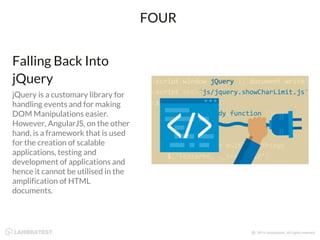
Falling Back Into
jQuery
jQuery is a customary library for
handling events and for making
DOM Manipulations easier.
However, AngularJS, on the other
hand, is a framework that is used
for the creation of scalable
applications, testing and
development of applications and
hence it cannot be utilised in the
amplification of HTML
documents.
FOUR
Angular’s horizon is seized to hold all the
data that is required to show all the
content of the page to the user. It is quite
affable that permits writing of custom
functions based upon the crowded
content.
Angular JS can be perfect specifically
when it comes to appending functionality
grounded on forecasted data like
boasting a button based on user input.
Improper Use Of Event
Handlers
FIVE
Don’t forget to Test
It’s quite handy for the developers to
compile and execute an application
on their individual machines and
presuming that it goes well with
every other system out there. Not
testing an application before their
release is a common mistake among
developers because they don’t
understand the fact that different
environments can instigate bugs.
SIX
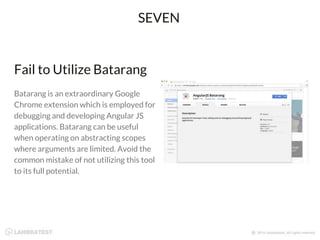
Fail to Utilize Batarang
Batarang is an extraordinary Google
Chrome extension which is employed for
debugging and developing Angular JS
applications. Batarang can be useful
when operating on abstracting scopes
where arguments are limited. Avoid the
common mistake of not utilizing this tool
to its full potential.
SEVEN
Fixed Scope Binding
Normally, Angular accompanies its very
own degree settling rules. A simple usage
of information sources limit to a model,
for example, it can prompt a typical
breakdown in the binding system.
However, the complexities come down
to making sure that the names are fully
upskilled.
EIGHT
Do Not Forget to
Unsubscribe
There are two scenarios where
unsubscribing grows into a major risk –
First, you ignite the lifecycle hook by
yourself if it’s a service that you’ve
subscription of and second, you
stimulate the OnDestroy lifecycle hook if
it’s in a constituent that you’ve
subscribed. Keep a check on these to
avoid any complications later.
NINE
Declaring Everything With
Anonymous Functions
Assigning your functions and objects
accounts for a tidy and maintainable
code. This kind of well-maintained and
documented code is easy to work with
and can easily be divided into files. Not
just this, such pieces of code have an
increased testability.
This makes it easy for the developer to
maintain the application code and gives
more expressibility to the code.
TEN
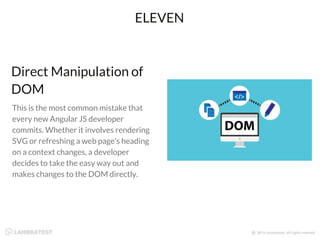
Direct Manipulation of
DOM
This is the most common mistake that
every new Angular JS developer
commits. Whether it involves rendering
SVG or refreshing a web page’s heading
on a context changes, a developer
decides to take the easy way out and
makes changes to the DOM directly.
ELEVEN
Not Using $applyAsync
Because there is polling contraption to
call $digest() in AngularJS, it is just
implemented because of the subsisting
directives. $applyAsync aids a lot in
detaining the expression resolution to
the next cycle of $digest(). There is both
an automated and manual way to wield
$applyAsync.
TWELVE
Same Component In More
Than One NgModule
Declaring a component in multiple
NGModule-s is one of the most
recurrent mistakes among Angular
developers that end up throwing an
error right at your screen. This error
occurs because one needs to mention
each component in the scope of its own
NgModule.
THIRTEEN
AngularJS is an exceptional front-end framework. It’s one of the leading tools on the
web for creating single page applications. And since it is scalable and backed by
Google, you get plenty of support and guides to get you started. Developing is not
just about writing error-free code, it’s about committing an error once and never
repeating it. Instead of embracing the “fail fast, fail often” concept, one needs to
learn from the mistakes of other developers and ensure that they rarely fail. At least,
due to the same mistake.
CONCLUSION
HAPPY TESTING!!

Top 13 Mistakes Committed by Angular Java script Developers

  • 2.
    Top 13 Mistakes CommittedBy Angular JavaScript Developers
  • 3.
    Keep a trackon the count of Watchers Angular JS creates a watcher for every binding. Evaluation and comparison for previous bindings are done at each digest phase. In the end, the number of watchers comes out to be huge. Few watchers are okay but these watchers start getting troublesome when there are hundreds and thousands of them in the code eventually slowing down the performance of an application in the browser. ONE
  • 4.
    Inability To UseThe Available Tools Most of the developers do not utilize the available tools to their best extent. This is one of the most disappointing circumstances since it becomes necessary to utilise a tool sooner or later. For instance, Firefox and Chrome incorporate uncommon improvement strings that involve investigation, mistake yield and profiling. TWO
  • 5.
    Not Compartmentalizing Properly Compartmentalizing yourcode is the core part of coding in Angular JS. When you work with MVC, the general concept is that you have a controller for a view. The controller is your rationale layer, and it’s imperative that inside this layer you make compact compartments for each area of your application THREE
  • 6.
    Falling Back Into jQuery jQueryis a customary library for handling events and for making DOM Manipulations easier. However, AngularJS, on the other hand, is a framework that is used for the creation of scalable applications, testing and development of applications and hence it cannot be utilised in the amplification of HTML documents. FOUR
  • 7.
    Angular’s horizon isseized to hold all the data that is required to show all the content of the page to the user. It is quite affable that permits writing of custom functions based upon the crowded content. Angular JS can be perfect specifically when it comes to appending functionality grounded on forecasted data like boasting a button based on user input. Improper Use Of Event Handlers FIVE
  • 8.
    Don’t forget toTest It’s quite handy for the developers to compile and execute an application on their individual machines and presuming that it goes well with every other system out there. Not testing an application before their release is a common mistake among developers because they don’t understand the fact that different environments can instigate bugs. SIX
  • 9.
    Fail to UtilizeBatarang Batarang is an extraordinary Google Chrome extension which is employed for debugging and developing Angular JS applications. Batarang can be useful when operating on abstracting scopes where arguments are limited. Avoid the common mistake of not utilizing this tool to its full potential. SEVEN
  • 10.
    Fixed Scope Binding Normally,Angular accompanies its very own degree settling rules. A simple usage of information sources limit to a model, for example, it can prompt a typical breakdown in the binding system. However, the complexities come down to making sure that the names are fully upskilled. EIGHT
  • 11.
    Do Not Forgetto Unsubscribe There are two scenarios where unsubscribing grows into a major risk – First, you ignite the lifecycle hook by yourself if it’s a service that you’ve subscription of and second, you stimulate the OnDestroy lifecycle hook if it’s in a constituent that you’ve subscribed. Keep a check on these to avoid any complications later. NINE
  • 12.
    Declaring Everything With AnonymousFunctions Assigning your functions and objects accounts for a tidy and maintainable code. This kind of well-maintained and documented code is easy to work with and can easily be divided into files. Not just this, such pieces of code have an increased testability. This makes it easy for the developer to maintain the application code and gives more expressibility to the code. TEN
  • 13.
    Direct Manipulation of DOM Thisis the most common mistake that every new Angular JS developer commits. Whether it involves rendering SVG or refreshing a web page’s heading on a context changes, a developer decides to take the easy way out and makes changes to the DOM directly. ELEVEN
  • 14.
    Not Using $applyAsync Becausethere is polling contraption to call $digest() in AngularJS, it is just implemented because of the subsisting directives. $applyAsync aids a lot in detaining the expression resolution to the next cycle of $digest(). There is both an automated and manual way to wield $applyAsync. TWELVE
  • 15.
    Same Component InMore Than One NgModule Declaring a component in multiple NGModule-s is one of the most recurrent mistakes among Angular developers that end up throwing an error right at your screen. This error occurs because one needs to mention each component in the scope of its own NgModule. THIRTEEN
  • 16.
    AngularJS is anexceptional front-end framework. It’s one of the leading tools on the web for creating single page applications. And since it is scalable and backed by Google, you get plenty of support and guides to get you started. Developing is not just about writing error-free code, it’s about committing an error once and never repeating it. Instead of embracing the “fail fast, fail often” concept, one needs to learn from the mistakes of other developers and ensure that they rarely fail. At least, due to the same mistake. CONCLUSION
  • 17.