Microservices Architecture
By Durga Lovababu
Agenda / Topics
• Monolithic Architecture
• Microservices Architecture
• Scalability
• When Microservices
• Microservices Prerequisites
• Demo Application
• Q?
Monolithic Architecture
• Monolithic application describes a single tiered software
application in which the user interface and data access code are
combined for every feature/business requirement into a single
war/ear/dll.
• There are logical components corresponding to different
functional areas of the application.
• Single war/EAR/dll/exes.
• Simple to develop, deploy and manage.
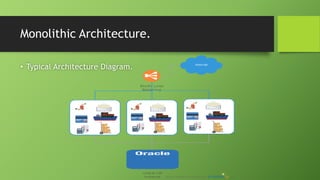
Monolithic Architecture.
• Typical Architecture Diagram.
Monolithic Architecture End
However once the application becomes large and the team grows in
size, this approach has number of drawbacks.
Large and complex code base can be difficult to understand and modify. As a result
development slow down.
Overloaded IDE, As a result slower the IDE and less productivity.
Overloaded Webcontainer - the larger applications slow down the server startup.
Continuous deployment is difficult – in order to change in one component forces to redeploy
the entire application.
Hard to Scale.
Require long term commitments to technology stack upgrade.
Microservices Architecture
• Microservice is an Architecture style as a specialization of SOA.
• Approach to developing a single application as a suite of small services, each
running its own process and communicating with light weight mechanism,
often an HTTP resource APIs.
• Each micro service is small and focused on specific feature/business
requirement.
• Independent scalable.
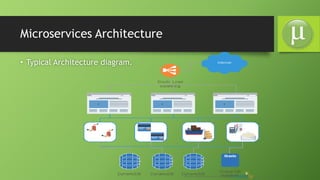
Microservices Architecture
• Typical Architecture diagram.
Microservices Architecture
Microservices can be developed independently by small team of developers.
Microservices are loosely coupled, means services are independent in terms of development
and deployment.
Each microservice can be developed in different programming language.
The productivity of new team member will be quick enough.
Should be container less deployment.
Sharing the same data base instance can be avoided, and NoSQL.
Microservices are easy to scale independently on demand.
No long term commitments required to upgrade tech stack.
Microservices are status aware.
 In app metrics.
 Ping and health checks.
What is Scalability?
• Is the ability of a computer application or product (hardware or software) to
continue to function well when it is changed in size or volume in order to
meet a user need.
• Capable of being easily expanded or upgraded on demand to handle
increasing loads without changing design.
• A service is said to be scalable if when we increase the resources in a system,
it results in increased performance in a manner proportional to resources
added.
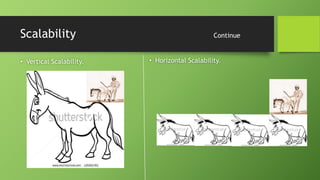
• Scalability can be achieved in two ways.
• Vertical Scalability.
• Horizontal Scalability.
Scalability Continue
• Vertical Scalability. • Horizontal Scalability.
Microservices Architecture
Frameworks to develop Microservices.
Dropwizard (written in Java)
Spring Boot (“ in Java)
Vert.x (“ in Java, JS, Groovy, Python, Ruby, Scala and Clojura)
Grails (“ in Groovy)
Ratpack (“ in Java)
Play (“ in Scala and Java)
Django (“ in Python)
WCF (“ in .NET)
There is a option to design container less/independent deployable services
using known framework spring 3+ and embedded jetty.
Microservices Architecture
Disadvantages.
Developers must deal with additional complexity of creating a distributed
system.
IDE do not support to develop distributed systems.
Testing is more difficult.
Developers must implement the inter service communication mechanism.
Deployment and operational complexity of deploying and managing system
comprised of many different services.
Finally Distributed system are complicated to manage.
Microservices Architecture
• Success Stories.
When Microservices ?
Microservices approach is all about handling a complex systems.
Principle: Device and conquer. Break down the complex problems into smaller
parts that can be solved independently.
When you use microservices you have to work on automated deployment,
monitoring, dealing with failures and other factors that a distributed system
introduces.
Don’t even consider microservices unless you have a system that’s too complex
to manage as a monolithic.
Monolith first! Do pay attention to good modularity within the monolith, but
don't try to decompose it into services from Greenfield systems.
Microservices Prerequisites?
Rapid Provisioning – achieve through cloud.
Basic Monitoring – metrics and health checks.
Rapid Application Deployment – achieve through CD.
Demo Application.
• Tech Stack.
• Spring Boot
• Spring boot embedded tomcat.
• Hibernate ORM.
• H2 inMemory data store.
• Jsondoc user interactive documentation.
• Feign and OKHTTP for client implementation.
• Interested one can clone it from here.
https://github.com/lovababu/SpringBootExample.git
Q?

MicroserviceArchitecture in detail over Monolith.

  • 1.
  • 2.
    Agenda / Topics •Monolithic Architecture • Microservices Architecture • Scalability • When Microservices • Microservices Prerequisites • Demo Application • Q?
  • 3.
    Monolithic Architecture • Monolithicapplication describes a single tiered software application in which the user interface and data access code are combined for every feature/business requirement into a single war/ear/dll. • There are logical components corresponding to different functional areas of the application. • Single war/EAR/dll/exes. • Simple to develop, deploy and manage.
  • 4.
  • 5.
    Monolithic Architecture End Howeveronce the application becomes large and the team grows in size, this approach has number of drawbacks. Large and complex code base can be difficult to understand and modify. As a result development slow down. Overloaded IDE, As a result slower the IDE and less productivity. Overloaded Webcontainer - the larger applications slow down the server startup. Continuous deployment is difficult – in order to change in one component forces to redeploy the entire application. Hard to Scale. Require long term commitments to technology stack upgrade.
  • 6.
    Microservices Architecture • Microserviceis an Architecture style as a specialization of SOA. • Approach to developing a single application as a suite of small services, each running its own process and communicating with light weight mechanism, often an HTTP resource APIs. • Each micro service is small and focused on specific feature/business requirement. • Independent scalable.
  • 7.
  • 8.
    Microservices Architecture Microservices canbe developed independently by small team of developers. Microservices are loosely coupled, means services are independent in terms of development and deployment. Each microservice can be developed in different programming language. The productivity of new team member will be quick enough. Should be container less deployment. Sharing the same data base instance can be avoided, and NoSQL. Microservices are easy to scale independently on demand. No long term commitments required to upgrade tech stack. Microservices are status aware.  In app metrics.  Ping and health checks.
  • 9.
    What is Scalability? •Is the ability of a computer application or product (hardware or software) to continue to function well when it is changed in size or volume in order to meet a user need. • Capable of being easily expanded or upgraded on demand to handle increasing loads without changing design. • A service is said to be scalable if when we increase the resources in a system, it results in increased performance in a manner proportional to resources added. • Scalability can be achieved in two ways. • Vertical Scalability. • Horizontal Scalability.
  • 10.
    Scalability Continue • VerticalScalability. • Horizontal Scalability.
  • 11.
    Microservices Architecture Frameworks todevelop Microservices. Dropwizard (written in Java) Spring Boot (“ in Java) Vert.x (“ in Java, JS, Groovy, Python, Ruby, Scala and Clojura) Grails (“ in Groovy) Ratpack (“ in Java) Play (“ in Scala and Java) Django (“ in Python) WCF (“ in .NET) There is a option to design container less/independent deployable services using known framework spring 3+ and embedded jetty.
  • 12.
    Microservices Architecture Disadvantages. Developers mustdeal with additional complexity of creating a distributed system. IDE do not support to develop distributed systems. Testing is more difficult. Developers must implement the inter service communication mechanism. Deployment and operational complexity of deploying and managing system comprised of many different services. Finally Distributed system are complicated to manage.
  • 13.
  • 14.
    When Microservices ? Microservicesapproach is all about handling a complex systems. Principle: Device and conquer. Break down the complex problems into smaller parts that can be solved independently. When you use microservices you have to work on automated deployment, monitoring, dealing with failures and other factors that a distributed system introduces. Don’t even consider microservices unless you have a system that’s too complex to manage as a monolithic. Monolith first! Do pay attention to good modularity within the monolith, but don't try to decompose it into services from Greenfield systems.
  • 15.
    Microservices Prerequisites? Rapid Provisioning– achieve through cloud. Basic Monitoring – metrics and health checks. Rapid Application Deployment – achieve through CD.
  • 16.
    Demo Application. • TechStack. • Spring Boot • Spring boot embedded tomcat. • Hibernate ORM. • H2 inMemory data store. • Jsondoc user interactive documentation. • Feign and OKHTTP for client implementation. • Interested one can clone it from here. https://github.com/lovababu/SpringBootExample.git
  • 17.

Editor's Notes