Multi-tenancy with MVC3
 and Entity Framework


              -By Lasantha Bandara
What is a Tenant?
 Literally


“A person who occupies land or property
rented from a landlord”
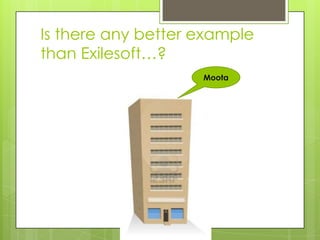
Is there any better example
than Exilesoft…?
Is there any better example
than Exilesoft…?
                    Moota
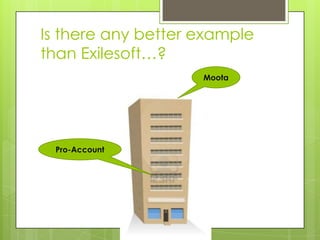
Is there any better example
than Exilesoft…?
                    Moota


 Pro-Account
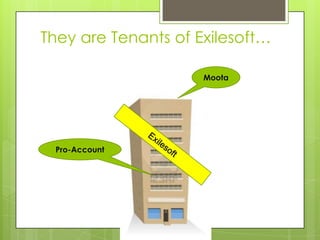
They are Tenants of Exilesoft…

                     Moota


 Pro-Account
Same situation applies to the cloud
based software applications.
 In
   SaaS (Software as a Service) Model
 Most of the web applications are SaaS – But not
  Multi-Tenant…!
 Multi-Tenant Examples,
        Highrise
        Jira
        YaY

 In these systems, organizations make their
  accounts and they are provided a look and feel
  of their own „Home‟
Why this is so important?
 Data   is vital for some businesses.

 Should be able to isolate data among
  tenants in SaaS model.

 If
   we provide it…. We have Competitive
  Advantage.
That implies…

Data Architecture is the most
significant factor in a Multi
Tenant Application.
We can identify 3 different
architectures at present…


   Separate DB – Separate Schema
   Shared DB – Separate Schema
   Shared DB – Shared Schema
Separate DB – Separate Schema


 Extendibilitywith tenant specific requirements
 Easy Backup
 High Cost
 Suitable for Medical and Banking applications in
  spite of high cost
Shared DB – Separate Schema


 Separate   set of tables for each tenant in same
  DB
 Extendible and easy to implement
 Suitable if No. of Tenants < 100
 Low cost than the previous one
Shared DB – Shared Schema


 Lowest  Cost
 Additional development effort
 Less security
 Each row contains tenant Id
 Suitable for a huge cluster of tiny tenants
Choosing an approach
   Cost Based
Security


  Shared   Isolated
Tenant Attributes
 Regularity Consideration
  (legal requirements of companies)


 Skills set of development team

                             etc…
 InYayCRM we have invented a model
  that is supported all those architectures

 You    can,
        - distribute databases in a server farm
        - expand and shrink the number of
        databases
        - move tenants among databases
Metadata      Tenant
          Database     Databases


Client   Application
           Server
Let’s go to demo…
Multi tenancy with mvc3 and entity framework

Multi tenancy with mvc3 and entity framework

  • 1.
    Multi-tenancy with MVC3 and Entity Framework -By Lasantha Bandara
  • 2.
    What is aTenant?  Literally “A person who occupies land or property rented from a landlord”
  • 3.
    Is there anybetter example than Exilesoft…?
  • 4.
    Is there anybetter example than Exilesoft…? Moota
  • 5.
    Is there anybetter example than Exilesoft…? Moota Pro-Account
  • 6.
    They are Tenantsof Exilesoft… Moota Pro-Account
  • 7.
    Same situation appliesto the cloud based software applications.  In SaaS (Software as a Service) Model  Most of the web applications are SaaS – But not Multi-Tenant…!  Multi-Tenant Examples,  Highrise  Jira  YaY  In these systems, organizations make their accounts and they are provided a look and feel of their own „Home‟
  • 8.
    Why this isso important?  Data is vital for some businesses.  Should be able to isolate data among tenants in SaaS model.  If we provide it…. We have Competitive Advantage.
  • 9.
    That implies… Data Architectureis the most significant factor in a Multi Tenant Application.
  • 10.
    We can identify3 different architectures at present…  Separate DB – Separate Schema  Shared DB – Separate Schema  Shared DB – Shared Schema
  • 11.
    Separate DB –Separate Schema  Extendibilitywith tenant specific requirements  Easy Backup  High Cost  Suitable for Medical and Banking applications in spite of high cost
  • 12.
    Shared DB –Separate Schema  Separate set of tables for each tenant in same DB  Extendible and easy to implement  Suitable if No. of Tenants < 100  Low cost than the previous one
  • 13.
    Shared DB –Shared Schema  Lowest Cost  Additional development effort  Less security  Each row contains tenant Id  Suitable for a huge cluster of tiny tenants
  • 14.
  • 15.
    Security Shared Isolated
  • 16.
  • 17.
     Regularity Consideration (legal requirements of companies)  Skills set of development team etc…
  • 18.
     InYayCRM wehave invented a model that is supported all those architectures  You can, - distribute databases in a server farm - expand and shrink the number of databases - move tenants among databases
  • 19.
    Metadata Tenant Database Databases Client Application Server
  • 21.