Design
Making
Design
Thinking
Design
Leading
THE FIELD OF
DESIGN IS
EVOLVING.
Design has moved away
from its roots of making.
Consultancies have
instead popularized
design thinking by
simplifying its core
concepts and making
them broadly accessible.
Today many disciplines
are teaching their own
form of design thinking.
?
WHAT WILL BE THE ROLE OF
THOSE TRAINED AS DESIGNERS
WHEN EVERYBODY
IS A DESIGN THINKER?
This question is posed in:
Sanders, E. (2017). Design Research at the Crossroads of Education and Practice.
She Ji: The Journal of Design, Economics, and Innovation, 3(1), pp.3-15.
Previous Objective
Future Aspiration
Craft and Methods for
Human-Centered
Objects + Visuals
Mindset and Principles for
Empathy on a
Mass Scale
Integrative Platforms to
Create and
Lead Change
DESIGN RESEARCH
CAN REORIENT ITS
PRACTICE OF MAKING
TOWARD NEW
INTEGRATIVE
PLATFORMS.
Making
Thinking
Leading
Design-led Strategy for
Digital Transformation
Design-led Systems for
Operational Excellence
Design-led Resilience for
Climate Disasters
Design-led Justice for
Educational Inequality
Design-led Change for
Public Policy
Design-led Planning for
Refugee Immigration
Possible
Design-Led
Platforms
THESE PLATFORMS
WILL BE DESIGN-LED.
Both industry-based and problem-
specific research platforms will emerge.
Design-led practices will enable
integration across stakeholders,
disciplines and time orientations.
Design-led platforms can incubate:
• New academic research
• New products and services
• New methods
• New technologies
• New startups and innovation
initiatives
Why Design-Led Integration?
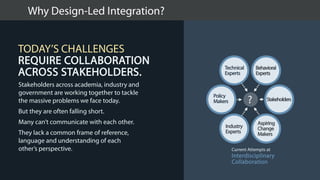
TODAY’S CHALLENGES
REQUIRE COLLABORATION
ACROSS STAKEHOLDERS.
Stakeholders across academia, industry and
government are working together to tackle
the massive problems we face today.
But they are often falling short.
Many can’t communicate with each other.
They lack a common frame of reference,
language and understanding of each
other’s perspective.
?
Technical
Experts
Behavioral
Experts
Industry
Experts
Aspiring
Change
Makers
Stakeholders
Policy
Makers
Current Attempts at
Interdisciplinary
Collaboration
Technical
Experts
Policy
Makers
Industry
Experts
Aspiring
Change
Makers
Stakeholders
Behavioral
Experts
Why Design-Led Integration?
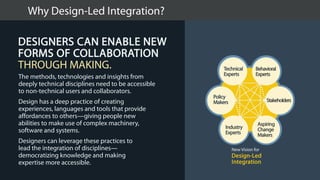
DESIGNERS CAN ENABLE NEW
FORMS OF COLLABORATION
THROUGH MAKING.
The methods, technologies and insights from
deeply technical disciplines need to be accessible
to non-technical users and collaborators.
Design has a deep practice of creating
experiences, languages and tools that provide
affordances to others—giving people new
abilities to make use of complex machinery,
software and systems.
Designers can leverage these practices to
lead the integration of disciplines—
democratizing knowledge and making
expertise more accessible.
New Vision for
Design-Led
Integration
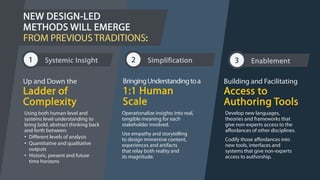
Up and Down the
Ladder of
Complexity
Using both human-level and
systems level understanding to
bring bold, abstract thinking back
and forth between:
• Different levels of analysis
• Quantitative and qualitative
outputs
• Historic, present and future
time horizons
Building and Facilitating
Access to
Authoring Tools
BringingUnderstandingtoa
1:1 Human
Scale
Operationalize insights into real,
tangible meaning for each
stakeholder involved.
Use empathy and storytelling
to design immersive content,
experiences and artifacts
that relay both reality and
its magnitude.
Systemic Insight1
NEW DESIGN-LED
METHODS WILL EMERGE
FROM PREVIOUS TRADITIONS:
Enablement3Simplification2
Develop new languages,
theories and frameworks that
give non-experts access to the
affordances of other disciplines.
Codify those affordances into
new tools, interfaces and
systems that give non-experts
access to authorship.
DESIGN MUST
TAKE ON A
LEADERSHIP
ROLE.
LEADERS MUST
INTEGRATE
THEMSELVES
WITHIN DESIGN TEAMS.
Leaders
Designing
Designers
Leading
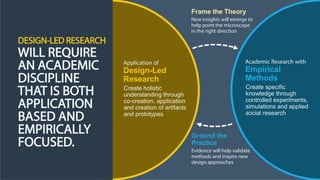
DESIGN-LED RESEARCH
WILL REQUIRE
AN ACADEMIC
DISCIPLINE
THAT IS BOTH
APPLICATION
BASED AND
EMPIRICALLY
FOCUSED.
Application of
Design-Led
Research
Create holistic
understanding through
co-creation, application
and creation of artifacts
and prototypes
Academic Research with
Empirical
Methods
Create specific
knowledge through
controlled experiments,
simulations and applied
social research
Frame the Theory
New insights will emerge to
help point the microscope
in the right direction
Ground the
Practice
Evidence will help validate
methods and inspire new
design approaches
MY PROJECTIONS
ABOUT THE
EVOLVING FIELD
OF DESIGN.
The previous slides are based on
perspectives I’ve gained from working
in multidisciplinary design teams and
pursuing the frontiers of innovation.
I believe the application of design-led
integration will be incubated across
various hubs—leading corporations,
start-ups disrupting complex
industries, forward-thinking
academic programs, next
generation social enterprises and
progressive government programs.
My goal is to leverage design-led
integration to push change for the
better—building a cohort of fellow
travelers who capture learnings,
push each other’s thinking and
proliferate an ecosystem of
design-led practice, platforms,
methods and theory.

Design-Led Integration

  • 1.
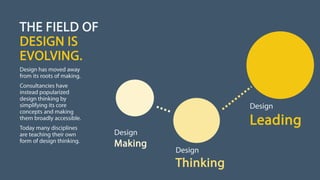
    Design Making Design Thinking Design Leading THE FIELD OF DESIGNIS EVOLVING. Design has moved away from its roots of making. Consultancies have instead popularized design thinking by simplifying its core concepts and making them broadly accessible. Today many disciplines are teaching their own form of design thinking.
  • 2.
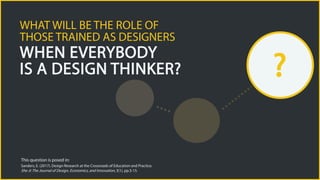
    ? WHAT WILL BETHE ROLE OF THOSE TRAINED AS DESIGNERS WHEN EVERYBODY IS A DESIGN THINKER? This question is posed in: Sanders, E. (2017). Design Research at the Crossroads of Education and Practice. She Ji: The Journal of Design, Economics, and Innovation, 3(1), pp.3-15.
  • 3.
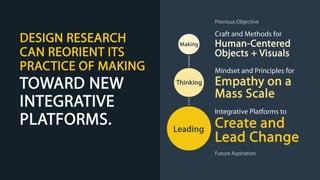
    Previous Objective Future Aspiration Craftand Methods for Human-Centered Objects + Visuals Mindset and Principles for Empathy on a Mass Scale Integrative Platforms to Create and Lead Change DESIGN RESEARCH CAN REORIENT ITS PRACTICE OF MAKING TOWARD NEW INTEGRATIVE PLATFORMS. Making Thinking Leading
  • 4.
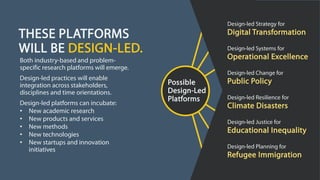
    Design-led Strategy for DigitalTransformation Design-led Systems for Operational Excellence Design-led Resilience for Climate Disasters Design-led Justice for Educational Inequality Design-led Change for Public Policy Design-led Planning for Refugee Immigration Possible Design-Led Platforms THESE PLATFORMS WILL BE DESIGN-LED. Both industry-based and problem- specific research platforms will emerge. Design-led practices will enable integration across stakeholders, disciplines and time orientations. Design-led platforms can incubate: • New academic research • New products and services • New methods • New technologies • New startups and innovation initiatives
  • 5.
    Why Design-Led Integration? TODAY’SCHALLENGES REQUIRE COLLABORATION ACROSS STAKEHOLDERS. Stakeholders across academia, industry and government are working together to tackle the massive problems we face today. But they are often falling short. Many can’t communicate with each other. They lack a common frame of reference, language and understanding of each other’s perspective. ? Technical Experts Behavioral Experts Industry Experts Aspiring Change Makers Stakeholders Policy Makers Current Attempts at Interdisciplinary Collaboration
  • 6.
    Technical Experts Policy Makers Industry Experts Aspiring Change Makers Stakeholders Behavioral Experts Why Design-Led Integration? DESIGNERSCAN ENABLE NEW FORMS OF COLLABORATION THROUGH MAKING. The methods, technologies and insights from deeply technical disciplines need to be accessible to non-technical users and collaborators. Design has a deep practice of creating experiences, languages and tools that provide affordances to others—giving people new abilities to make use of complex machinery, software and systems. Designers can leverage these practices to lead the integration of disciplines— democratizing knowledge and making expertise more accessible. New Vision for Design-Led Integration
  • 7.
    Up and Downthe Ladder of Complexity Using both human-level and systems level understanding to bring bold, abstract thinking back and forth between: • Different levels of analysis • Quantitative and qualitative outputs • Historic, present and future time horizons Building and Facilitating Access to Authoring Tools BringingUnderstandingtoa 1:1 Human Scale Operationalize insights into real, tangible meaning for each stakeholder involved. Use empathy and storytelling to design immersive content, experiences and artifacts that relay both reality and its magnitude. Systemic Insight1 NEW DESIGN-LED METHODS WILL EMERGE FROM PREVIOUS TRADITIONS: Enablement3Simplification2 Develop new languages, theories and frameworks that give non-experts access to the affordances of other disciplines. Codify those affordances into new tools, interfaces and systems that give non-experts access to authorship.
  • 8.
    DESIGN MUST TAKE ONA LEADERSHIP ROLE. LEADERS MUST INTEGRATE THEMSELVES WITHIN DESIGN TEAMS. Leaders Designing Designers Leading
  • 9.
    DESIGN-LED RESEARCH WILL REQUIRE ANACADEMIC DISCIPLINE THAT IS BOTH APPLICATION BASED AND EMPIRICALLY FOCUSED. Application of Design-Led Research Create holistic understanding through co-creation, application and creation of artifacts and prototypes Academic Research with Empirical Methods Create specific knowledge through controlled experiments, simulations and applied social research Frame the Theory New insights will emerge to help point the microscope in the right direction Ground the Practice Evidence will help validate methods and inspire new design approaches
  • 10.
    MY PROJECTIONS ABOUT THE EVOLVINGFIELD OF DESIGN. The previous slides are based on perspectives I’ve gained from working in multidisciplinary design teams and pursuing the frontiers of innovation. I believe the application of design-led integration will be incubated across various hubs—leading corporations, start-ups disrupting complex industries, forward-thinking academic programs, next generation social enterprises and progressive government programs. My goal is to leverage design-led integration to push change for the better—building a cohort of fellow travelers who capture learnings, push each other’s thinking and proliferate an ecosystem of design-led practice, platforms, methods and theory.