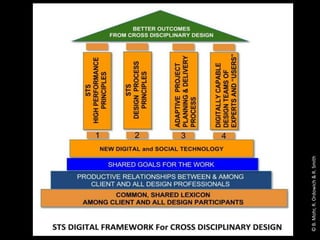
Cross Disciplinary Designing:
Combining Social & Digital Technology with STS-D Principles
To Support Systemic Work Design
Global STS-D Network, San Francisco 9.9.16 Bernard Mohr◼ Richard Ordowich◼ Ron Smith
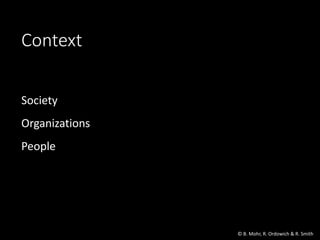
Context
Society
Organizations
People
© B. Mohr, R. Ordowich & R. Smith
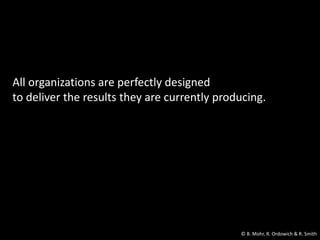
All organizations are perfectly designed
to deliver the results they are currently producing.
© B. Mohr, R. Ordowich & R. Smith
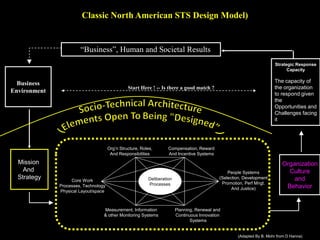
Business
Environment
Strategic Response
Capacity
The capacity of
the organization
to respond given
the
Opportunities and
Challenges facing
it
Mission
And
Strategy
Organization
Culture
and
Behavior
“Business”, Human and Societal Results
Classic North American STS Design Model)
Start Here ! -- Is there a good match ?
Org’n Structure, Roles,
And Responsibilities
Compensation, Reward
And Incentive Systems
People Systems
(Selection, Development
Promotion, Perf Mngt.
And Justice)
Planning, Renewal and
Continuous Innovation
Systems
Measurement, Information
& other Monitoring Systems
Core Work
Processes, Technology
Physical Layout/space
Deliberation
Processes
(Adapted By B. Mohr from D Hanna)
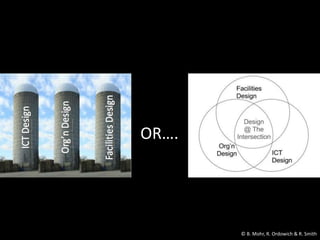
OR….
© B. Mohr, R. Ordowich & R. Smith
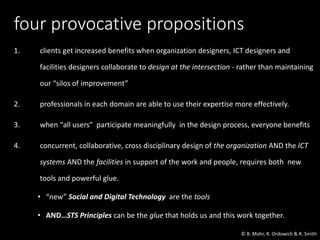
four provocative propositions
1. clients get increased benefits when organization designers, ICT designers and
facilities designers collaborate to design at the intersection - rather than maintaining
our “silos of improvement”
2. professionals in each domain are able to use their expertise more effectively.
3. when “all users” participate meaningfully in the design process, everyone benefits
4. concurrent, collaborative, cross disciplinary design of the organization AND the ICT
systems AND the facilities in support of the work and people, requires both new
tools and powerful glue.
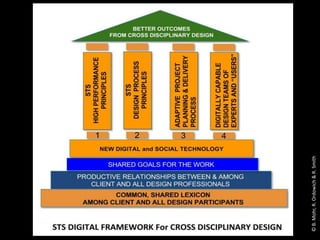
• “new” Social and Digital Technology are the tools
• AND…STS Principles can be the glue that holds us and this work together.
© B. Mohr, R. Ordowich & R. Smith
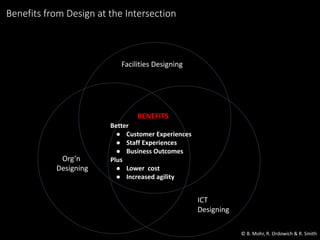
Benefits from Design at the Intersection
Facilities Designing
ICT
Designing
Org’n
Designing
Better
● Customer Experiences
● Staff Experiences
● Business Outcomes
Plus
● Lower cost
● Increased agility
BENEFITS
© B. Mohr, R. Ordowich & R. Smith
©B.Mohr,R.Ordowich&R.Smith
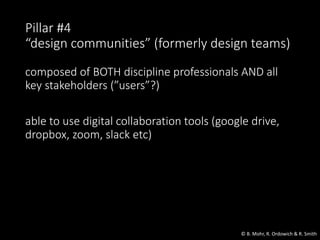
Pillar #4
“design communities” (formerly design teams)
composed of BOTH discipline professionals AND all
key stakeholders (”users”?)
able to use digital collaboration tools (google drive,
dropbox, zoom, slack etc)
© B. Mohr, R. Ordowich & R. Smith
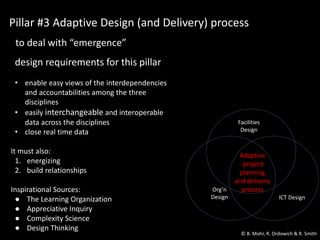
Pillar #3 Adaptive Design (and Delivery) process
Facilities
Design
ICT Design
Org’n
Design
Adaptive
project
planning
and delivery
process
to deal with “emergence”
design requirements for this pillar
• enable easy views of the interdependencies
and accountabilities among the three
disciplines
• easily interchangeable and interoperable
data across the disciplines
• close real time data
It must also:
1. energizing
2. build relationships
Inspirational Sources:
● The Learning Organization
● Appreciative Inquiry
● Complexity Science
● Design Thinking
© B. Mohr, R. Ordowich & R. Smith
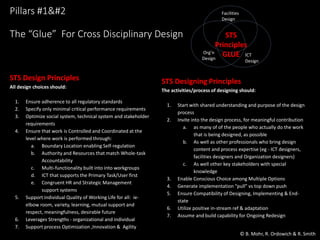
Pillars #1&#2
The “Glue” For Cross Disciplinary Design
STS Designing Principles
The activities/process of designing should:
1. Start with shared understanding and purpose of the design
process
2. Invite into the design process, for meaningful contribution
a. as many of of the people who actually do the work
that is being designed, as possible
b. As well as other professionals who bring design
content and process expertise (eg - ICT designers,
facilities designers and Organization designers)
c. As well other key stakeholders with special
knowledge
3. Enable Conscious Choice among Multiple Options
4. Generate implementation “pull” vs top down push
5. Ensure Compatibility of Designing, Implementing & End-
state
6. Utilize positive in-stream ref & adaptation
7. Assume and build capability for Ongoing Redesign
Facilities
Design
ICT
Design
Org’n
Design
STS
Principles
GLUE
STS Design Principles
All design choices should:
1. Ensure adherence to all regulatory standards
2. Specify only minimal critical performance requirements
3. Optimize social system, technical system and stakeholder
requirements
4. Ensure that work is Controlled and Coordinated at the
level where work is performed through:
a. Boundary Location enabling Self-regulation
b. Authority and Resources that match Whole-task
Accountability
c. Multi-functionality built into into workgroups
d. ICT that supports the Primary Task/User first
e. Congruent HR and Strategic Management
support systems
5. Support individual Quality of Working Life for all: ie-
elbow room, variety, learning, mutual support and
respect, meaningfulness, desirable future
6. Leverages Strengths - organizational and individual
7. Support process Optimization ,Innovation & Agility
© B. Mohr, R. Ordowich & R. Smith
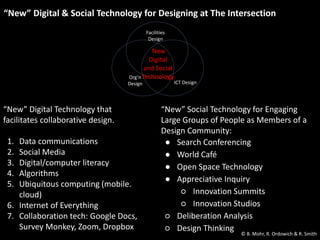
“New” Digital & Social Technology for Designing at The Intersection
Facilities
Design
ICT Design
Org’n
Design
New
Digital
and Social
Technology
“New” Digital Technology that
facilitates collaborative design.
1. Data communications
2. Social Media
3. Digital/computer literacy
4. Algorithms
5. Ubiquitous computing (mobile.
cloud)
6. Internet of Everything
7. Collaboration tech: Google Docs,
Survey Monkey, Zoom, Dropbox
“New” Social Technology for Engaging
Large Groups of People as Members of a
Design Community:
● Search Conferencing
● World Café
● Open Space Technology
● Appreciative Inquiry
○ Innovation Summits
○ Innovation Studios
○ Deliberation Analysis
○ Design Thinking
© B. Mohr, R. Ordowich & R. Smith
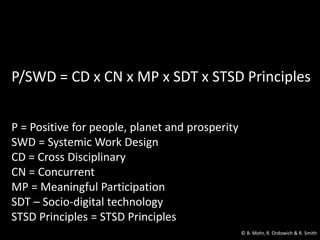
P/SWD = CD x CN x MP x SDT x STSD Principles
P = Positive for people, planet and prosperity
SWD = Systemic Work Design
CD = Cross Disciplinary
CN = Concurrent
MP = Meaningful Participation
SDT – Socio-digital technology
STSD Principles = STSD Principles
© B. Mohr, R. Ordowich & R. Smith
©B.Mohr,R.Ordowich&R.Smith
Thank You
• Ron Smith RonSmith@LS3P.com or (713) 252-2032
• Richard Ordowich richord@comcast.net or (609) 203-2279
• Bernard Mohr bjmohr@innovationpartners.com or (207) 807-4974

Mohr-Smith-Ordowich SF STSRT 2016 final

  • 1.
    Cross Disciplinary Designing: CombiningSocial & Digital Technology with STS-D Principles To Support Systemic Work Design Global STS-D Network, San Francisco 9.9.16 Bernard Mohr◼ Richard Ordowich◼ Ron Smith
  • 2.
  • 3.
    All organizations areperfectly designed to deliver the results they are currently producing. © B. Mohr, R. Ordowich & R. Smith
  • 4.
    Business Environment Strategic Response Capacity The capacityof the organization to respond given the Opportunities and Challenges facing it Mission And Strategy Organization Culture and Behavior “Business”, Human and Societal Results Classic North American STS Design Model) Start Here ! -- Is there a good match ? Org’n Structure, Roles, And Responsibilities Compensation, Reward And Incentive Systems People Systems (Selection, Development Promotion, Perf Mngt. And Justice) Planning, Renewal and Continuous Innovation Systems Measurement, Information & other Monitoring Systems Core Work Processes, Technology Physical Layout/space Deliberation Processes (Adapted By B. Mohr from D Hanna)
  • 5.
    OR…. © B. Mohr,R. Ordowich & R. Smith
  • 6.
    four provocative propositions 1.clients get increased benefits when organization designers, ICT designers and facilities designers collaborate to design at the intersection - rather than maintaining our “silos of improvement” 2. professionals in each domain are able to use their expertise more effectively. 3. when “all users” participate meaningfully in the design process, everyone benefits 4. concurrent, collaborative, cross disciplinary design of the organization AND the ICT systems AND the facilities in support of the work and people, requires both new tools and powerful glue. • “new” Social and Digital Technology are the tools • AND…STS Principles can be the glue that holds us and this work together. © B. Mohr, R. Ordowich & R. Smith
  • 7.
    Benefits from Designat the Intersection Facilities Designing ICT Designing Org’n Designing Better ● Customer Experiences ● Staff Experiences ● Business Outcomes Plus ● Lower cost ● Increased agility BENEFITS © B. Mohr, R. Ordowich & R. Smith
  • 8.
  • 9.
    Pillar #4 “design communities”(formerly design teams) composed of BOTH discipline professionals AND all key stakeholders (”users”?) able to use digital collaboration tools (google drive, dropbox, zoom, slack etc) © B. Mohr, R. Ordowich & R. Smith
  • 10.
    Pillar #3 AdaptiveDesign (and Delivery) process Facilities Design ICT Design Org’n Design Adaptive project planning and delivery process to deal with “emergence” design requirements for this pillar • enable easy views of the interdependencies and accountabilities among the three disciplines • easily interchangeable and interoperable data across the disciplines • close real time data It must also: 1. energizing 2. build relationships Inspirational Sources: ● The Learning Organization ● Appreciative Inquiry ● Complexity Science ● Design Thinking © B. Mohr, R. Ordowich & R. Smith
  • 11.
    Pillars #1&#2 The “Glue”For Cross Disciplinary Design STS Designing Principles The activities/process of designing should: 1. Start with shared understanding and purpose of the design process 2. Invite into the design process, for meaningful contribution a. as many of of the people who actually do the work that is being designed, as possible b. As well as other professionals who bring design content and process expertise (eg - ICT designers, facilities designers and Organization designers) c. As well other key stakeholders with special knowledge 3. Enable Conscious Choice among Multiple Options 4. Generate implementation “pull” vs top down push 5. Ensure Compatibility of Designing, Implementing & End- state 6. Utilize positive in-stream ref & adaptation 7. Assume and build capability for Ongoing Redesign Facilities Design ICT Design Org’n Design STS Principles GLUE STS Design Principles All design choices should: 1. Ensure adherence to all regulatory standards 2. Specify only minimal critical performance requirements 3. Optimize social system, technical system and stakeholder requirements 4. Ensure that work is Controlled and Coordinated at the level where work is performed through: a. Boundary Location enabling Self-regulation b. Authority and Resources that match Whole-task Accountability c. Multi-functionality built into into workgroups d. ICT that supports the Primary Task/User first e. Congruent HR and Strategic Management support systems 5. Support individual Quality of Working Life for all: ie- elbow room, variety, learning, mutual support and respect, meaningfulness, desirable future 6. Leverages Strengths - organizational and individual 7. Support process Optimization ,Innovation & Agility © B. Mohr, R. Ordowich & R. Smith
  • 12.
    “New” Digital &Social Technology for Designing at The Intersection Facilities Design ICT Design Org’n Design New Digital and Social Technology “New” Digital Technology that facilitates collaborative design. 1. Data communications 2. Social Media 3. Digital/computer literacy 4. Algorithms 5. Ubiquitous computing (mobile. cloud) 6. Internet of Everything 7. Collaboration tech: Google Docs, Survey Monkey, Zoom, Dropbox “New” Social Technology for Engaging Large Groups of People as Members of a Design Community: ● Search Conferencing ● World Café ● Open Space Technology ● Appreciative Inquiry ○ Innovation Summits ○ Innovation Studios ○ Deliberation Analysis ○ Design Thinking © B. Mohr, R. Ordowich & R. Smith
  • 13.
    P/SWD = CDx CN x MP x SDT x STSD Principles P = Positive for people, planet and prosperity SWD = Systemic Work Design CD = Cross Disciplinary CN = Concurrent MP = Meaningful Participation SDT – Socio-digital technology STSD Principles = STSD Principles © B. Mohr, R. Ordowich & R. Smith
  • 14.
  • 15.
    Thank You • RonSmith RonSmith@LS3P.com or (713) 252-2032 • Richard Ordowich richord@comcast.net or (609) 203-2279 • Bernard Mohr bjmohr@innovationpartners.com or (207) 807-4974