
Design Cycles of
Pattern Recognition
Al Mamun Khan
1
Overview
 Design Circle
 Data collection
 Feature Choice
 Model Choice
 Training
 Evaluation
2
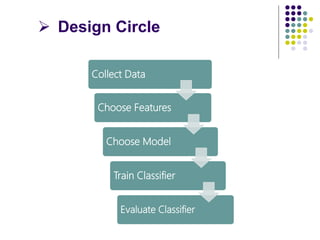
Collect Data
Choose Features
Choose Model
Train Classifier
Evaluate Classifier
 Design Circle
Collect
Data
Choose
Features
Choose
Model
Train
Classifier
Evaluate
Classifier
 Data Collection
Data Collection
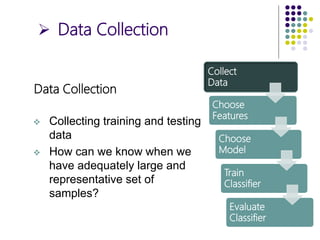
 Collecting training and testing
data
 How can we know when we
have adequately large and
representative set of
samples?
Collect
Data
Choose
Features
Choose
Model
Train
Classifier
Evaluate
Classifier
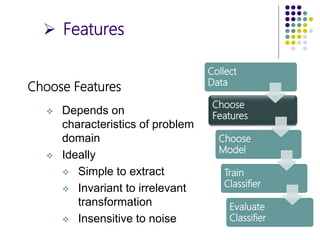
 Features
Choose Features
 Depends on
characteristics of problem
domain
 Ideally
 Simple to extract
 Invariant to irrelevant
transformation
 Insensitive to noise
Collect
Data
Choose
Features
Choose
Model
Train
Classifier
Evaluate
Classifier
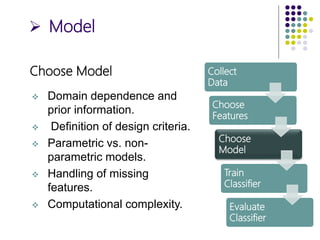
 Model
Choose Model
 Domain dependence and
prior information.
 Definition of design criteria.
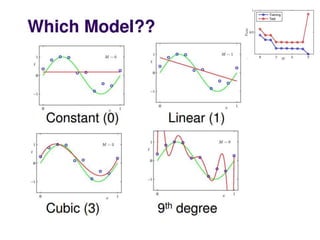
 Parametric vs. non-
parametric models.
 Handling of missing
features.
 Computational complexity.
Collect
Data
Choose
Features
Choose
Model
Train
Classifier
Evaluate
Classifier
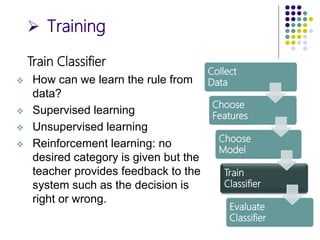
 Training
Train Classifier
 How can we learn the rule from
data?
 Supervised learning
 Unsupervised learning
 Reinforcement learning: no
desired category is given but the
teacher provides feedback to the
system such as the decision is
right or wrong.
Collect
Data
Choose
Features
Choose
Model
Train
Classifier
Evaluate
Classifier
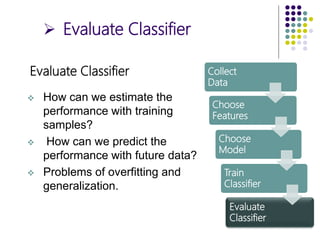
 Evaluate Classifier
Evaluate Classifier
 How can we estimate the
performance with training
samples?
 How can we predict the
performance with future data?
 Problems of overfitting and
generalization.
Design cycles of pattern recognition

Design cycles of pattern recognition