Epidemiological Study Designs
By Tilaye Workneh
(MPH/Epid, Asst. Prof. of Epidemiology)
Lecture 4
Objective of the course
3/24/2024
 Introduction to study design
 Describe the basic concepts of descriptive studies
 Describe when and how to carry out common descriptive studies
 Describe the limitations and strength of Descriptive studies
3/24/2024
 There are ample of health problem in the community which need
evidence based answer
 Planners and decision makers also need evidence as a resource based
on magnitude and factors causing disease for prevention and control
 Health professionals and researchers need evidence to answer why
and how the disease occurs
 Thus, all need research . . . appropriate study design
Introduction
Introduction
 Research design is the overall plan which connect the conceptual
research problems to the pertinent research outcome
 Study design is action plan which portray the strategies and tool
to answer the research question
 Study Design articulates what data is required, what methods are
going to be used to collect & analyze data, & how all of these are
going to answer your research question
3/24/2024
Introduction …
3/24/2024
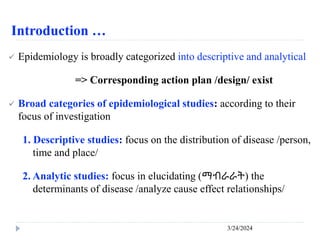
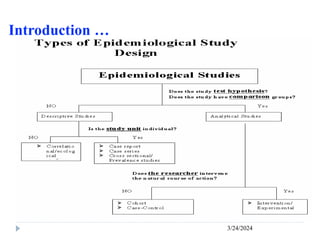
 Epidemiology is broadly categorized into descriptive and analytical
=> Corresponding action plan /design/ exist
 Broad categories of epidemiological studies: according to their
focus of investigation
1. Descriptive studies: focus on the distribution of disease /person,
time and place/
2. Analytic studies: focus in elucidating (įˆ›į‰„įˆ«įˆ«į‰µ) the
determinants of disease /analyze cause effect relationships/
Introduction . . .
Purpose of Epidemiological Studies
Descriptive study Analytic Study
 Characterize disease occurrence
by person, time and place
 Generate hypothesis
 Dealing with population
ļ¼ Correlational or ecological
 Dealing with individuals
ļ¼ Case report
ļ¼ Case series
ļ¼ Cross sectional
survey/Prevalence study
 Concerned with the search for
causes and effects relationships
 Test hypothesis about association
between exposure and outcome
 Observational studies
ļ¼ Case-control
ļ¼ Cohort
 Intervention studies
ļ¼ RCT
3/24/2024
Introduction …
3/24/2024
Descriptive Epidemiology
3/24/2024
 Description of disease occurrence by person, place and time
 Not intended to asses causality
 The Purpose of descriptive epidemiology is to quantify amount
and characterize the distribution of disease within a population.
Thus, in other words to identify health problems and patterns of
disease occurrence
Summary on Purpose of Descriptive Epidemiology
3/24/2024
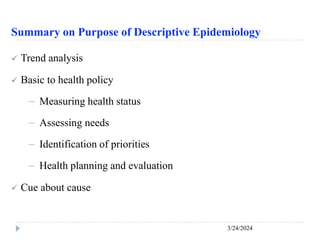
 Trend analysis
 Basic to health policy
ļ¼ Measuring health status
ļ¼ Assessing needs
ļ¼ Identification of priorities
ļ¼ Health planning and evaluation
 Cue about cause
Descriptive study designs …
3/24/2024
 Describe the person, time and place of health event occurrence
 Descriptive studies generally precede analytic studies,
 Descriptive information is important to generate hypothesis that
should be tested by analytical study designs
 Thus, descriptive studies often help to generate hypotheses about
cause and effect relationship
Descriptive study designs …
3/24/2024
Person
 Since disease does not occur at random:
 What kinds of people tend to develop a particular disease, and who tends
to be spared?
 What’s unusual about those people?
ļ¼Age,
ļ¼Sex,
ļ¼Race/Ethnicity,
ļ¼Social class,
Person…
3/24/2024
Age
 the most fundamental factor to consider when describing disease
occurrence
 The incidence of most chronic diseases increases with age
 However, the incidence of many infectious diseases is highest in
childhood
Person…
3/24/2024
 Sex:-biological and non-biological factors related to sex have disease risk.
 In all developed countries, life expectancy is higher in females than males
– principally due to lower heart disease mortality
 However, many chronic diseases occur more frequently in women
(depression, lupus, etc.)
 As lifestyles continue to become more similar, a question is whether
mortality rates will become more similar? (i.e. environmental vs biology)
Person…
3/24/2024
Race/Ethnicity – difficult to define, and to identify which characteristics
may relate to disease occurrence
- Remarkable variation exists in rates of disease occurrence across racial and
ethnic groups
ļ¼ Genetics?
ļ¼ Socioeconomic status(SES)?
ļ¼ Environmental exposures?
ļ¼ Access to health care?
ļ¼ Lifestyle factors, nutrition, …. ?
Person…
3/24/2024
Social class –Despite its unreliability, SES is consistently
associated with mortality in a gradient fashion
Example:
 Occupation
 Education
 Area of residence
 Income
 Lifestyle
Place
3/24/2024
Investigation by place includes:
 Across countries (international)
 Within country variation
 Urban/rural differences
 Localized areas
Place…
3/24/2024
 Infectious and chronic diseases show great variation from one
country to another
 Some differences may be attributed to:
ļ¼ Climate
ļ¼ Cultural factors
ļ¼ Diet
ļ¼ Genetics
Place…
3/24/2024
Some differences in disease occurrence between urban and rural
locations may be attributed to:
 Diet
 Physical activity
 Housing conditions (i.e. lead paint)
 Crowding (i.e. spread of infection)
 Pollution
Time
3/24/2024
 Since disease does not occur at random:
 How does disease frequency change over time, and what other
factors are temporally associated with those changes?
 The occurrence of health-relate events can vary by time:
 Secular trends
 Cyclic fluctuations (periodic)
 Point epidemics
Time…
3/24/2024
Secular trends
 refer to gradual changes in disease occurrence over long periods of
calendar time.
Example: Death from communicable diseases has been declining
where as deaths from non-communicable diseases has been
raising in some developing countries
Cyclic fluctuations /periodic/
 refer to shorter-term increases and decreases in disease occurrence
over a period of years, or within a year
Descriptive Study Designs
3/24/2024
 Studies based on individual level information
 Case reports
 Case series
 Cross sectional surveys
 Studies based on population level information
 Ecologic/correlational (aggregate) studies
1. Case Reports
3/24/2024
 Careful and detailed report by one or more clinicians about the profile
of a single patient
Purpose of case report
ļ¼ Document unusual medical occurrences
ļ¼ Can provide clues in identification of a new disease or adverse effects of
exposures (i.e. case report gave the clue OC use increases the risk of venous
thromboembolism)
 Case report is compiled from patient history, physical examination
and Laboratory investigation, radiology investigation, Treatment,
Outcome, etc.
Case report…
3/24/2024
 A group of physicians present a careful and detailed profile of a
single case which has not been seen before or change in natural
history of disease
 This may provide a clue as there is
 An emergence of new disease
 A change in the natural history of a disease
 A change in the agent character
 Emergence of new strain
Case report…
3/24/2024
Limitations of Case report
 No appropriate comparison group
 Cannot be used to test for presence of a valid statistical association
 Since based on the experience of one person:
ļ¼presence of any risk factor may be purely coincidental
ļ¼not a true epidemiologic design
2. Case Series
3/24/2024
 Description of clinical/epidemiologic characteristics of a number
of patients (usually 5-12) with a given disease
 Collection of individual case reports occurring within a fairly
short period of time
Purpose of case rseries
ļ‚§ Similar to case report
 Document unusual medical occurrences
 Can provide clues in identification of a new disease or adverse
effects of exposures
 Upcoming of epidemic
Case series…
3/24/2024
Strengths of case series:
 Used as an early means to identify the beginning or presence of an
epidemic
 Can suggest the emergence of a new disease (i.e. AIDS)
Case series…
3/24/2024
Limitations of case series:
 Lack of an appropriate comparison group
 Cannot be used to test for presence of a valid statistical association
 Not a true epidemiologic design
 Studies are prone to atomistic fallacy (opposite of ecological
fallacy) –impossible to generalize the result to population
Example: At individual level a high income may be associated with
lower rate of suicide but this does not mean that rich societies have a
lower rate of suicide
representativeness of cases???
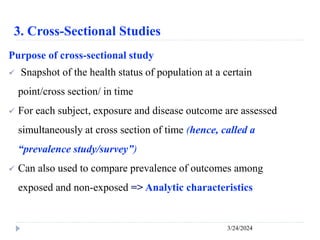
3. Cross-Sectional Studies
3/24/2024
Purpose of cross-sectional study
 Snapshot of the health status of population at a certain
point/cross section/ in time
 For each subject, exposure and disease outcome are assessed
simultaneously at cross section of time (hence, called a
ā€œprevalence study/surveyā€)
 Can also used to compare prevalence of outcomes among
exposed and non-exposed => Analytic characteristics
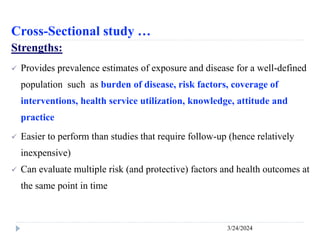
Cross-Sectional study …
3/24/2024
Strengths:
 Provides prevalence estimates of exposure and disease for a well-defined
population such as burden of disease, risk factors, coverage of
interventions, health service utilization, knowledge, attitude and
practice
 Easier to perform than studies that require follow-up (hence relatively
inexpensive)
 Can evaluate multiple risk (and protective) factors and health outcomes at
the same point in time
Cross-Sectional study …
3/24/2024
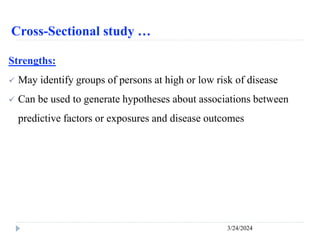
Strengths:
 May identify groups of persons at high or low risk of disease
 Can be used to generate hypotheses about associations between
predictive factors or exposures and disease outcomes
Cross-Sectional study …
3/24/2024
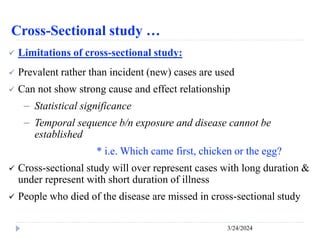
 Limitations of cross-sectional study:
 Prevalent rather than incident (new) cases are used
 Can not show strong cause and effect relationship
ļ¼ Statistical significance
ļ¼ Temporal sequence b/n exposure and disease cannot be
established
* i.e. Which came first, chicken or the egg?
 Cross-sectional study will over represent cases with long duration &
under represent with short duration of illness
 People who died of the disease are missed in cross-sectional study
Cross-Sectional Studies…
3/24/2024
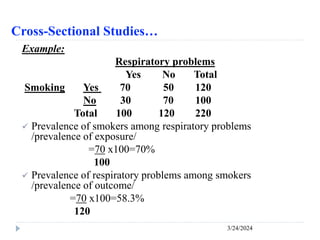
Example:
Respiratory problems
Yes No Total
Smoking Yes 70 50 120
No 30 70 100
Total 100 120 220
 Prevalence of smokers among respiratory problems
/prevalence of exposure/
=70 x100=70%
100
 Prevalence of respiratory problems among smokers
/prevalence of outcome/
=70 x100=58.3%
120
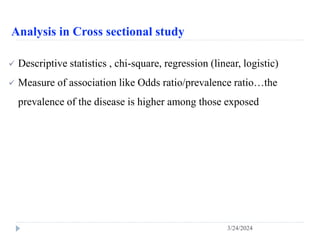
Analysis in Cross sectional study
 Descriptive statistics , chi-square, regression (linear, logistic)
 Measure of association like Odds ratio/prevalence ratio…the
prevalence of the disease is higher among those exposed
3/24/2024
4. Correlational/ecological studies
3/24/2024
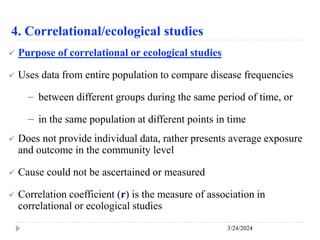
 Purpose of correlational or ecological studies
 Uses data from entire population to compare disease frequencies
ļ¼ between different groups during the same period of time, or
ļ¼ in the same population at different points in time
 Does not provide individual data, rather presents average exposure
and outcome in the community level
 Cause could not be ascertained or measured
 Correlation coefficient (r) is the measure of association in
correlational or ecological studies
4. Correlational/ecological studies…
3/24/2024
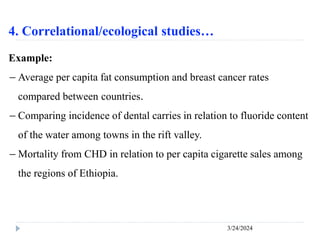
Example:
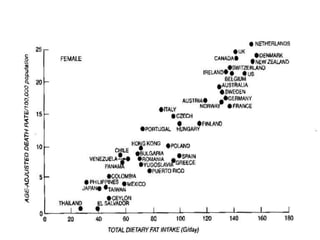
ļ¼ Average per capita fat consumption and breast cancer rates
compared between countries.
ļ¼ Comparing incidence of dental carries in relation to fluoride content
of the water among towns in the rift valley.
ļ¼ Mortality from CHD in relation to per capita cigarette sales among
the regions of Ethiopia.
Breast Cancer Mortality and Dietary Fat
Intake
3/24/2024
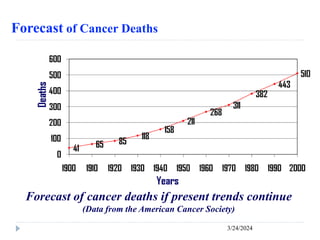
Forecast of Cancer Deaths
3/24/2024
Forecast of cancer deaths if present trends continue
(Data from the American Cancer Society)
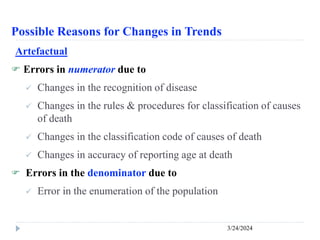
Possible Reasons for Changes in Trends
3/24/2024
Artefactual
 Errors in numerator due to
 Changes in the recognition of disease
 Changes in the rules & procedures for classification of causes
of death
 Changes in the classification code of causes of death
 Changes in accuracy of reporting age at death
 Errors in the denominator due to
 Error in the enumeration of the population
Possible Reasons for Changes in Trends …
3/24/2024
Real
 Changes in age distribution of the population
 Changes in survivorship
 Changes in incidence of disease resulting from
 Genetic factors
 Environmental factors
Correlational/ecological studies …
3/24/2024
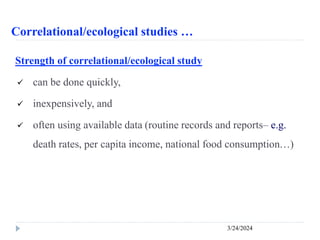
Strength of correlational/ecological study
 can be done quickly,
 inexpensively, and
 often using available data (routine records and reports– e.g.
death rates, per capita income, national food consumption…)
Correlational/ecological studies …
3/24/2024
Limitation of correlational/ecological study
 Inability to link exposure with disease
ļ¼ Data on exposure and outcome are not linked at the individual level; association
found with aggregate data (average values) may not apply to individuals (Prone to
ecological fallacy)
 Lack ability to control effects of potential confounding factors.
 It may mask a non-linear relationship between exposure and
disease.
E.g. non-linear relationship in alcohol consumption and mortality from
Congestive Heart Disease
Assignment
 1. Search research article on each design and explain
how appropriate for the research question, how is the
design outlines the strategies and tools to answer the
question?
 2. Write tree research titles which need each study
design
 Present to class next session !!! (5 minute for each student)
 Do not copy from each other
3/24/2024

3_Int_to_epid_study_design_and_Descriptive_Epid_study_designs.pptx

  • 1.
    Epidemiological Study Designs ByTilaye Workneh (MPH/Epid, Asst. Prof. of Epidemiology) Lecture 4
  • 2.
    Objective of thecourse 3/24/2024  Introduction to study design  Describe the basic concepts of descriptive studies  Describe when and how to carry out common descriptive studies  Describe the limitations and strength of Descriptive studies
  • 3.
    3/24/2024  There areample of health problem in the community which need evidence based answer  Planners and decision makers also need evidence as a resource based on magnitude and factors causing disease for prevention and control  Health professionals and researchers need evidence to answer why and how the disease occurs  Thus, all need research . . . appropriate study design Introduction
  • 4.
    Introduction  Research designis the overall plan which connect the conceptual research problems to the pertinent research outcome  Study design is action plan which portray the strategies and tool to answer the research question  Study Design articulates what data is required, what methods are going to be used to collect & analyze data, & how all of these are going to answer your research question 3/24/2024
  • 5.
    Introduction … 3/24/2024  Epidemiologyis broadly categorized into descriptive and analytical => Corresponding action plan /design/ exist  Broad categories of epidemiological studies: according to their focus of investigation 1. Descriptive studies: focus on the distribution of disease /person, time and place/ 2. Analytic studies: focus in elucidating (įˆ›į‰„įˆ«įˆ«į‰µ) the determinants of disease /analyze cause effect relationships/
  • 6.
    Introduction . .. Purpose of Epidemiological Studies Descriptive study Analytic Study  Characterize disease occurrence by person, time and place  Generate hypothesis  Dealing with population ļ¼ Correlational or ecological  Dealing with individuals ļ¼ Case report ļ¼ Case series ļ¼ Cross sectional survey/Prevalence study  Concerned with the search for causes and effects relationships  Test hypothesis about association between exposure and outcome  Observational studies ļ¼ Case-control ļ¼ Cohort  Intervention studies ļ¼ RCT 3/24/2024
  • 7.
  • 8.
    Descriptive Epidemiology 3/24/2024  Descriptionof disease occurrence by person, place and time  Not intended to asses causality  The Purpose of descriptive epidemiology is to quantify amount and characterize the distribution of disease within a population. Thus, in other words to identify health problems and patterns of disease occurrence
  • 9.
    Summary on Purposeof Descriptive Epidemiology 3/24/2024  Trend analysis  Basic to health policy ļ¼ Measuring health status ļ¼ Assessing needs ļ¼ Identification of priorities ļ¼ Health planning and evaluation  Cue about cause
  • 10.
    Descriptive study designs… 3/24/2024  Describe the person, time and place of health event occurrence  Descriptive studies generally precede analytic studies,  Descriptive information is important to generate hypothesis that should be tested by analytical study designs  Thus, descriptive studies often help to generate hypotheses about cause and effect relationship
  • 11.
    Descriptive study designs… 3/24/2024 Person  Since disease does not occur at random:  What kinds of people tend to develop a particular disease, and who tends to be spared?  What’s unusual about those people? ļ¼Age, ļ¼Sex, ļ¼Race/Ethnicity, ļ¼Social class,
  • 12.
    Person… 3/24/2024 Age  the mostfundamental factor to consider when describing disease occurrence  The incidence of most chronic diseases increases with age  However, the incidence of many infectious diseases is highest in childhood
  • 13.
    Person… 3/24/2024  Sex:-biological andnon-biological factors related to sex have disease risk.  In all developed countries, life expectancy is higher in females than males – principally due to lower heart disease mortality  However, many chronic diseases occur more frequently in women (depression, lupus, etc.)  As lifestyles continue to become more similar, a question is whether mortality rates will become more similar? (i.e. environmental vs biology)
  • 14.
    Person… 3/24/2024 Race/Ethnicity – difficultto define, and to identify which characteristics may relate to disease occurrence - Remarkable variation exists in rates of disease occurrence across racial and ethnic groups ļ¼ Genetics? ļ¼ Socioeconomic status(SES)? ļ¼ Environmental exposures? ļ¼ Access to health care? ļ¼ Lifestyle factors, nutrition, …. ?
  • 15.
    Person… 3/24/2024 Social class –Despiteits unreliability, SES is consistently associated with mortality in a gradient fashion Example:  Occupation  Education  Area of residence  Income  Lifestyle
  • 16.
    Place 3/24/2024 Investigation by placeincludes:  Across countries (international)  Within country variation  Urban/rural differences  Localized areas
  • 17.
    Place… 3/24/2024  Infectious andchronic diseases show great variation from one country to another  Some differences may be attributed to: ļ¼ Climate ļ¼ Cultural factors ļ¼ Diet ļ¼ Genetics
  • 18.
    Place… 3/24/2024 Some differences indisease occurrence between urban and rural locations may be attributed to:  Diet  Physical activity  Housing conditions (i.e. lead paint)  Crowding (i.e. spread of infection)  Pollution
  • 19.
    Time 3/24/2024  Since diseasedoes not occur at random:  How does disease frequency change over time, and what other factors are temporally associated with those changes?  The occurrence of health-relate events can vary by time:  Secular trends  Cyclic fluctuations (periodic)  Point epidemics
  • 20.
    Time… 3/24/2024 Secular trends  referto gradual changes in disease occurrence over long periods of calendar time. Example: Death from communicable diseases has been declining where as deaths from non-communicable diseases has been raising in some developing countries Cyclic fluctuations /periodic/  refer to shorter-term increases and decreases in disease occurrence over a period of years, or within a year
  • 21.
    Descriptive Study Designs 3/24/2024 Studies based on individual level information  Case reports  Case series  Cross sectional surveys  Studies based on population level information  Ecologic/correlational (aggregate) studies
  • 22.
    1. Case Reports 3/24/2024 Careful and detailed report by one or more clinicians about the profile of a single patient Purpose of case report ļ¼ Document unusual medical occurrences ļ¼ Can provide clues in identification of a new disease or adverse effects of exposures (i.e. case report gave the clue OC use increases the risk of venous thromboembolism)  Case report is compiled from patient history, physical examination and Laboratory investigation, radiology investigation, Treatment, Outcome, etc.
  • 23.
    Case report… 3/24/2024  Agroup of physicians present a careful and detailed profile of a single case which has not been seen before or change in natural history of disease  This may provide a clue as there is  An emergence of new disease  A change in the natural history of a disease  A change in the agent character  Emergence of new strain
  • 24.
    Case report… 3/24/2024 Limitations ofCase report  No appropriate comparison group  Cannot be used to test for presence of a valid statistical association  Since based on the experience of one person: ļ¼presence of any risk factor may be purely coincidental ļ¼not a true epidemiologic design
  • 25.
    2. Case Series 3/24/2024 Description of clinical/epidemiologic characteristics of a number of patients (usually 5-12) with a given disease  Collection of individual case reports occurring within a fairly short period of time Purpose of case rseries ļ‚§ Similar to case report  Document unusual medical occurrences  Can provide clues in identification of a new disease or adverse effects of exposures  Upcoming of epidemic
  • 26.
    Case series… 3/24/2024 Strengths ofcase series:  Used as an early means to identify the beginning or presence of an epidemic  Can suggest the emergence of a new disease (i.e. AIDS)
  • 27.
    Case series… 3/24/2024 Limitations ofcase series:  Lack of an appropriate comparison group  Cannot be used to test for presence of a valid statistical association  Not a true epidemiologic design  Studies are prone to atomistic fallacy (opposite of ecological fallacy) –impossible to generalize the result to population Example: At individual level a high income may be associated with lower rate of suicide but this does not mean that rich societies have a lower rate of suicide representativeness of cases???
  • 28.
    3. Cross-Sectional Studies 3/24/2024 Purposeof cross-sectional study  Snapshot of the health status of population at a certain point/cross section/ in time  For each subject, exposure and disease outcome are assessed simultaneously at cross section of time (hence, called a ā€œprevalence study/surveyā€)  Can also used to compare prevalence of outcomes among exposed and non-exposed => Analytic characteristics
  • 29.
    Cross-Sectional study … 3/24/2024 Strengths: Provides prevalence estimates of exposure and disease for a well-defined population such as burden of disease, risk factors, coverage of interventions, health service utilization, knowledge, attitude and practice  Easier to perform than studies that require follow-up (hence relatively inexpensive)  Can evaluate multiple risk (and protective) factors and health outcomes at the same point in time
  • 30.
    Cross-Sectional study … 3/24/2024 Strengths: May identify groups of persons at high or low risk of disease  Can be used to generate hypotheses about associations between predictive factors or exposures and disease outcomes
  • 31.
    Cross-Sectional study … 3/24/2024 Limitations of cross-sectional study:  Prevalent rather than incident (new) cases are used  Can not show strong cause and effect relationship ļ¼ Statistical significance ļ¼ Temporal sequence b/n exposure and disease cannot be established * i.e. Which came first, chicken or the egg?  Cross-sectional study will over represent cases with long duration & under represent with short duration of illness  People who died of the disease are missed in cross-sectional study
  • 32.
    Cross-Sectional Studies… 3/24/2024 Example: Respiratory problems YesNo Total Smoking Yes 70 50 120 No 30 70 100 Total 100 120 220  Prevalence of smokers among respiratory problems /prevalence of exposure/ =70 x100=70% 100  Prevalence of respiratory problems among smokers /prevalence of outcome/ =70 x100=58.3% 120
  • 33.
    Analysis in Crosssectional study  Descriptive statistics , chi-square, regression (linear, logistic)  Measure of association like Odds ratio/prevalence ratio…the prevalence of the disease is higher among those exposed 3/24/2024
  • 34.
    4. Correlational/ecological studies 3/24/2024 Purpose of correlational or ecological studies  Uses data from entire population to compare disease frequencies ļ¼ between different groups during the same period of time, or ļ¼ in the same population at different points in time  Does not provide individual data, rather presents average exposure and outcome in the community level  Cause could not be ascertained or measured  Correlation coefficient (r) is the measure of association in correlational or ecological studies
  • 35.
    4. Correlational/ecological studies… 3/24/2024 Example: ļ¼Average per capita fat consumption and breast cancer rates compared between countries. ļ¼ Comparing incidence of dental carries in relation to fluoride content of the water among towns in the rift valley. ļ¼ Mortality from CHD in relation to per capita cigarette sales among the regions of Ethiopia.
  • 36.
    Breast Cancer Mortalityand Dietary Fat Intake 3/24/2024
  • 37.
    Forecast of CancerDeaths 3/24/2024 Forecast of cancer deaths if present trends continue (Data from the American Cancer Society)
  • 38.
    Possible Reasons forChanges in Trends 3/24/2024 Artefactual  Errors in numerator due to  Changes in the recognition of disease  Changes in the rules & procedures for classification of causes of death  Changes in the classification code of causes of death  Changes in accuracy of reporting age at death  Errors in the denominator due to  Error in the enumeration of the population
  • 39.
    Possible Reasons forChanges in Trends … 3/24/2024 Real  Changes in age distribution of the population  Changes in survivorship  Changes in incidence of disease resulting from  Genetic factors  Environmental factors
  • 40.
    Correlational/ecological studies … 3/24/2024 Strengthof correlational/ecological study  can be done quickly,  inexpensively, and  often using available data (routine records and reports– e.g. death rates, per capita income, national food consumption…)
  • 41.
    Correlational/ecological studies … 3/24/2024 Limitationof correlational/ecological study  Inability to link exposure with disease ļ¼ Data on exposure and outcome are not linked at the individual level; association found with aggregate data (average values) may not apply to individuals (Prone to ecological fallacy)  Lack ability to control effects of potential confounding factors.  It may mask a non-linear relationship between exposure and disease. E.g. non-linear relationship in alcohol consumption and mortality from Congestive Heart Disease
  • 42.
    Assignment  1. Searchresearch article on each design and explain how appropriate for the research question, how is the design outlines the strategies and tools to answer the question?  2. Write tree research titles which need each study design  Present to class next session !!! (5 minute for each student)  Do not copy from each other 3/24/2024