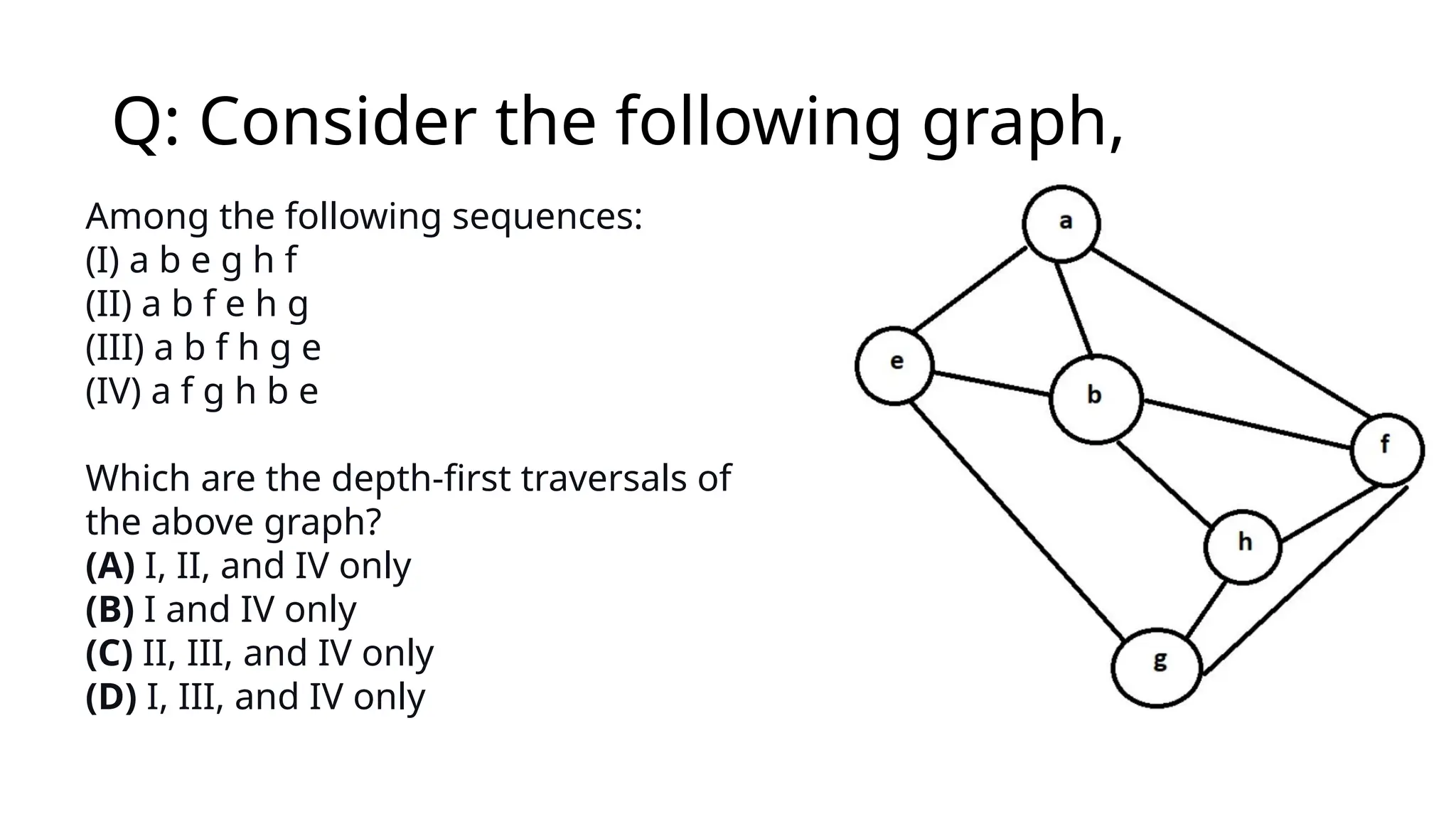
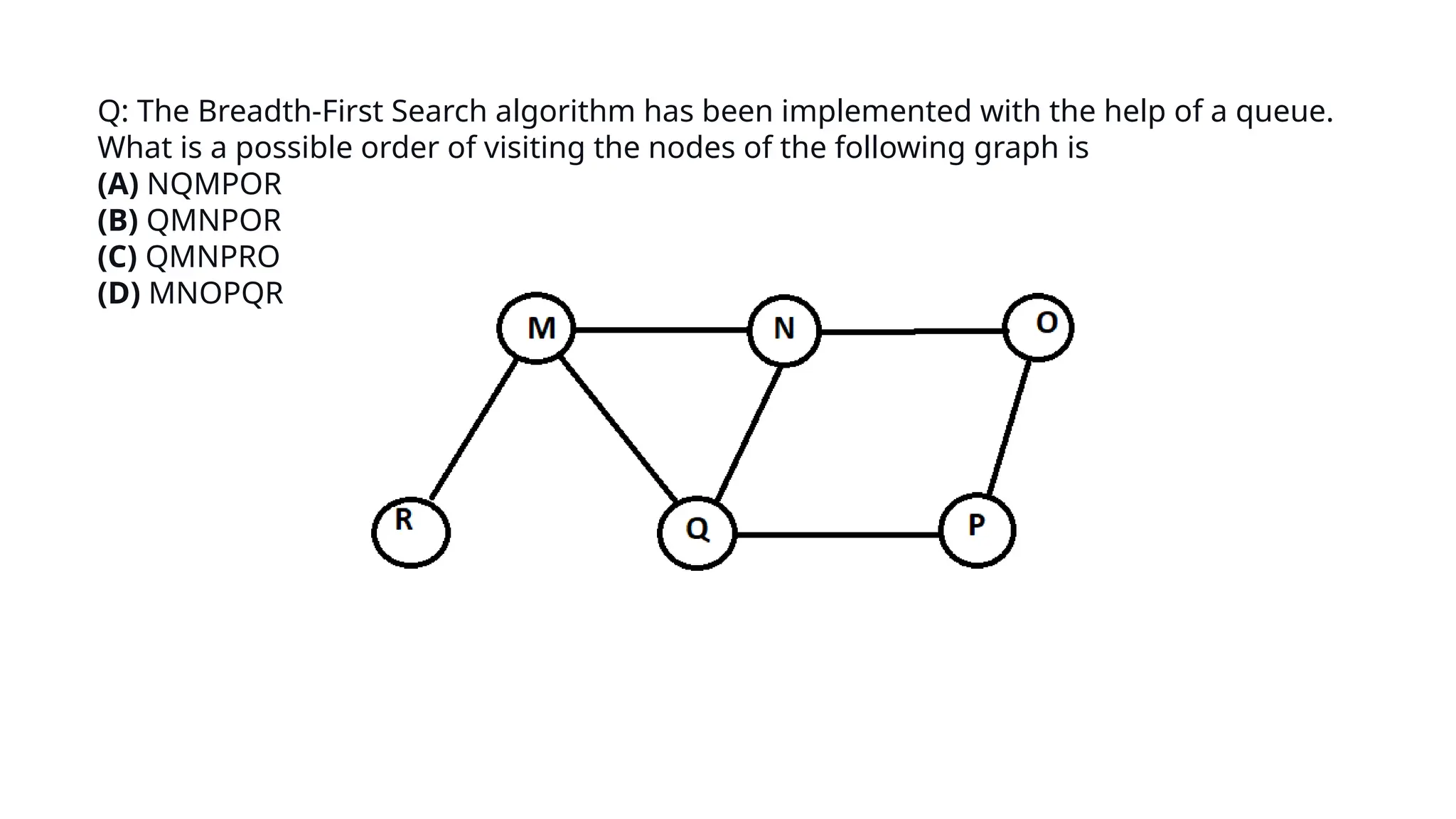
The document outlines algorithms for breadth-first search (BFS) and depth-first search (DFS) in graph traversal. The BFS algorithm utilizes a queue to explore nodes level by level, while the DFS algorithm employs a stack to explore nodes deeply before backtracking. Both sections provide initialization steps and describe how to process and update the status of nodes during traversal.
![Algorithm for BFS
2
This algorithm executes a breadth-first search on a graph G beginning at
starting node A.
1.Initialize all nodes to the ready state (STATUS=1)
2.Put the starting node A in QUEUE and change its status to the waiting state
(STATUS =2)
3.Repeat Steps 4 and 5 until QUEUE is empty:
4. Remove the front node N of QUEUE. Process N and change the status of N
to the processed state (STATUS = 3)
5. Add to the rear of QUEUE all the neighbors of N that are in the
ready state (STATUS = 1), and change their status to the
waiting state (STATUS = 2) [End of Step 3 Loop]
6. Exit](https://image.slidesharecdn.com/dfsandbfs-copy-241123165602-3cdf526f/75/Depth-First-Search-and-Breadth-First-Search-2-2048.jpg)
![DFS Algorithm
4
1. Initialize all nodes to the ready state (STATUS=1)
2. Push the starting node A onto STACK and change its status to the waiting state
(STATUS=2)
3. Repeat Steps 4 and 5 until STACK is empty
4. Pop the top node N of STACK. Process N and change its status to the processed
state (STATUS=3)
5. Push onto STACK the neighbour (which is alphabetically smaller) of N that are
still in the ready state (STATUS=1), and change their status to the waiting state
(STATUS = 2)
6. [End of Step 3 loop]
7. Exit](https://image.slidesharecdn.com/dfsandbfs-copy-241123165602-3cdf526f/75/Depth-First-Search-and-Breadth-First-Search-4-2048.jpg)