Reference: Data Structures and Algorithm
Analysis in C++ by Weiss Ch. 9
Prepared by Nisha Soms
Graph Traversals
2
Graphs
2
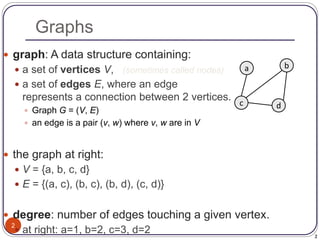
 graph: A data structure containing:
 a set of vertices V, (sometimes called nodes)
 a set of edges E, where an edge
represents a connection between 2 vertices.
 Graph G = (V, E)
 an edge is a pair (v, w) where v, w are in V
 the graph at right:
 V = {a, b, c, d}
 E = {(a, c), (b, c), (b, d), (c, d)}
 degree: number of edges touching a given vertex.
 at right: a=1, b=2, c=3, d=2
a
c
b
d
3
Graph examples
3
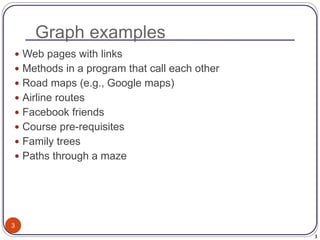
 Web pages with links
 Methods in a program that call each other
 Road maps (e.g., Google maps)
 Airline routes
 Facebook friends
 Course pre-requisites
 Family trees
 Paths through a maze
4
Paths
4
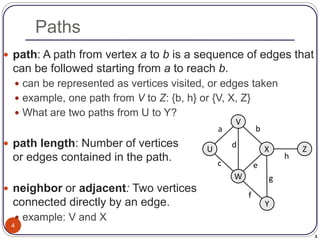
 path: A path from vertex a to b is a sequence of edges that
can be followed starting from a to reach b.
 can be represented as vertices visited, or edges taken
 example, one path from V to Z: {b, h} or {V, X, Z}
 What are two paths from U to Y?
 path length: Number of vertices
or edges contained in the path.
 neighbor or adjacent: Two vertices
connected directly by an edge.
 example: V and X
X
U
V
W
Z
Y
a
c
b
e
d
f
g
h
5
Reachability & Connectedness
5
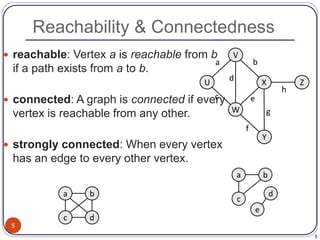
 reachable: Vertex a is reachable from b
if a path exists from a to b.
 connected: A graph is connected if every
vertex is reachable from any other.
 strongly connected: When every vertex
has an edge to every other vertex.
X
U
V
W
Z
Y
a
c
b
e
d
f
g
h
a
c
b
d
a
c
b
d
e
6
Loops and cycles
6
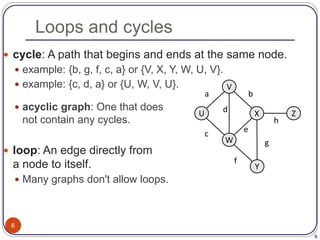
 cycle: A path that begins and ends at the same node.
 example: {b, g, f, c, a} or {V, X, Y, W, U, V}.
 example: {c, d, a} or {U, W, V, U}.
 acyclic graph: One that does
not contain any cycles.
 loop: An edge directly from
a node to itself.
 Many graphs don't allow loops.
X
U
V
W
Z
Y
a
c
b
e
d
f
g
h
7
Weighted graphs
7
 weight: Cost associated with a given edge.
 Some graphs have weighted edges, and some are
unweighted.
 Edges in an unweighted graph can be thought of as having
equal weight (e.g. all 0, or all 1, etc.)
 Most graphs do not allow negative weights.
 example: graph of airline flights, weighted by miles
between cities:
ORD
PVD
MIA
DFW
SFO
LAX
LGA
HNL
8
Directed graphs
8
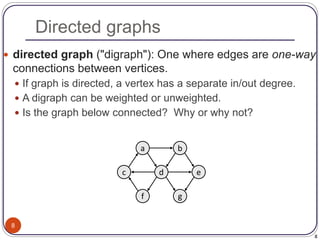
 directed graph ("digraph"): One where edges are one-way
connections between vertices.
 If graph is directed, a vertex has a separate in/out degree.
 A digraph can be weighted or unweighted.
 Is the graph below connected? Why or why not?
a
d
b
e
g
f
c
9
Linked Lists, Trees, Graphs
9
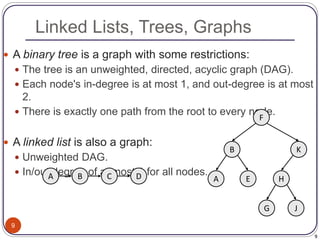
 A binary tree is a graph with some restrictions:
 The tree is an unweighted, directed, acyclic graph (DAG).
 Each node's in-degree is at most 1, and out-degree is at most
2.
 There is exactly one path from the root to every node.
 A linked list is also a graph:
 Unweighted DAG.
 In/out degree of at most 1 for all nodes.
F
B
A E
K
H
J
G
A B D
C
10
Searching for paths
10
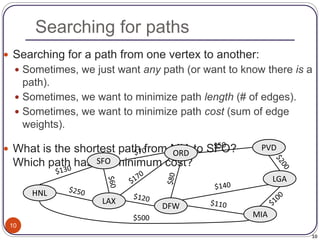
 Searching for a path from one vertex to another:
 Sometimes, we just want any path (or want to know there is a
path).
 Sometimes, we want to minimize path length (# of edges).
 Sometimes, we want to minimize path cost (sum of edge
weights).
 What is the shortest path from MIA to SFO?
Which path has the minimum cost?
ORD
PVD
MIA
DFW
SFO
LAX
LGA
HNL
$500
11
Depth-first search
11
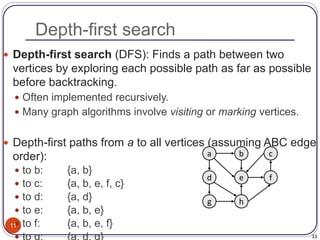
 Depth-first search (DFS): Finds a path between two
vertices by exploring each possible path as far as possible
before backtracking.
 Often implemented recursively.
 Many graph algorithms involve visiting or marking vertices.
 Depth-first paths from a to all vertices (assuming ABC edge
order):
 to b: {a, b}
 to c: {a, b, e, f, c}
 to d: {a, d}
 to e: {a, b, e}
 to f: {a, b, e, f}
a
e
b c
h
g
d f
12
DFS pseudocode
12
function dfs(v1, v2):
dfs(v1, v2, { }).
function dfs(v1, v2, path):
path += v1.
mark v1 as visited.
if v1 is v2:
a path is found!
for each unvisited neighbor n of v1:
if dfs(n, v2, path) finds a path: a path is found!
path -= v1. // path is not found.
a
e
b c
h
g
d f
13
DFS observations
13
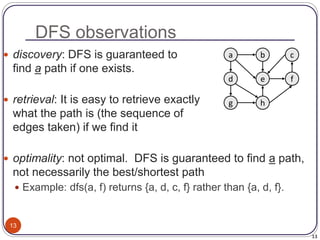
 discovery: DFS is guaranteed to
find a path if one exists.
 retrieval: It is easy to retrieve exactly
what the path is (the sequence of
edges taken) if we find it
 optimality: not optimal. DFS is guaranteed to find a path,
not necessarily the best/shortest path
 Example: dfs(a, f) returns {a, d, c, f} rather than {a, d, f}.
a
e
b c
h
g
d f
14
Breadth-first search
14
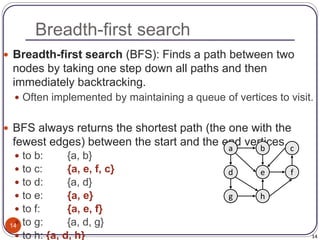
 Breadth-first search (BFS): Finds a path between two
nodes by taking one step down all paths and then
immediately backtracking.
 Often implemented by maintaining a queue of vertices to visit.
 BFS always returns the shortest path (the one with the
fewest edges) between the start and the end vertices.
 to b: {a, b}
 to c: {a, e, f, c}
 to d: {a, d}
 to e: {a, e}
 to f: {a, e, f}
 to g: {a, d, g}
 to h: {a, d, h}
a
e
b c
h
g
d f
15
BFS pseudocode
15
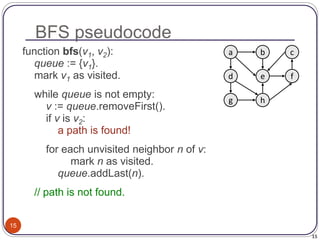
function bfs(v1, v2):
queue := {v1}.
mark v1 as visited.
while queue is not empty:
v := queue.removeFirst().
if v is v2:
a path is found!
for each unvisited neighbor n of v:
mark n as visited.
queue.addLast(n).
// path is not found.
a
e
b c
h
g
d f
16
BFS observations
16
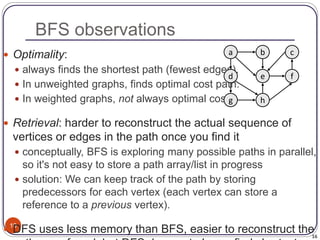
 Optimality:
 always finds the shortest path (fewest edges).
 In unweighted graphs, finds optimal cost path.
 In weighted graphs, not always optimal cost.
 Retrieval: harder to reconstruct the actual sequence of
vertices or edges in the path once you find it
 conceptually, BFS is exploring many possible paths in parallel,
so it's not easy to store a path array/list in progress
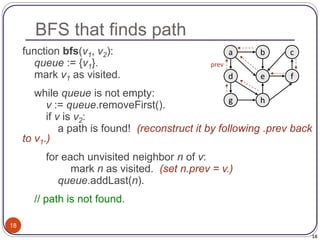
 solution: We can keep track of the path by storing
predecessors for each vertex (each vertex can store a
reference to a previous vertex).
 DFS uses less memory than BFS, easier to reconstruct the
a
e
b c
h
g
d f
17
DFS, BFS runtime
17
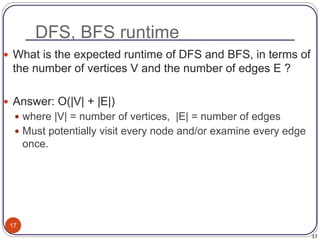
 What is the expected runtime of DFS and BFS, in terms of
the number of vertices V and the number of edges E ?
 Answer: O(|V| + |E|)
 where |V| = number of vertices, |E| = number of edges
 Must potentially visit every node and/or examine every edge
once.
18
BFS that finds path
18
function bfs(v1, v2):
queue := {v1}.
mark v1 as visited.
while queue is not empty:
v := queue.removeFirst().
if v is v2:
a path is found! (reconstruct it by following .prev back
to v1.)
for each unvisited neighbor n of v:
mark n as visited. (set n.prev = v.)
queue.addLast(n).
// path is not found.
a
e
b c
h
g
d f
prev
Thank you

Depth First Search and Breadth First Search

  • 1.
    Reference: Data Structuresand Algorithm Analysis in C++ by Weiss Ch. 9 Prepared by Nisha Soms Graph Traversals
  • 2.
    2 Graphs 2  graph: Adata structure containing:  a set of vertices V, (sometimes called nodes)  a set of edges E, where an edge represents a connection between 2 vertices.  Graph G = (V, E)  an edge is a pair (v, w) where v, w are in V  the graph at right:  V = {a, b, c, d}  E = {(a, c), (b, c), (b, d), (c, d)}  degree: number of edges touching a given vertex.  at right: a=1, b=2, c=3, d=2 a c b d
  • 3.
    3 Graph examples 3  Webpages with links  Methods in a program that call each other  Road maps (e.g., Google maps)  Airline routes  Facebook friends  Course pre-requisites  Family trees  Paths through a maze
  • 4.
    4 Paths 4  path: Apath from vertex a to b is a sequence of edges that can be followed starting from a to reach b.  can be represented as vertices visited, or edges taken  example, one path from V to Z: {b, h} or {V, X, Z}  What are two paths from U to Y?  path length: Number of vertices or edges contained in the path.  neighbor or adjacent: Two vertices connected directly by an edge.  example: V and X X U V W Z Y a c b e d f g h
  • 5.
    5 Reachability & Connectedness 5 reachable: Vertex a is reachable from b if a path exists from a to b.  connected: A graph is connected if every vertex is reachable from any other.  strongly connected: When every vertex has an edge to every other vertex. X U V W Z Y a c b e d f g h a c b d a c b d e
  • 6.
    6 Loops and cycles 6 cycle: A path that begins and ends at the same node.  example: {b, g, f, c, a} or {V, X, Y, W, U, V}.  example: {c, d, a} or {U, W, V, U}.  acyclic graph: One that does not contain any cycles.  loop: An edge directly from a node to itself.  Many graphs don't allow loops. X U V W Z Y a c b e d f g h
  • 7.
    7 Weighted graphs 7  weight:Cost associated with a given edge.  Some graphs have weighted edges, and some are unweighted.  Edges in an unweighted graph can be thought of as having equal weight (e.g. all 0, or all 1, etc.)  Most graphs do not allow negative weights.  example: graph of airline flights, weighted by miles between cities: ORD PVD MIA DFW SFO LAX LGA HNL
  • 8.
    8 Directed graphs 8  directedgraph ("digraph"): One where edges are one-way connections between vertices.  If graph is directed, a vertex has a separate in/out degree.  A digraph can be weighted or unweighted.  Is the graph below connected? Why or why not? a d b e g f c
  • 9.
    9 Linked Lists, Trees,Graphs 9  A binary tree is a graph with some restrictions:  The tree is an unweighted, directed, acyclic graph (DAG).  Each node's in-degree is at most 1, and out-degree is at most 2.  There is exactly one path from the root to every node.  A linked list is also a graph:  Unweighted DAG.  In/out degree of at most 1 for all nodes. F B A E K H J G A B D C
  • 10.
    10 Searching for paths 10 Searching for a path from one vertex to another:  Sometimes, we just want any path (or want to know there is a path).  Sometimes, we want to minimize path length (# of edges).  Sometimes, we want to minimize path cost (sum of edge weights).  What is the shortest path from MIA to SFO? Which path has the minimum cost? ORD PVD MIA DFW SFO LAX LGA HNL $500
  • 11.
    11 Depth-first search 11  Depth-firstsearch (DFS): Finds a path between two vertices by exploring each possible path as far as possible before backtracking.  Often implemented recursively.  Many graph algorithms involve visiting or marking vertices.  Depth-first paths from a to all vertices (assuming ABC edge order):  to b: {a, b}  to c: {a, b, e, f, c}  to d: {a, d}  to e: {a, b, e}  to f: {a, b, e, f} a e b c h g d f
  • 12.
    12 DFS pseudocode 12 function dfs(v1,v2): dfs(v1, v2, { }). function dfs(v1, v2, path): path += v1. mark v1 as visited. if v1 is v2: a path is found! for each unvisited neighbor n of v1: if dfs(n, v2, path) finds a path: a path is found! path -= v1. // path is not found. a e b c h g d f
  • 13.
    13 DFS observations 13  discovery:DFS is guaranteed to find a path if one exists.  retrieval: It is easy to retrieve exactly what the path is (the sequence of edges taken) if we find it  optimality: not optimal. DFS is guaranteed to find a path, not necessarily the best/shortest path  Example: dfs(a, f) returns {a, d, c, f} rather than {a, d, f}. a e b c h g d f
  • 14.
    14 Breadth-first search 14  Breadth-firstsearch (BFS): Finds a path between two nodes by taking one step down all paths and then immediately backtracking.  Often implemented by maintaining a queue of vertices to visit.  BFS always returns the shortest path (the one with the fewest edges) between the start and the end vertices.  to b: {a, b}  to c: {a, e, f, c}  to d: {a, d}  to e: {a, e}  to f: {a, e, f}  to g: {a, d, g}  to h: {a, d, h} a e b c h g d f
  • 15.
    15 BFS pseudocode 15 function bfs(v1,v2): queue := {v1}. mark v1 as visited. while queue is not empty: v := queue.removeFirst(). if v is v2: a path is found! for each unvisited neighbor n of v: mark n as visited. queue.addLast(n). // path is not found. a e b c h g d f
  • 16.
    16 BFS observations 16  Optimality: always finds the shortest path (fewest edges).  In unweighted graphs, finds optimal cost path.  In weighted graphs, not always optimal cost.  Retrieval: harder to reconstruct the actual sequence of vertices or edges in the path once you find it  conceptually, BFS is exploring many possible paths in parallel, so it's not easy to store a path array/list in progress  solution: We can keep track of the path by storing predecessors for each vertex (each vertex can store a reference to a previous vertex).  DFS uses less memory than BFS, easier to reconstruct the a e b c h g d f
  • 17.
    17 DFS, BFS runtime 17 What is the expected runtime of DFS and BFS, in terms of the number of vertices V and the number of edges E ?  Answer: O(|V| + |E|)  where |V| = number of vertices, |E| = number of edges  Must potentially visit every node and/or examine every edge once.
  • 18.
    18 BFS that findspath 18 function bfs(v1, v2): queue := {v1}. mark v1 as visited. while queue is not empty: v := queue.removeFirst(). if v is v2: a path is found! (reconstruct it by following .prev back to v1.) for each unvisited neighbor n of v: mark n as visited. (set n.prev = v.) queue.addLast(n). // path is not found. a e b c h g d f prev
  • 19.