
Dependability engineering

                                       Lecture 2


Dependability engineering, CSE, 2010               Slide 1
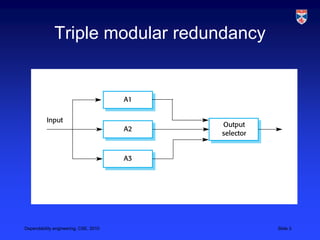
Hardware fault tolerance
                                       •   Depends on triple-modular
                                           redundancy (TMR).
                                       •   Three identical components that
                                           receive the same input and whose
                                           outputs are compared.
                                       •   If one output is different, it is
                                           ignored and component failure is
                                           assumed.
                                       •   Based on most faults resulting
                                           from component failures rather
                                           than design faults and a low
Dependability engineering, CSE, 2010       probability of simultaneous Slide 2
Triple modular redundancy


Dependability engineering, CSE, 2010      Slide 3
N-version programming
                                       •   Multiple versions of a software
                                           system carry out computations at
                                           the same time. There should be an
                                           odd number of computers
                                           involved, typically 3.
                                       •   The results are compared using a
                                           voting system and the majority
                                           result is taken to be the correct
                                           result.
                                       •   Approach derived from the notion
                                           of triple-modular redundancy, as
                                           used in hardware systems.
Dependability engineering, CSE, 2010                                    Slide 4
N-version programming


Dependability engineering, CSE, 2010        Slide 5
N-version programming
   •       The different system versions are designed and
           implemented by different teams. It is assumed that
           there is a low probability that they will make the
           same mistakes. The algorithms used should but may
           not be different.
   •       There is some empirical evidence that teams
           commonly misinterpret specifications in the same
           way and chose the same algorithms in their systems.


Dependability engineering, CSE, 2010                     Slide 6
Software diversity
  •       Approaches to software fault tolerance depend on
          software diversity where it is assumed that different
          implementations of the same software specification
          will fail in different ways.
  •       It is assumed that implementations are (a)
          independent and (b) do not include common errors.
  •       Strategies to achieve diversity
        –      Different programming languages
        –      Different design methods and tools
        –      Explicit specification of different algorithms

Dependability engineering, CSE, 2010                            Slide 7
Problems with design diversity
   •       Teams are not culturally diverse so they tend to
           tackle problems in the same way
   •       Characteristic errors
         –      Different teams make the same mistakes. Some parts of an
                implementation are more difficult than others so all teams
                tend to make mistakes in the same place;

   •       Specification errors;
         –      If there is an error in the specification then this is reflected in
                all implementations;
         –      This can be addressed to some extent by using multiple
                specification representations.

Dependability engineering, CSE, 2010                                         Slide 8
Specification dependency
   •       Both approaches to software redundancy are
           susceptible to specification errors. If the specification
           is incorrect, the system could fail
   •       This is also a problem with hardware but software
           specifications are usually more complex than
           hardware specifications and harder to validate.
   •       This has been addressed in some cases by
           developing separate software specifications from the
           same user specification.


Dependability engineering, CSE, 2010                           Slide 9
Improvements in practice
 •   In principle, if diversity and independence can be
     achieved, multi-version programming leads to very
     significant improvements in reliability and availability.
 •   In practice, observed improvements are much less
     significant but the approach seems leads to reliability
     improvements of between 5 and 9 times.
 •   Are such improvements are worth the considerable
     extra development costs for multi-version
     programming?
 •       Is it cheaper to increase the reliability of a single
         version using fault avoidance and fault detection
         techniques?
Dependability engineering, CSE, 2010                             Slide 10
Dependable programming
  •       Good programming practices can be adopted that
          help reduce the incidence of program faults.
  •       These programming practices support
        –      Fault avoidance
        –      Fault detection
        –      Fault tolerance


Dependability engineering, CSE, 2010                   Slide 11
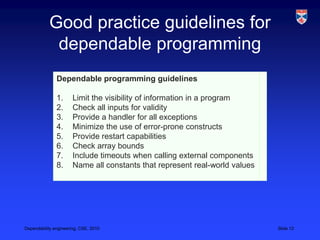
Good practice guidelines for
            dependable programming
               Dependable programming guidelines

               1.      Limit the visibility of information in a program
               2.      Check all inputs for validity
               3.      Provide a handler for all exceptions
               4.      Minimize the use of error-prone constructs
               5.      Provide restart capabilities
               6.      Check array bounds
               7.      Include timeouts when calling external components
               8.      Name all constants that represent real-world values


Dependability engineering, CSE, 2010                                         Slide 12
Control the visibility of
                  information in a program
  •       Program components should only be allowed access
          to data that they need for their implementation.
  •       This means that accidental corruption of parts of the
          program state by these components is impossible.
  •       You can control visibility by using abstract data types
          where the data representation is private and you only
          allow access to the data through predefined
          operations such as get () and put ().


Dependability engineering, CSE, 2010                        Slide 13
Check all inputs for validity
 •   All program take inputs from their environment and
     make assumptions about these inputs.
 •   However, program specifications rarely define what to
     do if an input is not consistent with these
     assumptions.
 •   Consequently, many programs behave unpredictably
     when presented with unusual inputs
     and, sometimes, these are threats to the security of
     the system.
 •       Consequently, you should always check inputs before
         processing against the assumptions made about
         these inputs.
Dependability engineering, CSE, 2010                   Slide 14
Validity checks
 •    Range checks
     –    Check that the input falls within a known range.

 •    Size checks
     –    Check that the input does not exceed some maximum size
          e.g. 40 characters for a name.

 •    Representation checks
     –    Check that the input does not include characters that should
          not be part of its representation e.g. names do not include
          numerals.

 •    Reasonableness checks
     –          Use information about the input to check if it is reasonable
Dependability engineering, CSE, 2010 an extreme value.
                rather than                                               Slide 15
Provide a handler for all
                         exceptions
   •       A program exception is an error or some
           unexpected event such as a power failure.
   •       Exception handling constructs allow for such
           events to be handled without the need for
           continual status checking to detect exceptions.
   •       Using normal control constructs to detect
           exceptions needs many additional statements to be
           added to the program. This adds a significant
           overhead and is potentially error-prone.


Dependability engineering, CSE, 2010                         Slide 16
Exception handling


Dependability engineering, CSE, 2010              Slide 17
Exception handling
  •       Three possible exception handling strategies
        –      Signal to a calling component that an exception has occurred
               and provide information about the type of exception.
        –      Carry out some alternative processing to the processing
               where the exception occurred. This is only possible where
               the exception handler has enough information to recover
               from the problem that has arisen.
        –      Pass control to a run-time support system to handle the
               exception.

  •       Exception handling is a mechanism to provide some
          fault tolerance

Dependability engineering, CSE, 2010                                     Slide 18
Minimize the use of error-prone
                constructs
  •       Program faults are usually a consequence of human
          error because programmers lose track of the
          relationships between the different parts of the
          system
  •       This is exacerbated by error-prone constructs in
          programming languages that are inherently complex
          or that don’t check for mistakes when they could do
          so.
  •       Therefore, when programming, you should try to
          avoid or at least minimize the use of these error-
          prone constructs.
Dependability engineering, CSE, 2010                           Slide 19
Error-prone constructs

   •       Unconditional branch (goto) statements
   •       Floating-point numbers
         –      Inherently imprecise. The imprecision may lead to invalid
                comparisons.
   •       Pointers
         –      Pointers referring to the wrong memory areas can corrupt
                data. Aliasing can make programs difficult to understand
                and change.
   •       Dynamic memory allocation
         –      Run-time allocation can cause memory overflow.


Dependability engineering, CSE, 2010                                   Slide 20
Error-prone constructs
   •   Parallelism
       –   Can result in subtle timing errors because of unforeseen
           interaction between parallel processes.
   •   Recursion
       –   Errors in recursion can cause memory overflow as the
           program stack fills up.
   •   Interrupts
       –   Interrupts can cause a critical operation to be terminated
           and make a program difficult to understand.
   •   Inheritance
       –           Code is not localised. This can result in unexpected
                   behaviour when changes are made and problems of
                   understanding the code.
Dependability engineering, CSE, 2010                                      Slide 21
Error-prone constructs
  •       Aliasing
        –      Using more than 1 name to refer to the same state variable.
  •       Unbounded arrays
        –      Buffer overflow failures can occur if no bound checking on
               arrays.
  •       Default input processing
        –      An input action that occurs irrespective of the input.
        –      This can cause problems if the default action is to transfer
               control elsewhere in the program. In incorrect or deliberately
               malicious input can then trigger a program failure.


Dependability engineering, CSE, 2010                                    Slide 22
Provide restart capabilities
  •       For systems that involve long transactions or user
          interactions, you should always provide a restart
          capability that allows the system to restart after failure
          without users having to redo everything that they
          have done.
  •       Restart depends on the type of system
        –      Keep copies of forms so that users don’t have to fill them in
               again if there is a problem
        –      Save state periodically and restart from the saved state


Dependability engineering, CSE, 2010                                      Slide 23
Check array bounds
  •       In some programming languages, such as C, it is
          possible to address a memory location outside of the
          range allowed for in an array declaration.
  •       This leads to the well-known ‘bounded buffer’
          vulnerability where attackers write executable code
          into memory by deliberately writing beyond the top
          element in an array.
  •       If your language does not include bound checking,
          you should therefore always check that an array
          access is within the bounds of the array.


Dependability engineering, CSE, 2010                       Slide 24
Include timeouts when calling
              external components
  •       In a distributed system, failure of a remote computer
          can be ‘silent’ so that programs expecting a service
          from that computer may never receive that service or
          any indication that there has been a failure.
  •       To avoid this, you should always include timeouts on
          all calls to external components.
  •       After a defined time period has elapsed without a
          response, your system should then assume failure
          and take whatever actions are required to recover
          from this.


Dependability engineering, CSE, 2010                       Slide 25
Name all constants that
             represent real-world values
  •       Always give constants that reflect real-world values
          (such as tax rates) names rather than using their
          numeric values and always refer to them by name
  •       You are less likely to make mistakes and type the
          wrong value when you are using a name rather than
          a value.
  •       This means that when these ‘constants’ change (for
          sure, they are not really constant), then you only have
          to make the change in one place in your program.


Dependability engineering, CSE, 2010                        Slide 26
Key points
  •       Software diversity is difficult to achieve because it is
          practically impossible to ensure that each version of
          the software is truly independent.
  •       Dependable programming relies on the inclusion of
          redundancy in a program to check the validity of
          inputs and the values of program variables.
  •       Some programming constructs and techniques, such
          as goto statements, pointers, recursion, inheritance
          and floating-point numbers, are inherently error-
          prone. You should try to avoid these constructs when
          developing dependable systems.
Dependability engineering, CSE, 2010                           Slide 27

Dependability Engineering 2 (CS 5032 2012)

  • 1.
    Dependability engineering Lecture 2 Dependability engineering, CSE, 2010 Slide 1
  • 2.
    Hardware fault tolerance • Depends on triple-modular redundancy (TMR). • Three identical components that receive the same input and whose outputs are compared. • If one output is different, it is ignored and component failure is assumed. • Based on most faults resulting from component failures rather than design faults and a low Dependability engineering, CSE, 2010 probability of simultaneous Slide 2
  • 3.
    Triple modular redundancy Dependabilityengineering, CSE, 2010 Slide 3
  • 4.
    N-version programming • Multiple versions of a software system carry out computations at the same time. There should be an odd number of computers involved, typically 3. • The results are compared using a voting system and the majority result is taken to be the correct result. • Approach derived from the notion of triple-modular redundancy, as used in hardware systems. Dependability engineering, CSE, 2010 Slide 4
  • 5.
  • 6.
    N-version programming • The different system versions are designed and implemented by different teams. It is assumed that there is a low probability that they will make the same mistakes. The algorithms used should but may not be different. • There is some empirical evidence that teams commonly misinterpret specifications in the same way and chose the same algorithms in their systems. Dependability engineering, CSE, 2010 Slide 6
  • 7.
    Software diversity • Approaches to software fault tolerance depend on software diversity where it is assumed that different implementations of the same software specification will fail in different ways. • It is assumed that implementations are (a) independent and (b) do not include common errors. • Strategies to achieve diversity – Different programming languages – Different design methods and tools – Explicit specification of different algorithms Dependability engineering, CSE, 2010 Slide 7
  • 8.
    Problems with designdiversity • Teams are not culturally diverse so they tend to tackle problems in the same way • Characteristic errors – Different teams make the same mistakes. Some parts of an implementation are more difficult than others so all teams tend to make mistakes in the same place; • Specification errors; – If there is an error in the specification then this is reflected in all implementations; – This can be addressed to some extent by using multiple specification representations. Dependability engineering, CSE, 2010 Slide 8
  • 9.
    Specification dependency • Both approaches to software redundancy are susceptible to specification errors. If the specification is incorrect, the system could fail • This is also a problem with hardware but software specifications are usually more complex than hardware specifications and harder to validate. • This has been addressed in some cases by developing separate software specifications from the same user specification. Dependability engineering, CSE, 2010 Slide 9
  • 10.
    Improvements in practice • In principle, if diversity and independence can be achieved, multi-version programming leads to very significant improvements in reliability and availability. • In practice, observed improvements are much less significant but the approach seems leads to reliability improvements of between 5 and 9 times. • Are such improvements are worth the considerable extra development costs for multi-version programming? • Is it cheaper to increase the reliability of a single version using fault avoidance and fault detection techniques? Dependability engineering, CSE, 2010 Slide 10
  • 11.
    Dependable programming • Good programming practices can be adopted that help reduce the incidence of program faults. • These programming practices support – Fault avoidance – Fault detection – Fault tolerance Dependability engineering, CSE, 2010 Slide 11
  • 12.
    Good practice guidelinesfor dependable programming Dependable programming guidelines 1. Limit the visibility of information in a program 2. Check all inputs for validity 3. Provide a handler for all exceptions 4. Minimize the use of error-prone constructs 5. Provide restart capabilities 6. Check array bounds 7. Include timeouts when calling external components 8. Name all constants that represent real-world values Dependability engineering, CSE, 2010 Slide 12
  • 13.
    Control the visibilityof information in a program • Program components should only be allowed access to data that they need for their implementation. • This means that accidental corruption of parts of the program state by these components is impossible. • You can control visibility by using abstract data types where the data representation is private and you only allow access to the data through predefined operations such as get () and put (). Dependability engineering, CSE, 2010 Slide 13
  • 14.
    Check all inputsfor validity • All program take inputs from their environment and make assumptions about these inputs. • However, program specifications rarely define what to do if an input is not consistent with these assumptions. • Consequently, many programs behave unpredictably when presented with unusual inputs and, sometimes, these are threats to the security of the system. • Consequently, you should always check inputs before processing against the assumptions made about these inputs. Dependability engineering, CSE, 2010 Slide 14
  • 15.
    Validity checks • Range checks – Check that the input falls within a known range. • Size checks – Check that the input does not exceed some maximum size e.g. 40 characters for a name. • Representation checks – Check that the input does not include characters that should not be part of its representation e.g. names do not include numerals. • Reasonableness checks – Use information about the input to check if it is reasonable Dependability engineering, CSE, 2010 an extreme value. rather than Slide 15
  • 16.
    Provide a handlerfor all exceptions • A program exception is an error or some unexpected event such as a power failure. • Exception handling constructs allow for such events to be handled without the need for continual status checking to detect exceptions. • Using normal control constructs to detect exceptions needs many additional statements to be added to the program. This adds a significant overhead and is potentially error-prone. Dependability engineering, CSE, 2010 Slide 16
  • 17.
  • 18.
    Exception handling • Three possible exception handling strategies – Signal to a calling component that an exception has occurred and provide information about the type of exception. – Carry out some alternative processing to the processing where the exception occurred. This is only possible where the exception handler has enough information to recover from the problem that has arisen. – Pass control to a run-time support system to handle the exception. • Exception handling is a mechanism to provide some fault tolerance Dependability engineering, CSE, 2010 Slide 18
  • 19.
    Minimize the useof error-prone constructs • Program faults are usually a consequence of human error because programmers lose track of the relationships between the different parts of the system • This is exacerbated by error-prone constructs in programming languages that are inherently complex or that don’t check for mistakes when they could do so. • Therefore, when programming, you should try to avoid or at least minimize the use of these error- prone constructs. Dependability engineering, CSE, 2010 Slide 19
  • 20.
    Error-prone constructs • Unconditional branch (goto) statements • Floating-point numbers – Inherently imprecise. The imprecision may lead to invalid comparisons. • Pointers – Pointers referring to the wrong memory areas can corrupt data. Aliasing can make programs difficult to understand and change. • Dynamic memory allocation – Run-time allocation can cause memory overflow. Dependability engineering, CSE, 2010 Slide 20
  • 21.
    Error-prone constructs • Parallelism – Can result in subtle timing errors because of unforeseen interaction between parallel processes. • Recursion – Errors in recursion can cause memory overflow as the program stack fills up. • Interrupts – Interrupts can cause a critical operation to be terminated and make a program difficult to understand. • Inheritance – Code is not localised. This can result in unexpected behaviour when changes are made and problems of understanding the code. Dependability engineering, CSE, 2010 Slide 21
  • 22.
    Error-prone constructs • Aliasing – Using more than 1 name to refer to the same state variable. • Unbounded arrays – Buffer overflow failures can occur if no bound checking on arrays. • Default input processing – An input action that occurs irrespective of the input. – This can cause problems if the default action is to transfer control elsewhere in the program. In incorrect or deliberately malicious input can then trigger a program failure. Dependability engineering, CSE, 2010 Slide 22
  • 23.
    Provide restart capabilities • For systems that involve long transactions or user interactions, you should always provide a restart capability that allows the system to restart after failure without users having to redo everything that they have done. • Restart depends on the type of system – Keep copies of forms so that users don’t have to fill them in again if there is a problem – Save state periodically and restart from the saved state Dependability engineering, CSE, 2010 Slide 23
  • 24.
    Check array bounds • In some programming languages, such as C, it is possible to address a memory location outside of the range allowed for in an array declaration. • This leads to the well-known ‘bounded buffer’ vulnerability where attackers write executable code into memory by deliberately writing beyond the top element in an array. • If your language does not include bound checking, you should therefore always check that an array access is within the bounds of the array. Dependability engineering, CSE, 2010 Slide 24
  • 25.
    Include timeouts whencalling external components • In a distributed system, failure of a remote computer can be ‘silent’ so that programs expecting a service from that computer may never receive that service or any indication that there has been a failure. • To avoid this, you should always include timeouts on all calls to external components. • After a defined time period has elapsed without a response, your system should then assume failure and take whatever actions are required to recover from this. Dependability engineering, CSE, 2010 Slide 25
  • 26.
    Name all constantsthat represent real-world values • Always give constants that reflect real-world values (such as tax rates) names rather than using their numeric values and always refer to them by name • You are less likely to make mistakes and type the wrong value when you are using a name rather than a value. • This means that when these ‘constants’ change (for sure, they are not really constant), then you only have to make the change in one place in your program. Dependability engineering, CSE, 2010 Slide 26
  • 27.
    Key points • Software diversity is difficult to achieve because it is practically impossible to ensure that each version of the software is truly independent. • Dependable programming relies on the inclusion of redundancy in a program to check the validity of inputs and the values of program variables. • Some programming constructs and techniques, such as goto statements, pointers, recursion, inheritance and floating-point numbers, are inherently error- prone. You should try to avoid these constructs when developing dependable systems. Dependability engineering, CSE, 2010 Slide 27