DENTINE CARIES
ITS PROGRESSION AND
HOW BEST TO STOP IT


   INDIAN DENTAL ACADEMY
   Leader in Continuing Dental Education
     www.indiandentalacademy.com
Dental Caries

Sugar and plaque, the arch
criminals of dental caries
Dental Caries


Demineralization, remineralization


       Sugar + Dental Plaque
            ACID
            S
        Demineralization
             Cavities
Dental Caries


Demineralization, remineralization


          Subsurface
    demineralization of
              enamel


      www.indiandentalacademy.com
Dental Caries


     Demineralization, remineralization


Occlusal lesions can
      be arrested by
    remineralization
Dental Caries


   Demineralization, remineralization


   recently cleaned front teeth
 with signs of demineralization
                 and gingivitis


        after some weeks
remineralization has taken
 place and the gingivitis is
                   healed


              www.indiandentalacademy.com
Dental Caries


Demineralization, remineralization


                                  No sugar before
                                    sleeping

    www.indiandentalacademy.com
Dental Caries


The Caries Balance


Resistance
   Plaque  removal
   Sugar reduction
   Fluoride
   Sealants
   Chlorhexidine


      www.indiandentalacademy.com
Dental Caries

Structure of dentine


   Living tissue
   Peritubular dentine
   Intertubular dentine
   Apatite crystals
   Intermolecular cross-linking


        www.indiandentalacademy.com
Dental Caries


Dentine Structure
Dental Caries


    Progression of dentine caries
    Bacterial Invasion
1

2

3

4

5

6

7

8


          www.indiandentalacademy.com
Dental Caries


    Progression of dentine caries
       Bacterial Invasion
1

2

3
           Bacteria need to have a source of nutrients,
4           i.e. from the oral environment.
5

6

7          Bacteria are found mostly in the biomass
8
            with few being found in the dentine tubules.


            www.indiandentalacademy.com
Dental Caries


    Progression of dentine caries
    Crystal Removal Process
1

2

3

4

5

6

7

8
Dental Caries


    Progression of dentine caries
    Crystal Removal Process
1        Acid from fermentation process penetrates
2
          the dentine tubules ahead of bacterial
3

4
          invasion.
5        This softens the dentine matrix.
6

7
         The collagen fibres are reversibly damaged
8
          in the dissolution process.
                                                 cont’d


          www.indiandentalacademy.com
Dental Caries


    Progression of dentine caries
    Crystal Removal Process (cont’d)
1         Continuation of acid production dissolves
2
           crystals in the peritubular and intertubular
3

4
           dentine.
5         Further continuation of acid production
6
           breaks the intermolecular crosslinks of
7
           collagen fibres irreversibly.
8
Dental Caries


    Progression of dentine caries
    Defense reaction in dentine
1

2

3

4

5

6

7

8
Dental Caries


    Progression of dentine caries
       Defense reaction in dentine
1       A  defence reaction takes place in the
2
          dentine.
3

4
         Dissolution alters the hydroxyapatite crystals.
5        Crystals with a lower hardness and a lower
6

7
          calcium density (= whitelockite) remain.
8
         The dentine tubules are blocked by
          precipitated intratubular whitelockite crystals.

                                                    cont’d
Dental Caries


    Progression of dentine caries
    Defense reaction in dentine      (cont’d)
1      These    crystals originate from the
2
        peritubular and intertubular dentine.
3

4
       This process is known as TUBULAR
5       SCLEROSIS.
6
       It is seen clinically as yellow-brownish
7

8
        discoloration of the dentine.


          www.indiandentalacademy.com
70      Outer Carious Dentine     Inner Carious Dentine                        Dental Caries
                               - bacterial invasion     - minimal bacterial invasion
                        60     - unremineralizable      - remineralizable
Knoop Hardness Number


                               - dead                   - alive
                               - without sensation      - sensitive
                        50

                        40

                        30
                                                                               transparant zone
                        20

                        10      zone of almost total           zone of partial demineralization        Sound Dentine
                                demineralization
                             E-D Junction               1000                             2000              3000 µm


                                                                                                         Crystals in Tubule Lumen
                                                                                Peritubular dentine
                                                                                Intertubular dentine

  Bacteria


                                                                                                         Odontoblast Process
Dental Caries


Two layers of carious dentine


Outer (‘infected’)      Inner (‘affected’)
   BacterialInvasion      Few   Bacterial
   Unreminerizable        Reminerizable
   Dead                   Alive
   Without sensation      Sensitive


      www.indiandentalacademy.com
Dental Caries


Remineralization of inner carious
dentine
Prerequisites physiological
  remineralization:
   Presence  collagen fibers
   Living odontoblastic process

External remineralization:
   Saliva
         , calcium and phosphate
   Exposure bio-active agents
Dental Caries

    Characteristics of occlusal caries

                     Fissure enamel caries
1

2

3

4
Dental Caries

    Characteristics of occlusal caries

                       Fissure enamel and
1
                         dentine caries
2

3

4
Dental Caries

    Characteristics of occlusal caries

                         Fissure cavity
1

2

3

4


                3.6 mm
Dental Caries

    Characteristics of occlusal caries

                        Lateral spread of fissure
1
                          cavity
2

3

4


               3.6 mm
Dental Caries

    Dentinal lesion formation and
    progression: a summary
1      Enamel demineralization follows the
        enamel rods.
2


       Initial dentine demineralization does not
        spread along the Enamel Dentine
        Junction (EDJ) beyond the periphery of
        the lesion in the enamel.
       This leads to a cone shape lesion with
        the base at the EDJ.
            www.indiandentalacademy.com
Dental Caries

    Dentinal lesion formation and
    progression: a summary
1      In any pit and fissure system there can
        be multiple lesions in different stages of
2


        progression. (Stages A, B and C.)

       Only when there is frank cavitation and a
        cariogenic environment, will dentine
        demineralization spread in a lateral
        direction. (Stage D)
Dental Caries

    Characteristics of approximal
    caries
    1. Subsurface demineralization of enamel.
1

2

3

4


           www.indiandentalacademy.com
Dental Caries

     Characteristics of approximal
     caries
    2. Partial demineralization of dentine directly
1
      underneath enamel lesion
2

3

4
Dental Caries

    Characteristics of approximal
    caries
    3. The dentine demineralization follows the
1
      dentine tubules
2

3

4
Dental Caries

    Characteristics of approximal
    caries
    4. Lateral spread of dentine caries occurs
1
      mainly in cavitated lesions
2

3

4
Dental Caries

Characteristics of approximal
caries : a summary
   Progression of approximal caries follows the
    same principles as for occlusal caries.

   It follows the enamel rods, but because of the
    curved shape of the approximal tooth surface,
    the lesion does not lead to a cone shape at the
    EDJ as present in an occlusal fossa.


         www.indiandentalacademy.co
Dental Caries

    Traditional concepts of cavity
    design
1

2
       GV Black’s cavity preparations followed
3       designs that were largely dictated by the
4
        physical properties of the filling materials
        (e.g., amalgam and silicate cement).
       These materials needed mechanical
        retention
Dental Caries

    Traditional concepts of cavity
    design
1

2
    Mechanical retention
3      Flatfloors
4
       Vertical walls
       Triangular retention
        niches
       Undercut areas
Dental Caries

    Traditional concepts of cavity
    design
1      Shape of the prepared cavity was not limited to
2
        the tooth destruction caused by caries.
3

4
       The preparation did not follow the way a dentine
        lesion progresses.

       Black's principles could be considered as: 'the
        application of a mechanical design on a biological
        process'
              www.indiandentalacademy.com
Dental Caries

    Traditional concepts of cavity
    design
    ‘The application of a mechanical design on a
      biological process'
1

2

3

4
Dental Caries

Longevity of amalgam
restorations
   Research findings
     survival time single surface: 10 – 8 years
     survival time multiple surface: 8 - 6 years


   Reasons for failures
     secondarycaries
     marginal breakdown


         www.indiandentalacademy.com
Dental Caries


    Repeat restoration cycle

1

2
    Repeat restoration cycle
3      Occlusal lesion and occlusal restoration
       2-Surface restoration
       Extended restoration
       Crown or Extraction
Dental Caries


    Repeat restoration cycle
       ‘Diagnoses’ are uncertain, with
1
        considerable variation occurring
        between dentists.
2

3

       Extensive cavity preparations (Black) in
        the name of outline form and extension
        for prevention result in restorations with
        weak margins, leading to marginal
        breakdown and ‘ditching’.

           www.indiandentalacademy.com
Dental Caries


    Repeat restoration cycle
       Dentists have an urge to replace restorations
1

2
       Perceived (but erroneous) requirement to
3
        ‘freshen up’ the cavity walls and margins.
       The teeth inevitably become weaker, thereby
        reducing their prognosis.
       The complexity of the restorations increases or
       Tooth needs to be extracted.
Dental Caries

    Traditional approach:
                           a Summary
1

2
       Much sound tooth tissue needs to be
        removed.
       Traditionally placed restorations, on
        average, do not last long.
       The replacement restorations, in many
        cases, last for less time.


            www.indiandentalacademy.com
Dental Caries

    Traditional approach:
                           a Summary
       The end result is a tooth that became
1
        weaker and weaker each time a
        replacement was made.
2


       The weaker the tooth becomes, the
        more likely the restoration will fail,
        resulting in a vicious cycle and termed
        the ‘repeat restoration cycle’.
Dental Caries

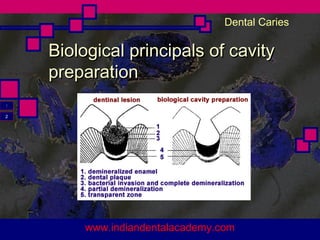
    Biological principals of cavity
    preparation
1      Cavity cleaning
2            Obtaining access
             Removal of dead dentine and enamel
       Anatomy determines the shape
       No preconceived cavity design
       Black's principles are redundant


           www.indiandentalacademy.com
Dental Caries

    Biological principals of cavity
    preparation
1

2


        www.indiandentalacademy.com
Dental Caries


    Appropriate instrumentation
       Mechanical retention is no longer
1
        needed with adhesive materials.
2

3

4

5
       Shape of the cavity is determined by the
6
        anatomy of the lesion.
7

8
Dental Caries


    Appropriate instrumentation
        Question:
1

2

3       Is a rotary instrument the best tool
4

5
           when the cavity is determined by
6            the anatomy of the lesion ?
7

8


            www.indiandentalacademy.com
Dental Caries


    Appropriate instrumentation

1
       NO !!!!     A rotary instrument is not
2
        the best instrument for:
3

4

5
           removing only soft, completely
6
            demineralized tooth tissue and
7

8          preserving as much as possible
            remineralizable enamel and dentine.
Dental Caries


    Appropriate instrumentation
       Hand instrument:
1
         Dental       hatchet
2

3

4

5

6

7

8


         (e.g., 10 – 6 - 12)


              www.indiandentalacademy.com
Dental Caries


    Appropriate instrumentation
       Hand instrument:
1
         Excavator
2

3

4

5

6

7

8


             (e.g., 153 – 154)
Dental Caries


    Appropriate instrumentation
       Rotary instruments (only certain circumstances)
1

2

3        Slow   speed drill
4            with straight bur for further opening of dentinal lesions
5
              that have a very small entrance
6
             with round bur for gentle removal of dead tissue.
7

8


             www.indiandentalacademy.com
Dental Caries


    Appropriate instrumentation
       Rotary instruments (only certain circumstances)
1

2

3
         High   speed drill
4
             onlyfor opening cavities that are inaccessible
5

6
             removal of failed restorations.

7

8
Dental Caries


    Appropriate instrumentation
       Why hand instruments?
1
         creates   the most ideal (conservative) cavity
2

3         shape
4        gives the operator improved tactile sense
5

6
         does not damage surfaces adjacent to the
7         lesion, in the case of approximal lesions and
8
         therefore, does not promote caries
          development.


            www.indiandentalacademy.com
Dental Caries


Cavity restoration:           WHY

   To stop the caries process
   To facilitate plaque removal
   To encourage remineralization of inner
    carious dentine
   To restore function
   To restore aesthetics.
Dental Caries


Cavity restoration:                  HOW

   Application of a material that:
     produces    a seal against bacterial invasion
     encourages remineralization
     is sufficiently durable
     maintains function.


        www.indiandentalacademy.com
Dental Caries

Cavity restoration:
           WHICH MATERIAL

   Adhesive restorative materials
     composite resins and polyacid-modified
      composite resins (‘compomers’)
     glass-ionomers and resin-modified glass-
      ionomers.
   Non-adhesive restorative materials
     amalgam
Dental Caries

     Tooth preservation versus
     cavity preparation
1

2

3

4        Preservation =
    restoration + prevention

         www.indiandentalacademy.com
Dental Caries

        Tooth preservation versus
        cavity preparation
1

2

3

4


    Sealant
      restorations
Dental Caries

    Tooth preservation versus
    cavity preparation
1

2      For carious lesions in occlusal,
3
        buccal and lingual surfaces of
4
        posterior teeth:
           Preventive resin restoration
           Preventive glass-ionomer restoration
           Atraumatic Restorative Treatment (ART )


            www.indiandentalacademy.com
Dental Caries

    Tooth preservation versus
    cavity preparation
1

2      For carious lesions in approximal
3
        surfaces of posterior teeth:
4
           Box-type restorations (outcome: good).
           Tunnel preparation (outcome: dubious).
           ART (outcome: unknown yet).
Dental Caries

Effect of sealed versus non-
sealed restorations
   Clinical trial in the USA.
     more   sound tooth structure was conserved
     restoration margins were better protected
     recurrent caries was less frequent
     clinical survival of restorations was
      prolonged.


        www.indiandentalacademy.com
Dental Caries


    Summary

1      The biological principle to the management of a
2

3
        dentine lesion is to only remove soft, completely
4
        demineralized tooth tissue. This is best achieved
        through using hand instruments and/or a slowly
        rotating drill rather than a high-speed drill. In doing
        so, less sound tooth tissues are removed and
        damage to surfaces of other teeth is minimized.
Dental Caries


    Summary

1
       Since only soft, completely
2       demineralized tissue is removed, there
3
        can be no preconceived cavity design;
4
        the anatomy of the carious lesion
        dictates the size and shape of the cavity
        preparation.


           www.indiandentalacademy.com
Dental Caries


    Summary
       The treatment is completed by placing an
1

2
        adhesive filling material into the cleaned cavity
3
        preparation, over its margin, and over the
4       adjacent pits and fissures. This sealant
        restoration will arrest caries activity that is
        present in dentine and enamel, provided that
        the bonding of the material to these tooth
        tissues is adequately established.


            www.indiandentalacademy.com
Dental Caries


    Summary

1
       This treatment modality has the potential
2       to:
3          control dentine caries
4
           increase survival of the restoration
           save tooth tissues and thus
           increase tooth life expectancy.
Dental Caries


   Remember:
     TO APPLY PREVENTIVE MEASURES


     TO ENCOURAGE ORAL HYGIENE AND


     TO PROMOTE THE USE OF   FLUORIDE
     TOOTHPASTE.
Dental Caries


Thank you for watching,
For more details please visit
 www.indiandentalacademy.com

Dental caries progression /certified fixed orthodontic courses by Indian dental academy

  • 1.
    DENTINE CARIES ITS PROGRESSIONAND HOW BEST TO STOP IT INDIAN DENTAL ACADEMY Leader in Continuing Dental Education www.indiandentalacademy.com
  • 2.
    Dental Caries Sugar andplaque, the arch criminals of dental caries
  • 3.
    Dental Caries Demineralization, remineralization Sugar + Dental Plaque ACID S Demineralization Cavities
  • 4.
    Dental Caries Demineralization, remineralization Subsurface demineralization of enamel www.indiandentalacademy.com
  • 5.
    Dental Caries Demineralization, remineralization Occlusal lesions can be arrested by remineralization
  • 6.
    Dental Caries Demineralization, remineralization recently cleaned front teeth with signs of demineralization and gingivitis after some weeks remineralization has taken place and the gingivitis is healed www.indiandentalacademy.com
  • 7.
    Dental Caries Demineralization, remineralization No sugar before sleeping www.indiandentalacademy.com
  • 8.
    Dental Caries The CariesBalance Resistance  Plaque removal  Sugar reduction  Fluoride  Sealants  Chlorhexidine www.indiandentalacademy.com
  • 9.
    Dental Caries Structure ofdentine  Living tissue  Peritubular dentine  Intertubular dentine  Apatite crystals  Intermolecular cross-linking www.indiandentalacademy.com
  • 10.
  • 11.
    Dental Caries Progression of dentine caries Bacterial Invasion 1 2 3 4 5 6 7 8 www.indiandentalacademy.com
  • 12.
    Dental Caries Progression of dentine caries  Bacterial Invasion 1 2 3  Bacteria need to have a source of nutrients, 4 i.e. from the oral environment. 5 6 7  Bacteria are found mostly in the biomass 8 with few being found in the dentine tubules. www.indiandentalacademy.com
  • 13.
    Dental Caries Progression of dentine caries Crystal Removal Process 1 2 3 4 5 6 7 8
  • 14.
    Dental Caries Progression of dentine caries Crystal Removal Process 1  Acid from fermentation process penetrates 2 the dentine tubules ahead of bacterial 3 4 invasion. 5  This softens the dentine matrix. 6 7  The collagen fibres are reversibly damaged 8 in the dissolution process. cont’d www.indiandentalacademy.com
  • 15.
    Dental Caries Progression of dentine caries Crystal Removal Process (cont’d) 1  Continuation of acid production dissolves 2 crystals in the peritubular and intertubular 3 4 dentine. 5  Further continuation of acid production 6 breaks the intermolecular crosslinks of 7 collagen fibres irreversibly. 8
  • 16.
    Dental Caries Progression of dentine caries Defense reaction in dentine 1 2 3 4 5 6 7 8
  • 17.
    Dental Caries Progression of dentine caries  Defense reaction in dentine 1 A defence reaction takes place in the 2 dentine. 3 4  Dissolution alters the hydroxyapatite crystals. 5  Crystals with a lower hardness and a lower 6 7 calcium density (= whitelockite) remain. 8  The dentine tubules are blocked by precipitated intratubular whitelockite crystals. cont’d
  • 18.
    Dental Caries Progression of dentine caries Defense reaction in dentine (cont’d) 1  These crystals originate from the 2 peritubular and intertubular dentine. 3 4  This process is known as TUBULAR 5 SCLEROSIS. 6  It is seen clinically as yellow-brownish 7 8 discoloration of the dentine. www.indiandentalacademy.com
  • 19.
    70 Outer Carious Dentine Inner Carious Dentine Dental Caries - bacterial invasion - minimal bacterial invasion 60 - unremineralizable - remineralizable Knoop Hardness Number - dead - alive - without sensation - sensitive 50 40 30 transparant zone 20 10 zone of almost total zone of partial demineralization Sound Dentine demineralization E-D Junction 1000 2000 3000 µm Crystals in Tubule Lumen Peritubular dentine Intertubular dentine Bacteria Odontoblast Process
  • 20.
    Dental Caries Two layersof carious dentine Outer (‘infected’) Inner (‘affected’)  BacterialInvasion  Few Bacterial  Unreminerizable  Reminerizable  Dead  Alive  Without sensation  Sensitive www.indiandentalacademy.com
  • 21.
    Dental Caries Remineralization ofinner carious dentine Prerequisites physiological remineralization:  Presence collagen fibers  Living odontoblastic process External remineralization:  Saliva , calcium and phosphate  Exposure bio-active agents
  • 22.
    Dental Caries Characteristics of occlusal caries Fissure enamel caries 1 2 3 4
  • 23.
    Dental Caries Characteristics of occlusal caries Fissure enamel and 1 dentine caries 2 3 4
  • 24.
    Dental Caries Characteristics of occlusal caries Fissure cavity 1 2 3 4 3.6 mm
  • 25.
    Dental Caries Characteristics of occlusal caries Lateral spread of fissure 1 cavity 2 3 4 3.6 mm
  • 26.
    Dental Caries Dentinal lesion formation and progression: a summary 1  Enamel demineralization follows the enamel rods. 2  Initial dentine demineralization does not spread along the Enamel Dentine Junction (EDJ) beyond the periphery of the lesion in the enamel.  This leads to a cone shape lesion with the base at the EDJ. www.indiandentalacademy.com
  • 27.
    Dental Caries Dentinal lesion formation and progression: a summary 1  In any pit and fissure system there can be multiple lesions in different stages of 2 progression. (Stages A, B and C.)  Only when there is frank cavitation and a cariogenic environment, will dentine demineralization spread in a lateral direction. (Stage D)
  • 28.
    Dental Caries Characteristics of approximal caries 1. Subsurface demineralization of enamel. 1 2 3 4 www.indiandentalacademy.com
  • 29.
    Dental Caries Characteristics of approximal caries 2. Partial demineralization of dentine directly 1 underneath enamel lesion 2 3 4
  • 30.
    Dental Caries Characteristics of approximal caries 3. The dentine demineralization follows the 1 dentine tubules 2 3 4
  • 31.
    Dental Caries Characteristics of approximal caries 4. Lateral spread of dentine caries occurs 1 mainly in cavitated lesions 2 3 4
  • 32.
    Dental Caries Characteristics ofapproximal caries : a summary  Progression of approximal caries follows the same principles as for occlusal caries.  It follows the enamel rods, but because of the curved shape of the approximal tooth surface, the lesion does not lead to a cone shape at the EDJ as present in an occlusal fossa. www.indiandentalacademy.co
  • 33.
    Dental Caries Traditional concepts of cavity design 1 2  GV Black’s cavity preparations followed 3 designs that were largely dictated by the 4 physical properties of the filling materials (e.g., amalgam and silicate cement).  These materials needed mechanical retention
  • 34.
    Dental Caries Traditional concepts of cavity design 1 2 Mechanical retention 3  Flatfloors 4  Vertical walls  Triangular retention niches  Undercut areas
  • 35.
    Dental Caries Traditional concepts of cavity design 1  Shape of the prepared cavity was not limited to 2 the tooth destruction caused by caries. 3 4  The preparation did not follow the way a dentine lesion progresses.  Black's principles could be considered as: 'the application of a mechanical design on a biological process' www.indiandentalacademy.com
  • 36.
    Dental Caries Traditional concepts of cavity design ‘The application of a mechanical design on a biological process' 1 2 3 4
  • 37.
    Dental Caries Longevity ofamalgam restorations  Research findings  survival time single surface: 10 – 8 years  survival time multiple surface: 8 - 6 years  Reasons for failures  secondarycaries  marginal breakdown www.indiandentalacademy.com
  • 38.
    Dental Caries Repeat restoration cycle 1 2 Repeat restoration cycle 3  Occlusal lesion and occlusal restoration  2-Surface restoration  Extended restoration  Crown or Extraction
  • 39.
    Dental Caries Repeat restoration cycle  ‘Diagnoses’ are uncertain, with 1 considerable variation occurring between dentists. 2 3  Extensive cavity preparations (Black) in the name of outline form and extension for prevention result in restorations with weak margins, leading to marginal breakdown and ‘ditching’. www.indiandentalacademy.com
  • 40.
    Dental Caries Repeat restoration cycle  Dentists have an urge to replace restorations 1 2  Perceived (but erroneous) requirement to 3 ‘freshen up’ the cavity walls and margins.  The teeth inevitably become weaker, thereby reducing their prognosis.  The complexity of the restorations increases or  Tooth needs to be extracted.
  • 41.
    Dental Caries Traditional approach: a Summary 1 2  Much sound tooth tissue needs to be removed.  Traditionally placed restorations, on average, do not last long.  The replacement restorations, in many cases, last for less time. www.indiandentalacademy.com
  • 42.
    Dental Caries Traditional approach: a Summary  The end result is a tooth that became 1 weaker and weaker each time a replacement was made. 2  The weaker the tooth becomes, the more likely the restoration will fail, resulting in a vicious cycle and termed the ‘repeat restoration cycle’.
  • 43.
    Dental Caries Biological principals of cavity preparation 1  Cavity cleaning 2  Obtaining access  Removal of dead dentine and enamel  Anatomy determines the shape  No preconceived cavity design  Black's principles are redundant www.indiandentalacademy.com
  • 44.
    Dental Caries Biological principals of cavity preparation 1 2 www.indiandentalacademy.com
  • 45.
    Dental Caries Appropriate instrumentation  Mechanical retention is no longer 1 needed with adhesive materials. 2 3 4 5  Shape of the cavity is determined by the 6 anatomy of the lesion. 7 8
  • 46.
    Dental Caries Appropriate instrumentation  Question: 1 2 3 Is a rotary instrument the best tool 4 5 when the cavity is determined by 6 the anatomy of the lesion ? 7 8 www.indiandentalacademy.com
  • 47.
    Dental Caries Appropriate instrumentation 1  NO !!!! A rotary instrument is not 2 the best instrument for: 3 4 5  removing only soft, completely 6 demineralized tooth tissue and 7 8  preserving as much as possible remineralizable enamel and dentine.
  • 48.
    Dental Caries Appropriate instrumentation  Hand instrument: 1  Dental hatchet 2 3 4 5 6 7 8 (e.g., 10 – 6 - 12) www.indiandentalacademy.com
  • 49.
    Dental Caries Appropriate instrumentation  Hand instrument: 1  Excavator 2 3 4 5 6 7 8 (e.g., 153 – 154)
  • 50.
    Dental Caries Appropriate instrumentation  Rotary instruments (only certain circumstances) 1 2 3  Slow speed drill 4  with straight bur for further opening of dentinal lesions 5 that have a very small entrance 6  with round bur for gentle removal of dead tissue. 7 8 www.indiandentalacademy.com
  • 51.
    Dental Caries Appropriate instrumentation  Rotary instruments (only certain circumstances) 1 2 3  High speed drill 4  onlyfor opening cavities that are inaccessible 5 6  removal of failed restorations. 7 8
  • 52.
    Dental Caries Appropriate instrumentation  Why hand instruments? 1  creates the most ideal (conservative) cavity 2 3 shape 4  gives the operator improved tactile sense 5 6  does not damage surfaces adjacent to the 7 lesion, in the case of approximal lesions and 8  therefore, does not promote caries development. www.indiandentalacademy.com
  • 53.
    Dental Caries Cavity restoration: WHY  To stop the caries process  To facilitate plaque removal  To encourage remineralization of inner carious dentine  To restore function  To restore aesthetics.
  • 54.
    Dental Caries Cavity restoration: HOW  Application of a material that:  produces a seal against bacterial invasion  encourages remineralization  is sufficiently durable  maintains function. www.indiandentalacademy.com
  • 55.
    Dental Caries Cavity restoration: WHICH MATERIAL  Adhesive restorative materials  composite resins and polyacid-modified composite resins (‘compomers’)  glass-ionomers and resin-modified glass- ionomers.  Non-adhesive restorative materials  amalgam
  • 56.
    Dental Caries Tooth preservation versus cavity preparation 1 2 3 4 Preservation = restoration + prevention www.indiandentalacademy.com
  • 57.
    Dental Caries Tooth preservation versus cavity preparation 1 2 3 4 Sealant restorations
  • 58.
    Dental Caries Tooth preservation versus cavity preparation 1 2  For carious lesions in occlusal, 3 buccal and lingual surfaces of 4 posterior teeth:  Preventive resin restoration  Preventive glass-ionomer restoration  Atraumatic Restorative Treatment (ART ) www.indiandentalacademy.com
  • 59.
    Dental Caries Tooth preservation versus cavity preparation 1 2  For carious lesions in approximal 3 surfaces of posterior teeth: 4  Box-type restorations (outcome: good).  Tunnel preparation (outcome: dubious).  ART (outcome: unknown yet).
  • 60.
    Dental Caries Effect ofsealed versus non- sealed restorations  Clinical trial in the USA.  more sound tooth structure was conserved  restoration margins were better protected  recurrent caries was less frequent  clinical survival of restorations was prolonged. www.indiandentalacademy.com
  • 61.
    Dental Caries Summary 1  The biological principle to the management of a 2 3 dentine lesion is to only remove soft, completely 4 demineralized tooth tissue. This is best achieved through using hand instruments and/or a slowly rotating drill rather than a high-speed drill. In doing so, less sound tooth tissues are removed and damage to surfaces of other teeth is minimized.
  • 62.
    Dental Caries Summary 1  Since only soft, completely 2 demineralized tissue is removed, there 3 can be no preconceived cavity design; 4 the anatomy of the carious lesion dictates the size and shape of the cavity preparation. www.indiandentalacademy.com
  • 63.
    Dental Caries Summary  The treatment is completed by placing an 1 2 adhesive filling material into the cleaned cavity 3 preparation, over its margin, and over the 4 adjacent pits and fissures. This sealant restoration will arrest caries activity that is present in dentine and enamel, provided that the bonding of the material to these tooth tissues is adequately established. www.indiandentalacademy.com
  • 64.
    Dental Caries Summary 1  This treatment modality has the potential 2 to: 3  control dentine caries 4  increase survival of the restoration  save tooth tissues and thus  increase tooth life expectancy.
  • 65.
    Dental Caries  Remember:  TO APPLY PREVENTIVE MEASURES  TO ENCOURAGE ORAL HYGIENE AND  TO PROMOTE THE USE OF FLUORIDE TOOTHPASTE.
  • 66.
    Dental Caries Thank youfor watching, For more details please visit www.indiandentalacademy.com