Salivary Gland Diseases Dr shabeel pn
Salivary Gland Diseases Functional disorders Obstructive disorders Non-neoplastic disorders Neoplastic disorders
Functional Disorders Sialorrhea (Increase in saliva flow) Psychosis, mental retardation, certain nuerologicval diseases, rabies,  mercery poisoning Xerostomia (Decrease in saliva flow) Mumps, sardoidosis, Sjogrens, syndrome, lupus, post-irradiation
Funtional Disorders Mucocele Secondary to trauma 70% occur in lower lip Excisional biopsy usually curative Ranula Sublingual salivary gland mucocele Treatment should include removal of sublingual gland
Obstructive Disorders Sialolithiasis 92% occur in submandibular gland 6% in parotid gland Multiple occurrence in same gland is common
Submandibular Gland Lithiasis Diagnosis Pain and sudden enlargement of gland while eating Palpation of stone submandibular duct Occlusal radiograph (80%)
Submandibular Gland Lithiasis Treatment Can be removed transorally if in duct and easily palpable If in gland and gland is damaged, then gland should be removed
Parotid Lithiasis Diagnosis Based on history Swelling during meals Bimanual palpation of painful gland 40% non-radiopaque Most  parotid stones are multiple
Partiod Lithiasis Treatment Stones in extraglandular portion of duct can be removed transorally Intraglandular stones removed  from extraoral approach
Non-Neoplastic Disorders
Acute Sialadentis Etiology Viral - ( Mumps) Bacterial
Acute Sialadentis Bacterial - swelling and dehydration, xerostomia, failure of secretion with ascending infection (Staph aureus, Strep pyogenes, most common infective organism) Painful swelling parotid gland, overlying skin red, shiny & tense, pus from parotid duct
Acute Sialadentis Treatment Culture pus  Appropriate  antibiotic Supportive therapy Fluids Heat Salivary stimulants
Chronic Sialadenitis Chronic recurrent parotitis Age 3-6 Caused by Strep viridans May spontaneously heal during  puberty
Necrotizing Sialometaplasis Benign inflammatory condition Usually involves in minor salivary gland of hard palate Will often simulate a malignant condition No definite etiology 1-3 cm  ulcer heals spontaneously
Neoplastic Disorders
Salivary Gland Tumors Adenomas (Epithelial) Pleomorphic adenoma Monomorphic adenoma Adenolymphoma Oxyphil adenoma Other types
Salivary Gland Tumors Mucoepidermoid tumor Acinic cell tumor
Salivary Gland Tumors Carcinomas Adenoid cystic carcinoma Adenocarcinoma Epidermoid carcinoma Undifferentiated carcinoma Carcinoma in pleomorphic adenoma
Non-epithelial Malignant lymphoma Unclassified tumors
Salivary Gland Tumors Allied conditions Benign lymphoepithelial lesions Sialosis Oncocytosis
Salivary Gland Tumors 80 % occur in parotid gland 5-10 % occur in the submandubular gland 1 % occur in sublingual gland 10-15% occur in the minor salivary glands
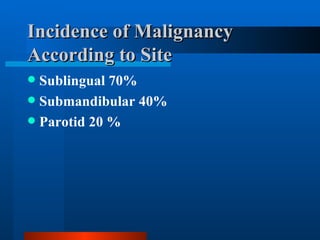
Incidence of Malignancy According to Site Sublingual 70% Submandibular 40% Parotid 20 %
Clinical Classification Benign (seldom recurrent) Adenolymphoma (Wharthins Tumor) Oxyphil adenoma (Oncocytoma) Other types of Monomorphic adenoma
Clinical Classification Benign (often recurrent) Pleomorphic adenoma (mixed tumor) Mucoepidermoid tumor ( low-grade) Acinic cell tumor (same)
Clinical Classification Malignant Carcinoma in pleomorphic adenoma Adenoid cyctic carcinoma Adinic cell tumor Mucoepidermoid tumor (high-grade)
Clinical Classification Malignant Squamous carcinoma Adenocarcinoma, other types Undifferentiated carcinoma
Sinus Disease
Sinusitis Acute Chronic
Acute Sinusitis Deep-seated ache which rapidly increases in intensity over evolved sinus May cause pain in upper molar teeth Pain is generally accompanied by increase in temperature Radiographic evidence of “air fluid level”
Acute Sinusits Treatment (early in course) Humidification Antibotics Systemic decongestants and nasal spray Refractory cases Surgical intervention
Chronic Sinusitis Recurrent bouts of sinus infection Low-grade in nature  Multiple causes Viral, bacterial, fungal, allergic, anatomic Radiographis findings of thickening of mucosa, polys
Chronic Sinusitis Treatment During acute phase- same as acute sinusitis If physical obstruction of ostic, septoplasty or Caldwell-Luc with nasal antrostomy
Chronic Sinusitis If allergy related: Avoidance of precipitating allergens Short course of topical    Decongestants Allergy testing and desensitization  therapy
Complications of Sinusitis Orbital cellulitis Can result in blindness secondary to ischemia of the retina or retinal   detachment Cavernous sinus thrombosis Can result in blindness Deficits of the central nervous system and death

salivary gland diseases

  • 1.
  • 2.
    Salivary Gland DiseasesFunctional disorders Obstructive disorders Non-neoplastic disorders Neoplastic disorders
  • 3.
    Functional Disorders Sialorrhea(Increase in saliva flow) Psychosis, mental retardation, certain nuerologicval diseases, rabies, mercery poisoning Xerostomia (Decrease in saliva flow) Mumps, sardoidosis, Sjogrens, syndrome, lupus, post-irradiation
  • 4.
    Funtional Disorders MucoceleSecondary to trauma 70% occur in lower lip Excisional biopsy usually curative Ranula Sublingual salivary gland mucocele Treatment should include removal of sublingual gland
  • 5.
    Obstructive Disorders Sialolithiasis92% occur in submandibular gland 6% in parotid gland Multiple occurrence in same gland is common
  • 6.
    Submandibular Gland LithiasisDiagnosis Pain and sudden enlargement of gland while eating Palpation of stone submandibular duct Occlusal radiograph (80%)
  • 7.
    Submandibular Gland LithiasisTreatment Can be removed transorally if in duct and easily palpable If in gland and gland is damaged, then gland should be removed
  • 8.
    Parotid Lithiasis DiagnosisBased on history Swelling during meals Bimanual palpation of painful gland 40% non-radiopaque Most parotid stones are multiple
  • 9.
    Partiod Lithiasis TreatmentStones in extraglandular portion of duct can be removed transorally Intraglandular stones removed from extraoral approach
  • 10.
  • 11.
    Acute Sialadentis EtiologyViral - ( Mumps) Bacterial
  • 12.
    Acute Sialadentis Bacterial- swelling and dehydration, xerostomia, failure of secretion with ascending infection (Staph aureus, Strep pyogenes, most common infective organism) Painful swelling parotid gland, overlying skin red, shiny & tense, pus from parotid duct
  • 13.
    Acute Sialadentis TreatmentCulture pus Appropriate antibiotic Supportive therapy Fluids Heat Salivary stimulants
  • 14.
    Chronic Sialadenitis Chronicrecurrent parotitis Age 3-6 Caused by Strep viridans May spontaneously heal during puberty
  • 15.
    Necrotizing Sialometaplasis Benigninflammatory condition Usually involves in minor salivary gland of hard palate Will often simulate a malignant condition No definite etiology 1-3 cm ulcer heals spontaneously
  • 16.
  • 17.
    Salivary Gland TumorsAdenomas (Epithelial) Pleomorphic adenoma Monomorphic adenoma Adenolymphoma Oxyphil adenoma Other types
  • 18.
    Salivary Gland TumorsMucoepidermoid tumor Acinic cell tumor
  • 19.
    Salivary Gland TumorsCarcinomas Adenoid cystic carcinoma Adenocarcinoma Epidermoid carcinoma Undifferentiated carcinoma Carcinoma in pleomorphic adenoma
  • 20.
  • 21.
    Salivary Gland TumorsAllied conditions Benign lymphoepithelial lesions Sialosis Oncocytosis
  • 22.
    Salivary Gland Tumors80 % occur in parotid gland 5-10 % occur in the submandubular gland 1 % occur in sublingual gland 10-15% occur in the minor salivary glands
  • 23.
    Incidence of MalignancyAccording to Site Sublingual 70% Submandibular 40% Parotid 20 %
  • 24.
    Clinical Classification Benign(seldom recurrent) Adenolymphoma (Wharthins Tumor) Oxyphil adenoma (Oncocytoma) Other types of Monomorphic adenoma
  • 25.
    Clinical Classification Benign(often recurrent) Pleomorphic adenoma (mixed tumor) Mucoepidermoid tumor ( low-grade) Acinic cell tumor (same)
  • 26.
    Clinical Classification MalignantCarcinoma in pleomorphic adenoma Adenoid cyctic carcinoma Adinic cell tumor Mucoepidermoid tumor (high-grade)
  • 27.
    Clinical Classification MalignantSquamous carcinoma Adenocarcinoma, other types Undifferentiated carcinoma
  • 28.
  • 29.
  • 30.
    Acute Sinusitis Deep-seatedache which rapidly increases in intensity over evolved sinus May cause pain in upper molar teeth Pain is generally accompanied by increase in temperature Radiographic evidence of “air fluid level”
  • 31.
    Acute Sinusits Treatment(early in course) Humidification Antibotics Systemic decongestants and nasal spray Refractory cases Surgical intervention
  • 32.
    Chronic Sinusitis Recurrentbouts of sinus infection Low-grade in nature Multiple causes Viral, bacterial, fungal, allergic, anatomic Radiographis findings of thickening of mucosa, polys
  • 33.
    Chronic Sinusitis TreatmentDuring acute phase- same as acute sinusitis If physical obstruction of ostic, septoplasty or Caldwell-Luc with nasal antrostomy
  • 34.
    Chronic Sinusitis Ifallergy related: Avoidance of precipitating allergens Short course of topical Decongestants Allergy testing and desensitization therapy
  • 35.
    Complications of SinusitisOrbital cellulitis Can result in blindness secondary to ischemia of the retina or retinal detachment Cavernous sinus thrombosis Can result in blindness Deficits of the central nervous system and death