Dental Instruments


      Presented by : Samar A. Fadel.
Dental Insturments
                           What are they?

                             Definition:
Hand instruments are those instruments that are used manually without a
                            power source .
Hand Instrument Design:

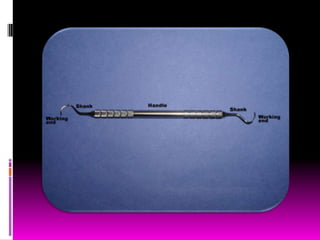
 Handle
    Portion of the instrument where the operator grasps.
 Shank
    Part of the instrument that attaches the working end to
    the handle.
 Working end
   Portion of the instrument with a specific function.
Identifying Hand Instruments:

 Referred to by:
    Name
    Assigned number
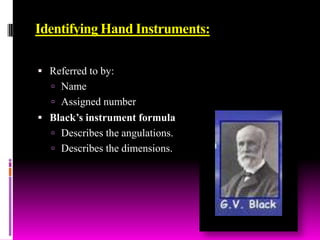
 Black’s instrument formula
    Describes the angulations.
    Describes the dimensions.
History:

The early hand-operated instruments characterized by:
Large, heavy handles and inferior metal alloys in the blades.
They were difficult to use, ineffective in many situations
  because there was no uniformity of manufacture or
  nomenclature.
Many dentists made their own hand instruments for different
  needs.
The experience was something like this:
Classification

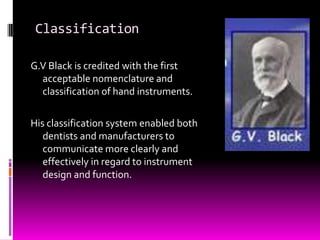
G.V Black is credited with the first
  acceptable nomenclature and
  classification of hand instruments.

His classification system enabled both
   dentists and manufacturers to
   communicate more clearly and
   effectively in regard to instrument
   design and function.
Dr. G. V. Black classified instruments according to :


ORDER names: Denote the purpose for which the instrument is to be used.
Such as Mallet or clamps.

SUBORDER names: Define the manner or position of use of the instrument, such as
hand mallet or molar clamps.

CLASS names: Describes the working point of the instrument , such as spoon
excavator or inverted cone bur.

SUBCLASS names: Indicates the angle of the shank, such as bin-angel.
What do you think these numbers mean?!
                     15-95-8-12R
Dr. Black also evolved the instrument formula by which
instruments could be readily duplicated anywhere.
-The number of a gingival margin trimmer is given as 15-95-8-
12R: The first two digits (15) designate the width of the blade in
tenths of millimeter, the third and fourth(95) its length in
millimeters.
-The fifth digit(8) represents the angle which the blade forms with
axis of the handle expressed in hundredths of a circle(100
gradations or centigrade's).
-The sixth and seventh digits represent the angle made by the
cutting edge with the axis of the hand( in instruments in which the
cutting edge is at angle to the length of the blade).
-The handle letter (R or L) signifies that the instrument is one of a
pair made in “rights” and “lefts” in order to work more efficiently.
Hand
                                                        Instrume
                                                           nts


                       Cutting                                                                   Non-
                                                                                                cutting
                      Instrume                                                                Instrumen
                         nts                                                                       ts


                                                                       Explorers                       Amalgam
Excavato                                                                Perio.          Mirrors        condenser      Others
   rs                  Chisels                Others                                                       s
                                                                        probs


                                                                                                                        Gingival
                                                                                                   Bin-     Enamel
                                                                   Straight        Curved                               margin
                                    Spoon                                                         Angled    Hatchet
           Ordinary       Angle                                                                                        trimmers
 Hoes                              excavato            Knives
           Hatches       formers
                                      rs


                                                       scalers


                                                       carvers
 Hatchets:
 -the blade and cutting edge are on a plane with the long
  axis of the handle, the shank has two angles
 -Used for cutting enamel, and to smooth the walls and
  floors of the tooth preparation.
 -used in Class II preparations, especially for finishing the
  enamel margins and removing unsupported enamel.
 Gingival margin trimmer:
    Used to cut enamel and place bevels along the gingival
     enamel margins of the preparation.
 used for rounding or beveling of the axiopulpal line angle
  of two-surface preparations.
 Hoe:
  Used to plane the walls and floors of the tooth
   preparation.
  Similar than chisel but the blade is angled more than
   12.5 centigrades
   - Used to remove unsupported enamel
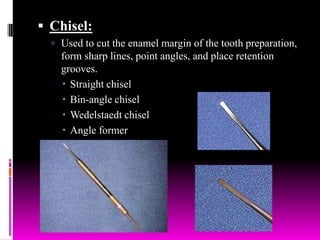
 Chisel:
   Used to cut the enamel margin of the tooth preparation,
    form sharp lines, point angles, and place retention
    grooves.
     Straight chisel
     Bin-angle chisel
     Wedelstaedt chisel
     Angle former
Please don’t be thise kind of Dentists :P
Guys, never forget this
Thank you ….

Dental Hand Instruments

  • 1.
    Dental Instruments Presented by : Samar A. Fadel.
  • 2.
    Dental Insturments What are they? Definition: Hand instruments are those instruments that are used manually without a power source .
  • 3.
    Hand Instrument Design: Handle  Portion of the instrument where the operator grasps.  Shank  Part of the instrument that attaches the working end to the handle.  Working end  Portion of the instrument with a specific function.
  • 5.
    Identifying Hand Instruments: Referred to by:  Name  Assigned number  Black’s instrument formula  Describes the angulations.  Describes the dimensions.
  • 6.
    History: The early hand-operatedinstruments characterized by: Large, heavy handles and inferior metal alloys in the blades. They were difficult to use, ineffective in many situations because there was no uniformity of manufacture or nomenclature. Many dentists made their own hand instruments for different needs.
  • 8.
    The experience wassomething like this:
  • 9.
    Classification G.V Black iscredited with the first acceptable nomenclature and classification of hand instruments. His classification system enabled both dentists and manufacturers to communicate more clearly and effectively in regard to instrument design and function.
  • 10.
    Dr. G. V.Black classified instruments according to : ORDER names: Denote the purpose for which the instrument is to be used. Such as Mallet or clamps. SUBORDER names: Define the manner or position of use of the instrument, such as hand mallet or molar clamps. CLASS names: Describes the working point of the instrument , such as spoon excavator or inverted cone bur. SUBCLASS names: Indicates the angle of the shank, such as bin-angel.
  • 11.
    What do youthink these numbers mean?! 15-95-8-12R Dr. Black also evolved the instrument formula by which instruments could be readily duplicated anywhere. -The number of a gingival margin trimmer is given as 15-95-8- 12R: The first two digits (15) designate the width of the blade in tenths of millimeter, the third and fourth(95) its length in millimeters. -The fifth digit(8) represents the angle which the blade forms with axis of the handle expressed in hundredths of a circle(100 gradations or centigrade's). -The sixth and seventh digits represent the angle made by the cutting edge with the axis of the hand( in instruments in which the cutting edge is at angle to the length of the blade). -The handle letter (R or L) signifies that the instrument is one of a pair made in “rights” and “lefts” in order to work more efficiently.
  • 12.
    Hand Instrume nts Cutting Non- cutting Instrume Instrumen nts ts Explorers Amalgam Excavato Perio. Mirrors condenser Others rs Chisels Others s probs Gingival Bin- Enamel Straight Curved margin Spoon Angled Hatchet Ordinary Angle trimmers Hoes excavato Knives Hatches formers rs scalers carvers
  • 13.
     Hatchets:  -theblade and cutting edge are on a plane with the long axis of the handle, the shank has two angles  -Used for cutting enamel, and to smooth the walls and floors of the tooth preparation.  -used in Class II preparations, especially for finishing the enamel margins and removing unsupported enamel.
  • 14.
     Gingival margintrimmer:  Used to cut enamel and place bevels along the gingival enamel margins of the preparation.  used for rounding or beveling of the axiopulpal line angle of two-surface preparations.
  • 15.
     Hoe: Used to plane the walls and floors of the tooth preparation.  Similar than chisel but the blade is angled more than 12.5 centigrades - Used to remove unsupported enamel
  • 16.
     Chisel:  Used to cut the enamel margin of the tooth preparation, form sharp lines, point angles, and place retention grooves.  Straight chisel  Bin-angle chisel  Wedelstaedt chisel  Angle former
  • 21.
    Please don’t bethise kind of Dentists :P
  • 22.
  • 23.