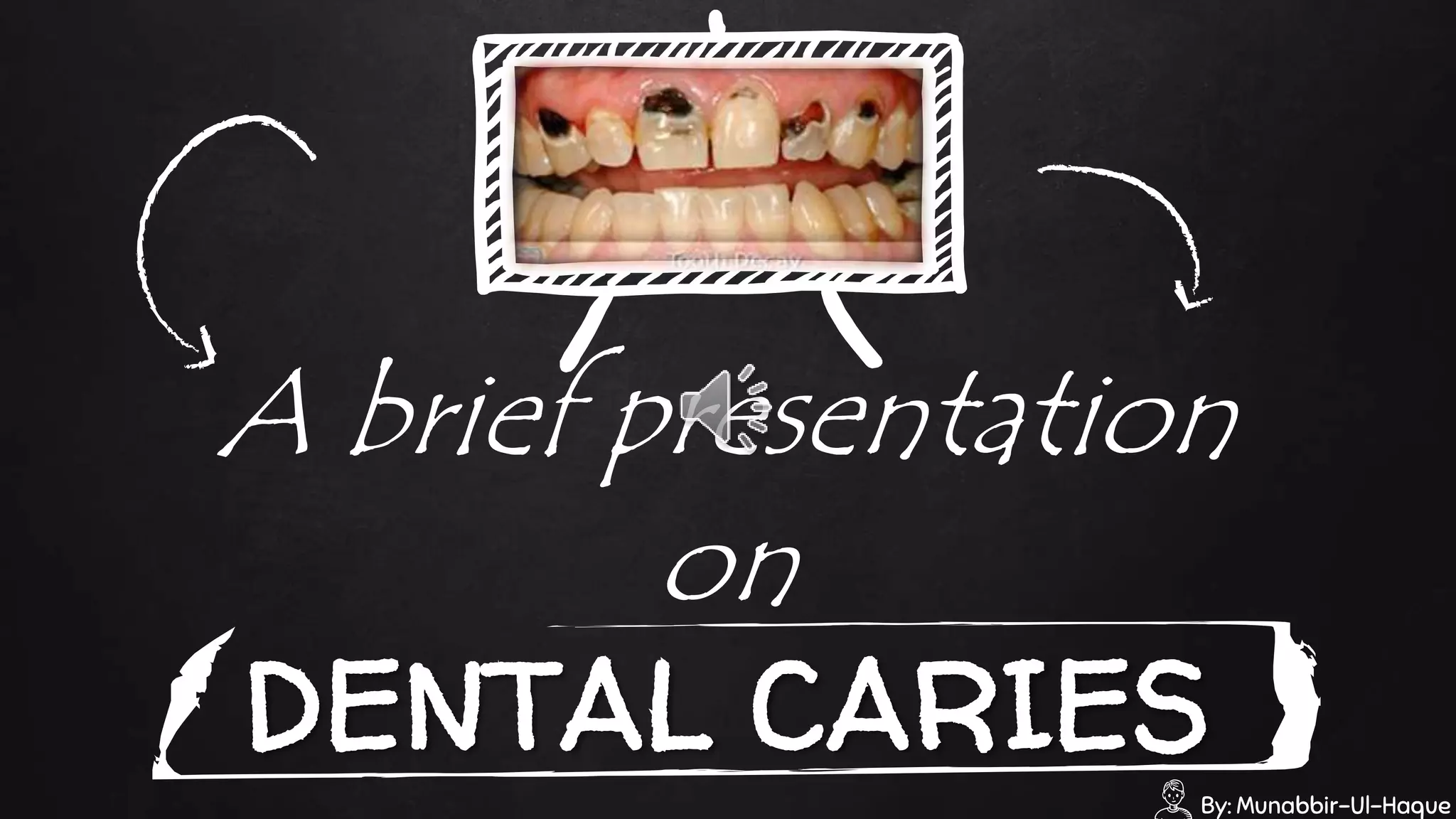


A brief presentation
on
DENTAL CARIES
By: Munabbir-Ul-Haque
Contents of this presentation:
1 > Definition 9 > Diagnosis
2 > Sign & Symptoms 10 > Classification
3 > Etiology/Causing factors 11 > Prevention
4 > Bacterial Plaque 12 > Treatment
5 > Susceptibility of teeth to caries 13 > Consequences
6 > Saliva and Dental Caries 14 > Complications
7 > Pathogenesis 15 > Overview at a glance
8 > Pathology 16 > Reference
1.
What is Dental Caries?
“Dental caries is an irreversible microbial disease of the
calcified tissues of the teeth, characterized by
demineralization of the inorganic portion and destruction
of the organic substance of the tooth , which often leads
to cavitation”
2.
Signs & Symptoms :
“As the decay gets larger, it may cause signs and symptoms such as:
 The earliest sign may be the appearance of a chalky white
spot on the surface of the tooth
 Toothache.
 Tooth sensitivity.
 Mild to sharp pain when eating or drinking something
sweet, hot or cold.
 Visible holes or pits on tooth surface.
 Brown, black or white staining on any surface of a tooth.
 Pain while biting down.
3.
Aetiology / Cuasing factors
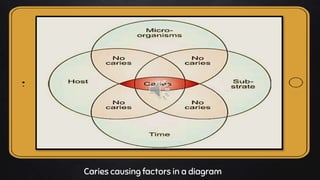
“In 1890, W. D. Miller showed that lesions similar to dental
caries could be produced by incubating teeth in saliva when
carbohydrates were added. Miller concluded that caries could
result from decalcification caused by bacterial acid production
followed by invasion and destruction of any remaining tissue.
However, dental caries develops only in the presence of several
interacting variables.
Essential requirements for development of dental caries :
1.
Cariogenic (acidogenic)
bacteria
[ These are viridans streptococci which are a heterogeneous
group including Streptococcus mutans, S. sobrinus, S. salivarius,
S. mitior and S. sanguis
and lactobacilli. ]
Essential requirements for development of dental caries :
2.
Bacterial plaque
[Dental plaque is a biofilm or mass of bacteria that grows on
stagnation areas of tooth surface , usually sticky & colorless
and gradually becoming harder & brownish resulting in tooth
decay. ]
Essential requirements for development of dental caries :
3.
Stagnation areas
[The location on the surface of a tooth where there is
a tendency for food debris to accumulate. ]
Essential requirements for development of dental caries :
4.
Fermentable bacterial
substrate (sugar)
e.g. disaccharide, polysaccharide etc.
Essential requirements for development of dental caries :
5.
Susceptible tooth surfaces
[ Some tooth surfaces are more susceptible or vulnerable to
form and develop plaque and caries, depending on enamel
structure & mineral+fluoride contents ]
Essential requirements for development of dental caries :
6.
Time
[ If time is provided to the causing bacteria by not treating
them, they spontaneously multiply and form plaque followed
by caries ]
Place your screenshot here
Caries causing factors in a diagram
Place your screenshot here
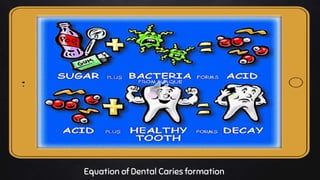
Equation of Dental Caries formation
4.
Bacterial Plaque :
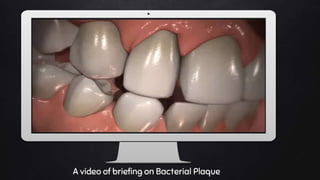
“Bacterial plaque or Dental plaque is a dense, nonmineralized
complex composed primarily of colonies of bacteria embedded in
a gelatinous matrix containing amino acids, carbohydrates,
proteins, lipids, and salts from saliva and gingival fluid; soluble food
substances; shed leukocytes and epithelial cells; and products of
bacterial metabolism. Plaque is the major causative factor in most
dental diseases, including dental caries and inflammatory
periodontal diseases.
Place your screenshot here
A video of briefing on Bacterial Plaque
5.
SUSCEPTIBILITY OF TEETH
TO CARIES
“Caries susceptible teeth means that the teeth are at risk of being affected by caries.
Everyone who has teeth is at risk of getting affected by caries, the following factors can
increase risks:
 Tooth location (decay most oftenly occurs in the back teeth i.e. molars and premolars,
due to having lots of grooves & fissures)
 Certain foods and drinks (sugary foods, beverage drinks, fast foods etc. )
 Frequent snacking or sipping (frequent intaking of snacks & drinks accelerate
bacterial growth)
 Bedtime infant feeding (bedtime feeding or eating provides growth media to the
bacteria whole night long)
“ Inadequate brushing (plaque forms quickly and the first stages of decay can begin if
teeth are not brushed right after eating meal)

 Not getting enough fluoride (Fluoride, a naturally occurring mineral, helps prevent
cavities and can even reverse the earliest stages of tooth damage)
 Younger or older age (dental caries are common in children and teenagers. Teeth of
elderly adults are also vulnerable to caries)
 Worn fillings or dental devices. (Over the years, dental fillings can weaken, begin to
break down or develop rough edges allowing plaque to build up more easily)
 Dry mouth (it is caused by a lack of saliva, which helps prevent tooth decay by
washing away food and plaque from teeth)
6.
Saliva and Dental Caries
“Saliva is the medium in which plaque develops and works.
Though saliva inevitably plays some part in the process of car-
ies, it is a complex secretion whose rate of flow, composition
and properties have effects on dental caries formation.
 Salivary flow is highly important in clearing cariogenic food particles from the oral
cavity and thus decreases caries risk.
 Dental caries may occur aggressively in humans with xerostomia (no or decreased
salivation)
 Buffering power of saliva with its rate of flow effects on maintaining pH not to decrease
preventing to be acidic.
“ In Down’s Syndrome, caries activity is low due to high salivation with high buffering
power.
 Salivary amylase breaks down polysaccharides and contributes their clearance from
the mouth.
 Saliva contains thiocyanates, lysozyme-like substances and other anti-bacterial
substances which prevent bacterial colonization.
 Salivary components contribute to plaque formation and form much of its matrix
 Sucrose dissolves in saliva and is actively taken up by plaque
 Gross reduction in salivary secretion leads to increased caries activity when a
cariogenic diet is eaten
Place your screenshot here
An animated overview of salivary flow in oral cavity
7.
Pathogenesis
Place your screenshot here
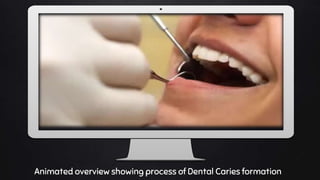
Animated overview showing process of Dental Caries formation
8.
Pathology
“The minerals in the hard tissues of the teeth (enamel, dentin and cementum) are
constantly undergoing processes of demineralization and remineralisation. Dental caries
results when the demineralization rate is faster than the remineralisation and there is
net mineral loss. This happens when there is an ecologic shift within the dental biofilm,
from a balanced population of micro-organisms to a population that produce acids and
can survive in an acid environment.
Carious pathology involves Enamel, Cementum, Dentin and ultimately affects dental pulp
resulting tooth decay.
Therefore, there are Pathology of *Enamel caries, *Dentin caries and *Cementum caries
“P a t h o l o g y o f E n a m e l C a r i e s
Enamel is affected by caries mostly and firstly. If the carious lesion occur in crown portion
of the tooth, then enamel is the primary lesion area.
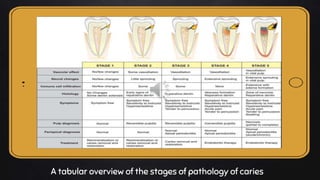
Stages of Enamel caries :
I. • The early (submicroscopic) lesion
II. • Phase of non-bacterial enamel crystal destruction
III. • Cavity formation
IV. • Bacterial invasion of enamel
V. • Undermining of enamel from below after spread into dentine
Place your screenshot here
A tabular overview of the stages of pathology of caries
“P a t h o l o g y o f D e n t i n C a r i e s
Unlike enamel, the dentin reacts to the progression of dental caries. Since
odontoblasts are present, a stimulus, such as caries, can trigger a biologic
response. These defense mechanisms include the formation of sclerotic and
tertiary dentin.
Streptococci play the major role in the attack on enamel, but lactobacilli may
be as important in dentine caries. As the lesion progresses, the bacterial
population becomes increasingly mixed and their relative contributions to
dentine destruction become more difficult to remove.
“Key events in the development of dentine caries :
I. • Non-bacterial, precavitation, acid softening of matrix
II. • Widening of tubules by demineralisation
III. • Migration of pioneer bacteria along tubules
IV. • Distortion of tubules by expanding masses of bacteria
V. • Breakdown of intervening matrix forming liquefaction foci
VI. • Progressive disintegration of remaining matrix tissue
Place your screenshot here
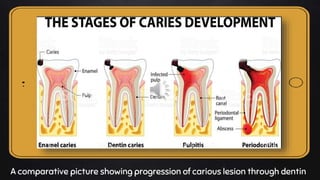
A comparative picture showing progression of carious lesion through dentin
Place your screenshot here
Another video overview showing development of dental caries
9.
Diagnosis
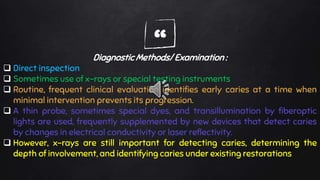
“Diagnostic Methods/ Examination :
 Direct inspection
 Sometimes use of x-rays or special testing instruments
 Routine, frequent clinical evaluation identifies early caries at a time when
minimal intervention prevents its progression.
 A thin probe, sometimes special dyes, and transillumination by fiberoptic
lights are used, frequently supplemented by new devices that detect caries
by changes in electrical conductivity or laser reflectivity.
 However, x-rays are still important for detecting caries, determining the
depth of involvement, and identifying caries under existing restorations
“The International Caries Detection and Assessment System (ICDAS) was developed in 2001 by an
international group of researchers. The system was proposed as a strategy to integrate the modern
detection systems into one standard system.
Criteria
0 Sound
1 First Visual Change in enamel
2 Distinct Visual Change in enamel
3 Localized enamel breakdown
4 Underlying dentine shadow
5 Distinct cavity with visible dentine
6 Extensive cavity with visible dentine
ICDAS scores
“
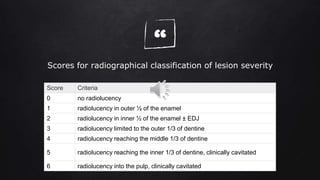
Score Criteria
0 no radiolucency
1 radiolucency in outer ½ of the enamel
2 radiolucency in inner ½ of the enamel ± EDJ
3 radiolucency limited to the outer 1/3 of dentine
4 radiolucency reaching the middle 1/3 of dentine
5 radiolucency reaching the inner 1/3 of dentine, clinically cavitated
6 radiolucency into the pulp, clinically cavitated
Scores for radiographical classification of lesion severity
10.
Classification
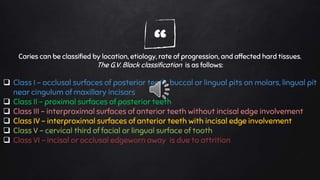
“Caries can be classified by location, etiology, rate of progression, and affected hard tissues.
The G.V. Black classification is as follows:
 Class I – occlusal surfaces of posterior teeth, buccal or lingual pits on molars, lingual pit
near cingulum of maxillary incisors
 Class II – proximal surfaces of posterior teeth
 Class III – interproximal surfaces of anterior teeth without incisal edge involvement
 Class IV – interproximal surfaces of anterior teeth with incisal edge involvement
 Class V – cervical third of facial or lingual surface of tooth
 Class VI – incisal or occlusal edgeworn away is due to attrition
11.
Prevention
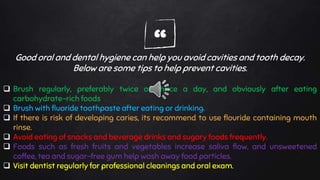
“Good oral and dental hygiene can help you avoid cavities and tooth decay.
Below are some tips to help prevent cavities.
 Brush regularly, preferably twice or thrice a day, and obviously after eating
carbohydrate-rich foods
 Brush with fluoride toothpaste after eating or drinking.
 If there is risk of developing caries, its recommend to use flouride containing mouth
rinse.
 Avoid eating of snacks and beverage drinks and sugary foods frequently.
 Foods such as fresh fruits and vegetables increase saliva flow, and unsweetened
coffee, tea and sugar-free gum help wash away food particles.
 Visit dentist regularly for professional cleanings and oral exam.
12.
Treatment / Cure
“Most importantly, whether the carious lesion is cavitated or non-cavitated dictates the
management. Clinical assess ment of whether the lesion is active or arrested is also important.
Treatment of tooth decay depends on how advanced it is.
I. For early stage tooth decay –recommended amount of sugar should be in diet. Application of a
fluoride gel, varnish or paste to the area may be recommended or advised.
II. For average carious lesion – Filling or Crowning is recommended which involves removing the
dental decay, offering local anaesthetic to numb the tooth and filling the hole.
III. If tooth decay has spread to the Pulp – this may be removed and restored by Root Canal
Treatment.
IV. If the tooth is so badly damaged that it can't be restored – it may need to be
removed/extracted. Then, the tooth should be replaced with a partial denture, bridge or
implant.
13.
Consequences of Dental Caries
“Oral health consequences :
 Apical periodontitis
 Periapical abscess
 Cellulitis
 Osteomyelitis of the jaw
“Spread from maxillary teeth :
 Purulent sinusitis
 Meningitis
 Brain abscess
 Orbital cellulitis
 Cavernous sinus thrombosis
“Spread from mandibular teeth may cause :
 Ludwig's angina
 Parapharyngeal abscess,
 Pericarditis
14.
Complications of Dental Caries
“• Pain.
• Spread of infections around the tooth.
• Distant spread of infections.
• Oral abscess and respiratory complications.
• Heart complications:
*Infective endocarditic,
*Infection of heart valves.
• Worsening of existing medical illnesses such as diabetes.
• Death may result from complication of dental caries.
15.
Overview at a glance
Place your screenshot here
Beginner’s Review Video of Dental caries at a whole
16.
References
“Cawson’s Essentials of Oral Pathology and Oral Medicine (8th Edition)
Google Search
Wikipedia
Dentistry and Medicine web blog
SlideShare
YouTube
. . . & other sites

Dental Caries ; A Presentation by- MunabbiR

  • 1.
    A brief presentation on DENTALCARIES By: Munabbir-Ul-Haque
  • 2.
    Contents of thispresentation: 1 > Definition 9 > Diagnosis 2 > Sign & Symptoms 10 > Classification 3 > Etiology/Causing factors 11 > Prevention 4 > Bacterial Plaque 12 > Treatment 5 > Susceptibility of teeth to caries 13 > Consequences 6 > Saliva and Dental Caries 14 > Complications 7 > Pathogenesis 15 > Overview at a glance 8 > Pathology 16 > Reference
  • 3.
    1. What is DentalCaries? “Dental caries is an irreversible microbial disease of the calcified tissues of the teeth, characterized by demineralization of the inorganic portion and destruction of the organic substance of the tooth , which often leads to cavitation”
  • 4.
  • 5.
    “As the decaygets larger, it may cause signs and symptoms such as:  The earliest sign may be the appearance of a chalky white spot on the surface of the tooth  Toothache.  Tooth sensitivity.  Mild to sharp pain when eating or drinking something sweet, hot or cold.  Visible holes or pits on tooth surface.  Brown, black or white staining on any surface of a tooth.  Pain while biting down.
  • 6.
  • 7.
    “In 1890, W.D. Miller showed that lesions similar to dental caries could be produced by incubating teeth in saliva when carbohydrates were added. Miller concluded that caries could result from decalcification caused by bacterial acid production followed by invasion and destruction of any remaining tissue. However, dental caries develops only in the presence of several interacting variables.
  • 8.
    Essential requirements fordevelopment of dental caries : 1. Cariogenic (acidogenic) bacteria [ These are viridans streptococci which are a heterogeneous group including Streptococcus mutans, S. sobrinus, S. salivarius, S. mitior and S. sanguis and lactobacilli. ]
  • 9.
    Essential requirements fordevelopment of dental caries : 2. Bacterial plaque [Dental plaque is a biofilm or mass of bacteria that grows on stagnation areas of tooth surface , usually sticky & colorless and gradually becoming harder & brownish resulting in tooth decay. ]
  • 10.
    Essential requirements fordevelopment of dental caries : 3. Stagnation areas [The location on the surface of a tooth where there is a tendency for food debris to accumulate. ]
  • 11.
    Essential requirements fordevelopment of dental caries : 4. Fermentable bacterial substrate (sugar) e.g. disaccharide, polysaccharide etc.
  • 12.
    Essential requirements fordevelopment of dental caries : 5. Susceptible tooth surfaces [ Some tooth surfaces are more susceptible or vulnerable to form and develop plaque and caries, depending on enamel structure & mineral+fluoride contents ]
  • 13.
    Essential requirements fordevelopment of dental caries : 6. Time [ If time is provided to the causing bacteria by not treating them, they spontaneously multiply and form plaque followed by caries ]
  • 14.
    Place your screenshothere Caries causing factors in a diagram
  • 15.
    Place your screenshothere Equation of Dental Caries formation
  • 16.
  • 17.
    “Bacterial plaque orDental plaque is a dense, nonmineralized complex composed primarily of colonies of bacteria embedded in a gelatinous matrix containing amino acids, carbohydrates, proteins, lipids, and salts from saliva and gingival fluid; soluble food substances; shed leukocytes and epithelial cells; and products of bacterial metabolism. Plaque is the major causative factor in most dental diseases, including dental caries and inflammatory periodontal diseases.
  • 18.
    Place your screenshothere A video of briefing on Bacterial Plaque
  • 19.
  • 20.
    “Caries susceptible teethmeans that the teeth are at risk of being affected by caries. Everyone who has teeth is at risk of getting affected by caries, the following factors can increase risks:  Tooth location (decay most oftenly occurs in the back teeth i.e. molars and premolars, due to having lots of grooves & fissures)  Certain foods and drinks (sugary foods, beverage drinks, fast foods etc. )  Frequent snacking or sipping (frequent intaking of snacks & drinks accelerate bacterial growth)  Bedtime infant feeding (bedtime feeding or eating provides growth media to the bacteria whole night long)
  • 21.
    “ Inadequate brushing(plaque forms quickly and the first stages of decay can begin if teeth are not brushed right after eating meal)  Not getting enough fluoride (Fluoride, a naturally occurring mineral, helps prevent cavities and can even reverse the earliest stages of tooth damage)  Younger or older age (dental caries are common in children and teenagers. Teeth of elderly adults are also vulnerable to caries)  Worn fillings or dental devices. (Over the years, dental fillings can weaken, begin to break down or develop rough edges allowing plaque to build up more easily)  Dry mouth (it is caused by a lack of saliva, which helps prevent tooth decay by washing away food and plaque from teeth)
  • 22.
  • 23.
    “Saliva is themedium in which plaque develops and works. Though saliva inevitably plays some part in the process of car- ies, it is a complex secretion whose rate of flow, composition and properties have effects on dental caries formation.  Salivary flow is highly important in clearing cariogenic food particles from the oral cavity and thus decreases caries risk.  Dental caries may occur aggressively in humans with xerostomia (no or decreased salivation)  Buffering power of saliva with its rate of flow effects on maintaining pH not to decrease preventing to be acidic.
  • 24.
    “ In Down’sSyndrome, caries activity is low due to high salivation with high buffering power.  Salivary amylase breaks down polysaccharides and contributes their clearance from the mouth.  Saliva contains thiocyanates, lysozyme-like substances and other anti-bacterial substances which prevent bacterial colonization.  Salivary components contribute to plaque formation and form much of its matrix  Sucrose dissolves in saliva and is actively taken up by plaque  Gross reduction in salivary secretion leads to increased caries activity when a cariogenic diet is eaten
  • 25.
    Place your screenshothere An animated overview of salivary flow in oral cavity
  • 26.
  • 27.
    Place your screenshothere Animated overview showing process of Dental Caries formation
  • 28.
  • 29.
    “The minerals inthe hard tissues of the teeth (enamel, dentin and cementum) are constantly undergoing processes of demineralization and remineralisation. Dental caries results when the demineralization rate is faster than the remineralisation and there is net mineral loss. This happens when there is an ecologic shift within the dental biofilm, from a balanced population of micro-organisms to a population that produce acids and can survive in an acid environment. Carious pathology involves Enamel, Cementum, Dentin and ultimately affects dental pulp resulting tooth decay. Therefore, there are Pathology of *Enamel caries, *Dentin caries and *Cementum caries
  • 30.
    “P a th o l o g y o f E n a m e l C a r i e s Enamel is affected by caries mostly and firstly. If the carious lesion occur in crown portion of the tooth, then enamel is the primary lesion area. Stages of Enamel caries : I. • The early (submicroscopic) lesion II. • Phase of non-bacterial enamel crystal destruction III. • Cavity formation IV. • Bacterial invasion of enamel V. • Undermining of enamel from below after spread into dentine
  • 31.
    Place your screenshothere A tabular overview of the stages of pathology of caries
  • 32.
    “P a th o l o g y o f D e n t i n C a r i e s Unlike enamel, the dentin reacts to the progression of dental caries. Since odontoblasts are present, a stimulus, such as caries, can trigger a biologic response. These defense mechanisms include the formation of sclerotic and tertiary dentin. Streptococci play the major role in the attack on enamel, but lactobacilli may be as important in dentine caries. As the lesion progresses, the bacterial population becomes increasingly mixed and their relative contributions to dentine destruction become more difficult to remove.
  • 33.
    “Key events inthe development of dentine caries : I. • Non-bacterial, precavitation, acid softening of matrix II. • Widening of tubules by demineralisation III. • Migration of pioneer bacteria along tubules IV. • Distortion of tubules by expanding masses of bacteria V. • Breakdown of intervening matrix forming liquefaction foci VI. • Progressive disintegration of remaining matrix tissue
  • 34.
    Place your screenshothere A comparative picture showing progression of carious lesion through dentin
  • 35.
    Place your screenshothere Another video overview showing development of dental caries
  • 36.
  • 37.
    “Diagnostic Methods/ Examination:  Direct inspection  Sometimes use of x-rays or special testing instruments  Routine, frequent clinical evaluation identifies early caries at a time when minimal intervention prevents its progression.  A thin probe, sometimes special dyes, and transillumination by fiberoptic lights are used, frequently supplemented by new devices that detect caries by changes in electrical conductivity or laser reflectivity.  However, x-rays are still important for detecting caries, determining the depth of involvement, and identifying caries under existing restorations
  • 38.
    “The International CariesDetection and Assessment System (ICDAS) was developed in 2001 by an international group of researchers. The system was proposed as a strategy to integrate the modern detection systems into one standard system. Criteria 0 Sound 1 First Visual Change in enamel 2 Distinct Visual Change in enamel 3 Localized enamel breakdown 4 Underlying dentine shadow 5 Distinct cavity with visible dentine 6 Extensive cavity with visible dentine ICDAS scores
  • 39.
    “ Score Criteria 0 noradiolucency 1 radiolucency in outer ½ of the enamel 2 radiolucency in inner ½ of the enamel ± EDJ 3 radiolucency limited to the outer 1/3 of dentine 4 radiolucency reaching the middle 1/3 of dentine 5 radiolucency reaching the inner 1/3 of dentine, clinically cavitated 6 radiolucency into the pulp, clinically cavitated Scores for radiographical classification of lesion severity
  • 40.
  • 41.
    “Caries can beclassified by location, etiology, rate of progression, and affected hard tissues. The G.V. Black classification is as follows:  Class I – occlusal surfaces of posterior teeth, buccal or lingual pits on molars, lingual pit near cingulum of maxillary incisors  Class II – proximal surfaces of posterior teeth  Class III – interproximal surfaces of anterior teeth without incisal edge involvement  Class IV – interproximal surfaces of anterior teeth with incisal edge involvement  Class V – cervical third of facial or lingual surface of tooth  Class VI – incisal or occlusal edgeworn away is due to attrition
  • 42.
  • 43.
    “Good oral anddental hygiene can help you avoid cavities and tooth decay. Below are some tips to help prevent cavities.  Brush regularly, preferably twice or thrice a day, and obviously after eating carbohydrate-rich foods  Brush with fluoride toothpaste after eating or drinking.  If there is risk of developing caries, its recommend to use flouride containing mouth rinse.  Avoid eating of snacks and beverage drinks and sugary foods frequently.  Foods such as fresh fruits and vegetables increase saliva flow, and unsweetened coffee, tea and sugar-free gum help wash away food particles.  Visit dentist regularly for professional cleanings and oral exam.
  • 44.
  • 45.
    “Most importantly, whetherthe carious lesion is cavitated or non-cavitated dictates the management. Clinical assess ment of whether the lesion is active or arrested is also important. Treatment of tooth decay depends on how advanced it is. I. For early stage tooth decay –recommended amount of sugar should be in diet. Application of a fluoride gel, varnish or paste to the area may be recommended or advised. II. For average carious lesion – Filling or Crowning is recommended which involves removing the dental decay, offering local anaesthetic to numb the tooth and filling the hole. III. If tooth decay has spread to the Pulp – this may be removed and restored by Root Canal Treatment. IV. If the tooth is so badly damaged that it can't be restored – it may need to be removed/extracted. Then, the tooth should be replaced with a partial denture, bridge or implant.
  • 46.
  • 47.
    “Oral health consequences:  Apical periodontitis  Periapical abscess  Cellulitis  Osteomyelitis of the jaw
  • 48.
    “Spread from maxillaryteeth :  Purulent sinusitis  Meningitis  Brain abscess  Orbital cellulitis  Cavernous sinus thrombosis
  • 49.
    “Spread from mandibularteeth may cause :  Ludwig's angina  Parapharyngeal abscess,  Pericarditis
  • 50.
  • 51.
    “• Pain. • Spreadof infections around the tooth. • Distant spread of infections. • Oral abscess and respiratory complications. • Heart complications: *Infective endocarditic, *Infection of heart valves. • Worsening of existing medical illnesses such as diabetes. • Death may result from complication of dental caries.
  • 52.
  • 53.
    Place your screenshothere Beginner’s Review Video of Dental caries at a whole
  • 54.
  • 55.
    “Cawson’s Essentials ofOral Pathology and Oral Medicine (8th Edition) Google Search Wikipedia Dentistry and Medicine web blog SlideShare YouTube . . . & other sites