

Dengue Fever
Thuwaiba Abdullah Naser S. Saif Al-huneirny
What is Dengue Fever?
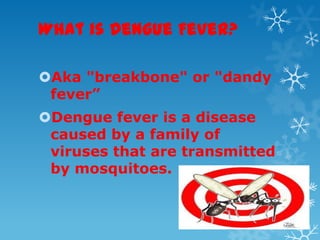
Aka "breakbone" or "dandy
fever”
Dengue fever is a disease
caused by a family of
viruses that are transmitted
by mosquitoes.
Incubation
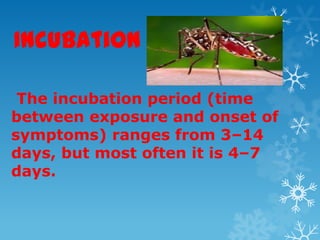
The incubation period (time
between exposure and onset of
symptoms) ranges from 3–14
days, but most often it is 4–7
days.
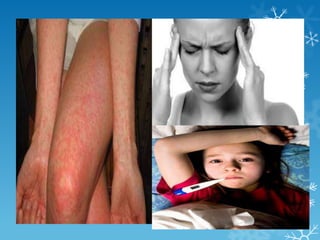
Symptoms of
High Fever
Severe Headache
Pain behind the eyes
Joint and muscle pain
Rash
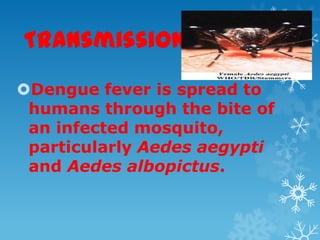
Transmission
Dengue fever is spread to
humans through the bite of
an infected mosquito,
particularly Aedes aegypti
and Aedes albopictus.
Prevention
Clothing - your chances of being bitten
are significantly reduced if you expose
as little skin as possible.
Mosquito traps and nets - the risk of
being bitten by mosquitoes is
considerably reduced with the use of
mosquito net when you sleep.
Smell - Avoid wearing heavily scented
soaps and perfumes.
Windows - use window screens or
netting.
Certain times of day - try to avoid
being outside at dawn, dusk and
early evening.
Stagnant water - the Aedes mosquito
prefers to breed in clean, stagnant
water. It is important to frequently
check and remove stagnant water in
your home/premises.
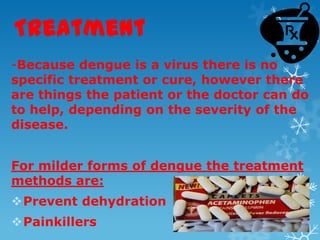
Treatment
-Because dengue is a virus there is no
specific treatment or cure, however there
are things the patient or the doctor can do
to help, depending on the severity of the
disease.
For milder forms of dengue the treatment
methods are:
Prevent dehydration
Painkillers
For the severe forms of dengue
fever the treatment methods
are:
Intravenous fluid
supplementation (IV drip)
Blood transfusion
Hospital care
THANK
YOU 

Dengue fever

  • 1.
    Dengue Fever Thuwaiba AbdullahNaser S. Saif Al-huneirny
  • 2.
    What is DengueFever? Aka "breakbone" or "dandy fever” Dengue fever is a disease caused by a family of viruses that are transmitted by mosquitoes.
  • 3.
    Incubation The incubation period(time between exposure and onset of symptoms) ranges from 3–14 days, but most often it is 4–7 days.
  • 4.
    Symptoms of High Fever SevereHeadache Pain behind the eyes Joint and muscle pain Rash
  • 6.
    Transmission Dengue fever isspread to humans through the bite of an infected mosquito, particularly Aedes aegypti and Aedes albopictus.
  • 7.
    Prevention Clothing - yourchances of being bitten are significantly reduced if you expose as little skin as possible. Mosquito traps and nets - the risk of being bitten by mosquitoes is considerably reduced with the use of mosquito net when you sleep. Smell - Avoid wearing heavily scented soaps and perfumes.
  • 8.
    Windows - usewindow screens or netting. Certain times of day - try to avoid being outside at dawn, dusk and early evening. Stagnant water - the Aedes mosquito prefers to breed in clean, stagnant water. It is important to frequently check and remove stagnant water in your home/premises.
  • 9.
    Treatment -Because dengue isa virus there is no specific treatment or cure, however there are things the patient or the doctor can do to help, depending on the severity of the disease. For milder forms of dengue the treatment methods are: Prevent dehydration Painkillers
  • 10.
    For the severeforms of dengue fever the treatment methods are: Intravenous fluid supplementation (IV drip) Blood transfusion Hospital care
  • 11.