My Presentation Topic is
Inflectional disease: Dengue fever and Chicken pox
Presented by
Ferdows Ahmed
Roll:570
Batch: 19th
Department of Pharmacy
World University of Bangladesh
Content
 Infectious disease
 Classification of Infectious Disease
 Infectious Disease Agents
 How Infectious Agents Cause Disease
 Transmission of Infectious Diseases
 Dengue Fever
 Dengue virus
 Dengue fever Symptoms
 Prevention of dengue fever
 Transmission of Infectious Diseases
 Chickenpox
 Chicken pox Transmission
 Treatment of chicken pox
Disease
a pathological condition of body parts or tissues characterized
by an identifiable group of signs and symptoms.
Infectious disease
disease caused by an infectious agent such as a bacterium,
virus, protozoan, or fungus that can be passed on to others.
Classification of Infectious Disease
By duration
Acute – develops and runs its course quickly.
Chronic – develops more slowly and is usually less
severe, but may persist for a long, indefinite period of time.
Latent – characterized by periods of no symptoms between
outbreaks of illness.
By location
 Local – confined to a specific area of the body.
 Systemic – a generalized illness that infects most of the body
with pathogens distributed widely in tissues.
 By timing
 Primary – initial infection in a previously healthy person.
 Secondary – infection that occurs in a person weakened by a
primary infection.
Infectious Disease Agents:
Most infectious agents that cause disease are microscopic in size
and thus, are called microbes or microorganisms.
Different groups of agents that cause disease are:
Bacteria
Viruses
Protozoa (Protists)
Fungi
Helminths (Animals)
How Infectious Agents Cause Disease
 Production of poisons, such as toxins and enzymes, that
destroy cells and tissues.
 Direct invasion and destruction of host cells.
 Triggering responses from the host’s immune system leading
to disease signs and symptoms.
Phases of Infectious Disease
Incubation period – time between infection and the appearance of
signs and symptoms.
 Prodromal phase – mild, nonspecific symptoms that signal
onset of some diseases.
 Clinical phase – a person experiences typical signs and
symptoms of disease.
 Decline phase - subsidence of symptoms.
 Recovery phase – symptoms have disappeared, tissues heal,
and the body regains strength.
Transmission of Infectious Diseases:
Agents that cause infectious diseases can
Agents that cause infectious diseases can be transmitted in many
ways.
 Through the air.
 Through contaminated food or water.
 Through body fluids.
 By direct contact with contaminated objects.
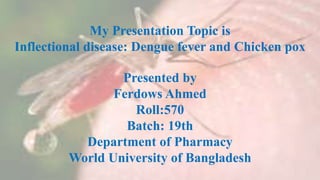
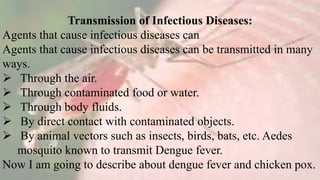
 By animal vectors such as insects, birds, bats, etc. Aedes
mosquito known to transmit Dengue fever.
Now I am going to describe about dengue fever and chicken pox.
Dengue Fever
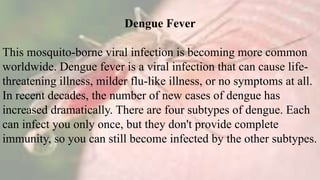
This mosquito-borne viral infection is becoming more common
worldwide. Dengue fever is a viral infection that can cause life-
threatening illness, milder flu-like illness, or no symptoms at all.
In recent decades, the number of new cases of dengue has
increased dramatically. There are four subtypes of dengue. Each
can infect you only once, but they don't provide complete
immunity, so you can still become infected by the other subtypes.
The risk for severe dengue increases with each infection.
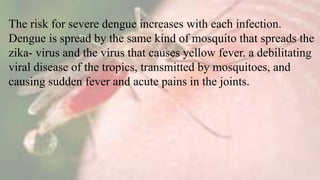
Dengue is spread by the same kind of mosquito that spreads the
zika- virus and the virus that causes yellow fever. a debilitating
viral disease of the tropics, transmitted by mosquitoes, and
causing sudden fever and acute pains in the joints.
Dengue virus
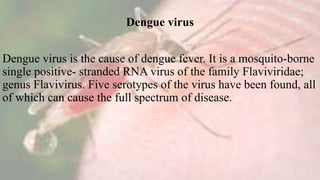
Dengue virus is the cause of dengue fever. It is a mosquito-borne
single positive- stranded RNA virus of the family Flaviviridae;
genus Flavivirus. Five serotypes of the virus have been found, all
of which can cause the full spectrum of disease.
Symptoms
Symptoms, which usually begin four to six days after infection
and last for up to 10 days, may include
 Sudden, high fever
 Severe headaches
 Pain behind the eyes
 Severe joint and muscle pain
 Fatigue
 Nausea
 Vomiting
 Skin rash, which appears two to five days after the onset of
fever
 Mild bleeding (such a nose bleed, bleeding gums, or easy
bruising)
 Sometimes, symptoms are mild and can be mistaken for those
of the flu or another viral infection. Younger children and
people who have never had the infection before tend to have
milder cases than older children and adults. However, serious
problems can develop.
Synonyms of Dengue Fever
 Break bone Fever.
 Dandy Fever.
 Dengue Hemorrhagic Fever.
 Dengue Shock Syndrome.
 Seven Day Fever Dengue Type.
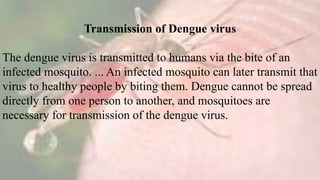
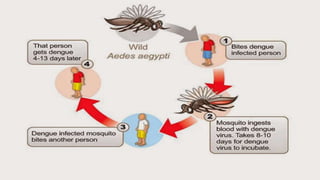
Transmission of Dengue virus
The dengue virus is transmitted to humans via the bite of an
infected mosquito. ... An infected mosquito can later transmit that
virus to healthy people by biting them. Dengue cannot be spread
directly from one person to another, and mosquitoes are
necessary for transmission of the dengue virus.
Habitats of Aedes Mosquitoes
Aedes mosquitoes typically live indoors and are often found in
dark, cool places such as in closets, under beds, behind curtains,
and in bathrooms.
The risk of being bitten in highest during the early morning,
several hours after daybreak, and in the late afternoon before
sunset. However, mosquitoes may feed at any time during the
day.
Prevention of dengue fever
Cover all water tanks, barrels and storage container with tightly
covers or with wire mesh 18 squares to the inch.
Flowers pots saucers and vases should be emptied and scrubbed
at least once a week to destroy mosquito eggs. Eggs can hatch in
to larvae in 3-6 days.
Cut down and remove all bushes and clear overgrown lost than
can harder mosquitoes.
Keep guttering clear of leave and others debris.
Treatment
Dengue is a virus, so there is no specific treatment or cure.
However, intervention can help, depending on how severe the
disease is.
For milder forms, treatment includes:
Preventing dehydration: A high fever and vomiting can dehydrate
the body. The person should drink clean water, ideally bottled
rather than tap water. Rehydration salts can also help replace
fluids and minerals. Painkillers, such as Tylenol or paracetamol:
These can help lower fever and ease pain. On-steroidal anti-
inflammatory drugs (NSAIDs), such as aspirin or ibuprofen, are
not advised, as they can increase the risk of internal bleeding.
Chickenpox
A highly infectious viral disease also known medically as
varicella -- in many countries, this disease is always called
"varicella" -- that causes a blister-like rash, itching, fatigue and
fever. The rash crops up first on the face and trunk and can
spread over the entire body resulting in 250 to 500 itchy blisters.
Causes
Chickenpox is caused by the varicella-zoster virus, which also
causes shingles. Chickenpox is highly contagious and spreads by
closeness and contact with someone with chickenpox. Fever,
malaise, and a very itchy rash (red spots, fluid-filled tiny blisters,
and crusted lesions) are all symptoms and signs of chickenpox.
Symptoms
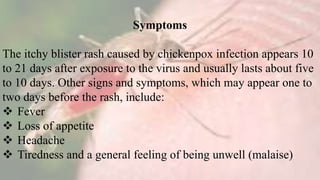
The itchy blister rash caused by chickenpox infection appears 10
to 21 days after exposure to the virus and usually lasts about five
to 10 days. Other signs and symptoms, which may appear one to
two days before the rash, include:
 Fever
 Loss of appetite
 Headache
 Tiredness and a general feeling of being unwell (malaise)
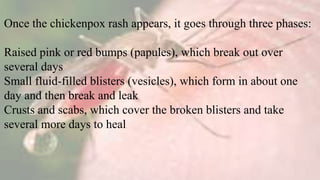
Once the chickenpox rash appears, it goes through three phases:
Raised pink or red bumps (papules), which break out over
several days
Small fluid-filled blisters (vesicles), which form in about one
day and then break and leak
Crusts and scabs, which cover the broken blisters and take
several more days to heal
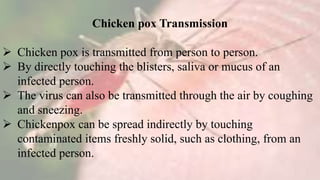
Chicken pox Transmission
 Chicken pox is transmitted from person to person.
 By directly touching the blisters, saliva or mucus of an
infected person.
 The virus can also be transmitted through the air by coughing
and sneezing.
 Chickenpox can be spread indirectly by touching
contaminated items freshly solid, such as clothing, from an
infected person.
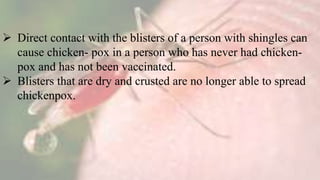
 Direct contact with the blisters of a person with shingles can
cause chicken- pox in a person who has never had chicken-
pox and has not been vaccinated.
 Blisters that are dry and crusted are no longer able to spread
chickenpox.
Prevention
The best way to prevent chickenpox is to get the chickenpox
vaccine. Everyone – including children, adolescents, and adults –
should get two doses of chickenpox vaccine if they have never
had chickenpox or were never vaccinated.
Chickenpox vaccine is very safe and effective at preventing the
disease. Most people who get the vaccine will not get
chickenpox. If a vaccinated person does get chickenpox, the
symptoms are usually milder with fewer
or no blisters (they may have just red spots) and mild or no fever.
The chickenpox vaccine prevents almost all cases of severe
illness. Since the varicella vaccination program began in the
United States, there has been over 90% decrease in chickenpox
cases, hospitalizations, and deaths.
For more information about chickenpox vaccine, see
Vaccination. The chickenpox vaccine isn't approved for:
Pregnant women
People who have weakened immune systems, such as those who
are infected with HIV, or people who are taking immune-
suppressing medications
People who are allergic to gelatin or the antibiotic neomycin.
Treatment of chicken pox
Drugs used in the treatment of chickenpox are antiviral drugs
antihistamines and antipyretics.
Commonly used drug is acyclovir available AZ zovirax in the
market, famiclovir available as famvir and foscarnet available as
foscovir.
Antiviral medicines can be taken orally intravenously or applied
on the skin.
These are prescribed to people with long term illness.
Impaired immune system and pregnant women.
Also others drugs are given to reduce fever, cold, itching,
irritation of the rash, sore throat etc.
Ferdous ahmed

Ferdous ahmed

  • 1.
    My Presentation Topicis Inflectional disease: Dengue fever and Chicken pox Presented by Ferdows Ahmed Roll:570 Batch: 19th Department of Pharmacy World University of Bangladesh
  • 2.
    Content  Infectious disease Classification of Infectious Disease  Infectious Disease Agents  How Infectious Agents Cause Disease  Transmission of Infectious Diseases  Dengue Fever  Dengue virus  Dengue fever Symptoms  Prevention of dengue fever  Transmission of Infectious Diseases  Chickenpox  Chicken pox Transmission  Treatment of chicken pox
  • 3.
    Disease a pathological conditionof body parts or tissues characterized by an identifiable group of signs and symptoms. Infectious disease disease caused by an infectious agent such as a bacterium, virus, protozoan, or fungus that can be passed on to others.
  • 4.
    Classification of InfectiousDisease By duration Acute – develops and runs its course quickly. Chronic – develops more slowly and is usually less severe, but may persist for a long, indefinite period of time. Latent – characterized by periods of no symptoms between outbreaks of illness.
  • 5.
    By location  Local– confined to a specific area of the body.  Systemic – a generalized illness that infects most of the body with pathogens distributed widely in tissues.  By timing  Primary – initial infection in a previously healthy person.  Secondary – infection that occurs in a person weakened by a primary infection.
  • 6.
    Infectious Disease Agents: Mostinfectious agents that cause disease are microscopic in size and thus, are called microbes or microorganisms. Different groups of agents that cause disease are: Bacteria Viruses Protozoa (Protists) Fungi Helminths (Animals)
  • 7.
    How Infectious AgentsCause Disease  Production of poisons, such as toxins and enzymes, that destroy cells and tissues.  Direct invasion and destruction of host cells.  Triggering responses from the host’s immune system leading to disease signs and symptoms.
  • 8.
    Phases of InfectiousDisease Incubation period – time between infection and the appearance of signs and symptoms.  Prodromal phase – mild, nonspecific symptoms that signal onset of some diseases.  Clinical phase – a person experiences typical signs and symptoms of disease.  Decline phase - subsidence of symptoms.  Recovery phase – symptoms have disappeared, tissues heal, and the body regains strength.
  • 9.
    Transmission of InfectiousDiseases: Agents that cause infectious diseases can Agents that cause infectious diseases can be transmitted in many ways.  Through the air.  Through contaminated food or water.  Through body fluids.  By direct contact with contaminated objects.  By animal vectors such as insects, birds, bats, etc. Aedes mosquito known to transmit Dengue fever. Now I am going to describe about dengue fever and chicken pox.
  • 10.
    Dengue Fever This mosquito-borneviral infection is becoming more common worldwide. Dengue fever is a viral infection that can cause life- threatening illness, milder flu-like illness, or no symptoms at all. In recent decades, the number of new cases of dengue has increased dramatically. There are four subtypes of dengue. Each can infect you only once, but they don't provide complete immunity, so you can still become infected by the other subtypes.
  • 11.
    The risk forsevere dengue increases with each infection. Dengue is spread by the same kind of mosquito that spreads the zika- virus and the virus that causes yellow fever. a debilitating viral disease of the tropics, transmitted by mosquitoes, and causing sudden fever and acute pains in the joints.
  • 12.
    Dengue virus Dengue virusis the cause of dengue fever. It is a mosquito-borne single positive- stranded RNA virus of the family Flaviviridae; genus Flavivirus. Five serotypes of the virus have been found, all of which can cause the full spectrum of disease.
  • 13.
    Symptoms Symptoms, which usuallybegin four to six days after infection and last for up to 10 days, may include  Sudden, high fever  Severe headaches  Pain behind the eyes  Severe joint and muscle pain  Fatigue
  • 14.
     Nausea  Vomiting Skin rash, which appears two to five days after the onset of fever  Mild bleeding (such a nose bleed, bleeding gums, or easy bruising)  Sometimes, symptoms are mild and can be mistaken for those of the flu or another viral infection. Younger children and people who have never had the infection before tend to have milder cases than older children and adults. However, serious problems can develop.
  • 15.
    Synonyms of DengueFever  Break bone Fever.  Dandy Fever.  Dengue Hemorrhagic Fever.  Dengue Shock Syndrome.  Seven Day Fever Dengue Type.
  • 16.
    Transmission of Denguevirus The dengue virus is transmitted to humans via the bite of an infected mosquito. ... An infected mosquito can later transmit that virus to healthy people by biting them. Dengue cannot be spread directly from one person to another, and mosquitoes are necessary for transmission of the dengue virus.
  • 18.
    Habitats of AedesMosquitoes Aedes mosquitoes typically live indoors and are often found in dark, cool places such as in closets, under beds, behind curtains, and in bathrooms. The risk of being bitten in highest during the early morning, several hours after daybreak, and in the late afternoon before sunset. However, mosquitoes may feed at any time during the day.
  • 19.
    Prevention of denguefever Cover all water tanks, barrels and storage container with tightly covers or with wire mesh 18 squares to the inch. Flowers pots saucers and vases should be emptied and scrubbed at least once a week to destroy mosquito eggs. Eggs can hatch in to larvae in 3-6 days. Cut down and remove all bushes and clear overgrown lost than can harder mosquitoes. Keep guttering clear of leave and others debris.
  • 20.
    Treatment Dengue is avirus, so there is no specific treatment or cure. However, intervention can help, depending on how severe the disease is. For milder forms, treatment includes: Preventing dehydration: A high fever and vomiting can dehydrate the body. The person should drink clean water, ideally bottled rather than tap water. Rehydration salts can also help replace fluids and minerals. Painkillers, such as Tylenol or paracetamol: These can help lower fever and ease pain. On-steroidal anti- inflammatory drugs (NSAIDs), such as aspirin or ibuprofen, are not advised, as they can increase the risk of internal bleeding.
  • 21.
    Chickenpox A highly infectiousviral disease also known medically as varicella -- in many countries, this disease is always called "varicella" -- that causes a blister-like rash, itching, fatigue and fever. The rash crops up first on the face and trunk and can spread over the entire body resulting in 250 to 500 itchy blisters.
  • 22.
    Causes Chickenpox is causedby the varicella-zoster virus, which also causes shingles. Chickenpox is highly contagious and spreads by closeness and contact with someone with chickenpox. Fever, malaise, and a very itchy rash (red spots, fluid-filled tiny blisters, and crusted lesions) are all symptoms and signs of chickenpox.
  • 23.
    Symptoms The itchy blisterrash caused by chickenpox infection appears 10 to 21 days after exposure to the virus and usually lasts about five to 10 days. Other signs and symptoms, which may appear one to two days before the rash, include:  Fever  Loss of appetite  Headache  Tiredness and a general feeling of being unwell (malaise)
  • 24.
    Once the chickenpoxrash appears, it goes through three phases: Raised pink or red bumps (papules), which break out over several days Small fluid-filled blisters (vesicles), which form in about one day and then break and leak Crusts and scabs, which cover the broken blisters and take several more days to heal
  • 25.
    Chicken pox Transmission Chicken pox is transmitted from person to person.  By directly touching the blisters, saliva or mucus of an infected person.  The virus can also be transmitted through the air by coughing and sneezing.  Chickenpox can be spread indirectly by touching contaminated items freshly solid, such as clothing, from an infected person.
  • 26.
     Direct contactwith the blisters of a person with shingles can cause chicken- pox in a person who has never had chicken- pox and has not been vaccinated.  Blisters that are dry and crusted are no longer able to spread chickenpox.
  • 27.
    Prevention The best wayto prevent chickenpox is to get the chickenpox vaccine. Everyone – including children, adolescents, and adults – should get two doses of chickenpox vaccine if they have never had chickenpox or were never vaccinated. Chickenpox vaccine is very safe and effective at preventing the disease. Most people who get the vaccine will not get chickenpox. If a vaccinated person does get chickenpox, the symptoms are usually milder with fewer
  • 28.
    or no blisters(they may have just red spots) and mild or no fever. The chickenpox vaccine prevents almost all cases of severe illness. Since the varicella vaccination program began in the United States, there has been over 90% decrease in chickenpox cases, hospitalizations, and deaths. For more information about chickenpox vaccine, see Vaccination. The chickenpox vaccine isn't approved for: Pregnant women
  • 29.
    People who haveweakened immune systems, such as those who are infected with HIV, or people who are taking immune- suppressing medications People who are allergic to gelatin or the antibiotic neomycin.
  • 30.
    Treatment of chickenpox Drugs used in the treatment of chickenpox are antiviral drugs antihistamines and antipyretics. Commonly used drug is acyclovir available AZ zovirax in the market, famiclovir available as famvir and foscarnet available as foscovir.
  • 31.
    Antiviral medicines canbe taken orally intravenously or applied on the skin. These are prescribed to people with long term illness. Impaired immune system and pregnant women. Also others drugs are given to reduce fever, cold, itching, irritation of the rash, sore throat etc.