Social Pharmacy
* Arthropod Borne Diseases
* Dengue- Vector, mode of transmission,
types of dengue fever, symptoms,
treatment and prevention.
* Chikungunya- Causative agent,
clinical presentation, treatment and
prevention.
* References
Arthropod-borne diseases are transmitted by arthropods, members of the
invertebrate phylum Arthropoda, which includes insects, spiders, and
crustaceans (Tortoise, crabs).
Arthropod vector can cause a variety of human diseases, including malaria,
yellow fever, chikunguniya, and dengue fever.
Vector is a living organism that transmit infectious agent from an infected animal to a
human or another animal.
 Dengue is a viral infection spread by the bite of an infected Aedes
mosquito.
 Dengue virus belongs to the family Flaviviridae.
 Dengue fever is frequent following the rainy season.
 The reservoir of infection is both man & human.
.
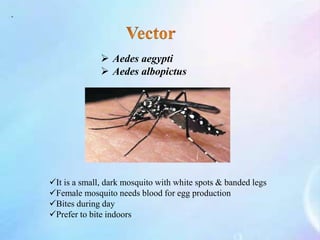
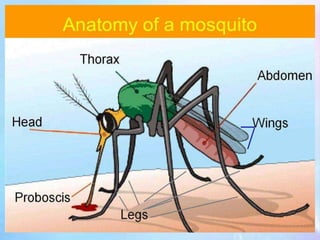
 Aedes aegypti
 Aedes albopictus
It is a small, dark mosquito with white spots & banded legs
Female mosquito needs blood for egg production
Bites during day
Prefer to bite indoors
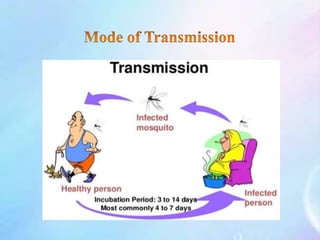
The Dengue virus can be found in the blood of a patient with Dengue
fever.
When a dengue fever patient is bitten by an Aedes mosquito, the
mosquito draws blood & the Dengue virus into its body.
For a few days, the virus continues to develop inside the mosquito’s
body.
When a mosquito carrying the virus bites a healthy person, the virus is
injected into the person’s body, innfecting him or her & causing
dengue fever.
Incubation period
3-14 days.
Most commonly 4-7 days.
1. Classical (Simple) Dengue fever/ Break bone dengue
fever/ Haddi tod bukhar
2. Dengue Haemorrhagic Fever (DHF)
3. Dengue Shock Syndrome
1. Classical (Simple) Dengue fever/ Break bone dengue
fever/ Haddi tod bukhar
• Sudden onset of high fever with feeling of chills. Fever lasts for 5 days.
• Severe headache
• Pain in muscles & joints
• Pain behind the eyeballs especially on pressing the eyes or on moving the
eyeballs
• Extreme weakness
• Loss of appetite & Loss of taste
• Feeling of nausea
• Pain in abdomen
• Mild throat pain
• Feeling of depression & extreme sickness
2. Dengue Haemorrhagic Fever (DHF)
 Along with the symptoms of classic dengue fever following
symptoms occur in DHF:
• Bleeding from nose & gums
• Blood in the stools or in vomiting
• Bleeding spots on the skin which are seen as dark bluish-black,
small or large patches
• Epigastric discomfort
2. Dengue Shock Syndrome (DSS)
 Along with the symptoms of dengue haemorrhagic fever
following symptoms occur in DSS:
• Restlessness
• Despite a high fever, the skin feels cold & clammy
• Loss of consciousness
• Weak & rapid pulse rate
• Low blood pressure
 Keep the fever low by giving paracetamol tablet or syrup as per
the Doctor’s advice
 Do not give Aspirin or Disprin tablets to the patient
 If the fever is higher than 102 degree Fahrenheit, use
hydrotherapy to lower the temperature
 Give the patient plenty of fluids, such as water, shikanji
 Continue to feed as usual.
 Allow the patient to rest
 Platelet transfusion
Mosquito control
• Keep water flowing & avoid accumulation of unhygienic stagnant
water
• Replace plant water at least once a week
• Make sure all drains are clear of clogs
Vaccines- No satisfactory vaccine is available
Other measures
Use bed nets or mosquito screens
Wear long sleeved shirts & pants
Use insect repellent
 Chikungunya is a viral disease that is transmitted to people by
mosquitoes.
 In late 2013, Chikungunya was found first time in the Americas
Caribbean island.
Aedes aegypti
Aedes albopictus.
Same type of mosquitoes transmit dengue virus.
Animal reservoirs of the virus include monkeys, birds, cattle & rodents.
These mosquitoes bite mostly during the daytime.
 Incubation period is 3-7 days
• It is caused by Chikungunya virus belonging to family
Togaviridae.
• It is an alphavirus with single stranded RNA.
 Clinical Presentation
 Sudden fever
 Chills
 Headache
 Nausea
 Vomiting
 Joint pain
 Rash
 Currently no vaccine to prevent or treat chikungunya
 Prolonged & persistent joint pain may require analgesic &
long- term anti-inflammatory therapy.
 Fluid replacement
 Rest
 Drinking plenty of fluids
Mosquito control
• Keep water flowing & avoid accumulation of unhygienic stagnant
water
• Replace plant water at least once a week
• Make sure all drains are clear of clogs
Vaccines- No satisfactory vaccine is available
Other measures
Use bed nets or mosquito screens
Wear long sleeved shirts & pants
Use insect repellent
Use of Larvicides
Where the water cannot be removed but used for cattle or other
purposes, Temephos can be used once a week at a dose of 1ppm
(parts per million)
Pyrethrum extract (0.1% ) can be sprayed in rooms to kill the adult
mosquitoes hiding in the house.
1. Dr. Bhise SB, Mrs. Bhise MS. Social Pharmacy. Nirali Prakashan,
2021;1st edition: pp: 4.37-4.44.
2. Dengue & chikungunya, 2013. Avialable from:
https://www.who.int/europe/news-room/fact-sheets/item/dengue-
and-chikungunya
3. Wanchoo A. Difference between Chikungunya & Dengue Fever,
2023. Available from:
https://www.credihealth.com/blog/chikungunya-dengue-fever-
difference/
Dengue & Chikungunya

Dengue & Chikungunya

  • 1.
  • 2.
    * Arthropod BorneDiseases * Dengue- Vector, mode of transmission, types of dengue fever, symptoms, treatment and prevention. * Chikungunya- Causative agent, clinical presentation, treatment and prevention. * References
  • 3.
    Arthropod-borne diseases aretransmitted by arthropods, members of the invertebrate phylum Arthropoda, which includes insects, spiders, and crustaceans (Tortoise, crabs). Arthropod vector can cause a variety of human diseases, including malaria, yellow fever, chikunguniya, and dengue fever. Vector is a living organism that transmit infectious agent from an infected animal to a human or another animal.
  • 4.
     Dengue isa viral infection spread by the bite of an infected Aedes mosquito.  Dengue virus belongs to the family Flaviviridae.  Dengue fever is frequent following the rainy season.  The reservoir of infection is both man & human.
  • 5.
    .  Aedes aegypti Aedes albopictus It is a small, dark mosquito with white spots & banded legs Female mosquito needs blood for egg production Bites during day Prefer to bite indoors
  • 8.
    The Dengue viruscan be found in the blood of a patient with Dengue fever. When a dengue fever patient is bitten by an Aedes mosquito, the mosquito draws blood & the Dengue virus into its body. For a few days, the virus continues to develop inside the mosquito’s body. When a mosquito carrying the virus bites a healthy person, the virus is injected into the person’s body, innfecting him or her & causing dengue fever. Incubation period 3-14 days. Most commonly 4-7 days.
  • 9.
    1. Classical (Simple)Dengue fever/ Break bone dengue fever/ Haddi tod bukhar 2. Dengue Haemorrhagic Fever (DHF) 3. Dengue Shock Syndrome
  • 10.
    1. Classical (Simple)Dengue fever/ Break bone dengue fever/ Haddi tod bukhar • Sudden onset of high fever with feeling of chills. Fever lasts for 5 days. • Severe headache • Pain in muscles & joints • Pain behind the eyeballs especially on pressing the eyes or on moving the eyeballs • Extreme weakness • Loss of appetite & Loss of taste • Feeling of nausea • Pain in abdomen • Mild throat pain • Feeling of depression & extreme sickness
  • 11.
    2. Dengue HaemorrhagicFever (DHF)  Along with the symptoms of classic dengue fever following symptoms occur in DHF: • Bleeding from nose & gums • Blood in the stools or in vomiting • Bleeding spots on the skin which are seen as dark bluish-black, small or large patches • Epigastric discomfort
  • 12.
    2. Dengue ShockSyndrome (DSS)  Along with the symptoms of dengue haemorrhagic fever following symptoms occur in DSS: • Restlessness • Despite a high fever, the skin feels cold & clammy • Loss of consciousness • Weak & rapid pulse rate • Low blood pressure
  • 13.
     Keep thefever low by giving paracetamol tablet or syrup as per the Doctor’s advice  Do not give Aspirin or Disprin tablets to the patient  If the fever is higher than 102 degree Fahrenheit, use hydrotherapy to lower the temperature  Give the patient plenty of fluids, such as water, shikanji  Continue to feed as usual.  Allow the patient to rest  Platelet transfusion
  • 14.
    Mosquito control • Keepwater flowing & avoid accumulation of unhygienic stagnant water • Replace plant water at least once a week • Make sure all drains are clear of clogs Vaccines- No satisfactory vaccine is available Other measures Use bed nets or mosquito screens Wear long sleeved shirts & pants Use insect repellent
  • 15.
     Chikungunya isa viral disease that is transmitted to people by mosquitoes.  In late 2013, Chikungunya was found first time in the Americas Caribbean island. Aedes aegypti Aedes albopictus. Same type of mosquitoes transmit dengue virus. Animal reservoirs of the virus include monkeys, birds, cattle & rodents. These mosquitoes bite mostly during the daytime.
  • 16.
     Incubation periodis 3-7 days • It is caused by Chikungunya virus belonging to family Togaviridae. • It is an alphavirus with single stranded RNA.  Clinical Presentation  Sudden fever  Chills  Headache  Nausea  Vomiting  Joint pain  Rash
  • 17.
     Currently novaccine to prevent or treat chikungunya  Prolonged & persistent joint pain may require analgesic & long- term anti-inflammatory therapy.  Fluid replacement  Rest  Drinking plenty of fluids
  • 18.
    Mosquito control • Keepwater flowing & avoid accumulation of unhygienic stagnant water • Replace plant water at least once a week • Make sure all drains are clear of clogs Vaccines- No satisfactory vaccine is available Other measures Use bed nets or mosquito screens Wear long sleeved shirts & pants Use insect repellent
  • 19.
    Use of Larvicides Wherethe water cannot be removed but used for cattle or other purposes, Temephos can be used once a week at a dose of 1ppm (parts per million) Pyrethrum extract (0.1% ) can be sprayed in rooms to kill the adult mosquitoes hiding in the house.
  • 20.
    1. Dr. BhiseSB, Mrs. Bhise MS. Social Pharmacy. Nirali Prakashan, 2021;1st edition: pp: 4.37-4.44. 2. Dengue & chikungunya, 2013. Avialable from: https://www.who.int/europe/news-room/fact-sheets/item/dengue- and-chikungunya 3. Wanchoo A. Difference between Chikungunya & Dengue Fever, 2023. Available from: https://www.credihealth.com/blog/chikungunya-dengue-fever- difference/