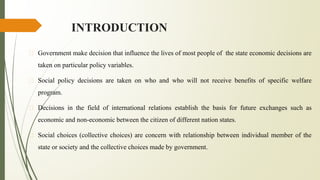
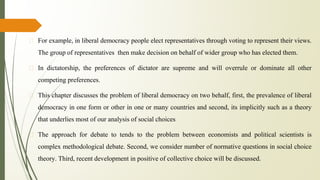
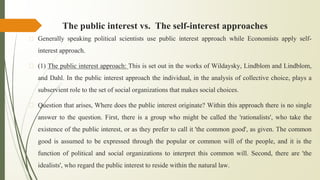
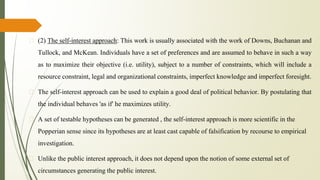
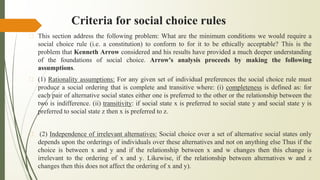
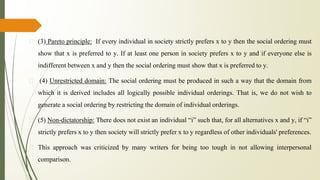
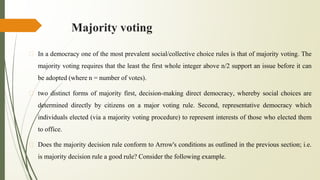
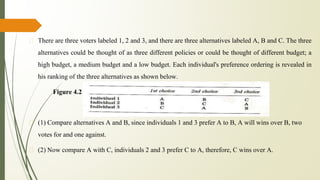
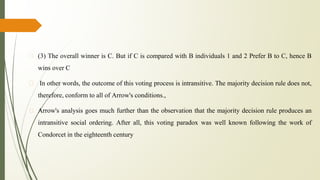
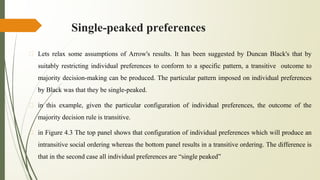
This document discusses social choice and collective decision making. It begins by defining social choices as those made by governments that influence many people, such as economic and social policy decisions. It then discusses two approaches to understanding social choices - the public interest approach views individuals as subordinate to social organizations, while the self-interest approach sees individuals as acting to maximize their own utility. The document goes on to examine criteria for acceptable social choice rules, including rationality, independence, Pareto principles, unrestricted domain, and non-dictatorship. It analyzes majority voting rules and concludes they can produce intransitive outcomes, violating Arrow's criteria for social choice. Relaxing some assumptions, like restricting preferences to a single-peak pattern,





![Public goods & Private Goods [2022].pptx](https://cdn.slidesharecdn.com/ss_thumbnails/publicgoodsprivategoods2022-230122001115-511aa1e9-thumbnail.jpg?width=640&height=640&fit=bounds)


