Demand and Demand
Function
BY ABHIJEET SINGH CHAWRA
MBA (SEM I)
CMAT 2017-19
DMS, JNVU, JODHPUR
Demand
 In general terms ‘Demand’ means desire, need , want or
requirement of a commodity.
 So Demand is an economic principle that describes a
consumer’s desire and willingness to pay a price for a
specific good or service. Holding all other factors(such as
price of related goods, income, tastes and preferences,
advertising etc.) constant, an increase in the price of a good
or service will decrease demand, and vice versa.
 For instance-
Everyone might have willingness to buy “Mercedes-S Class”
but only a few have the ability to pay for it, a few have the
purchasing power. Thus, everyone cannot be said to have a demand
for the car “Mercedes-S Class”.
Demand Function
 Demand Function is a mathematical function showing
relationship between the quantity demanded of a commodity
and the factors influencing demand.
 A Demand Function expresses quantity demanded as a function
of product price
 The relation between price and quantity demanded per period
of time, when all other factor that affects consumer demand are
held constant, is called a demand function
What is Quantity Demanded?
 Quantity demanded Is a term used in economics
to describe the total amount of goods or services
demanded at any given point in time. It depends
on the price of a good or service in the
marketplace, regardless of whether that market is
in equilibrium.
 Quantities of a commodity which the consumers buy at a
particular price
 It is a flow concept
 Quantity demanded>Quantity available for sale
 Quantity demanded = F(Price)
 Other determinants are assumed to be constant
 Higher the price, lower will be the quantity demanded.
Quantity Demanded
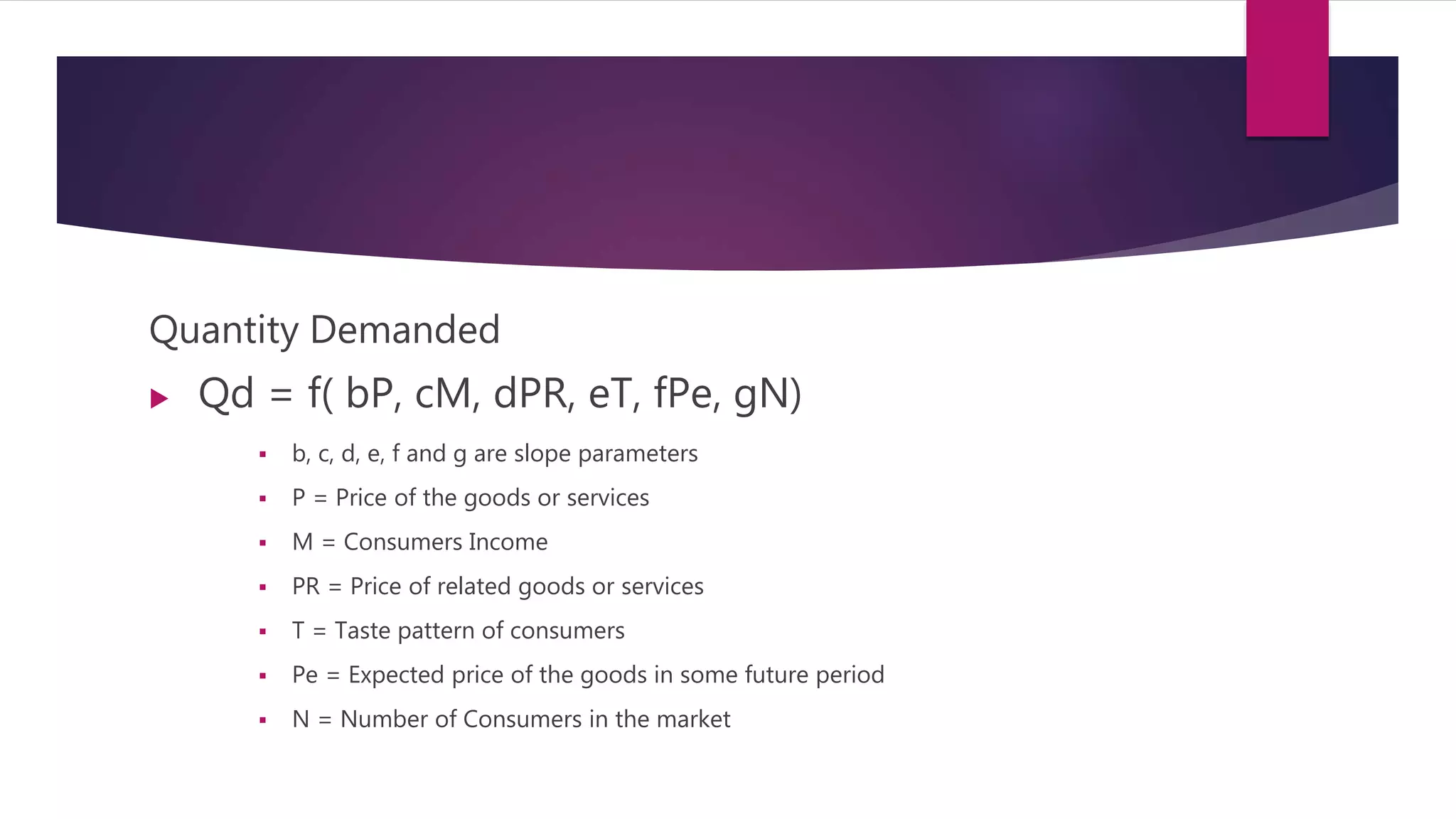
 Qd = f( bP, cM, dPR, eT, fPe, gN)
 b, c, d, e, f and g are slope parameters
 P = Price of the goods or services
 M = Consumers Income
 PR = Price of related goods or services
 T = Taste pattern of consumers
 Pe = Expected price of the goods in some future period
 N = Number of Consumers in the market
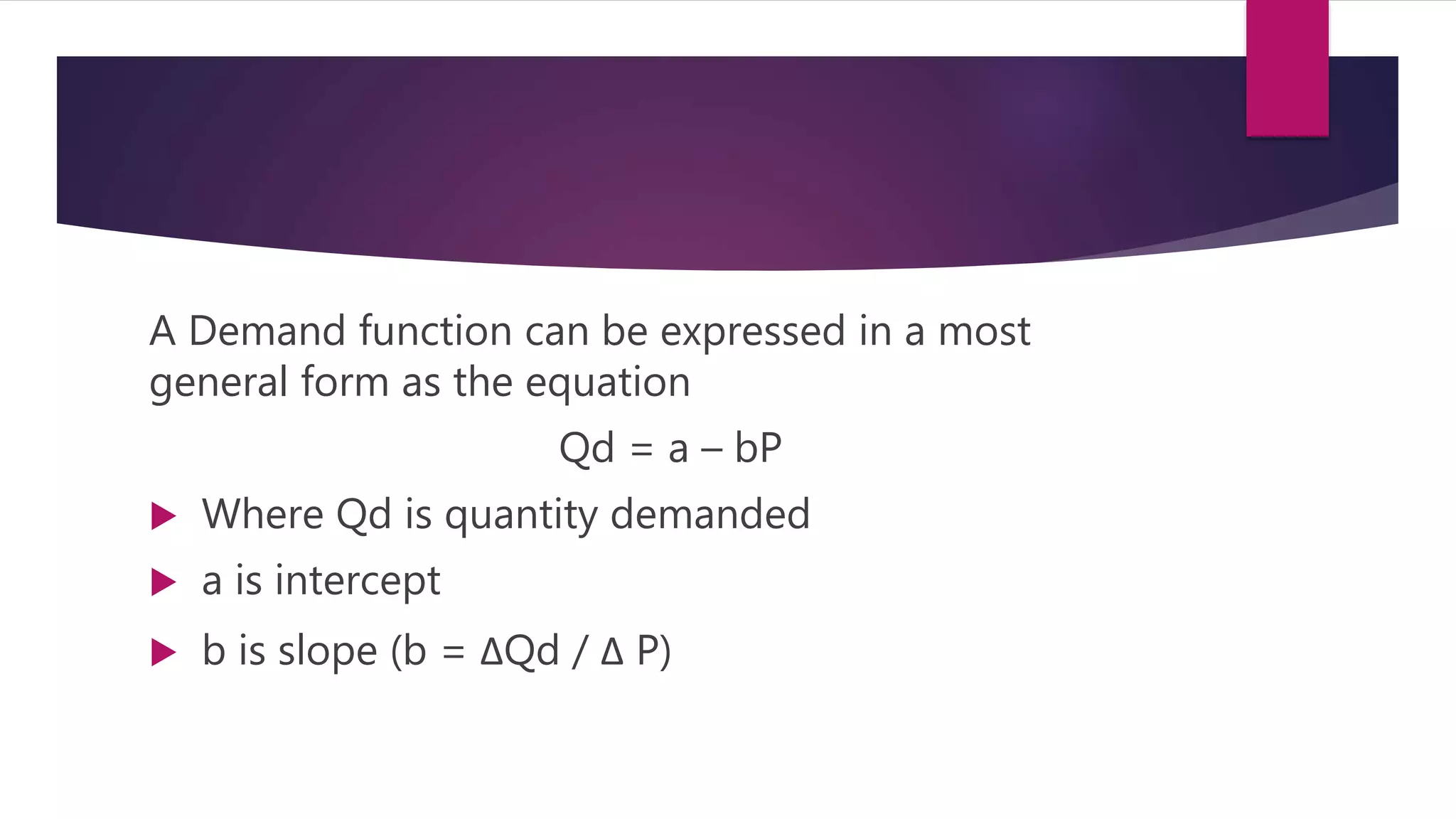
A Demand function can be expressed in a most
general form as the equation
Qd = a – bP
 Where Qd is quantity demanded
 a is intercept
 b is slope (b = ΔQd / Δ P)
Factors Affecting Demand Function
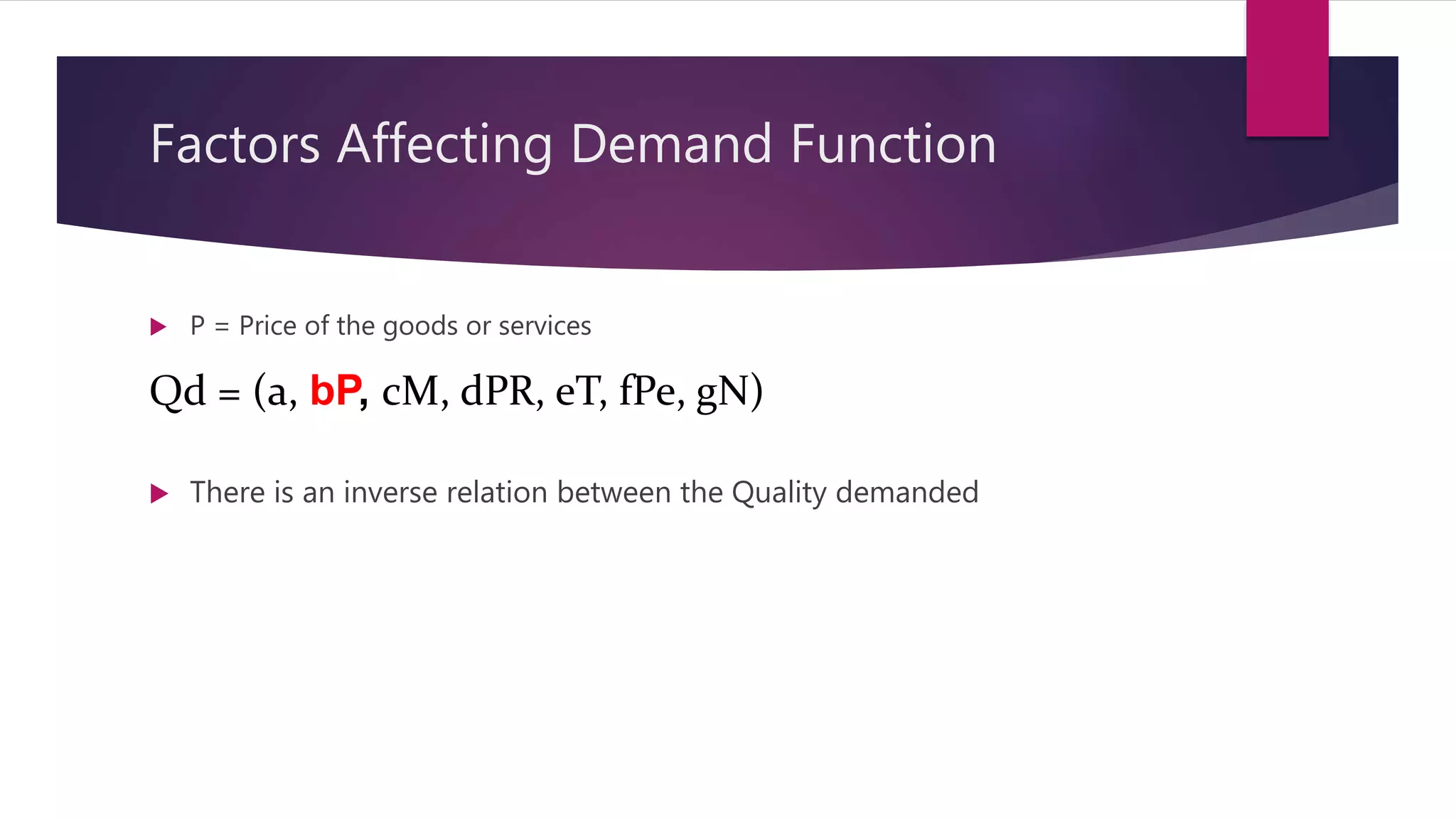
 P = Price of the goods or services
Qd = (a, bP, cM, dPR, eT, fPe, gN)
 There is an inverse relation between the Quality demanded
0
20
40
60
80
100
10 20 30 40
Quantity
Price
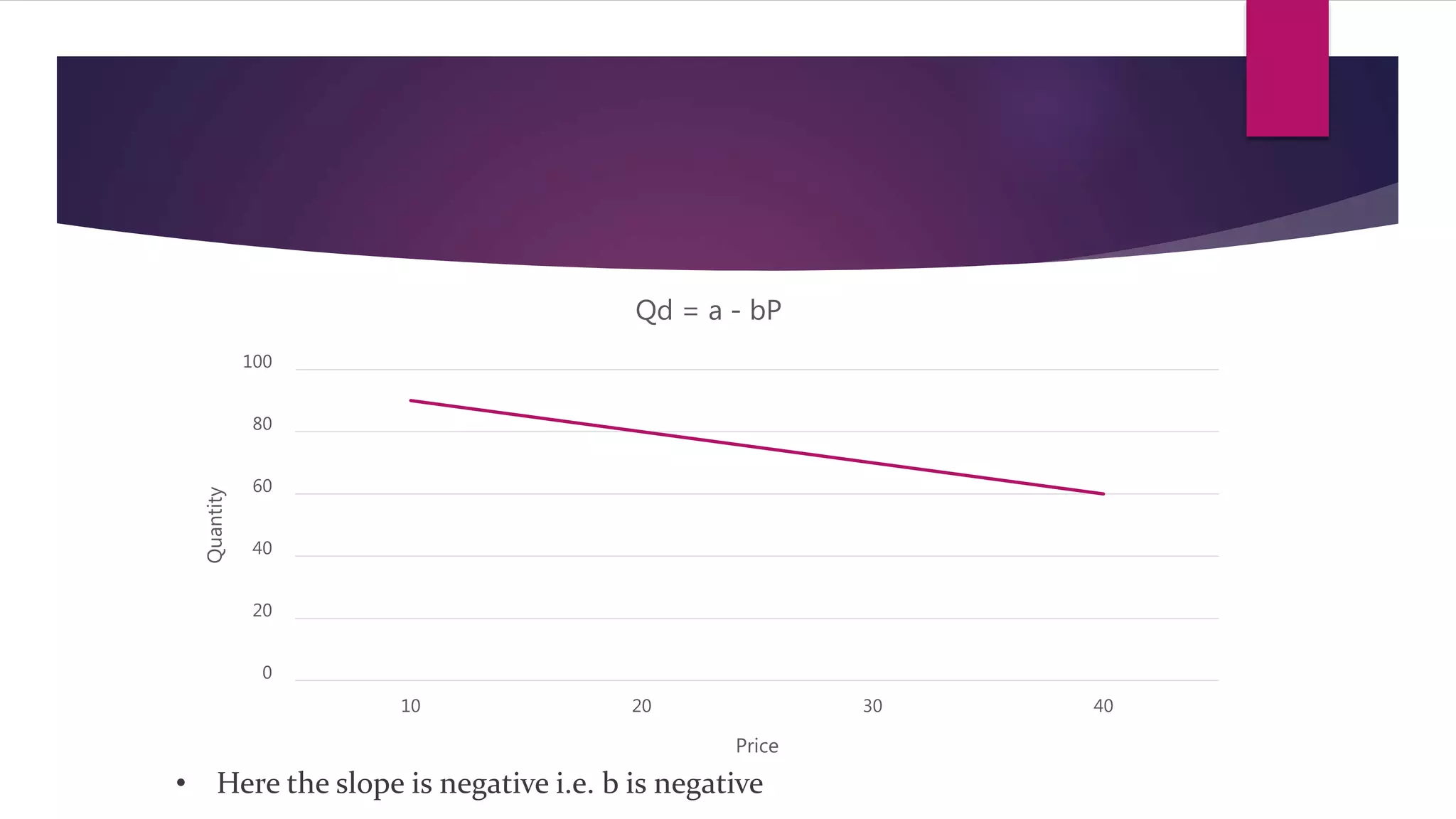
Qd = a - bP
• Here the slope is negative i.e. b is negative
Factors Affecting Demand Function
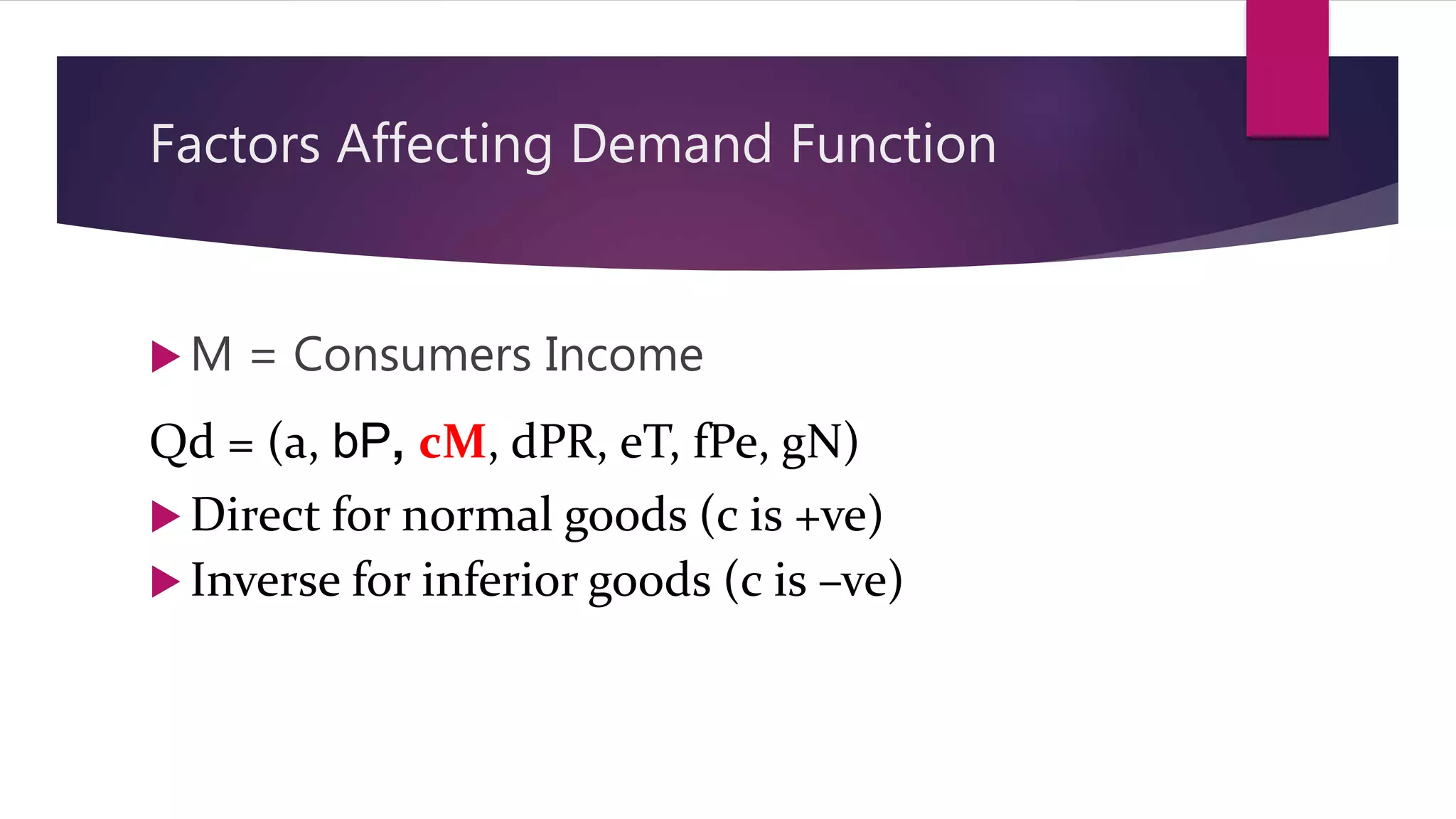
 M = Consumers Income
Qd = (a, bP, cM, dPR, eT, fPe, gN)
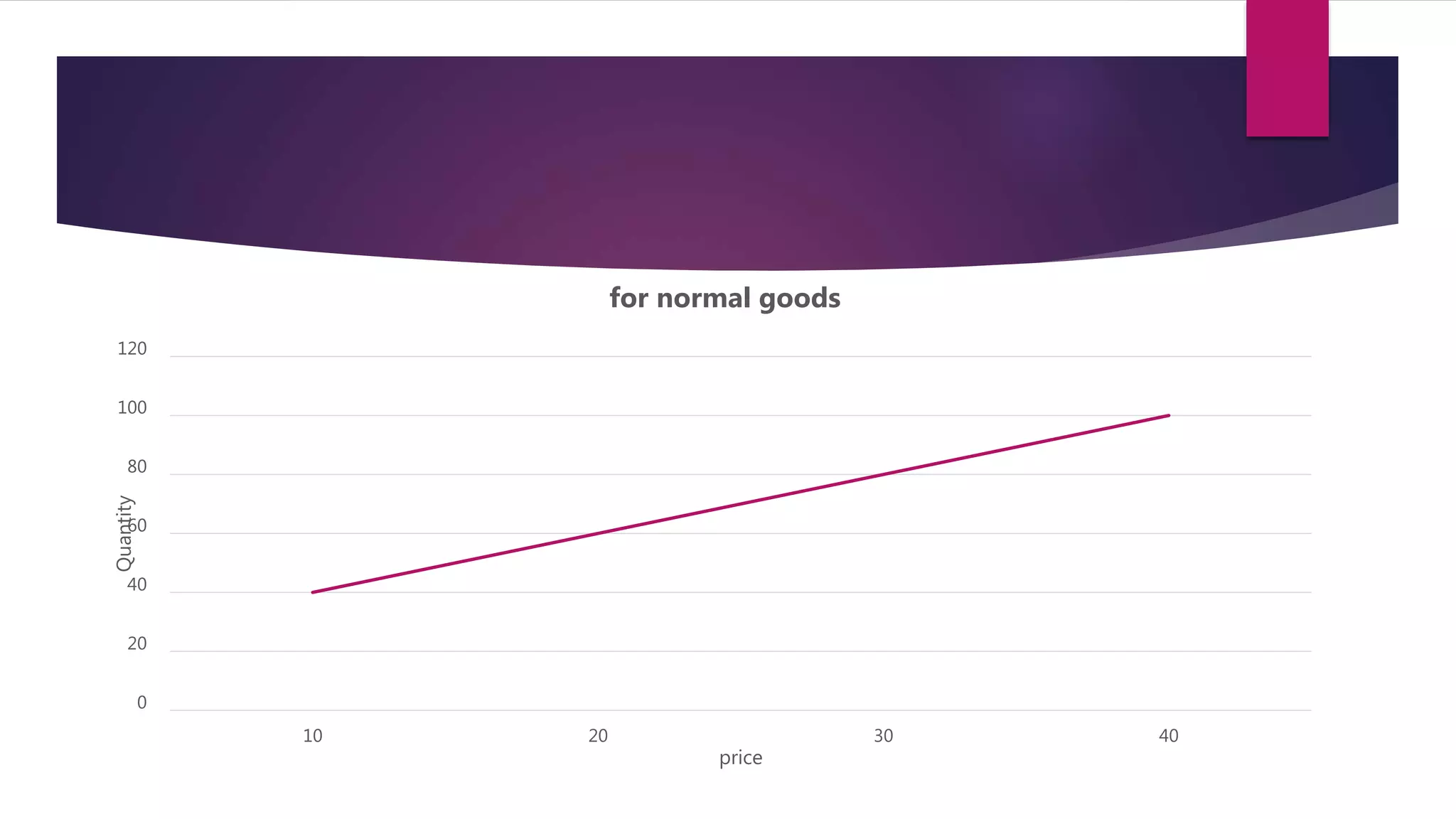
 Direct for normal goods (c is +ve)
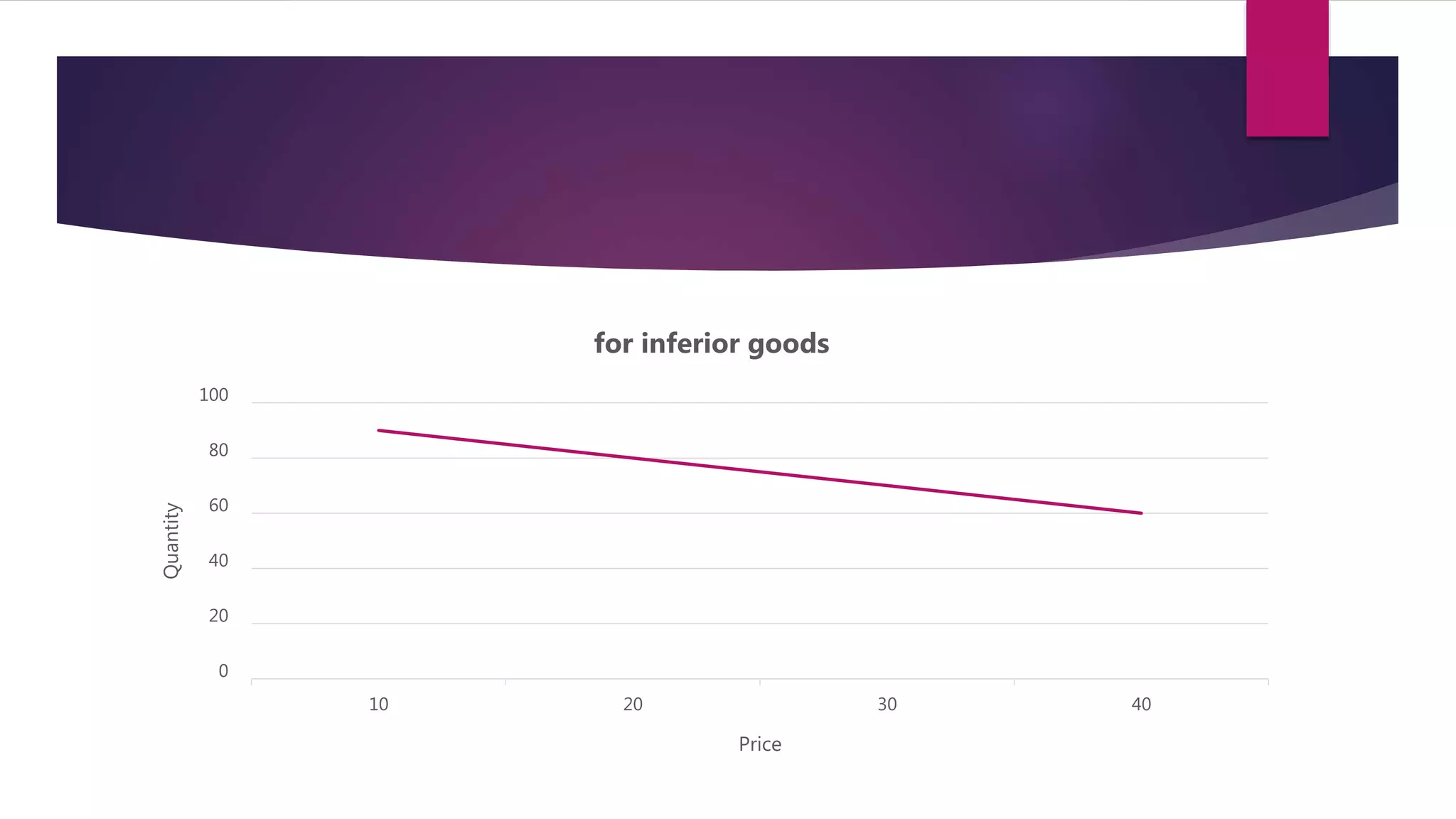
 Inverse for inferior goods (c is –ve)
0
20
40
60
80
100
120
10 20 30 40
Quantity
price
for normal goods
0
20
40
60
80
100
10 20 30 40
Quantity
Price
for inferior goods
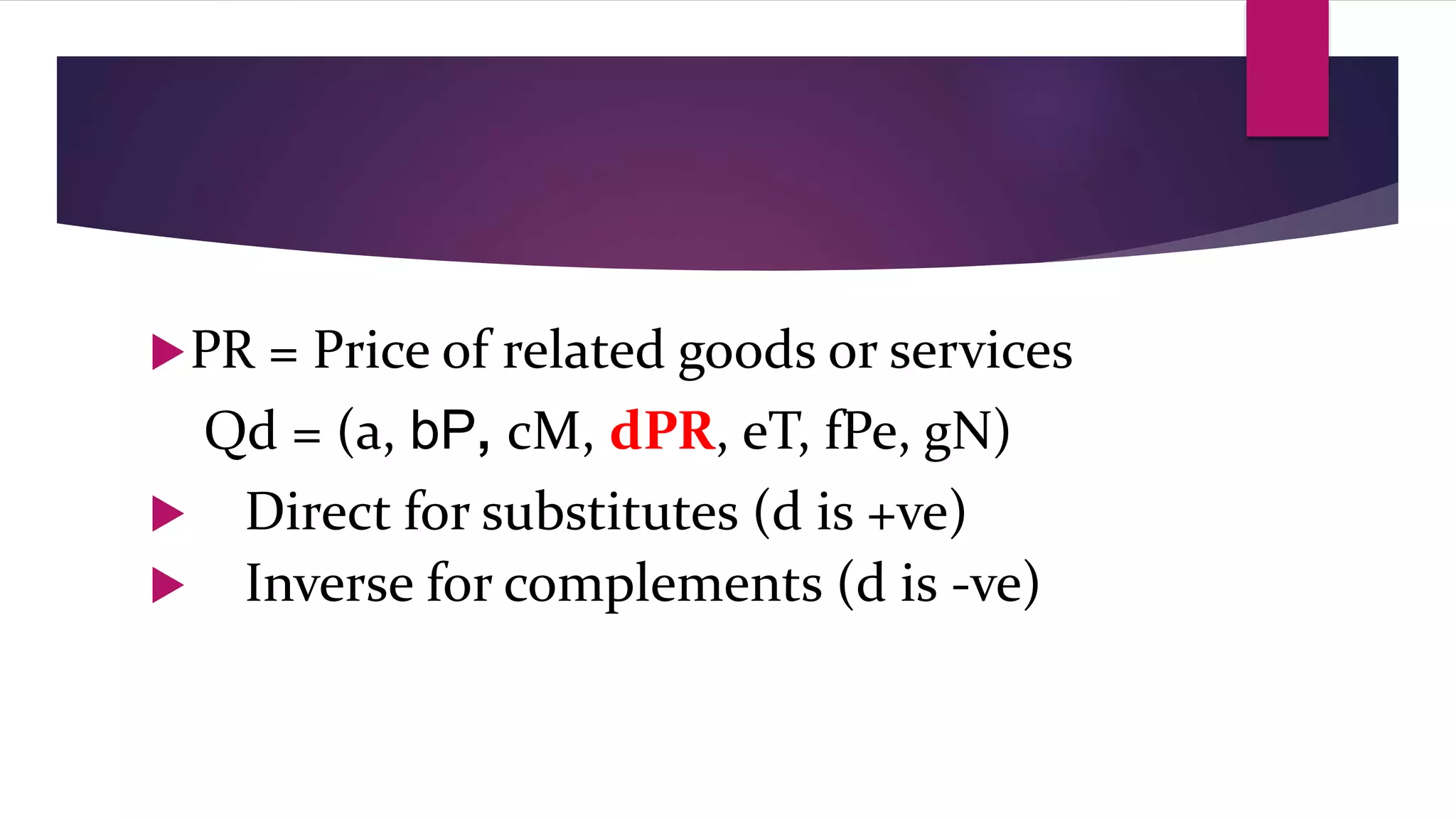
PR = Price of related goods or services
Qd = (a, bP, cM, dPR, eT, fPe, gN)
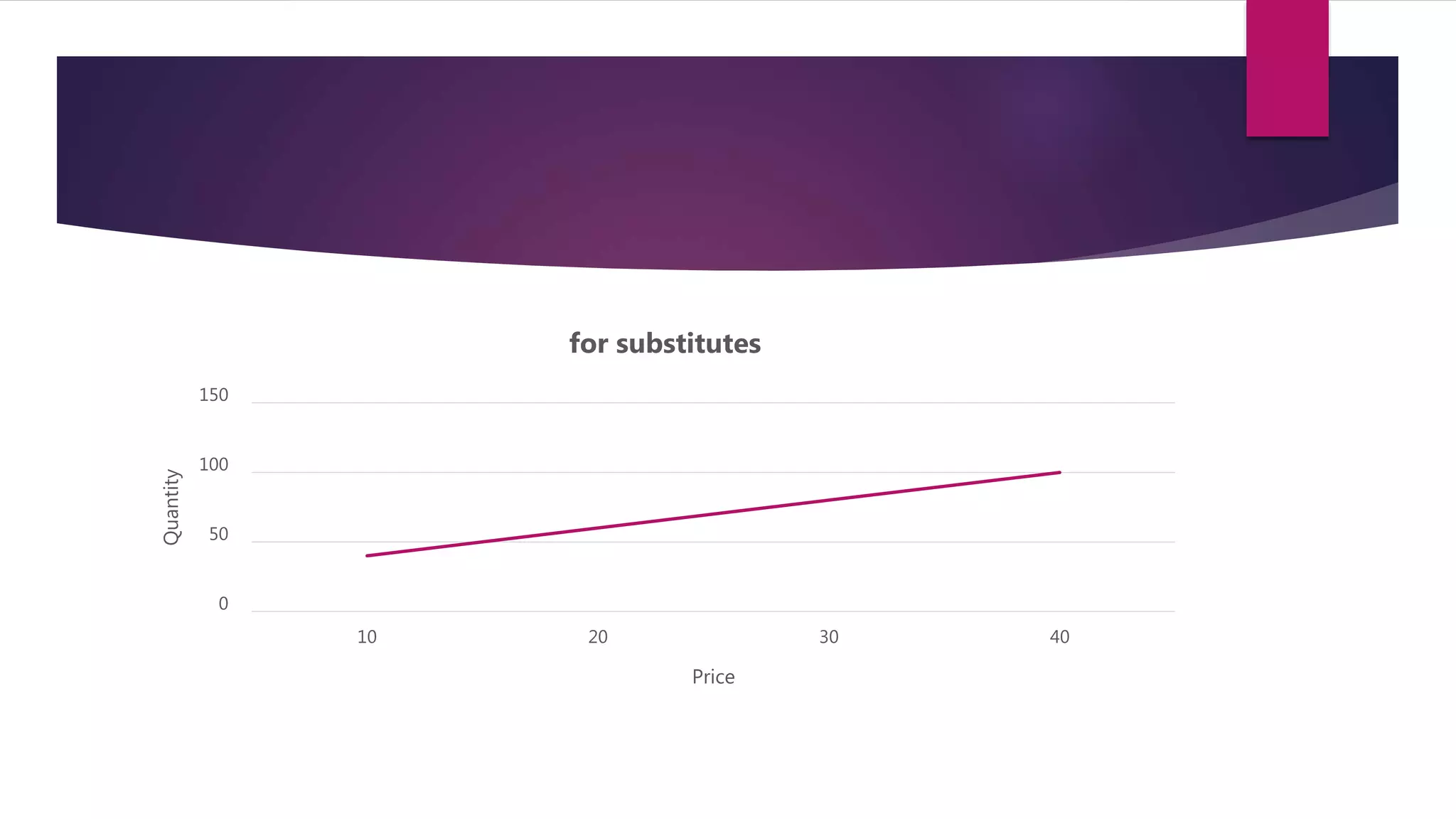
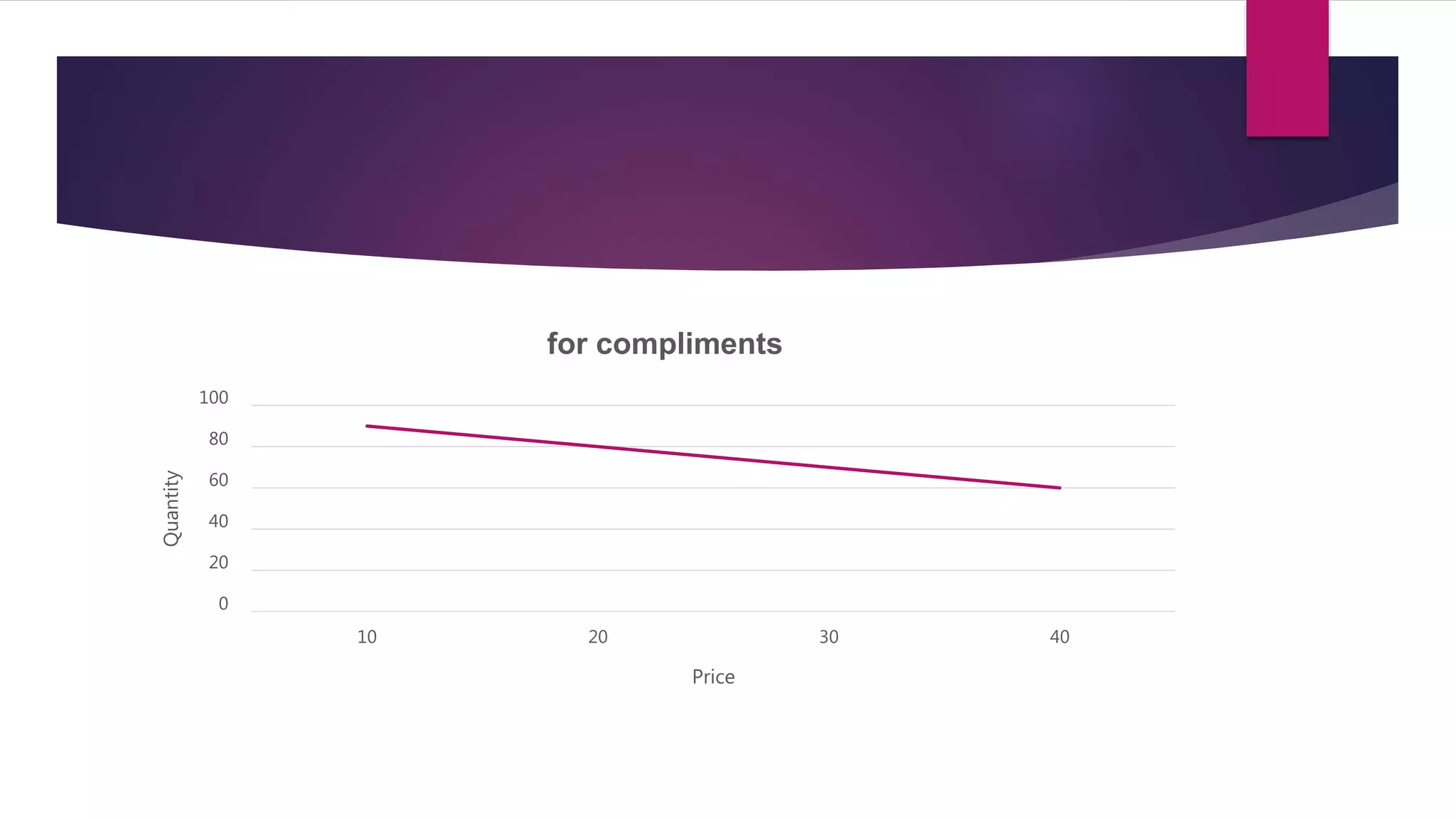
 Direct for substitutes (d is +ve)
 Inverse for complements (d is -ve)
0
50
100
150
10 20 30 40
Quantity
Price
for substitutes
0
20
40
60
80
100
10 20 30 40
Quantity
Price
for compliments
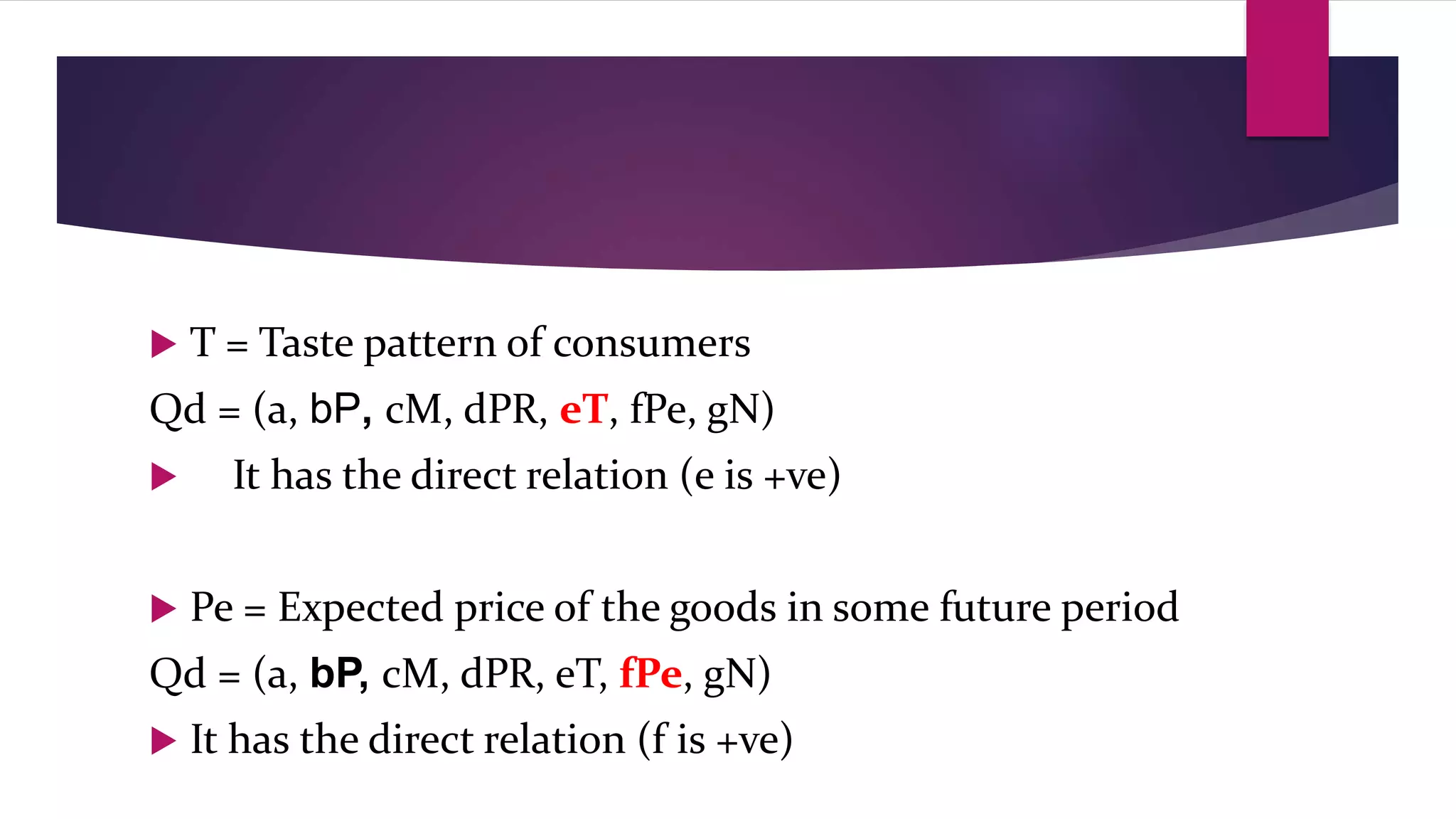
 T = Taste pattern of consumers
Qd = (a, bP, cM, dPR, eT, fPe, gN)
 It has the direct relation (e is +ve)
 Pe = Expected price of the goods in some future period
Qd = (a, bP, cM, dPR, eT, fPe, gN)
 It has the direct relation (f is +ve)
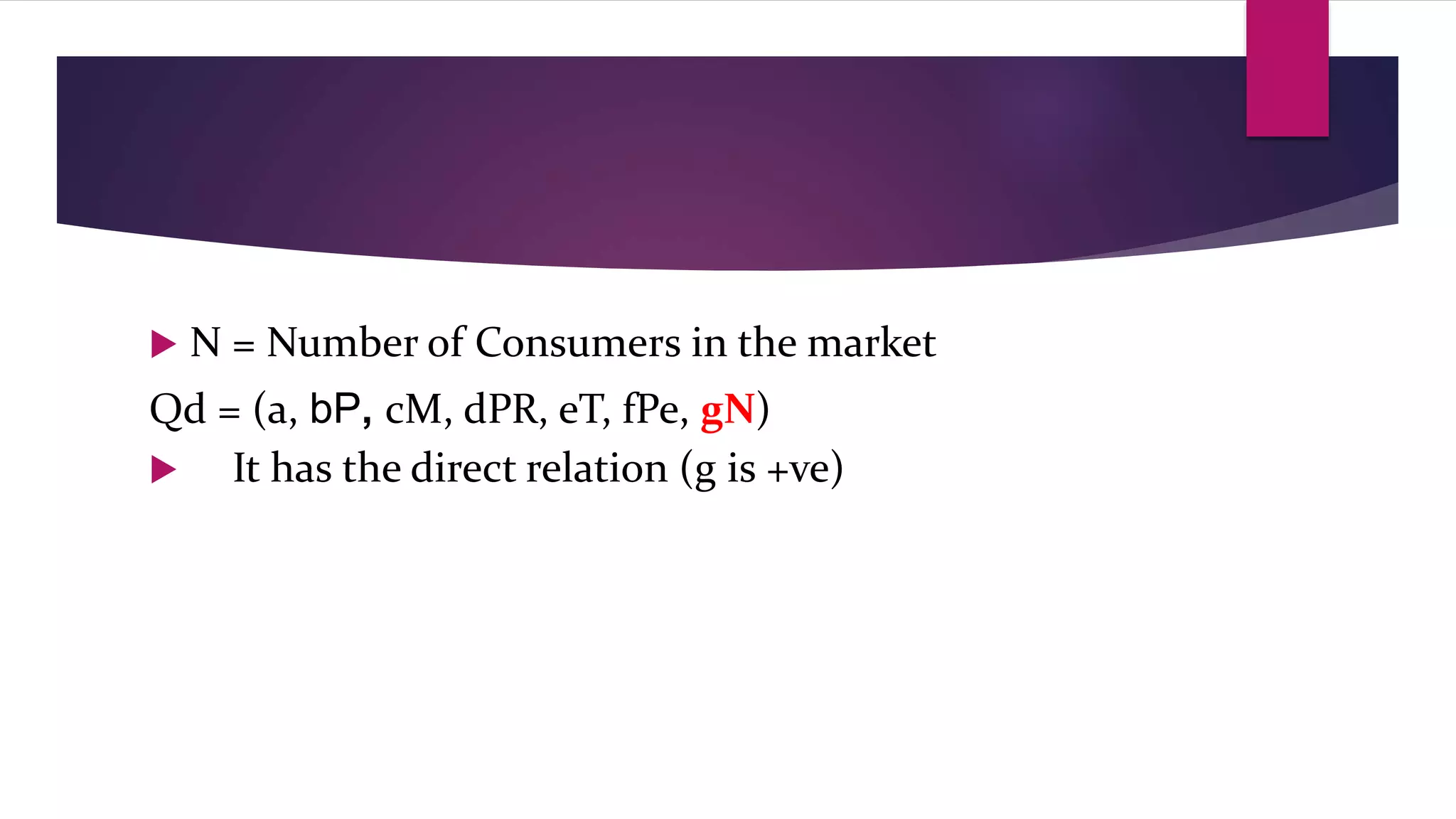
 N = Number of Consumers in the market
Qd = (a, bP, cM, dPR, eT, fPe, gN)
 It has the direct relation (g is +ve)
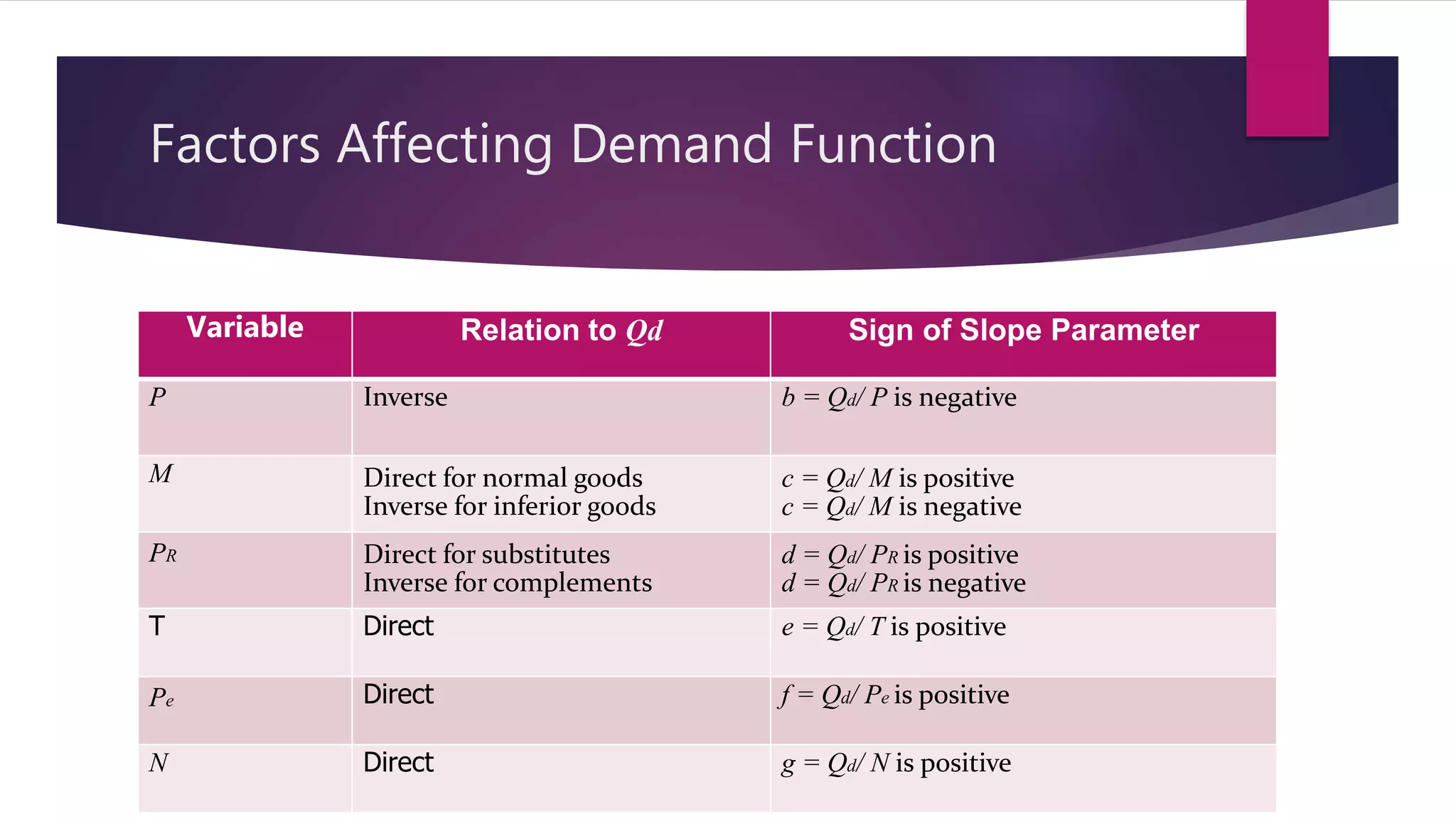
Variable Relation to Qd Sign of Slope Parameter
P Inverse b = Qd/ P is negative
M Direct for normal goods
Inverse for inferior goods
c = Qd/ M is positive
c = Qd/ M is negative
PR Direct for substitutes
Inverse for complements
d = Qd/ PR is positive
d = Qd/ PR is negative
T Direct e = Qd/ T is positive
Pe Direct f = Qd/ Pe is positive
N Direct g = Qd/ N is positive
Factors Affecting Demand Function
Demand function

Demand function

  • 1.
    Demand and Demand Function BYABHIJEET SINGH CHAWRA MBA (SEM I) CMAT 2017-19 DMS, JNVU, JODHPUR
  • 2.
    Demand  In generalterms ‘Demand’ means desire, need , want or requirement of a commodity.  So Demand is an economic principle that describes a consumer’s desire and willingness to pay a price for a specific good or service. Holding all other factors(such as price of related goods, income, tastes and preferences, advertising etc.) constant, an increase in the price of a good or service will decrease demand, and vice versa.
  • 3.
     For instance- Everyonemight have willingness to buy “Mercedes-S Class” but only a few have the ability to pay for it, a few have the purchasing power. Thus, everyone cannot be said to have a demand for the car “Mercedes-S Class”.
  • 4.
    Demand Function  DemandFunction is a mathematical function showing relationship between the quantity demanded of a commodity and the factors influencing demand.  A Demand Function expresses quantity demanded as a function of product price  The relation between price and quantity demanded per period of time, when all other factor that affects consumer demand are held constant, is called a demand function
  • 5.
    What is QuantityDemanded?  Quantity demanded Is a term used in economics to describe the total amount of goods or services demanded at any given point in time. It depends on the price of a good or service in the marketplace, regardless of whether that market is in equilibrium.
  • 6.
     Quantities ofa commodity which the consumers buy at a particular price  It is a flow concept  Quantity demanded>Quantity available for sale  Quantity demanded = F(Price)  Other determinants are assumed to be constant  Higher the price, lower will be the quantity demanded.
  • 7.
    Quantity Demanded  Qd= f( bP, cM, dPR, eT, fPe, gN)  b, c, d, e, f and g are slope parameters  P = Price of the goods or services  M = Consumers Income  PR = Price of related goods or services  T = Taste pattern of consumers  Pe = Expected price of the goods in some future period  N = Number of Consumers in the market
  • 8.
    A Demand functioncan be expressed in a most general form as the equation Qd = a – bP  Where Qd is quantity demanded  a is intercept  b is slope (b = ΔQd / Δ P)
  • 9.
    Factors Affecting DemandFunction  P = Price of the goods or services Qd = (a, bP, cM, dPR, eT, fPe, gN)  There is an inverse relation between the Quality demanded
  • 10.
    0 20 40 60 80 100 10 20 3040 Quantity Price Qd = a - bP • Here the slope is negative i.e. b is negative
  • 11.
    Factors Affecting DemandFunction  M = Consumers Income Qd = (a, bP, cM, dPR, eT, fPe, gN)  Direct for normal goods (c is +ve)  Inverse for inferior goods (c is –ve)
  • 12.
    0 20 40 60 80 100 120 10 20 3040 Quantity price for normal goods
  • 13.
    0 20 40 60 80 100 10 20 3040 Quantity Price for inferior goods
  • 14.
    PR = Priceof related goods or services Qd = (a, bP, cM, dPR, eT, fPe, gN)  Direct for substitutes (d is +ve)  Inverse for complements (d is -ve)
  • 15.
    0 50 100 150 10 20 3040 Quantity Price for substitutes
  • 16.
    0 20 40 60 80 100 10 20 3040 Quantity Price for compliments
  • 17.
     T =Taste pattern of consumers Qd = (a, bP, cM, dPR, eT, fPe, gN)  It has the direct relation (e is +ve)  Pe = Expected price of the goods in some future period Qd = (a, bP, cM, dPR, eT, fPe, gN)  It has the direct relation (f is +ve)
  • 18.
     N =Number of Consumers in the market Qd = (a, bP, cM, dPR, eT, fPe, gN)  It has the direct relation (g is +ve)
  • 19.
    Variable Relation toQd Sign of Slope Parameter P Inverse b = Qd/ P is negative M Direct for normal goods Inverse for inferior goods c = Qd/ M is positive c = Qd/ M is negative PR Direct for substitutes Inverse for complements d = Qd/ PR is positive d = Qd/ PR is negative T Direct e = Qd/ T is positive Pe Direct f = Qd/ Pe is positive N Direct g = Qd/ N is positive Factors Affecting Demand Function