INTRODUCTION TO DEMAND
•Whatis Demand?
In general ‘Demand’ means desire, need, want or requirement of
commodity.
Demand refers to the quantity of a good or service that consumers are
willing and able to buy at various prices during a given period.
So, demand is an economic principle that describes a consumer’s desire
and willingness to pay a price for a specific goods and service.
It depends on price, income, tastes, prices of related goods, and
expectations.
3.
DEMAND FUNCTION
What isDemand Function?
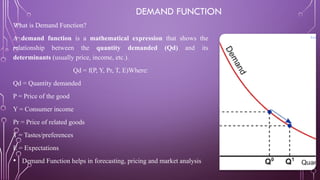
A demand function is a mathematical expression that shows the
relationship between the quantity demanded (Qd) and its
determinants (usually price, income, etc.).
Qd = f(P, Y, Pr, T, E)Where:
Qd= Quantity demanded
P = Price of the good
Y = Consumer income
Pr= Price of related goods
T = Tastes/preferences
E = Expectations
• Demand Function helps in forecasting, pricing and market analysis
4.
LAW OF DEMAND
•Law of Demand states that there exist an inverse relationship between price and
quantity demanded, as the price decreases, the quantity demanded increases,
ceteris paribus (other things remaining constant).
• Inverse relationship means negative relationship showing downward sloping
demand curve
DETERMINANTS OF DEMAND
•PRICE OF THE COMMODITY: Inverse relationship between price of the commodity and
its quantity demanded.
• Price of Related Goods: two cases
Substitute Goods: Tea And Coffee- Direct relationship between price of a commodity and
demand for its substitute
Complimentary Goods: Ink and Pen- Inverse relationship between price of a commodity
and demand for its complimentary good.
• Income of the Consumer: Two cases
Normal Goods: Direct relation- Demand of the commodity increases with increase in
income of the consumer.
Inferior Goods: Inverse relation-Demand of the commodity decreases with increase in
income of the consumer
7.
• Taste andPreference of the Consumer: Direct Relation- Favourable changes in
the taste and preference of the consumer increases the demand for the
commodity.
• Expectation of the consumer about future change in price of the commodity-
Direct relation.
• Size of population- Direct relation
8.
CHANGE IN QUANTITYDEMAND
• Change in quantity demanded refers to a movement along the same demand
curve due to a change in the price of the good or service itself while all other
factors remain constant.
• Cause of change in quantity demand is due to change in the price of the good.
• Effect of change in quantity demanded is movement along the demand curve
there is no shift taking place.
• The effect of change in quantity demanded is often called as Expansion and
Contraction of quantity demanded.
9.
EXPANSION OF DEMANDCURVE
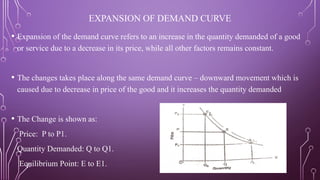
• Expansion of the demand curve refers to an increase in the quantity demanded of a good
or service due to a decrease in its price, while all other factors remains constant.
• The changes takes place along the same demand curve – downward movement which is
caused due to decrease in price of the good and it increases the quantity demanded
• The Change is shown as:
Price: P to P1.
Quantity Demanded: Q to Q1.
Equilibrium Point: E to E1.
10.
CONTRACTION OF THEDEMAND CURVE
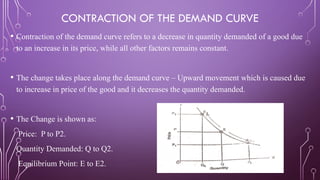
• Contraction of the demand curve refers to a decrease in quantity demanded of a good due
to an increase in its price, while all other factors remains constant.
• The change takes place along the demand curve – Upward movement which is caused due
to increase in price of the good and it decreases the quantity demanded.
• The Change is shown as:
Price: P to P2.
Quantity Demanded: Q to Q2.
Equilibrium Point: E to E2.
11.
SHIFT IN DEMANDCURVE
• Shift in demand curve refers to a change in the entire demand for a good due to factors
other than price . This means the quantity demanded changes at every price level , resulting
in a new demand curve .
• The shift in demand curve is called as Increase in Demand and Decrease in Demand.
• Increase in Demand is Rightward Shift
• Decrease in Demand is Leftward Shift
12.
INCREASE IN DEMAND
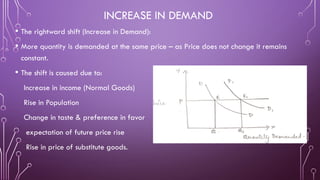
•The rightward shift (Increase in Demand):
• More quantity is demanded at the same price – as Price does not change it remains
constant.
• The shift is caused due to:
Increase in income (Normal Goods)
Rise in Population
Change in taste & preference in favor
expectation of future price rise
Rise in price of substitute goods.
13.
DECREASE IN DEMAND
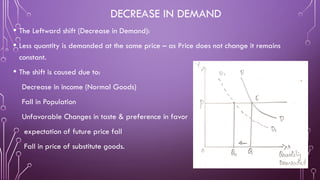
•The Leftward shift (Decrease in Demand):
• Less quantity is demanded at the same price – as Price does not change it remains
constant.
• The shift is caused due to:
Decrease in income (Normal Goods)
Fall in Population
Unfavorable Changes in taste & preference in favor
expectation of future price fall
Fall in price of substitute goods.







![Awareness of digital currency[1] (1).pptx](https://cdn.slidesharecdn.com/ss_thumbnails/awarenessofdigitalcurrency11-260125155504-b1badee4-thumbnail.jpg?width=640&height=640&fit=bounds)


