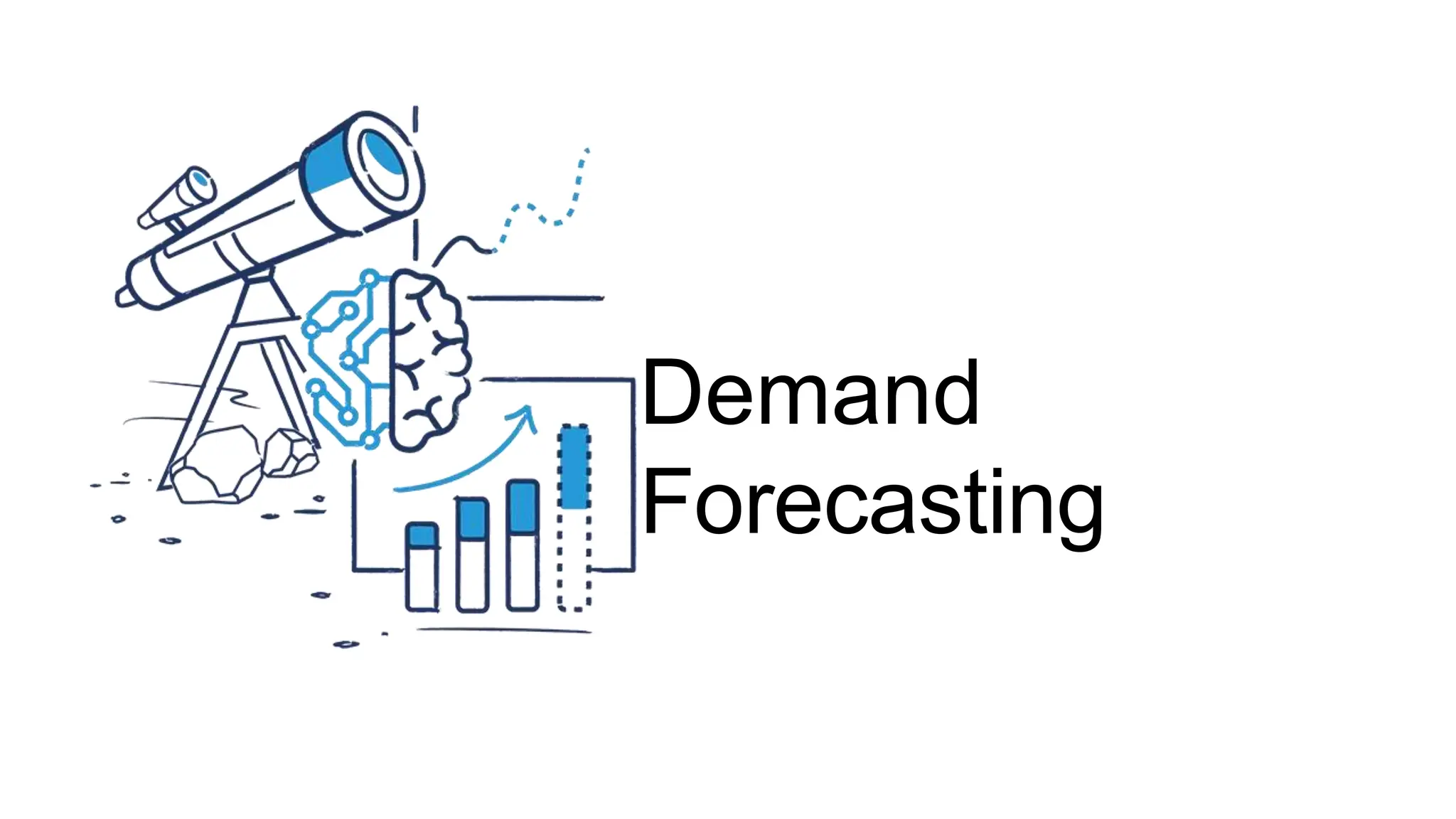
Demand
Forecasting
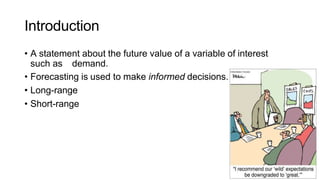
Introduction
• A statement about the future value of a variable of interest
such as demand.
• Forecasting is used to make informed decisions.
• Long-range
• Short-range
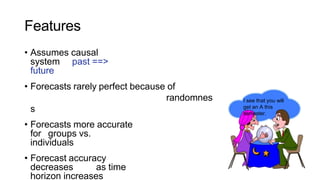
Features
• Assumes causal
system past ==>
future
• Forecasts rarely perfect because of
randomnes
s
• Forecasts more accurate
for groups vs.
individuals
• Forecast accuracy
decreases as time
horizon increases
I see that you will
get an A this
semester.
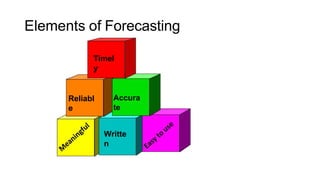
Elements of Forecasting
Timel
y
Accura
te
Reliabl
e
Writte
n
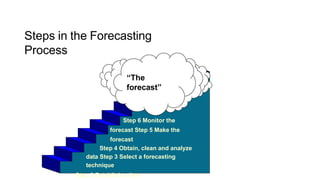
Steps in the Forecasting
Process
Step 6 Monitor the
forecast Step 5 Make the
forecast
Step 4 Obtain, clean and analyze
data Step 3 Select a forecasting
technique
Step 2 Establish a time
“The
forecast”
Qualitative forecasting
techniques
• Judgmental - uses subjective inputs
• Time series - uses historical data assuming the future will be
like the past
• Associative models - uses explanatory variables to predict the
future
3-7
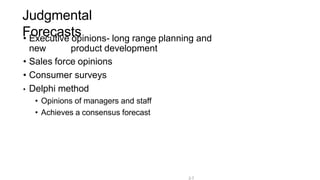
Judgmental
Forecasts
• Executive opinions- long range planning and
new product development
• Sales force opinions
• Consumer surveys
• Delphi method
• Opinions of managers and staff
• Achieves a consensus forecast
3-8
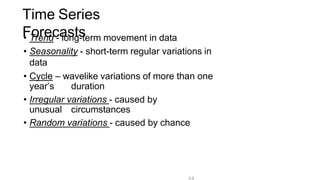
Time Series
Forecasts
• Trend - long-term movement in data
• Seasonality - short-term regular variations in
data
• Cycle – wavelike variations of more than one
year’s duration
• Irregular variations - caused by
unusual circumstances
• Random variations - caused by chance
3-9
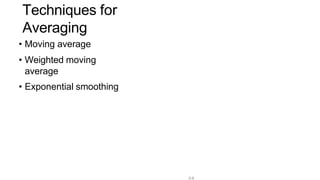
Techniques for
Averaging
• Moving average
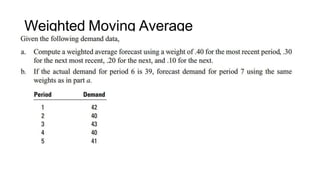
• Weighted moving
average
• Exponential smoothing
3-
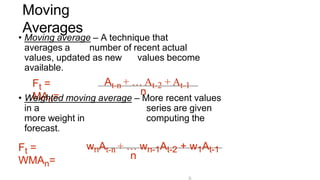
Moving
Averages
Ft =
MAn=
• Moving average – A technique that
averages a number of recent actual
values, updated as new values become
available.
At-n + … At-2 + At-1
n
Ft =
WMAn=
• Weighted moving average – More recent values
in a series are given
more weight in computing the
forecast.
wnAt-n + … wn-1At-2 + w1At-1
n
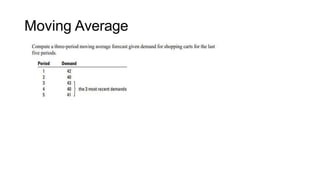
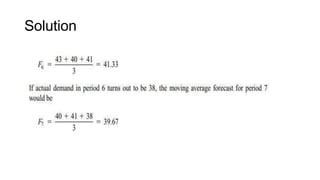
Moving Average
Solution
Weighted Moving Average
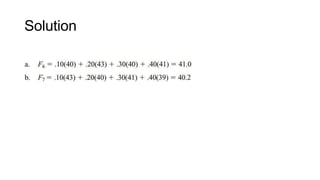
Solution
3-
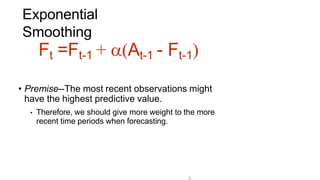
Exponential
Smoothing
Ft =Ft-1 + (At-1 - Ft-1)
• Premise--The most recent observations might
have the highest predictive value.
• Therefore, we should give more weight to the more
recent time periods when forecasting.
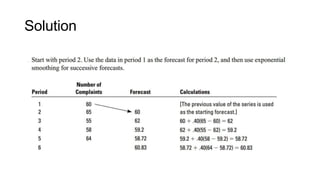
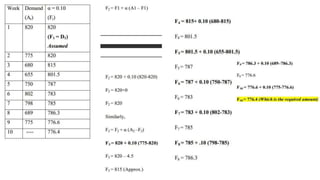
Exponential Smoothing
Solution
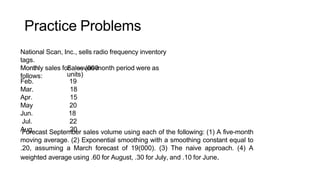
Practice Problems
National Scan, Inc., sells radio frequency inventory
tags.
Monthly sales for a seven-month period were as
follows:
Month Sales (000
units)
Feb. 19
Mar. 18
Apr. 15
May 20
Jun. 18
Jul. 22
Aug. 20
Forecast September sales volume using each of the following: (1) A five-month
moving average. (2) Exponential smoothing with a smoothing constant equal to
.20, assuming a March forecast of 19(000). (3) The naive approach. (4) A
weighted average using .60 for August, .30 for July, and .10 for June.
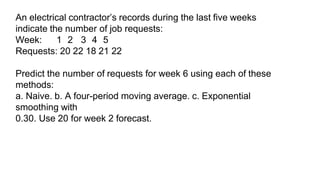
An electrical contractor’s records during the last five weeks
indicate the number of job requests:
Week: 1 2 3 4 5
Requests: 20 22 18 21 22
Predict the number of requests for week 6 using each of these
methods:
a. Naive. b. A four-period moving average. c. Exponential
smoothing with
0.30. Use 20 for week 2 forecast.

Demand Forecasting and it's indepth knowledge

  • 1.
  • 2.
    Introduction • A statementabout the future value of a variable of interest such as demand. • Forecasting is used to make informed decisions. • Long-range • Short-range
  • 3.
    Features • Assumes causal systempast ==> future • Forecasts rarely perfect because of randomnes s • Forecasts more accurate for groups vs. individuals • Forecast accuracy decreases as time horizon increases I see that you will get an A this semester.
  • 4.
  • 5.
    Steps in theForecasting Process Step 6 Monitor the forecast Step 5 Make the forecast Step 4 Obtain, clean and analyze data Step 3 Select a forecasting technique Step 2 Establish a time “The forecast”
  • 6.
    Qualitative forecasting techniques • Judgmental- uses subjective inputs • Time series - uses historical data assuming the future will be like the past • Associative models - uses explanatory variables to predict the future
  • 7.
    3-7 Judgmental Forecasts • Executive opinions-long range planning and new product development • Sales force opinions • Consumer surveys • Delphi method • Opinions of managers and staff • Achieves a consensus forecast
  • 8.
    3-8 Time Series Forecasts • Trend- long-term movement in data • Seasonality - short-term regular variations in data • Cycle – wavelike variations of more than one year’s duration • Irregular variations - caused by unusual circumstances • Random variations - caused by chance
  • 9.
    3-9 Techniques for Averaging • Movingaverage • Weighted moving average • Exponential smoothing
  • 10.
    3- Moving Averages Ft = MAn= • Movingaverage – A technique that averages a number of recent actual values, updated as new values become available. At-n + … At-2 + At-1 n Ft = WMAn= • Weighted moving average – More recent values in a series are given more weight in computing the forecast. wnAt-n + … wn-1At-2 + w1At-1 n
  • 11.
  • 12.
  • 13.
  • 14.
  • 15.
    3- Exponential Smoothing Ft =Ft-1 +(At-1 - Ft-1) • Premise--The most recent observations might have the highest predictive value. • Therefore, we should give more weight to the more recent time periods when forecasting.
  • 16.
  • 19.
  • 22.
    Practice Problems National Scan,Inc., sells radio frequency inventory tags. Monthly sales for a seven-month period were as follows: Month Sales (000 units) Feb. 19 Mar. 18 Apr. 15 May 20 Jun. 18 Jul. 22 Aug. 20 Forecast September sales volume using each of the following: (1) A five-month moving average. (2) Exponential smoothing with a smoothing constant equal to .20, assuming a March forecast of 19(000). (3) The naive approach. (4) A weighted average using .60 for August, .30 for July, and .10 for June.
  • 23.
    An electrical contractor’srecords during the last five weeks indicate the number of job requests: Week: 1 2 3 4 5 Requests: 20 22 18 21 22 Predict the number of requests for week 6 using each of these methods: a. Naive. b. A four-period moving average. c. Exponential smoothing with 0.30. Use 20 for week 2 forecast.