Forecasting
Forecasting
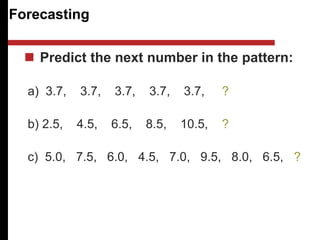
 Predict the next number in the pattern:
a) 3.7, 3.7, 3.7, 3.7, 3.7, ?
b) 2.5, 4.5, 6.5, 8.5, 10.5, ?
c) 5.0, 7.5, 6.0, 4.5, 7.0, 9.5, 8.0, 6.5, ?
Forecasting
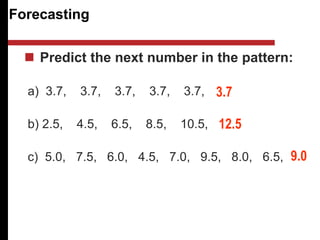
 Predict the next number in the pattern:
a) 3.7, 3.7, 3.7, 3.7, 3.7,
b) 2.5, 4.5, 6.5, 8.5, 10.5,
c) 5.0, 7.5, 6.0, 4.5, 7.0, 9.5, 8.0, 6.5,
3.7
12.5
9.0
Outline
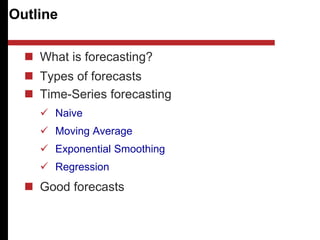
 What is forecasting?
 Types of forecasts
 Time-Series forecasting
 Naive
 Moving Average
 Exponential Smoothing
 Regression
 Good forecasts
What is Forecasting?
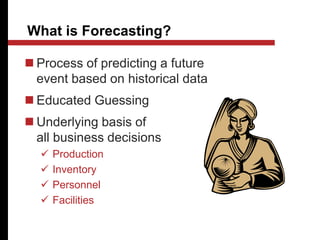
 Process of predicting a future
event based on historical data
 Educated Guessing
 Underlying basis of
all business decisions
 Production
 Inventory
 Personnel
 Facilities
In general, forecasts are almost always wrong. So,
Why do we need to forecast?
Throughout the day we forecast very different
things such as weather, traffic, stock market, state
of our company from different perspectives.
Virtually every business attempt is based on
forecasting. Not all of them are derived from
sophisticated methods. However, “Best" educated
guesses about future are more valuable for
purpose of Planning than no forecasts and hence
no planning.
Departments throughout the organization depend on
forecasts to formulate and execute their plans.
Finance needs forecasts to project cash flows and
capital requirements.
Human resources need forecasts to anticipate hiring
needs.
Production needs forecasts to plan production
levels, workforce, material requirements,
inventories, etc.
Importance of Forecasting in PPC
Demand is not the only variable of interest to
forecasters.
Manufacturers also forecast worker absenteeism,
machine availability, material costs, transportation
and production lead times, etc.
Besides demand, service providers are also
interested in forecasts of population, of other
demographic variables, of weather, etc.
Importance of Forecasting in PPC
Definition of forecasting
 In literary sense forecasting means
prediction. It may be defined as a technique
of translating past experience into
prediction of things to come.
OBJECTIVES OF FORECASTING
 Short term objectives
• Formulation of suitable production policy.
• Regulate supply of raw material.
• Best utilization of machines.
• Regular availability of labor.
• Price policy formulation.
• Forecasting of short term financial
requirements.
• Setting the sales target.
Long term objectives
• Deciding plant capacity.
• Manpower planning.
• Estimating cash inflows.
• Determining dividend policy.
• Planning of long-run production.
• Long run of financial requirements.
• Budgetary control over expenditure.
Factors affecting forecasting
• General business conditions.
• Conditions within the industry.
• Conditions within the company.
• Factors affecting export trade.
• Political stability.
• Government restrictions.
• Fiscal and monetary policy.
• Price level and trend.
• Technological research and development.
Factors for selecting particular forecasting
method
• The purpose of forecast.
• The degree of accuracy desirable.
• The time period to be forecasted.
• The cost and benefit of the forecast to the
company.
• The time available for making the analysis.
• Component of the system, for which
forecast has to be made etc.
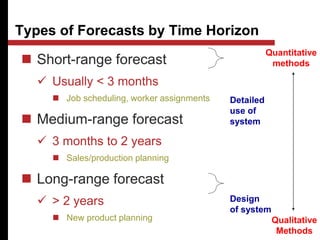
 Short-range forecast
 Usually < 3 months
 Job scheduling, worker assignments
 Medium-range forecast
 3 months to 2 years
 Sales/production planning
 Long-range forecast
 > 2 years
 New product planning
Types of Forecasts by Time Horizon
Design
of system
Detailed
use of
system
Quantitative
methods
Qualitative
Methods
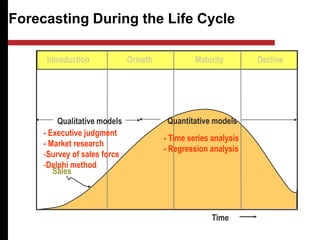
Forecasting During the Life Cycle
Introduction Growth Maturity Decline
Sales
Time
Quantitative models
- Time series analysis
- Regression analysis
Qualitative models
- Executive judgment
- Market research
-Survey of sales force
-Delphi method
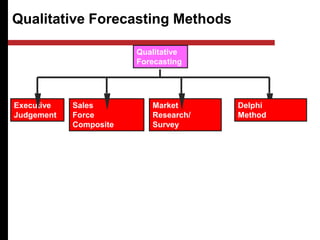
Qualitative Forecasting Methods
Qualitative
Forecasting
Models
Market
Research/
Survey
Market
Research/
Survey
Sales
Force
Composite
Executive
Judgement
Delphi
Method
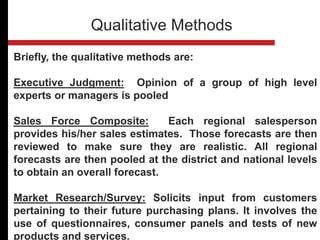
Briefly, the qualitative methods are:
Executive Judgment: Opinion of a group of high level
experts or managers is pooled
Sales Force Composite: Each regional salesperson
provides his/her sales estimates. Those forecasts are then
reviewed to make sure they are realistic. All regional
forecasts are then pooled at the district and national levels
to obtain an overall forecast.
Market Research/Survey: Solicits input from customers
pertaining to their future purchasing plans. It involves the
use of questionnaires, consumer panels and tests of new
products and services.
Qualitative Methods
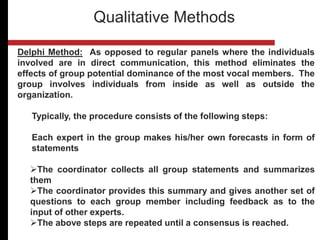
Delphi Method: As opposed to regular panels where the individuals
involved are in direct communication, this method eliminates the
effects of group potential dominance of the most vocal members. The
group involves individuals from inside as well as outside the
organization.
Typically, the procedure consists of the following steps:
Each expert in the group makes his/her own forecasts in form of
statements
The coordinator collects all group statements and summarizes
them
The coordinator provides this summary and gives another set of
questions to each group member including feedback as to the
input of other experts.
The above steps are repeated until a consensus is reached.
Qualitative Methods
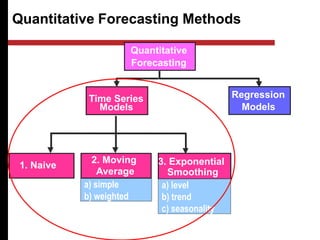
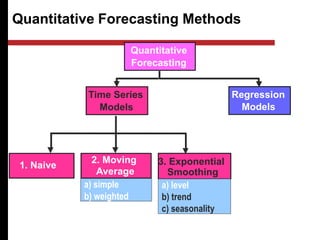
Quantitative Forecasting Methods
Quantitative
Forecasting
Regression
Models
2. Moving
Average
1. Naive
Time Series
Models
3. Exponential
Smoothing
a) simple
b) weighted
a) level
b) trend
c) seasonality
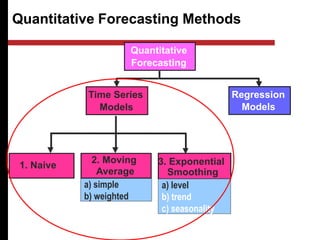
Quantitative Forecasting Methods
Quantitative
Forecasting
Regression
Models
2. Moving
Average
1. Naive
Time Series
Models
3. Exponential
Smoothing
a) simple
b) weighted
a) level
b) trend
c) seasonality
Time Series Models
 Try to predict the future based on past
data
 Assume that factors influencing the past will
continue to influence the future
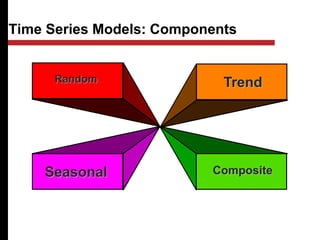
Random
Seasonal
Trend
Composite
Time Series Models: Components
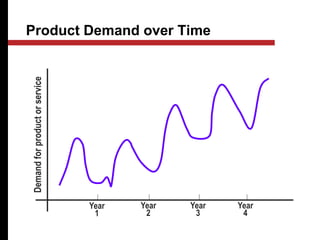
Product Demand over Time
Year
1
Year
2
Year
3
Year
4
Demand
for
product
or
service
Product Demand over Time
Year
1
Year
2
Year
3
Year
4
Demand
for
product
or
service
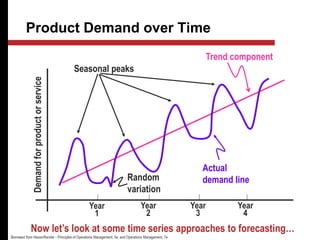
Trend component
Actual
demand line
Seasonal peaks
Random
variation
Now let’s look at some time series approaches to forecasting…
Borrowed from Heizer/Render - Principles of Operations Management, 5e, and Operations Management, 7e
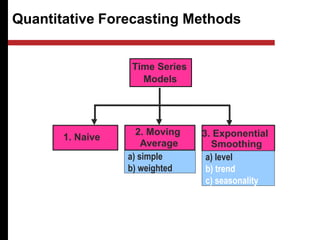
Quantitative Forecasting Methods
Quantitative
Models
2. Moving
Average
1. Naive
Time Series
Models
3. Exponential
Smoothing
a) simple
b) weighted
a) level
b) trend
c) seasonality
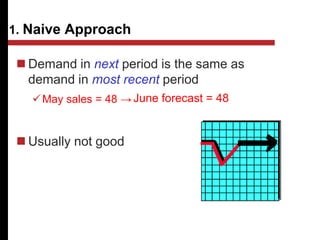
1. Naive Approach
 Demand in next period is the same as
demand in most recent period
May sales = 48 →
 Usually not good
June forecast = 48
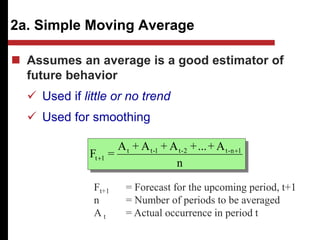
2a. Simple Moving Average
n
A
+
...
+
A
+
A
+
A
=
F 1
n
-
t
2
-
t
1
-
t
t
1
t


 Assumes an average is a good estimator of
future behavior
 Used if little or no trend
 Used for smoothing
Ft+1 = Forecast for the upcoming period, t+1
n = Number of periods to be averaged
A t = Actual occurrence in period t
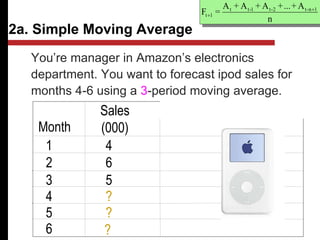
2a. Simple Moving Average
You’re manager in Amazon’s electronics
department. You want to forecast ipod sales for
months 4-6 using a 3-period moving average.
n
A
+
...
+
A
+
A
+
A
=
F 1
n
-
t
2
-
t
1
-
t
t
1
t


Month
Sales
(000)
1 4
2 6
3 5
4 ?
5 ?
6 ?
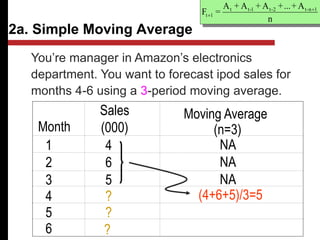
2a. Simple Moving Average
Month
Sales
(000)
Moving Average
(n=3)
1 4 NA
2 6 NA
3 5 NA
4 ?
5 ?
(4+6+5)/3=5
6 ?
n
A
+
...
+
A
+
A
+
A
=
F 1
n
-
t
2
-
t
1
-
t
t
1
t


You’re manager in Amazon’s electronics
department. You want to forecast ipod sales for
months 4-6 using a 3-period moving average.
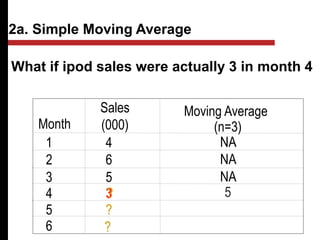
What if ipod sales were actually 3 in month 4
Month
Sales
(000)
Moving Average
(n=3)
1 4 NA
2 6 NA
3 5 NA
4 3
5 ?
5
6 ?
2a. Simple Moving Average
?
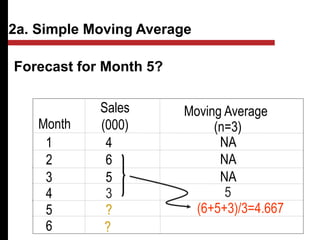
Forecast for Month 5?
Month
Sales
(000)
Moving Average
(n=3)
1 4 NA
2 6 NA
3 5 NA
4 3
5 ?
5
6 ?
(6+5+3)/3=4.667
2a. Simple Moving Average
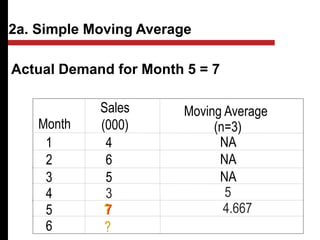
Actual Demand for Month 5 = 7
Month
Sales
(000)
Moving Average
(n=3)
1 4 NA
2 6 NA
3 5 NA
4 3
5 7
5
6 ?
4.667
2a. Simple Moving Average
?
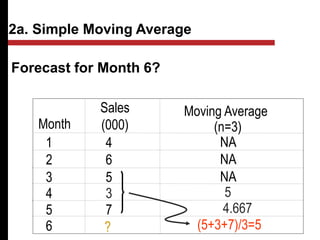
Forecast for Month 6?
Month
Sales
(000)
Moving Average
(n=3)
1 4 NA
2 6 NA
3 5 NA
4 3
5 7
5
6 ?
4.667
(5+3+7)/3=5
2a. Simple Moving Average
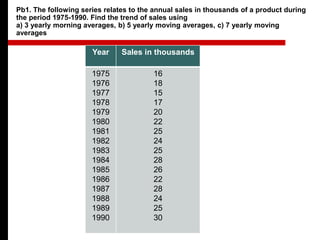
Pb1. The following series relates to the annual sales in thousands of a product during
the period 1975-1990. Find the trend of sales using
a) 3 yearly morning averages, b) 5 yearly moving averages, c) 7 yearly moving
averages
Year Sales in thousands
1975
1976
1977
1978
1979
1980
1981
1982
1983
1984
1985
1986
1987
1988
1989
1990
16
18
15
17
20
22
25
24
25
28
26
22
28
24
25
30
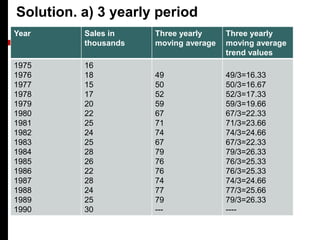
Solution. a) 3 yearly period
Year Sales in
thousands
Three yearly
moving average
Three yearly
moving average
trend values
1975
1976
1977
1978
1979
1980
1981
1982
1983
1984
1985
1986
1987
1988
1989
1990
16
18
15
17
20
22
25
24
25
28
26
22
28
24
25
30
49
50
52
59
67
71
74
67
79
76
76
74
77
79
---
49/3=16.33
50/3=16.67
52/3=17.33
59/3=19.66
67/3=22.33
71/3=23.66
74/3=24.66
67/3=22.33
79/3=26.33
76/3=25.33
76/3=25.33
74/3=24.66
77/3=25.66
79/3=26.33
----
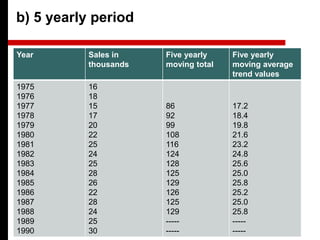
b) 5 yearly period
Year Sales in
thousands
Five yearly
moving total
Five yearly
moving average
trend values
1975
1976
1977
1978
1979
1980
1981
1982
1983
1984
1985
1986
1987
1988
1989
1990
16
18
15
17
20
22
25
24
25
28
26
22
28
24
25
30
86
92
99
108
116
124
128
125
129
126
125
129
-----
-----
17.2
18.4
19.8
21.6
23.2
24.8
25.6
25.0
25.8
25.2
25.0
25.8
-----
-----
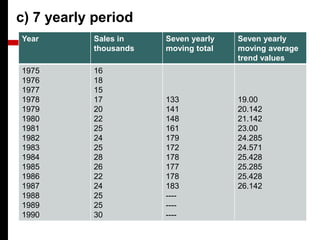
c) 7 yearly period
Year Sales in
thousands
Seven yearly
moving total
Seven yearly
moving average
trend values
1975
1976
1977
1978
1979
1980
1981
1982
1983
1984
1985
1986
1987
1988
1989
1990
16
18
15
17
20
22
25
24
25
28
26
22
24
25
25
30
133
141
148
161
179
172
178
177
178
183
----
----
----
19.00
20.142
21.142
23.00
24.285
24.571
25.428
25.285
25.428
26.142
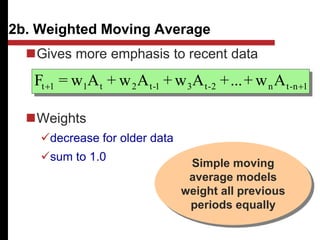
Gives more emphasis to recent data
Weights
decrease for older data
sum to 1.0
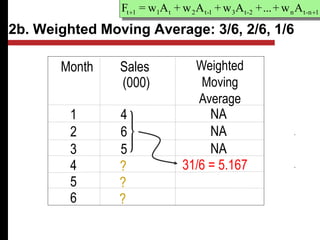
2b. Weighted Moving Average
1
n
-
t
n
2
-
t
3
1
-
t
2
t
1
1
t A
w
+
...
+
A
w
+
A
w
+
A
w
=
F 

Simple moving
average models
weight all previous
periods equally
2b. Weighted Moving Average: 3/6, 2/6, 1/6
Month Weighted
Moving
Average
1 4 NA
2 6 NA
3 5 NA
4 31/6 = 5.167
5
6 ?
?
?
1
n
-
t
n
2
-
t
3
1
-
t
2
t
1
1
t A
w
+
...
+
A
w
+
A
w
+
A
w
=
F 

Sales
(000)
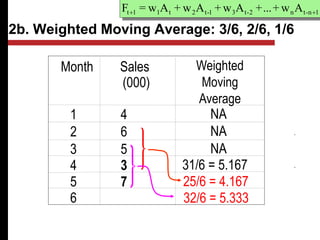
2b. Weighted Moving Average: 3/6, 2/6, 1/6
Month Sales
(000)
Weighted
Moving
Average
1 4 NA
2 6 NA
3 5 NA
4 3 31/6 = 5.167
5 7
6
25/6 = 4.167
32/6 = 5.333
1
n
-
t
n
2
-
t
3
1
-
t
2
t
1
1
t A
w
+
...
+
A
w
+
A
w
+
A
w
=
F 

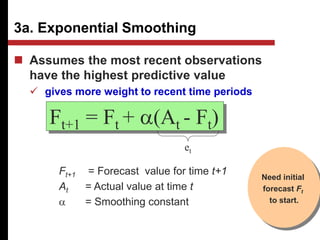
3a. Exponential Smoothing
 Assumes the most recent observations
have the highest predictive value
 gives more weight to recent time periods
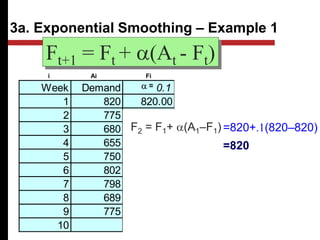
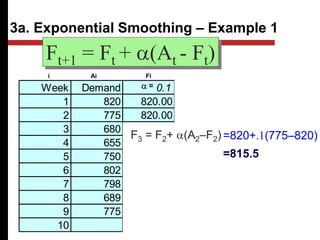
Ft+1 = Ft + a(At - Ft)
et
Ft+1 = Forecast value for time t+1
At = Actual value at time t
a = Smoothing constant
Need initial
forecast Ft
to start.
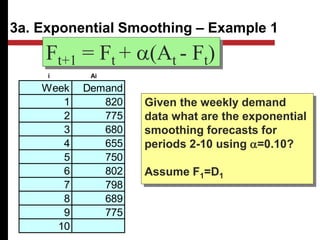
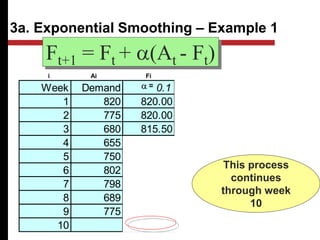
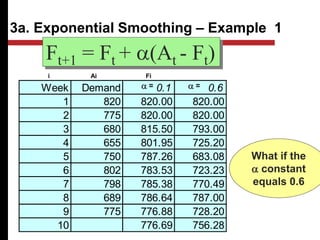
3a. Exponential Smoothing – Example 1
Week Demand
1 820
2 775
3 680
4 655
5 750
6 802
7 798
8 689
9 775
10
Given the weekly demand
data what are the exponential
smoothing forecasts for
periods 2-10 using a=0.10?
Assume F1=D1
Ft+1 = Ft + a(At - Ft)
i Ai
Week Demand 0.1 0.6
1 820 820.00 820.00
2 775 820.00 820.00
3 680 815.50 793.00
4 655 801.95 725.20
5 750 787.26 683.08
6 802 783.53 723.23
7 798 785.38 770.49
8 689 786.64 787.00
9 775 776.88 728.20
10 776.69 756.28
Ft+1 = Ft + a(At - Ft)
3a. Exponential Smoothing – Example 1
a =
F2 = F1+ a(A1–F1) =820+.1(820–820)
=820
i Ai Fi
Week Demand 0.1 0.6
1 820 820.00 820.00
2 775 820.00 820.00
3 680 815.50 793.00
4 655 801.95 725.20
5 750 787.26 683.08
6 802 783.53 723.23
7 798 785.38 770.49
8 689 786.64 787.00
9 775 776.88 728.20
10 776.69 756.28
Ft+1 = Ft + a(At - Ft)
3a. Exponential Smoothing – Example 1
a =
F3 = F2+ a(A2–F2) =820+.1(775–820)
=815.5
i Ai Fi
Week Demand 0.1 0.6
1 820 820.00 820.00
2 775 820.00 820.00
3 680 815.50 793.00
4 655 801.95 725.20
5 750 787.26 683.08
6 802 783.53 723.23
7 798 785.38 770.49
8 689 786.64 787.00
9 775 776.88 728.20
10 776.69 756.28
Ft+1 = Ft + a(At - Ft)
This process
continues
through week
10
3a. Exponential Smoothing – Example 1
a =
i Ai Fi
Week Demand 0.1 0.6
1 820 820.00 820.00
2 775 820.00 820.00
3 680 815.50 793.00
4 655 801.95 725.20
5 750 787.26 683.08
6 802 783.53 723.23
7 798 785.38 770.49
8 689 786.64 787.00
9 775 776.88 728.20
10 776.69 756.28
Ft+1 = Ft + a(At - Ft)
What if the
a constant
equals 0.6
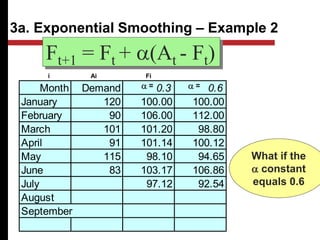
3a. Exponential Smoothing – Example 1
a = a =
i Ai Fi
Month Demand 0.3 0.6
January 120 100.00 100.00
February 90 106.00 112.00
March 101 101.20 98.80
April 91 101.14 100.12
May 115 98.10 94.65
June 83 103.17 106.86
July 97.12 92.54
August
September
Ft+1 = Ft + a(At - Ft)
What if the
a constant
equals 0.6
3a. Exponential Smoothing – Example 2
a = a =
i Ai Fi
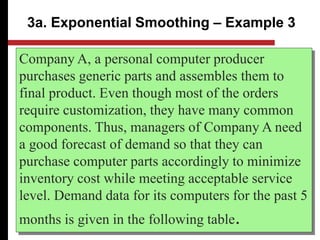
Company A, a personal computer producer
purchases generic parts and assembles them to
final product. Even though most of the orders
require customization, they have many common
components. Thus, managers of Company A need
a good forecast of demand so that they can
purchase computer parts accordingly to minimize
inventory cost while meeting acceptable service
level. Demand data for its computers for the past 5
months is given in the following table.
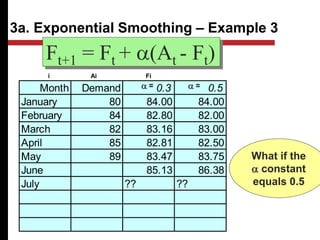
3a. Exponential Smoothing – Example 3
Month Demand 0.3 0.5
January 80 84.00 84.00
February 84 82.80 82.00
March 82 83.16 83.00
April 85 82.81 82.50
May 89 83.47 83.75
June 85.13 86.38
July ?? ??
Ft+1 = Ft + a(At - Ft)
What if the
a constant
equals 0.5
3a. Exponential Smoothing – Example 3
a = a =
i Ai Fi
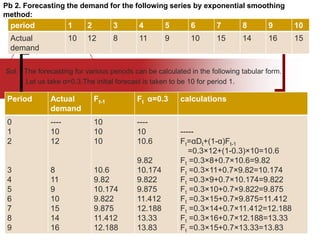
Sol. The forecasting for various periods can be calculated in the following tabular form.
Let us take α=0.3.The initial forecast is taken to be 10 for period 1.
Pb 2. Forecasting the demand for the following series by exponential smoothing
method:
period 1 2 3 4 5 6 7 8 9 10
Actual
demand
10 12 8 11 9 10 15 14 16 15
Period Actual
demand
Ft-1 Ft α=0.3 calculations
0
1
2
3
4
5
6
7
8
9
----
10
12
8
11
9
10
15
14
16
10
10
10
10.6
9.82
10.174
9.822
9.875
11.412
12.188
----
10
10.6
9.82
10.174
9.822
9.875
11.412
12.188
13.33
13.83
-----
Ft=αDt+(1-α)Ft-1
=0.3×12+(1-0.3)×10=10.6
Ft =0.3×8+0.7×10.6=9.82
Ft =0.3×11+0.7×9.82=10.174
Ft =0.3×9+0.7×10.174=9.822
Ft =0.3×10+0.7×9.822=9.875
Ft =0.3×15+0.7×9.875=11.412
Ft =0.3×14+0.7×11.412=12.188
Ft =0.3×16+0.7×12.188=13.33
Ft =0.3×15+0.7×13.33=13.83
How to choose α
depends on the emphasis you want to place
on the most recent data
Increasing α makes forecast more
sensitive to recent data
3a. Exponential Smoothing
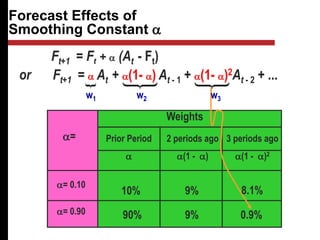
Ft+1 = a At + a(1- a) At - 1 + a(1- a)2At - 2 + ...
Forecast Effects of
Smoothing Constant a
Weights
Prior Period
a
2 periods ago
a(1 - a)
3 periods ago
a(1 - a)2
a=
a= 0.10
a= 0.90
10% 9% 8.1%
90% 9% 0.9%
Ft+1 = Ft + a (At - Ft)
or
w1 w2 w3
 Collect historical data
 Select a model
 Moving average methods
 Select n (number of periods)
 For weighted moving average: select weights
 Exponential smoothing
 Select a
 Selections should produce a good forecast
To Use a Forecasting Method
…but what is a good forecast?
A Good Forecast
Has a small error
 Error = Demand - Forecast
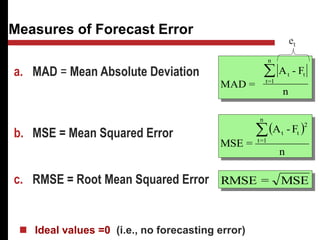
Measures of Forecast Error
b. MSE = Mean Squared Error  
n
F
-
A
=
MSE
n
1
=
t
2
t
t

MAD =
A - F
n
t t
t=1
n

et
 Ideal values =0 (i.e., no forecasting error)
MSE
=
RMSE
c. RMSE = Root Mean Squared Error
a. MAD = Mean Absolute Deviation
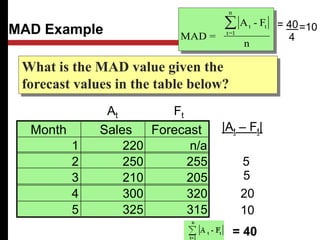
MAD Example
Month Sales Forecast
1 220 n/a
2 250 255
3 210 205
4 300 320
5 325 315
What is the MAD value given the
forecast values in the table below?
MAD =
A - F
n
t t
t=1
n

5
5
20
10
|At – Ft|
Ft
At
= 40
= 40
4
=10
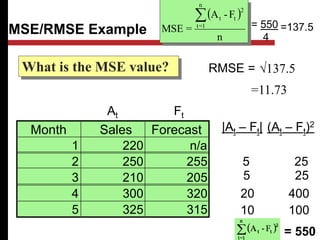
MSE/RMSE Example
Month Sales Forecast
1 220 n/a
2 250 255
3 210 205
4 300 320
5 325 315
What is the MSE value?
5
5
20
10
|At – Ft|
Ft
At
= 550
4
=137.5
(At – Ft)2
25
25
400
100
= 550
 
n
F
-
A
=
MSE
n
1
=
t
2
t
t

RMSE = √137.5
=11.73
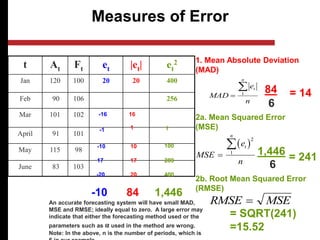
Measures of Error
t At Ft et |et| et
2
Jan 120 100 20 20 400
Feb 90 106 256
Mar 101 102
April 91 101
May 115 98
June 83 103
1. Mean Absolute Deviation
(MAD)
n
e
MAD
n
t

 1
2a. Mean Squared Error
(MSE)
 
MSE
e
n
t
n


2
1
2b. Root Mean Squared Error
(RMSE)
RMSE MSE

-16 16
-1 1
-10
17
-20
10
17
20
1
100
289
400
-10 84 1,446
84
6
= 14
1,446
6
= 241
= SQRT(241)
=15.52
An accurate forecasting system will have small MAD,
MSE and RMSE; ideally equal to zero. A large error may
indicate that either the forecasting method used or the
parameters such as α used in the method are wrong.
Note: In the above, n is the number of periods, which is
deviation
absolute
Mean
)
(
=
MAD
RSFE
=
TS
 
t
t
t forecast
actual
30
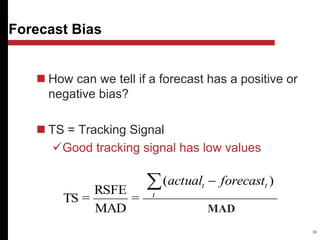
 How can we tell if a forecast has a positive or
negative bias?
 TS = Tracking Signal
Good tracking signal has low values
Forecast Bias
MAD
Quantitative Forecasting Methods
Quantitative
Forecasting
Regression
Models
2. Moving
Average
1. Naive
Time Series
Models
3. Exponential
Smoothing
a) simple
b) weighted
a) level
b) trend
c) seasonality
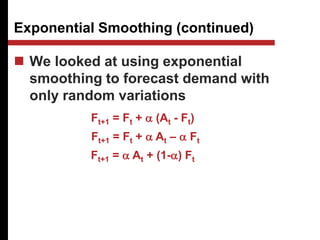
 We looked at using exponential
smoothing to forecast demand with
only random variations
Exponential Smoothing (continued)
Ft+1 = Ft + a (At - Ft)
Ft+1 = Ft + a At – a Ft
Ft+1 = a At + (1-a) Ft
Exponential Smoothing (continued)
 We looked at using exponential
smoothing to forecast demand with
only random variations
 What if demand varies due to
randomness and trend?
 What if we have trend and seasonality
in the data?
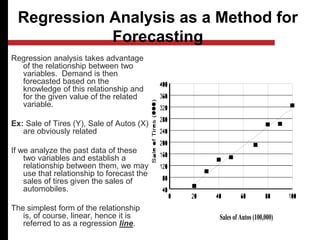
Regression Analysis as a Method for
Forecasting
Regression analysis takes advantage
of the relationship between two
variables. Demand is then
forecasted based on the
knowledge of this relationship and
for the given value of the related
variable.
Ex: Sale of Tires (Y), Sale of Autos (X)
are obviously related
If we analyze the past data of these
two variables and establish a
relationship between them, we may
use that relationship to forecast the
sales of tires given the sales of
automobiles.
The simplest form of the relationship
is, of course, linear, hence it is
referred to as a regression line.
Sales of Autos (100,000)
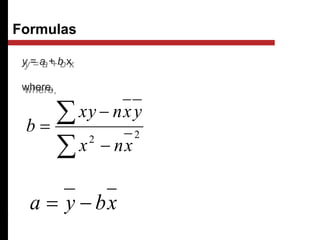
Formulas
x
b
y
a 





 2
2
x
n
x
y
x
n
xy
b
x
y

x

y
y = a + b x
where,
MonthAdvertising Sales X 2
XY
January 3 1 9.00 3.00
February 4 2 16.00 8.00
March 2 1 4.00 2.00
April 5 3 25.00 15.00
May 4 2 16.00 8.00
June 2 1 4.00 2.00
July
TOTAL 20 10 74 38
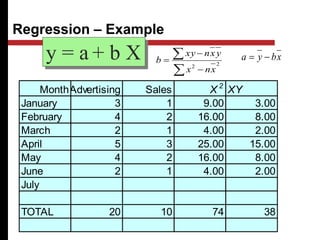
y = a + b X
Regression – Example




 2
2
x
n
x
y
x
n
xy
b x
b
y
a 

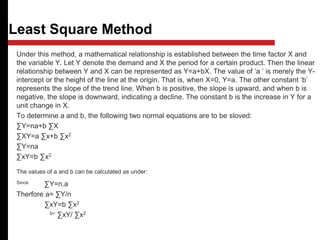
Least Square Method
Under this method, a mathematical relationship is established between the time factor X and
the variable Y. Let Y denote the demand and X the period for a certain product. Then the linear
relationship between Y and X can be represented as Y=a+bX. The value of ‘a ‘ is merely the Y-
intercept or the height of the line at the origin. That is, when X=0, Y=a. The other constant ‘b’
represents the slope of the trend line. When b is positive, the slope is upward, and when b is
negative, the slope is downward, indicating a decline. The constant b is the increase in Y for a
unit change in X.
To determine a and b, the following two normal equations are to be sloved:
∑Y=na+b ∑X
∑XY=a ∑x+b ∑x2
∑Y=na
∑xY=b ∑x2
The values of a and b can be calculated as under:
Since ∑Y=n.a
Therfore a= ∑Y/n
∑xY=b ∑x2
b= ∑xY/ ∑x2
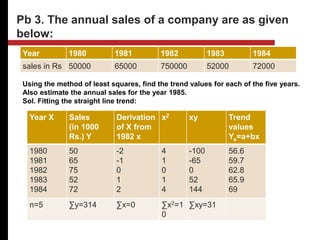
Using the method of least squares, find the trend values for each of the five years.
Also estimate the annual sales for the year 1985.
Sol. Fitting the straight line trend:
Year 1980 1981 1982 1983 1984
sales in Rs 50000 65000 750000 52000 72000
Pb 3. The annual sales of a company are as given
below:
Year X Sales
(in 1000
Rs.) Y
Derivation
of X from
1982 x
x2 xy Trend
values
Ye=a+bx
1980
1981
1982
1983
1984
50
65
75
52
72
-2
-1
0
1
2
4
1
0
1
4
-100
-65
0
52
144
56.6
59.7
62.8
65.9
69
n=5 ∑y=314 ∑x=0 ∑x2=1
0
∑xy=31
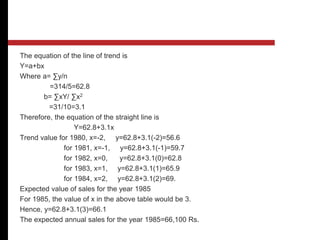
The equation of the line of trend is
Y=a+bx
Where a= ∑y/n
=314/5=62.8
b= ∑xY/ ∑x2
=31/10=3.1
Therefore, the equation of the straight line is
Y=62.8+3.1x
Trend value for 1980, x=-2, y=62.8+3.1(-2)=56.6
for 1981, x=-1, y=62.8+3.1(-1)=59.7
for 1982, x=0, y=62.8+3.1(0)=62.8
for 1983, x=1, y=62.8+3.1(1)=65.9
for 1984, x=2, y=62.8+3.1(2)=69.
Expected value of sales for the year 1985
For 1985, the value of x in the above table would be 3.
Hence, y=62.8+3.1(3)=66.1
The expected annual sales for the year 1985=66,100 Rs.
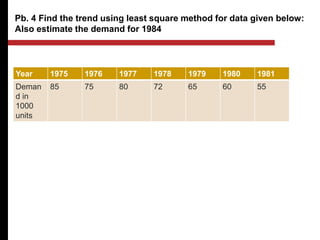
Pb. 4 Find the trend using least square method for data given below:
Also estimate the demand for 1984
Year 1975 1976 1977 1978 1979 1980 1981
Deman
d in
1000
units
85 75 80 72 65 60 55
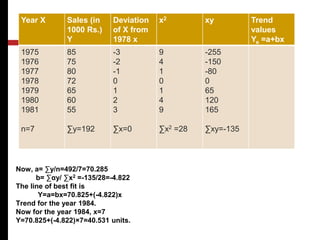
Now, a= ∑y/n=492/7=70.285
b= ∑αy/ ∑x2 =-135/28=-4.822
The line of best fit is
Y=a=bx=70.825+(-4.822)x
Trend for the year 1984.
Now for the year 1984, x=7
Y=70.825+(-4.822)×7=40.531 units.
Year X Sales (in
1000 Rs.)
Y
Deviation
of X from
1978 x
x2 xy Trend
values
Ye =a+bx
1975
1976
1977
1978
1979
1980
1981
n=7
85
75
80
72
65
60
55
∑y=192
-3
-2
-1
0
1
2
3
∑x=0
9
4
1
0
1
4
9
∑x2 =28
-255
-150
-80
0
65
120
165
∑xy=-135

Forecasting_Quantitative Forecasting.pptx

  • 1.
  • 2.
    Forecasting  Predict thenext number in the pattern: a) 3.7, 3.7, 3.7, 3.7, 3.7, ? b) 2.5, 4.5, 6.5, 8.5, 10.5, ? c) 5.0, 7.5, 6.0, 4.5, 7.0, 9.5, 8.0, 6.5, ?
  • 3.
    Forecasting  Predict thenext number in the pattern: a) 3.7, 3.7, 3.7, 3.7, 3.7, b) 2.5, 4.5, 6.5, 8.5, 10.5, c) 5.0, 7.5, 6.0, 4.5, 7.0, 9.5, 8.0, 6.5, 3.7 12.5 9.0
  • 4.
    Outline  What isforecasting?  Types of forecasts  Time-Series forecasting  Naive  Moving Average  Exponential Smoothing  Regression  Good forecasts
  • 5.
    What is Forecasting? Process of predicting a future event based on historical data  Educated Guessing  Underlying basis of all business decisions  Production  Inventory  Personnel  Facilities
  • 6.
    In general, forecastsare almost always wrong. So, Why do we need to forecast? Throughout the day we forecast very different things such as weather, traffic, stock market, state of our company from different perspectives. Virtually every business attempt is based on forecasting. Not all of them are derived from sophisticated methods. However, “Best" educated guesses about future are more valuable for purpose of Planning than no forecasts and hence no planning.
  • 7.
    Departments throughout theorganization depend on forecasts to formulate and execute their plans. Finance needs forecasts to project cash flows and capital requirements. Human resources need forecasts to anticipate hiring needs. Production needs forecasts to plan production levels, workforce, material requirements, inventories, etc. Importance of Forecasting in PPC
  • 8.
    Demand is notthe only variable of interest to forecasters. Manufacturers also forecast worker absenteeism, machine availability, material costs, transportation and production lead times, etc. Besides demand, service providers are also interested in forecasts of population, of other demographic variables, of weather, etc. Importance of Forecasting in PPC
  • 9.
    Definition of forecasting In literary sense forecasting means prediction. It may be defined as a technique of translating past experience into prediction of things to come.
  • 10.
    OBJECTIVES OF FORECASTING Short term objectives • Formulation of suitable production policy. • Regulate supply of raw material. • Best utilization of machines. • Regular availability of labor. • Price policy formulation. • Forecasting of short term financial requirements. • Setting the sales target.
  • 11.
    Long term objectives •Deciding plant capacity. • Manpower planning. • Estimating cash inflows. • Determining dividend policy. • Planning of long-run production. • Long run of financial requirements. • Budgetary control over expenditure.
  • 12.
    Factors affecting forecasting •General business conditions. • Conditions within the industry. • Conditions within the company. • Factors affecting export trade. • Political stability. • Government restrictions. • Fiscal and monetary policy. • Price level and trend. • Technological research and development.
  • 13.
    Factors for selectingparticular forecasting method • The purpose of forecast. • The degree of accuracy desirable. • The time period to be forecasted. • The cost and benefit of the forecast to the company. • The time available for making the analysis. • Component of the system, for which forecast has to be made etc.
  • 14.
     Short-range forecast Usually < 3 months  Job scheduling, worker assignments  Medium-range forecast  3 months to 2 years  Sales/production planning  Long-range forecast  > 2 years  New product planning Types of Forecasts by Time Horizon Design of system Detailed use of system Quantitative methods Qualitative Methods
  • 15.
    Forecasting During theLife Cycle Introduction Growth Maturity Decline Sales Time Quantitative models - Time series analysis - Regression analysis Qualitative models - Executive judgment - Market research -Survey of sales force -Delphi method
  • 16.
  • 17.
    Briefly, the qualitativemethods are: Executive Judgment: Opinion of a group of high level experts or managers is pooled Sales Force Composite: Each regional salesperson provides his/her sales estimates. Those forecasts are then reviewed to make sure they are realistic. All regional forecasts are then pooled at the district and national levels to obtain an overall forecast. Market Research/Survey: Solicits input from customers pertaining to their future purchasing plans. It involves the use of questionnaires, consumer panels and tests of new products and services. Qualitative Methods
  • 18.
    Delphi Method: Asopposed to regular panels where the individuals involved are in direct communication, this method eliminates the effects of group potential dominance of the most vocal members. The group involves individuals from inside as well as outside the organization. Typically, the procedure consists of the following steps: Each expert in the group makes his/her own forecasts in form of statements The coordinator collects all group statements and summarizes them The coordinator provides this summary and gives another set of questions to each group member including feedback as to the input of other experts. The above steps are repeated until a consensus is reached. Qualitative Methods
  • 19.
    Quantitative Forecasting Methods Quantitative Forecasting Regression Models 2.Moving Average 1. Naive Time Series Models 3. Exponential Smoothing a) simple b) weighted a) level b) trend c) seasonality
  • 20.
    Quantitative Forecasting Methods Quantitative Forecasting Regression Models 2.Moving Average 1. Naive Time Series Models 3. Exponential Smoothing a) simple b) weighted a) level b) trend c) seasonality
  • 21.
    Time Series Models Try to predict the future based on past data  Assume that factors influencing the past will continue to influence the future
  • 22.
  • 23.
    Product Demand overTime Year 1 Year 2 Year 3 Year 4 Demand for product or service
  • 24.
    Product Demand overTime Year 1 Year 2 Year 3 Year 4 Demand for product or service Trend component Actual demand line Seasonal peaks Random variation Now let’s look at some time series approaches to forecasting… Borrowed from Heizer/Render - Principles of Operations Management, 5e, and Operations Management, 7e
  • 25.
    Quantitative Forecasting Methods Quantitative Models 2.Moving Average 1. Naive Time Series Models 3. Exponential Smoothing a) simple b) weighted a) level b) trend c) seasonality
  • 26.
    1. Naive Approach Demand in next period is the same as demand in most recent period May sales = 48 →  Usually not good June forecast = 48
  • 27.
    2a. Simple MovingAverage n A + ... + A + A + A = F 1 n - t 2 - t 1 - t t 1 t    Assumes an average is a good estimator of future behavior  Used if little or no trend  Used for smoothing Ft+1 = Forecast for the upcoming period, t+1 n = Number of periods to be averaged A t = Actual occurrence in period t
  • 28.
    2a. Simple MovingAverage You’re manager in Amazon’s electronics department. You want to forecast ipod sales for months 4-6 using a 3-period moving average. n A + ... + A + A + A = F 1 n - t 2 - t 1 - t t 1 t   Month Sales (000) 1 4 2 6 3 5 4 ? 5 ? 6 ?
  • 29.
    2a. Simple MovingAverage Month Sales (000) Moving Average (n=3) 1 4 NA 2 6 NA 3 5 NA 4 ? 5 ? (4+6+5)/3=5 6 ? n A + ... + A + A + A = F 1 n - t 2 - t 1 - t t 1 t   You’re manager in Amazon’s electronics department. You want to forecast ipod sales for months 4-6 using a 3-period moving average.
  • 30.
    What if ipodsales were actually 3 in month 4 Month Sales (000) Moving Average (n=3) 1 4 NA 2 6 NA 3 5 NA 4 3 5 ? 5 6 ? 2a. Simple Moving Average ?
  • 31.
    Forecast for Month5? Month Sales (000) Moving Average (n=3) 1 4 NA 2 6 NA 3 5 NA 4 3 5 ? 5 6 ? (6+5+3)/3=4.667 2a. Simple Moving Average
  • 32.
    Actual Demand forMonth 5 = 7 Month Sales (000) Moving Average (n=3) 1 4 NA 2 6 NA 3 5 NA 4 3 5 7 5 6 ? 4.667 2a. Simple Moving Average ?
  • 33.
    Forecast for Month6? Month Sales (000) Moving Average (n=3) 1 4 NA 2 6 NA 3 5 NA 4 3 5 7 5 6 ? 4.667 (5+3+7)/3=5 2a. Simple Moving Average
  • 34.
    Pb1. The followingseries relates to the annual sales in thousands of a product during the period 1975-1990. Find the trend of sales using a) 3 yearly morning averages, b) 5 yearly moving averages, c) 7 yearly moving averages Year Sales in thousands 1975 1976 1977 1978 1979 1980 1981 1982 1983 1984 1985 1986 1987 1988 1989 1990 16 18 15 17 20 22 25 24 25 28 26 22 28 24 25 30
  • 35.
    Solution. a) 3yearly period Year Sales in thousands Three yearly moving average Three yearly moving average trend values 1975 1976 1977 1978 1979 1980 1981 1982 1983 1984 1985 1986 1987 1988 1989 1990 16 18 15 17 20 22 25 24 25 28 26 22 28 24 25 30 49 50 52 59 67 71 74 67 79 76 76 74 77 79 --- 49/3=16.33 50/3=16.67 52/3=17.33 59/3=19.66 67/3=22.33 71/3=23.66 74/3=24.66 67/3=22.33 79/3=26.33 76/3=25.33 76/3=25.33 74/3=24.66 77/3=25.66 79/3=26.33 ----
  • 36.
    b) 5 yearlyperiod Year Sales in thousands Five yearly moving total Five yearly moving average trend values 1975 1976 1977 1978 1979 1980 1981 1982 1983 1984 1985 1986 1987 1988 1989 1990 16 18 15 17 20 22 25 24 25 28 26 22 28 24 25 30 86 92 99 108 116 124 128 125 129 126 125 129 ----- ----- 17.2 18.4 19.8 21.6 23.2 24.8 25.6 25.0 25.8 25.2 25.0 25.8 ----- -----
  • 37.
    c) 7 yearlyperiod Year Sales in thousands Seven yearly moving total Seven yearly moving average trend values 1975 1976 1977 1978 1979 1980 1981 1982 1983 1984 1985 1986 1987 1988 1989 1990 16 18 15 17 20 22 25 24 25 28 26 22 24 25 25 30 133 141 148 161 179 172 178 177 178 183 ---- ---- ---- 19.00 20.142 21.142 23.00 24.285 24.571 25.428 25.285 25.428 26.142
  • 38.
    Gives more emphasisto recent data Weights decrease for older data sum to 1.0 2b. Weighted Moving Average 1 n - t n 2 - t 3 1 - t 2 t 1 1 t A w + ... + A w + A w + A w = F   Simple moving average models weight all previous periods equally
  • 39.
    2b. Weighted MovingAverage: 3/6, 2/6, 1/6 Month Weighted Moving Average 1 4 NA 2 6 NA 3 5 NA 4 31/6 = 5.167 5 6 ? ? ? 1 n - t n 2 - t 3 1 - t 2 t 1 1 t A w + ... + A w + A w + A w = F   Sales (000)
  • 40.
    2b. Weighted MovingAverage: 3/6, 2/6, 1/6 Month Sales (000) Weighted Moving Average 1 4 NA 2 6 NA 3 5 NA 4 3 31/6 = 5.167 5 7 6 25/6 = 4.167 32/6 = 5.333 1 n - t n 2 - t 3 1 - t 2 t 1 1 t A w + ... + A w + A w + A w = F  
  • 41.
    3a. Exponential Smoothing Assumes the most recent observations have the highest predictive value  gives more weight to recent time periods Ft+1 = Ft + a(At - Ft) et Ft+1 = Forecast value for time t+1 At = Actual value at time t a = Smoothing constant Need initial forecast Ft to start.
  • 42.
    3a. Exponential Smoothing– Example 1 Week Demand 1 820 2 775 3 680 4 655 5 750 6 802 7 798 8 689 9 775 10 Given the weekly demand data what are the exponential smoothing forecasts for periods 2-10 using a=0.10? Assume F1=D1 Ft+1 = Ft + a(At - Ft) i Ai
  • 43.
    Week Demand 0.10.6 1 820 820.00 820.00 2 775 820.00 820.00 3 680 815.50 793.00 4 655 801.95 725.20 5 750 787.26 683.08 6 802 783.53 723.23 7 798 785.38 770.49 8 689 786.64 787.00 9 775 776.88 728.20 10 776.69 756.28 Ft+1 = Ft + a(At - Ft) 3a. Exponential Smoothing – Example 1 a = F2 = F1+ a(A1–F1) =820+.1(820–820) =820 i Ai Fi
  • 44.
    Week Demand 0.10.6 1 820 820.00 820.00 2 775 820.00 820.00 3 680 815.50 793.00 4 655 801.95 725.20 5 750 787.26 683.08 6 802 783.53 723.23 7 798 785.38 770.49 8 689 786.64 787.00 9 775 776.88 728.20 10 776.69 756.28 Ft+1 = Ft + a(At - Ft) 3a. Exponential Smoothing – Example 1 a = F3 = F2+ a(A2–F2) =820+.1(775–820) =815.5 i Ai Fi
  • 45.
    Week Demand 0.10.6 1 820 820.00 820.00 2 775 820.00 820.00 3 680 815.50 793.00 4 655 801.95 725.20 5 750 787.26 683.08 6 802 783.53 723.23 7 798 785.38 770.49 8 689 786.64 787.00 9 775 776.88 728.20 10 776.69 756.28 Ft+1 = Ft + a(At - Ft) This process continues through week 10 3a. Exponential Smoothing – Example 1 a = i Ai Fi
  • 46.
    Week Demand 0.10.6 1 820 820.00 820.00 2 775 820.00 820.00 3 680 815.50 793.00 4 655 801.95 725.20 5 750 787.26 683.08 6 802 783.53 723.23 7 798 785.38 770.49 8 689 786.64 787.00 9 775 776.88 728.20 10 776.69 756.28 Ft+1 = Ft + a(At - Ft) What if the a constant equals 0.6 3a. Exponential Smoothing – Example 1 a = a = i Ai Fi
  • 47.
    Month Demand 0.30.6 January 120 100.00 100.00 February 90 106.00 112.00 March 101 101.20 98.80 April 91 101.14 100.12 May 115 98.10 94.65 June 83 103.17 106.86 July 97.12 92.54 August September Ft+1 = Ft + a(At - Ft) What if the a constant equals 0.6 3a. Exponential Smoothing – Example 2 a = a = i Ai Fi
  • 48.
    Company A, apersonal computer producer purchases generic parts and assembles them to final product. Even though most of the orders require customization, they have many common components. Thus, managers of Company A need a good forecast of demand so that they can purchase computer parts accordingly to minimize inventory cost while meeting acceptable service level. Demand data for its computers for the past 5 months is given in the following table. 3a. Exponential Smoothing – Example 3
  • 49.
    Month Demand 0.30.5 January 80 84.00 84.00 February 84 82.80 82.00 March 82 83.16 83.00 April 85 82.81 82.50 May 89 83.47 83.75 June 85.13 86.38 July ?? ?? Ft+1 = Ft + a(At - Ft) What if the a constant equals 0.5 3a. Exponential Smoothing – Example 3 a = a = i Ai Fi
  • 50.
    Sol. The forecastingfor various periods can be calculated in the following tabular form. Let us take α=0.3.The initial forecast is taken to be 10 for period 1. Pb 2. Forecasting the demand for the following series by exponential smoothing method: period 1 2 3 4 5 6 7 8 9 10 Actual demand 10 12 8 11 9 10 15 14 16 15 Period Actual demand Ft-1 Ft α=0.3 calculations 0 1 2 3 4 5 6 7 8 9 ---- 10 12 8 11 9 10 15 14 16 10 10 10 10.6 9.82 10.174 9.822 9.875 11.412 12.188 ---- 10 10.6 9.82 10.174 9.822 9.875 11.412 12.188 13.33 13.83 ----- Ft=αDt+(1-α)Ft-1 =0.3×12+(1-0.3)×10=10.6 Ft =0.3×8+0.7×10.6=9.82 Ft =0.3×11+0.7×9.82=10.174 Ft =0.3×9+0.7×10.174=9.822 Ft =0.3×10+0.7×9.822=9.875 Ft =0.3×15+0.7×9.875=11.412 Ft =0.3×14+0.7×11.412=12.188 Ft =0.3×16+0.7×12.188=13.33 Ft =0.3×15+0.7×13.33=13.83
  • 51.
    How to chooseα depends on the emphasis you want to place on the most recent data Increasing α makes forecast more sensitive to recent data 3a. Exponential Smoothing
  • 52.
    Ft+1 = aAt + a(1- a) At - 1 + a(1- a)2At - 2 + ... Forecast Effects of Smoothing Constant a Weights Prior Period a 2 periods ago a(1 - a) 3 periods ago a(1 - a)2 a= a= 0.10 a= 0.90 10% 9% 8.1% 90% 9% 0.9% Ft+1 = Ft + a (At - Ft) or w1 w2 w3
  • 53.
     Collect historicaldata  Select a model  Moving average methods  Select n (number of periods)  For weighted moving average: select weights  Exponential smoothing  Select a  Selections should produce a good forecast To Use a Forecasting Method …but what is a good forecast?
  • 54.
    A Good Forecast Hasa small error  Error = Demand - Forecast
  • 55.
    Measures of ForecastError b. MSE = Mean Squared Error   n F - A = MSE n 1 = t 2 t t  MAD = A - F n t t t=1 n  et  Ideal values =0 (i.e., no forecasting error) MSE = RMSE c. RMSE = Root Mean Squared Error a. MAD = Mean Absolute Deviation
  • 56.
    MAD Example Month SalesForecast 1 220 n/a 2 250 255 3 210 205 4 300 320 5 325 315 What is the MAD value given the forecast values in the table below? MAD = A - F n t t t=1 n  5 5 20 10 |At – Ft| Ft At = 40 = 40 4 =10
  • 57.
    MSE/RMSE Example Month SalesForecast 1 220 n/a 2 250 255 3 210 205 4 300 320 5 325 315 What is the MSE value? 5 5 20 10 |At – Ft| Ft At = 550 4 =137.5 (At – Ft)2 25 25 400 100 = 550   n F - A = MSE n 1 = t 2 t t  RMSE = √137.5 =11.73
  • 58.
    Measures of Error tAt Ft et |et| et 2 Jan 120 100 20 20 400 Feb 90 106 256 Mar 101 102 April 91 101 May 115 98 June 83 103 1. Mean Absolute Deviation (MAD) n e MAD n t   1 2a. Mean Squared Error (MSE)   MSE e n t n   2 1 2b. Root Mean Squared Error (RMSE) RMSE MSE  -16 16 -1 1 -10 17 -20 10 17 20 1 100 289 400 -10 84 1,446 84 6 = 14 1,446 6 = 241 = SQRT(241) =15.52 An accurate forecasting system will have small MAD, MSE and RMSE; ideally equal to zero. A large error may indicate that either the forecasting method used or the parameters such as α used in the method are wrong. Note: In the above, n is the number of periods, which is
  • 59.
    deviation absolute Mean ) ( = MAD RSFE = TS   t t t forecast actual 30 How can we tell if a forecast has a positive or negative bias?  TS = Tracking Signal Good tracking signal has low values Forecast Bias MAD
  • 60.
    Quantitative Forecasting Methods Quantitative Forecasting Regression Models 2.Moving Average 1. Naive Time Series Models 3. Exponential Smoothing a) simple b) weighted a) level b) trend c) seasonality
  • 61.
     We lookedat using exponential smoothing to forecast demand with only random variations Exponential Smoothing (continued) Ft+1 = Ft + a (At - Ft) Ft+1 = Ft + a At – a Ft Ft+1 = a At + (1-a) Ft
  • 62.
    Exponential Smoothing (continued) We looked at using exponential smoothing to forecast demand with only random variations  What if demand varies due to randomness and trend?  What if we have trend and seasonality in the data?
  • 63.
    Regression Analysis asa Method for Forecasting Regression analysis takes advantage of the relationship between two variables. Demand is then forecasted based on the knowledge of this relationship and for the given value of the related variable. Ex: Sale of Tires (Y), Sale of Autos (X) are obviously related If we analyze the past data of these two variables and establish a relationship between them, we may use that relationship to forecast the sales of tires given the sales of automobiles. The simplest form of the relationship is, of course, linear, hence it is referred to as a regression line. Sales of Autos (100,000)
  • 64.
  • 65.
    MonthAdvertising Sales X2 XY January 3 1 9.00 3.00 February 4 2 16.00 8.00 March 2 1 4.00 2.00 April 5 3 25.00 15.00 May 4 2 16.00 8.00 June 2 1 4.00 2.00 July TOTAL 20 10 74 38 y = a + b X Regression – Example      2 2 x n x y x n xy b x b y a  
  • 66.
    Least Square Method Underthis method, a mathematical relationship is established between the time factor X and the variable Y. Let Y denote the demand and X the period for a certain product. Then the linear relationship between Y and X can be represented as Y=a+bX. The value of ‘a ‘ is merely the Y- intercept or the height of the line at the origin. That is, when X=0, Y=a. The other constant ‘b’ represents the slope of the trend line. When b is positive, the slope is upward, and when b is negative, the slope is downward, indicating a decline. The constant b is the increase in Y for a unit change in X. To determine a and b, the following two normal equations are to be sloved: ∑Y=na+b ∑X ∑XY=a ∑x+b ∑x2 ∑Y=na ∑xY=b ∑x2 The values of a and b can be calculated as under: Since ∑Y=n.a Therfore a= ∑Y/n ∑xY=b ∑x2 b= ∑xY/ ∑x2
  • 67.
    Using the methodof least squares, find the trend values for each of the five years. Also estimate the annual sales for the year 1985. Sol. Fitting the straight line trend: Year 1980 1981 1982 1983 1984 sales in Rs 50000 65000 750000 52000 72000 Pb 3. The annual sales of a company are as given below: Year X Sales (in 1000 Rs.) Y Derivation of X from 1982 x x2 xy Trend values Ye=a+bx 1980 1981 1982 1983 1984 50 65 75 52 72 -2 -1 0 1 2 4 1 0 1 4 -100 -65 0 52 144 56.6 59.7 62.8 65.9 69 n=5 ∑y=314 ∑x=0 ∑x2=1 0 ∑xy=31
  • 68.
    The equation ofthe line of trend is Y=a+bx Where a= ∑y/n =314/5=62.8 b= ∑xY/ ∑x2 =31/10=3.1 Therefore, the equation of the straight line is Y=62.8+3.1x Trend value for 1980, x=-2, y=62.8+3.1(-2)=56.6 for 1981, x=-1, y=62.8+3.1(-1)=59.7 for 1982, x=0, y=62.8+3.1(0)=62.8 for 1983, x=1, y=62.8+3.1(1)=65.9 for 1984, x=2, y=62.8+3.1(2)=69. Expected value of sales for the year 1985 For 1985, the value of x in the above table would be 3. Hence, y=62.8+3.1(3)=66.1 The expected annual sales for the year 1985=66,100 Rs.
  • 69.
    Pb. 4 Findthe trend using least square method for data given below: Also estimate the demand for 1984 Year 1975 1976 1977 1978 1979 1980 1981 Deman d in 1000 units 85 75 80 72 65 60 55
  • 70.
    Now, a= ∑y/n=492/7=70.285 b=∑αy/ ∑x2 =-135/28=-4.822 The line of best fit is Y=a=bx=70.825+(-4.822)x Trend for the year 1984. Now for the year 1984, x=7 Y=70.825+(-4.822)×7=40.531 units. Year X Sales (in 1000 Rs.) Y Deviation of X from 1978 x x2 xy Trend values Ye =a+bx 1975 1976 1977 1978 1979 1980 1981 n=7 85 75 80 72 65 60 55 ∑y=192 -3 -2 -1 0 1 2 3 ∑x=0 9 4 1 0 1 4 9 ∑x2 =28 -255 -150 -80 0 65 120 165 ∑xy=-135