Submitted by
Submitted by
Mansi Kadlag (MBACORE019024)
Chandan Kadu (MBACORE019025
Chandan Kadu (MBACORE019025)
)
What Is Project ?
2
• Project is a great opportunity for organizations and
individuals to achieve their business and non-business
objectives more efficiently through implementing change.
• A Project is a temporary, unique and progressive attempt
or endeavour made to produce some kind of a tangible or
intangible result (a unique product, service, benefit,
competitive advantage, etc.). It usually includes a series of
interrelated tasks that are planned for execution over a
fixed period of time and within certain requirements and
limitations such as cost, quality, performance, others.
What Is Finance?
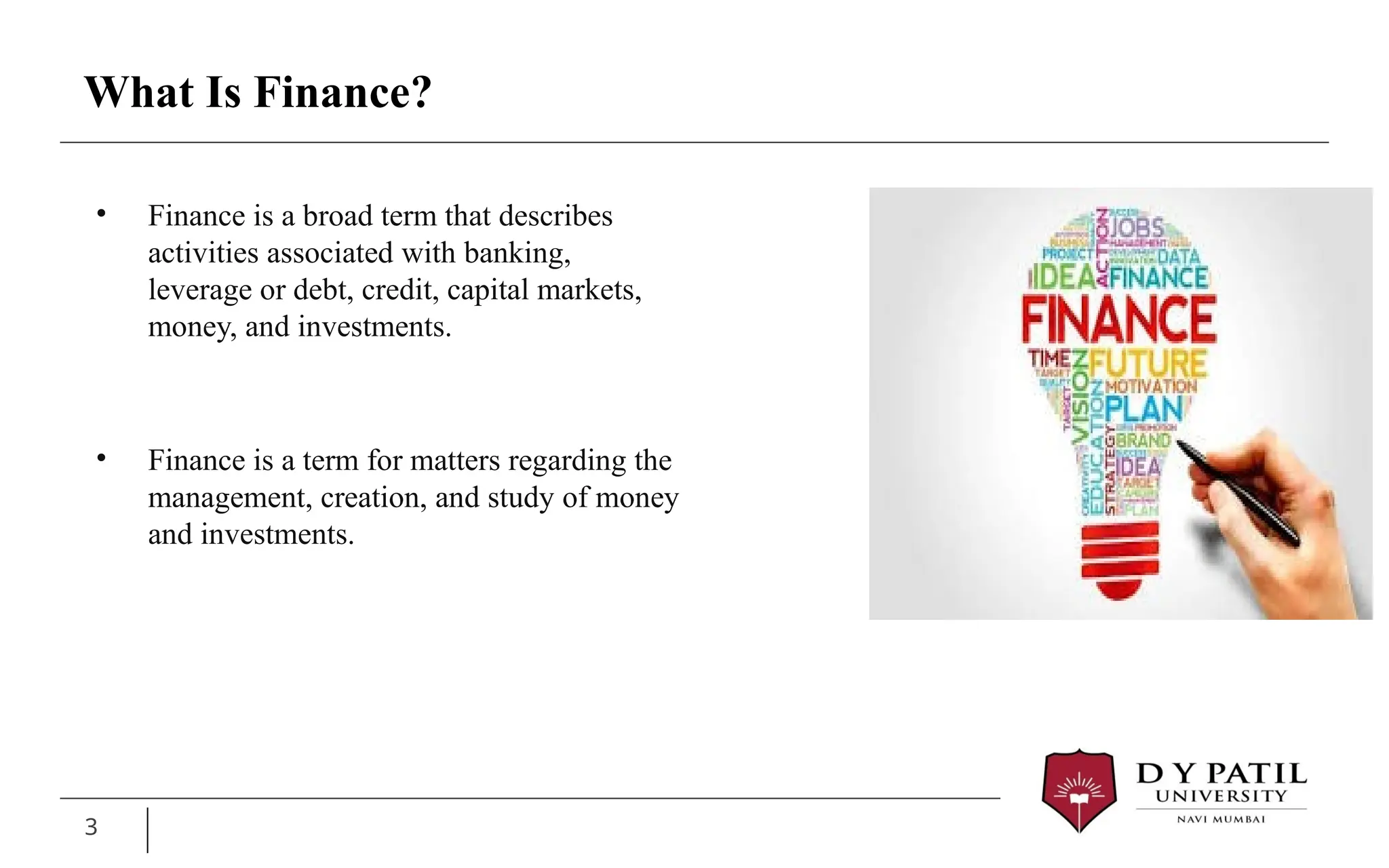
• Finance is a broad term that describes
activities associated with banking,
leverage or debt, credit, capital markets,
money, and investments.
• Finance is a term for matters regarding the
management, creation, and study of money
and investments.
3
What is Project Finance ?
• Project Finance deals with financial aspects
related to a particular project that involves
analysing the feasibility of a project and its
funding requirements on the basis of the cash
flows that the project is expected to generate, if
undertaken, over the years.
• Project finance is a form of syndicated finance
designed for long–term infrastructure and
industrial projects often involving governments.
4
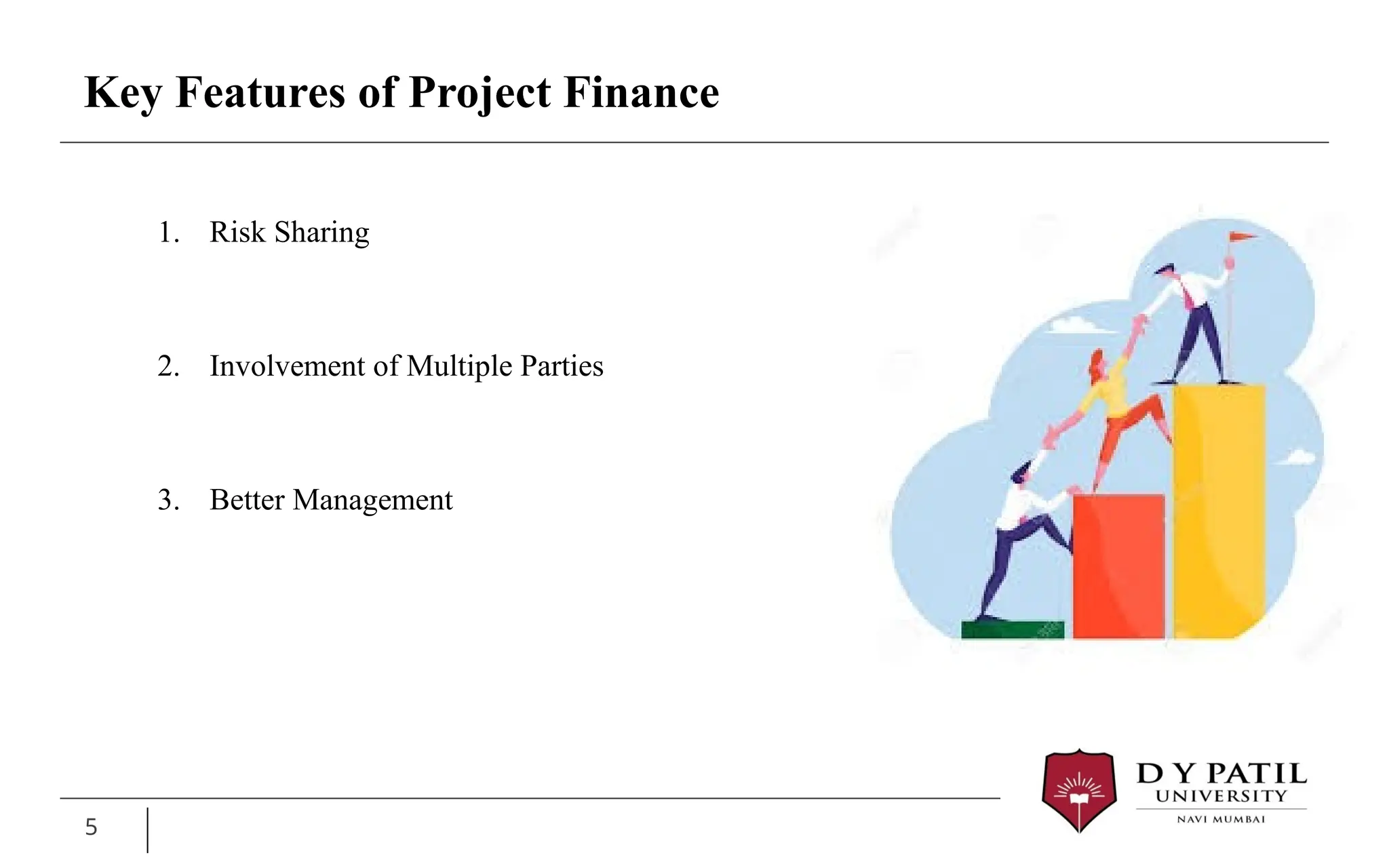
Key Features of Project Finance
1. Risk Sharing
2. Involvement of Multiple Parties
3. Better Management
5
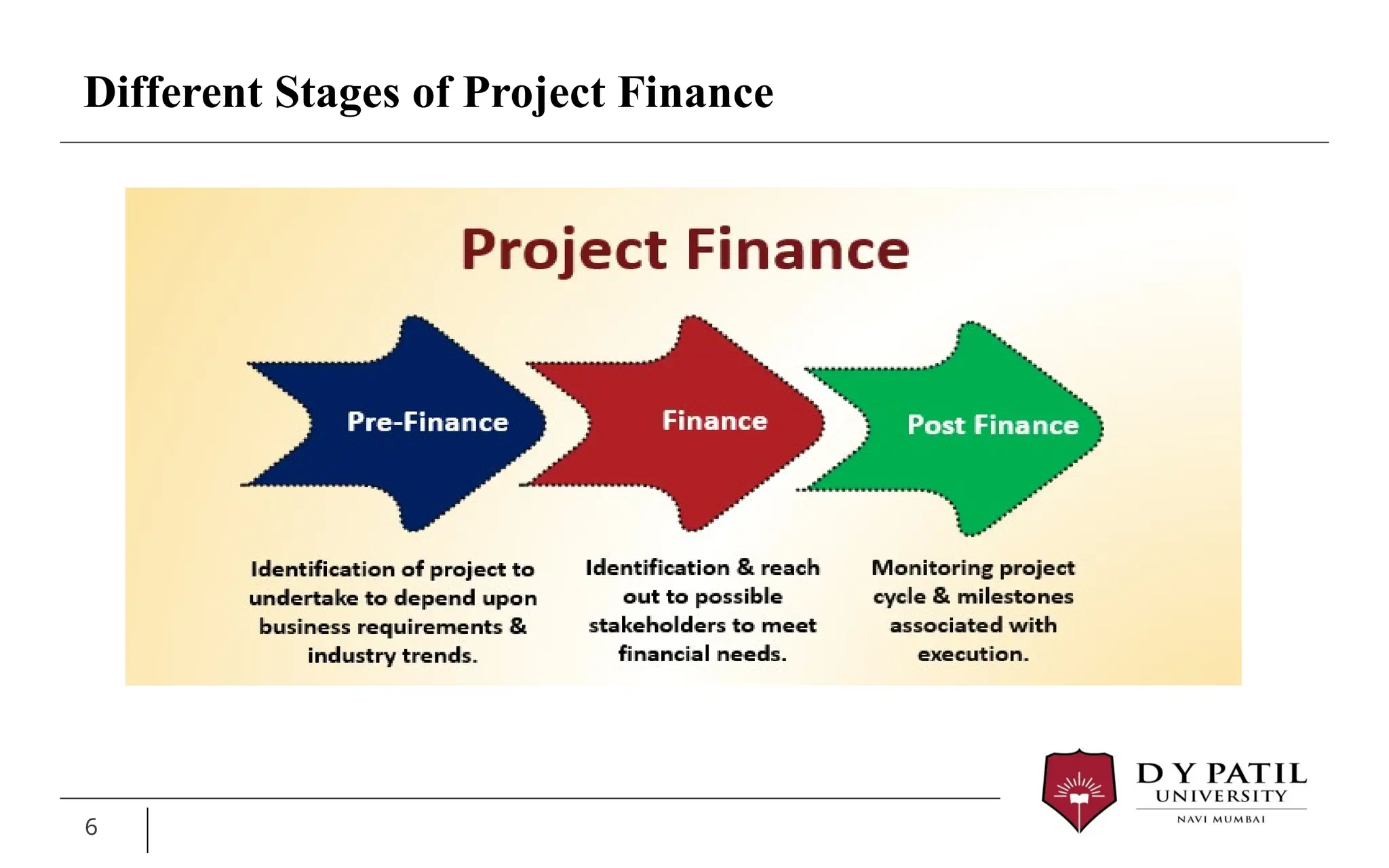
Different Stages of Project Finance
6
Advantages and Disadvantages of Project Finance
7
Advantages of Project Finance
•Eliminate or reduce the lender’s recourse to the sponsors.
•Permit an off-balance sheet treatment of the debt financing.
•Maximize the leverage of a project.
•Avoid any restrictions or covenants binding the sponsors under their
respective financial obligations.
•Avoid any negative impact of a project on the credit standing of the
sponsors.
Disadvantages of Project Finance
•Often takes longer to structure than equivalent size corporate finance.
•Higher transaction costs due to creation of an independent entity.
•Project finance requires greater disclosure of proprietary information
and strategic deals.
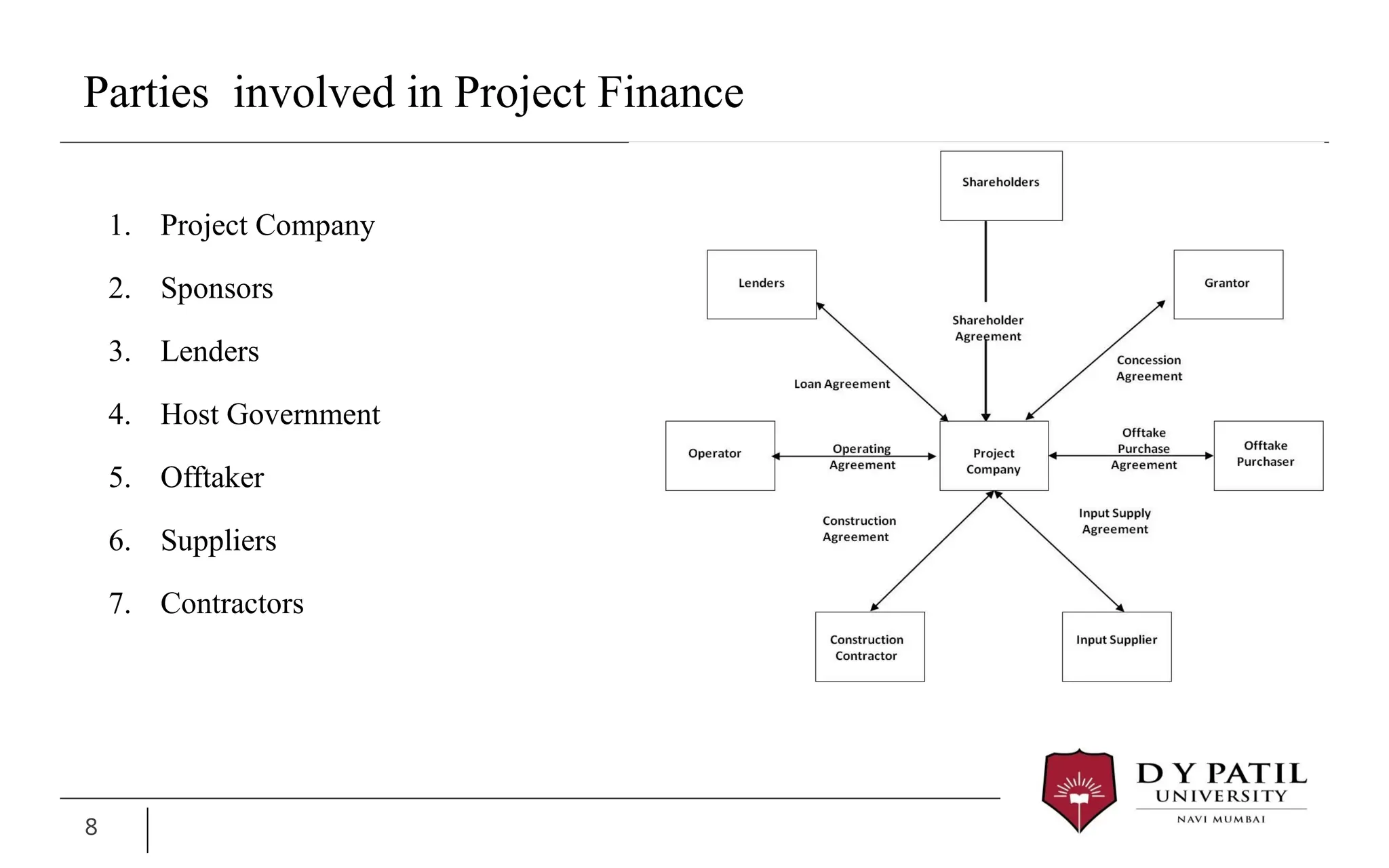
Parties involved in Project Finance
1. Project Company
2. Sponsors
3. Lenders
4. Host Government
5. Offtaker
6. Suppliers
7. Contractors
8
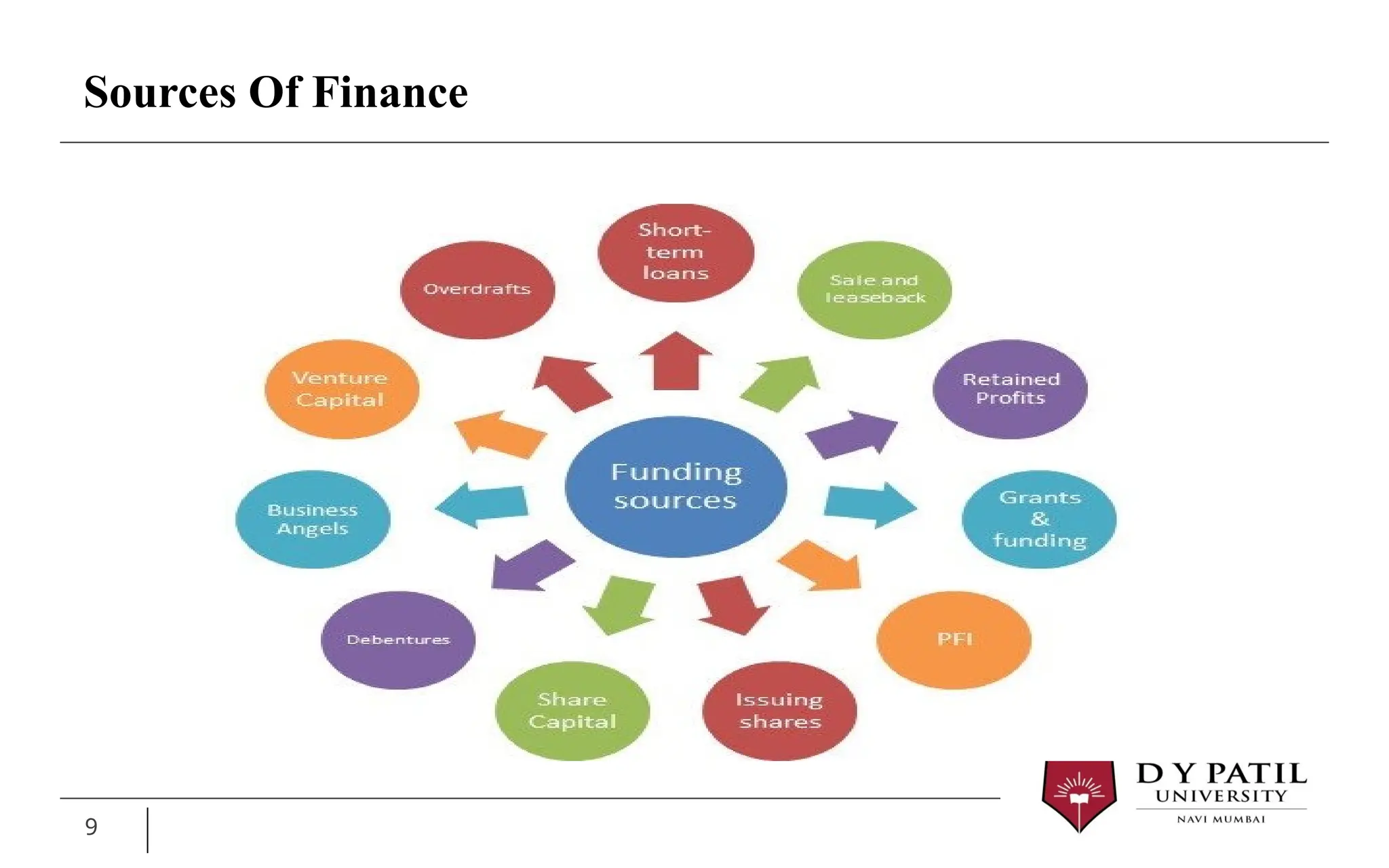
Sources Of Finance
9
• Overdrafts are useful sources of short-term finance due for repayment in less than a year. Interest
is only charged when the facility is used and the interest payments are tax-deductible. They can be
arranged at short notice and are flexible in the amount borrowed at any time.
• Loans generally have higher rates of interest and are less flexible as payments need to be made for
a pre-agreed amount and at a pre-agreed time. Loans can be repaid in stages or at the end of the
loan period. The interest is also tax deductible and return on the loan can exceed the interest
payments. The cost of borrowing money can be compared with the return from a project by
calculating the Internal Rate of Return.
10
Sources of long–term project finance
11
• Sale and leaseback:
Assets can be sold to a financial institution and then leased back for a certain term. This
releases capital in assets, which can be used for investment, but should be offset by the
rental payments and loss of capital growth should the assets increase in value.
• Loan Capital:
Debentures: Some loans are secured by a fixed or floating charge against a company’s
assets and are known as debenture loans. Debenture holders receive their interest payment
before any dividend is paid to shareholders and if the business fails the holders will be
preferential creditors.
Sources of long–term project finance
12
- Business Angels: These are private investors who invest directly in a company in
exchange for an equity stake and perhaps a place on the board. They normally invest in the
region of £10k to £100k and they invest in order to receive a capital gain, they are usually
experienced entrepreneurs and can be a source of useful knowledge for the business.
- Venture Capital : Venture Capitalists usually offer 100k or more to companies that
other financial institutions might consider too risky. They exchange their capital for an equity
share and involvement at a strategic level often through a non-executive position on the board.
Their prime aim is to increase the value of their shares so that they can sell them at a profit.
Sources of long–term project finance
13
• Share Capital:
Share Capital is raised through the company shareholders. In exchange for their investment
they receive a share of the profits through a dividend. They may also receive a capital gain
through sale of their shares are some future date. There are two main types of shares.
Ordinary shares are held by the owners of the business who have a right to a share of the
company profits through dividends, which vary in value depending on performance. As
owners of the company they have voting rights at Annual and Extra-Ordinary General
Meetings, however they are liable should the company become insolvent and are therefore
accepting a level of risk with their investment. Preference shares are less risky as the holders
of preference shares are not owners of the company. They offer a guaranteed dividend
although this may be less than that received by ordinary shareholders. As preference
shareholders are not owners of the company they have limited voting rights.
Sources of long–term project finance
14
• Retained profits Not all profits are distributed to shareholders: the company retains a
proportion as reserves. This is usually the most significant source of equity finance, costs far
less than external sources that charge interest and can be distributed as the company sees fit.
• Issuing shares Shares can be issued through new issues or rights issues. New issues are
generally made at the same time as the company is floated on the stock market, and the
capital raised is significant. The price of the new share is based on project growth rates,
stability, market sentiment, and comparison with other similar companies and the capital
structure of the company.
Sources of long–term project finance
Thank You

All about the knowledge ofProject Finance.ppt

  • 1.
    Submitted by Submitted by MansiKadlag (MBACORE019024) Mansi Kadlag (MBACORE019024) Chandan Kadu (MBACORE019025 Chandan Kadu (MBACORE019025) )
  • 2.
    What Is Project? 2 • Project is a great opportunity for organizations and individuals to achieve their business and non-business objectives more efficiently through implementing change. • A Project is a temporary, unique and progressive attempt or endeavour made to produce some kind of a tangible or intangible result (a unique product, service, benefit, competitive advantage, etc.). It usually includes a series of interrelated tasks that are planned for execution over a fixed period of time and within certain requirements and limitations such as cost, quality, performance, others.
  • 3.
    What Is Finance? •Finance is a broad term that describes activities associated with banking, leverage or debt, credit, capital markets, money, and investments. • Finance is a term for matters regarding the management, creation, and study of money and investments. 3
  • 4.
    What is ProjectFinance ? • Project Finance deals with financial aspects related to a particular project that involves analysing the feasibility of a project and its funding requirements on the basis of the cash flows that the project is expected to generate, if undertaken, over the years. • Project finance is a form of syndicated finance designed for long–term infrastructure and industrial projects often involving governments. 4
  • 5.
    Key Features ofProject Finance 1. Risk Sharing 2. Involvement of Multiple Parties 3. Better Management 5
  • 6.
    Different Stages ofProject Finance 6
  • 7.
    Advantages and Disadvantagesof Project Finance 7 Advantages of Project Finance •Eliminate or reduce the lender’s recourse to the sponsors. •Permit an off-balance sheet treatment of the debt financing. •Maximize the leverage of a project. •Avoid any restrictions or covenants binding the sponsors under their respective financial obligations. •Avoid any negative impact of a project on the credit standing of the sponsors. Disadvantages of Project Finance •Often takes longer to structure than equivalent size corporate finance. •Higher transaction costs due to creation of an independent entity. •Project finance requires greater disclosure of proprietary information and strategic deals.
  • 8.
    Parties involved inProject Finance 1. Project Company 2. Sponsors 3. Lenders 4. Host Government 5. Offtaker 6. Suppliers 7. Contractors 8
  • 9.
  • 10.
    • Overdrafts areuseful sources of short-term finance due for repayment in less than a year. Interest is only charged when the facility is used and the interest payments are tax-deductible. They can be arranged at short notice and are flexible in the amount borrowed at any time. • Loans generally have higher rates of interest and are less flexible as payments need to be made for a pre-agreed amount and at a pre-agreed time. Loans can be repaid in stages or at the end of the loan period. The interest is also tax deductible and return on the loan can exceed the interest payments. The cost of borrowing money can be compared with the return from a project by calculating the Internal Rate of Return. 10 Sources of long–term project finance
  • 11.
    11 • Sale andleaseback: Assets can be sold to a financial institution and then leased back for a certain term. This releases capital in assets, which can be used for investment, but should be offset by the rental payments and loss of capital growth should the assets increase in value. • Loan Capital: Debentures: Some loans are secured by a fixed or floating charge against a company’s assets and are known as debenture loans. Debenture holders receive their interest payment before any dividend is paid to shareholders and if the business fails the holders will be preferential creditors. Sources of long–term project finance
  • 12.
    12 - Business Angels:These are private investors who invest directly in a company in exchange for an equity stake and perhaps a place on the board. They normally invest in the region of £10k to £100k and they invest in order to receive a capital gain, they are usually experienced entrepreneurs and can be a source of useful knowledge for the business. - Venture Capital : Venture Capitalists usually offer 100k or more to companies that other financial institutions might consider too risky. They exchange their capital for an equity share and involvement at a strategic level often through a non-executive position on the board. Their prime aim is to increase the value of their shares so that they can sell them at a profit. Sources of long–term project finance
  • 13.
    13 • Share Capital: ShareCapital is raised through the company shareholders. In exchange for their investment they receive a share of the profits through a dividend. They may also receive a capital gain through sale of their shares are some future date. There are two main types of shares. Ordinary shares are held by the owners of the business who have a right to a share of the company profits through dividends, which vary in value depending on performance. As owners of the company they have voting rights at Annual and Extra-Ordinary General Meetings, however they are liable should the company become insolvent and are therefore accepting a level of risk with their investment. Preference shares are less risky as the holders of preference shares are not owners of the company. They offer a guaranteed dividend although this may be less than that received by ordinary shareholders. As preference shareholders are not owners of the company they have limited voting rights. Sources of long–term project finance
  • 14.
    14 • Retained profitsNot all profits are distributed to shareholders: the company retains a proportion as reserves. This is usually the most significant source of equity finance, costs far less than external sources that charge interest and can be distributed as the company sees fit. • Issuing shares Shares can be issued through new issues or rights issues. New issues are generally made at the same time as the company is floated on the stock market, and the capital raised is significant. The price of the new share is based on project growth rates, stability, market sentiment, and comparison with other similar companies and the capital structure of the company. Sources of long–term project finance
  • 15.

Editor's Notes

  • #5 Risk Sharing: The company shares the risks associated with the project failure with the other participating entities by keeping the project off the balance sheet. Involvement of Multiple Parties: As the projects are large and capital extensive, multiple parties often provide capital in the form of debt or equity. Better Management: As the whole project is a different entity in itself, often, a dedicated team is assigned to look after the completion of the project, which results in better efficiency and output.
  • #6 #1 – Pre Finance Identification of the project to undertake to depend upon business requirements and industry trends; Identifying the risks involved if the project is undertaken (both internal and external); Investigating the feasibility of the project, both technical and financial, on the basis of resource requirements; #2 – Finance Identification and reach out to possible stakeholders to meet financial needs. Negotiate the terms and conditions associated with the debt or equity from stakeholders. Receiving the funds from the stakeholders; #3 – Post Finance Monitoring the project cycle and milestones associated with the execution; Completing the project before the deadline; Repayment of the loans through the cash flows generated from the project; Project identification </li></ul></ul><ul><ul><li>Risk identification & minimizing Pre Financing Stage </li></ul></ul><ul><ul><li>Technical and financial feasibility </li></ul></ul><ul><li>Equity arrangement </li></ul><ul><ul><li>Negotiation and syndication Financing Stage </li></ul></ul><ul><ul><li>Commitments and documentation </li></ul></ul><ul><ul><li>Disbursement. </li></ul></ul><ul><li>Monitoring and review </li></ul><ul><ul><li>Financial Closure / Project Closure Post Financing Stage </li></ul></ul><ul><ul><li>Repayments & Subsequent monitoring. </li></ul></ul> 13. Stages in Project Financing – Project Identification. <ul><li>Identification of the Project </li></ul><ul><ul><li>Government announced </li></ul></ul><ul><ul><li>Self conceived / initiated </li></ul></ul><ul><li>Identification of market </li></ul><ul><ul><li>Product of the project </li></ul></ul><ul><ul><li>Users of the product </li></ul></ul><ul><ul><li>Marketability of the product </li></ul></ul><ul><ul><li>Marketing Plan </li></ul></ul>
  • #8 The main parties involved in project finance are: Project Company: This is the legal owner of the project that owns every aspect of the project, right from building, developing, and operating it. It is referred to as the Special purpose vehicle or SPV, specially created for a particular project. An SPV can be created either by the government of the host country by inviting bids or by one company or a group of companies. Sponsors: Sponsors are the promoters of the project. They can be owners and equity investors of the company floating the project. They can be industrial sponsors, public sponsors, contractual sponsors, and financial sponsors. Lenders: lenders can be one or more agencies or financial institutions such as banks, bank holders and export important agencies. Host Government: The government of the country where the project is being run and operated. It allows all the permits, licenses, and other important aspects of running a business in that country. Offtaker: This comprises one or more parties bound by contract to offtake or buys some or all of the production from the project. Suppliers: The parties who provide raw materials or other project inputs for payment. Contractors: a project has many stages of getting designed, developed, built, operated and maintained. All those parties involved at various stages are bound by contracts, and these are called contractors of a project.