Operations Management
Forecasting
By
Dr. Hisham Hussein Zaher
Forecasting at Tupperware
¨ Each of 50 profit centers around the
world is responsible for computerized
monthly, quarterly, and 12-month sales
projections
¨ These projections are aggregated by
region, then globally at Tupperware’s
World Headquarters.
Tupperware - Forecast by
Consensus
¨ Although inputs come from sales,
marketing, finance, and production,
final forecasts are the consensus of all
participating managers.
¨ The final step is Tupperware’s version
of the “jury of executive opinion”.
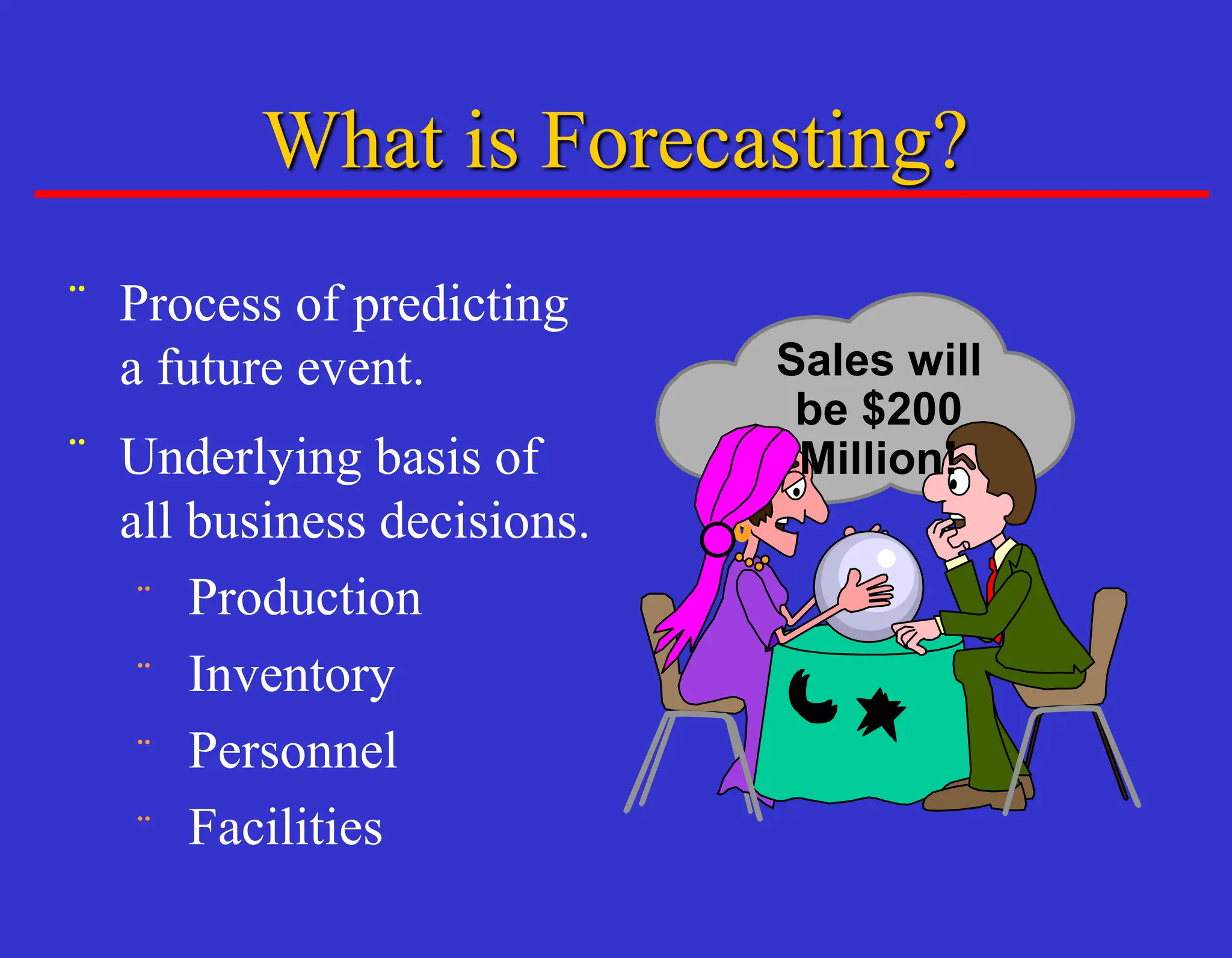
What is Forecasting?
¨ Process of predicting
a future event.
¨ Underlying basis of
all business decisions.
¨ Production
¨ Inventory
¨ Personnel
¨ Facilities
Sales will
be $200
Million!
¨ Short-range forecast:
¨ Up to 1 year; usually < 3 months.
¨ Job scheduling, worker assignments.
¨ Medium-range forecast:
¨ 3 months to 3 years.
¨ Sales & production planning, budgeting.
¨ Long-range forecast:
¨ 3+ years.
¨ New product planning, facility location.
Types of Forecasts by Time
Horizon
Short-term vs. Longer-term
Forecasting
¨ Medium/long range forecasts deal with more
comprehensive issues and support
management decisions regarding planning
and products, plants and processes.
¨ Short-term forecasting usually employs
different methodologies than longer-term
forecasting.
¨ Short-term forecasts tend to be more accurate
than longer-term forecasts.
Influence of Product Life Cycle
¨ Stages of introduction & growth
require longer forecasts than maturity
and decline.
¨ Forecasts useful in projecting:
¨ staffing levels,
¨ inventory levels, and
¨ factory capacity
as product passes through stages.
Types of Forecasts
¨ Economic forecasts:
¨ Address business cycle.
¨ e.g., inflation rate, money supply etc.
¨ Technological forecasts:
¨ Predict technological change.
¨ Predict new product sales.
¨ Demand forecasts:
¨ Predict existing product sales.
)
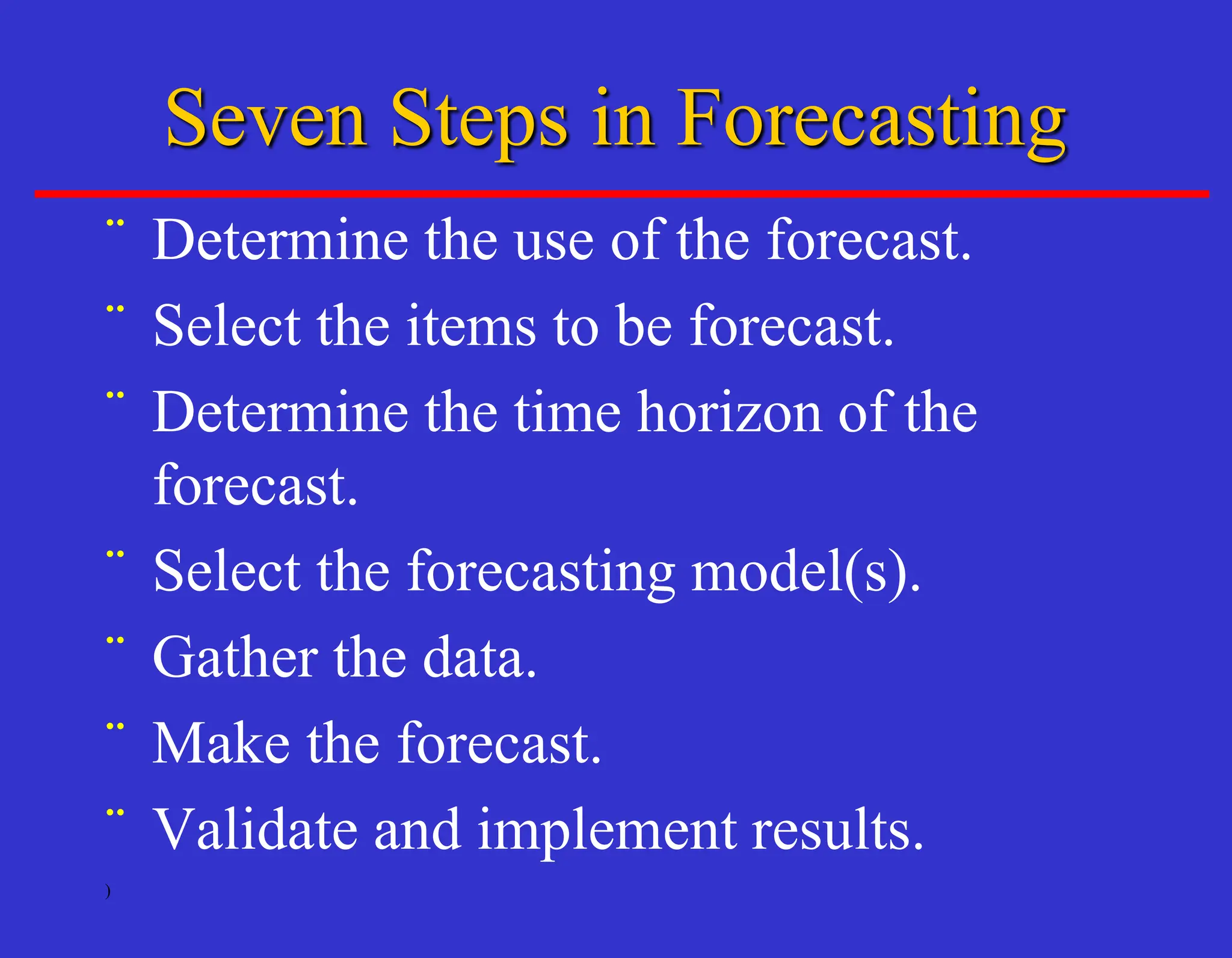
Seven Steps in Forecasting
¨ Determine the use of the forecast.
¨ Select the items to be forecast.
¨ Determine the time horizon of the
forecast.
¨ Select the forecasting model(s).
¨ Gather the data.
¨ Make the forecast.
¨ Validate and implement results.
Realities of Forecasting
¨ Forecasts are seldom perfect.
¨ Most forecasting methods assume that
there is some underlying stability in the
system.
¨ Both product family and aggregated
product forecasts are more accurate
than individual product forecasts.
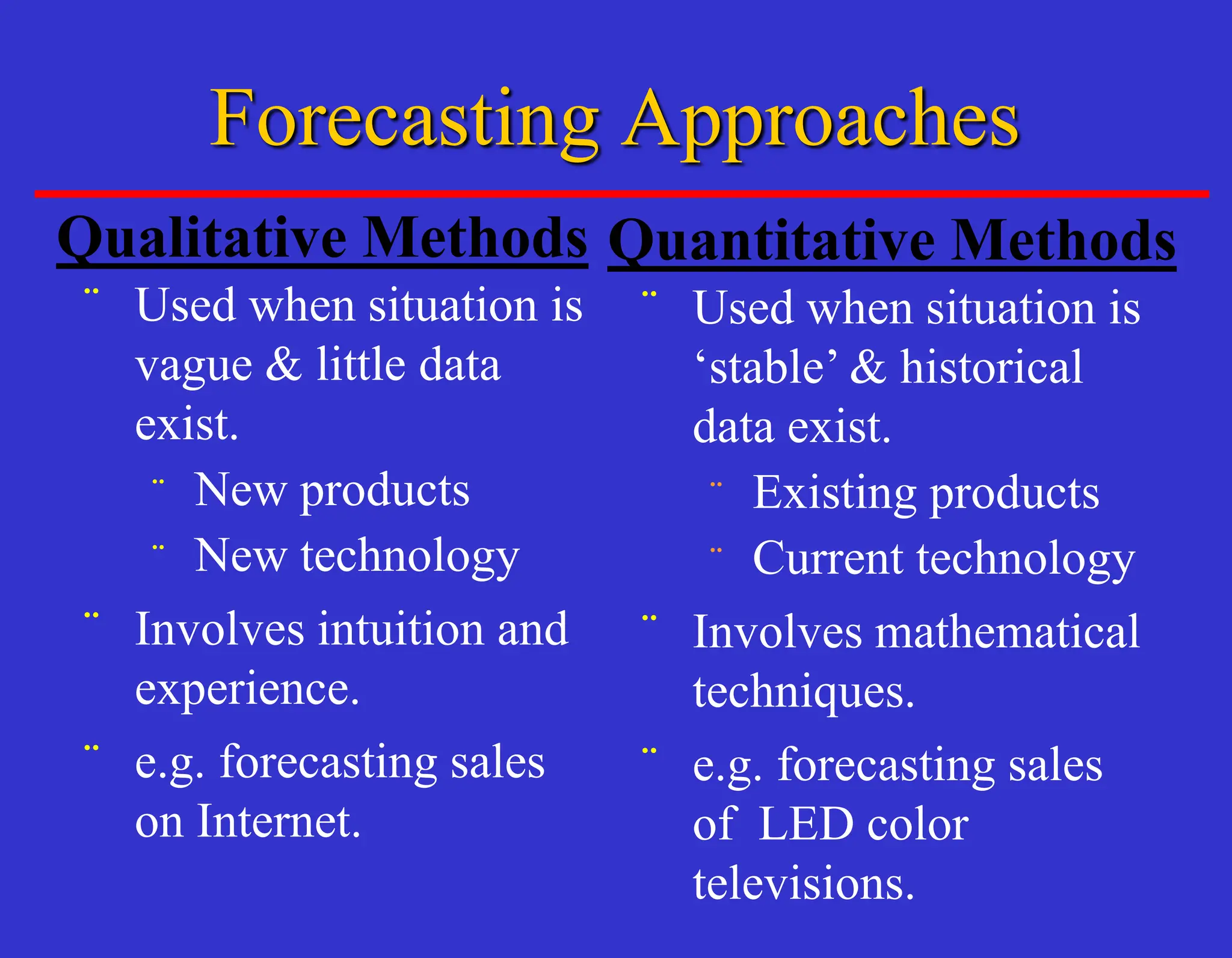
Forecasting Approaches
¨ Used when situation is
‘stable’ & historical
data exist.
¨ Existing products
¨ Current technology
¨ Involves mathematical
techniques.
¨ e.g. forecasting sales
of LED color
televisions.
Quantitative Methods
¨ Used when situation is
vague & little data
exist.
¨ New products
¨ New technology
¨ Involves intuition and
experience.
¨ e.g. forecasting sales
on Internet.
Qualitative Methods
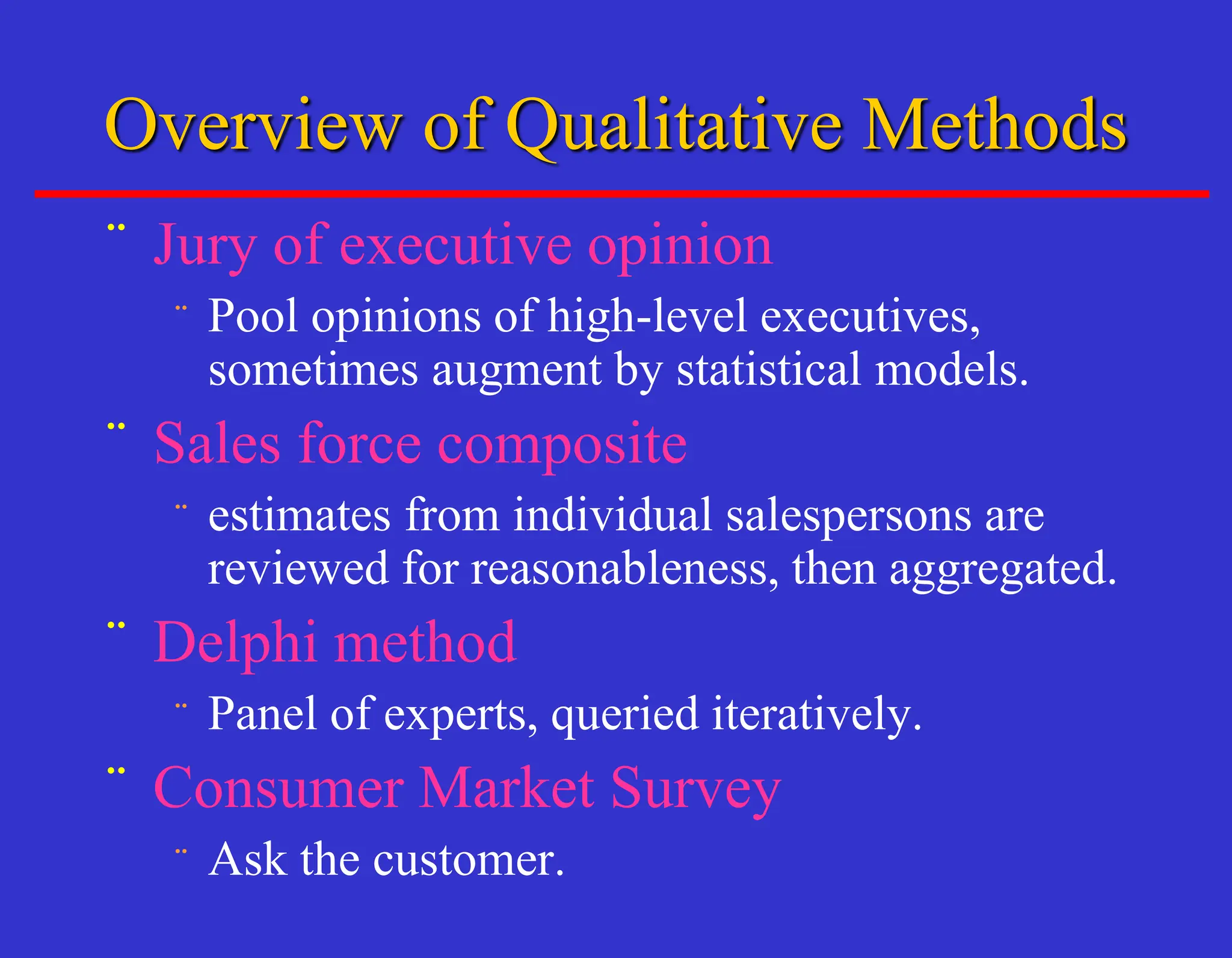
Overview of Qualitative Methods
¨ Jury of executive opinion
¨ Pool opinions of high-level executives,
sometimes augment by statistical models.
¨ Sales force composite
¨ estimates from individual salespersons are
reviewed for reasonableness, then aggregated.
¨ Delphi method
¨ Panel of experts, queried iteratively.
¨ Consumer Market Survey
¨ Ask the customer.
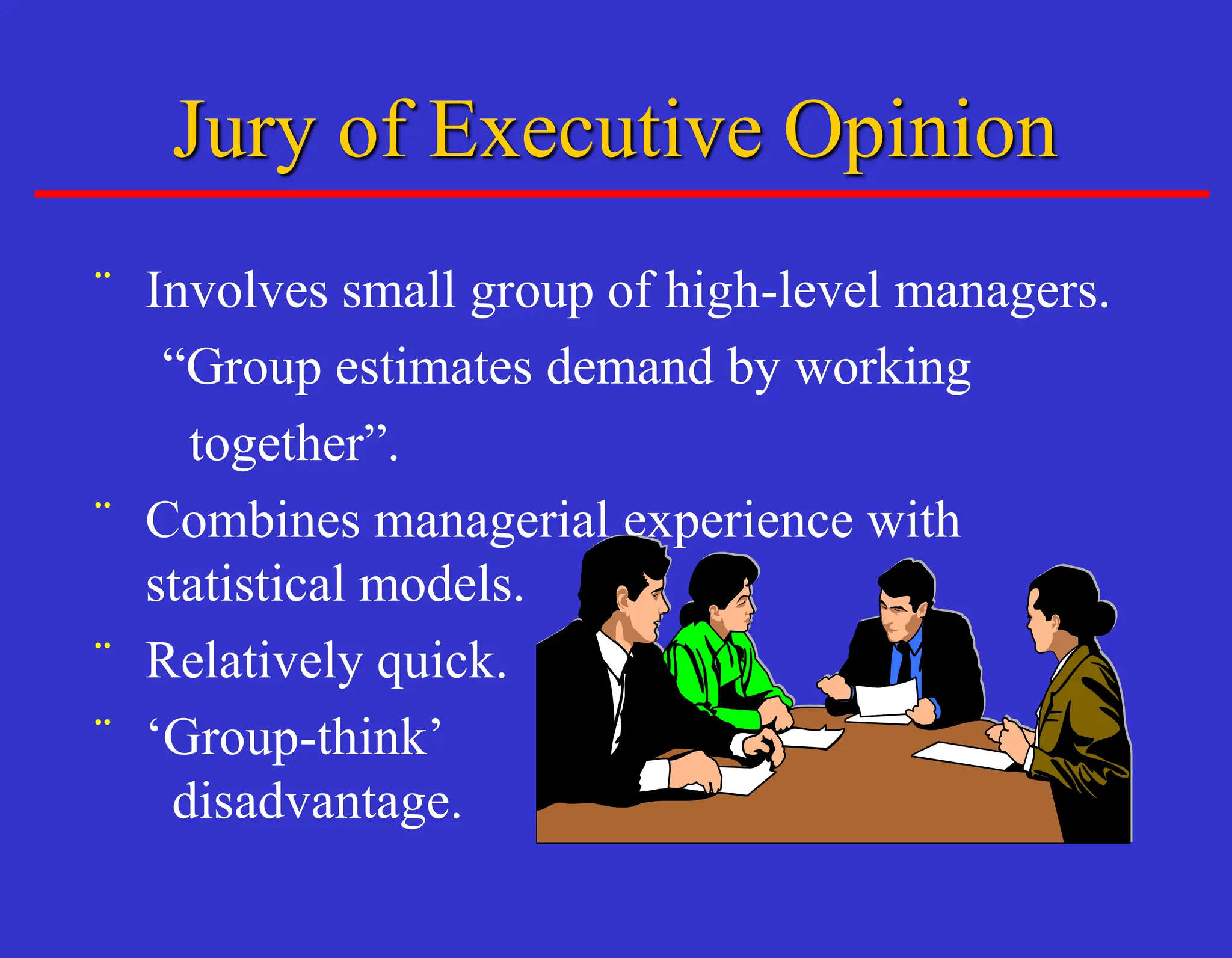
¨ Involves small group of high-level managers.
“Group estimates demand by working
together”.
¨ Combines managerial experience with
statistical models.
¨ Relatively quick.
¨ ‘Group-think’
disadvantage.
Jury of Executive Opinion
Sales Force Composite
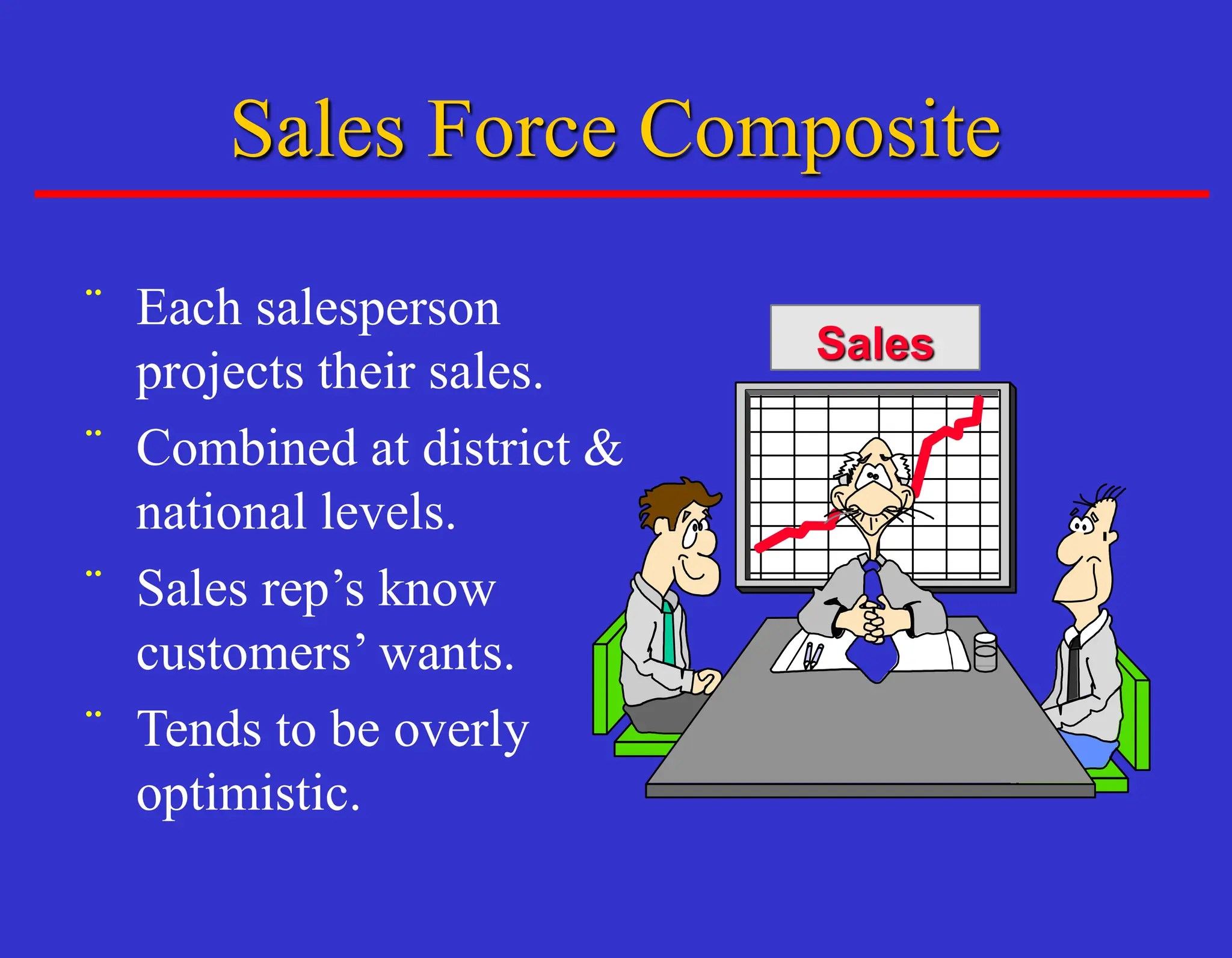
¨ Each salesperson
projects their sales.
¨ Combined at district &
national levels.
¨ Sales rep’s know
customers’ wants.
¨ Tends to be overly
optimistic.
Sales
Delphi Method
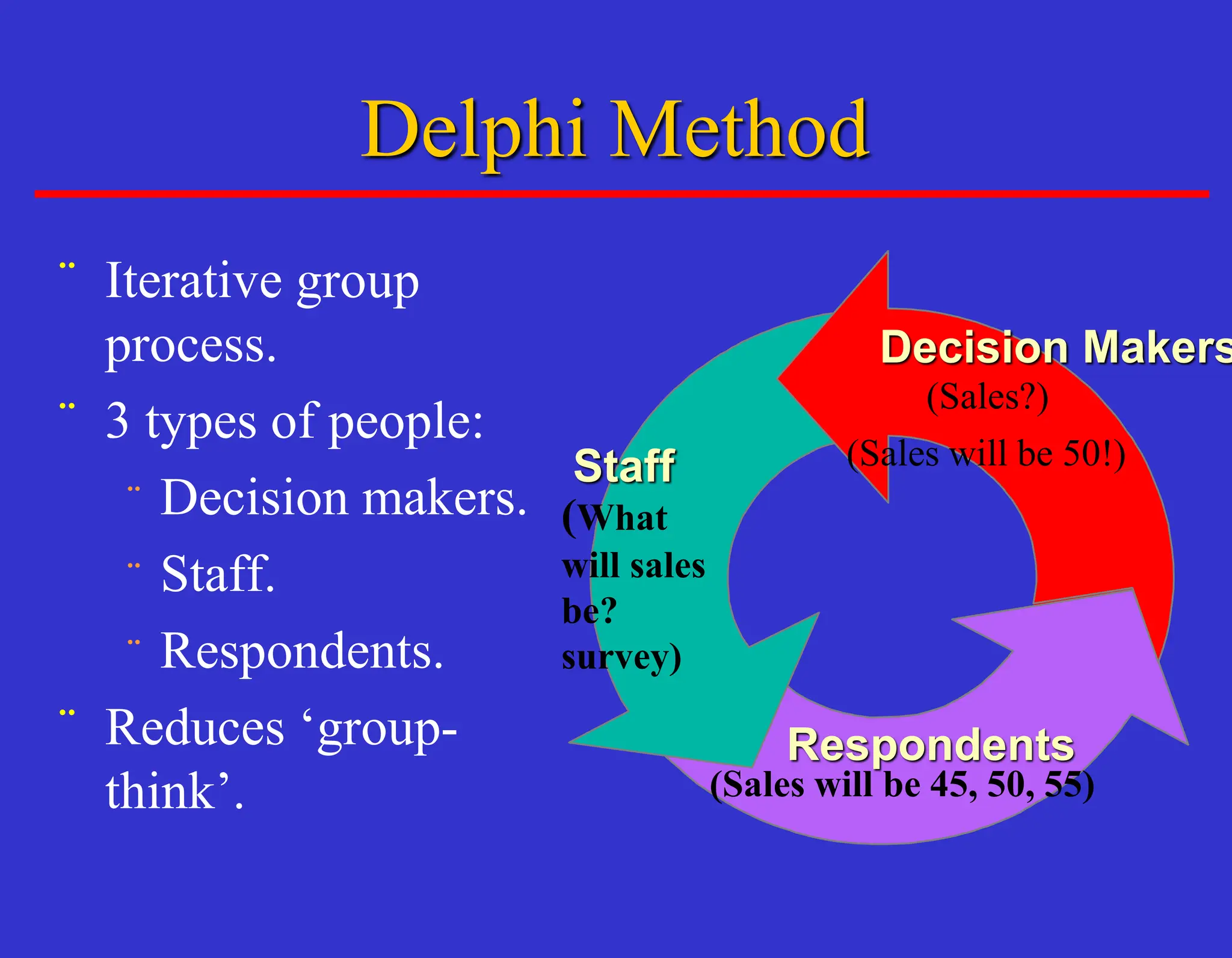
¨ Iterative group
process.
¨ 3 types of people:
¨ Decision makers.
¨ Staff.
¨ Respondents.
¨ Reduces ‘group-
think’.
Respondents
Staff
Decision Makers
(Sales?)
(What
will sales
be?
survey)
(Sales will be 45, 50, 55)
(Sales will be 50!)
Consumer Market Survey
¨ Ask customers
about purchasing
plans.
¨ What consumers
say, and what they
actually do are
often different.
¨ Sometimes
difficult to answer.
How many hours will
you use the Internet
next week?
© 1995 Corel
Corp.
Overview of Quantitative Approaches
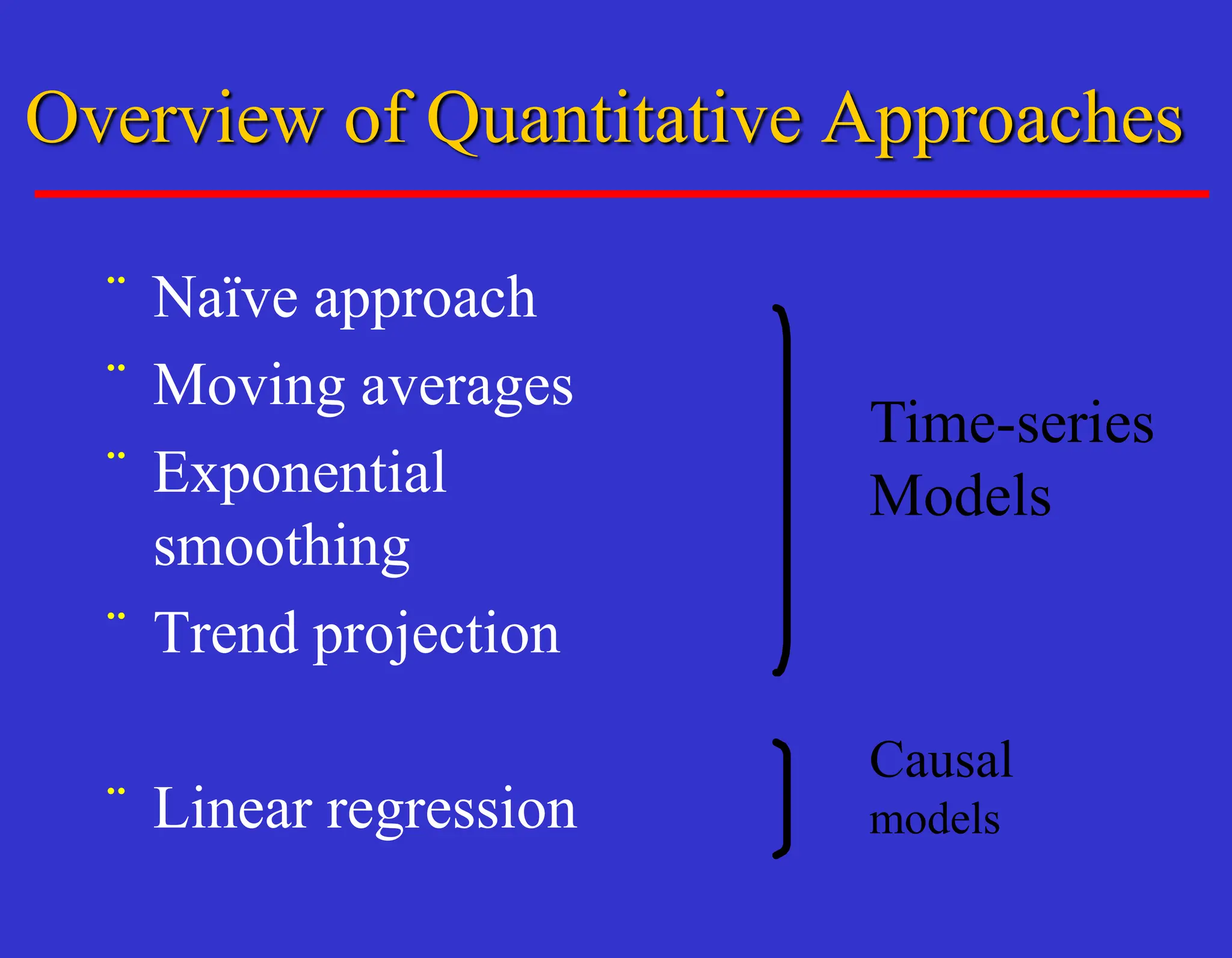
¨ Naïve approach
¨ Moving averages
¨ Exponential
smoothing
¨ Trend projection
¨ Linear regression
Time-series
Models
Causal
models
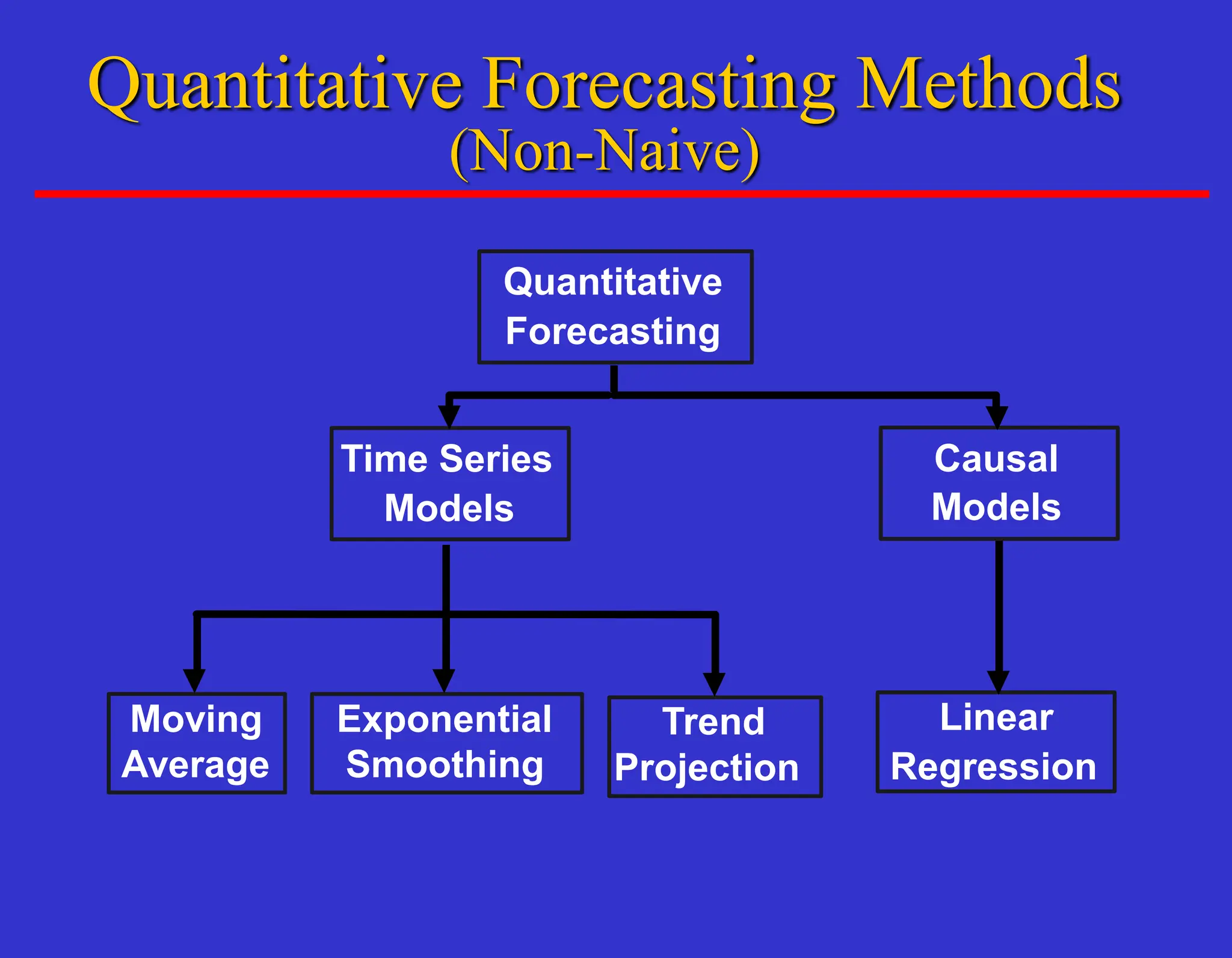
Quantitative Forecasting Methods
(Non-Naive)
Quantitative
Forecasting
Linear
Regression
Causal
Models
Exponential
Smoothing
Moving
Average
Time Series
Models
Trend
Projection
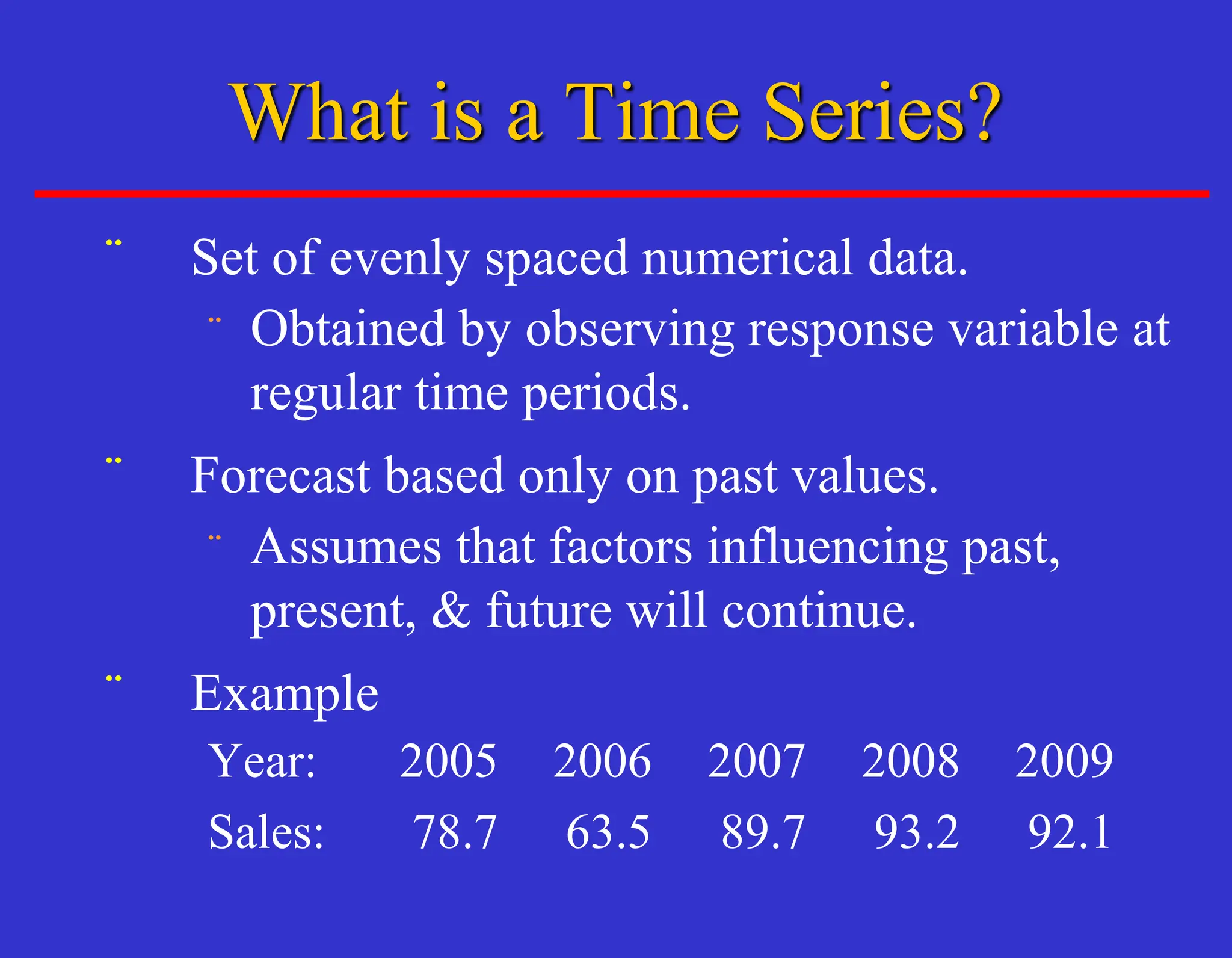
¨ Set of evenly spaced numerical data.
¨ Obtained by observing response variable at
regular time periods.
¨ Forecast based only on past values.
¨ Assumes that factors influencing past,
present, & future will continue.
¨ Example
Year: 2005 2006 2007 2008 2009
Sales: 78.7 63.5 89.7 93.2 92.1
What is a Time Series?
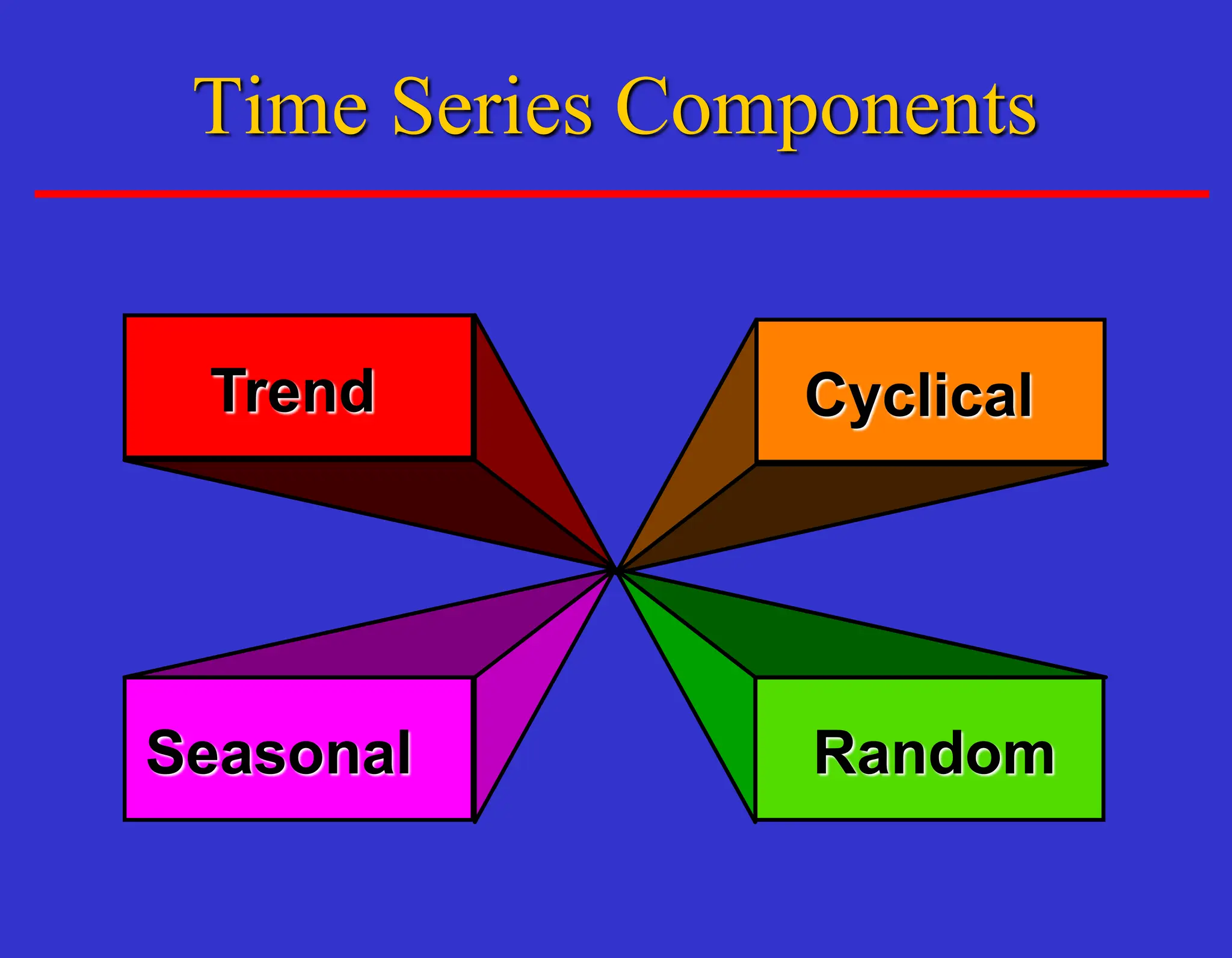
Trend
Seasonal
Cyclical
Random
Time Series Components
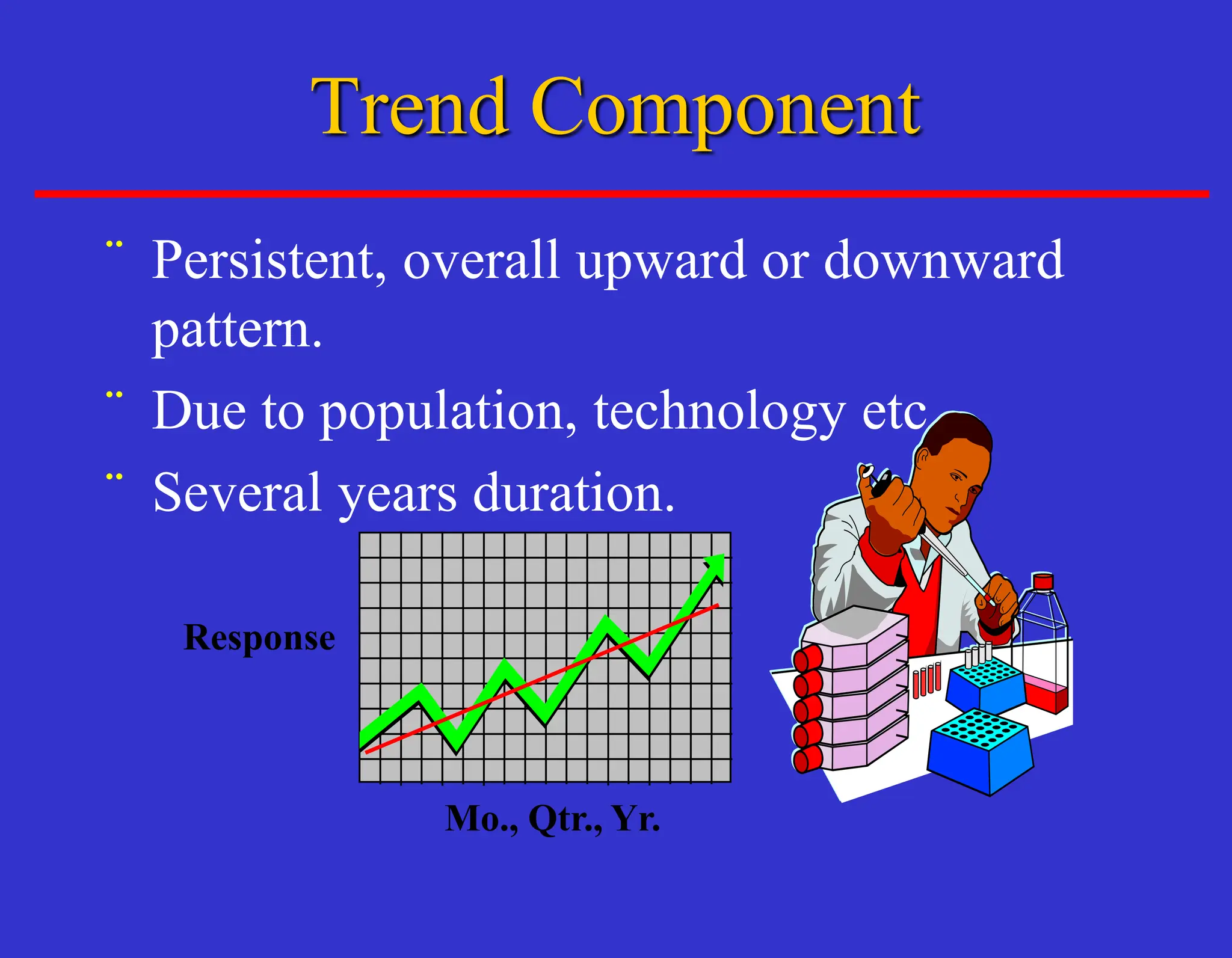
¨ Persistent, overall upward or downward
pattern.
¨ Due to population, technology etc...
¨ Several years duration.
Mo., Qtr., Yr.
Response
Trend Component
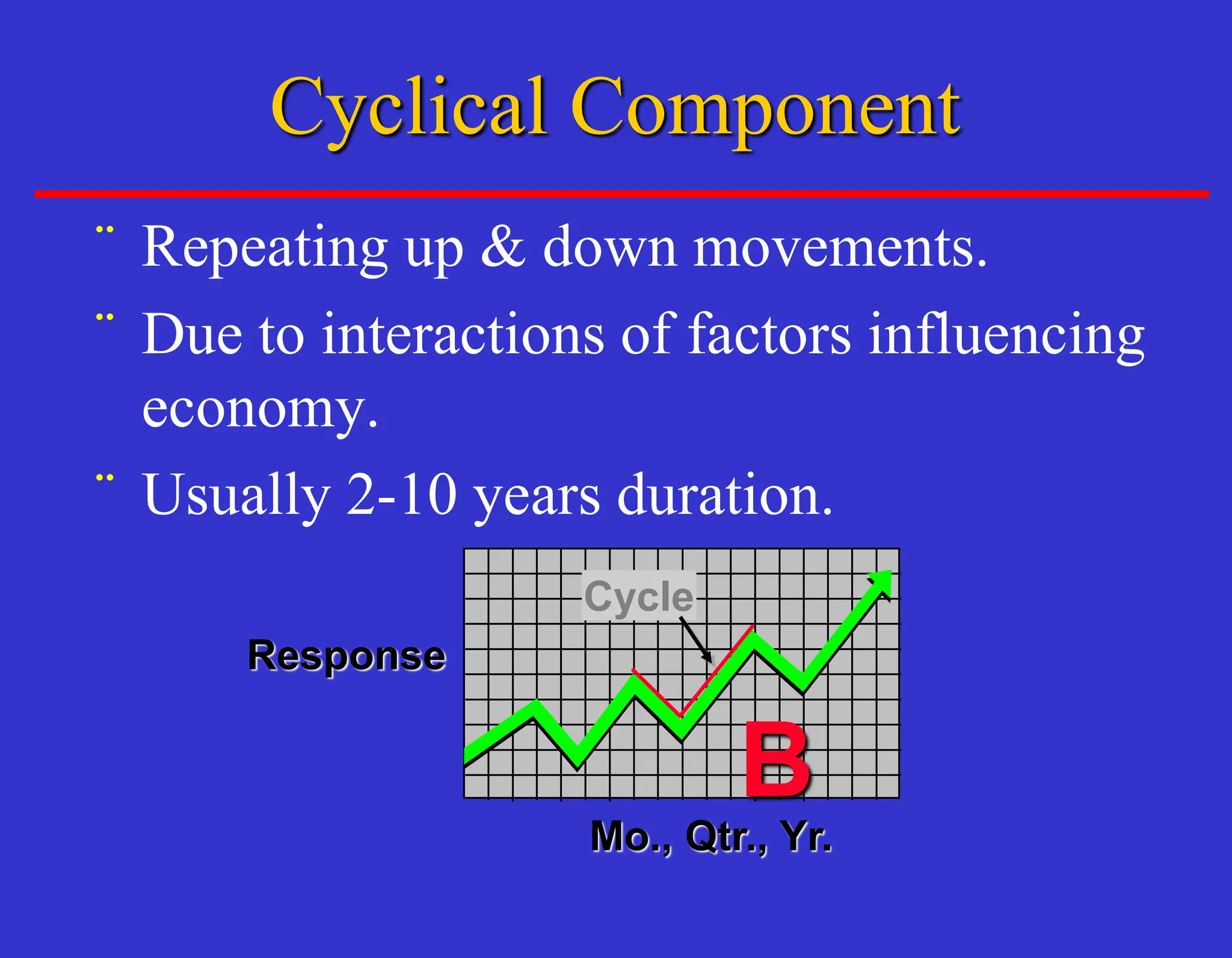
¨ Repeating up & down movements.
¨ Due to interactions of factors influencing
economy.
¨ Usually 2-10 years duration.
Mo., Qtr., Yr.
Response
Cycle
B
Cyclical Component
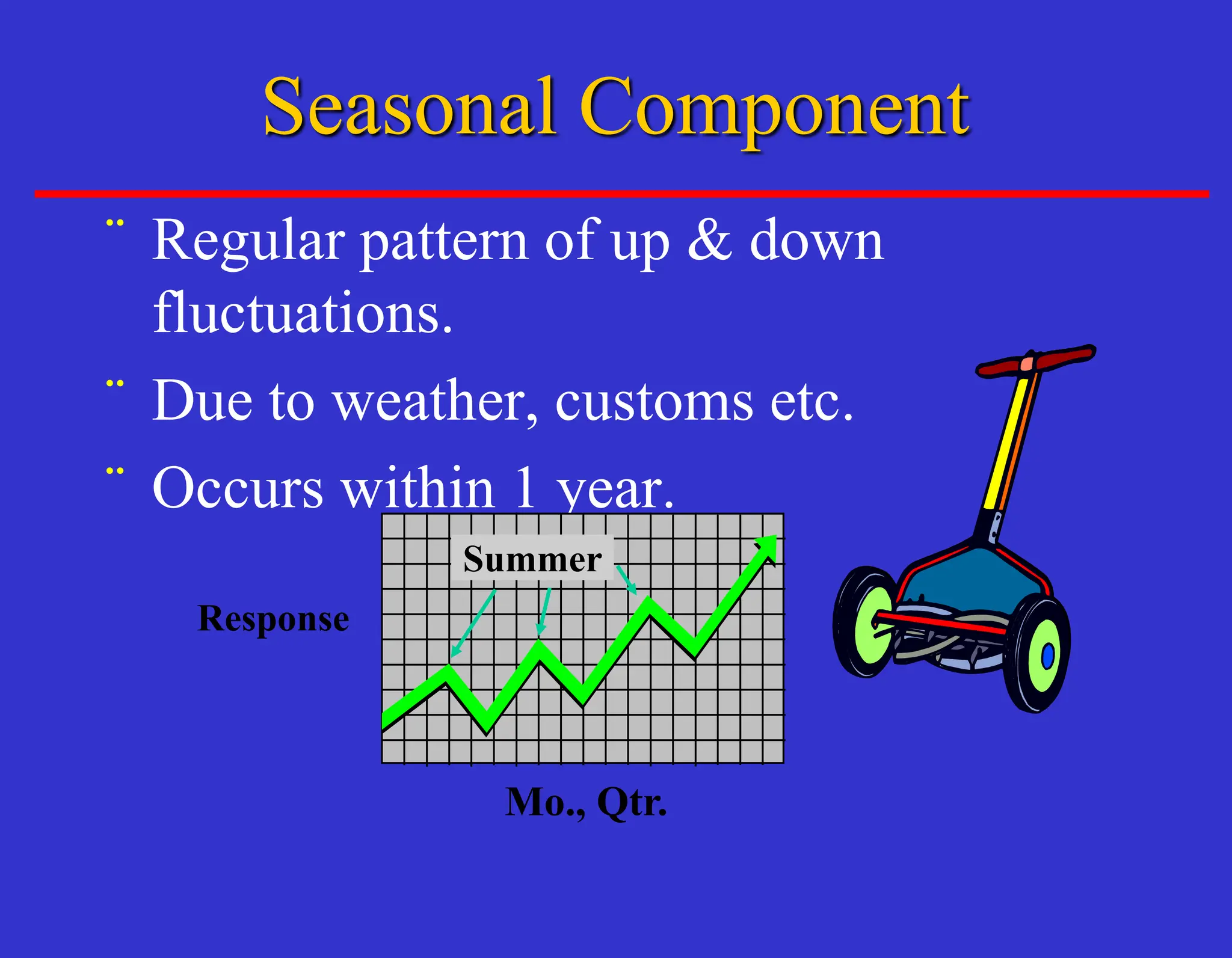
¨ Regular pattern of up & down
fluctuations.
¨ Due to weather, customs etc.
¨ Occurs within 1 year.
Mo., Qtr.
Response
Summer
Seasonal Component
¨ Erratic, unsystematic, ‘residual’
fluctuations.
¨ Due to random variation or unforeseen
events.
¨ Union strike
¨ Tornado
¨ Short duration &
no repeating.
Random Component
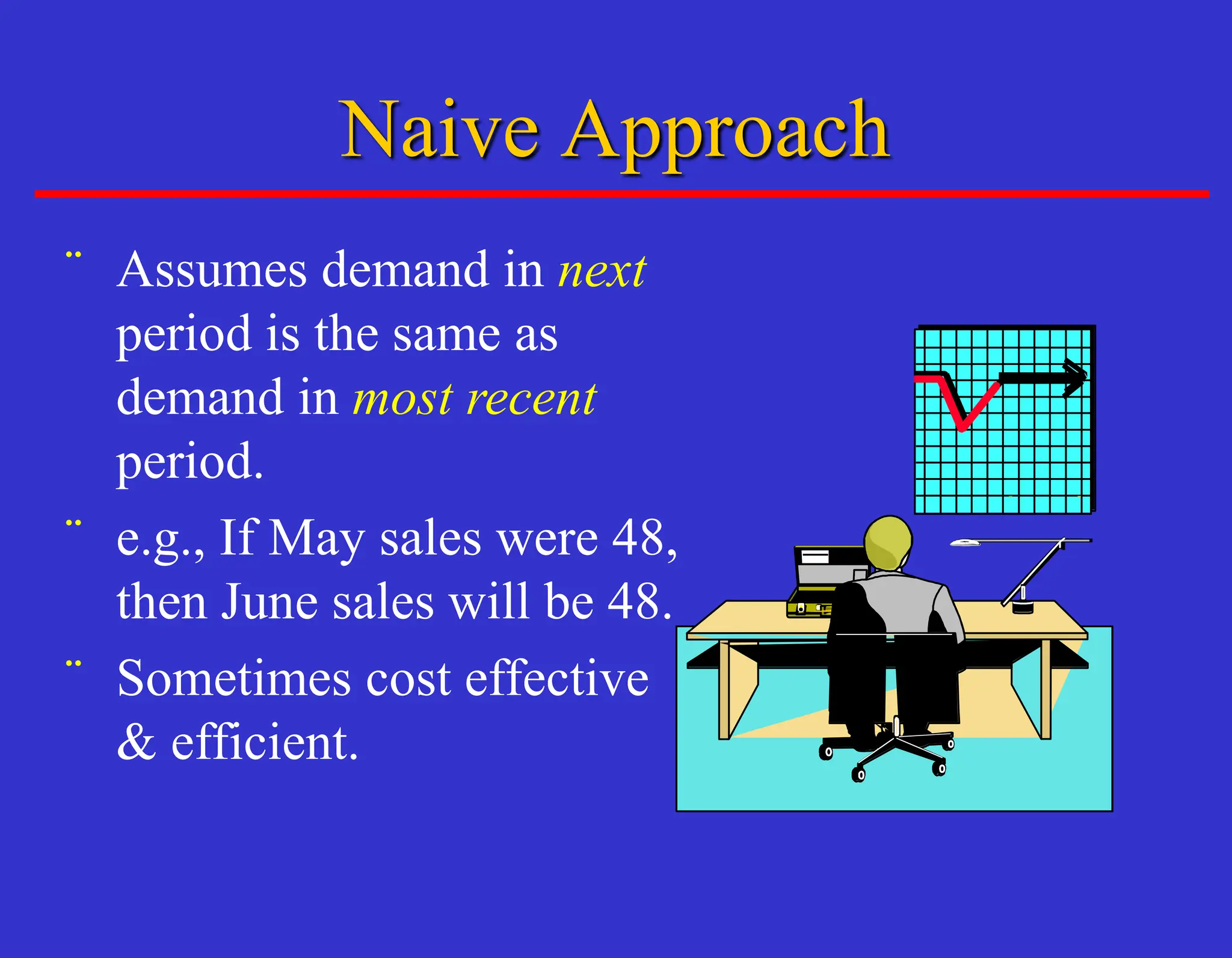
Naive Approach
¨ Assumes demand in next
period is the same as
demand in most recent
period.
¨ e.g., If May sales were 48,
then June sales will be 48.
¨ Sometimes cost effective
& efficient.
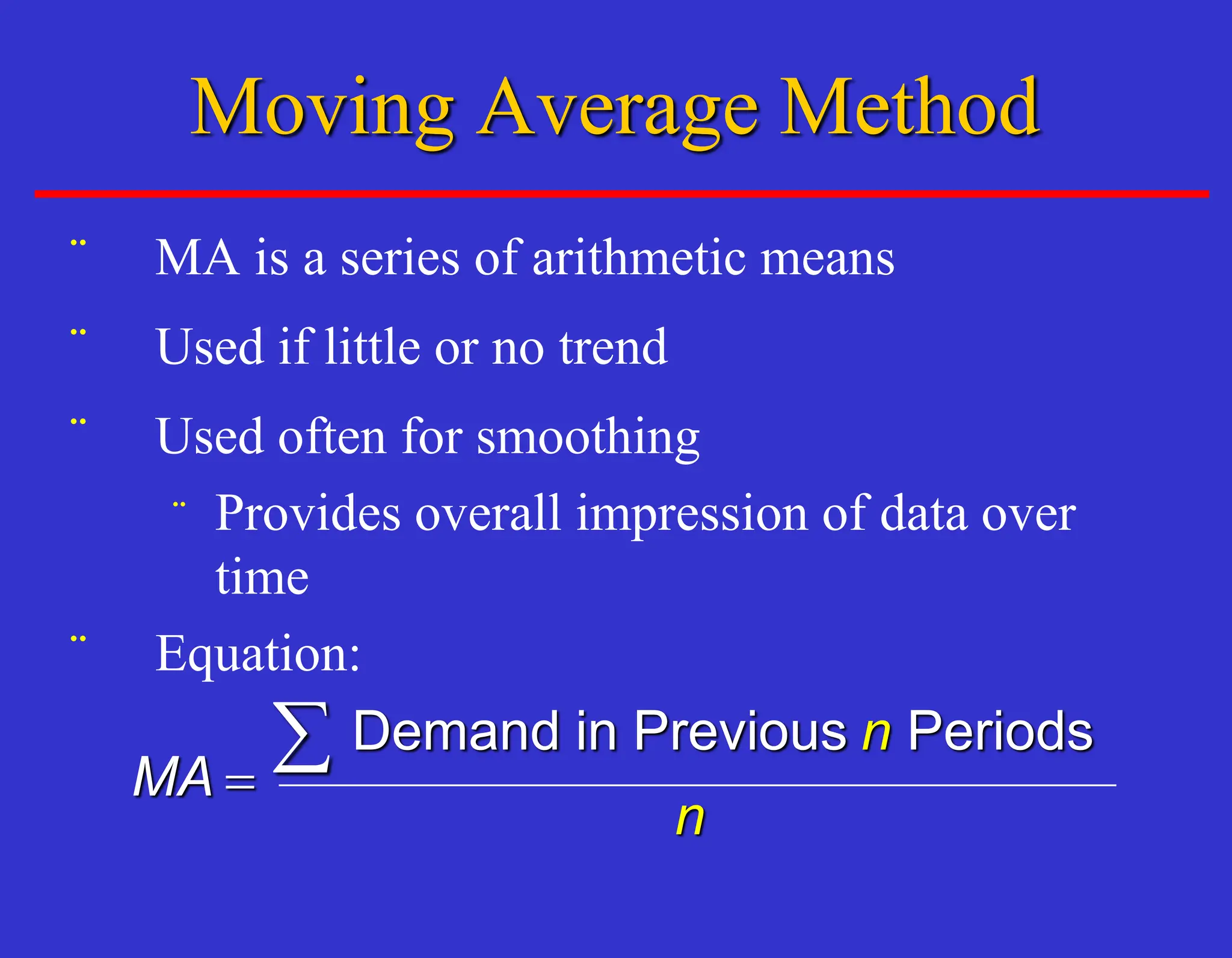
¨ MA is a series of arithmetic means
¨ Used if little or no trend
¨ Used often for smoothing
¨ Provides overall impression of data over
time
¨ Equation:
MA
n
n
=
 Demand in Previous Periods
Moving Average Method
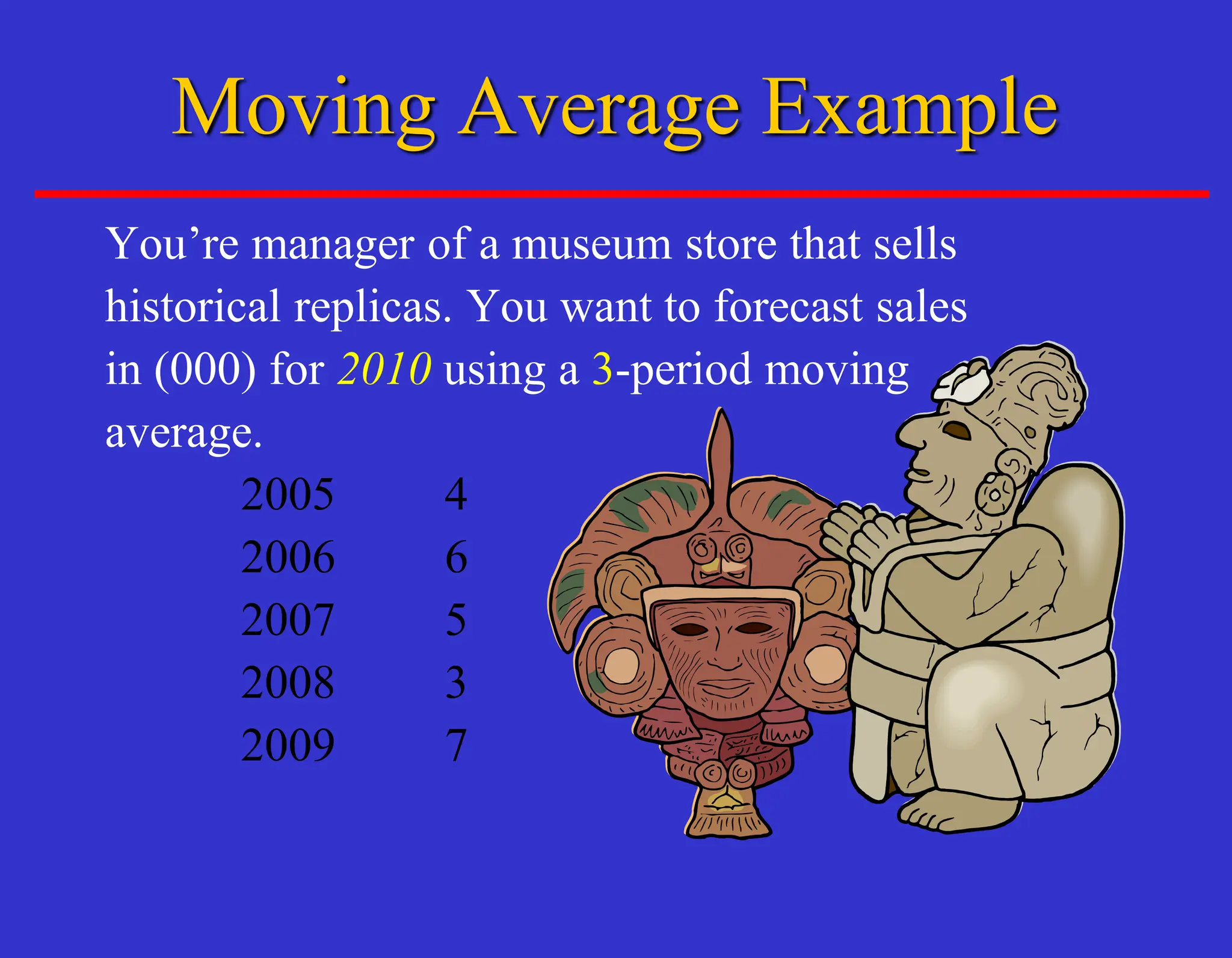
You’re manager of a museum store that sells
historical replicas. You want to forecast sales
in (000) for 2010 using a 3-period moving
average.
2005 4
2006 6
2007 5
2008 3
2009 7
Moving Average Example
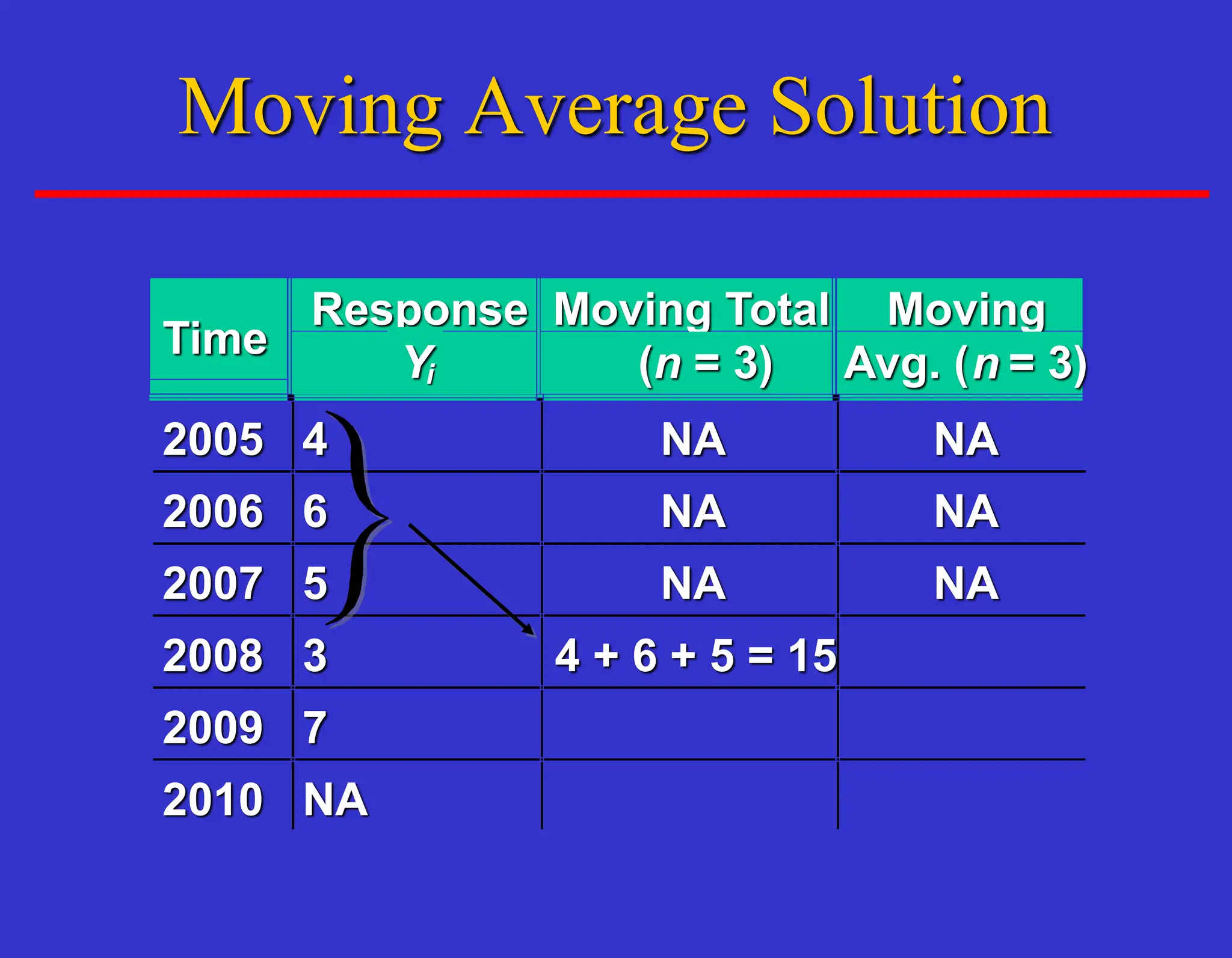
Time
Response
Yi
Moving Total
(n = 3)
Moving
Avg. (n = 3)
2005 4
2006 6
2007 5
NA NA
NA NA
NA NA
2008 3
2009 7
2010 NA
4 + 6 + 5 = 15
Moving Average Solution
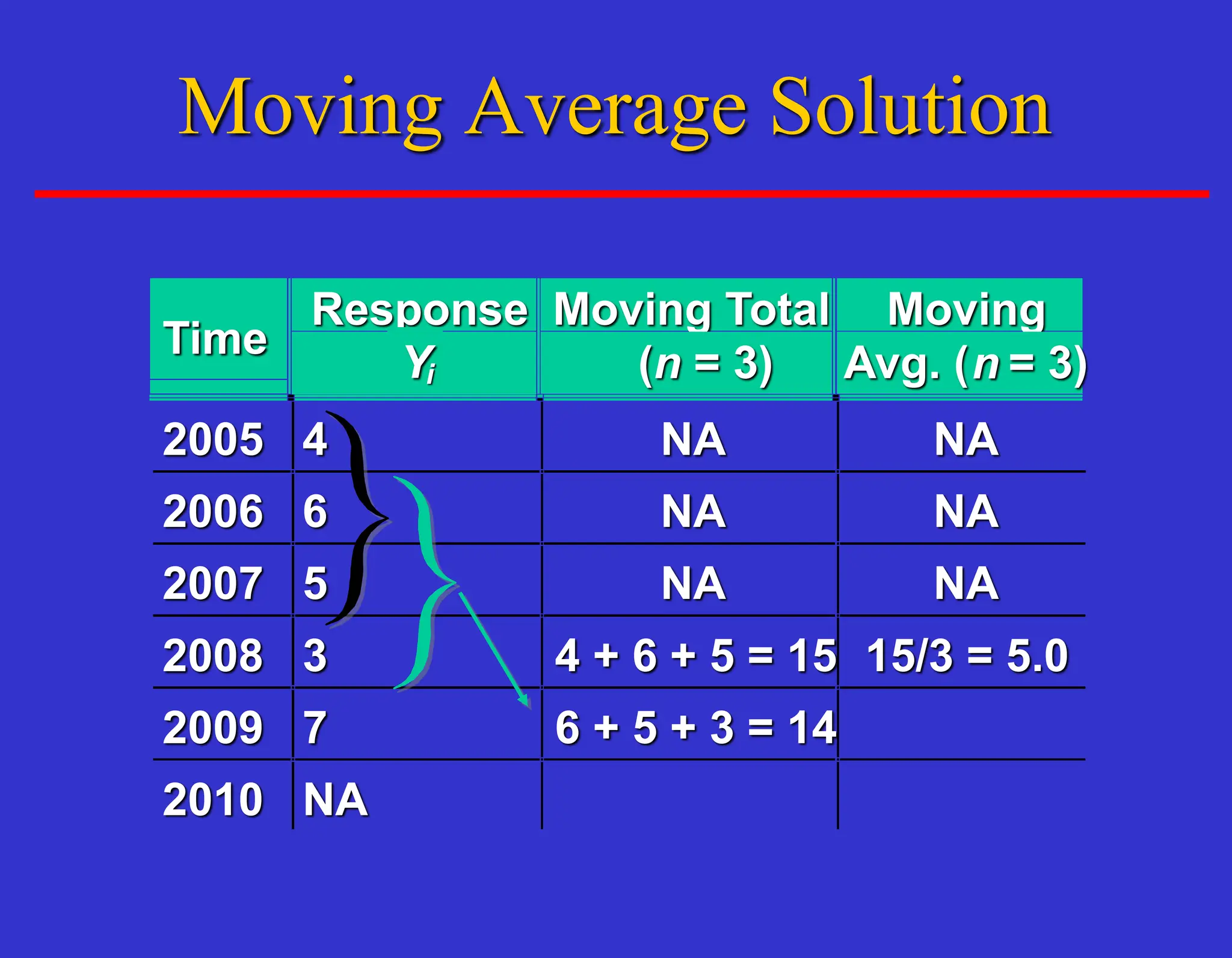
Time
Response
Yi
Moving Total
(n = 3)
Moving
Avg. (n = 3)
2005 4 NA NA
2006 6 NA NA
2007 5 NA NA
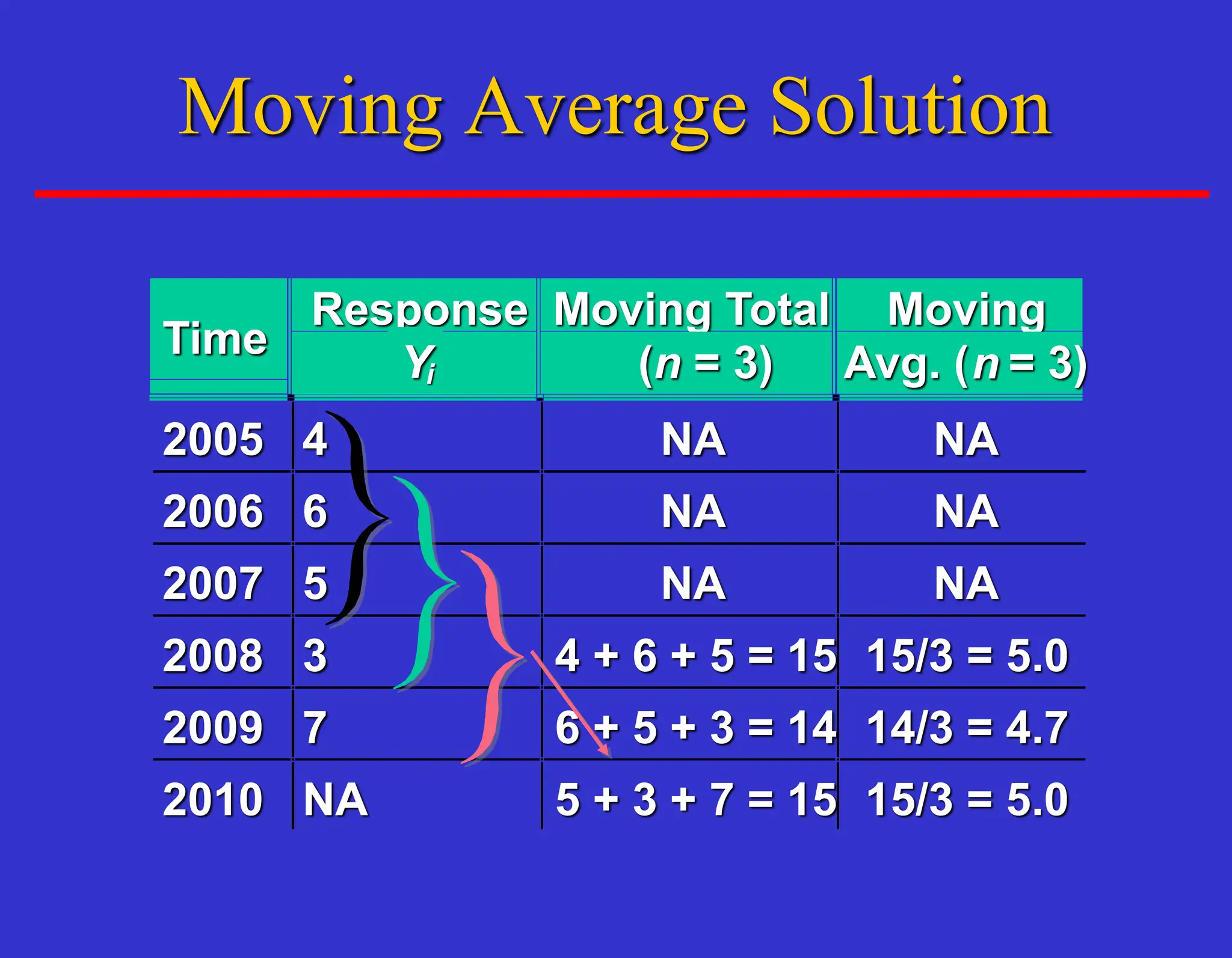
2008 3 4 + 6 + 5 = 15 15/3 = 5.0
2009 7
2010 NA
6 + 5 + 3 = 14
Moving Average Solution
Time
Response
Yi
Moving Total
(n = 3)
Moving
Avg. (n = 3)
2005 4 NA NA
2006 6 NA NA
2007 5 NA NA
2008 3 4 + 6 + 5 = 15 15/3 = 5.0
2009 7 6 + 5 + 3 = 14 14/3 = 4.7
2010 NA 5 + 3 + 7 = 15 15/3 = 5.0
Moving Average Solution
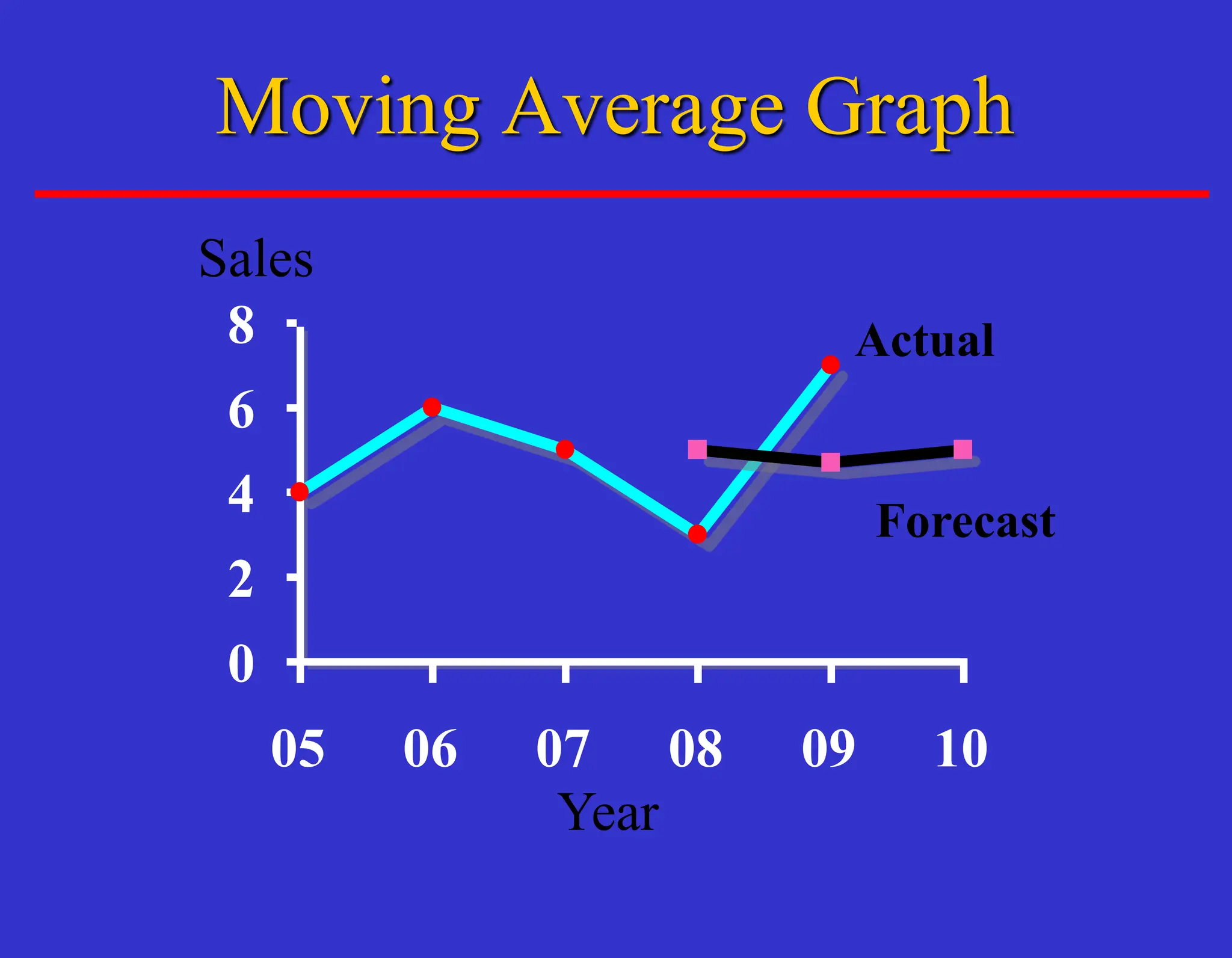
Year
Sales
0
2
4
6
8
05 06 07 08 09 10
Actual
Forecast
Moving Average Graph
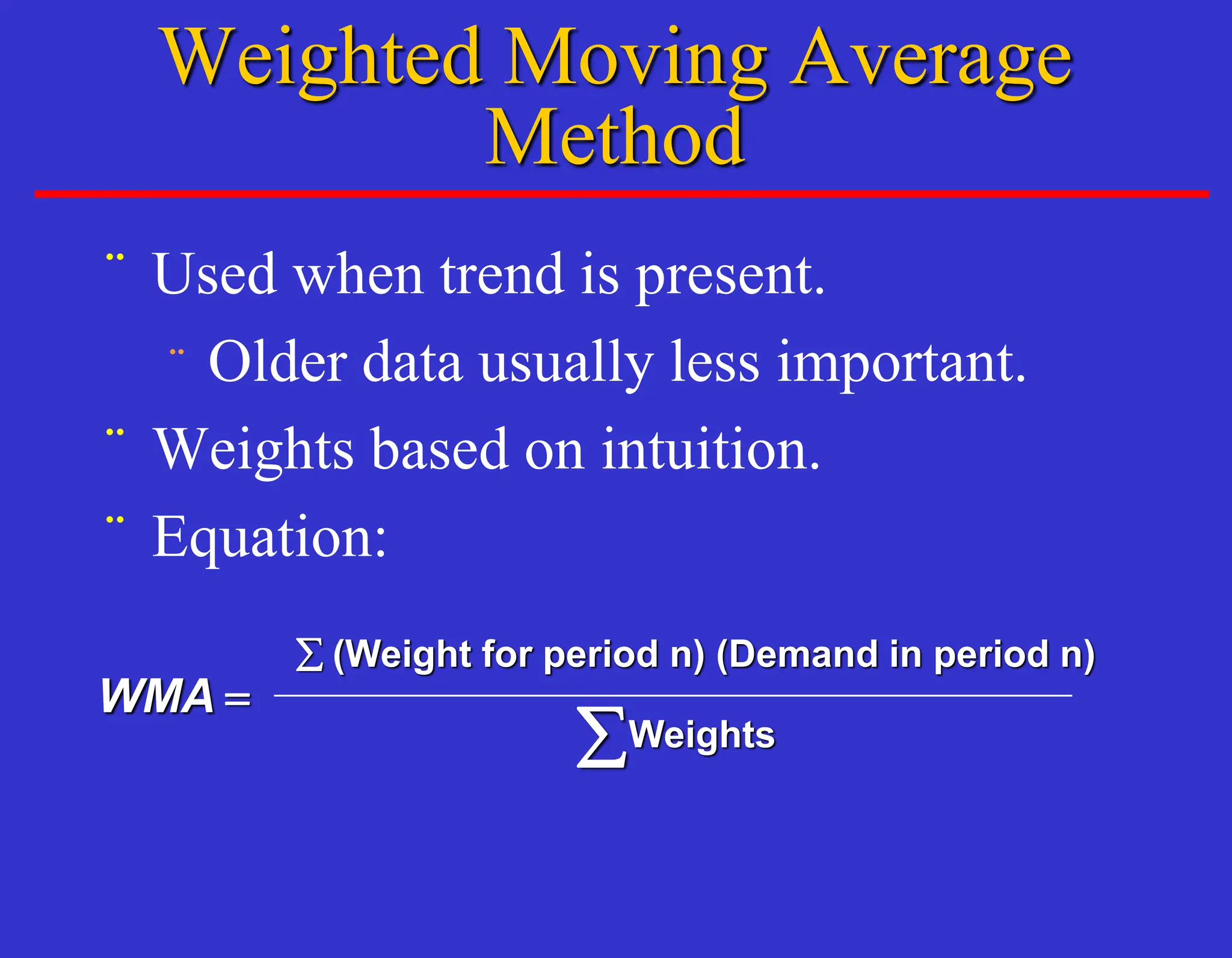
¨ Used when trend is present.
¨ Older data usually less important.
¨ Weights based on intuition.
¨ Equation:
WMA =

(Weight for period n) (Demand in period n)
Weights
Weighted Moving Average
Method
¨ Increasing n makes forecast less
sensitive to changes.
¨ Do not forecast trend well.
¨ Require much historical
data.
Disadvantages of
Moving Average Method
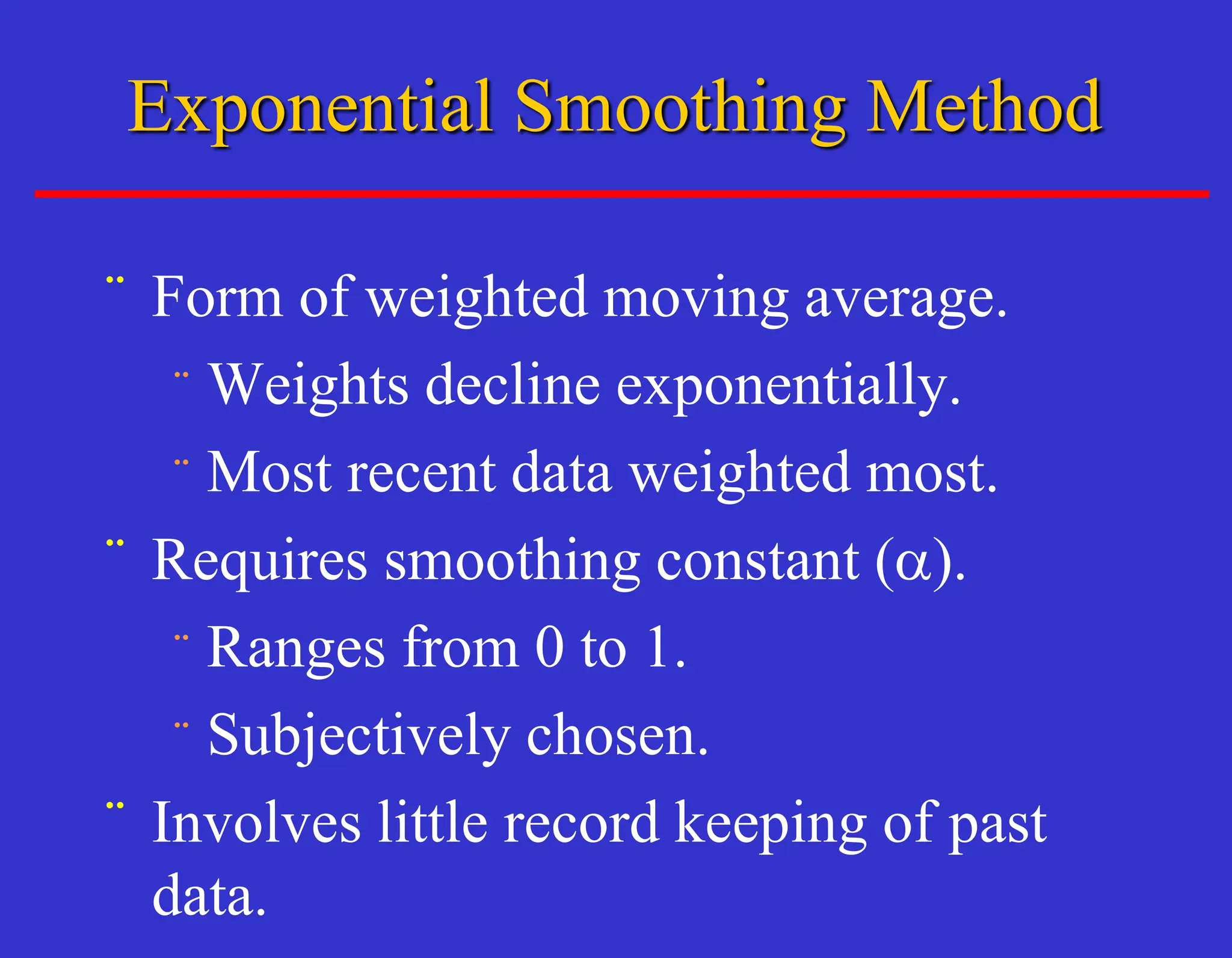
¨ Form of weighted moving average.
¨ Weights decline exponentially.
¨ Most recent data weighted most.
¨ Requires smoothing constant (a).
¨ Ranges from 0 to 1.
¨ Subjectively chosen.
¨ Involves little record keeping of past
data.
Exponential Smoothing Method
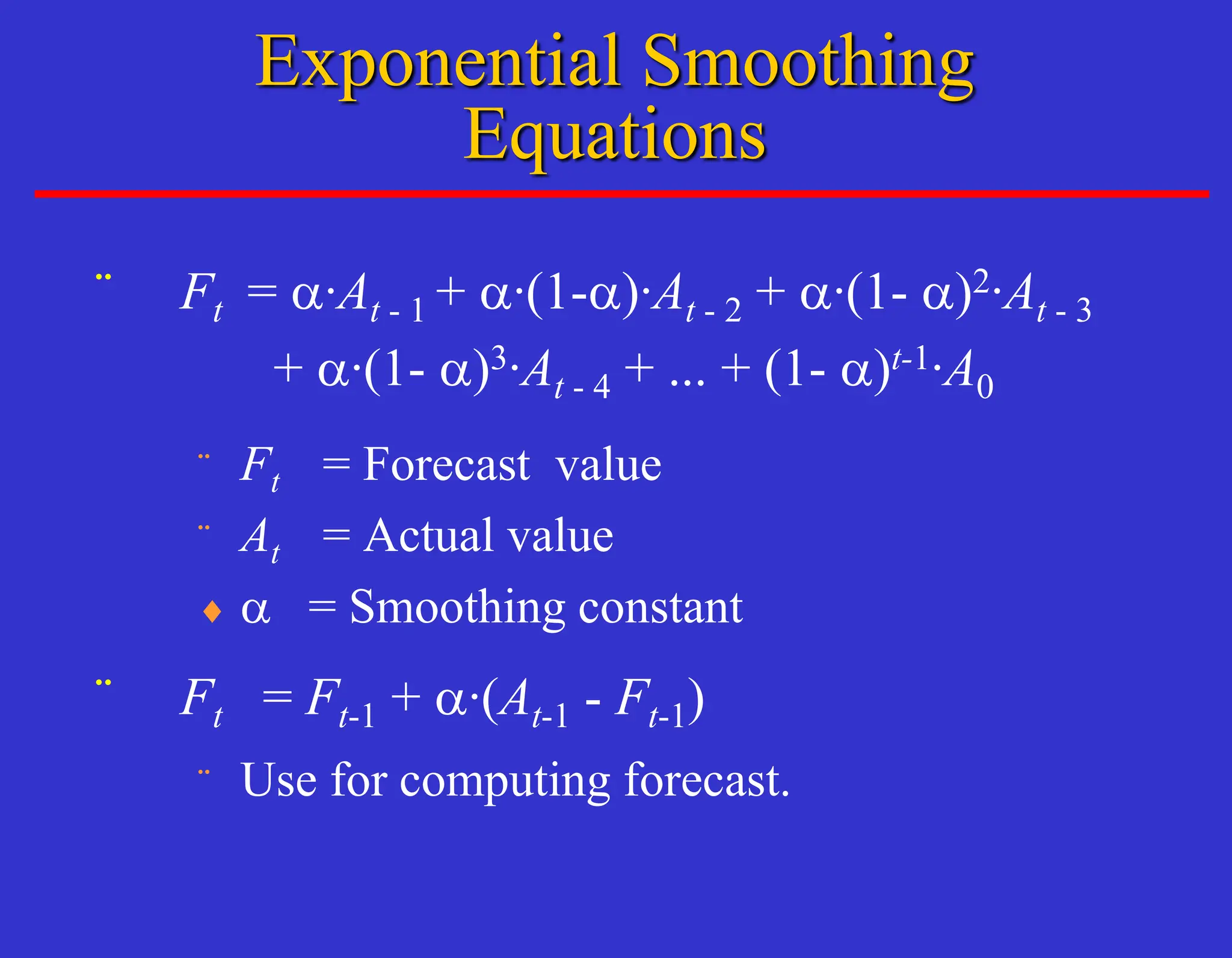
¨ Ft = a·At - 1 + a·(1-a)·At - 2 + a·(1- a)2·At - 3
+ a·(1- a)3·At - 4 + ... + (1- a)t-1·A0
¨ Ft = Forecast value
¨ At = Actual value
 a = Smoothing constant
¨ Ft = Ft-1 + a·(At-1 - Ft-1)
¨ Use for computing forecast.
Exponential Smoothing
Equations
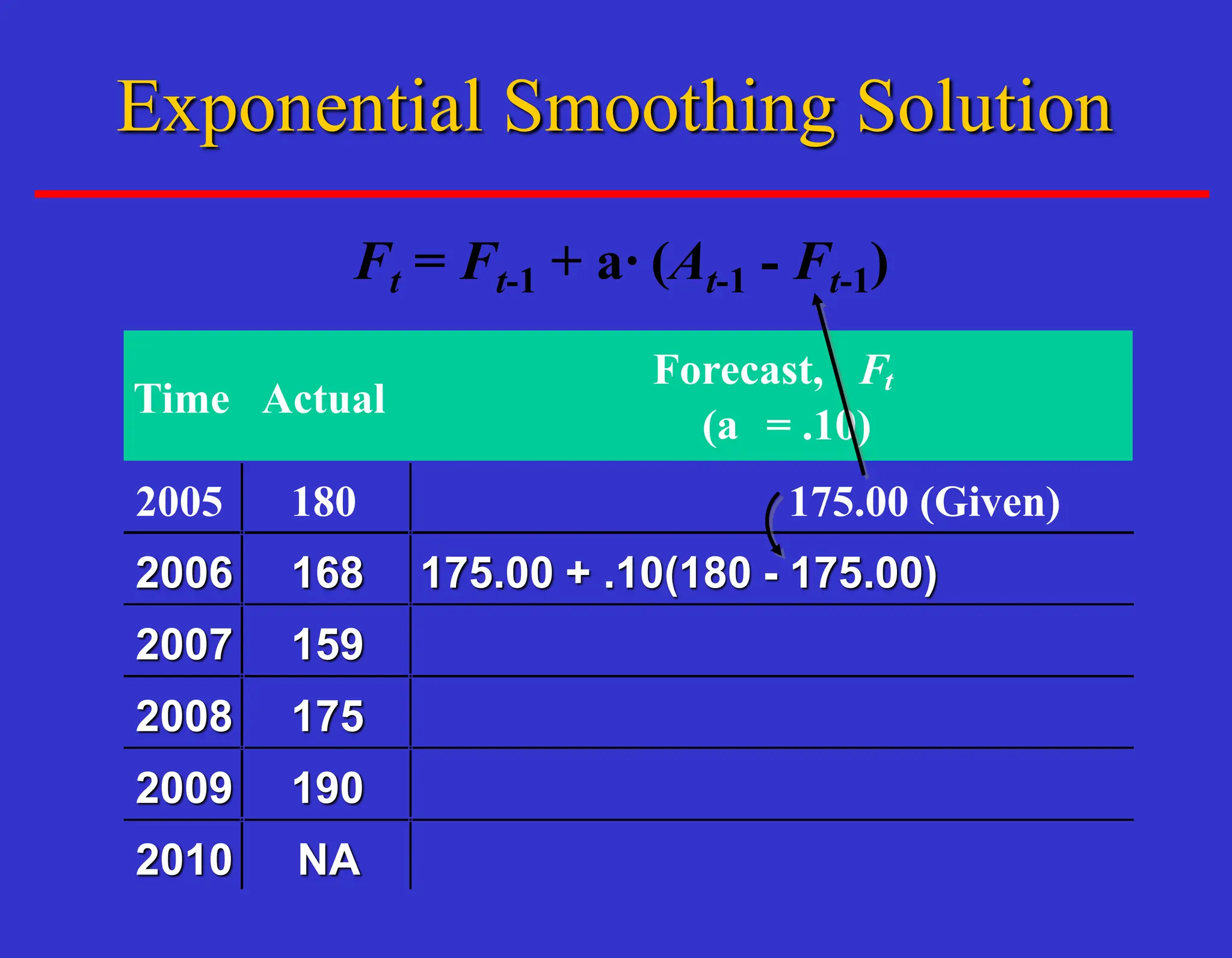
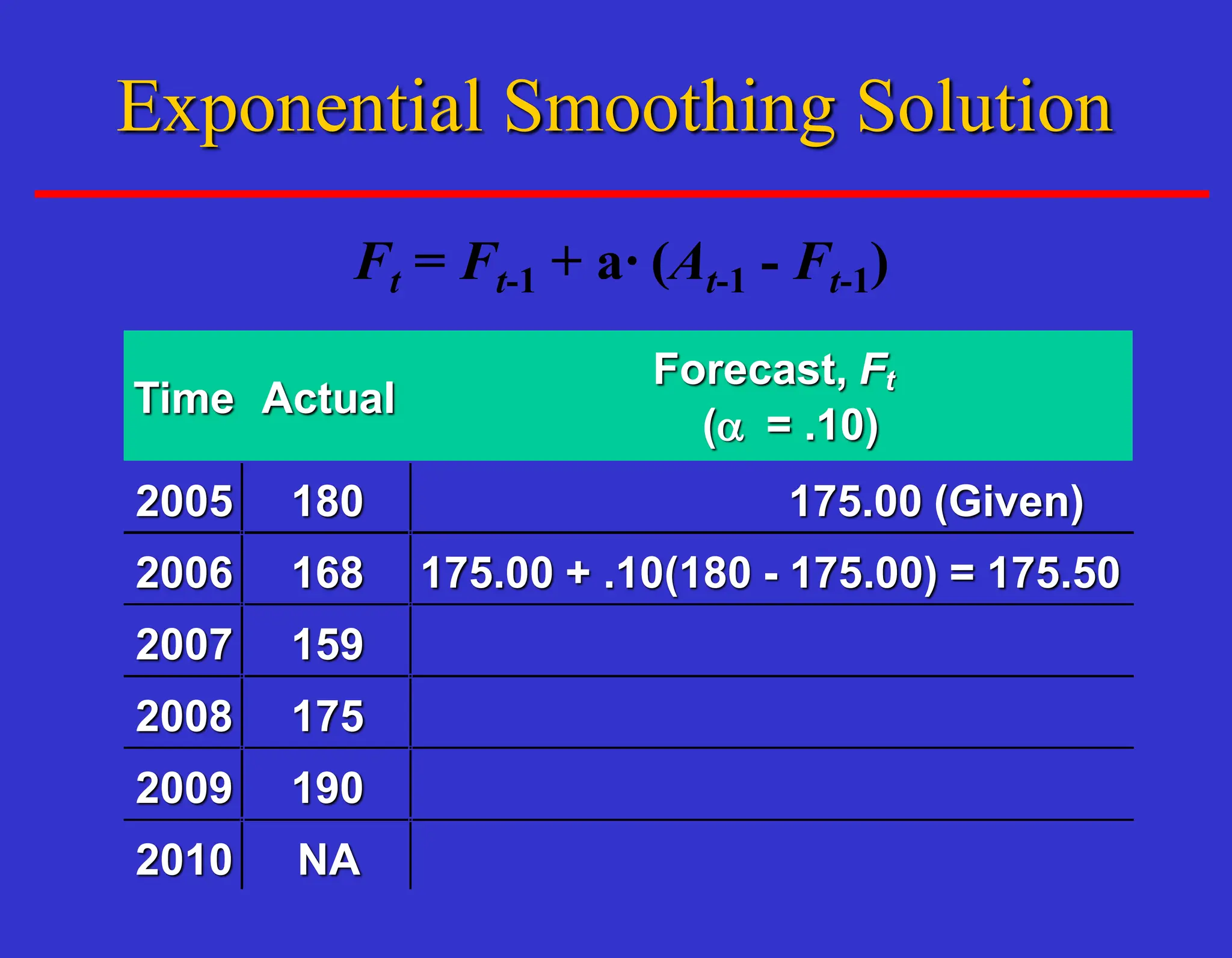
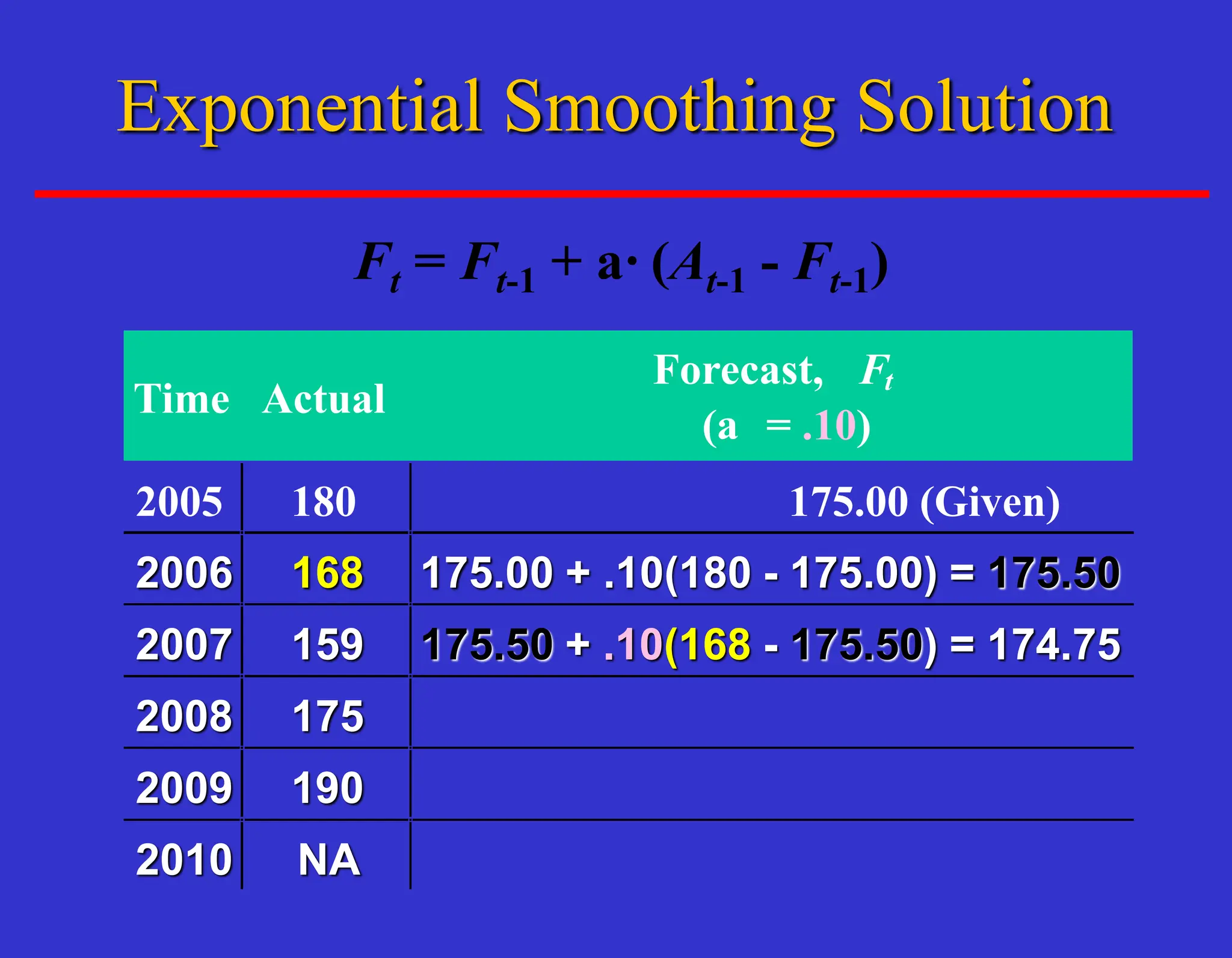
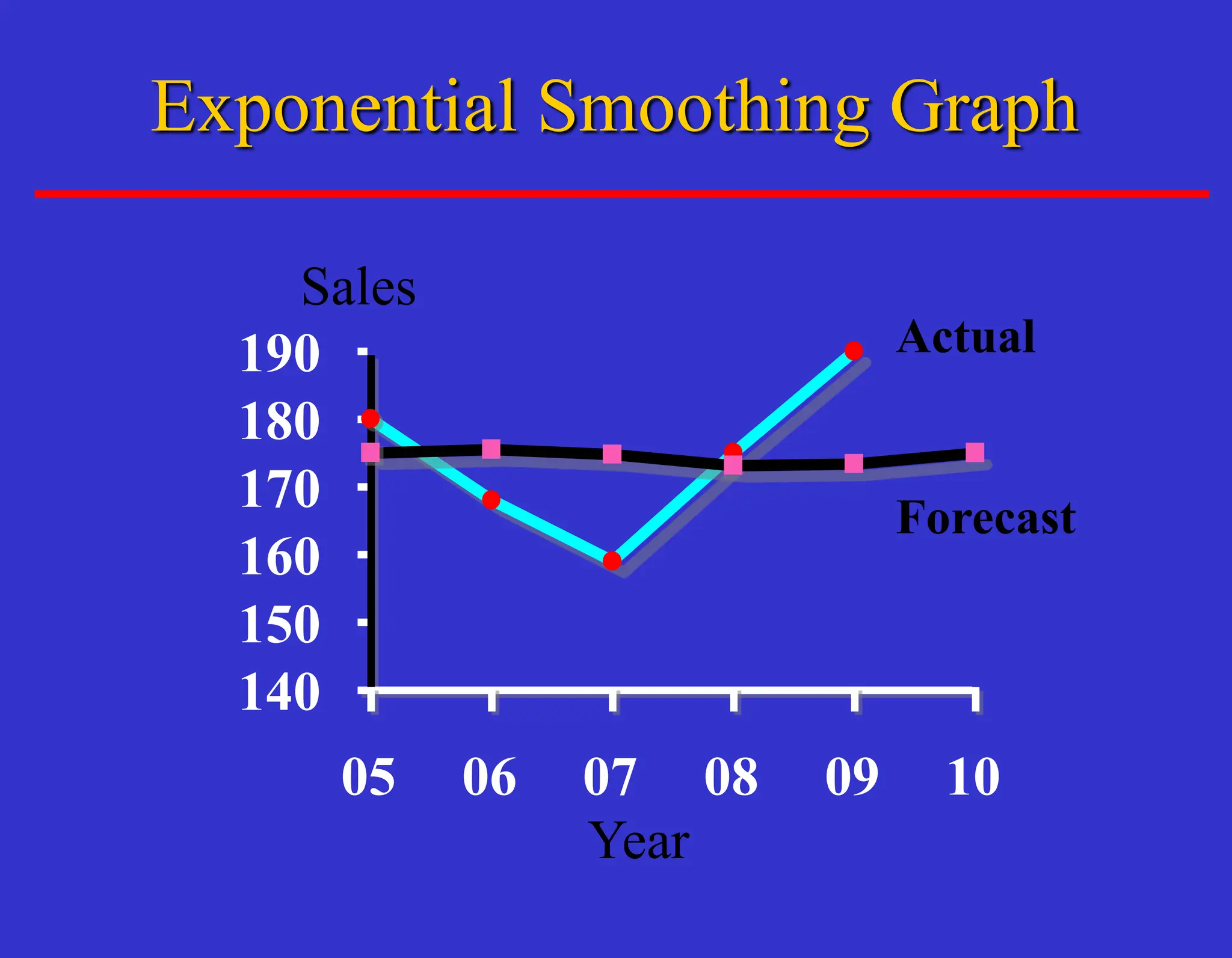
You’re organizing a Kwanza meeting. You
want to forecast attendance for 2010 using
exponential smoothing
(a = .10). The 2005 forecast was 175.
2005 180
2006 168
2007 159
2008 175
2009 190
Exponential Smoothing Example
Ft = Ft-1 + a· (At-1 - Ft-1)
Time Actual
Forecast, Ft
(a = .10)
2005 180 175.00 (Given)
2006 168
2007 159
2008 175
2009 190
2010 NA
175.00 +
Exponential Smoothing Solution
Ft = Ft-1 + a· (At-1 - Ft-1)
Time Actual
Forecast, Ft
(a = .10)
2005 180 175.00 (Given)
2006 168 175.00 + .10(
2007 159
2008 175
2009 190
2010 NA
Exponential Smoothing Solution
Ft = Ft-1 + a· (At-1 - Ft-1)
Time Actual
Forecast, Ft
(a = .10)
2005 180 175.00 (Given)
2006 168 175.00 + .10(180 -
2007 159
2008 175
2009 190
2010 NA
Exponential Smoothing Solution
Ft = Ft-1 + a· (At-1 - Ft-1)
Time Actual
Forecast, Ft
(a = .10)
2005 180 175.00 (Given)
2006 168 175.00 + .10(180 - 175.00)
2007 159
2008 175
2009 190
2010 NA
Exponential Smoothing Solution
Ft = Ft-1 + a· (At-1 - Ft-1)
Time Actual
Forecast, Ft
(a = .10)
2005 180 175.00 (Given)
2006 168 175.00 + .10(180 - 175.00) = 175.50
2007 159
2008 175
2009 190
2010 NA
Exponential Smoothing Solution
Ft = Ft-1 + a· (At-1 - Ft-1)
Time Actual
Forecast, Ft
(a = .10)
2005 180 175.00 (Given)
2006 168 175.00 + .10(180 - 175.00) = 175.50
2007 159 175.50 + .10(168 - 175.50) = 174.75
2008 175
2009 190
2010 NA
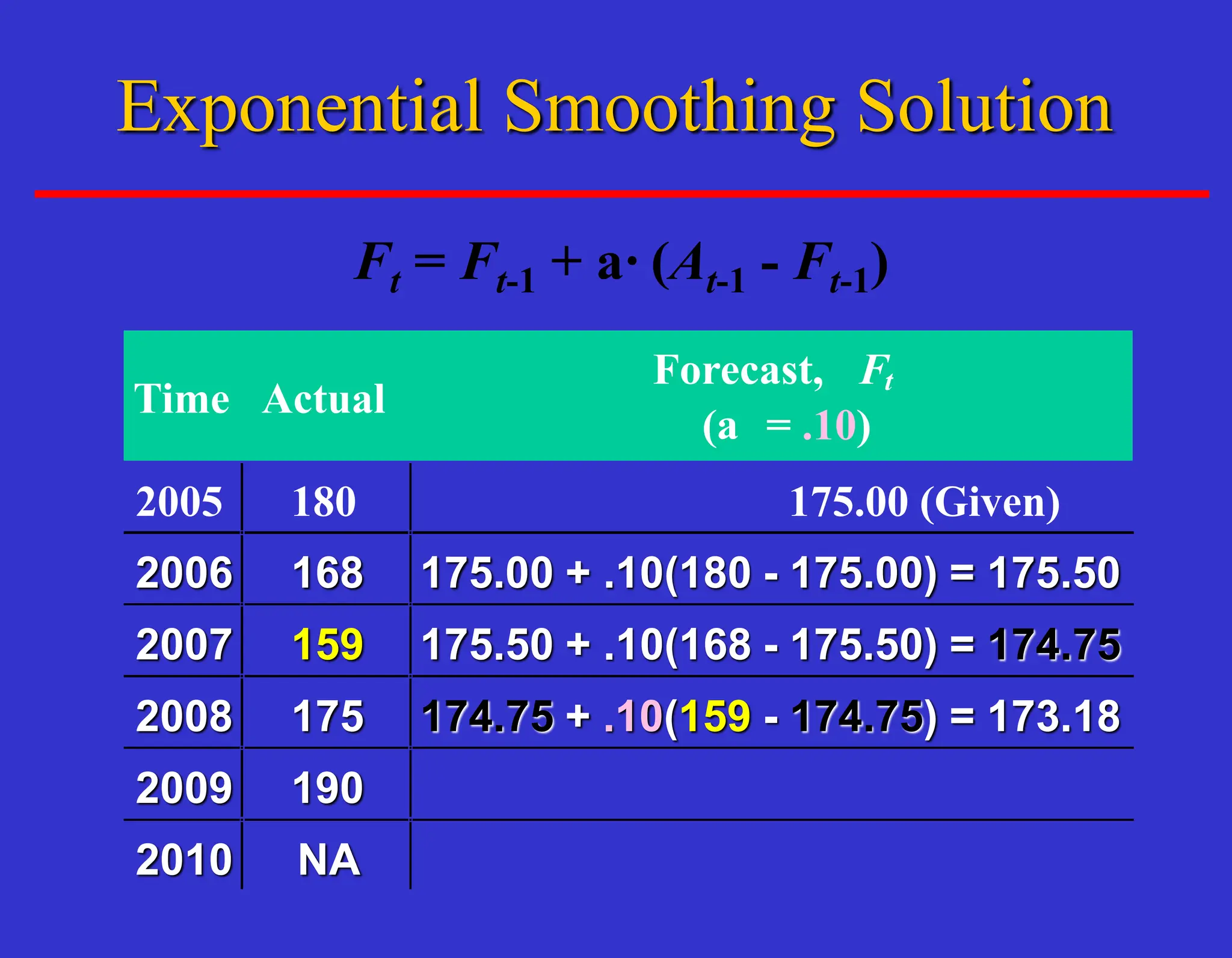
Exponential Smoothing Solution
Ft = Ft-1 + a· (At-1 - Ft-1)
Time Actual
Forecast, Ft
(a = .10)
2005 180 175.00 (Given)
2006 168 175.00 + .10(180 - 175.00) = 175.50
2007 159 175.50 + .10(168 - 175.50) = 174.75
2008 175
2009 190
2010 NA
174.75 + .10(159 - 174.75) = 173.18
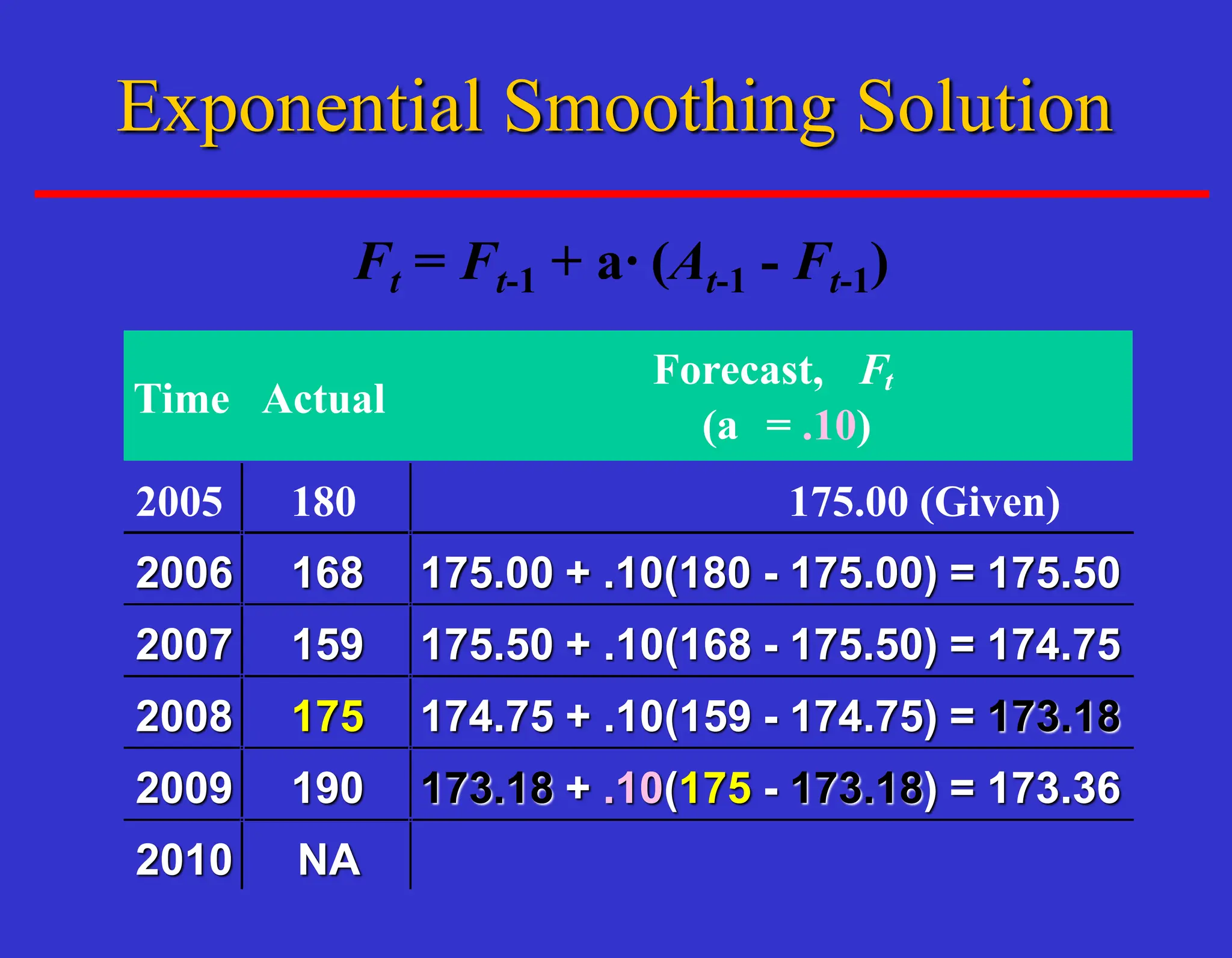
Exponential Smoothing Solution
Ft = Ft-1 + a· (At-1 - Ft-1)
Time Actual
Forecast, Ft
(a = .10)
2005 180 175.00 (Given)
2006 168 175.00 + .10(180 - 175.00) = 175.50
2007 159 175.50 + .10(168 - 175.50) = 174.75
2008 175 174.75 + .10(159 - 174.75) = 173.18
2009 190 173.18 + .10(175 - 173.18) = 173.36
2010 NA
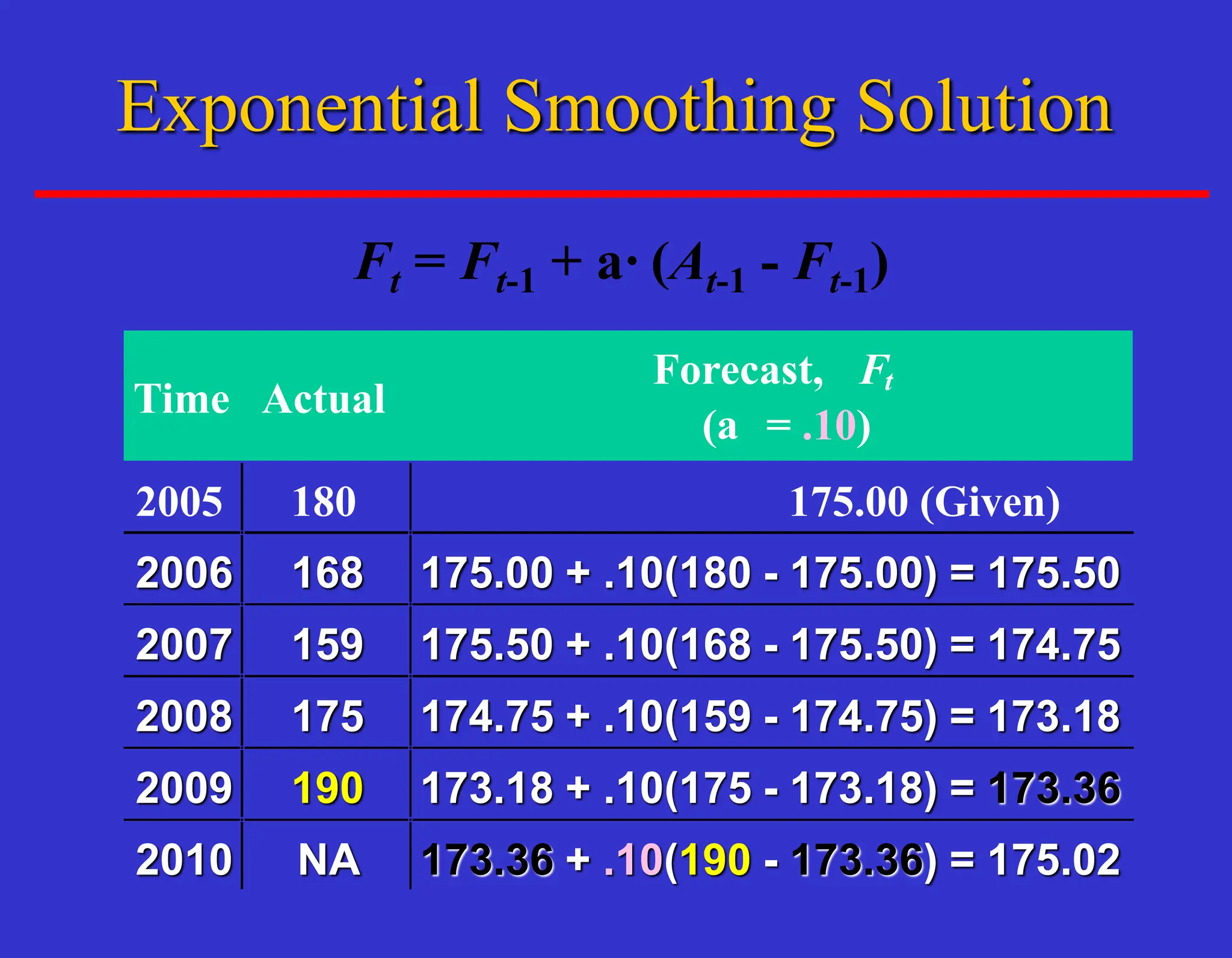
Exponential Smoothing Solution
Ft = Ft-1 + a· (At-1 - Ft-1)
Time Actual
Forecast, Ft
(a = .10)
2005 180 175.00 (Given)
2006 168 175.00 + .10(180 - 175.00) = 175.50
2007 159 175.50 + .10(168 - 175.50) = 174.75
2008 175 174.75 + .10(159 - 174.75) = 173.18
2009 190 173.18 + .10(175 - 173.18) = 173.36
2010 NA 173.36 + .10(190 - 173.36) = 175.02
Exponential Smoothing Solution
Year
Sales
140
150
160
170
180
190
05 06 07 08 09 10
Actual
Forecast
Exponential Smoothing Graph
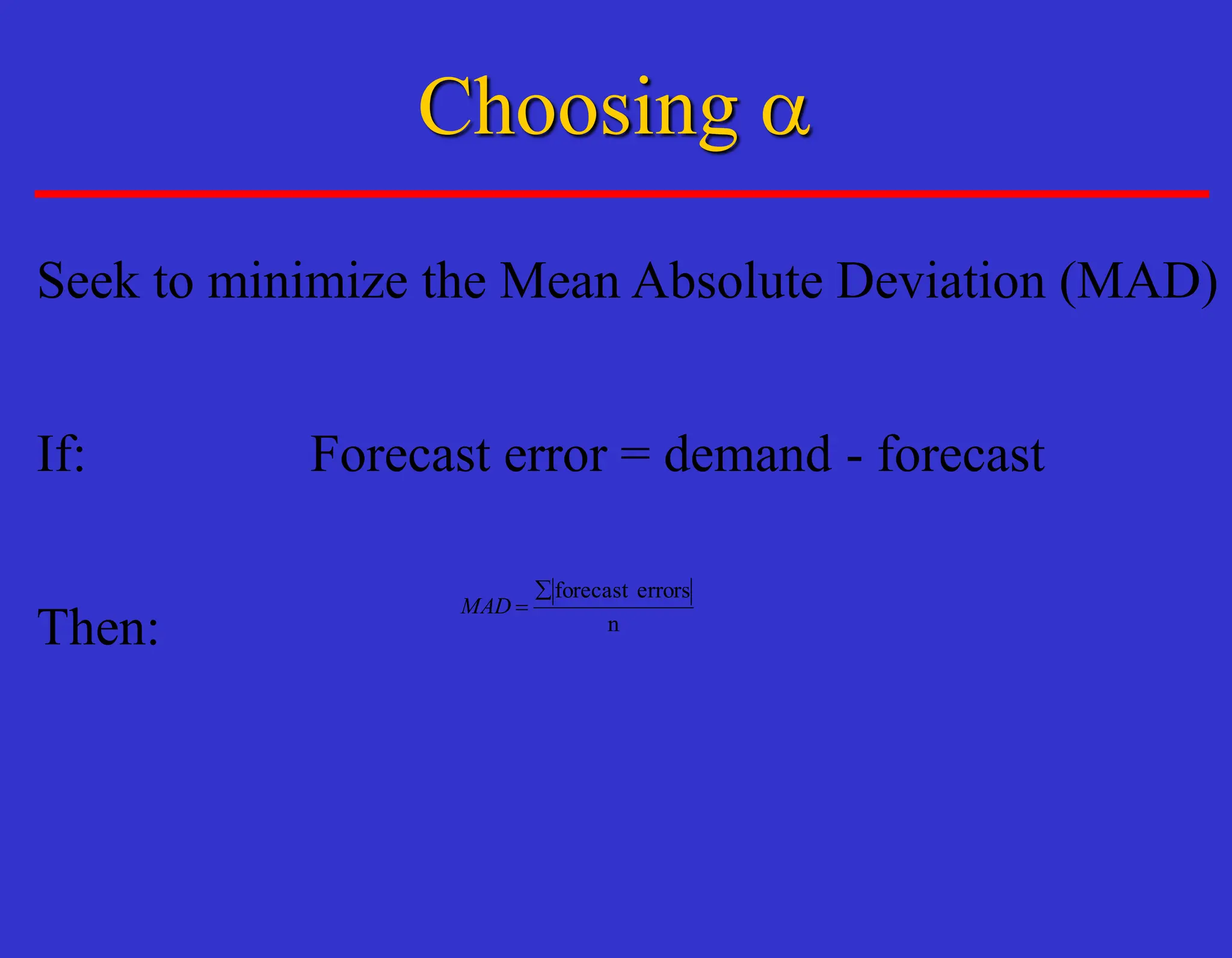
Choosing a
Seek to minimize the Mean Absolute Deviation (MAD)
If: Forecast error = demand - forecast
Then: n
errors
forecast

=
MAD
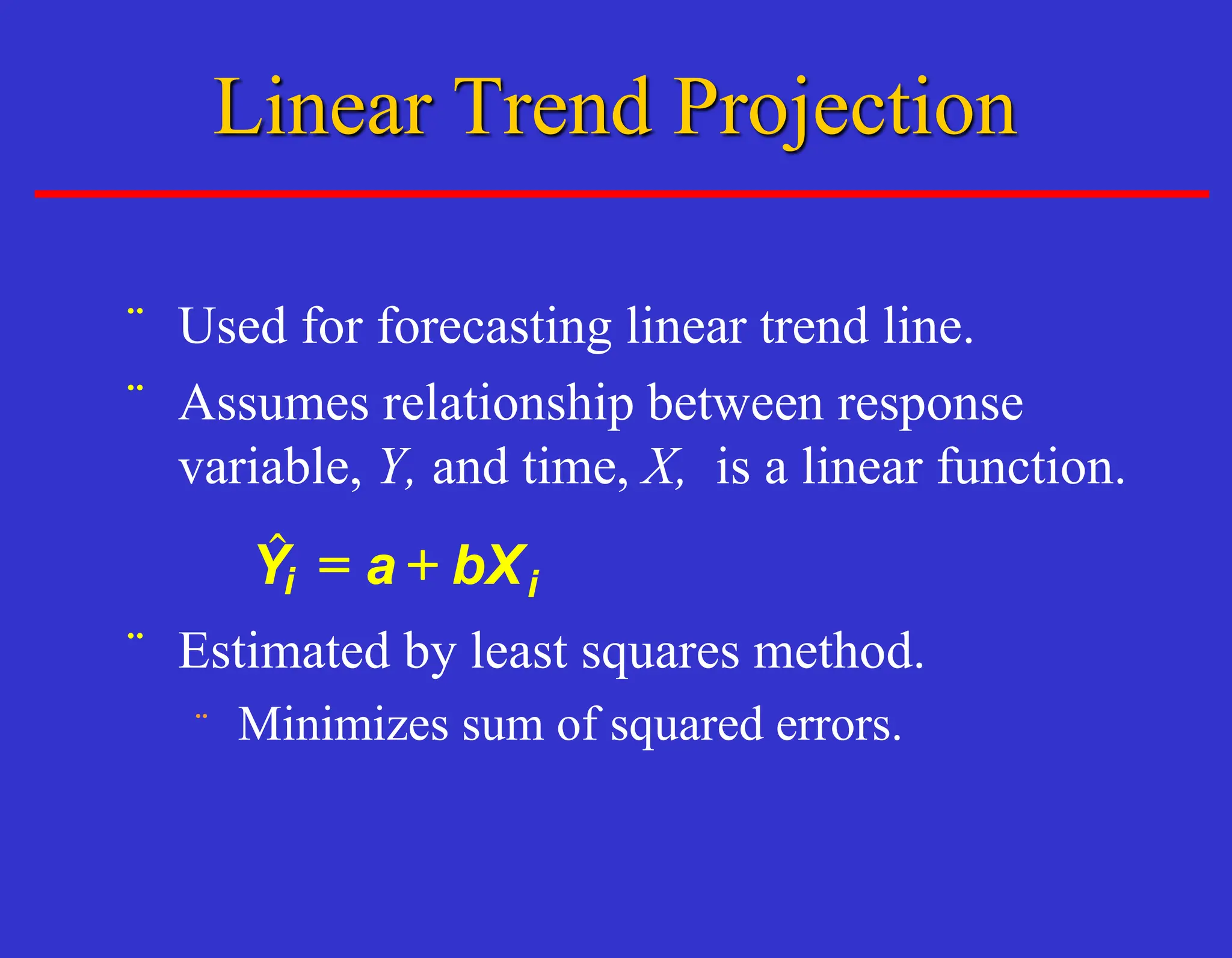
¨ Used for forecasting linear trend line.
¨ Assumes relationship between response
variable, Y, and time, X, is a linear function.
¨ Estimated by least squares method.
¨ Minimizes sum of squared errors.
$i
Y a bXi
= +
Linear Trend Projection
$
Y a bX
i i
= +
$
Y a bX
i i
= +
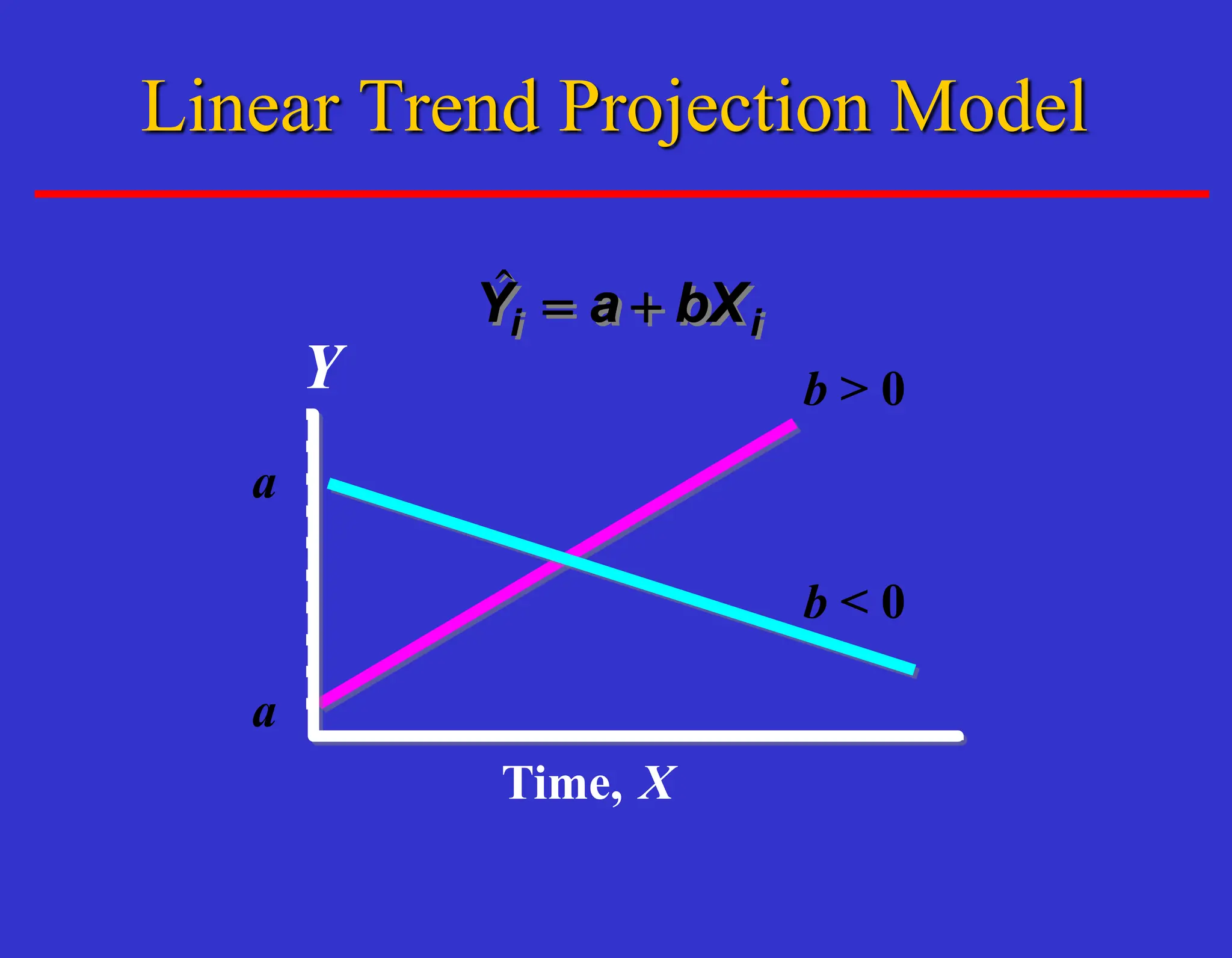
b > 0
b < 0
a
a
Y
Time, X
Linear Trend Projection Model
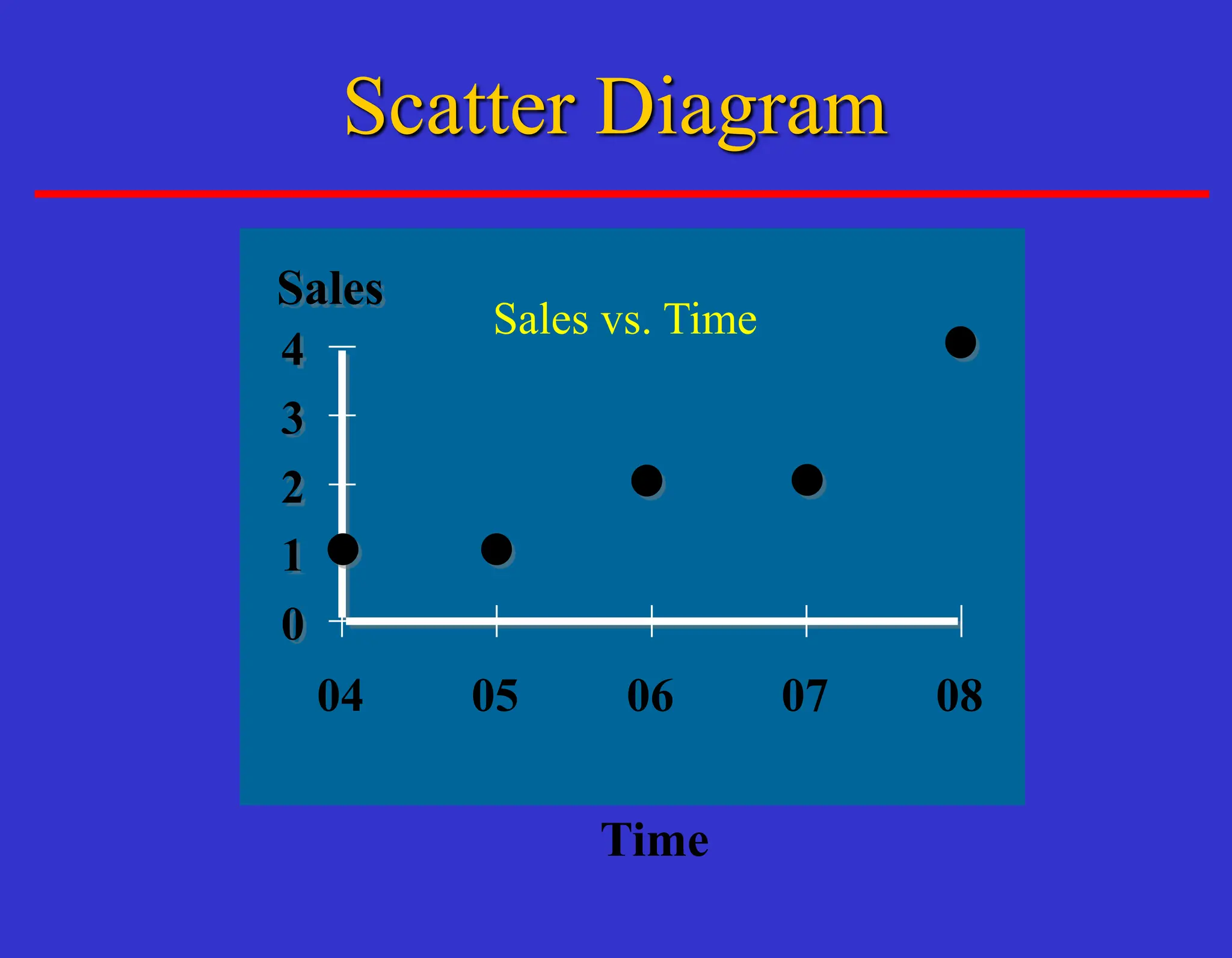
Time
Sales
0
1
2
3
4
04 05 06 07 08
Sales vs. Time
Scatter Diagram
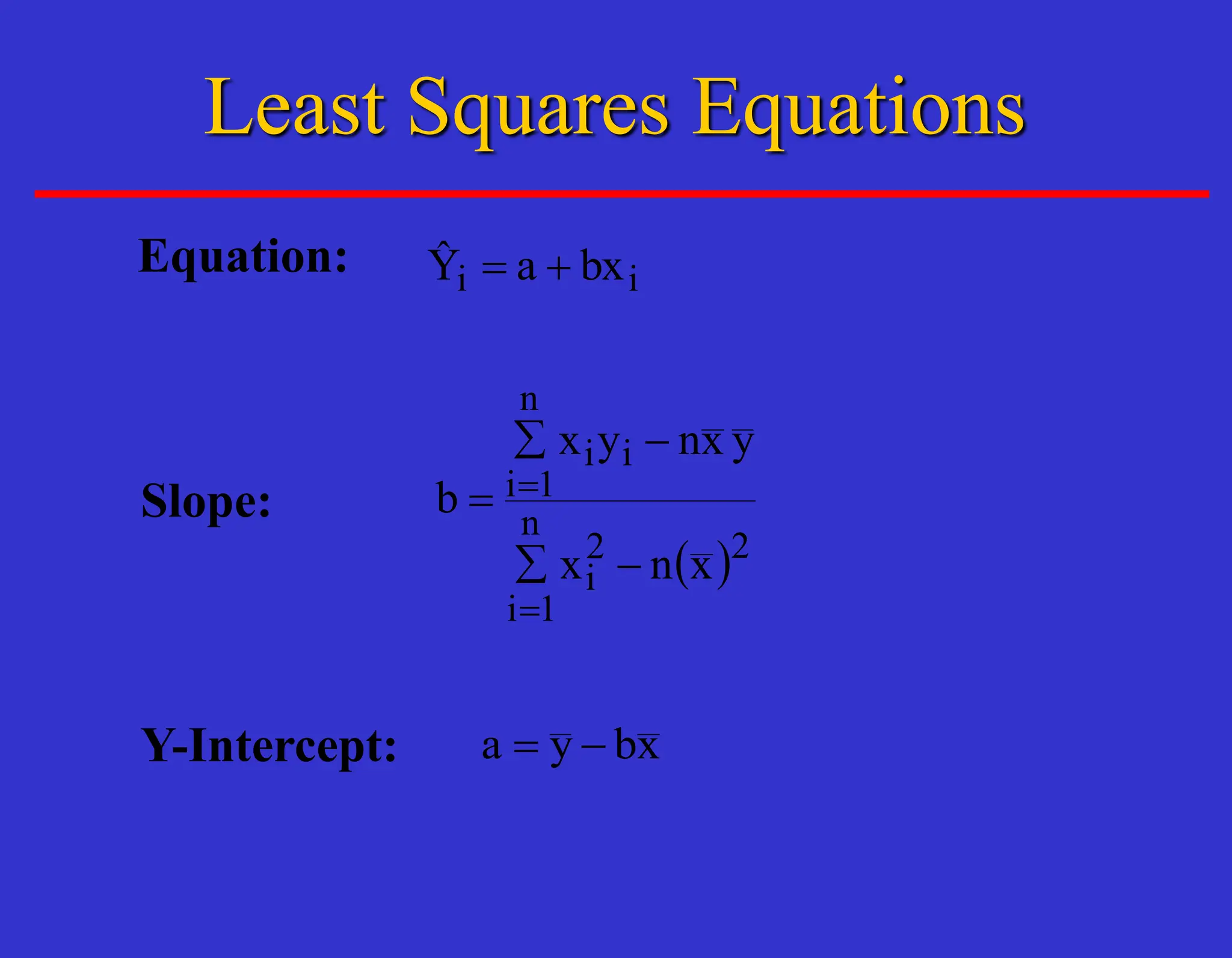
Least Squares Equations
Equation: i
i bx
a
Ŷ +
=
Slope:
 


=

=




=
x
n
x
y
x
n
y
x
b
i
n
i
i
i
n
i
Y-Intercept: x
b
y
a 
=
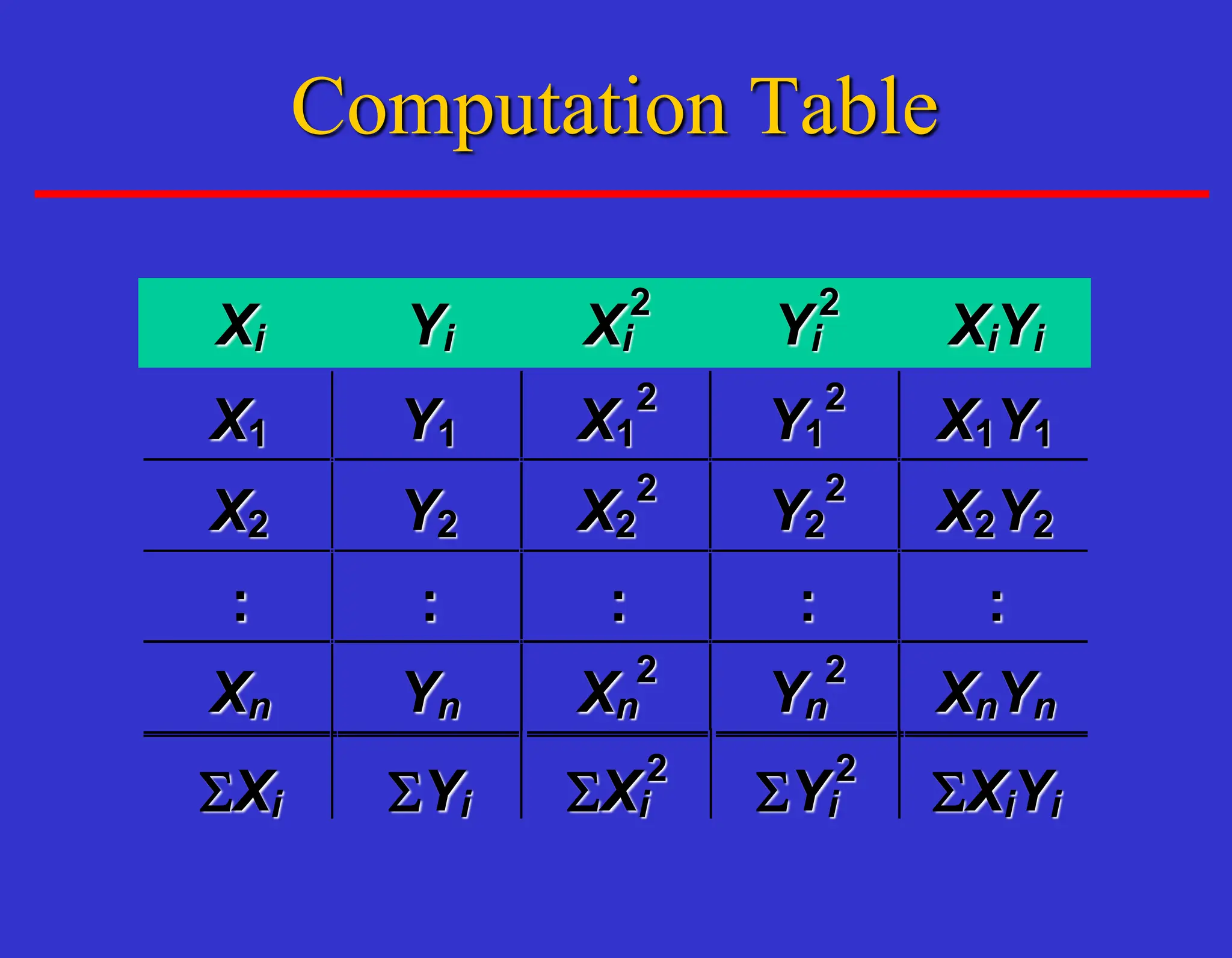
Xi Yi Xi
2
Yi
2
XiYi
X1 Y1 X1
2
Y1
2
X1Y1
X2 Y2 X2
2
Y2
2
X2Y2
: : : : :
Xn Yn Xn
2
Yn
2
XnYn
SXi SYi SXi
2
SYi
2
SXiYi
Computation Table
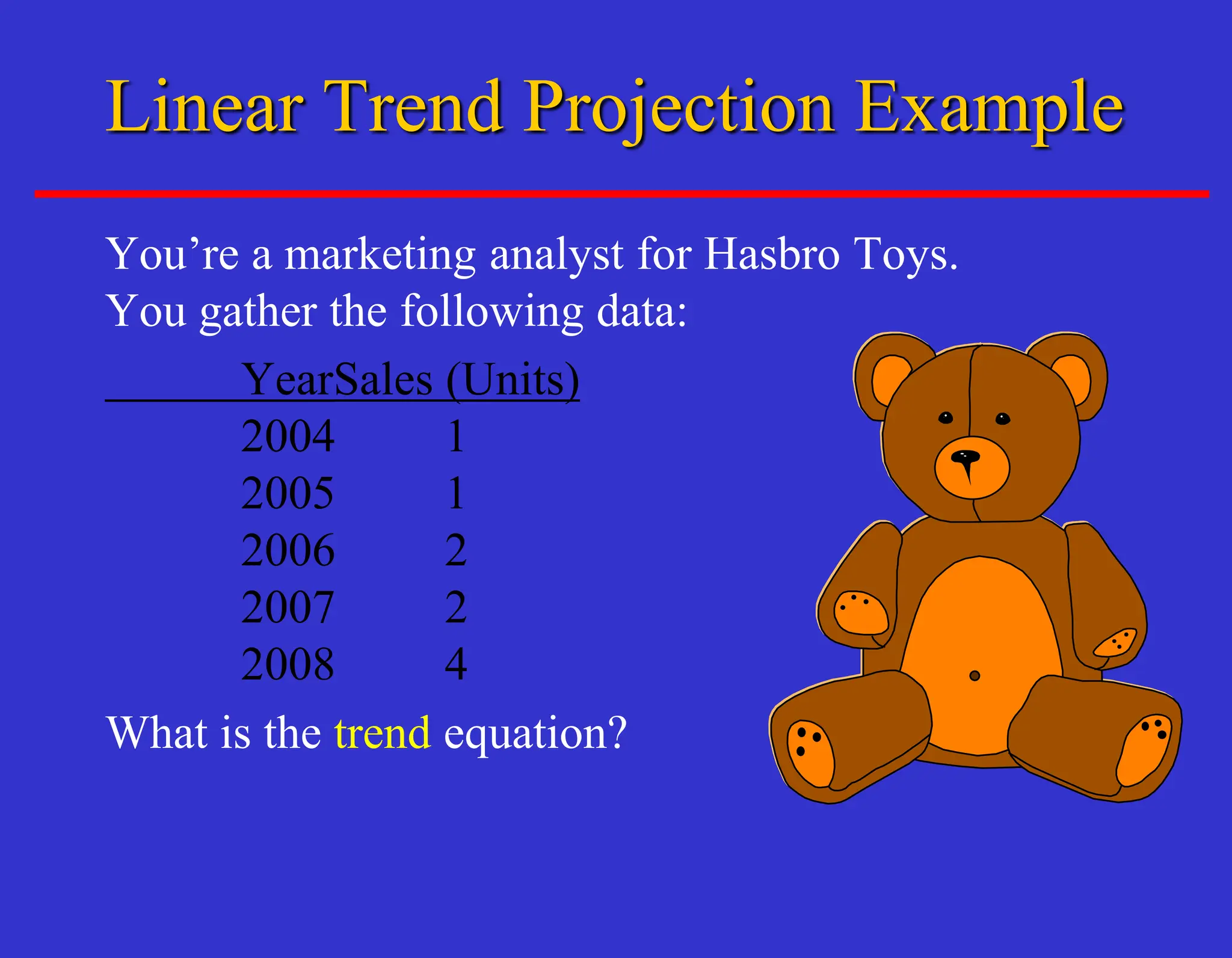
You’re a marketing analyst for Hasbro Toys.
You gather the following data:
YearSales (Units)
2004 1
2005 1
2006 2
2007 2
2008 4
What is the trend equation?
Linear Trend Projection Example
Y X
i i
= +
a b
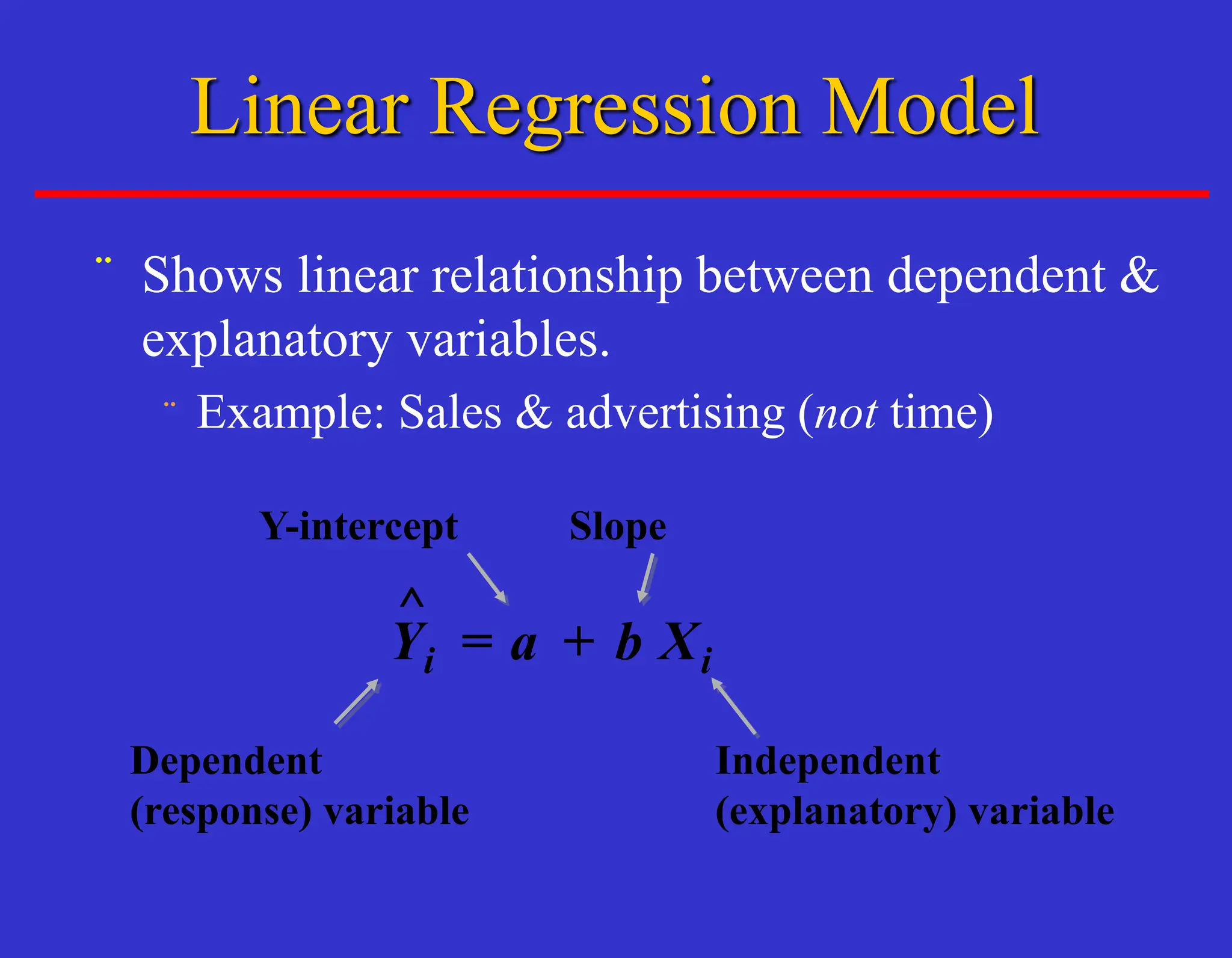
¨ Shows linear relationship between dependent &
explanatory variables.
¨ Example: Sales & advertising (not time)
Dependent
(response) variable
Independent
(explanatory) variable
Slope
Y-intercept
^
Linear Regression Model
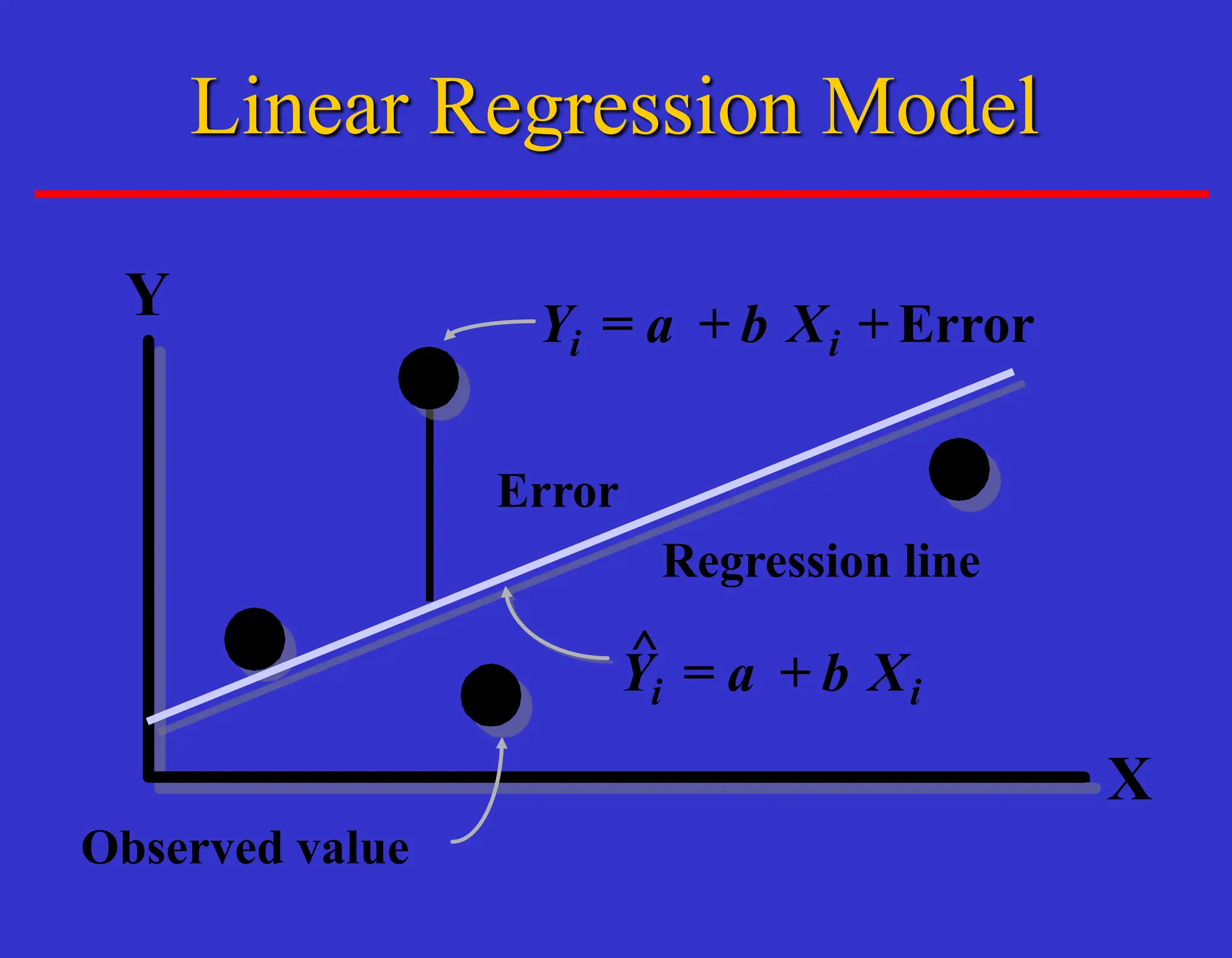
Y
X
Y a i
+
^
i i
b X
i = + Error
Error
Observed value
Y a b X
= +
Regression line
Linear Regression Model
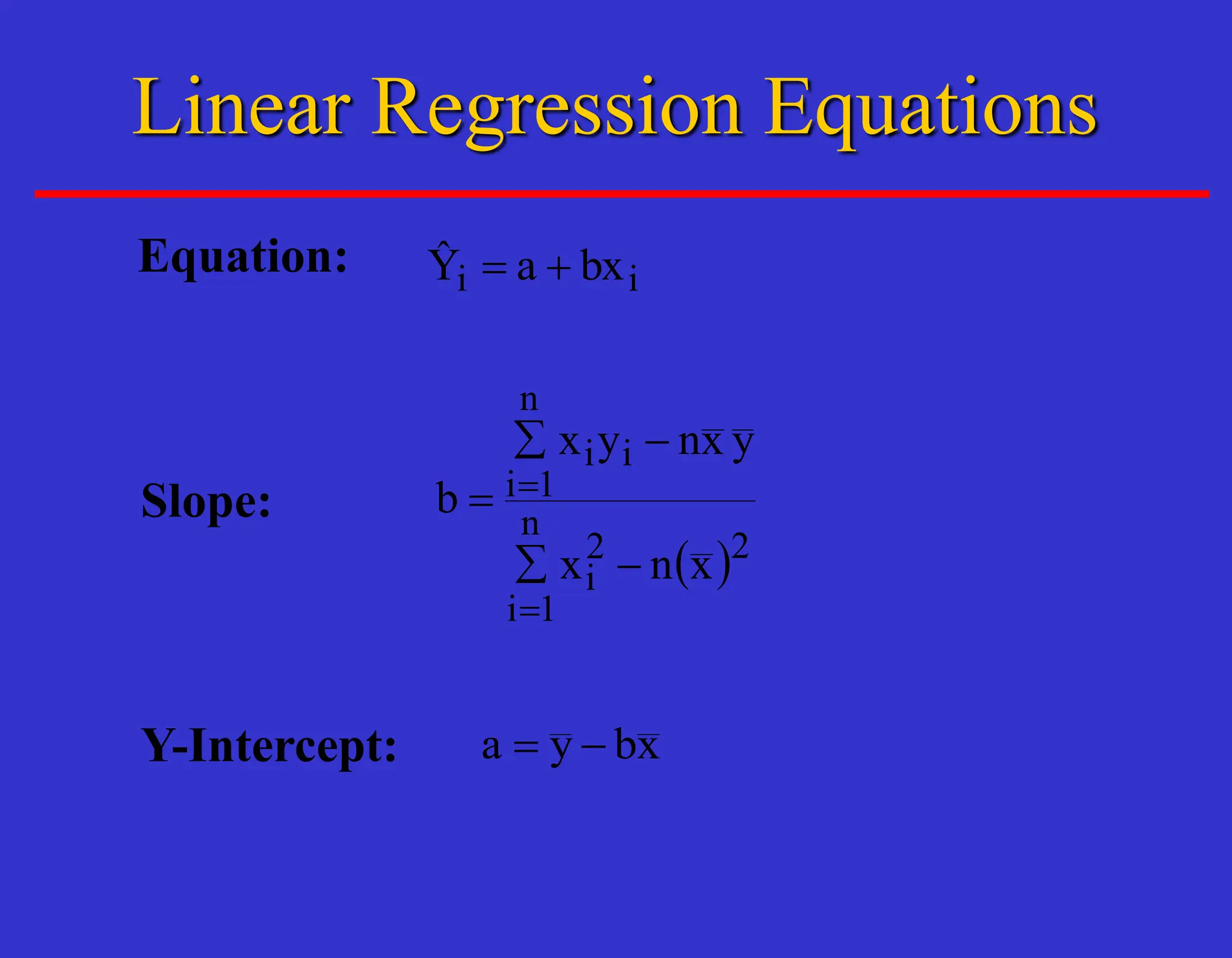
Linear Regression Equations
Equation: i
i bx
a
Ŷ +
=
Slope:
 


=

=




=
x
n
x
y
x
n
y
x
b
i
n
i
i
i
n
i
Y-Intercept: x
b
y
a 
=
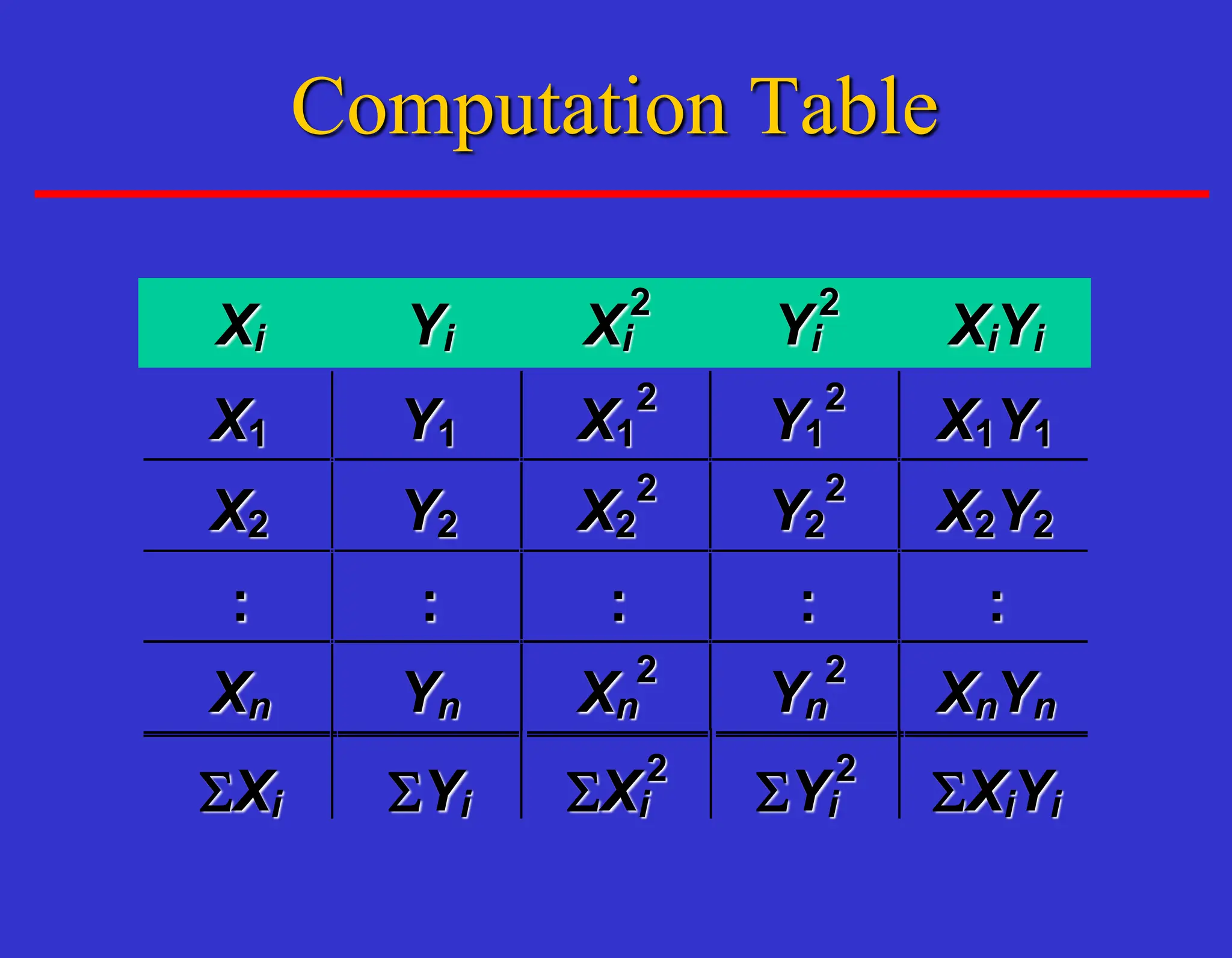
Xi Yi Xi
2
Yi
2
XiYi
X1 Y1 X1
2
Y1
2
X1Y1
X2 Y2 X2
2
Y2
2
X2Y2
: : : : :
Xn Yn Xn
2
Yn
2
XnYn
SXi SYi SXi
2
SYi
2
SXiYi
Computation Table
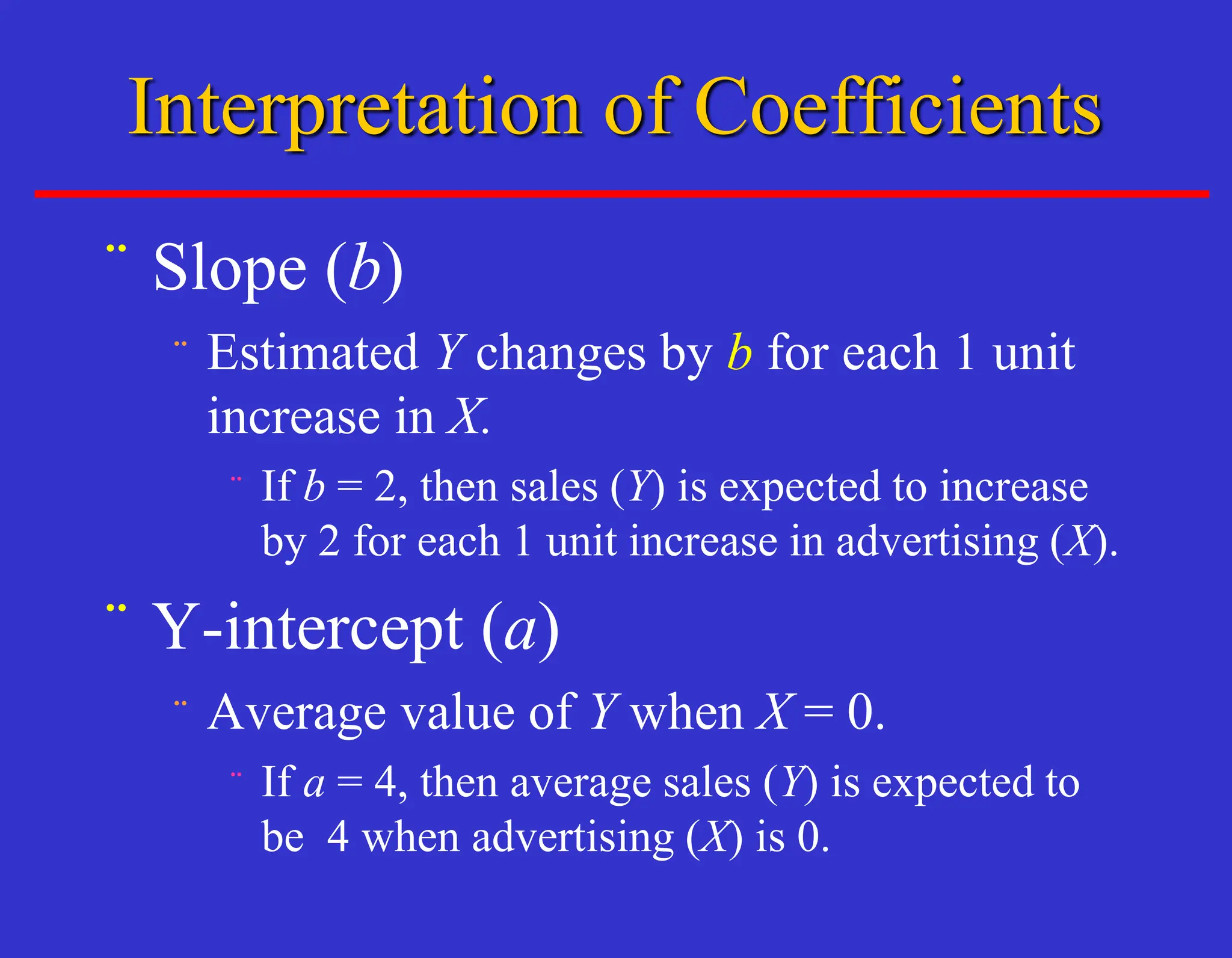
¨ Slope (b)
¨ Estimated Y changes by b for each 1 unit
increase in X.
¨ If b = 2, then sales (Y) is expected to increase
by 2 for each 1 unit increase in advertising (X).
¨ Y-intercept (a)
¨ Average value of Y when X = 0.
¨ If a = 4, then average sales (Y) is expected to
be 4 when advertising (X) is 0.
Interpretation of Coefficients
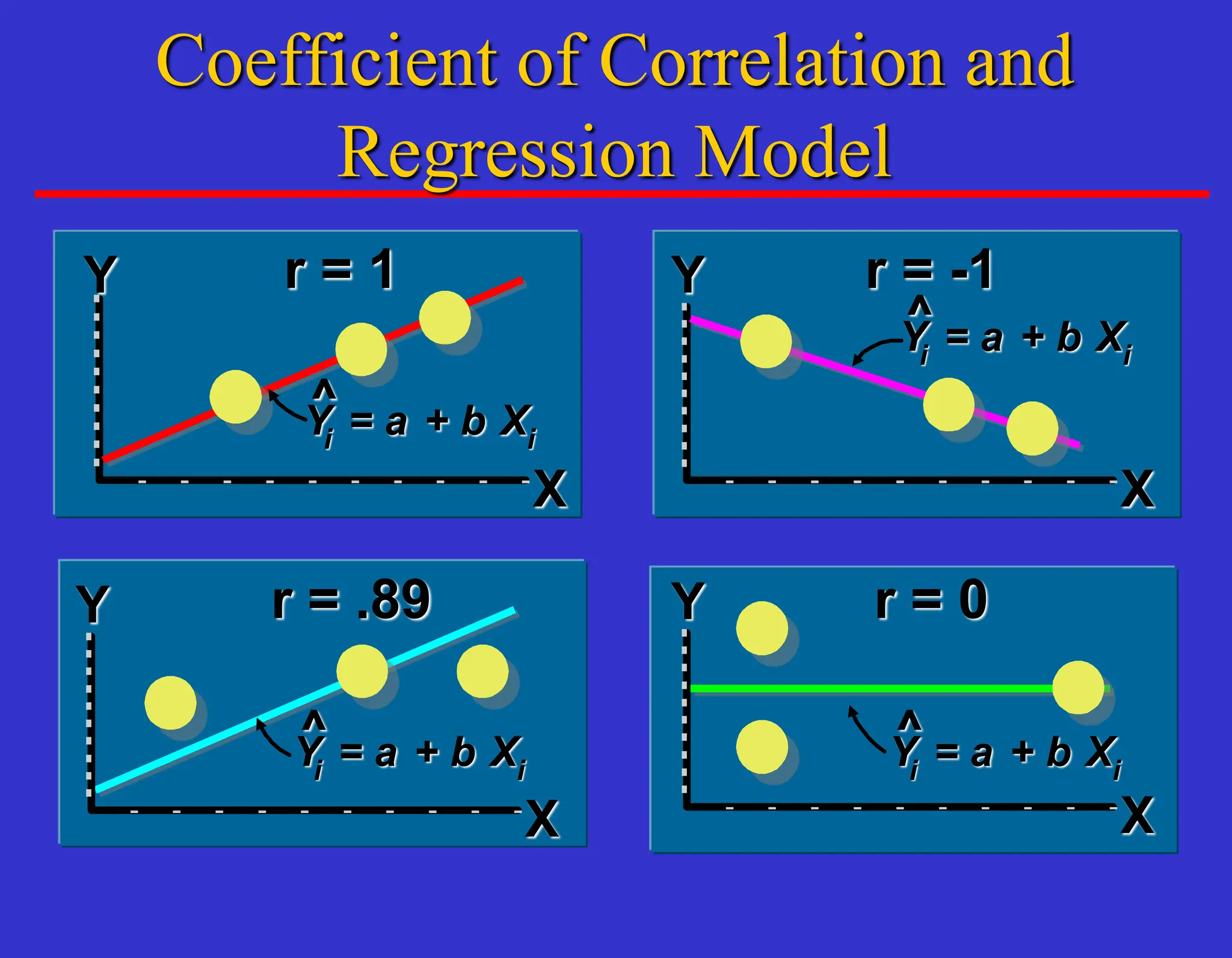
¨ Answers: ‘how strong is the linear
relationship between the variables?.’
¨ Coefficient of correlation Sample
correlation coefficient denoted r.
¨ Values range from -1 to +1.
¨ Measures degree of association.
Correlation
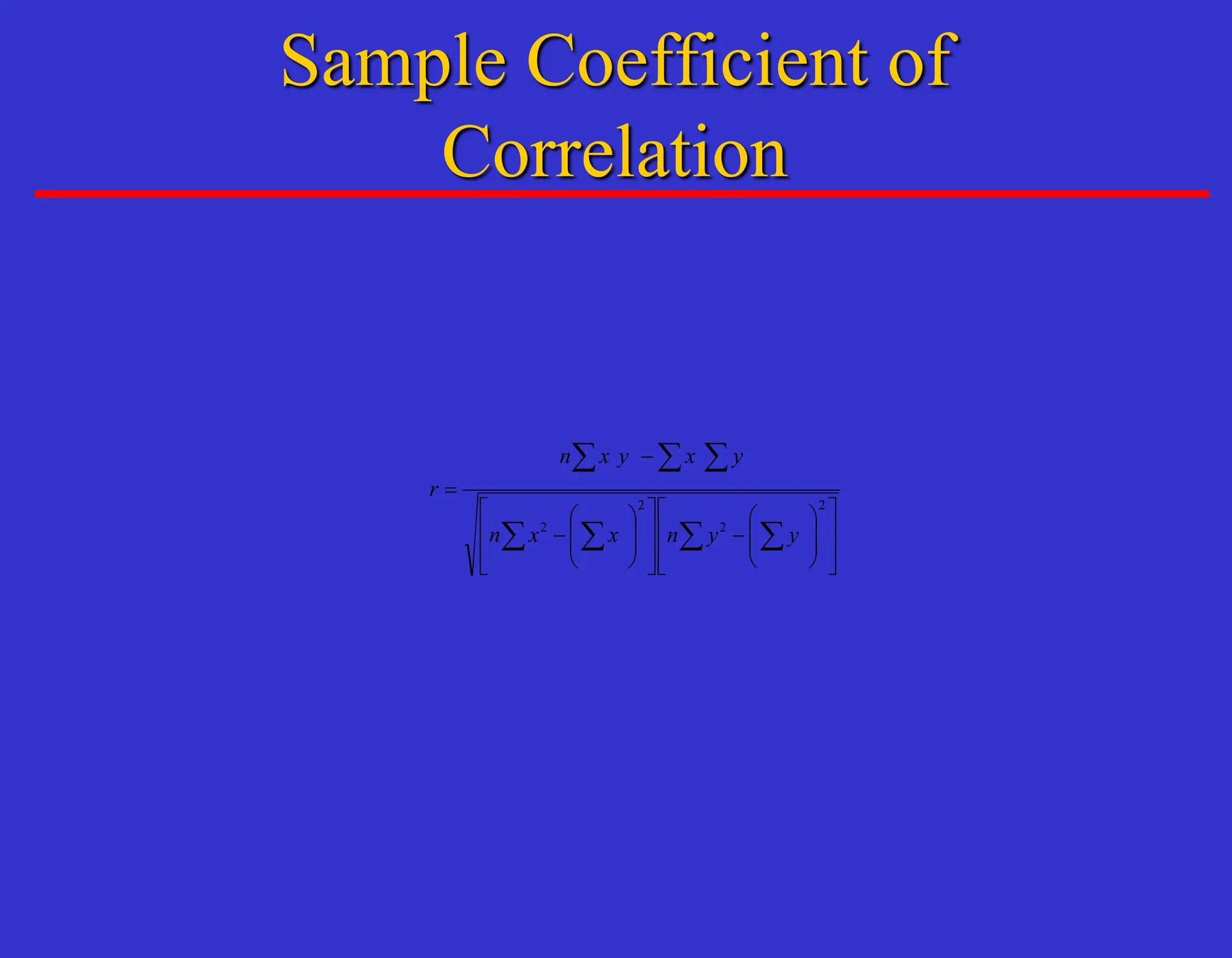
Sample Coefficient of
Correlation



































=
 
 
  
2
2
2
2
y
y
n
x
x
n
y
x
y
x
n
r
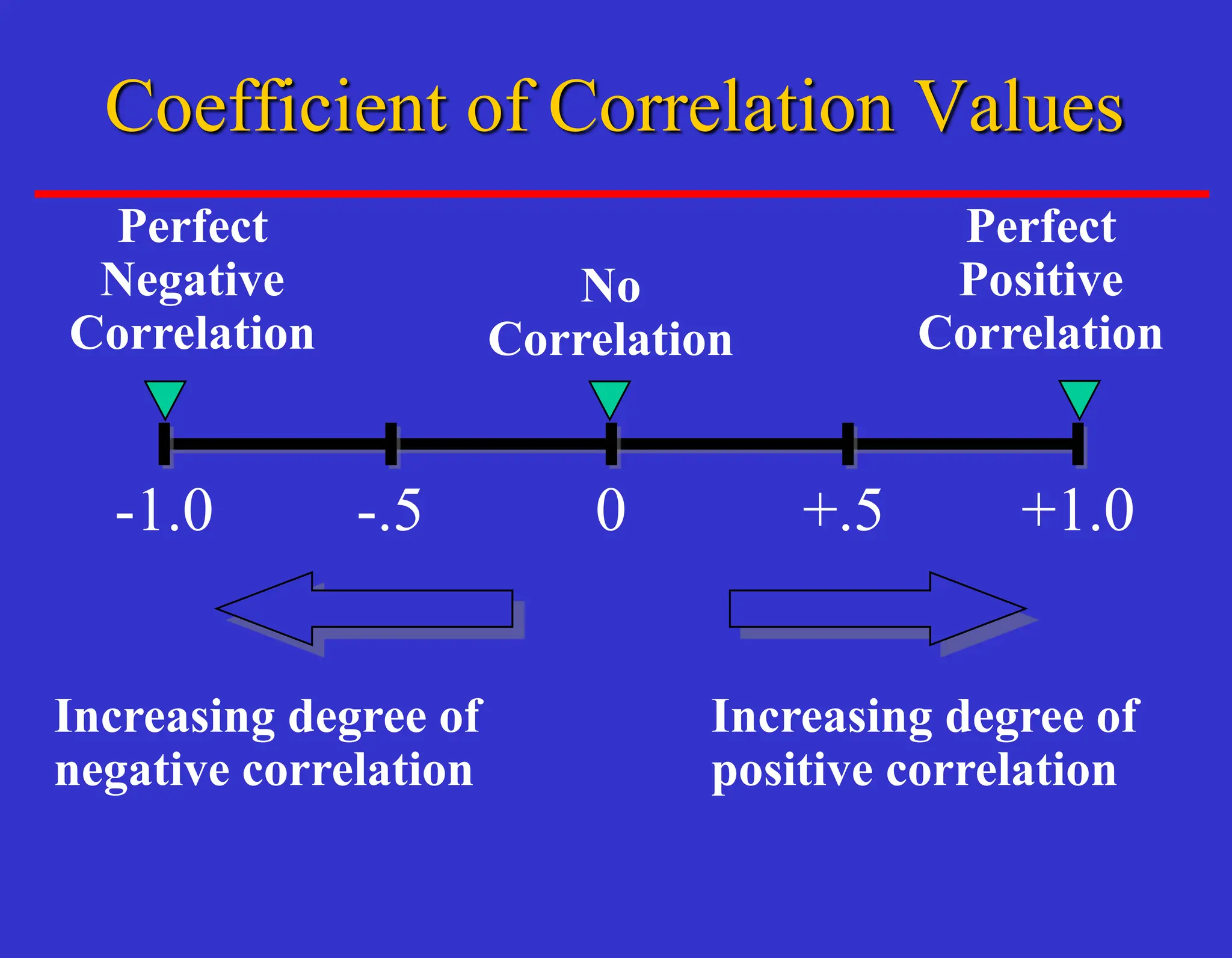
-1.0 +1.0
0
Perfect
Positive
Correlation
Increasing degree of
negative correlation
-.5 +.5
Perfect
Negative
Correlation
No
Correlation
Increasing degree of
positive correlation
Coefficient of Correlation Values
r = 1 r = -1
r = .89 r = 0
Y
X
Yi = a + b Xi
^
Y
X
Y
X
Y
X
Yi = a + b Xi
^ Yi = a + b Xi
^
Yi = a + b Xi
^
Coefficient of Correlation and
Regression Model
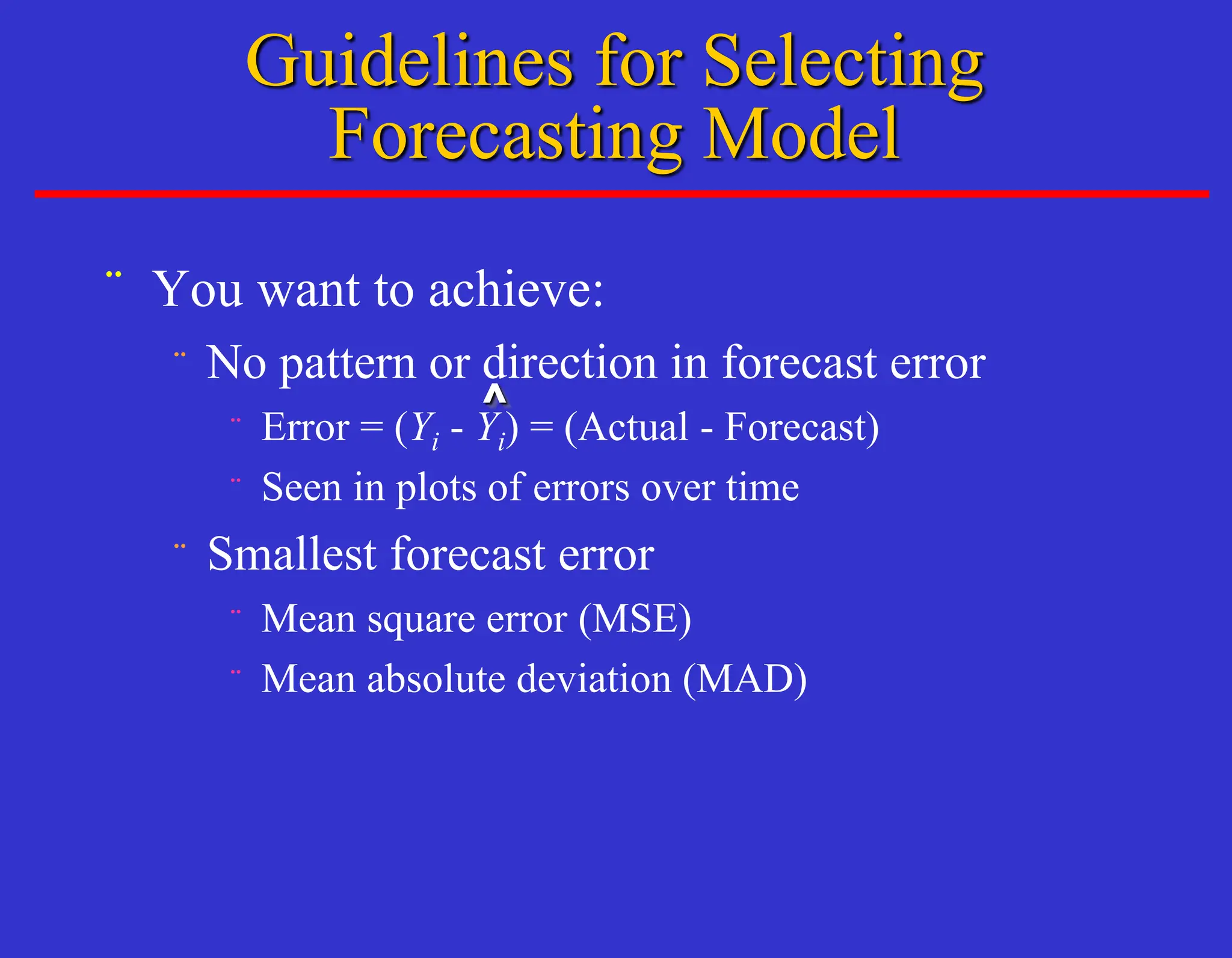
¨ You want to achieve:
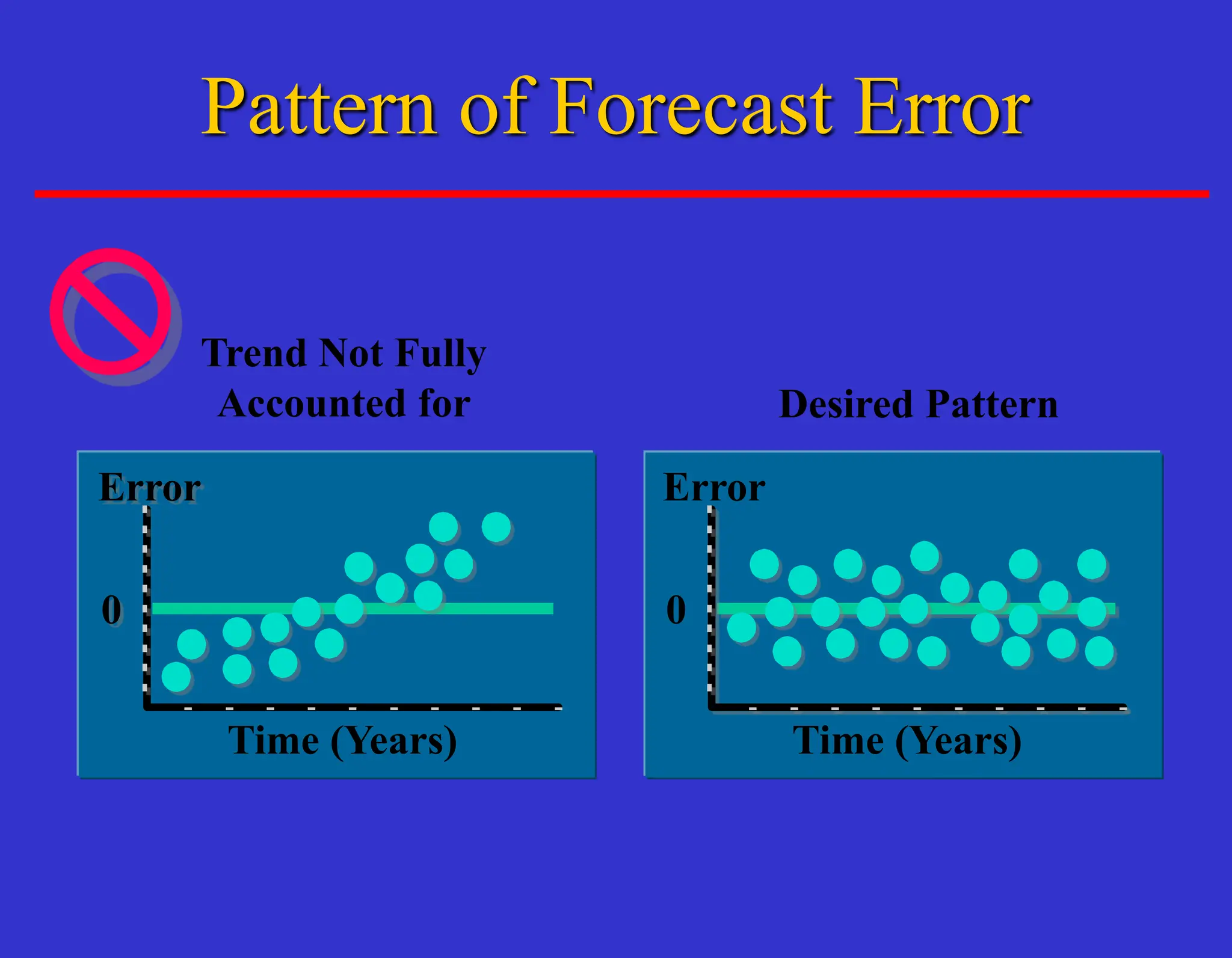
¨ No pattern or direction in forecast error
¨ Error = (Yi - Yi) = (Actual - Forecast)
¨ Seen in plots of errors over time
¨ Smallest forecast error
¨ Mean square error (MSE)
¨ Mean absolute deviation (MAD)
^
Guidelines for Selecting
Forecasting Model
Time (Years)
Error
0
Desired Pattern
Time (Years)
Error
0
Trend Not Fully
Accounted for
Pattern of Forecast Error
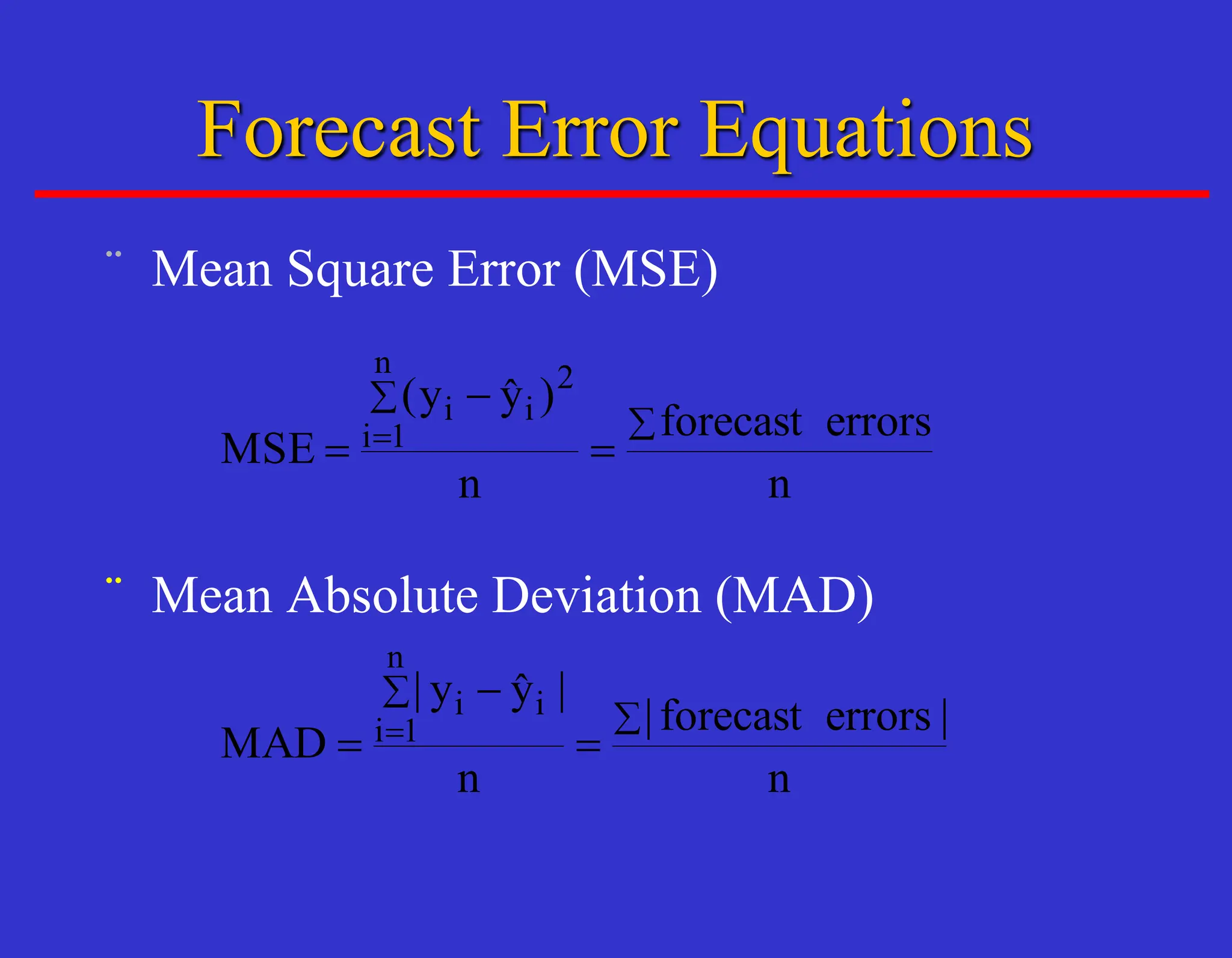
¨ Mean Square Error (MSE)
¨ Mean Absolute Deviation (MAD)
Forecast Error Equations
n
errors
forecast
n
)
ŷ
y
(
MSE
n
i
i
i 

=

= 
=

n
|
errors
forecast
|
n
|
ŷ
y
|
MAD
n
i
i
i 

=

= 
=
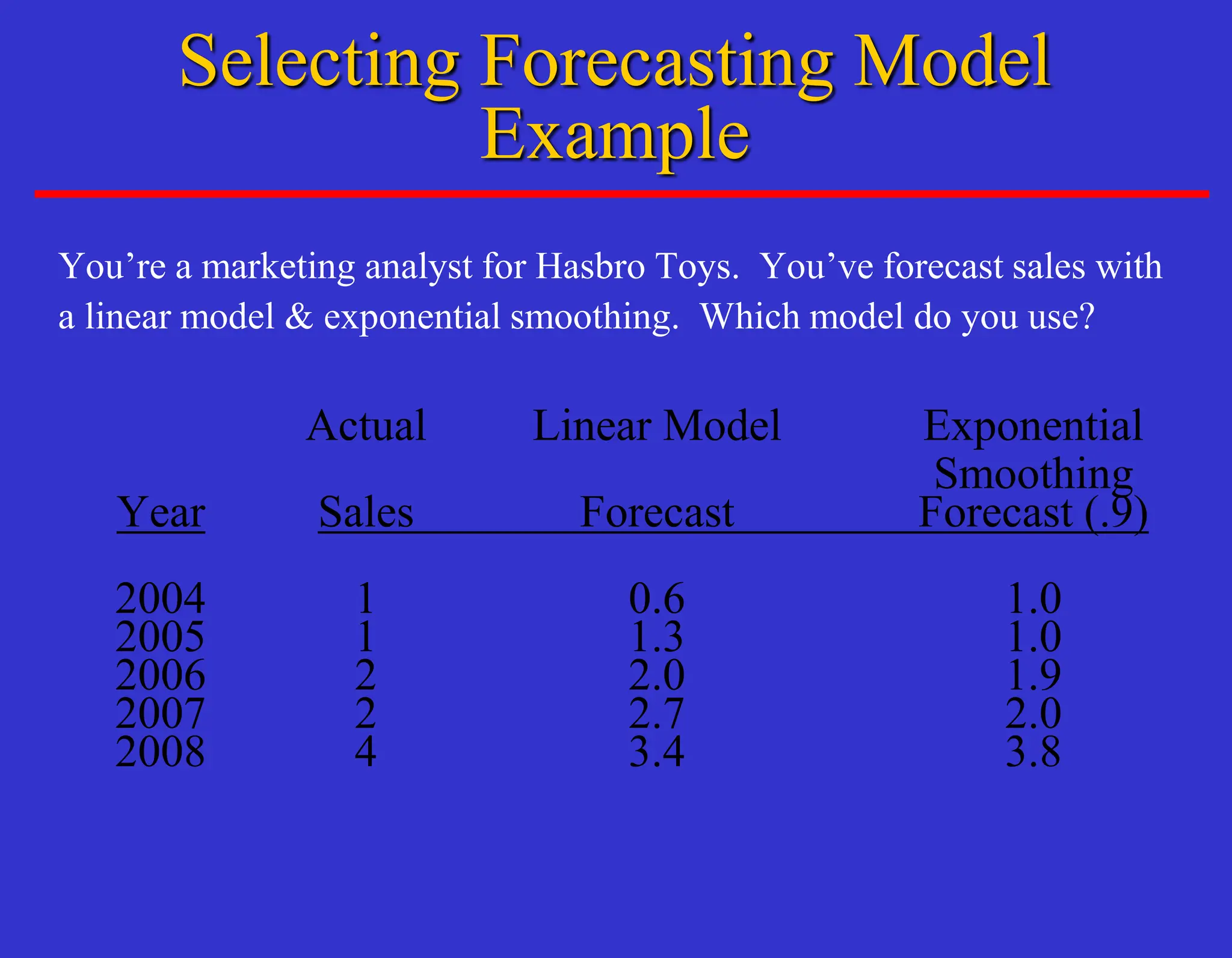
You’re a marketing analyst for Hasbro Toys. You’ve forecast sales with
a linear model & exponential smoothing. Which model do you use?
Actual Linear Model Exponential
Smoothing
Year Sales Forecast Forecast (.9)
2004 1 0.6 1.0
2005 1 1.3 1.0
2006 2 2.0 1.9
2007 2 2.7 2.0
2008 4 3.4 3.8
Selecting Forecasting Model
Example
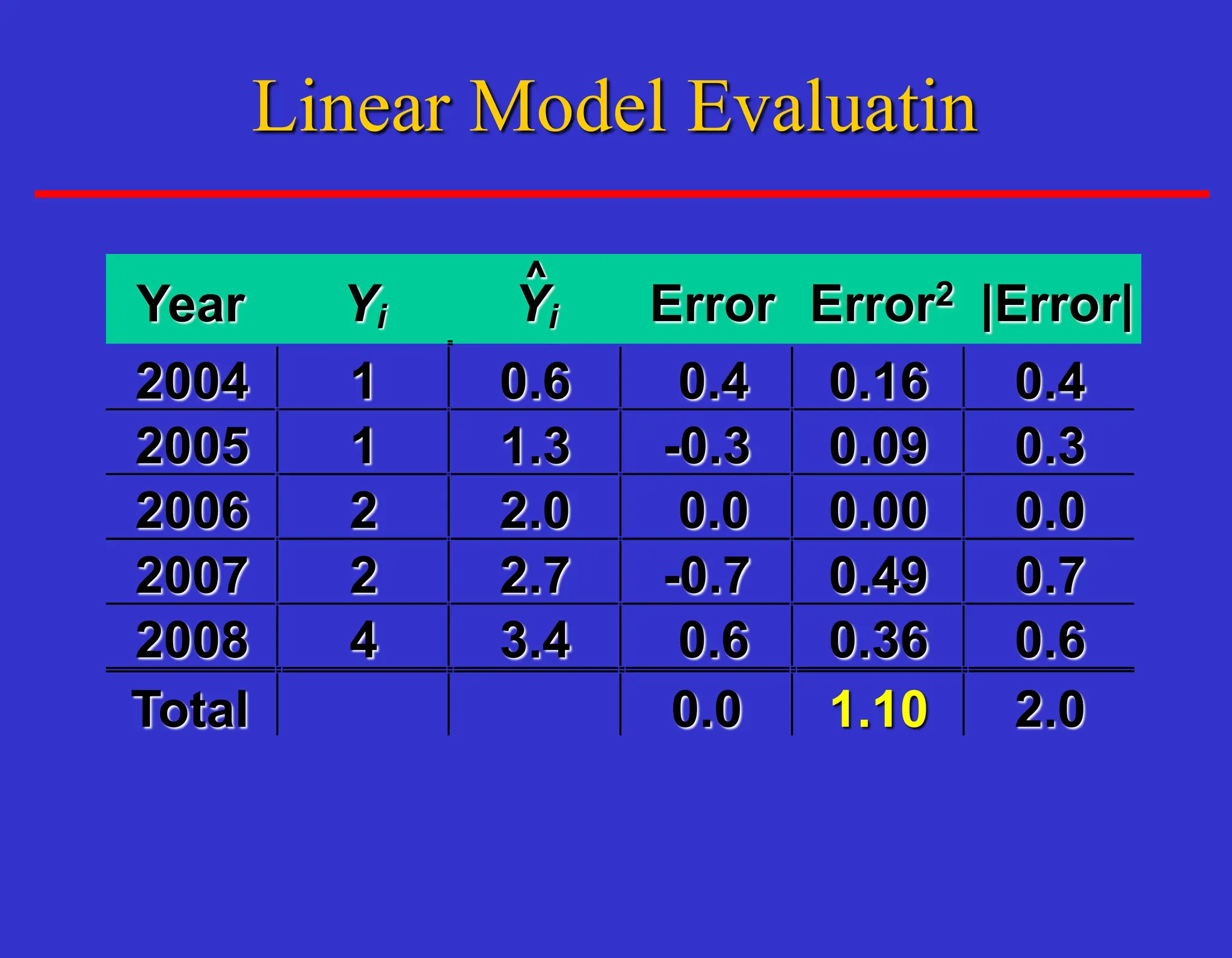
Year
^
Yi Yi
^
2004 1 0.6 0.4 0.16 0.4
2005 1 1.3 -0.3 0.09 0.3
2006 2 2.0 0.0 0.00 0.0
2007 2 2.7 -0.7 0.49 0.7
2008 4 3.4 0.6 0.36 0.6
Total 0.0 1.10 2.0
Error Error2 |Error|
Linear Model Evaluatin
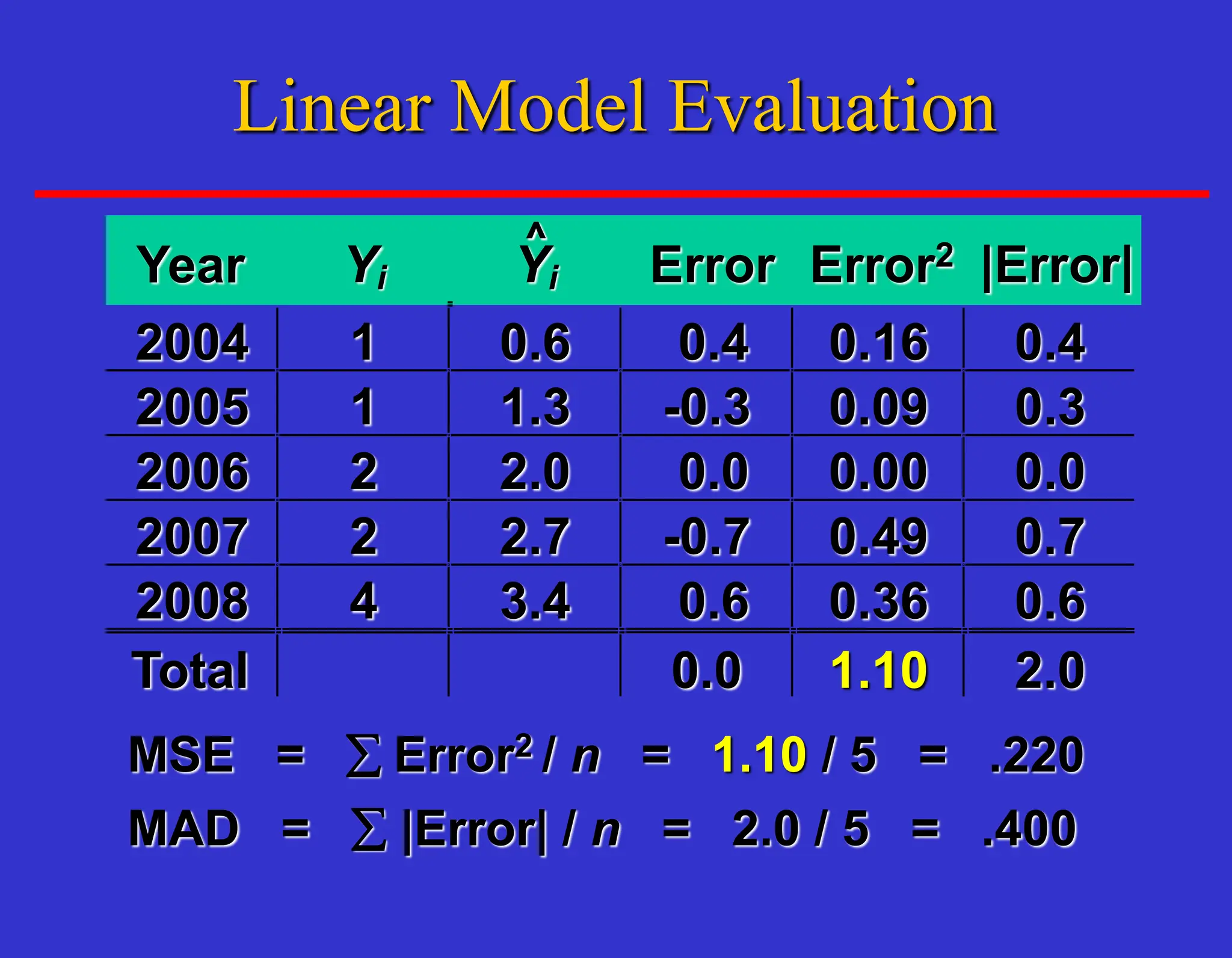
Year
^
Yi Yi
^
2004 1 0.6 0.4 0.16 0.4
2005 1 1.3 -0.3 0.09 0.3
2006 2 2.0 0.0 0.00 0.0
2007 2 2.7 -0.7 0.49 0.7
2008 4 3.4 0.6 0.36 0.6
Total 0.0 1.10 2.0
MSE = Error2 / n = 1.10 / 5 = .220
MAD =  |Error| / n = 2.0 / 5 = .400
Error Error2 |Error|
Linear Model Evaluation
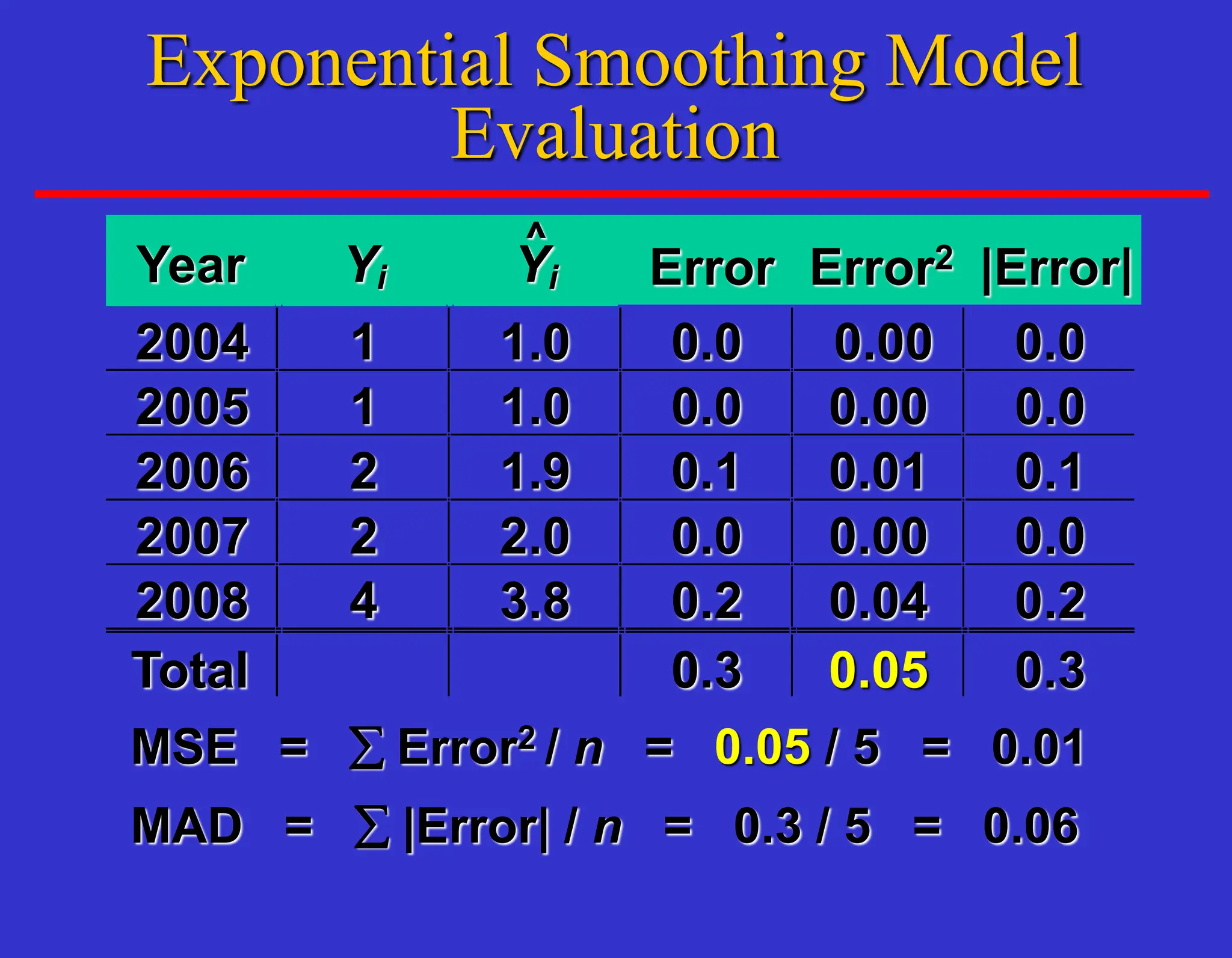
Year Yi Yi
2004 1 1.0 0.0 0.00 0.0
2005 1 1.0 0.0 0.00 0.0
2006 2 1.9 0.1 0.01 0.1
2007 2 2.0 0.0 0.00 0.0
2008 4 3.8 0.2 0.04 0.2
Total 0.3 0.05 0.3
^
MSE = Error2 / n = 0.05 / 5 = 0.01
MAD = |Error| / n = 0.3 / 5 = 0.06
Error Error2 |Error|
Exponential Smoothing Model
Evaluation

sales Forecasting and how to achieve your target

  • 1.
  • 2.
    Forecasting at Tupperware ¨Each of 50 profit centers around the world is responsible for computerized monthly, quarterly, and 12-month sales projections ¨ These projections are aggregated by region, then globally at Tupperware’s World Headquarters.
  • 3.
    Tupperware - Forecastby Consensus ¨ Although inputs come from sales, marketing, finance, and production, final forecasts are the consensus of all participating managers. ¨ The final step is Tupperware’s version of the “jury of executive opinion”.
  • 4.
    What is Forecasting? ¨Process of predicting a future event. ¨ Underlying basis of all business decisions. ¨ Production ¨ Inventory ¨ Personnel ¨ Facilities Sales will be $200 Million!
  • 5.
    ¨ Short-range forecast: ¨Up to 1 year; usually < 3 months. ¨ Job scheduling, worker assignments. ¨ Medium-range forecast: ¨ 3 months to 3 years. ¨ Sales & production planning, budgeting. ¨ Long-range forecast: ¨ 3+ years. ¨ New product planning, facility location. Types of Forecasts by Time Horizon
  • 6.
    Short-term vs. Longer-term Forecasting ¨Medium/long range forecasts deal with more comprehensive issues and support management decisions regarding planning and products, plants and processes. ¨ Short-term forecasting usually employs different methodologies than longer-term forecasting. ¨ Short-term forecasts tend to be more accurate than longer-term forecasts.
  • 7.
    Influence of ProductLife Cycle ¨ Stages of introduction & growth require longer forecasts than maturity and decline. ¨ Forecasts useful in projecting: ¨ staffing levels, ¨ inventory levels, and ¨ factory capacity as product passes through stages.
  • 8.
    Types of Forecasts ¨Economic forecasts: ¨ Address business cycle. ¨ e.g., inflation rate, money supply etc. ¨ Technological forecasts: ¨ Predict technological change. ¨ Predict new product sales. ¨ Demand forecasts: ¨ Predict existing product sales.
  • 9.
    ) Seven Steps inForecasting ¨ Determine the use of the forecast. ¨ Select the items to be forecast. ¨ Determine the time horizon of the forecast. ¨ Select the forecasting model(s). ¨ Gather the data. ¨ Make the forecast. ¨ Validate and implement results.
  • 10.
    Realities of Forecasting ¨Forecasts are seldom perfect. ¨ Most forecasting methods assume that there is some underlying stability in the system. ¨ Both product family and aggregated product forecasts are more accurate than individual product forecasts.
  • 11.
    Forecasting Approaches ¨ Usedwhen situation is ‘stable’ & historical data exist. ¨ Existing products ¨ Current technology ¨ Involves mathematical techniques. ¨ e.g. forecasting sales of LED color televisions. Quantitative Methods ¨ Used when situation is vague & little data exist. ¨ New products ¨ New technology ¨ Involves intuition and experience. ¨ e.g. forecasting sales on Internet. Qualitative Methods
  • 12.
    Overview of QualitativeMethods ¨ Jury of executive opinion ¨ Pool opinions of high-level executives, sometimes augment by statistical models. ¨ Sales force composite ¨ estimates from individual salespersons are reviewed for reasonableness, then aggregated. ¨ Delphi method ¨ Panel of experts, queried iteratively. ¨ Consumer Market Survey ¨ Ask the customer.
  • 13.
    ¨ Involves smallgroup of high-level managers. “Group estimates demand by working together”. ¨ Combines managerial experience with statistical models. ¨ Relatively quick. ¨ ‘Group-think’ disadvantage. Jury of Executive Opinion
  • 14.
    Sales Force Composite ¨Each salesperson projects their sales. ¨ Combined at district & national levels. ¨ Sales rep’s know customers’ wants. ¨ Tends to be overly optimistic. Sales
  • 15.
    Delphi Method ¨ Iterativegroup process. ¨ 3 types of people: ¨ Decision makers. ¨ Staff. ¨ Respondents. ¨ Reduces ‘group- think’. Respondents Staff Decision Makers (Sales?) (What will sales be? survey) (Sales will be 45, 50, 55) (Sales will be 50!)
  • 16.
    Consumer Market Survey ¨Ask customers about purchasing plans. ¨ What consumers say, and what they actually do are often different. ¨ Sometimes difficult to answer. How many hours will you use the Internet next week? © 1995 Corel Corp.
  • 17.
    Overview of QuantitativeApproaches ¨ Naïve approach ¨ Moving averages ¨ Exponential smoothing ¨ Trend projection ¨ Linear regression Time-series Models Causal models
  • 18.
  • 19.
    ¨ Set ofevenly spaced numerical data. ¨ Obtained by observing response variable at regular time periods. ¨ Forecast based only on past values. ¨ Assumes that factors influencing past, present, & future will continue. ¨ Example Year: 2005 2006 2007 2008 2009 Sales: 78.7 63.5 89.7 93.2 92.1 What is a Time Series?
  • 20.
  • 21.
    ¨ Persistent, overallupward or downward pattern. ¨ Due to population, technology etc... ¨ Several years duration. Mo., Qtr., Yr. Response Trend Component
  • 22.
    ¨ Repeating up& down movements. ¨ Due to interactions of factors influencing economy. ¨ Usually 2-10 years duration. Mo., Qtr., Yr. Response Cycle B Cyclical Component
  • 23.
    ¨ Regular patternof up & down fluctuations. ¨ Due to weather, customs etc. ¨ Occurs within 1 year. Mo., Qtr. Response Summer Seasonal Component
  • 24.
    ¨ Erratic, unsystematic,‘residual’ fluctuations. ¨ Due to random variation or unforeseen events. ¨ Union strike ¨ Tornado ¨ Short duration & no repeating. Random Component
  • 25.
    Naive Approach ¨ Assumesdemand in next period is the same as demand in most recent period. ¨ e.g., If May sales were 48, then June sales will be 48. ¨ Sometimes cost effective & efficient.
  • 26.
    ¨ MA isa series of arithmetic means ¨ Used if little or no trend ¨ Used often for smoothing ¨ Provides overall impression of data over time ¨ Equation: MA n n =  Demand in Previous Periods Moving Average Method
  • 27.
    You’re manager ofa museum store that sells historical replicas. You want to forecast sales in (000) for 2010 using a 3-period moving average. 2005 4 2006 6 2007 5 2008 3 2009 7 Moving Average Example
  • 28.
    Time Response Yi Moving Total (n =3) Moving Avg. (n = 3) 2005 4 2006 6 2007 5 NA NA NA NA NA NA 2008 3 2009 7 2010 NA 4 + 6 + 5 = 15 Moving Average Solution
  • 29.
    Time Response Yi Moving Total (n =3) Moving Avg. (n = 3) 2005 4 NA NA 2006 6 NA NA 2007 5 NA NA 2008 3 4 + 6 + 5 = 15 15/3 = 5.0 2009 7 2010 NA 6 + 5 + 3 = 14 Moving Average Solution
  • 30.
    Time Response Yi Moving Total (n =3) Moving Avg. (n = 3) 2005 4 NA NA 2006 6 NA NA 2007 5 NA NA 2008 3 4 + 6 + 5 = 15 15/3 = 5.0 2009 7 6 + 5 + 3 = 14 14/3 = 4.7 2010 NA 5 + 3 + 7 = 15 15/3 = 5.0 Moving Average Solution
  • 31.
    Year Sales 0 2 4 6 8 05 06 0708 09 10 Actual Forecast Moving Average Graph
  • 32.
    ¨ Used whentrend is present. ¨ Older data usually less important. ¨ Weights based on intuition. ¨ Equation: WMA =  (Weight for period n) (Demand in period n) Weights Weighted Moving Average Method
  • 33.
    ¨ Increasing nmakes forecast less sensitive to changes. ¨ Do not forecast trend well. ¨ Require much historical data. Disadvantages of Moving Average Method
  • 34.
    ¨ Form ofweighted moving average. ¨ Weights decline exponentially. ¨ Most recent data weighted most. ¨ Requires smoothing constant (a). ¨ Ranges from 0 to 1. ¨ Subjectively chosen. ¨ Involves little record keeping of past data. Exponential Smoothing Method
  • 35.
    ¨ Ft =a·At - 1 + a·(1-a)·At - 2 + a·(1- a)2·At - 3 + a·(1- a)3·At - 4 + ... + (1- a)t-1·A0 ¨ Ft = Forecast value ¨ At = Actual value  a = Smoothing constant ¨ Ft = Ft-1 + a·(At-1 - Ft-1) ¨ Use for computing forecast. Exponential Smoothing Equations
  • 36.
    You’re organizing aKwanza meeting. You want to forecast attendance for 2010 using exponential smoothing (a = .10). The 2005 forecast was 175. 2005 180 2006 168 2007 159 2008 175 2009 190 Exponential Smoothing Example
  • 37.
    Ft = Ft-1+ a· (At-1 - Ft-1) Time Actual Forecast, Ft (a = .10) 2005 180 175.00 (Given) 2006 168 2007 159 2008 175 2009 190 2010 NA 175.00 + Exponential Smoothing Solution
  • 38.
    Ft = Ft-1+ a· (At-1 - Ft-1) Time Actual Forecast, Ft (a = .10) 2005 180 175.00 (Given) 2006 168 175.00 + .10( 2007 159 2008 175 2009 190 2010 NA Exponential Smoothing Solution
  • 39.
    Ft = Ft-1+ a· (At-1 - Ft-1) Time Actual Forecast, Ft (a = .10) 2005 180 175.00 (Given) 2006 168 175.00 + .10(180 - 2007 159 2008 175 2009 190 2010 NA Exponential Smoothing Solution
  • 40.
    Ft = Ft-1+ a· (At-1 - Ft-1) Time Actual Forecast, Ft (a = .10) 2005 180 175.00 (Given) 2006 168 175.00 + .10(180 - 175.00) 2007 159 2008 175 2009 190 2010 NA Exponential Smoothing Solution
  • 41.
    Ft = Ft-1+ a· (At-1 - Ft-1) Time Actual Forecast, Ft (a = .10) 2005 180 175.00 (Given) 2006 168 175.00 + .10(180 - 175.00) = 175.50 2007 159 2008 175 2009 190 2010 NA Exponential Smoothing Solution
  • 42.
    Ft = Ft-1+ a· (At-1 - Ft-1) Time Actual Forecast, Ft (a = .10) 2005 180 175.00 (Given) 2006 168 175.00 + .10(180 - 175.00) = 175.50 2007 159 175.50 + .10(168 - 175.50) = 174.75 2008 175 2009 190 2010 NA Exponential Smoothing Solution
  • 43.
    Ft = Ft-1+ a· (At-1 - Ft-1) Time Actual Forecast, Ft (a = .10) 2005 180 175.00 (Given) 2006 168 175.00 + .10(180 - 175.00) = 175.50 2007 159 175.50 + .10(168 - 175.50) = 174.75 2008 175 2009 190 2010 NA 174.75 + .10(159 - 174.75) = 173.18 Exponential Smoothing Solution
  • 44.
    Ft = Ft-1+ a· (At-1 - Ft-1) Time Actual Forecast, Ft (a = .10) 2005 180 175.00 (Given) 2006 168 175.00 + .10(180 - 175.00) = 175.50 2007 159 175.50 + .10(168 - 175.50) = 174.75 2008 175 174.75 + .10(159 - 174.75) = 173.18 2009 190 173.18 + .10(175 - 173.18) = 173.36 2010 NA Exponential Smoothing Solution
  • 45.
    Ft = Ft-1+ a· (At-1 - Ft-1) Time Actual Forecast, Ft (a = .10) 2005 180 175.00 (Given) 2006 168 175.00 + .10(180 - 175.00) = 175.50 2007 159 175.50 + .10(168 - 175.50) = 174.75 2008 175 174.75 + .10(159 - 174.75) = 173.18 2009 190 173.18 + .10(175 - 173.18) = 173.36 2010 NA 173.36 + .10(190 - 173.36) = 175.02 Exponential Smoothing Solution
  • 46.
    Year Sales 140 150 160 170 180 190 05 06 0708 09 10 Actual Forecast Exponential Smoothing Graph
  • 47.
    Choosing a Seek tominimize the Mean Absolute Deviation (MAD) If: Forecast error = demand - forecast Then: n errors forecast  = MAD
  • 48.
    ¨ Used forforecasting linear trend line. ¨ Assumes relationship between response variable, Y, and time, X, is a linear function. ¨ Estimated by least squares method. ¨ Minimizes sum of squared errors. $i Y a bXi = + Linear Trend Projection
  • 49.
    $ Y a bX ii = + $ Y a bX i i = + b > 0 b < 0 a a Y Time, X Linear Trend Projection Model
  • 50.
    Time Sales 0 1 2 3 4 04 05 0607 08 Sales vs. Time Scatter Diagram
  • 51.
    Least Squares Equations Equation:i i bx a Ŷ + = Slope:     =  =     = x n x y x n y x b i n i i i n i Y-Intercept: x b y a  =
  • 52.
    Xi Yi Xi 2 Yi 2 XiYi X1Y1 X1 2 Y1 2 X1Y1 X2 Y2 X2 2 Y2 2 X2Y2 : : : : : Xn Yn Xn 2 Yn 2 XnYn SXi SYi SXi 2 SYi 2 SXiYi Computation Table
  • 53.
    You’re a marketinganalyst for Hasbro Toys. You gather the following data: YearSales (Units) 2004 1 2005 1 2006 2 2007 2 2008 4 What is the trend equation? Linear Trend Projection Example
  • 54.
    Y X i i =+ a b ¨ Shows linear relationship between dependent & explanatory variables. ¨ Example: Sales & advertising (not time) Dependent (response) variable Independent (explanatory) variable Slope Y-intercept ^ Linear Regression Model
  • 55.
    Y X Y a i + ^ ii b X i = + Error Error Observed value Y a b X = + Regression line Linear Regression Model
  • 56.
    Linear Regression Equations Equation:i i bx a Ŷ + = Slope:     =  =     = x n x y x n y x b i n i i i n i Y-Intercept: x b y a  =
  • 57.
    Xi Yi Xi 2 Yi 2 XiYi X1Y1 X1 2 Y1 2 X1Y1 X2 Y2 X2 2 Y2 2 X2Y2 : : : : : Xn Yn Xn 2 Yn 2 XnYn SXi SYi SXi 2 SYi 2 SXiYi Computation Table
  • 58.
    ¨ Slope (b) ¨Estimated Y changes by b for each 1 unit increase in X. ¨ If b = 2, then sales (Y) is expected to increase by 2 for each 1 unit increase in advertising (X). ¨ Y-intercept (a) ¨ Average value of Y when X = 0. ¨ If a = 4, then average sales (Y) is expected to be 4 when advertising (X) is 0. Interpretation of Coefficients
  • 59.
    ¨ Answers: ‘howstrong is the linear relationship between the variables?.’ ¨ Coefficient of correlation Sample correlation coefficient denoted r. ¨ Values range from -1 to +1. ¨ Measures degree of association. Correlation
  • 60.
  • 61.
    -1.0 +1.0 0 Perfect Positive Correlation Increasing degreeof negative correlation -.5 +.5 Perfect Negative Correlation No Correlation Increasing degree of positive correlation Coefficient of Correlation Values
  • 62.
    r = 1r = -1 r = .89 r = 0 Y X Yi = a + b Xi ^ Y X Y X Y X Yi = a + b Xi ^ Yi = a + b Xi ^ Yi = a + b Xi ^ Coefficient of Correlation and Regression Model
  • 63.
    ¨ You wantto achieve: ¨ No pattern or direction in forecast error ¨ Error = (Yi - Yi) = (Actual - Forecast) ¨ Seen in plots of errors over time ¨ Smallest forecast error ¨ Mean square error (MSE) ¨ Mean absolute deviation (MAD) ^ Guidelines for Selecting Forecasting Model
  • 64.
    Time (Years) Error 0 Desired Pattern Time(Years) Error 0 Trend Not Fully Accounted for Pattern of Forecast Error
  • 65.
    ¨ Mean SquareError (MSE) ¨ Mean Absolute Deviation (MAD) Forecast Error Equations n errors forecast n ) ŷ y ( MSE n i i i   =  =  =  n | errors forecast | n | ŷ y | MAD n i i i   =  =  =
  • 66.
    You’re a marketinganalyst for Hasbro Toys. You’ve forecast sales with a linear model & exponential smoothing. Which model do you use? Actual Linear Model Exponential Smoothing Year Sales Forecast Forecast (.9) 2004 1 0.6 1.0 2005 1 1.3 1.0 2006 2 2.0 1.9 2007 2 2.7 2.0 2008 4 3.4 3.8 Selecting Forecasting Model Example
  • 67.
    Year ^ Yi Yi ^ 2004 10.6 0.4 0.16 0.4 2005 1 1.3 -0.3 0.09 0.3 2006 2 2.0 0.0 0.00 0.0 2007 2 2.7 -0.7 0.49 0.7 2008 4 3.4 0.6 0.36 0.6 Total 0.0 1.10 2.0 Error Error2 |Error| Linear Model Evaluatin
  • 68.
    Year ^ Yi Yi ^ 2004 10.6 0.4 0.16 0.4 2005 1 1.3 -0.3 0.09 0.3 2006 2 2.0 0.0 0.00 0.0 2007 2 2.7 -0.7 0.49 0.7 2008 4 3.4 0.6 0.36 0.6 Total 0.0 1.10 2.0 MSE = Error2 / n = 1.10 / 5 = .220 MAD =  |Error| / n = 2.0 / 5 = .400 Error Error2 |Error| Linear Model Evaluation
  • 69.
    Year Yi Yi 20041 1.0 0.0 0.00 0.0 2005 1 1.0 0.0 0.00 0.0 2006 2 1.9 0.1 0.01 0.1 2007 2 2.0 0.0 0.00 0.0 2008 4 3.8 0.2 0.04 0.2 Total 0.3 0.05 0.3 ^ MSE = Error2 / n = 0.05 / 5 = 0.01 MAD = |Error| / n = 0.3 / 5 = 0.06 Error Error2 |Error| Exponential Smoothing Model Evaluation