A case study on Dell’s call centre
outsourcing
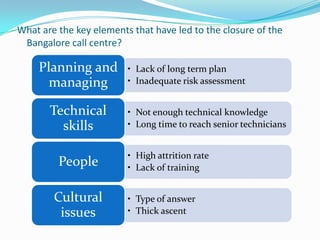
What are the key elements that have led to the closure of the
Bangalore call centre?
• Lack of long term plan
• Inadequate risk assessment
Planning and
managing
• Not enough technical knowledge
• Long time to reach senior technicians
Technical
skills
• High attrition rate
• Lack of training
People
• Type of answer
• Thick ascent
Cultural
issues
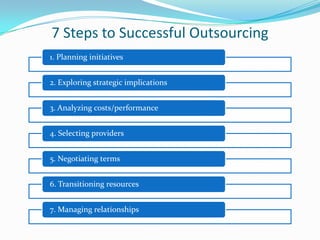
7 Steps to Successful Outsourcing
1. Planning initiatives
2. Exploring strategic implications
3. Analyzing costs/performance
4. Selecting providers
5. Negotiating terms
6. Transitioning resources
7. Managing relationships
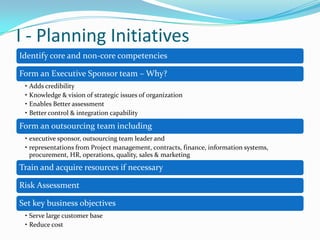
I - Planning Initiatives
Identify core and non-core competencies
Form an Executive Sponsor team – Why?
• Adds credibility
• Knowledge & vision of strategic issues of organization
• Enables Better assessment
• Better control & integration capability
Form an outsourcing team including
• executive sponsor, outsourcing team leader and
• representations from Project management, contracts, finance, information systems,
procurement, HR, operations, quality, sales & marketing
Train and acquire resources if necessary
Risk Assessment
Set key business objectives
• Serve large customer base
• Reduce cost
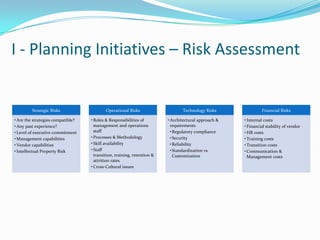
I - Planning Initiatives – Risk Assessment
Strategic Risks
•Are the strategies compatible?
•Any past experience?
•Level of executive commitment
•Management capabilities
•Vendor capabilities
•Intellectual Property Risk
Operational Risks
•Roles & Responsibilities of
management and operations
staff
•Processes & Methodology
•Skill availability
•Staff
transition, training, retention &
attrition rates
•Cross-Cultural issues
Technology Risks
•Architectural approach &
requirements
•Regulatory compliance
•Security
•Reliability
•Standardization vs
Customization
Financial Risks
•Internal costs
•Financial stability of vendor
•HR costs
•Training costs
•Transition costs
•Communication &
Management costs
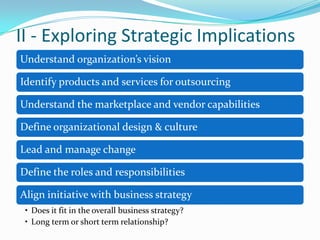
II - Exploring Strategic Implications
Understand organization’s vision
Identify products and services for outsourcing
Understand the marketplace and vendor capabilities
Define organizational design & culture
Lead and manage change
Define the roles and responsibilities
Align initiative with business strategy
• Does it fit in the overall business strategy?
• Long term or short term relationship?
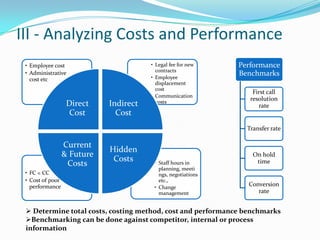
III - Analyzing Costs and Performance
• Staff hours in
planning, meeti
ngs, negotiations
etc.,
• Change
management
• FC < CC
• Cost of poor
performance
• Legal fee for new
contracts
• Employee
displacement
cost
• Communication
costs
• Employee cost
• Administrative
cost etc
Direct
Cost
Indirect
Cost
Hidden
Costs
Current
& Future
Costs
Performance
Benchmarks
First call
resolution
rate
Transfer rate
On hold
time
Conversion
rate
 Determine total costs, costing method, cost and performance benchmarks
Benchmarking can be done against competitor, internal or process
information
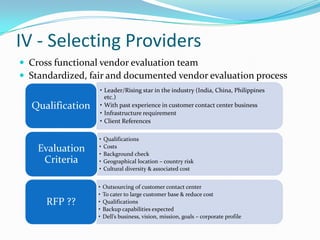
IV - Selecting Providers
 Cross functional vendor evaluation team
 Standardized, fair and documented vendor evaluation process
• Leader/Rising star in the industry (India, China, Philippines
etc.)
• With past experience in customer contact center business
• Infrastructure requirement
• Client References
Qualification
• Qualifications
• Costs
• Background check
• Geographical location – country risk
• Cultural diversity & associated cost
Evaluation
Criteria
• Outsourcing of customer contact center
• To cater to large customer base & reduce cost
• Qualifications
• Backup capabilities expected
• Dell’s business, vision, mission, goals – corporate profile
RFP ??
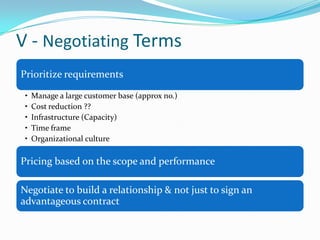
V - Negotiating Terms
Prioritize requirements
• Manage a large customer base (approx no.)
• Cost reduction ??
• Infrastructure (Capacity)
• Time frame
• Organizational culture
Pricing based on the scope and performance
Negotiate to build a relationship & not just to sign an
advantageous contract
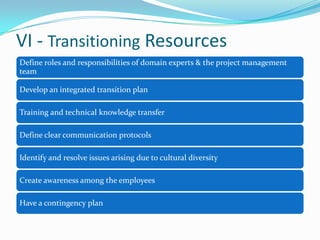
VI - Transitioning Resources
Define roles and responsibilities of domain experts & the project management
team
Develop an integrated transition plan
Training and technical knowledge transfer
Define clear communication protocols
Identify and resolve issues arising due to cultural diversity
Create awareness among the employees
Have a contingency plan
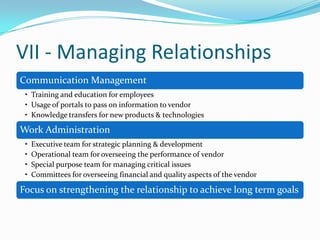
VII - Managing Relationships
Communication Management
• Training and education for employees
• Usage of portals to pass on information to vendor
• Knowledge transfers for new products & technologies
Work Administration
• Executive team for strategic planning & development
• Operational team for overseeing the performance of vendor
• Special purpose team for managing critical issues
• Committees for overseeing financial and quality aspects of the vendor
Focus on strengthening the relationship to achieve long term goals
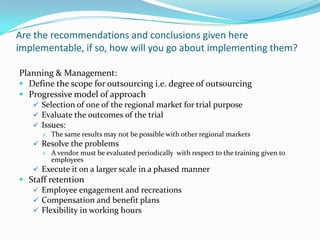
Are the recommendations and conclusions given here
implementable, if so, how will you go about implementing them?
Planning & Management:
 Define the scope for outsourcing i.e. degree of outsourcing
 Progressive model of approach
 Selection of one of the regional market for trial purpose
 Evaluate the outcomes of the trial
 Issues:
 The same results may not be possible with other regional markets
 Resolve the problems
 A vendor must be evaluated periodically with respect to the training given to
employees
 Execute it on a larger scale in a phased manner
 Staff retention
 Employee engagement and recreations
 Compensation and benefit plans
 Flexibility in working hours
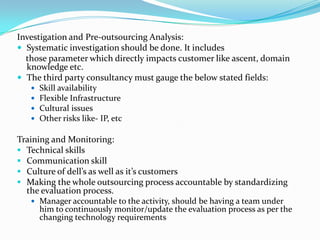
Investigation and Pre-outsourcing Analysis:
 Systematic investigation should be done. It includes
those parameter which directly impacts customer like ascent, domain
knowledge etc.
 The third party consultancy must gauge the below stated fields:
 Skill availability
 Flexible Infrastructure
 Cultural issues
 Other risks like- IP, etc
Training and Monitoring:
 Technical skills
 Communication skill
 Culture of dell’s as well as it’s customers
 Making the whole outsourcing process accountable by standardizing
the evaluation process.
 Manager accountable to the activity, should be having a team under
him to continuously monitor/update the evaluation process as per the
changing technology requirements
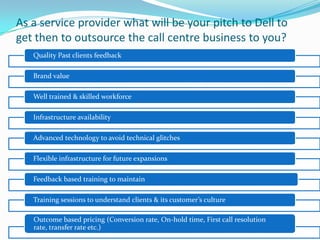
As a service provider what will be your pitch to Dell to
get then to outsource the call centre business to you?
Quality Past clients feedback
Brand value
Well trained & skilled workforce
Infrastructure availability
Advanced technology to avoid technical glitches
Flexible infrastructure for future expansions
Feedback based training to maintain
Training sessions to understand clients & its customer’s culture
Outcome based pricing (Conversion rate, On-hold time, First call resolution
rate, transfer rate etc.)

Dell case

  • 1.
    A case studyon Dell’s call centre outsourcing
  • 2.
    What are thekey elements that have led to the closure of the Bangalore call centre? • Lack of long term plan • Inadequate risk assessment Planning and managing • Not enough technical knowledge • Long time to reach senior technicians Technical skills • High attrition rate • Lack of training People • Type of answer • Thick ascent Cultural issues
  • 3.
    7 Steps toSuccessful Outsourcing 1. Planning initiatives 2. Exploring strategic implications 3. Analyzing costs/performance 4. Selecting providers 5. Negotiating terms 6. Transitioning resources 7. Managing relationships
  • 4.
    I - PlanningInitiatives Identify core and non-core competencies Form an Executive Sponsor team – Why? • Adds credibility • Knowledge & vision of strategic issues of organization • Enables Better assessment • Better control & integration capability Form an outsourcing team including • executive sponsor, outsourcing team leader and • representations from Project management, contracts, finance, information systems, procurement, HR, operations, quality, sales & marketing Train and acquire resources if necessary Risk Assessment Set key business objectives • Serve large customer base • Reduce cost
  • 5.
    I - PlanningInitiatives – Risk Assessment Strategic Risks •Are the strategies compatible? •Any past experience? •Level of executive commitment •Management capabilities •Vendor capabilities •Intellectual Property Risk Operational Risks •Roles & Responsibilities of management and operations staff •Processes & Methodology •Skill availability •Staff transition, training, retention & attrition rates •Cross-Cultural issues Technology Risks •Architectural approach & requirements •Regulatory compliance •Security •Reliability •Standardization vs Customization Financial Risks •Internal costs •Financial stability of vendor •HR costs •Training costs •Transition costs •Communication & Management costs
  • 6.
    II - ExploringStrategic Implications Understand organization’s vision Identify products and services for outsourcing Understand the marketplace and vendor capabilities Define organizational design & culture Lead and manage change Define the roles and responsibilities Align initiative with business strategy • Does it fit in the overall business strategy? • Long term or short term relationship?
  • 7.
    III - AnalyzingCosts and Performance • Staff hours in planning, meeti ngs, negotiations etc., • Change management • FC < CC • Cost of poor performance • Legal fee for new contracts • Employee displacement cost • Communication costs • Employee cost • Administrative cost etc Direct Cost Indirect Cost Hidden Costs Current & Future Costs Performance Benchmarks First call resolution rate Transfer rate On hold time Conversion rate  Determine total costs, costing method, cost and performance benchmarks Benchmarking can be done against competitor, internal or process information
  • 8.
    IV - SelectingProviders  Cross functional vendor evaluation team  Standardized, fair and documented vendor evaluation process • Leader/Rising star in the industry (India, China, Philippines etc.) • With past experience in customer contact center business • Infrastructure requirement • Client References Qualification • Qualifications • Costs • Background check • Geographical location – country risk • Cultural diversity & associated cost Evaluation Criteria • Outsourcing of customer contact center • To cater to large customer base & reduce cost • Qualifications • Backup capabilities expected • Dell’s business, vision, mission, goals – corporate profile RFP ??
  • 9.
    V - NegotiatingTerms Prioritize requirements • Manage a large customer base (approx no.) • Cost reduction ?? • Infrastructure (Capacity) • Time frame • Organizational culture Pricing based on the scope and performance Negotiate to build a relationship & not just to sign an advantageous contract
  • 10.
    VI - TransitioningResources Define roles and responsibilities of domain experts & the project management team Develop an integrated transition plan Training and technical knowledge transfer Define clear communication protocols Identify and resolve issues arising due to cultural diversity Create awareness among the employees Have a contingency plan
  • 11.
    VII - ManagingRelationships Communication Management • Training and education for employees • Usage of portals to pass on information to vendor • Knowledge transfers for new products & technologies Work Administration • Executive team for strategic planning & development • Operational team for overseeing the performance of vendor • Special purpose team for managing critical issues • Committees for overseeing financial and quality aspects of the vendor Focus on strengthening the relationship to achieve long term goals
  • 12.
    Are the recommendationsand conclusions given here implementable, if so, how will you go about implementing them? Planning & Management:  Define the scope for outsourcing i.e. degree of outsourcing  Progressive model of approach  Selection of one of the regional market for trial purpose  Evaluate the outcomes of the trial  Issues:  The same results may not be possible with other regional markets  Resolve the problems  A vendor must be evaluated periodically with respect to the training given to employees  Execute it on a larger scale in a phased manner  Staff retention  Employee engagement and recreations  Compensation and benefit plans  Flexibility in working hours
  • 13.
    Investigation and Pre-outsourcingAnalysis:  Systematic investigation should be done. It includes those parameter which directly impacts customer like ascent, domain knowledge etc.  The third party consultancy must gauge the below stated fields:  Skill availability  Flexible Infrastructure  Cultural issues  Other risks like- IP, etc Training and Monitoring:  Technical skills  Communication skill  Culture of dell’s as well as it’s customers  Making the whole outsourcing process accountable by standardizing the evaluation process.  Manager accountable to the activity, should be having a team under him to continuously monitor/update the evaluation process as per the changing technology requirements
  • 14.
    As a serviceprovider what will be your pitch to Dell to get then to outsource the call centre business to you? Quality Past clients feedback Brand value Well trained & skilled workforce Infrastructure availability Advanced technology to avoid technical glitches Flexible infrastructure for future expansions Feedback based training to maintain Training sessions to understand clients & its customer’s culture Outcome based pricing (Conversion rate, On-hold time, First call resolution rate, transfer rate etc.)

Editor's Notes

  • #5 Objective  to cater to larger customer base and reduce cost
  • #6 Pg 62 onwards in outsourcing handbook