Delivering the Goods
Best Practices in Design and Delivery of Instruction
July 6, 2018
Max Anderson, MLIS, MS (PhD Candidate)
Instructional Designer – UICOM
max@uic.edu
Learning Objectives
• Differentiate between best practices for
content delivery methods appropriate for
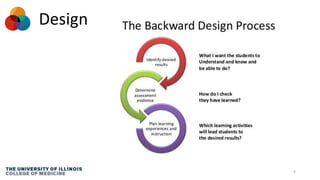
noon conferences, mini-teaching sessions,
and micro-teaching.
• Explain how differences in PowerPoint design
impact retention of information.
• Determine how observing others deliver
content is an potential alternative to
evaluations.
2
My role
• Instructional Designer (MS)
• Medical Librarian (MLIS)
• Educational Technologist
• PhD Candidate
3
5
6
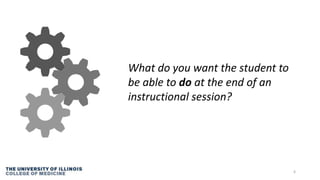
What do you want the student to
be able to do at the end of an
instructional session?
Design
7
8
Design Choose
textbooks
Write syllabus
Write / Revise
lectures
Prepare PPT
slides
Write exam /
problem sets
Formulate broad
learning goals
Set specific
learning
objectives
Design
assessments
Develop learning
activities
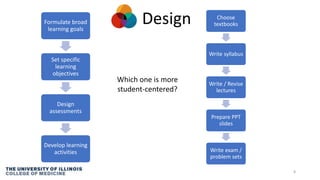
Which one is more
student-centered?
9
Design
10
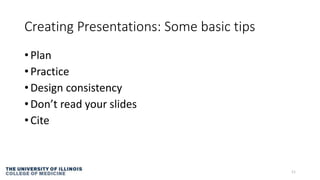
Creating Presentations: Some basic tips
• Plan
• Practice
• Design consistency
• Don’t read your slides
• Cite
11
12
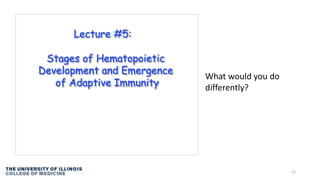
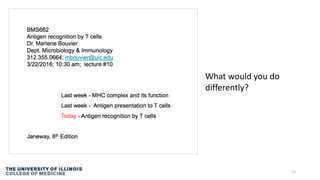
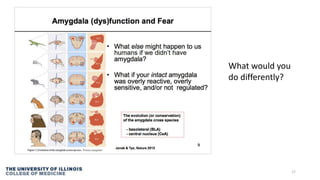
What would you do
differently?
13
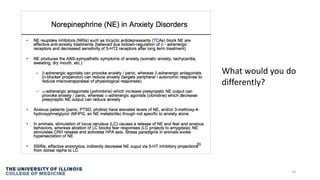
What would you do
differently?
14
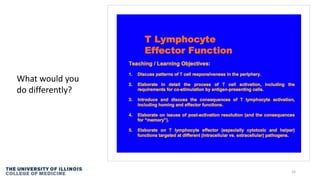
What would you do
differently?
15
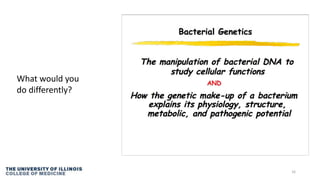
What would you
do differently?
16
What would you
do differently?
17
What would you
do differently?
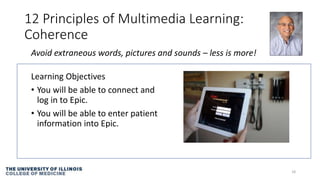
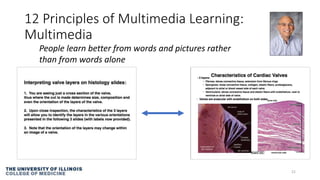
12 Principles of Multimedia Learning:
Coherence
Learning Objectives
• You will be able to connect and
log in to Epic.
• You will be able to enter patient
information into Epic.
18
Avoid extraneous words, pictures and sounds – less is more!
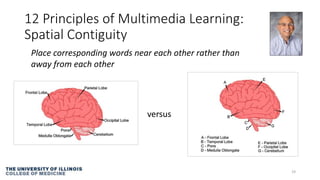
12 Principles of Multimedia Learning:
Spatial Contiguity
19
Place corresponding words near each other rather than
away from each other
versus
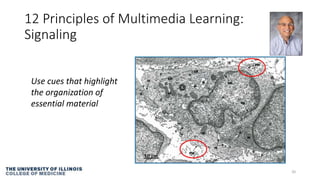
12 Principles of Multimedia Learning:
Signaling
20
Use cues that highlight
the organization of
essential material
12 Principles of Multimedia Learning:
Multimedia
21
People learn better from words and pictures rather
than from words alone
Delivery
22
Facilitation (aka Delivery)
• Noon conferences
• Mini-teaching
• Micro-teaching
How are these different to you?
23
24
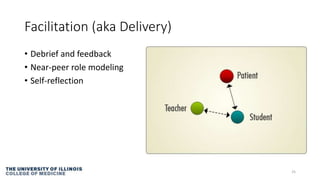
Facilitation (aka Delivery)
• Debrief and feedback
• Near-peer role modeling
• Self-reflection
25
26
Self-reflection is a humbling
process. It’s essential to find out
why you think, say, and do certain
things…and then better yourself.
Self-Directed Learning
• LCME Element 6.3
• How do learners view themselves as learners?
• Are there demands on a learning situation that influence the capacity
for self-direction?
• As learners master subjects, the capacity to be self-directed is
enhanced
• Situated learning – learning is inseparable from situations where
knowledge is used
• Knowledge is socially constructed
• Knowledge is dependent on context for meaning
27
Facilitation (aka Delivery):
Keys to asking effective questions
• Ask one question at a time
• Wait 3 seconds before and after the student answers
• Stay neutral until after the student has explained the answer
• Use higher-order, open-ended questions
• Create a safe environment that permits students to answer
incorrectly or to guess
How do you ask questions?
How do you deal with clear gaps in knowledge?
28
Riddle, J. (2010). Teaching clinical skills. In W. B. Jeffries & K. N. Huggett (eds.)., An introduction to medical teaching.
Facilitation (aka Delivery): Consultation Room
• Consultation Room Training
• Cognitive constructivism
• Gagne (1985) says:
• Cognitive phase: consciously develop a routine with cues from facilitator
• Associative phase: deliberate practice to integrate component parts.
• Autonomous phase: skill automatic to enable cognitive activity
• Ask students how they would like to run the session – it’s
really their time to learn.
29
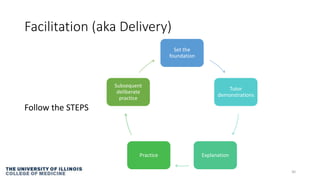
Facilitation (aka Delivery)
Follow the STEPS
30
Set the
foundation
Tutor
demonstrations
ExplanationPractice
Subsequent
deliberate
practice
Observation as Evaluation
31
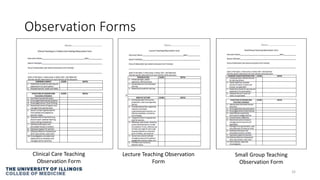
Observation Forms
32
Clinical Care Teaching
Observation Form
Lecture Teaching Observation
Form
Small Group Teaching
Observation Form
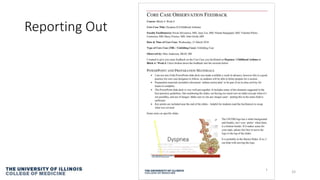
Reporting Out
33
Learning Objectives
• Differentiate between best practices for
content delivery methods appropriate for
noon conferences, mini-teaching sessions,
and micro-teaching.
• Explain how differences in PowerPoint design
impact retention of information.
• Determine how observing others deliver
content is an potential alternative to
evaluations.
34
References
Dent, J. A., & Harden, R. M. (2013). A practical guide for medical teachers. (4th
ed). Elsevier.
Harden, R. M., & Laidlaw, J. M. (2012). Essential skills for a medical teacher: An
introduction to teaching and learning in medicine. Elsevier.
Jeffries, W. B., & Huggett, K. N. (2010). An introduction to medical teaching.
New York: Springer.
Kaufman, D. M., & Mann, K. V. (2010). Teaching and learning in medical
education: How theory can inform practice. In T. Swanwick (ed.)., Understanding
medical education: Evidence, theory and practice. Association for the Study of
Medical Education.
35
References
Kessler, C. S., Chan, T., Loeb, J. M., & Malka, S. T. (2013). I’m clear,
you’re clear, we’re all clear: Improving consultation communication
skills in undergraduate medical education. Academic Medicine, 88(6),
753-758.
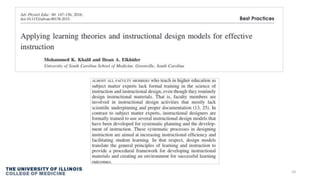
Khalil, M. K., & Elkhider, I. A. (2016). Applying learning theories and
instructional design models for effective instruction. Advancements in
Physiology Education, 40, 147-156.
Wong, B. M. et al. (2017). Faculty-resident “co-learning”: A longitudinal
exploration of an innovative model for faculty development in quality
improvement. Academic Medicine, 92(8), 1151-1159.
36

Delivering the Goods

  • 1.
    Delivering the Goods BestPractices in Design and Delivery of Instruction July 6, 2018 Max Anderson, MLIS, MS (PhD Candidate) Instructional Designer – UICOM max@uic.edu
  • 2.
    Learning Objectives • Differentiatebetween best practices for content delivery methods appropriate for noon conferences, mini-teaching sessions, and micro-teaching. • Explain how differences in PowerPoint design impact retention of information. • Determine how observing others deliver content is an potential alternative to evaluations. 2
  • 3.
    My role • InstructionalDesigner (MS) • Medical Librarian (MLIS) • Educational Technologist • PhD Candidate 3
  • 5.
  • 6.
    6 What do youwant the student to be able to do at the end of an instructional session?
  • 7.
  • 8.
    8 Design Choose textbooks Write syllabus Write/ Revise lectures Prepare PPT slides Write exam / problem sets Formulate broad learning goals Set specific learning objectives Design assessments Develop learning activities Which one is more student-centered?
  • 9.
  • 10.
  • 11.
    Creating Presentations: Somebasic tips • Plan • Practice • Design consistency • Don’t read your slides • Cite 11
  • 12.
    12 What would youdo differently?
  • 13.
    13 What would youdo differently?
  • 14.
    14 What would youdo differently?
  • 15.
  • 16.
  • 17.
  • 18.
    12 Principles ofMultimedia Learning: Coherence Learning Objectives • You will be able to connect and log in to Epic. • You will be able to enter patient information into Epic. 18 Avoid extraneous words, pictures and sounds – less is more!
  • 19.
    12 Principles ofMultimedia Learning: Spatial Contiguity 19 Place corresponding words near each other rather than away from each other versus
  • 20.
    12 Principles ofMultimedia Learning: Signaling 20 Use cues that highlight the organization of essential material
  • 21.
    12 Principles ofMultimedia Learning: Multimedia 21 People learn better from words and pictures rather than from words alone
  • 22.
  • 23.
    Facilitation (aka Delivery) •Noon conferences • Mini-teaching • Micro-teaching How are these different to you? 23
  • 24.
  • 25.
    Facilitation (aka Delivery) •Debrief and feedback • Near-peer role modeling • Self-reflection 25
  • 26.
    26 Self-reflection is ahumbling process. It’s essential to find out why you think, say, and do certain things…and then better yourself.
  • 27.
    Self-Directed Learning • LCMEElement 6.3 • How do learners view themselves as learners? • Are there demands on a learning situation that influence the capacity for self-direction? • As learners master subjects, the capacity to be self-directed is enhanced • Situated learning – learning is inseparable from situations where knowledge is used • Knowledge is socially constructed • Knowledge is dependent on context for meaning 27
  • 28.
    Facilitation (aka Delivery): Keysto asking effective questions • Ask one question at a time • Wait 3 seconds before and after the student answers • Stay neutral until after the student has explained the answer • Use higher-order, open-ended questions • Create a safe environment that permits students to answer incorrectly or to guess How do you ask questions? How do you deal with clear gaps in knowledge? 28 Riddle, J. (2010). Teaching clinical skills. In W. B. Jeffries & K. N. Huggett (eds.)., An introduction to medical teaching.
  • 29.
    Facilitation (aka Delivery):Consultation Room • Consultation Room Training • Cognitive constructivism • Gagne (1985) says: • Cognitive phase: consciously develop a routine with cues from facilitator • Associative phase: deliberate practice to integrate component parts. • Autonomous phase: skill automatic to enable cognitive activity • Ask students how they would like to run the session – it’s really their time to learn. 29
  • 30.
    Facilitation (aka Delivery) Followthe STEPS 30 Set the foundation Tutor demonstrations ExplanationPractice Subsequent deliberate practice
  • 31.
  • 32.
    Observation Forms 32 Clinical CareTeaching Observation Form Lecture Teaching Observation Form Small Group Teaching Observation Form
  • 33.
  • 34.
    Learning Objectives • Differentiatebetween best practices for content delivery methods appropriate for noon conferences, mini-teaching sessions, and micro-teaching. • Explain how differences in PowerPoint design impact retention of information. • Determine how observing others deliver content is an potential alternative to evaluations. 34
  • 35.
    References Dent, J. A.,& Harden, R. M. (2013). A practical guide for medical teachers. (4th ed). Elsevier. Harden, R. M., & Laidlaw, J. M. (2012). Essential skills for a medical teacher: An introduction to teaching and learning in medicine. Elsevier. Jeffries, W. B., & Huggett, K. N. (2010). An introduction to medical teaching. New York: Springer. Kaufman, D. M., & Mann, K. V. (2010). Teaching and learning in medical education: How theory can inform practice. In T. Swanwick (ed.)., Understanding medical education: Evidence, theory and practice. Association for the Study of Medical Education. 35
  • 36.
    References Kessler, C. S.,Chan, T., Loeb, J. M., & Malka, S. T. (2013). I’m clear, you’re clear, we’re all clear: Improving consultation communication skills in undergraduate medical education. Academic Medicine, 88(6), 753-758. Khalil, M. K., & Elkhider, I. A. (2016). Applying learning theories and instructional design models for effective instruction. Advancements in Physiology Education, 40, 147-156. Wong, B. M. et al. (2017). Faculty-resident “co-learning”: A longitudinal exploration of an innovative model for faculty development in quality improvement. Academic Medicine, 92(8), 1151-1159. 36

Editor's Notes

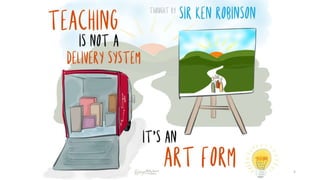
  • #3 What teaching is not by @bryanMMathers is licenced under CC-BY-ND
  • #5 What is one thing in your daily interaction with health professions colleagues that is the most challenging for you? https://www.polleverywhere.com/free_text_polls/Z15Q3zGThWfTonz
  • #9 Traditional method of design of any instruction (instructor centered) Choose textbook Write syllabus Write/Revise lectures Prepare PowerPoint slides Write exam / problem sets Backward design (student centered) Formulate broad learning goals Set specific learning objectives Design assessments (formative and summative) Develop learning activities (lectures, etc.)
  • #10 Traditional method of design of any instruction (instructor centered) Choose textbook Write syllabus Write/Revise lectures Prepare PowerPoint slides Write exam / problem sets Backward design (student centered) Formulate broad learning goals Set specific learning objectives Design assessments (formative and summative) Develop learning activities (lectures, etc.)
  • #13 Font / shadows
  • #14 Good – scaffolding / spiral
  • #15 Too much text!
  • #16 Color Text size
  • #17 Font and use of Bold
  • #18 Richard Mayers ‘contiguity principle’ Slide numbers
  • #24 What types of feedback do they get? What do they do with that information?
  • #25 Safe, effective intercollegial communication in health care requires a sophisticated skill set that encompasses relationship building, argument structuring, clinical synthesis, cultural competency, and professionalism.
  • #26 Reflection is one of the most important parts of the learning process. Reflection on learning experiences allows students to formulate and refine clinical concepts. This part of the learning process also gives additional opportunities for giving and receiving constructive feedback.
  • #27 Reflection-in-action Reframing and reworking the problem from different perspectives Establishing where the problem fits into learned schema – already existing knowledge and expertise Understanding the elements and implications present in the problem, its solution, and consequences Reflection-on-action Process of thinking back on what has happed in the situation to determine what may have contributed to the unexpected, and how this situation might affect future practice. Schon There is a dynamic relationship between reflective practice and self-assessment. The ability to self-assess depends on the ability to reflect accurately on one’s practice and the ability to reflect effectively relies on accurate self-assessment.
  • #30 From Dent: Cognitive constructivism is a useful approach to developing expertise in consultation skills. This builds on prior knowledge and experience and enables the event to be linked to existing experience in the cognitive, psychomotor, and affective domains.
  • #31 S: Set the foundation or prior learning, the importance of the skill and the context in which it will be learned and applied. T: Tutor demonstration in real time without commentary E: Explanation with repeat demonstration P: Practice under supervision with feedback from peer and tutor. S: Subsequent deliberate practice encouraged (Dent)
  • #35 What teaching is not by @bryanMMathers is licenced under CC-BY-ND