
Delivering Sustainability – The UK experience Nick Hayes 22nd September 2010
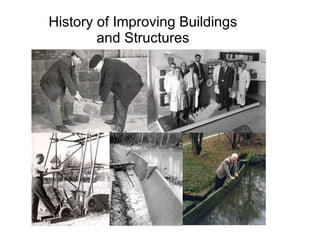
History of Improving Buildings and Structures
 
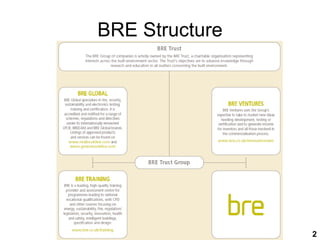
BRE Structure 2
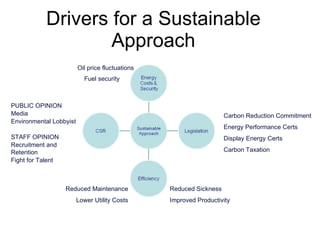
Drivers for a Sustainable Approach Carbon Reduction Commitment  Energy Performance Certs Display Energy Certs Carbon Taxation Reduced Sickness Improved Productivity PUBLIC OPINION Media Environmental Lobbyist STAFF OPINION Recruitment and Retention Fight for Talent Reduced Maintenance Lower Utility Costs Oil price fluctuations Fuel security
Drivers for a Sustainable Approach Governmental Carbon targets, Energy Performance certificates Code for Sustainable Homes Grants and certification for renewables Feed in Tariffs Local policy – e.g. renewable energy Corporate Retailers, banks, automotive… ‘ Flagship’ 2012 Olympics, sustainable games, materials, legacy…. Financial The value of Green Buildings, Investment, Risk…
 
 
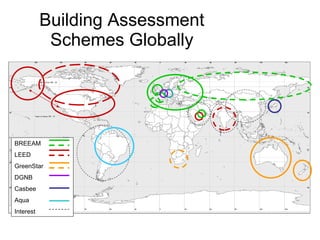
Building Assessment Schemes Globally BREEAM LEED GreenStar DGNB Casbee Aqua Interest
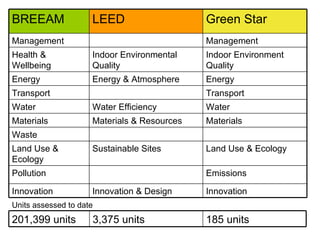
Units assessed to date BREEAM LEED Green Star Management Management Health & Wellbeing Indoor Environmental Quality Indoor Environment Quality Energy Energy & Atmosphere Energy Transport Transport Water Water Efficiency Water Materials Materials & Resources Materials Waste Land Use & Ecology Sustainable Sites Land Use & Ecology Pollution Emissions Innovation Innovation & Design Innovation 201,399 units 3,375 units 185 units
Types of projects that can be assessed? Development types: Domestic or  Mixed Use Different development sizes:  Small (e.g. up to 10) Medium (e.g. 10 to 500) Large (e.g. 500 to 5000+) Now - New Developments  Infill / Brownfield Greenfield  Regeneration
But also… BREEAM used as  basis for other rating schemes : Such as Green Globes (Canada), Green Star (Australia), HKBEAM (Hong Kong) Individual  high-profile  projects internationally: Such as European Parliament in Luxembourg Support to others wishing to develop their own assessment methods: Companies working / building internationally Developments, regions, countries etc. Emerging Green Building Councils
What is BREEAM? Environmental Assessment Method Certification scheme Voluntary Independent & credible Holistic Customer focused Credits based
Aims Improve environmental performance of buildings Improve internal environment for occupants
Benefits of using BREEAM Reduced environmental impacts Improved functionality, flexibility and durability   Higher user satisfaction Demonstrate improved performance (design & operation) Improved letting / sales potential
Development history 1990 : Launch of BREEAM Offices 1991 : Launch of BREEAM Industrial 1993 : Launch of version for retail superstores 1998 : Launch of BREEAM 98 Major overhaul of the schemes (current layout, weightings etc) 2002 – 2006 : Annual update process Development of Bespoke BREEAM process Development of more schemes
Development history 2008 : Major update Introduction of new schemes International development As a consequence: More than  5,000 buildings  registered for assessment in 2008 compared to  1600  in 2007 (300% increase) 680  buildings certified in 2008 compared to  362  in 2007 1200  individuals trained on the non domestic side compared to  761  in 2007. 17,000  worldwide public downloads of the new BREEAM 2008 Guidance
BREEAM in the UK   All building types Nationally recognised standard schemes for common building types  Bespoke BREEAM for others All stages Design Construction Operation
BREEAM in the UK UK Government Government departments Social housing Land owners Planning Authorities Development Agencies Private Property Developers
BREEAM Family Bespoke Courts Code for Sustainable Homes Ecohomes EcohomesXB Prisons Multi-residential International Industrial Healthcare Offices Retail Education Communities
Setting the standard Environmental Standards Number of buildings Regulatory minimum Minimal BREEAM  Aspirational BREEAM  Excellent Outstanding Market Pull
BREEAM In-Use BREEAM In-Use is a new scheme to help building owners and occupiers to improve the environmental performance and reduce running costs of existing buildings. It consists of: a standard An easy-to-use assessment methodology and a 3rd party certification process  Providing a  clear and credible route map to improving sustainability
BREEAM Communities Standard What is the BREEAM Communities Certification Standard? Sustainability  Objectives Planning Policy  Requirements BREEAM  Communities Standard
Key features – BREEAM Communities Eight categories of holistic sustainability  Environmental Social  Economic Applied at the site development level (planning stage of development control process) 3 Stage Process  Registration of Assessment Framework Outline Planning Stage Certification (Interim) Detailed Planning Stage Certification (Final) Regional Variations Innovation credits
BREEAM Communities Assessment Stages Registration of a Compliant Assessment Framework By the developer to BRE Global Mandatory to achieve certification against the BREEAM Communities standard Created through the use of a compliant assessment methodology Outline Planning Stage To assess the master plan and developers early commitments for the proposed project Results in interim certificate Detailed Planning Stage  Ensures the detailed planning documentation on the developers commitments have been provided as specified in the OPS assessment Results in final certificate
What does this all mean?  BREEAM Communities brings clarity to a confused market  Drawing upon the BREEAM suite of tools, offering third party assurance and the confidence in a schemes quality  Provides a benchmark Delivery of local priorities (Focus, Clarify, Prioritise, Deliver)
The Categories Climate & Energy  Resources  Transport    Ecology  Business   Community   Place Shaping   Buildings
What will it do for development projects within the built environment…?   Open and transparent framework for both developers and planners Certainty and verification on  development’s commitments  Assists in speeding up the planning process for developers Assists in reducing costs associated with delivering sustainable communities  Stewardship for Sustainable Communities throughout the development process
Athletes Village – Stratford (London)   Sustainability Features Building: Code Level 4 (Domestic) or BREEAM: Excellent (Non-Domestic) FSC Timber Certification  Extensive new public transport and cycling networks Over 10 hectares of public realm (open space) Development Facts - Legacy Site size – 2.5 square miles: Commercial 365,000m2 Residential 80,000m2 Legacy Masterplan 2020 looking East
BREEAM Communities - Summary The sustainable development framework is an open and transparent structure, with a flexible and non-prescriptive approach to addressing key sustainability objectives and planning requirements The process provides a simple, clear and consistent, yet flexible, assessment framework for developers to address the sustainable objectives and planning policy requirements of a development BREEAM Communities  certification assists in the review of planning submissions, reducing pressure on planning departments and helping approval decisions to be made faster, at lower costs and with greater confidence
International development of BREEAM
BREEAM International Banner under which  all  BREEAM assessments outside the UK are undertaken Includes ‘ One off’ tailored assessments Regional standard Schemes Country specific schemes
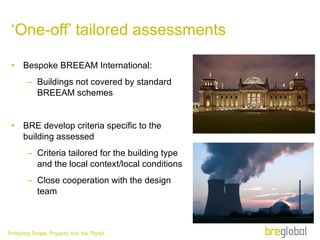
‘ One-off’ tailored assessments Bespoke BREEAM International: Buildings not covered by standard BREEAM schemes BRE develop criteria specific to the building assessed Criteria tailored for the building type and the local context/local conditions Close cooperation with the design team
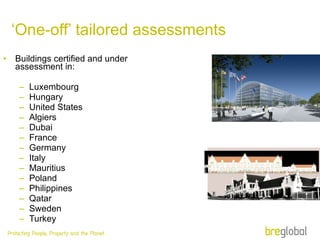
‘ One-off’ tailored assessments Buildings certified and under assessment in: Luxembourg Hungary  United States  Algiers Dubai France Germany Italy Mauritius Poland Philippines Qatar Sweden Turkey
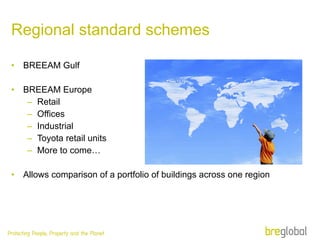
Regional standard schemes BREEAM Gulf BREEAM Europe  Retail  Offices Industrial Toyota retail units More to come… Allows comparison of a portfolio of buildings across one region
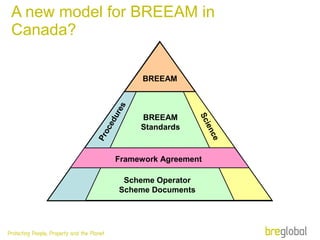
A new model for BREEAM in Canada?
What is GreenPrint? Methodology to assist design teams to maximise the potential for sustainable communities Workshop led approach involving the whole stakeholder team Sets out clear understandable sustainability objectives and benchmarks Prioritises sustainability issues most important to a development Independent appraisal of the final masterplan Provides an overall  GreenPrint  Score and Rating An approved route to BREEAM Communities certification
What does the GreenPrint cover?
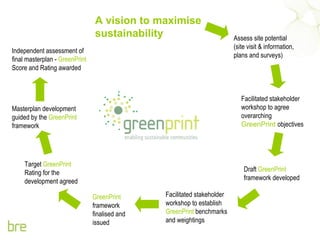
A vision to maximise sustainability Assess site potential (site visit & information, plans and surveys) Facilitated stakeholder  workshop to agree overarching  GreenPrint   objectives Facilitated stakeholder workshop to establish  GreenPrint  benchmarks and weightings Target  GreenPrint  Rating for the development agreed Masterplan development guided by the  GreenPrint  framework Independent assessment of final masterplan -  GreenPrint  Score and Rating awarded Draft  GreenPrint  framework developed GreenPrint  framework finalised and issued
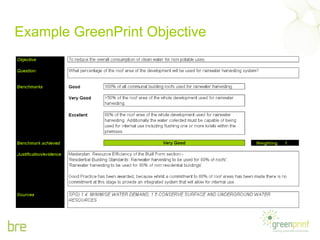
Example GreenPrint Objective
  No grade <50% Good 50% – 64% Very Good 65% – 74% Excellent   75% – 84% Exemplar   >84% GreenPrint Rating CLIMATE CHANGE TRANSPORT ECOLOGY BUSINESS PLACEMAKING RESOURCES BUILDINGS COMMUNITY
GreenPrint Case Studies
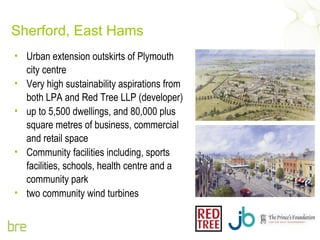
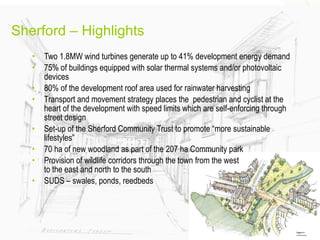
Sherford, East Hams Urban extension outskirts of Plymouth city centre Very high sustainability aspirations from both LPA and Red Tree LLP (developer) up to 5,500 dwellings, and 80,000 plus square metres of business, commercial and retail space Community facilities including, sports facilities, schools, health centre and a community park two community wind turbines
Sherford – Highlights Two 1.8MW wind turbines generate up to 41% development energy demand 75% of buildings equipped with solar thermal systems and/or photovoltaic devices 80% of the development roof area used for rainwater harvesting Transport and movement strategy places the  pedestrian and cyclist at the heart of the development with speed limits which are self-enforcing through street design Set-up of the Sherford Community Trust to promote “more sustainable lifestyles” 70 ha of new woodland as part of the 207 ha Community park Provision of wildlife corridors through the town from the west  to the east and north to the south SUDS – swales, ponds, reedbeds
Sherford GreenPrint Score & Rating Sherford masterplan achieved an overall score of  85% “ Exemplar ”   GreenPrint  rating CLIMATE CHANGE COMMUNITY TRANSPORT ECOLOGY BUSINESS PLACEMAKING RESOURCES BUILDINGS
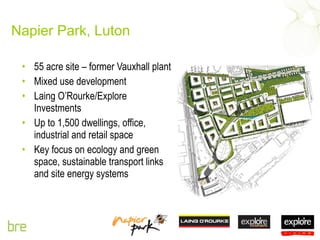
Napier Park, Luton 55 acre site – former Vauxhall plant Mixed use development Laing O’Rourke/Explore Investments Up to 1,500 dwellings, office, industrial and retail space Key focus on ecology and green space, sustainable transport links and site energy systems
From this…. Improving the Napier masterplan CLIMATE CHANGE COMMUNITY TRANSPORT ECOLOGY BUSINESS PLACEMAKING RESOURCES BUILDINGS GreenPrint  Rating ”Good” COMMUNITY COMMUNITY
To this Improving the Napier masterplan GreenPrint  Rating ”Excellent” CLIMATE CHANGE TRANSPORT ECOLOGY BUSINESS PLACEMAKING RESOURCES BUILDINGS COMMUNITY
“ The GreenPrint documentation prepared by the BRE has enabled Explore Investments to clearly articulate to the Design Team the sustainability aspirations of the Napier Park Project  ” George Graham, Explore Investments
Approach can be tailored to non-standard solutions
Benefits to the Masterplanning process Addresses sustainability issues at the very beginning of the process Adaptable to local priorities, policies and targets Takes account of a site ’ s strengths and weaknesses, and focuses on issues that a developer can influence Complements BREEAM and the Code for Sustainable Homes, and other recognised tools and standards (eg Secured by Design, Lifetime homes) Looks at  “ outcomes ”  rather than  “ outputs ”   –  developer creativity is not stifled Provides an overall  GreenPrint  Score and Rating that gives confidence in the sustainability credentials of a masterplan
GreenPrint summary BREEAM Communities provides certification of a development against and accreditted standard GreenPrint  provides a tailored route to delivering a sustainable community within the parameters of the site. GreenPrint  is an approved methodology to achieving BREEAM Communities certification
Demonstration - Innovation Parks
Setting Standards for Sustainability Code for Sustainable Homes Energy / CO 2 Potable water Surface water runoff Materials Site waste / household waste Pollution Health and wellbeing Management Ecology
Energy Potable Water Consumption Waste Materials Water Surface Run-off Pollution Health & Wellbeing Management Tradable Credits Waste Materials Water Surface Run-off Mandatory Standards Energy Potable Water Consumption Environmental Weightings Issue Category Scores Overall Score Level 1 Level 2 Level 3 Level 4  Level 5 Level 6
Code Thresholds – Points Scores Level 1 36 Points (Mandatory + 33.3 Points) Above Regulations EcoHomes 2006 Pass EST Good Practice Level 2 48 Points (Mandatory + 43.0 Points) EcoHomes 2006 - Good Level 3 57 Points (Mandatory + 46.7 Points) EcoHomes 2006 Very Good EST Best Practice Conventional Water fittings Level 4 68 Points (Mandatory + 54.1 Points) Grey water/Rainwater Passive House (approx) Level 5 84 Points (Mandatory + 60.1 Points) Zero SAP Significant Renewables Level 6 90 Points (Mandatory + 64.9 Points) Zero Operational Carbon Most Code Credits achieved
Hanson EcoHouse - Code 4
Barratt Green House -  Code 6
Stewart Milne Sigma homes - Code 5
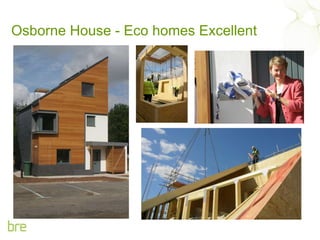
Osborne House - Eco homes Excellent
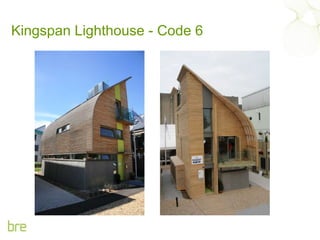
Kingspan Lighthouse - Code 6
EcoTech Organics House - Code 4
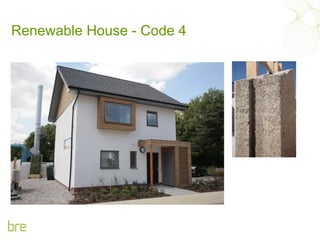
Renewable House - Code 4 Walls of Hempcrete
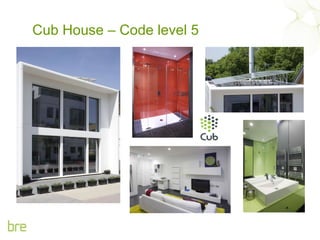
Cub House – Code level 5
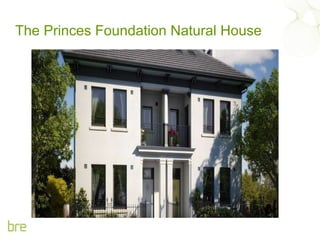
The Princes Foundation Natural House
BRE Visitors Centre - Not CSH Rated
Healthcare Campus -  Not CSH Rated
Landscaping
BRE Scotland Innovation Park Ravenscraig
BRE Innovation Park Ravenscraig - overview Drivers for Scotland’s Innovation Park Industry challenges Identifying key themes The Site
‘ A Low Carbon Buildings Strategy for Scotland’ The Sullivan Report Towards Zero Carbon Buildings 2010, Low Carbon Buildings – Domestic 30% CO 2  improvement on 2007 standards; Non-Domestic less 50% 2013, Very Low Carbon Buildings; 60% CO 2  improvement on 2007 standards; Non-Domestic less 75% 2016/2017: Net Zero Carbon Buildings Total life zero carbon buildings – 2030 Construction  Materials  In use  Maintenance Demolition
Identifying key themes Energy Sustainability Affordability Community
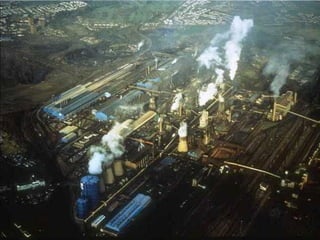
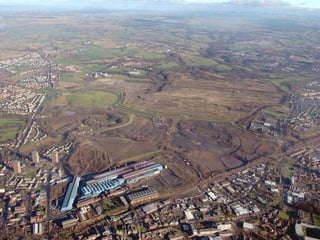
The site Ravenscraig steelworks – closed in 1992 1125 acre site UK’s largest regeneration project
Ravenscraig Development Vision Ravenscraig will become home to over 10,000 people, and is expected to create 12,000 jobs and attract in excess of £1.2 billion of private sector investment over the next 15 to 20 years. A project of national significance, Ravenscraig will lead to the construction of: •  Around 3,500 new homes • A new town centre with 84,000 sq m of retail and leisure space. • Up to 216,000 sq m of business and industrial space • Major parkland areas  •  A new transport network • New sports facility • A new college campus • Two New schools.
 
 
BRE Innovation Park
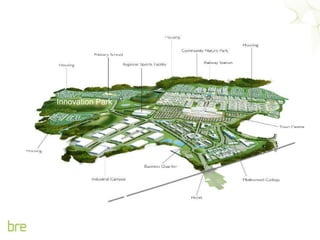
Innovation Park
Innovation Park - development 6-9 plots and Technology Pavilion to be developed (LZC) SUDs systems and integrated surface water management Hard and soft landscaping Porous paving and road surfaces Street furniture and lighting Park operating ‘off grid’ ‘ Vision of sustainable development’ Showcasing (not exclusively) Scottish products and innovation –  80 industry partners
 
 
Innovation Park Phasing Strategy Enabling Phase Jan 2010 – April 2010 Build on site  April 2010 – September 2010 Phase 1: Zero Carbon September 2010 – April 2013 Phase 2: Net Zero Carbon September 2013 – April 2016 Phase 3: Total Zero Carbon  September 2016 – April 2019
Innovation parks – summary, opportunities… Practical demonstration against legislative drivers Stimulates innovation – products and approaches Stimulates collaboration Speeds up products to market Test approaches and solutions Opportunities for Canada? Park Products and services Route to sustainable communities
Delivering Sustainability  –  The UK experience Nick Hayes 22nd September 2010

BRE UK - GBF2010

  • 1.
    Delivering Sustainability –The UK experience Nick Hayes 22nd September 2010
  • 2.
    History of ImprovingBuildings and Structures
  • 3.
  • 4.
  • 5.
    Drivers for aSustainable Approach Carbon Reduction Commitment Energy Performance Certs Display Energy Certs Carbon Taxation Reduced Sickness Improved Productivity PUBLIC OPINION Media Environmental Lobbyist STAFF OPINION Recruitment and Retention Fight for Talent Reduced Maintenance Lower Utility Costs Oil price fluctuations Fuel security
  • 6.
    Drivers for aSustainable Approach Governmental Carbon targets, Energy Performance certificates Code for Sustainable Homes Grants and certification for renewables Feed in Tariffs Local policy – e.g. renewable energy Corporate Retailers, banks, automotive… ‘ Flagship’ 2012 Olympics, sustainable games, materials, legacy…. Financial The value of Green Buildings, Investment, Risk…
  • 7.
  • 8.
  • 9.
    Building Assessment SchemesGlobally BREEAM LEED GreenStar DGNB Casbee Aqua Interest
  • 10.
    Units assessed todate BREEAM LEED Green Star Management Management Health & Wellbeing Indoor Environmental Quality Indoor Environment Quality Energy Energy & Atmosphere Energy Transport Transport Water Water Efficiency Water Materials Materials & Resources Materials Waste Land Use & Ecology Sustainable Sites Land Use & Ecology Pollution Emissions Innovation Innovation & Design Innovation 201,399 units 3,375 units 185 units
  • 11.
    Types of projectsthat can be assessed? Development types: Domestic or Mixed Use Different development sizes: Small (e.g. up to 10) Medium (e.g. 10 to 500) Large (e.g. 500 to 5000+) Now - New Developments Infill / Brownfield Greenfield Regeneration
  • 12.
    But also… BREEAMused as basis for other rating schemes : Such as Green Globes (Canada), Green Star (Australia), HKBEAM (Hong Kong) Individual high-profile projects internationally: Such as European Parliament in Luxembourg Support to others wishing to develop their own assessment methods: Companies working / building internationally Developments, regions, countries etc. Emerging Green Building Councils
  • 13.
    What is BREEAM?Environmental Assessment Method Certification scheme Voluntary Independent & credible Holistic Customer focused Credits based
  • 14.
    Aims Improve environmentalperformance of buildings Improve internal environment for occupants
  • 15.
    Benefits of usingBREEAM Reduced environmental impacts Improved functionality, flexibility and durability Higher user satisfaction Demonstrate improved performance (design & operation) Improved letting / sales potential
  • 16.
    Development history 1990: Launch of BREEAM Offices 1991 : Launch of BREEAM Industrial 1993 : Launch of version for retail superstores 1998 : Launch of BREEAM 98 Major overhaul of the schemes (current layout, weightings etc) 2002 – 2006 : Annual update process Development of Bespoke BREEAM process Development of more schemes
  • 17.
    Development history 2008: Major update Introduction of new schemes International development As a consequence: More than 5,000 buildings registered for assessment in 2008 compared to 1600 in 2007 (300% increase) 680 buildings certified in 2008 compared to 362 in 2007 1200 individuals trained on the non domestic side compared to 761 in 2007. 17,000  worldwide public downloads of the new BREEAM 2008 Guidance
  • 18.
    BREEAM in theUK All building types Nationally recognised standard schemes for common building types Bespoke BREEAM for others All stages Design Construction Operation
  • 19.
    BREEAM in theUK UK Government Government departments Social housing Land owners Planning Authorities Development Agencies Private Property Developers
  • 20.
    BREEAM Family BespokeCourts Code for Sustainable Homes Ecohomes EcohomesXB Prisons Multi-residential International Industrial Healthcare Offices Retail Education Communities
  • 21.
    Setting the standardEnvironmental Standards Number of buildings Regulatory minimum Minimal BREEAM Aspirational BREEAM Excellent Outstanding Market Pull
  • 22.
    BREEAM In-Use BREEAMIn-Use is a new scheme to help building owners and occupiers to improve the environmental performance and reduce running costs of existing buildings. It consists of: a standard An easy-to-use assessment methodology and a 3rd party certification process Providing a clear and credible route map to improving sustainability
  • 23.
    BREEAM Communities StandardWhat is the BREEAM Communities Certification Standard? Sustainability Objectives Planning Policy Requirements BREEAM Communities Standard
  • 24.
    Key features –BREEAM Communities Eight categories of holistic sustainability Environmental Social Economic Applied at the site development level (planning stage of development control process) 3 Stage Process Registration of Assessment Framework Outline Planning Stage Certification (Interim) Detailed Planning Stage Certification (Final) Regional Variations Innovation credits
  • 25.
    BREEAM Communities AssessmentStages Registration of a Compliant Assessment Framework By the developer to BRE Global Mandatory to achieve certification against the BREEAM Communities standard Created through the use of a compliant assessment methodology Outline Planning Stage To assess the master plan and developers early commitments for the proposed project Results in interim certificate Detailed Planning Stage Ensures the detailed planning documentation on the developers commitments have been provided as specified in the OPS assessment Results in final certificate
  • 26.
    What does thisall mean? BREEAM Communities brings clarity to a confused market Drawing upon the BREEAM suite of tools, offering third party assurance and the confidence in a schemes quality Provides a benchmark Delivery of local priorities (Focus, Clarify, Prioritise, Deliver)
  • 27.
    The Categories Climate& Energy Resources Transport Ecology Business Community Place Shaping Buildings
  • 28.
    What will itdo for development projects within the built environment…? Open and transparent framework for both developers and planners Certainty and verification on development’s commitments Assists in speeding up the planning process for developers Assists in reducing costs associated with delivering sustainable communities Stewardship for Sustainable Communities throughout the development process
  • 29.
    Athletes Village –Stratford (London) Sustainability Features Building: Code Level 4 (Domestic) or BREEAM: Excellent (Non-Domestic) FSC Timber Certification Extensive new public transport and cycling networks Over 10 hectares of public realm (open space) Development Facts - Legacy Site size – 2.5 square miles: Commercial 365,000m2 Residential 80,000m2 Legacy Masterplan 2020 looking East
  • 30.
    BREEAM Communities -Summary The sustainable development framework is an open and transparent structure, with a flexible and non-prescriptive approach to addressing key sustainability objectives and planning requirements The process provides a simple, clear and consistent, yet flexible, assessment framework for developers to address the sustainable objectives and planning policy requirements of a development BREEAM Communities certification assists in the review of planning submissions, reducing pressure on planning departments and helping approval decisions to be made faster, at lower costs and with greater confidence
  • 31.
  • 32.
    BREEAM International Bannerunder which all BREEAM assessments outside the UK are undertaken Includes ‘ One off’ tailored assessments Regional standard Schemes Country specific schemes
  • 33.
    ‘ One-off’ tailoredassessments Bespoke BREEAM International: Buildings not covered by standard BREEAM schemes BRE develop criteria specific to the building assessed Criteria tailored for the building type and the local context/local conditions Close cooperation with the design team
  • 34.
    ‘ One-off’ tailoredassessments Buildings certified and under assessment in: Luxembourg Hungary United States Algiers Dubai France Germany Italy Mauritius Poland Philippines Qatar Sweden Turkey
  • 35.
    Regional standard schemesBREEAM Gulf BREEAM Europe Retail Offices Industrial Toyota retail units More to come… Allows comparison of a portfolio of buildings across one region
  • 36.
    A new modelfor BREEAM in Canada?
  • 37.
    What is GreenPrint?Methodology to assist design teams to maximise the potential for sustainable communities Workshop led approach involving the whole stakeholder team Sets out clear understandable sustainability objectives and benchmarks Prioritises sustainability issues most important to a development Independent appraisal of the final masterplan Provides an overall GreenPrint Score and Rating An approved route to BREEAM Communities certification
  • 38.
    What does theGreenPrint cover?
  • 39.
    A vision tomaximise sustainability Assess site potential (site visit & information, plans and surveys) Facilitated stakeholder workshop to agree overarching GreenPrint objectives Facilitated stakeholder workshop to establish GreenPrint benchmarks and weightings Target GreenPrint Rating for the development agreed Masterplan development guided by the GreenPrint framework Independent assessment of final masterplan - GreenPrint Score and Rating awarded Draft GreenPrint framework developed GreenPrint framework finalised and issued
  • 40.
  • 41.
  • 42.
    Nograde <50% Good 50% – 64% Very Good 65% – 74% Excellent 75% – 84% Exemplar >84% GreenPrint Rating CLIMATE CHANGE TRANSPORT ECOLOGY BUSINESS PLACEMAKING RESOURCES BUILDINGS COMMUNITY
  • 43.
  • 44.
    Sherford, East HamsUrban extension outskirts of Plymouth city centre Very high sustainability aspirations from both LPA and Red Tree LLP (developer) up to 5,500 dwellings, and 80,000 plus square metres of business, commercial and retail space Community facilities including, sports facilities, schools, health centre and a community park two community wind turbines
  • 45.
    Sherford – HighlightsTwo 1.8MW wind turbines generate up to 41% development energy demand 75% of buildings equipped with solar thermal systems and/or photovoltaic devices 80% of the development roof area used for rainwater harvesting Transport and movement strategy places the pedestrian and cyclist at the heart of the development with speed limits which are self-enforcing through street design Set-up of the Sherford Community Trust to promote “more sustainable lifestyles” 70 ha of new woodland as part of the 207 ha Community park Provision of wildlife corridors through the town from the west to the east and north to the south SUDS – swales, ponds, reedbeds
  • 46.
    Sherford GreenPrint Score& Rating Sherford masterplan achieved an overall score of 85% “ Exemplar ” GreenPrint rating CLIMATE CHANGE COMMUNITY TRANSPORT ECOLOGY BUSINESS PLACEMAKING RESOURCES BUILDINGS
  • 47.
    Napier Park, Luton55 acre site – former Vauxhall plant Mixed use development Laing O’Rourke/Explore Investments Up to 1,500 dwellings, office, industrial and retail space Key focus on ecology and green space, sustainable transport links and site energy systems
  • 48.
    From this…. Improvingthe Napier masterplan CLIMATE CHANGE COMMUNITY TRANSPORT ECOLOGY BUSINESS PLACEMAKING RESOURCES BUILDINGS GreenPrint Rating ”Good” COMMUNITY COMMUNITY
  • 49.
    To this Improvingthe Napier masterplan GreenPrint Rating ”Excellent” CLIMATE CHANGE TRANSPORT ECOLOGY BUSINESS PLACEMAKING RESOURCES BUILDINGS COMMUNITY
  • 50.
    “ The GreenPrintdocumentation prepared by the BRE has enabled Explore Investments to clearly articulate to the Design Team the sustainability aspirations of the Napier Park Project ” George Graham, Explore Investments
  • 51.
    Approach can betailored to non-standard solutions
  • 52.
    Benefits to theMasterplanning process Addresses sustainability issues at the very beginning of the process Adaptable to local priorities, policies and targets Takes account of a site ’ s strengths and weaknesses, and focuses on issues that a developer can influence Complements BREEAM and the Code for Sustainable Homes, and other recognised tools and standards (eg Secured by Design, Lifetime homes) Looks at “ outcomes ” rather than “ outputs ” – developer creativity is not stifled Provides an overall GreenPrint Score and Rating that gives confidence in the sustainability credentials of a masterplan
  • 53.
    GreenPrint summary BREEAMCommunities provides certification of a development against and accreditted standard GreenPrint provides a tailored route to delivering a sustainable community within the parameters of the site. GreenPrint is an approved methodology to achieving BREEAM Communities certification
  • 54.
  • 55.
    Setting Standards forSustainability Code for Sustainable Homes Energy / CO 2 Potable water Surface water runoff Materials Site waste / household waste Pollution Health and wellbeing Management Ecology
  • 56.
    Energy Potable WaterConsumption Waste Materials Water Surface Run-off Pollution Health & Wellbeing Management Tradable Credits Waste Materials Water Surface Run-off Mandatory Standards Energy Potable Water Consumption Environmental Weightings Issue Category Scores Overall Score Level 1 Level 2 Level 3 Level 4 Level 5 Level 6
  • 57.
    Code Thresholds –Points Scores Level 1 36 Points (Mandatory + 33.3 Points) Above Regulations EcoHomes 2006 Pass EST Good Practice Level 2 48 Points (Mandatory + 43.0 Points) EcoHomes 2006 - Good Level 3 57 Points (Mandatory + 46.7 Points) EcoHomes 2006 Very Good EST Best Practice Conventional Water fittings Level 4 68 Points (Mandatory + 54.1 Points) Grey water/Rainwater Passive House (approx) Level 5 84 Points (Mandatory + 60.1 Points) Zero SAP Significant Renewables Level 6 90 Points (Mandatory + 64.9 Points) Zero Operational Carbon Most Code Credits achieved
  • 58.
  • 59.
  • 60.
    Stewart Milne Sigmahomes - Code 5
  • 61.
    Osborne House -Eco homes Excellent
  • 62.
  • 63.
  • 64.
    Renewable House -Code 4 Walls of Hempcrete
  • 65.
    Cub House –Code level 5
  • 66.
  • 67.
    BRE Visitors Centre- Not CSH Rated
  • 68.
    Healthcare Campus - Not CSH Rated
  • 69.
  • 70.
    BRE Scotland InnovationPark Ravenscraig
  • 71.
    BRE Innovation ParkRavenscraig - overview Drivers for Scotland’s Innovation Park Industry challenges Identifying key themes The Site
  • 72.
    ‘ A LowCarbon Buildings Strategy for Scotland’ The Sullivan Report Towards Zero Carbon Buildings 2010, Low Carbon Buildings – Domestic 30% CO 2 improvement on 2007 standards; Non-Domestic less 50% 2013, Very Low Carbon Buildings; 60% CO 2 improvement on 2007 standards; Non-Domestic less 75% 2016/2017: Net Zero Carbon Buildings Total life zero carbon buildings – 2030 Construction Materials In use Maintenance Demolition
  • 73.
    Identifying key themesEnergy Sustainability Affordability Community
  • 74.
    The site Ravenscraigsteelworks – closed in 1992 1125 acre site UK’s largest regeneration project
  • 75.
    Ravenscraig Development VisionRavenscraig will become home to over 10,000 people, and is expected to create 12,000 jobs and attract in excess of £1.2 billion of private sector investment over the next 15 to 20 years. A project of national significance, Ravenscraig will lead to the construction of: • Around 3,500 new homes • A new town centre with 84,000 sq m of retail and leisure space. • Up to 216,000 sq m of business and industrial space • Major parkland areas • A new transport network • New sports facility • A new college campus • Two New schools.
  • 76.
  • 77.
  • 78.
  • 79.
  • 80.
    Innovation Park -development 6-9 plots and Technology Pavilion to be developed (LZC) SUDs systems and integrated surface water management Hard and soft landscaping Porous paving and road surfaces Street furniture and lighting Park operating ‘off grid’ ‘ Vision of sustainable development’ Showcasing (not exclusively) Scottish products and innovation – 80 industry partners
  • 81.
  • 82.
  • 83.
    Innovation Park PhasingStrategy Enabling Phase Jan 2010 – April 2010 Build on site April 2010 – September 2010 Phase 1: Zero Carbon September 2010 – April 2013 Phase 2: Net Zero Carbon September 2013 – April 2016 Phase 3: Total Zero Carbon September 2016 – April 2019
  • 84.
    Innovation parks –summary, opportunities… Practical demonstration against legislative drivers Stimulates innovation – products and approaches Stimulates collaboration Speeds up products to market Test approaches and solutions Opportunities for Canada? Park Products and services Route to sustainable communities
  • 85.
    Delivering Sustainability – The UK experience Nick Hayes 22nd September 2010

Editor's Notes

  • #14 Certification scheme – UKAS and ISO9001. Receive a certificate once scheme been quality assured by BRE. Not mandatory unless specifically asked for by government bodies. DCSF requires the following new build and refurbishment projects to achieve at least a ‘very good’ rating: primary school projects costing £500k or more secondary school projects costing £2m or more all projects involving remodelling or complete refurbishment of more than 10% of the total gross internal floor area of a school. Independent – assessed by trained and licensed assessors, we don’t carry out assessments. Focuses on a number of issues, not just energy. Customer focused – we receive feedback from people in the industry and assessors. Credits based system.
  • #15 BREEAM is looking to improve the environmental performance of buildings in a number of areas, not just in energy performance, it also addresses the internal performance of the building in relation to the building occupants health and well being, this looks at daylight quality, ventilation etc. It is all very well having a building that performs efficiently in terms of environmental standards but we need to have buildings that also enable the occupants to be satisfied with their surroundings.
  • #22 Going above and over Building Regulations
  • #24 We have spoken at length about planning and planning requirements and the need for sustainability. BREEAM Communities wades into all of this with a ‘one stop shop’ approach. By combining legislative requirements and being responsive to local requirements and standards, BREEAM Communities provides developers and planners alike with a recognised tool and brand through which to certify their proposals, ensuring the industry knows what is going on!!! PLANNERS: you have a reliable tool! DEVELOPERS: you have a market that will expand, controlling costs (assessors) and a framework that over time will build knowledge to ensure sustainability is embedded in proposals, not tacked on (WHICH IS THE DIFFICULT WAY TO DO THINGS!!!!!!!!)
  • #26 Not mandatory in international assessments yet
  • #35 Mention European Parliament in Luxembourg or Tour Phare in La Defense
  • #38 STAKEHOLDERS - Not just the internal stakeholders but external stakeholders – Local Planning Authority rep, EA, or other local interested parties GreenPrint Objectives – Steer the overall direction of the masterplan and ensure that important issues are not simply forgotten Benchmarks – Quantitative and Qualitative!!! Quantitative: % of reclaimed materials used on the development or the Density of urban centres Qualitative: Placemaking - creating sense of place through application of Urban Design Principles for example - ensuring that entrances act as gateways - landmarks on site to help orientate users, use of corner buildings and building lines to help orientate users PRIORITISE – resources are limited and therefore you need to prioritise where you focus these resources in regard to sustainability to ensure you maximise your positive impact
  • #39 Climate Change - Ensures developments are appropriately adapted to the impacts of present and future climate change. Resources - Promotes the sustainable use of resources including water, materials and waste both in construction and operation. Transport - Ensures transport hierarchy issues are fully addressed and catered for within the development. Ecology - Ensures the ecological value of the site is conserved and enhanced. Business - Ensures that the development contributes to the sustainable economic vitality of the local area and region. Community - Ensures the development supports a vibrant, diverse and inclusive community which integrates with surrounding communities. Placemaking - Ensures the design process, layout structure and form provide a development that is appropriate to the local context. Buildings - Ensures that the design of individual buildings does not undermine the sustainability of the overall development.
  • #40 GreenPrint approach very much complements the process set out by the CLG in the new Planning Performance Agreements (PPA). PPA effectively provides a framework of understanding between a Local Planning Authority and Developer, and includes at the scoping stage the need to create a vision for the development, as well as a set of objectives which should link to performance criteria. The GreenPrint process can deliver much of what is required under the PPA.
  • #43 BENEFITS OF THE GREENPRINT Addresses sustainability issues at the very beginning of the process Adaptable to local priorities, policies and targets Takes account of a site’s strengths and weaknesses, and focuses on issues that a developer can influence Complements BREEAM and the Code for Sustainable Homes, and other recognised tools and standards (eg Secured by Design, Lifetime homes) Looks at “outcomes” rather than “outputs” – developer creativity is not stifled Provides an overall GreenPrint Score and Rating that gives confidence in the sustainability credentials of a masterplan
  • #57 The scoring structure becomes more complex when mandatory standards are added into the equation but: These issues are measured broadly in the same way They are not scored as they are mandatory requirements