




1
|
Delegate to Develop
Delegation and Empowerment
MTL Course Topics
Delegate to Develop
DELEGATION AND
EMPOWERMENT
2
|
Delegate to Develop
Delegation and Empowerment
MTL Course Topics
The Course Topics series from Manage Train Learn is a large collection of topics that will help you as a learner
to quickly and easily master a range of skills in your everyday working life and life outside work. If you are a
trainer, they are perfect for adding to your classroom courses and online learning plans.
COURSE TOPICS FROM MTL
The written content in this Slide Topic belongs exclusively to Manage Train Learn and may only be reprinted
either by attribution to Manage Train Learn or with the express written permission of Manage Train Learn.
They are designed as a series of numbered
slides. As with all programmes on Slide
Topics, these slides are fully editable and
can be used in your own programmes,
royalty-free. Your only limitation is that
you may not re-publish or sell these slides
as your own.
Copyright Manage Train Learn 2020
onwards.
Attribution: All images are from sources
which do not require attribution and may
be used for commercial uses. Sources
include pixabay, unsplash, and freepik.
These images may also be those which are
in the public domain, out of copyright, for
fair use, or allowed under a Creative
Commons license.
3
|
Delegate to Develop
Delegation and Empowerment
MTL Course Topics
ARE YOU READY?
OK, LET’S START!
4
|
Delegate to Develop
Delegation and Empowerment
MTL Course Topics
INTRODUCTION:
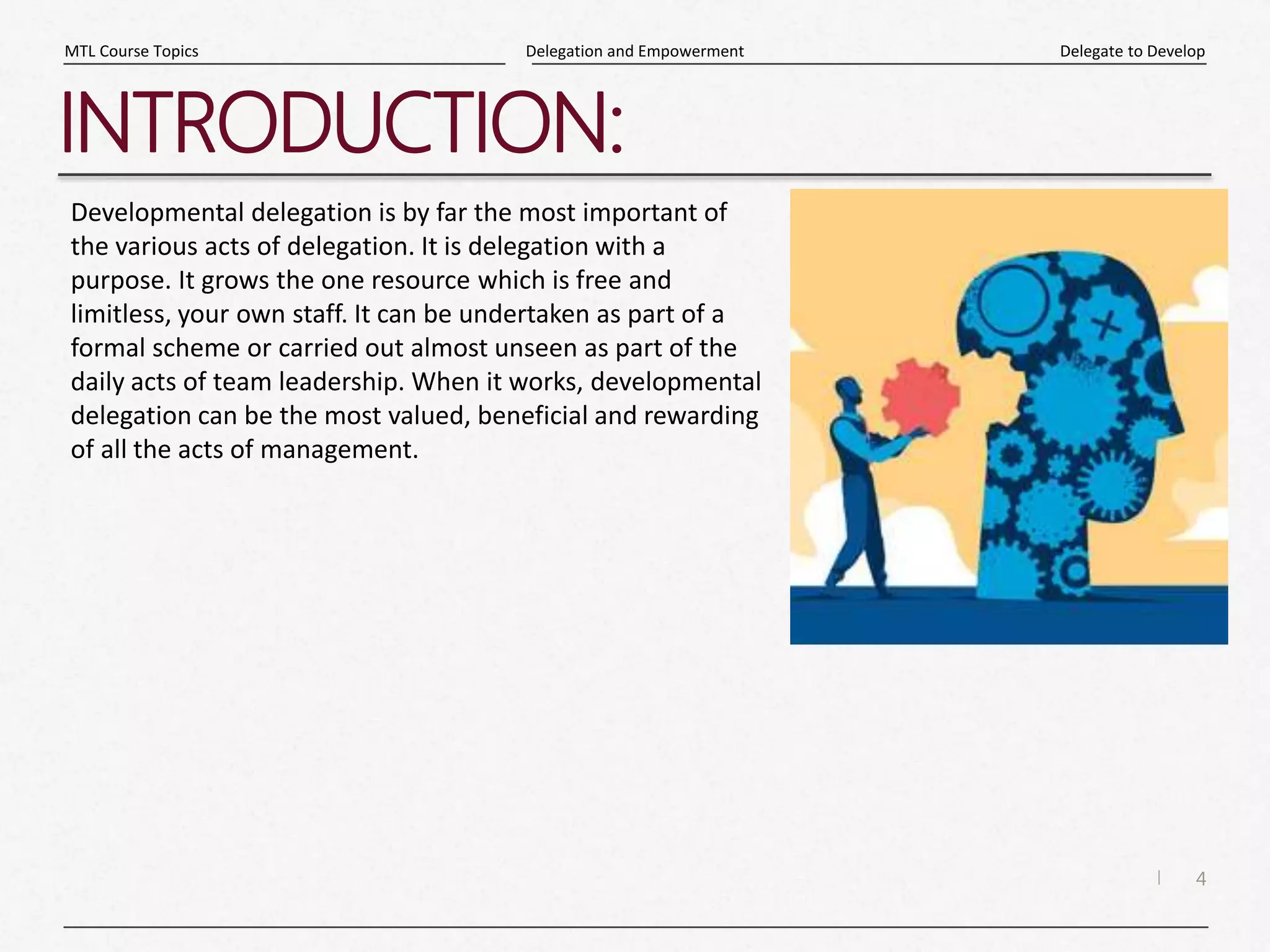
Developmental delegation is by far the most important of
the various acts of delegation. It is delegation with a
purpose. It grows the one resource which is free and
limitless, your own staff. It can be undertaken as part of a
formal scheme or carried out almost unseen as part of the
daily acts of team leadership. When it works, developmental
delegation can be the most valued, beneficial and rewarding
of all the acts of management.
5
|
Delegate to Develop
Delegation and Empowerment
MTL Course Topics
MANAGING BY CONTROL
Writer Ken Blanchard says that the occasional clear-outs
that take place in control organisations are like a scene out
of a James Bond film: "All of a sudden, a scream...and
someone goes down the chute."
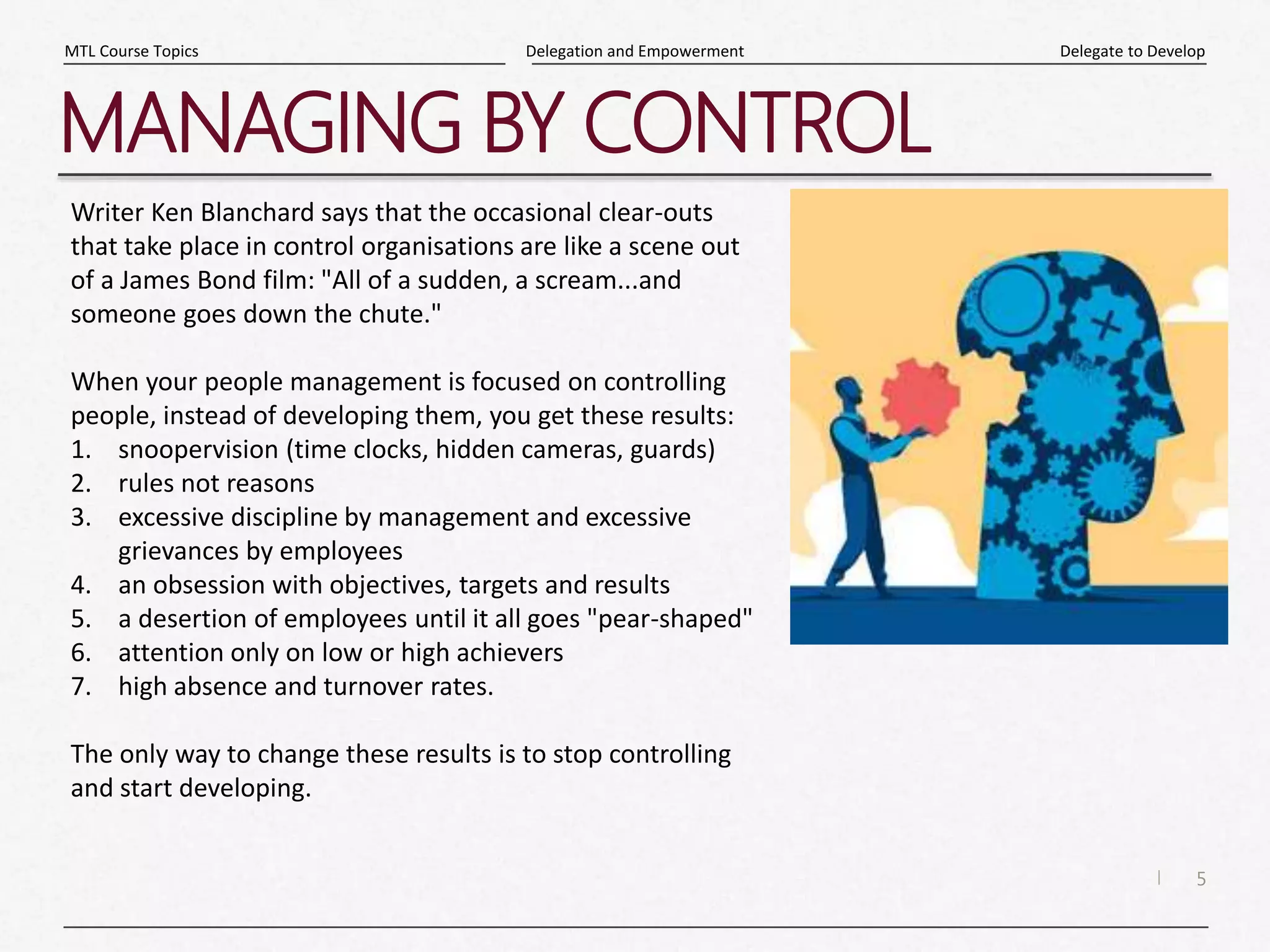
When your people management is focused on controlling
people, instead of developing them, you get these results:
1. snoopervision (time clocks, hidden cameras, guards)
2. rules not reasons
3. excessive discipline by management and excessive
grievances by employees
4. an obsession with objectives, targets and results
5. a desertion of employees until it all goes "pear-shaped"
6. attention only on low or high achievers
7. high absence and turnover rates.
The only way to change these results is to stop controlling
and start developing.
6
|
Delegate to Develop
Delegation and Empowerment
MTL Course Topics
DELEGATING TO DEVELOP
There are seven essential steps in Developmental
Delegation. These are...
1. have a belief in everyone's ability to grow and develop.
Then kindle their inner fire.
2. get to know your own staff so that you know their
strengths and weaknesses
3. find jobs that need to be done which match people's
developmental needs
4. agree a delegation plan which includes the authority
level of the delegatee; the results you expect; the
amount of training they need; and the level and
frequency of contact between you
5. deal with any fears they might have about doing the job
6. create a climate of trust
7. support them in whatever ways they need, both
practical and moral, both hands on and eyes on.
“Giving people self-confidence is by far the most important
thing I can do. Because then they will act.” (Jack Welch)
7
|
Delegate to Develop
Delegation and Empowerment
MTL Course Topics
KINDLING THE SPIRIT
The first step in making developmental delegation work is
the belief that everyone in the team is capable of change
and growth. We can show that belief in a number of ways:
1. by being genuinely interested in what others are doing
2. by having faith in their abilities to learn
3. by helping them discover their own potential.
4. With some people, the idea of development finds a
fertile soil; they will welcome the chance to do new
things. With others, it may take time, patience and
some persuasion.
"In everyone's life, at some time, our inner fire goes out. It is
then burst into flames by an encounter with another human
being. We should all be thankful for those people who re-
kindle the inner spirit." (Albert Schweitzer)
8
|
Delegate to Develop
Delegation and Empowerment
MTL Course Topics
READING THE TEAM
The second stage in developmental delegation is to know
your staff intimately. When you know their personalities,
their histories, their ambitions, their hopes, their fears, you
begin to know what they want to do with their work.
1. I know everyone in the team.
2. I know them well.
3. I know what each is good at and not so good at.
4. I know what each one likes to do.
5. I know what each one loves to do.
6. I know what each one would love to do more of.
Mike Brearley, one of England's most successful cricket
captains, had a passionate interest in getting to know his
team intimately. His star player, Ian Botham, said of him:
"There is something about the man. He reads me like a
book. He knows what I am thinking and gets the best out of
me."
9
|
Delegate to Develop
Delegation and Empowerment
MTL Course Topics
RABBIT GOES TO SCHOOL
We gain little by developing people's weaknesses; we gain
hugely by developing their strengths.
When Rabbit first went to school, he was delighted with
what the instructor told him. "Rabbit, you have fine legs.
You hop well, spring well and jump well. With some
guidance, you can be an excellent jumper." Rabbit loved
every minute of the Hopping class and excelled.
Then the Head Teacher said: "But Rabbit, you don't swim
well or climb trees at all well. You must stop the Jumping
class and concentrate on swimming and tree climbing.“
So, Rabbit left the Jumping class that he loved and went to
the Swimming class and Tree climbing class that he hated.
After a while, miserable and dispirited, he begged his
parents to take him out of school. "If only I'd been allowed
to stay in Jumping," he thought.
(Thanks to Donald Clifton and Paula Nelson)
10
|
Delegate to Develop
Delegation and Empowerment
MTL Course Topics
THAT'S NOT WORK
Commitment and passion are not confined to a few people
lucky enough to enjoy their work. They are qualities to be
found in everyone. When they seem to be missing in the
workplace, it's because we've not found a way to enthuse
people.
Joe found his work on the production line boring, repetitive
and soulless. His thoughts invariably strayed to his hi-fi
hobby. Each night and every weekend, he devoted hours of
painstaking care to building it up.
When his boss discovered Joe's talent, he said:
"But, Joe, all that effort must take a lot of work."
Joe replied:
"Work? That's not work. I love doing that."
11
|
Delegate to Develop
Delegation and Empowerment
MTL Course Topics
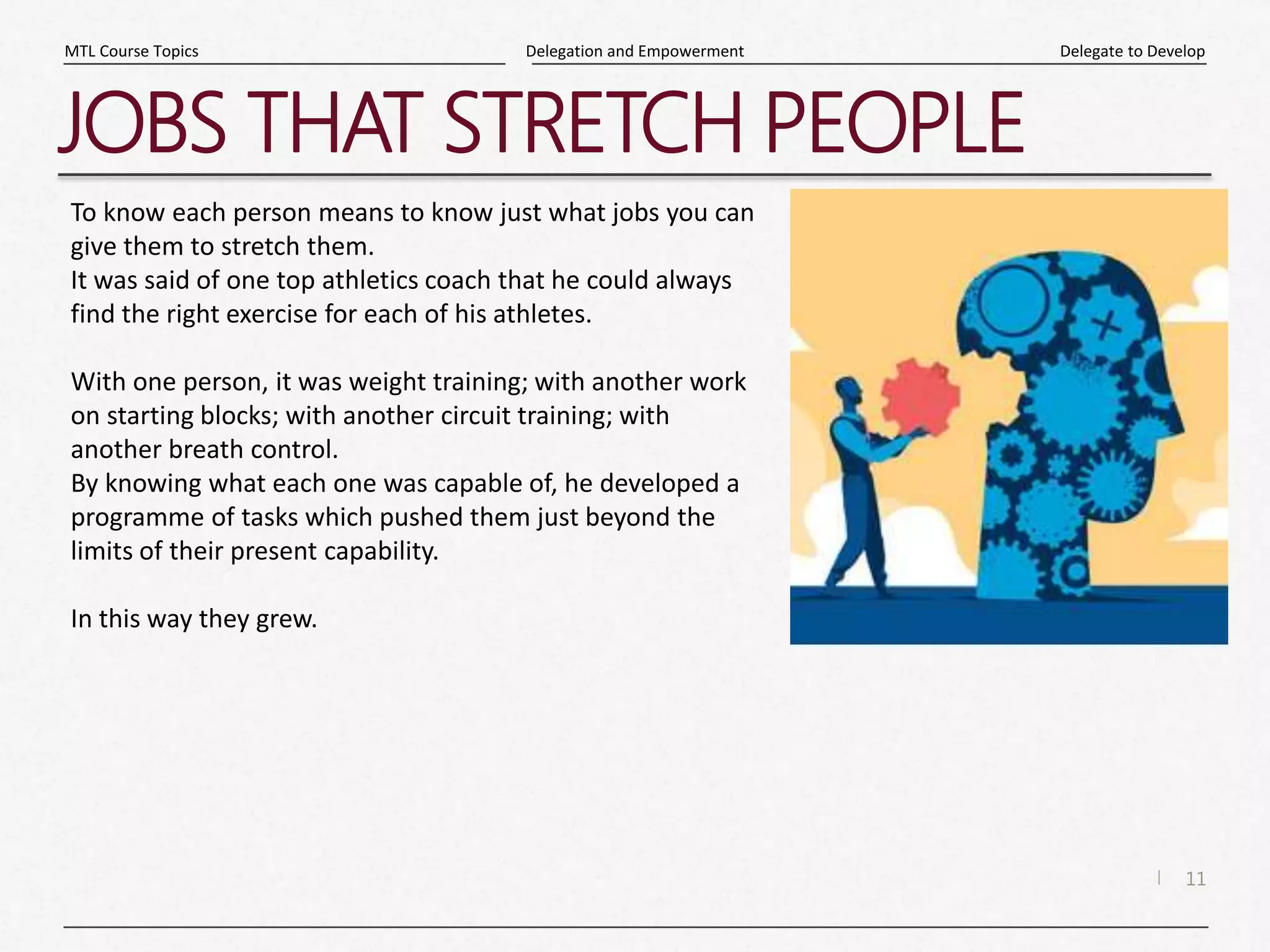
JOBS THAT STRETCH PEOPLE
To know each person means to know just what jobs you can
give them to stretch them.
It was said of one top athletics coach that he could always
find the right exercise for each of his athletes.
With one person, it was weight training; with another work
on starting blocks; with another circuit training; with
another breath control.
By knowing what each one was capable of, he developed a
programme of tasks which pushed them just beyond the
limits of their present capability.
In this way they grew.
12
|
Delegate to Develop
Delegation and Empowerment
MTL Course Topics
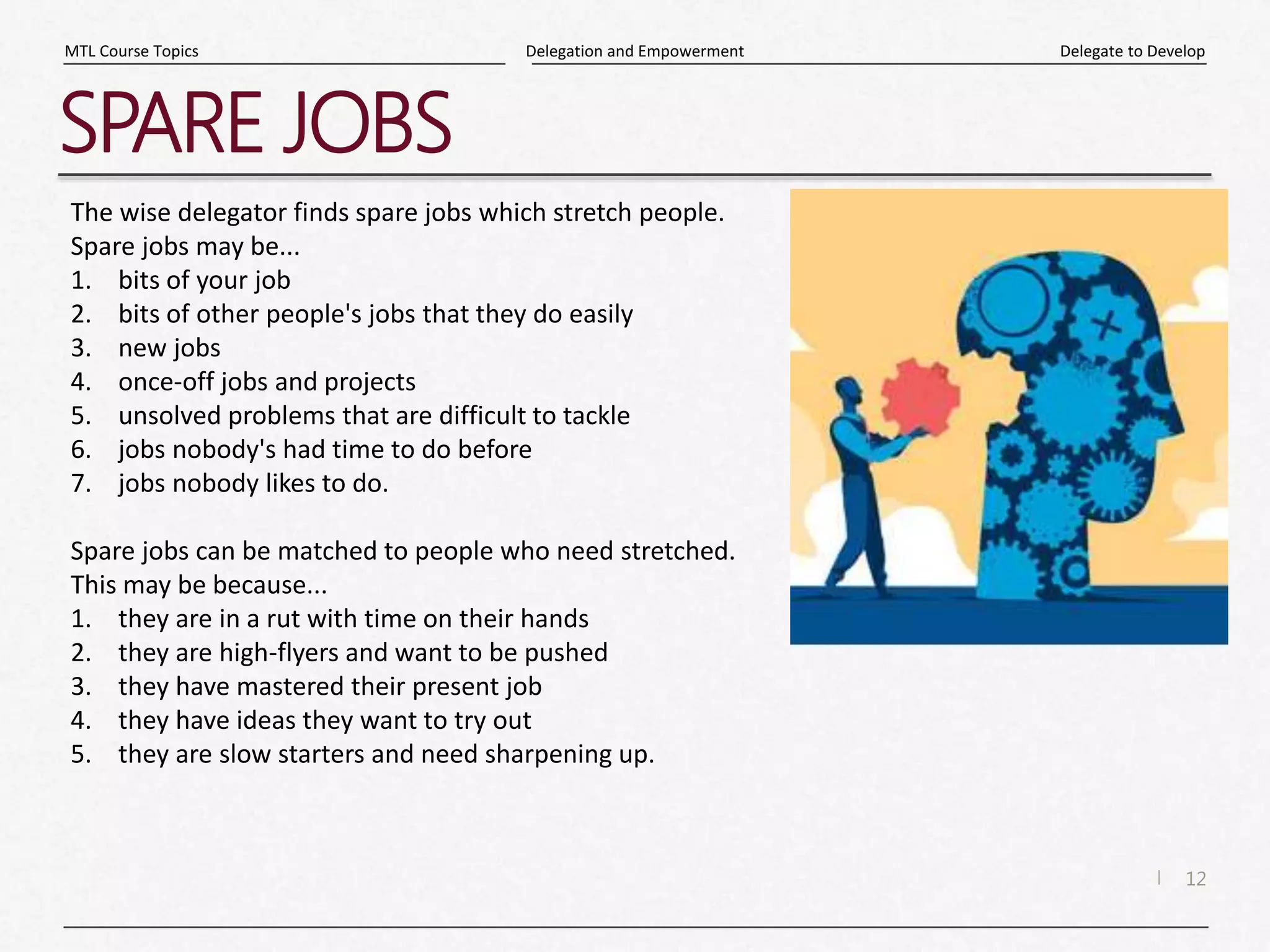
SPARE JOBS
The wise delegator finds spare jobs which stretch people.
Spare jobs may be...
1. bits of your job
2. bits of other people's jobs that they do easily
3. new jobs
4. once-off jobs and projects
5. unsolved problems that are difficult to tackle
6. jobs nobody's had time to do before
7. jobs nobody likes to do.
Spare jobs can be matched to people who need stretched.
This may be because...
1. they are in a rut with time on their hands
2. they are high-flyers and want to be pushed
3. they have mastered their present job
4. they have ideas they want to try out
5. they are slow starters and need sharpening up.
13
|
Delegate to Develop
Delegation and Empowerment
MTL Course Topics
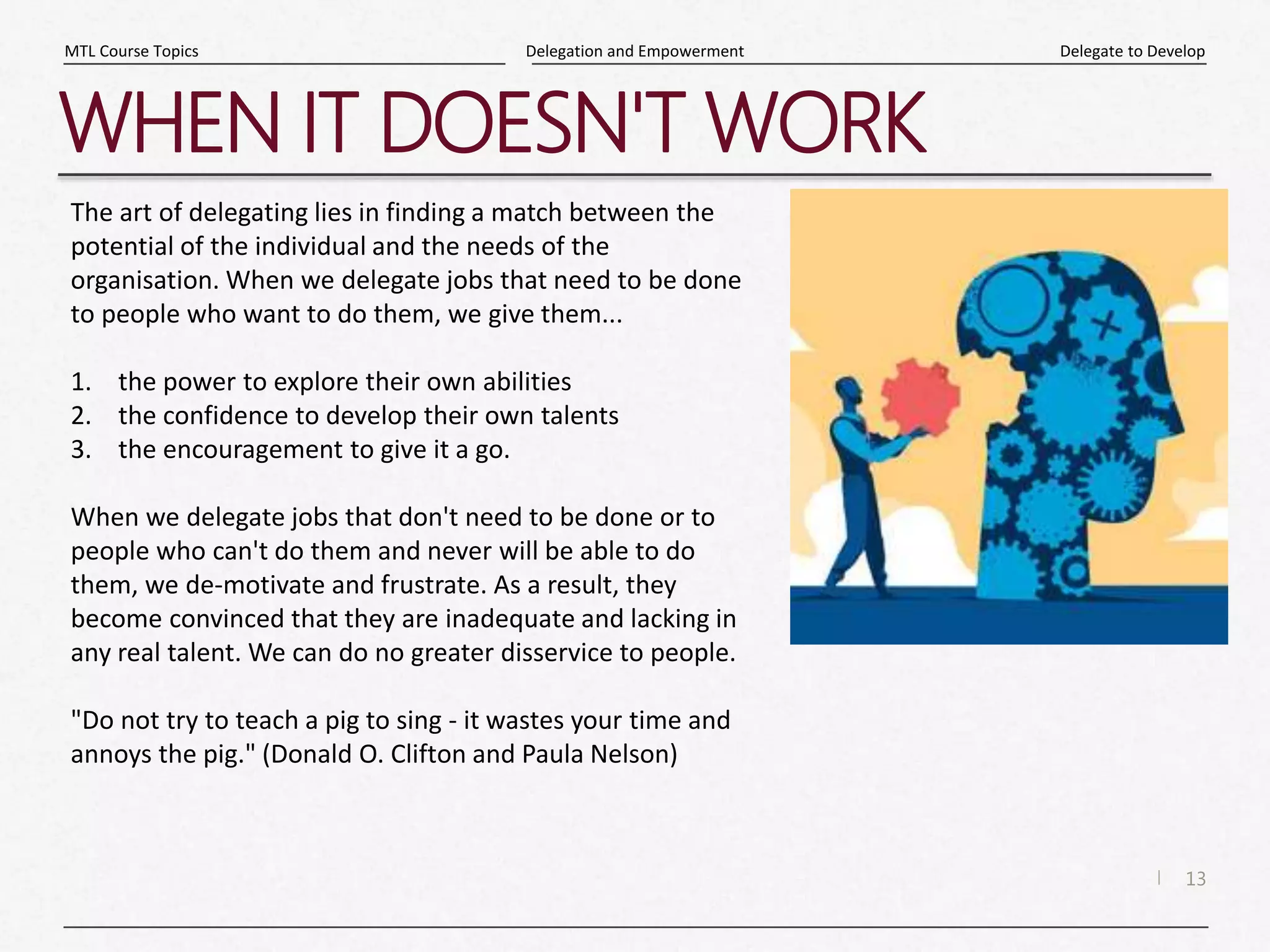
WHEN IT DOESN'T WORK
The art of delegating lies in finding a match between the
potential of the individual and the needs of the
organisation. When we delegate jobs that need to be done
to people who want to do them, we give them...
1. the power to explore their own abilities
2. the confidence to develop their own talents
3. the encouragement to give it a go.
When we delegate jobs that don't need to be done or to
people who can't do them and never will be able to do
them, we de-motivate and frustrate. As a result, they
become convinced that they are inadequate and lacking in
any real talent. We can do no greater disservice to people.
"Do not try to teach a pig to sing - it wastes your time and
annoys the pig." (Donald O. Clifton and Paula Nelson)
14
|
Delegate to Develop
Delegation and Empowerment
MTL Course Topics
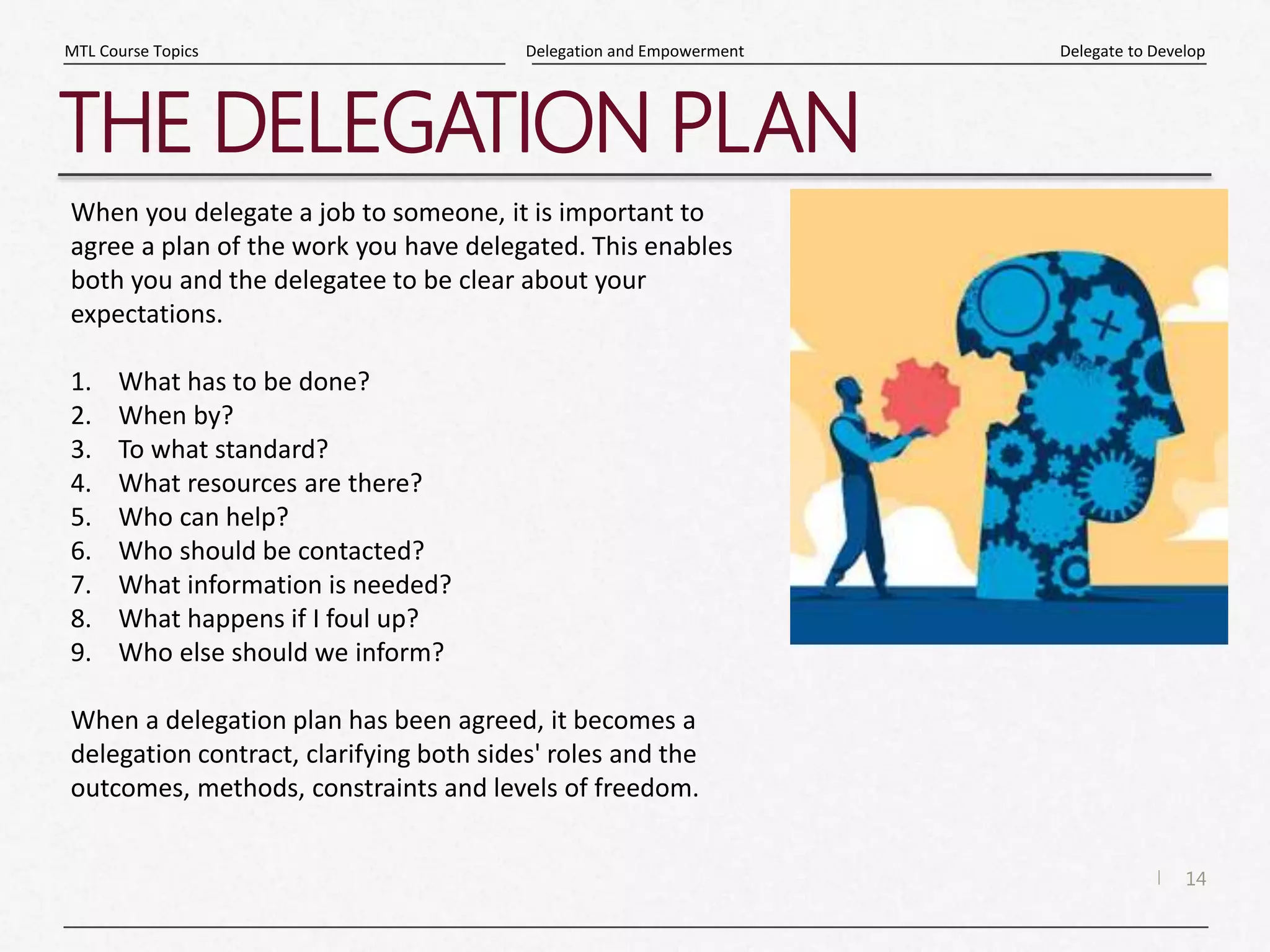
THE DELEGATION PLAN
When you delegate a job to someone, it is important to
agree a plan of the work you have delegated. This enables
both you and the delegatee to be clear about your
expectations.
1. What has to be done?
2. When by?
3. To what standard?
4. What resources are there?
5. Who can help?
6. Who should be contacted?
7. What information is needed?
8. What happens if I foul up?
9. Who else should we inform?
When a delegation plan has been agreed, it becomes a
delegation contract, clarifying both sides' roles and the
outcomes, methods, constraints and levels of freedom.
15
|
Delegate to Develop
Delegation and Empowerment
MTL Course Topics
OWNERSHIP AND CONTROL
In a developmental delegation contract a manager can
specify the level of control he or she retains and the level of
ownership or freedom that the delegatee is given.
There are five broad bands of control and freedom:
1. High manager control: "Look at the job and tell me what
needs done. Don't do anything unless I tell you."
2. Not so high manager control: "Do what needs to be
done, but if there are any problem areas, see me at once."
3. A balance of control and freedom: "Do what you want in
areas A and B; but don't do anything different in areas X and
Y without checking with me first."
4. Looser manager control: "Have a go at the job and if you
need any help, come and see me."
5. High employee freedom: "Do the job as you want as long
as you get the results. Experiment with new ideas. Try things
out. Let's meet when you've done it and review."
16
|
Delegate to Develop
Delegation and Empowerment
MTL Course Topics
CONCERNS
In developmental delegation, staff can have two kinds of
concerns: concerns about "what's in it for me?" and
concerns about whether they will succeed.
People sometimes resist doing developmental work because
they do not see the benefits for them. Their questions are
typical of traditional, old-style thinking.
Q: Why me and not one of the others?
Q: What if I say "No"?
Q: Will I be paid more?
Q: Will this guarantee promotion?
Q: Is it in my job description?
These concerns may mask a number of fears such as fear of
not having the skills or knowledge, fear of the consequences
of making a mistake, fear of not having the power and
authority to act, fear of no recognition from others.
17
|
Delegate to Develop
Delegation and Empowerment
MTL Course Topics
BUILDING TRUST
When you want others to do work that stretches them they
must have trust in you and you must have trust in them.
1. Don't trick people into accepting tasks by suggesting the
job is much easier than it really is.
2. Don't hint that you'll help them when you know you
can't.
3. Don't make promises in return for them doing the task.
4. Don't suggest rewards might come if they won't.
5. Don't use developmental delegation just to get a nasty
job done.
6. Don't flatter them into believing they can do a job which
they need help with.
The story is told of the manager who gave delegation a try.
He reluctantly agreed to pass down some of his routines to
his secretary, but every night after she'd gone home, went
into her drawer to check what she'd done.
18
|
Delegate to Develop
Delegation and Empowerment
MTL Course Topics
TRUST
In their book "Managing Cultural Differences", Philip Harris
and Robert Moran have described eight features of
managers who show trust...
1. Express your own doubts and fears openly.
2. Be supportive of subordinates who express doubts and
fears.
3. Demand honesty as one standard not to be
compromised.
4. Explain why you want things done.
5. Talk through your expectations of each other when
assigning work.
6. Encourage others to use you as a possible resource while
you develop their self-reliance.
7. When something goes wrong, find out what happened
not who did it.
8. Share credit for success (or, better still, give them all the
credit).
19
|
Delegate to Develop
Delegation and Empowerment
MTL Course Topics
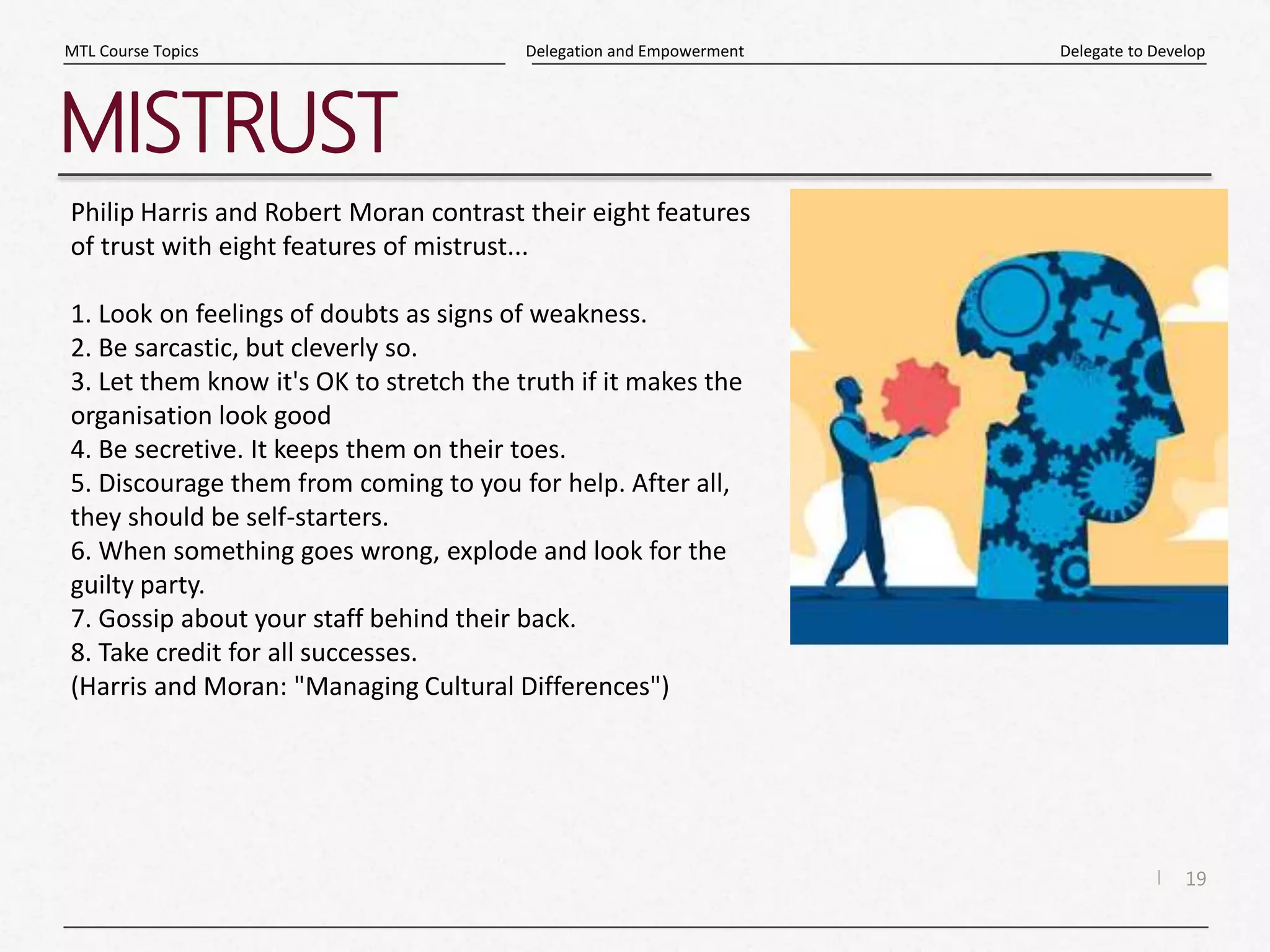
MISTRUST
Philip Harris and Robert Moran contrast their eight features
of trust with eight features of mistrust...
1. Look on feelings of doubts as signs of weakness.
2. Be sarcastic, but cleverly so.
3. Let them know it's OK to stretch the truth if it makes the
organisation look good
4. Be secretive. It keeps them on their toes.
5. Discourage them from coming to you for help. After all,
they should be self-starters.
6. When something goes wrong, explode and look for the
guilty party.
7. Gossip about your staff behind their back.
8. Take credit for all successes.
(Harris and Moran: "Managing Cultural Differences")
20
|
Delegate to Develop
Delegation and Empowerment
MTL Course Topics
A PARENT AT THE SWIMMING
POOL
Working out how near or far you need to be in a delegating
relationship is the true art of managing others. Too close
and you don't give people enough freedom to take risks and
learn; too far and they lose hope. One rule is to take your
hands off but keep your eyes on.
This relationship is similar to parents teaching their children
to swim. At the start, they stand right next to them with
their hands under their tummies. They never let go. Then
gradually as the children begin to gain in confidence and
skill, they move back. First they let one hand go.
Imperceptibly. Then the other hand. Then they take a step
back. Then another. And eventually they move out of reach
to the side of the pool. In the end they leave the children
alone and get out of the pool.
But all the time and even now, they never take their eyes off
them.
21
|
Delegate to Develop
Delegation and Empowerment
MTL Course Topics
THE INVISIBLE UMBILICAL CORD
In a developmental delegation relationship there is an
invisible umbilical cord between delegator and delegatee,
through which the manager feeds trust and support and
feedback until the day comes when he or she can cut the
cord and let them go on their own.
1. the link between delegator and delegatee is like that
between an astronaut on a spacewalk and the mother
ship.
2. the link between delegator and delegatee is like that of
lots of small spider plant offshoots growing from a
healthy mother plant.
3. the link between delegator and delegatee is like that of
a mother cat with her kittens: encouraging, feeding,
reproaching, gently pushing them away and standing
back.
22
|
Delegate to Develop
Delegation and Empowerment
MTL Course Topics
THAT’S
IT!
WELL DONE!
23
|
Delegate to Develop
Delegation and Empowerment
MTL Course Topics
THANK YOU
This has been a Slide Topic from Manage Train Learn

Delegate to Develop

  • 1.
    1 | Delegate to Develop Delegationand Empowerment MTL Course Topics Delegate to Develop DELEGATION AND EMPOWERMENT
  • 2.
    2 | Delegate to Develop Delegationand Empowerment MTL Course Topics The Course Topics series from Manage Train Learn is a large collection of topics that will help you as a learner to quickly and easily master a range of skills in your everyday working life and life outside work. If you are a trainer, they are perfect for adding to your classroom courses and online learning plans. COURSE TOPICS FROM MTL The written content in this Slide Topic belongs exclusively to Manage Train Learn and may only be reprinted either by attribution to Manage Train Learn or with the express written permission of Manage Train Learn. They are designed as a series of numbered slides. As with all programmes on Slide Topics, these slides are fully editable and can be used in your own programmes, royalty-free. Your only limitation is that you may not re-publish or sell these slides as your own. Copyright Manage Train Learn 2020 onwards. Attribution: All images are from sources which do not require attribution and may be used for commercial uses. Sources include pixabay, unsplash, and freepik. These images may also be those which are in the public domain, out of copyright, for fair use, or allowed under a Creative Commons license.
  • 3.
    3 | Delegate to Develop Delegationand Empowerment MTL Course Topics ARE YOU READY? OK, LET’S START!
  • 4.
    4 | Delegate to Develop Delegationand Empowerment MTL Course Topics INTRODUCTION: Developmental delegation is by far the most important of the various acts of delegation. It is delegation with a purpose. It grows the one resource which is free and limitless, your own staff. It can be undertaken as part of a formal scheme or carried out almost unseen as part of the daily acts of team leadership. When it works, developmental delegation can be the most valued, beneficial and rewarding of all the acts of management.
  • 5.
    5 | Delegate to Develop Delegationand Empowerment MTL Course Topics MANAGING BY CONTROL Writer Ken Blanchard says that the occasional clear-outs that take place in control organisations are like a scene out of a James Bond film: "All of a sudden, a scream...and someone goes down the chute." When your people management is focused on controlling people, instead of developing them, you get these results: 1. snoopervision (time clocks, hidden cameras, guards) 2. rules not reasons 3. excessive discipline by management and excessive grievances by employees 4. an obsession with objectives, targets and results 5. a desertion of employees until it all goes "pear-shaped" 6. attention only on low or high achievers 7. high absence and turnover rates. The only way to change these results is to stop controlling and start developing.
  • 6.
    6 | Delegate to Develop Delegationand Empowerment MTL Course Topics DELEGATING TO DEVELOP There are seven essential steps in Developmental Delegation. These are... 1. have a belief in everyone's ability to grow and develop. Then kindle their inner fire. 2. get to know your own staff so that you know their strengths and weaknesses 3. find jobs that need to be done which match people's developmental needs 4. agree a delegation plan which includes the authority level of the delegatee; the results you expect; the amount of training they need; and the level and frequency of contact between you 5. deal with any fears they might have about doing the job 6. create a climate of trust 7. support them in whatever ways they need, both practical and moral, both hands on and eyes on. “Giving people self-confidence is by far the most important thing I can do. Because then they will act.” (Jack Welch)
  • 7.
    7 | Delegate to Develop Delegationand Empowerment MTL Course Topics KINDLING THE SPIRIT The first step in making developmental delegation work is the belief that everyone in the team is capable of change and growth. We can show that belief in a number of ways: 1. by being genuinely interested in what others are doing 2. by having faith in their abilities to learn 3. by helping them discover their own potential. 4. With some people, the idea of development finds a fertile soil; they will welcome the chance to do new things. With others, it may take time, patience and some persuasion. "In everyone's life, at some time, our inner fire goes out. It is then burst into flames by an encounter with another human being. We should all be thankful for those people who re- kindle the inner spirit." (Albert Schweitzer)
  • 8.
    8 | Delegate to Develop Delegationand Empowerment MTL Course Topics READING THE TEAM The second stage in developmental delegation is to know your staff intimately. When you know their personalities, their histories, their ambitions, their hopes, their fears, you begin to know what they want to do with their work. 1. I know everyone in the team. 2. I know them well. 3. I know what each is good at and not so good at. 4. I know what each one likes to do. 5. I know what each one loves to do. 6. I know what each one would love to do more of. Mike Brearley, one of England's most successful cricket captains, had a passionate interest in getting to know his team intimately. His star player, Ian Botham, said of him: "There is something about the man. He reads me like a book. He knows what I am thinking and gets the best out of me."
  • 9.
    9 | Delegate to Develop Delegationand Empowerment MTL Course Topics RABBIT GOES TO SCHOOL We gain little by developing people's weaknesses; we gain hugely by developing their strengths. When Rabbit first went to school, he was delighted with what the instructor told him. "Rabbit, you have fine legs. You hop well, spring well and jump well. With some guidance, you can be an excellent jumper." Rabbit loved every minute of the Hopping class and excelled. Then the Head Teacher said: "But Rabbit, you don't swim well or climb trees at all well. You must stop the Jumping class and concentrate on swimming and tree climbing.“ So, Rabbit left the Jumping class that he loved and went to the Swimming class and Tree climbing class that he hated. After a while, miserable and dispirited, he begged his parents to take him out of school. "If only I'd been allowed to stay in Jumping," he thought. (Thanks to Donald Clifton and Paula Nelson)
  • 10.
    10 | Delegate to Develop Delegationand Empowerment MTL Course Topics THAT'S NOT WORK Commitment and passion are not confined to a few people lucky enough to enjoy their work. They are qualities to be found in everyone. When they seem to be missing in the workplace, it's because we've not found a way to enthuse people. Joe found his work on the production line boring, repetitive and soulless. His thoughts invariably strayed to his hi-fi hobby. Each night and every weekend, he devoted hours of painstaking care to building it up. When his boss discovered Joe's talent, he said: "But, Joe, all that effort must take a lot of work." Joe replied: "Work? That's not work. I love doing that."
  • 11.
    11 | Delegate to Develop Delegationand Empowerment MTL Course Topics JOBS THAT STRETCH PEOPLE To know each person means to know just what jobs you can give them to stretch them. It was said of one top athletics coach that he could always find the right exercise for each of his athletes. With one person, it was weight training; with another work on starting blocks; with another circuit training; with another breath control. By knowing what each one was capable of, he developed a programme of tasks which pushed them just beyond the limits of their present capability. In this way they grew.
  • 12.
    12 | Delegate to Develop Delegationand Empowerment MTL Course Topics SPARE JOBS The wise delegator finds spare jobs which stretch people. Spare jobs may be... 1. bits of your job 2. bits of other people's jobs that they do easily 3. new jobs 4. once-off jobs and projects 5. unsolved problems that are difficult to tackle 6. jobs nobody's had time to do before 7. jobs nobody likes to do. Spare jobs can be matched to people who need stretched. This may be because... 1. they are in a rut with time on their hands 2. they are high-flyers and want to be pushed 3. they have mastered their present job 4. they have ideas they want to try out 5. they are slow starters and need sharpening up.
  • 13.
    13 | Delegate to Develop Delegationand Empowerment MTL Course Topics WHEN IT DOESN'T WORK The art of delegating lies in finding a match between the potential of the individual and the needs of the organisation. When we delegate jobs that need to be done to people who want to do them, we give them... 1. the power to explore their own abilities 2. the confidence to develop their own talents 3. the encouragement to give it a go. When we delegate jobs that don't need to be done or to people who can't do them and never will be able to do them, we de-motivate and frustrate. As a result, they become convinced that they are inadequate and lacking in any real talent. We can do no greater disservice to people. "Do not try to teach a pig to sing - it wastes your time and annoys the pig." (Donald O. Clifton and Paula Nelson)
  • 14.
    14 | Delegate to Develop Delegationand Empowerment MTL Course Topics THE DELEGATION PLAN When you delegate a job to someone, it is important to agree a plan of the work you have delegated. This enables both you and the delegatee to be clear about your expectations. 1. What has to be done? 2. When by? 3. To what standard? 4. What resources are there? 5. Who can help? 6. Who should be contacted? 7. What information is needed? 8. What happens if I foul up? 9. Who else should we inform? When a delegation plan has been agreed, it becomes a delegation contract, clarifying both sides' roles and the outcomes, methods, constraints and levels of freedom.
  • 15.
    15 | Delegate to Develop Delegationand Empowerment MTL Course Topics OWNERSHIP AND CONTROL In a developmental delegation contract a manager can specify the level of control he or she retains and the level of ownership or freedom that the delegatee is given. There are five broad bands of control and freedom: 1. High manager control: "Look at the job and tell me what needs done. Don't do anything unless I tell you." 2. Not so high manager control: "Do what needs to be done, but if there are any problem areas, see me at once." 3. A balance of control and freedom: "Do what you want in areas A and B; but don't do anything different in areas X and Y without checking with me first." 4. Looser manager control: "Have a go at the job and if you need any help, come and see me." 5. High employee freedom: "Do the job as you want as long as you get the results. Experiment with new ideas. Try things out. Let's meet when you've done it and review."
  • 16.
    16 | Delegate to Develop Delegationand Empowerment MTL Course Topics CONCERNS In developmental delegation, staff can have two kinds of concerns: concerns about "what's in it for me?" and concerns about whether they will succeed. People sometimes resist doing developmental work because they do not see the benefits for them. Their questions are typical of traditional, old-style thinking. Q: Why me and not one of the others? Q: What if I say "No"? Q: Will I be paid more? Q: Will this guarantee promotion? Q: Is it in my job description? These concerns may mask a number of fears such as fear of not having the skills or knowledge, fear of the consequences of making a mistake, fear of not having the power and authority to act, fear of no recognition from others.
  • 17.
    17 | Delegate to Develop Delegationand Empowerment MTL Course Topics BUILDING TRUST When you want others to do work that stretches them they must have trust in you and you must have trust in them. 1. Don't trick people into accepting tasks by suggesting the job is much easier than it really is. 2. Don't hint that you'll help them when you know you can't. 3. Don't make promises in return for them doing the task. 4. Don't suggest rewards might come if they won't. 5. Don't use developmental delegation just to get a nasty job done. 6. Don't flatter them into believing they can do a job which they need help with. The story is told of the manager who gave delegation a try. He reluctantly agreed to pass down some of his routines to his secretary, but every night after she'd gone home, went into her drawer to check what she'd done.
  • 18.
    18 | Delegate to Develop Delegationand Empowerment MTL Course Topics TRUST In their book "Managing Cultural Differences", Philip Harris and Robert Moran have described eight features of managers who show trust... 1. Express your own doubts and fears openly. 2. Be supportive of subordinates who express doubts and fears. 3. Demand honesty as one standard not to be compromised. 4. Explain why you want things done. 5. Talk through your expectations of each other when assigning work. 6. Encourage others to use you as a possible resource while you develop their self-reliance. 7. When something goes wrong, find out what happened not who did it. 8. Share credit for success (or, better still, give them all the credit).
  • 19.
    19 | Delegate to Develop Delegationand Empowerment MTL Course Topics MISTRUST Philip Harris and Robert Moran contrast their eight features of trust with eight features of mistrust... 1. Look on feelings of doubts as signs of weakness. 2. Be sarcastic, but cleverly so. 3. Let them know it's OK to stretch the truth if it makes the organisation look good 4. Be secretive. It keeps them on their toes. 5. Discourage them from coming to you for help. After all, they should be self-starters. 6. When something goes wrong, explode and look for the guilty party. 7. Gossip about your staff behind their back. 8. Take credit for all successes. (Harris and Moran: "Managing Cultural Differences")
  • 20.
    20 | Delegate to Develop Delegationand Empowerment MTL Course Topics A PARENT AT THE SWIMMING POOL Working out how near or far you need to be in a delegating relationship is the true art of managing others. Too close and you don't give people enough freedom to take risks and learn; too far and they lose hope. One rule is to take your hands off but keep your eyes on. This relationship is similar to parents teaching their children to swim. At the start, they stand right next to them with their hands under their tummies. They never let go. Then gradually as the children begin to gain in confidence and skill, they move back. First they let one hand go. Imperceptibly. Then the other hand. Then they take a step back. Then another. And eventually they move out of reach to the side of the pool. In the end they leave the children alone and get out of the pool. But all the time and even now, they never take their eyes off them.
  • 21.
    21 | Delegate to Develop Delegationand Empowerment MTL Course Topics THE INVISIBLE UMBILICAL CORD In a developmental delegation relationship there is an invisible umbilical cord between delegator and delegatee, through which the manager feeds trust and support and feedback until the day comes when he or she can cut the cord and let them go on their own. 1. the link between delegator and delegatee is like that between an astronaut on a spacewalk and the mother ship. 2. the link between delegator and delegatee is like that of lots of small spider plant offshoots growing from a healthy mother plant. 3. the link between delegator and delegatee is like that of a mother cat with her kittens: encouraging, feeding, reproaching, gently pushing them away and standing back.
  • 22.
    22 | Delegate to Develop Delegationand Empowerment MTL Course Topics THAT’S IT! WELL DONE!
  • 23.
    23 | Delegate to Develop Delegationand Empowerment MTL Course Topics THANK YOU This has been a Slide Topic from Manage Train Learn