12 Service to the Fleet, September 2014
Confessions of a TQM refugee
How the Learning Organization
Concept Changed My Attitude
I
n the late 1990s I was in Air Force ROTC at
university learning the TQM (Total Quality
Management) system of management. At the end
of the semester, as we handed in our final exams, the
ROTC professor said, “Good job. Now forget it. The
Air Force is no longer doing TQM.”
A few years later as a new first lieutenant assigned
to a base in England, I was sent to seminars on
Stephen Covey’s Seven Habits of Highly Effective
People. It worked for about a month.
Next I was assigned to a base in Germany where
they were attempting to apply the Air Force’s new
version of the LEAN management concept, but
it mostly focused on adjusting processes instead
of addressing the human element and changing
behaviors so it didn’t gather much of a voluntary
following.
A few weeks ago I found myself, yet again, sitting
in a classroom staring down the business end of
a three‑day course on what they call “Learning
Organization 101.” My first thought? “Here we go
again.” But I soon learned this wasn’t just another
process fixer.
The other programs I had studied (voluntold to
study) were based on fixing processes that weren’t
necessarily broken. There was no personal buy-in
in the organizations to which they were applied. In
fact, often times the new programs would only last
as long as the current commander who would then be
replaced by another commander with his own version
of process improvement. These were programs
applied from the top down to improve processes, not
people. There are many valuable lessons and habits to
learn and use in the other programs, but none of the
other programs addresses the human element quite
like LO 101.
Norfolk Naval Shipyard (NNSY) has a real human
issue to tackle: how do we deal with the experience
gap that is hanging over the shipyard at the moment?
NNSY officials are now predicting that with the
number of personnel retiring by the end of 2015, more
than 50 percent of the workers at NNSY will have
less than five years of experience. It seems that now,
more than ever, open communication and mentoring
are needed in order to ensure decades of knowledge
don’t disappear from the shipyard over the next few
years. How do we address this very people-specific
issue? The Learning Organization concept is one of
the ways NNSY is addressing this challenge.
In three days of class, I learned that LO attempts
to address the people piece of problems. It takes the
process thinking out of problem solving and addresses
the human piece of the puzzle—the actual why
instead of the perceived why. Process improvement is
important, but if you don’t understand the people part
of it, attempts at process improvement become futile.
This was the piece I missed while learning the other
programs. It may have been there somewhere in the
teaching, but I didn’t see it. LO 101 broke it down for
me. Once you understand how to involve everyone in
problem solving and you achieve buy-in at all levels,
then you can apply the principles taught in LEAN and
Covey and TQM.
I believe the other process improvement programs
didn’t survive in the organizations I worked because
they didn’t have personal buy-in by those on the line.
Only the senior leaders had skin in the game and so
those of us several rungs down the ladder could not
see what the new way of thinking would do for us.
In the Learning Organization concept, everyone
has input. One way this happens is when an issue
or problem comes up that cannot be resolved and a
By Chris Watt, Code 1160 Public Affairs Specialist
Service to the Fleet, September 2014 13
learning cell is requested. This learning cell is made
up of employees from all levels and shops involved
in the problem. Experienced team members with
their sage wisdom through new hires with their new
ideas are all put around the same table to discuss the
issues as they affect the work. Senior leaders may
sponsor a learning cell but they are not present for the
discussions, eliminating the boss-is-listening issue.
Problems are taken apart and examined from all
angles. Patterns and common threads often become
apparent once the pieces of problems are displayed on
the board. Process is removed from the conversation
and the discussion turns to the human elements
of problems (e.g., Is there an unpredicted human
limitation that resulted in a process to bog down at
a certain point? Is it tough to do a task in a coat but
it’s too cold in the building to go without? Did a
change in a process cause a chain reaction of
unintended consequences that has affected
communication channels between
workers? Are carrier workers having
the same issues that submarine
workers are having with a
certain task?, etc.).
Solutions—however
obvious or far-fetched—
are presented and placed
on the board. From all the
sticky notes on the board comes
ideas for actions—some simple,
some complicated, some obvious
and others brilliant. These actions are
gathered together and presented in an
outbrief to the sponsor of the learning cell.
Here’s the greatest part of LO: the answers
and actions are our ideas. Our suggestions. Our
recommendations based on our own knowledge and
experience. We own the solutions. The sponsors
(senior leaders) may or may not approve all of the
actions we bring back to them, but the ones they do
approve we are more likely to implement because we
now have buy-in. We have skin in the game. We want
to see our solutions succeed.
As a student of process management programs, I
believe this is the main reason LO has taken hold at
NNSY. According to Code 1142 records, more than
6,000 of the approximately 9,500 current members
of NNSY have taken the LO 101 class. This means
more than half of those you meet on the shipyard
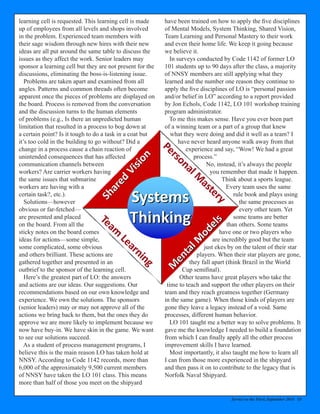
have been trained on how to apply the five disciplines
of Mental Models, System Thinking, Shared Vision,
Team Learning and Personal Mastery to their work
and even their home life. We keep it going because
we believe it.
In surveys conducted by Code 1142 of former LO
101 students up to 90 days after the class, a majority
of NNSY members are still applying what they
learned and the number one reason they continue to
apply the five disciplines of LO is “personal passion
and/or belief in LO” according to a report provided
by Jon Echols, Code 1142, LO 101 workshop training
program administrator.
To me this makes sense. Have you ever been part
of a winning team or a part of a group that knew
what they were doing and did it well as a team? I
have never heard anyone walk away from that
experience and say, “Wow! We had a great
process.”
No, instead, it’s always the people
you remember that made it happen.
Think about a sports league.
Every team uses the same
rule book and plays using
the same processes as
every other team. Yet
some teams are better
than others. Some teams
have one or two players who
are incredibly good but the team
just ekes by on the talent of their star
players. When their star players are gone,
they fall apart (think Brazil in the World
Cup semifinal).
Other teams have great players who take the
time to teach and support the other players on their
team and they reach greatness together (Germany
in the same game). When those kinds of players are
gone they leave a legacy instead of a void. Same
processes, different human behavior.
LO 101 taught me a better way to solve problems. It
gave me the knowledge I needed to build a foundation
from which I can finally apply all the other process
improvement skills I have learned.
Most importantly, it also taught me how to learn all
I can from those more experienced in the shipyard
and then pass it on to contribute to the legacy that is
Norfolk Naval Shipyard.

I024 - Writing - Commentary - Confessions of a TQM Refugee - Watt

  • 1.
    12 Service tothe Fleet, September 2014 Confessions of a TQM refugee How the Learning Organization Concept Changed My Attitude I n the late 1990s I was in Air Force ROTC at university learning the TQM (Total Quality Management) system of management. At the end of the semester, as we handed in our final exams, the ROTC professor said, “Good job. Now forget it. The Air Force is no longer doing TQM.” A few years later as a new first lieutenant assigned to a base in England, I was sent to seminars on Stephen Covey’s Seven Habits of Highly Effective People. It worked for about a month. Next I was assigned to a base in Germany where they were attempting to apply the Air Force’s new version of the LEAN management concept, but it mostly focused on adjusting processes instead of addressing the human element and changing behaviors so it didn’t gather much of a voluntary following. A few weeks ago I found myself, yet again, sitting in a classroom staring down the business end of a three‑day course on what they call “Learning Organization 101.” My first thought? “Here we go again.” But I soon learned this wasn’t just another process fixer. The other programs I had studied (voluntold to study) were based on fixing processes that weren’t necessarily broken. There was no personal buy-in in the organizations to which they were applied. In fact, often times the new programs would only last as long as the current commander who would then be replaced by another commander with his own version of process improvement. These were programs applied from the top down to improve processes, not people. There are many valuable lessons and habits to learn and use in the other programs, but none of the other programs addresses the human element quite like LO 101. Norfolk Naval Shipyard (NNSY) has a real human issue to tackle: how do we deal with the experience gap that is hanging over the shipyard at the moment? NNSY officials are now predicting that with the number of personnel retiring by the end of 2015, more than 50 percent of the workers at NNSY will have less than five years of experience. It seems that now, more than ever, open communication and mentoring are needed in order to ensure decades of knowledge don’t disappear from the shipyard over the next few years. How do we address this very people-specific issue? The Learning Organization concept is one of the ways NNSY is addressing this challenge. In three days of class, I learned that LO attempts to address the people piece of problems. It takes the process thinking out of problem solving and addresses the human piece of the puzzle—the actual why instead of the perceived why. Process improvement is important, but if you don’t understand the people part of it, attempts at process improvement become futile. This was the piece I missed while learning the other programs. It may have been there somewhere in the teaching, but I didn’t see it. LO 101 broke it down for me. Once you understand how to involve everyone in problem solving and you achieve buy-in at all levels, then you can apply the principles taught in LEAN and Covey and TQM. I believe the other process improvement programs didn’t survive in the organizations I worked because they didn’t have personal buy-in by those on the line. Only the senior leaders had skin in the game and so those of us several rungs down the ladder could not see what the new way of thinking would do for us. In the Learning Organization concept, everyone has input. One way this happens is when an issue or problem comes up that cannot be resolved and a By Chris Watt, Code 1160 Public Affairs Specialist
  • 2.
    Service to theFleet, September 2014 13 learning cell is requested. This learning cell is made up of employees from all levels and shops involved in the problem. Experienced team members with their sage wisdom through new hires with their new ideas are all put around the same table to discuss the issues as they affect the work. Senior leaders may sponsor a learning cell but they are not present for the discussions, eliminating the boss-is-listening issue. Problems are taken apart and examined from all angles. Patterns and common threads often become apparent once the pieces of problems are displayed on the board. Process is removed from the conversation and the discussion turns to the human elements of problems (e.g., Is there an unpredicted human limitation that resulted in a process to bog down at a certain point? Is it tough to do a task in a coat but it’s too cold in the building to go without? Did a change in a process cause a chain reaction of unintended consequences that has affected communication channels between workers? Are carrier workers having the same issues that submarine workers are having with a certain task?, etc.). Solutions—however obvious or far-fetched— are presented and placed on the board. From all the sticky notes on the board comes ideas for actions—some simple, some complicated, some obvious and others brilliant. These actions are gathered together and presented in an outbrief to the sponsor of the learning cell. Here’s the greatest part of LO: the answers and actions are our ideas. Our suggestions. Our recommendations based on our own knowledge and experience. We own the solutions. The sponsors (senior leaders) may or may not approve all of the actions we bring back to them, but the ones they do approve we are more likely to implement because we now have buy-in. We have skin in the game. We want to see our solutions succeed. As a student of process management programs, I believe this is the main reason LO has taken hold at NNSY. According to Code 1142 records, more than 6,000 of the approximately 9,500 current members of NNSY have taken the LO 101 class. This means more than half of those you meet on the shipyard have been trained on how to apply the five disciplines of Mental Models, System Thinking, Shared Vision, Team Learning and Personal Mastery to their work and even their home life. We keep it going because we believe it. In surveys conducted by Code 1142 of former LO 101 students up to 90 days after the class, a majority of NNSY members are still applying what they learned and the number one reason they continue to apply the five disciplines of LO is “personal passion and/or belief in LO” according to a report provided by Jon Echols, Code 1142, LO 101 workshop training program administrator. To me this makes sense. Have you ever been part of a winning team or a part of a group that knew what they were doing and did it well as a team? I have never heard anyone walk away from that experience and say, “Wow! We had a great process.” No, instead, it’s always the people you remember that made it happen. Think about a sports league. Every team uses the same rule book and plays using the same processes as every other team. Yet some teams are better than others. Some teams have one or two players who are incredibly good but the team just ekes by on the talent of their star players. When their star players are gone, they fall apart (think Brazil in the World Cup semifinal). Other teams have great players who take the time to teach and support the other players on their team and they reach greatness together (Germany in the same game). When those kinds of players are gone they leave a legacy instead of a void. Same processes, different human behavior. LO 101 taught me a better way to solve problems. It gave me the knowledge I needed to build a foundation from which I can finally apply all the other process improvement skills I have learned. Most importantly, it also taught me how to learn all I can from those more experienced in the shipyard and then pass it on to contribute to the legacy that is Norfolk Naval Shipyard.