
1
|
Group Formation
Facilitation Skills
MTL Course Topics
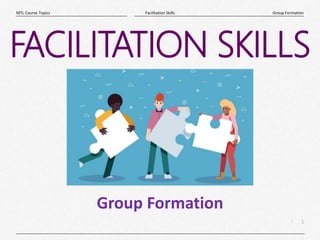
FACILITATION SKILLS
Group Formation
2
|
Group Formation
Facilitation Skills
MTL Course Topics
The Course Topics series from Manage Train Learn is a large collection of topics that will help you as a learner
to quickly and easily master a range of skills in your everyday working life and life outside work. If you are a
trainer, they are perfect for adding to your classroom courses and online learning plans.
COURSE TOPICS FROM MTL
The written content in this Slide Topic belongs exclusively to Manage Train Learn and may only be reprinted
either by attribution to Manage Train Learn or with the express written permission of Manage Train Learn.
They are designed as a series of numbered
slides. As with all programmes on Slide
Topics, these slides are fully editable and
can be used in your own programmes,
royalty-free. Your only limitation is that
you may not re-publish or sell these slides
as your own.
Copyright Manage Train Learn 2020
onwards.
Attribution: All images are from sources
which do not require attribution and may
be used for commercial uses. Sources
include pixabay, unsplash, and freepik.
These images may also be those which are
in the public domain, out of copyright, for
fair use, or allowed under a Creative
Commons license.
3
|
Group Formation
Facilitation Skills
MTL Course Topics
ARE YOU READY?
OK, LET’S START!
4
|
Group Formation
Facilitation Skills
MTL Course Topics
INTRODUCTION
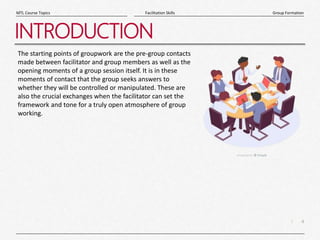
The starting points of groupwork are the pre-group contacts
made between facilitator and group members as well as the
opening moments of a group session itself. It is in these
moments of contact that the group seeks answers to
whether they will be controlled or manipulated. These are
also the crucial exchanges when the facilitator can set the
framework and tone for a truly open atmosphere of group
working.
5
|
Group Formation
Facilitation Skills
MTL Course Topics
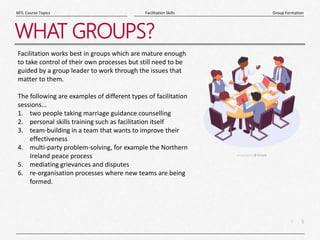
WHAT GROUPS?
Facilitation works best in groups which are mature enough
to take control of their own processes but still need to be
guided by a group leader to work through the issues that
matter to them.
The following are examples of different types of facilitation
sessions...
1. two people taking marriage guidance counselling
2. personal skills training such as facilitation itself
3. team-building in a team that wants to improve their
effectiveness
4. multi-party problem-solving, for example the Northern
Ireland peace process
5. mediating grievances and disputes
6. re-organisation processes where new teams are being
formed.
6
|
Group Formation
Facilitation Skills
MTL Course Topics
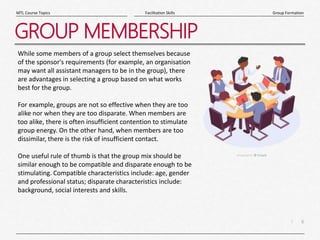
GROUP MEMBERSHIP
While some members of a group select themselves because
of the sponsor's requirements (for example, an organisation
may want all assistant managers to be in the group), there
are advantages in selecting a group based on what works
best for the group.
For example, groups are not so effective when they are too
alike nor when they are too disparate. When members are
too alike, there is often insufficient contention to stimulate
group energy. On the other hand, when members are too
dissimilar, there is the risk of insufficient contact.
One useful rule of thumb is that the group mix should be
similar enough to be compatible and disparate enough to be
stimulating. Compatible characteristics include: age, gender
and professional status; disparate characteristics include:
background, social interests and skills.
7
|
Group Formation
Facilitation Skills
MTL Course Topics
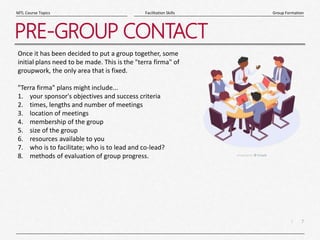
PRE-GROUP CONTACT
Once it has been decided to put a group together, some
initial plans need to be made. This is the "terra firma" of
groupwork, the only area that is fixed.
"Terra firma" plans might include...
1. your sponsor's objectives and success criteria
2. times, lengths and number of meetings
3. location of meetings
4. membership of the group
5. size of the group
6. resources available to you
7. who is to facilitate; who is to lead and co-lead?
8. methods of evaluation of group progress.
8
|
Group Formation
Facilitation Skills
MTL Course Topics
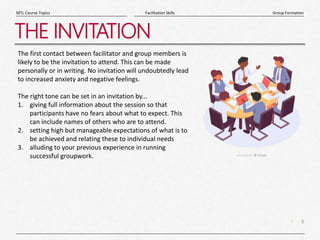
THE INVITATION
The first contact between facilitator and group members is
likely to be the invitation to attend. This can be made
personally or in writing. No invitation will undoubtedly lead
to increased anxiety and negative feelings.
The right tone can be set in an invitation by...
1. giving full information about the session so that
participants have no fears about what to expect. This
can include names of others who are to attend.
2. setting high but manageable expectations of what is to
be achieved and relating these to individual needs
3. alluding to your previous experience in running
successful groupwork.
9
|
Group Formation
Facilitation Skills
MTL Course Topics
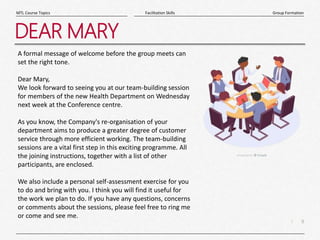
DEAR MARY
A formal message of welcome before the group meets can
set the right tone.
Dear Mary,
We look forward to seeing you at our team-building session
for members of the new Health Department on Wednesday
next week at the Conference centre.
As you know, the Company's re-organisation of your
department aims to produce a greater degree of customer
service through more efficient working. The team-building
sessions are a vital first step in this exciting programme. All
the joining instructions, together with a list of other
participants, are enclosed.
We also include a personal self-assessment exercise for you
to do and bring with you. I think you will find it useful for
the work we plan to do. If you have any questions, concerns
or comments about the sessions, please feel free to ring me
or come and see me.
10
|
Group Formation
Facilitation Skills
MTL Course Topics
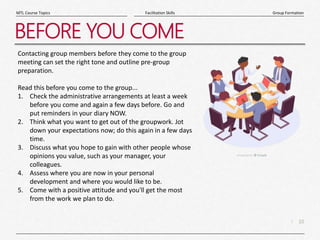
BEFORE YOU COME
Contacting group members before they come to the group
meeting can set the right tone and outline pre-group
preparation.
Read this before you come to the group...
1. Check the administrative arrangements at least a week
before you come and again a few days before. Go and
put reminders in your diary NOW.
2. Think what you want to get out of the groupwork. Jot
down your expectations now; do this again in a few days
time.
3. Discuss what you hope to gain with other people whose
opinions you value, such as your manager, your
colleagues.
4. Assess where you are now in your personal
development and where you would like to be.
5. Come with a positive attitude and you'll get the most
from the work we plan to do.
11
|
Group Formation
Facilitation Skills
MTL Course Topics
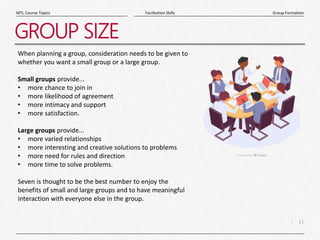
GROUP SIZE
When planning a group, consideration needs to be given to
whether you want a small group or a large group.
Small groups provide...
• more chance to join in
• more likelihood of agreement
• more intimacy and support
• more satisfaction.
Large groups provide...
• more varied relationships
• more interesting and creative solutions to problems
• more need for rules and direction
• more time to solve problems.
Seven is thought to be the best number to enjoy the
benefits of small and large groups and to have meaningful
interaction with everyone else in the group.
12
|
Group Formation
Facilitation Skills
MTL Course Topics
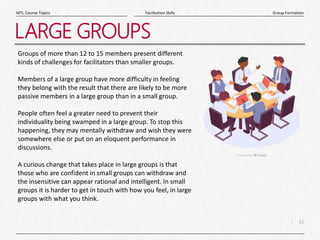
LARGE GROUPS
Groups of more than 12 to 15 members present different
kinds of challenges for facilitators than smaller groups.
Members of a large group have more difficulty in feeling
they belong with the result that there are likely to be more
passive members in a large group than in a small group.
People often feel a greater need to prevent their
individuality being swamped in a large group. To stop this
happening, they may mentally withdraw and wish they were
somewhere else or put on an eloquent performance in
discussions.
A curious change that takes place in large groups is that
those who are confident in small groups can withdraw and
the insensitive can appear rational and intelligent. In small
groups it is harder to get in touch with how you feel, in large
groups with what you think.
13
|
Group Formation
Facilitation Skills
MTL Course Topics
CLOSED GROUPWORK
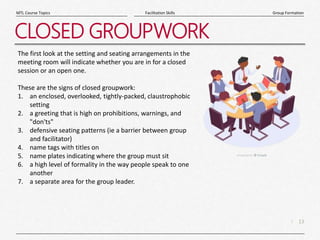
The first look at the setting and seating arrangements in the
meeting room will indicate whether you are in for a closed
session or an open one.
These are the signs of closed groupwork:
1. an enclosed, overlooked, tightly-packed, claustrophobic
setting
2. a greeting that is high on prohibitions, warnings, and
"don'ts"
3. defensive seating patterns (ie a barrier between group
and facilitator)
4. name tags with titles on
5. name plates indicating where the group must sit
6. a high level of formality in the way people speak to one
another
7. a separate area for the group leader.
14
|
Group Formation
Facilitation Skills
MTL Course Topics
OPEN GROUPWORK
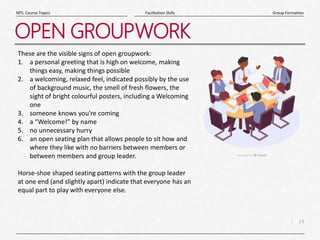
These are the visible signs of open groupwork:
1. a personal greeting that is high on welcome, making
things easy, making things possible
2. a welcoming, relaxed feel, indicated possibly by the use
of background music, the smell of fresh flowers, the
sight of bright colourful posters, including a Welcoming
one
3. someone knows you're coming
4. a “Welcome!” by name
5. no unnecessary hurry
6. an open seating plan that allows people to sit how and
where they like with no barriers between members or
between members and group leader.
Horse-shoe shaped seating patterns with the group leader
at one end (and slightly apart) indicate that everyone has an
equal part to play with everyone else.
15
|
Group Formation
Facilitation Skills
MTL Course Topics
WELCOMES
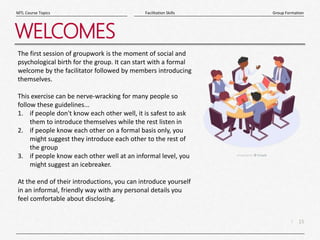
The first session of groupwork is the moment of social and
psychological birth for the group. It can start with a formal
welcome by the facilitator followed by members introducing
themselves.
This exercise can be nerve-wracking for many people so
follow these guidelines...
1. if people don't know each other well, it is safest to ask
them to introduce themselves while the rest listen in
2. if people know each other on a formal basis only, you
might suggest they introduce each other to the rest of
the group
3. if people know each other well at an informal level, you
might suggest an icebreaker.
At the end of their introductions, you can introduce yourself
in an informal, friendly way with any personal details you
feel comfortable about disclosing.
16
|
Group Formation
Facilitation Skills
MTL Course Topics
INTRODUCTIONS
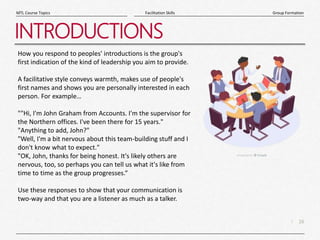
How you respond to peoples' introductions is the group's
first indication of the kind of leadership you aim to provide.
A facilitative style conveys warmth, makes use of people's
first names and shows you are personally interested in each
person. For example…
""Hi, I'm John Graham from Accounts. I'm the supervisor for
the Northern offices. I've been there for 15 years."
"Anything to add, John?"
"Well, I'm a bit nervous about this team-building stuff and I
don't know what to expect."
"OK, John, thanks for being honest. It's likely others are
nervous, too, so perhaps you can tell us what it's like from
time to time as the group progresses.“
Use these responses to show that your communication is
two-way and that you are a listener as much as a talker.
17
|
Group Formation
Facilitation Skills
MTL Course Topics
ICEBREAKERS
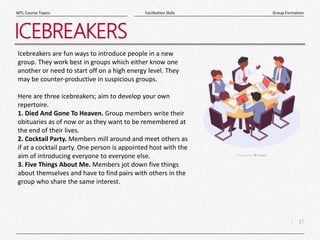
Icebreakers are fun ways to introduce people in a new
group. They work best in groups which either know one
another or need to start off on a high energy level. They
may be counter-productive in suspicious groups.
Here are three icebreakers; aim to develop your own
repertoire.
1. Died And Gone To Heaven. Group members write their
obituaries as of now or as they want to be remembered at
the end of their lives.
2. Cocktail Party. Members mill around and meet others as
if at a cocktail party. One person is appointed host with the
aim of introducing everyone to everyone else.
3. Five Things About Me. Members jot down five things
about themselves and have to find pairs with others in the
group who share the same interest.
18
|
Group Formation
Facilitation Skills
MTL Course Topics
PERSONAL GOAL-SETTING
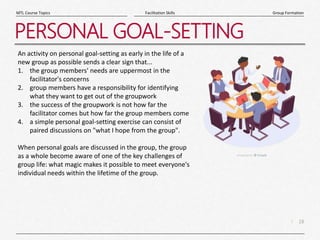
An activity on personal goal-setting as early in the life of a
new group as possible sends a clear sign that...
1. the group members' needs are uppermost in the
facilitator's concerns
2. group members have a responsibility for identifying
what they want to get out of the groupwork
3. the success of the groupwork is not how far the
facilitator comes but how far the group members come
4. a simple personal goal-setting exercise can consist of
paired discussions on "what I hope from the group".
When personal goals are discussed in the group, the group
as a whole become aware of one of the key challenges of
group life: what magic makes it possible to meet everyone's
individual needs within the lifetime of the group.
19
|
Group Formation
Facilitation Skills
MTL Course Topics
RIGHT RELATIONS
The concept of "right relations" can be introduced at the
start of groupwork in the knowledge that it influences every
aspect of group functioning. As facilitator, you may need to
coach the group in right relations if the group fails to make
headway.
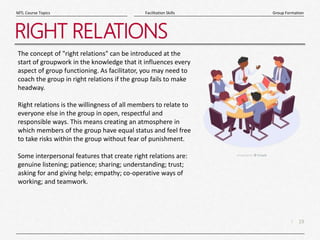
Right relations is the willingness of all members to relate to
everyone else in the group in open, respectful and
responsible ways. This means creating an atmosphere in
which members of the group have equal status and feel free
to take risks within the group without fear of punishment.
Some interpersonal features that create right relations are:
genuine listening; patience; sharing; understanding; trust;
asking for and giving help; empathy; co-operative ways of
working; and teamwork.
20
|
Group Formation
Facilitation Skills
MTL Course Topics
GROUP CONTRACTING
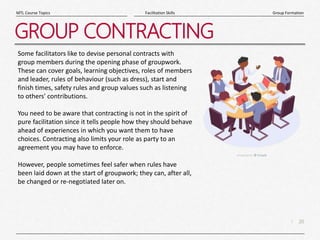
Some facilitators like to devise personal contracts with
group members during the opening phase of groupwork.
These can cover goals, learning objectives, roles of members
and leader, rules of behaviour (such as dress), start and
finish times, safety rules and group values such as listening
to others' contributions.
You need to be aware that contracting is not in the spirit of
pure facilitation since it tells people how they should behave
ahead of experiences in which you want them to have
choices. Contracting also limits your role as party to an
agreement you may have to enforce.
However, people sometimes feel safer when rules have
been laid down at the start of groupwork; they can, after all,
be changed or re-negotiated later on.
21
|
Group Formation
Facilitation Skills
MTL Course Topics
A CONTRACT
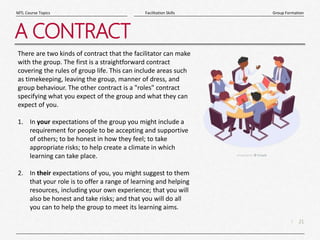
There are two kinds of contract that the facilitator can make
with the group. The first is a straightforward contract
covering the rules of group life. This can include areas such
as timekeeping, leaving the group, manner of dress, and
group behaviour. The other contract is a "roles" contract
specifying what you expect of the group and what they can
expect of you.
1. In your expectations of the group you might include a
requirement for people to be accepting and supportive
of others; to be honest in how they feel; to take
appropriate risks; to help create a climate in which
learning can take place.
2. In their expectations of you, you might suggest to them
that your role is to offer a range of learning and helping
resources, including your own experience; that you will
also be honest and take risks; and that you will do all
you can to help the group to meet its learning aims.
22
|
Group Formation
Facilitation Skills
MTL Course Topics
WORK AND PLAY
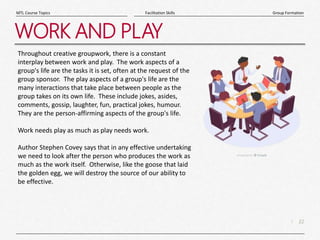
Throughout creative groupwork, there is a constant
interplay between work and play. The work aspects of a
group's life are the tasks it is set, often at the request of the
group sponsor. The play aspects of a group's life are the
many interactions that take place between people as the
group takes on its own life. These include jokes, asides,
comments, gossip, laughter, fun, practical jokes, humour.
They are the person-affirming aspects of the group's life.
Work needs play as much as play needs work.
Author Stephen Covey says that in any effective undertaking
we need to look after the person who produces the work as
much as the work itself. Otherwise, like the goose that laid
the golden egg, we will destroy the source of our ability to
be effective.
23
|
Group Formation
Facilitation Skills
MTL Course Topics
GROUP EXERCISES
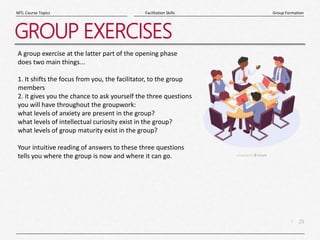
A group exercise at the latter part of the opening phase
does two main things...
1. It shifts the focus from you, the facilitator, to the group
members
2. it gives you the chance to ask yourself the three questions
you will have throughout the groupwork:
what levels of anxiety are present in the group?
what levels of intellectual curiosity exist in the group?
what levels of group maturity exist in the group?
Your intuitive reading of answers to these three questions
tells you where the group is now and where it can go.
24
|
Group Formation
Facilitation Skills
MTL Course Topics
NUDGING INTO OWNERSHIP
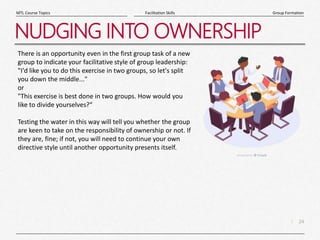
There is an opportunity even in the first group task of a new
group to indicate your facilitative style of group leadership:
"I'd like you to do this exercise in two groups, so let's split
you down the middle..."
or
"This exercise is best done in two groups. How would you
like to divide yourselves?“
Testing the water in this way will tell you whether the group
are keen to take on the responsibility of ownership or not. If
they are, fine; if not, you will need to continue your own
directive style until another opportunity presents itself.
25
|
Group Formation
Facilitation Skills
MTL Course Topics
THAT’S
IT!
WELL DONE!
26
|
Group Formation
Facilitation Skills
MTL Course Topics
THANK YOU
This has been a Slide Topic from Manage Train Learn

Group Formation

  • 1.
    1 | Group Formation Facilitation Skills MTLCourse Topics FACILITATION SKILLS Group Formation
  • 2.
    2 | Group Formation Facilitation Skills MTLCourse Topics The Course Topics series from Manage Train Learn is a large collection of topics that will help you as a learner to quickly and easily master a range of skills in your everyday working life and life outside work. If you are a trainer, they are perfect for adding to your classroom courses and online learning plans. COURSE TOPICS FROM MTL The written content in this Slide Topic belongs exclusively to Manage Train Learn and may only be reprinted either by attribution to Manage Train Learn or with the express written permission of Manage Train Learn. They are designed as a series of numbered slides. As with all programmes on Slide Topics, these slides are fully editable and can be used in your own programmes, royalty-free. Your only limitation is that you may not re-publish or sell these slides as your own. Copyright Manage Train Learn 2020 onwards. Attribution: All images are from sources which do not require attribution and may be used for commercial uses. Sources include pixabay, unsplash, and freepik. These images may also be those which are in the public domain, out of copyright, for fair use, or allowed under a Creative Commons license.
  • 3.
    3 | Group Formation Facilitation Skills MTLCourse Topics ARE YOU READY? OK, LET’S START!
  • 4.
    4 | Group Formation Facilitation Skills MTLCourse Topics INTRODUCTION The starting points of groupwork are the pre-group contacts made between facilitator and group members as well as the opening moments of a group session itself. It is in these moments of contact that the group seeks answers to whether they will be controlled or manipulated. These are also the crucial exchanges when the facilitator can set the framework and tone for a truly open atmosphere of group working.
  • 5.
    5 | Group Formation Facilitation Skills MTLCourse Topics WHAT GROUPS? Facilitation works best in groups which are mature enough to take control of their own processes but still need to be guided by a group leader to work through the issues that matter to them. The following are examples of different types of facilitation sessions... 1. two people taking marriage guidance counselling 2. personal skills training such as facilitation itself 3. team-building in a team that wants to improve their effectiveness 4. multi-party problem-solving, for example the Northern Ireland peace process 5. mediating grievances and disputes 6. re-organisation processes where new teams are being formed.
  • 6.
    6 | Group Formation Facilitation Skills MTLCourse Topics GROUP MEMBERSHIP While some members of a group select themselves because of the sponsor's requirements (for example, an organisation may want all assistant managers to be in the group), there are advantages in selecting a group based on what works best for the group. For example, groups are not so effective when they are too alike nor when they are too disparate. When members are too alike, there is often insufficient contention to stimulate group energy. On the other hand, when members are too dissimilar, there is the risk of insufficient contact. One useful rule of thumb is that the group mix should be similar enough to be compatible and disparate enough to be stimulating. Compatible characteristics include: age, gender and professional status; disparate characteristics include: background, social interests and skills.
  • 7.
    7 | Group Formation Facilitation Skills MTLCourse Topics PRE-GROUP CONTACT Once it has been decided to put a group together, some initial plans need to be made. This is the "terra firma" of groupwork, the only area that is fixed. "Terra firma" plans might include... 1. your sponsor's objectives and success criteria 2. times, lengths and number of meetings 3. location of meetings 4. membership of the group 5. size of the group 6. resources available to you 7. who is to facilitate; who is to lead and co-lead? 8. methods of evaluation of group progress.
  • 8.
    8 | Group Formation Facilitation Skills MTLCourse Topics THE INVITATION The first contact between facilitator and group members is likely to be the invitation to attend. This can be made personally or in writing. No invitation will undoubtedly lead to increased anxiety and negative feelings. The right tone can be set in an invitation by... 1. giving full information about the session so that participants have no fears about what to expect. This can include names of others who are to attend. 2. setting high but manageable expectations of what is to be achieved and relating these to individual needs 3. alluding to your previous experience in running successful groupwork.
  • 9.
    9 | Group Formation Facilitation Skills MTLCourse Topics DEAR MARY A formal message of welcome before the group meets can set the right tone. Dear Mary, We look forward to seeing you at our team-building session for members of the new Health Department on Wednesday next week at the Conference centre. As you know, the Company's re-organisation of your department aims to produce a greater degree of customer service through more efficient working. The team-building sessions are a vital first step in this exciting programme. All the joining instructions, together with a list of other participants, are enclosed. We also include a personal self-assessment exercise for you to do and bring with you. I think you will find it useful for the work we plan to do. If you have any questions, concerns or comments about the sessions, please feel free to ring me or come and see me.
  • 10.
    10 | Group Formation Facilitation Skills MTLCourse Topics BEFORE YOU COME Contacting group members before they come to the group meeting can set the right tone and outline pre-group preparation. Read this before you come to the group... 1. Check the administrative arrangements at least a week before you come and again a few days before. Go and put reminders in your diary NOW. 2. Think what you want to get out of the groupwork. Jot down your expectations now; do this again in a few days time. 3. Discuss what you hope to gain with other people whose opinions you value, such as your manager, your colleagues. 4. Assess where you are now in your personal development and where you would like to be. 5. Come with a positive attitude and you'll get the most from the work we plan to do.
  • 11.
    11 | Group Formation Facilitation Skills MTLCourse Topics GROUP SIZE When planning a group, consideration needs to be given to whether you want a small group or a large group. Small groups provide... • more chance to join in • more likelihood of agreement • more intimacy and support • more satisfaction. Large groups provide... • more varied relationships • more interesting and creative solutions to problems • more need for rules and direction • more time to solve problems. Seven is thought to be the best number to enjoy the benefits of small and large groups and to have meaningful interaction with everyone else in the group.
  • 12.
    12 | Group Formation Facilitation Skills MTLCourse Topics LARGE GROUPS Groups of more than 12 to 15 members present different kinds of challenges for facilitators than smaller groups. Members of a large group have more difficulty in feeling they belong with the result that there are likely to be more passive members in a large group than in a small group. People often feel a greater need to prevent their individuality being swamped in a large group. To stop this happening, they may mentally withdraw and wish they were somewhere else or put on an eloquent performance in discussions. A curious change that takes place in large groups is that those who are confident in small groups can withdraw and the insensitive can appear rational and intelligent. In small groups it is harder to get in touch with how you feel, in large groups with what you think.
  • 13.
    13 | Group Formation Facilitation Skills MTLCourse Topics CLOSED GROUPWORK The first look at the setting and seating arrangements in the meeting room will indicate whether you are in for a closed session or an open one. These are the signs of closed groupwork: 1. an enclosed, overlooked, tightly-packed, claustrophobic setting 2. a greeting that is high on prohibitions, warnings, and "don'ts" 3. defensive seating patterns (ie a barrier between group and facilitator) 4. name tags with titles on 5. name plates indicating where the group must sit 6. a high level of formality in the way people speak to one another 7. a separate area for the group leader.
  • 14.
    14 | Group Formation Facilitation Skills MTLCourse Topics OPEN GROUPWORK These are the visible signs of open groupwork: 1. a personal greeting that is high on welcome, making things easy, making things possible 2. a welcoming, relaxed feel, indicated possibly by the use of background music, the smell of fresh flowers, the sight of bright colourful posters, including a Welcoming one 3. someone knows you're coming 4. a “Welcome!” by name 5. no unnecessary hurry 6. an open seating plan that allows people to sit how and where they like with no barriers between members or between members and group leader. Horse-shoe shaped seating patterns with the group leader at one end (and slightly apart) indicate that everyone has an equal part to play with everyone else.
  • 15.
    15 | Group Formation Facilitation Skills MTLCourse Topics WELCOMES The first session of groupwork is the moment of social and psychological birth for the group. It can start with a formal welcome by the facilitator followed by members introducing themselves. This exercise can be nerve-wracking for many people so follow these guidelines... 1. if people don't know each other well, it is safest to ask them to introduce themselves while the rest listen in 2. if people know each other on a formal basis only, you might suggest they introduce each other to the rest of the group 3. if people know each other well at an informal level, you might suggest an icebreaker. At the end of their introductions, you can introduce yourself in an informal, friendly way with any personal details you feel comfortable about disclosing.
  • 16.
    16 | Group Formation Facilitation Skills MTLCourse Topics INTRODUCTIONS How you respond to peoples' introductions is the group's first indication of the kind of leadership you aim to provide. A facilitative style conveys warmth, makes use of people's first names and shows you are personally interested in each person. For example… ""Hi, I'm John Graham from Accounts. I'm the supervisor for the Northern offices. I've been there for 15 years." "Anything to add, John?" "Well, I'm a bit nervous about this team-building stuff and I don't know what to expect." "OK, John, thanks for being honest. It's likely others are nervous, too, so perhaps you can tell us what it's like from time to time as the group progresses.“ Use these responses to show that your communication is two-way and that you are a listener as much as a talker.
  • 17.
    17 | Group Formation Facilitation Skills MTLCourse Topics ICEBREAKERS Icebreakers are fun ways to introduce people in a new group. They work best in groups which either know one another or need to start off on a high energy level. They may be counter-productive in suspicious groups. Here are three icebreakers; aim to develop your own repertoire. 1. Died And Gone To Heaven. Group members write their obituaries as of now or as they want to be remembered at the end of their lives. 2. Cocktail Party. Members mill around and meet others as if at a cocktail party. One person is appointed host with the aim of introducing everyone to everyone else. 3. Five Things About Me. Members jot down five things about themselves and have to find pairs with others in the group who share the same interest.
  • 18.
    18 | Group Formation Facilitation Skills MTLCourse Topics PERSONAL GOAL-SETTING An activity on personal goal-setting as early in the life of a new group as possible sends a clear sign that... 1. the group members' needs are uppermost in the facilitator's concerns 2. group members have a responsibility for identifying what they want to get out of the groupwork 3. the success of the groupwork is not how far the facilitator comes but how far the group members come 4. a simple personal goal-setting exercise can consist of paired discussions on "what I hope from the group". When personal goals are discussed in the group, the group as a whole become aware of one of the key challenges of group life: what magic makes it possible to meet everyone's individual needs within the lifetime of the group.
  • 19.
    19 | Group Formation Facilitation Skills MTLCourse Topics RIGHT RELATIONS The concept of "right relations" can be introduced at the start of groupwork in the knowledge that it influences every aspect of group functioning. As facilitator, you may need to coach the group in right relations if the group fails to make headway. Right relations is the willingness of all members to relate to everyone else in the group in open, respectful and responsible ways. This means creating an atmosphere in which members of the group have equal status and feel free to take risks within the group without fear of punishment. Some interpersonal features that create right relations are: genuine listening; patience; sharing; understanding; trust; asking for and giving help; empathy; co-operative ways of working; and teamwork.
  • 20.
    20 | Group Formation Facilitation Skills MTLCourse Topics GROUP CONTRACTING Some facilitators like to devise personal contracts with group members during the opening phase of groupwork. These can cover goals, learning objectives, roles of members and leader, rules of behaviour (such as dress), start and finish times, safety rules and group values such as listening to others' contributions. You need to be aware that contracting is not in the spirit of pure facilitation since it tells people how they should behave ahead of experiences in which you want them to have choices. Contracting also limits your role as party to an agreement you may have to enforce. However, people sometimes feel safer when rules have been laid down at the start of groupwork; they can, after all, be changed or re-negotiated later on.
  • 21.
    21 | Group Formation Facilitation Skills MTLCourse Topics A CONTRACT There are two kinds of contract that the facilitator can make with the group. The first is a straightforward contract covering the rules of group life. This can include areas such as timekeeping, leaving the group, manner of dress, and group behaviour. The other contract is a "roles" contract specifying what you expect of the group and what they can expect of you. 1. In your expectations of the group you might include a requirement for people to be accepting and supportive of others; to be honest in how they feel; to take appropriate risks; to help create a climate in which learning can take place. 2. In their expectations of you, you might suggest to them that your role is to offer a range of learning and helping resources, including your own experience; that you will also be honest and take risks; and that you will do all you can to help the group to meet its learning aims.
  • 22.
    22 | Group Formation Facilitation Skills MTLCourse Topics WORK AND PLAY Throughout creative groupwork, there is a constant interplay between work and play. The work aspects of a group's life are the tasks it is set, often at the request of the group sponsor. The play aspects of a group's life are the many interactions that take place between people as the group takes on its own life. These include jokes, asides, comments, gossip, laughter, fun, practical jokes, humour. They are the person-affirming aspects of the group's life. Work needs play as much as play needs work. Author Stephen Covey says that in any effective undertaking we need to look after the person who produces the work as much as the work itself. Otherwise, like the goose that laid the golden egg, we will destroy the source of our ability to be effective.
  • 23.
    23 | Group Formation Facilitation Skills MTLCourse Topics GROUP EXERCISES A group exercise at the latter part of the opening phase does two main things... 1. It shifts the focus from you, the facilitator, to the group members 2. it gives you the chance to ask yourself the three questions you will have throughout the groupwork: what levels of anxiety are present in the group? what levels of intellectual curiosity exist in the group? what levels of group maturity exist in the group? Your intuitive reading of answers to these three questions tells you where the group is now and where it can go.
  • 24.
    24 | Group Formation Facilitation Skills MTLCourse Topics NUDGING INTO OWNERSHIP There is an opportunity even in the first group task of a new group to indicate your facilitative style of group leadership: "I'd like you to do this exercise in two groups, so let's split you down the middle..." or "This exercise is best done in two groups. How would you like to divide yourselves?“ Testing the water in this way will tell you whether the group are keen to take on the responsibility of ownership or not. If they are, fine; if not, you will need to continue your own directive style until another opportunity presents itself.
  • 25.
    25 | Group Formation Facilitation Skills MTLCourse Topics THAT’S IT! WELL DONE!
  • 26.
    26 | Group Formation Facilitation Skills MTLCourse Topics THANK YOU This has been a Slide Topic from Manage Train Learn