Generating Evidence and New Directions for Equitable Results
INTRODUCING THE ‘NEW’ CGIAR GENDER
PLATFORM
Nicoline de Haan (ILRI)
CGIAR gender research coordinators meeting
Rome, 14-16 January 2020
Vision: a world in which gender equality drives a transformation towards
equitable, sustainable, productive and climate-resilient food systems
Goals:
• Become the go-to place for high-quality evidence, knowledge, methods, tools and
alliances around gender that foster transformational change for inclusive and
equitable food systems within planetary boundaries.
• Use tools and evidence to support CGIAR and its partners in transforming local and
global food systems through improved gender equality.
• Change the organizational cultures and enhance capacities for achieving gender
outcomes within CGIAR and its partner institutions such that gender equality
becomes a core principle in priority setting, research and day-to-day activities.
Vision: a world in which gender equality drives a transformation towards
equitable, sustainable, productive and climate-resilient food systems
Strategic objectives:
• Generate the high-quality research evidence needed to influence the broader
AR4D ecosystem and to integrate gender to achieve gender-equal outcomes from
AR4D.
• Create an enabling environment within which gender equality is embraced as a
core principle in priority setting, research and day-to-day activities within CGIAR
and its partners.
• Develop the capacity of CGIAR and its partner organizations to carry out gender
integrated and gender strategic research that is transformative and strengthens
global, regional and national food systems.
Vision: a world in which gender equality drives a transformation towards
equitable, sustainable, productive and climate-resilient food systems
Outcomes:
• The global food system’s development agenda, including that of CGIAR and its
partners, governments, regional bodies, donors and multilateral organizations, is
informed by gender research and evidence generated by CGIAR and partners.
• Gender equality and transformative thinking is integral to the CGIAR system and to
NARES, universities and NGOs, and it is a key criterion for priority setting, targeting
and managing AR4D at all levels.
• Partnerships for achieving gender equality are developed and/or strengthened,
including linkages with existing CGIAR initiatives and external activities relating to
gender equality and food systems development, to reach scale and impact lives.
………………………………………………………………………………………………………………………………………………………………………………………………………….
………………………………………………………………………………………………………………………………………………………………………………………………………….
………………………………………………………………………………………………………………………………………………………………………………………………………….
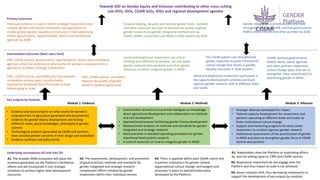
Underlying assumptions (A) and risks (R)
Key outputs by modules
Intermediate outcomes (Next users level)
Primary outcomes
Towards IDO on Gender Equity and Inclusion contributing to other cross-cutting
sub-IDOs, IDOs, CGIAR SLOs, SDGs and regional development agendas
• Evidence and lessons learnt on what works for women’s
empowerment in agriculture generated and documented
• Evidence for gender theory development and testing
(different views, plural knowledges, philosophy of gender
science)
• Technological products generated by CGIAR and partners
have included gender concerns in their design and evaluation
• Evidence synthesis and policy briefs
• Communities of practice to promote dialogues on knowledge
about agricultural development and collaboration on methods
and tool development
• Approaches/processes facilitating gender theory development
• Reviews/meta-analyses on methods and standards for gender
integrated and strategic research
• Good practices in standard operating procedure for gender
intentional food systems research
• A suite of resources on how to integrate gender in AR4D
• Strategic alliances developed for impact
• Tailored capacity development for researchers and
partners operating at different levels and scales to
foster institutional culture change
• Support and mentoring programs for early career
researchers to conduct rigorous gender research
• Institutional assessments of the prioritization of gender
in AR4D and plans to strengthen gender focus in CGIAR
centres and partners
Module 1: Evidence Module 2: Methods Module 3: Alliances
A1: The broader AR4D ecosystem will value the
evidence generated via the Platform’s facilitation
efforts and will incorporate it into strategic
initiatives to achieve higher-level development
outcomes.
A2: The assessments, development, and promotion
of good practices, methods and standards for
gender integrated and strategic research
complement efforts initiated by gender
researchers within their individual centres.
A3: There is appetite within each CGIAR centre and
in partner institutions for gender-related
organizational culture change, and budgets and
processes in place to operationalize plans
developed by the Platform.
R1: Stakeholders view the Platform as duplicating efforts
by, and not adding value to, CRPs and CGIAR centres.
R2: Biophysical researchers do not engage with the
Platform and thus impact at scale is not achieved.
R3: Donor interests shift, thus decreasing investments to
support the development of key outputs by modules.
CRPs, CGIAR centres, governments, regional bodies, donors and multilateral
agencies utilize the evidence on what works for women’s empowerment in
agriculture to inform strategic investments.
CRPs, CGIAR centres, and NARES
improve the quality of gender
research evidence generated.
Social and biophysical researchers use critical
thinking and reflexivity to develop, use and adapt
gender methods and standards and other gender
resources to better integrate gender in AR4D.
Social and biophysical researchers participate in
the capacity development activities and build
rigorous gender research skills at different levels
and scales.
CGIAR, national governments,
NARES, NGOs, donor agencies
and other partners implement
culture change plans that aim to
strengthen their commitment to
prioritizing gender in AR4D.
Improved evidence is used to inform strategic investments and
scalable gender-intentional innovations and approaches to
enable greater gender equality and inclusion in food systems by
CGIAR, governments, regional bodies, donors and multilateral
agencies by 2028.
Forward-looking, dynamic and iterative gender tools, methods
and other resources are used to improve the quality of global
gender research and gender integrated interventions by
CGIAR, NARES, universities and NGOs in food systems by 2029.
Gender integration is prioritized and practiced
throughout AR4D by CGIAR, national governments,
NARES, NGOs, donors and other partners by 2030.
The CGIAR system uses strengthened
gender capacities to guide institutional
culture change that results in gender
equality outcomes in food systems.
CRPs, CGIAR centres, and NARES test and evaluate
innovations and pro-poor, transformative
approaches developed from the evidence base
before going to scale.
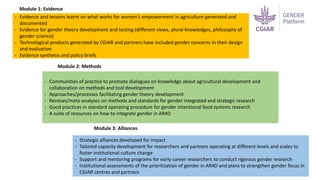
• Evidence and lessons learnt on what works for women’s empowerment in agriculture generated and
documented
• Evidence for gender theory development and testing (different views, plural knowledges, philosophy of
gender science)
• Technological products generated by CGIAR and partners have included gender concerns in their design
and evaluation
• Evidence synthesis and policy briefs
• Communities of practice to promote dialogues on knowledge about agricultural development and
collaboration on methods and tool development
• Approaches/processes facilitating gender theory development
• Reviews/meta-analyses on methods and standards for gender integrated and strategic research
• Good practices in standard operating procedure for gender intentional food systems research
• A suite of resources on how to integrate gender in AR4D
• Strategic alliances developed for impact
• Tailored capacity development for researchers and partners operating at different levels and scales to
foster institutional culture change
• Support and mentoring programs for early career researchers to conduct rigorous gender research
• Institutional assessments of the prioritization of gender in AR4D and plans to strengthen gender focus in
CGIAR centres and partners
Module 1: Evidence
Module 2: Methods
Module 3: Alliances
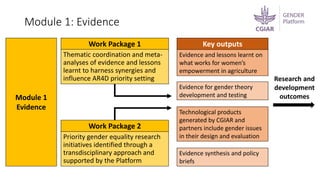
Module 1: Evidence
Research and
development
outcomesModule 1
Evidence
Work Package 1
Work Package 2
Thematic coordination and meta-
analyses of evidence and lessons
learnt to harness synergies and
influence AR4D priority setting
Priority gender equality research
initiatives identified through a
transdisciplinary approach and
supported by the Platform
Evidence and lessons learnt on
what works for women’s
empowerment in agriculture
Evidence for gender theory
development and testing
Technological products
generated by CGIAR and
partners include gender issues
in their design and evaluation
Evidence synthesis and policy
briefs
Key outputs
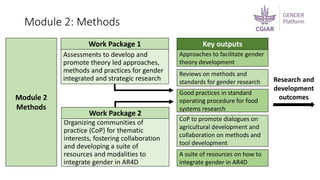
Module 2: Methods
Module 2
Methods
Work Package 1
Work Package 2
Assessments to develop and
promote theory led approaches,
methods and practices for gender
integrated and strategic research
Organizing communities of
practice (CoP) for thematic
interests, fostering collaboration
and developing a suite of
resources and modalities to
integrate gender in AR4D
CoP to promote dialogues on
agricultural development and
collaboration on methods and
tool development
Approaches to facilitate gender
theory development
Key outputs
Research and
development
outcomes
Reviews on methods and
standards for gender research
Good practices in standard
operating procedure for food
systems research
A suite of resources on how to
integrate gender in AR4D
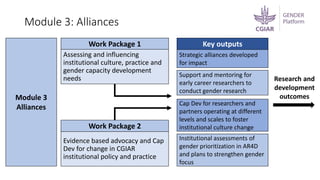
Module 3: Alliances
Module 3
Alliances
Work Package 1
Work Package 2
Assessing and influencing
institutional culture, practice and
gender capacity development
needs
Evidence based advocacy and Cap
Dev for change in CGIAR
institutional policy and practice
Strategic alliances developed
for impact
Support and mentoring for
early career researchers to
conduct gender research
Cap Dev for researchers and
partners operating at different
levels and scales to foster
institutional culture change
Institutional assessments of
gender prioritization in AR4D
and plans to strengthen gender
focus
Key outputs
Research and
development
outcomes
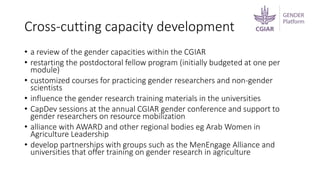
Cross-cutting capacity development
• a review of the gender capacities within the CGIAR
• restarting the postdoctoral fellow program (initially budgeted at one per
module)
• customized courses for practicing gender researchers and non-gender
scientists
• influence the gender research training materials in the universities
• CapDev sessions at the annual CGIAR gender conference and support to
gender researchers on resource mobilization
• alliance with AWARD and other regional bodies eg Arab Women in
Agriculture Leadership
• develop partnerships with groups such as the MenEngage Alliance and
universities that offer training on gender research in agriculture
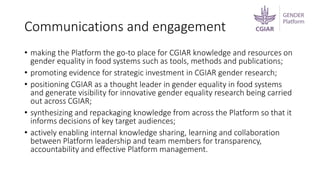
Communications and engagement
• making the Platform the go-to place for CGIAR knowledge and resources on
gender equality in food systems such as tools, methods and publications;
• promoting evidence for strategic investment in CGIAR gender research;
• positioning CGIAR as a thought leader in gender equality in food systems
and generate visibility for innovative gender equality research being carried
out across CGIAR;
• synthesizing and repackaging knowledge from across the Platform so that it
informs decisions of key target audiences;
• actively enabling internal knowledge sharing, learning and collaboration
between Platform leadership and team members for transparency,
accountability and effective Platform management.
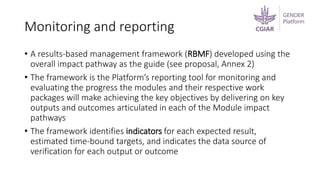
Monitoring and reporting
• A results-based management framework (RBMF) developed using the
overall impact pathway as the guide (see proposal, Annex 2)
• The framework is the Platform’s reporting tool for monitoring and
evaluating the progress the modules and their respective work
packages will make achieving the key objectives by delivering on key
outputs and outcomes articulated in each of the Module impact
pathways
• The framework identifies indicators for each expected result,
estimated time-bound targets, and indicates the data source of
verification for each output or outcome
Monitoring and reporting
• The Platform team will develop an overall implementation plan based on the
RBMF
• The high-level implementation plan will be complemented by detailed yearly
work plans, which will be broken down into specific work plans by module
• The RBMF and yearly work plans provide the basis for the Platform’s M&E
system, against which progress towards milestones and longer-term
outcomes by 2030 can be assessed and reported
• A full-time project manager-cum-M&E expert will be hired to operationalize and
maintain the M&E system
• External evaluations will be implemented at regular intervals to assess
relevance, efficiency, quality of science, effectiveness, attributable impact
and sustainability
Governance principles
• support all CRPs, platforms and centres;
• be inclusive to ensure diverse representation;
• ensure that activities under its modules and work packages are responsive to and
driven by the needs of the CGIAR system and the gender researchers within it;
• add value to work being done in CRPs, platforms and centres;
• promote transparency and accountability; and
• have regular critical reflections and feedback on Platform functioning to remain
relevant and effective.
• create structures for diverse partnerships with NARES, universities and the private
sector
• contribute to the global gender agenda through engaging with continental (e.g.
the CAADP process of the AU) and global gender mechanisms (e.g. SDG
benchmarking and monitoring of gender indicators)
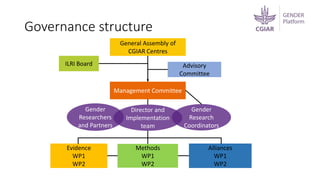
Governance structure
General Assembly of
CGIAR Centres
ILRI Board Advisory
Committee
Management Committee
Evidence
WP1
WP2
Methods
WP1
WP2
Alliances
WP1
WP2
Gender
Researchers
and Partners
Director and
Implementation
team
Gender
Research
Coordinators
Updates
• Transition plan
• Interim Management Committee – 1st meeting held
• Chair: Iain Wright, Members: Marlene Elias, Ruth Meinzen-Dick, Netsayi Mudege, Ranjitha Puskur
and Nicoline de Haan
• GRC meeting today
• Discussions with SMO, SMO on M&E, BMGF, IDRC, SLU
• Job descriptions and recruitments about to start
• Director
• Science manager
• Communications manager
• Interim implementation team in place – Nadine Sanginga, Marianne Gadeberg with Vivian Atakos, Simon
Turere and Joyce Wanderi
• Updating the website and plan for comms over the next months
Update
Thank you
The platform thanks all donors and organizations which globally support its work through their contributions to
the CGIAR Trust Fund
This presentation is licensed for use under the Creative Commons Attribution 4.0 International Licence.

Introducing the ‘new’ CGIAR Gender Platform

  • 1.
    Generating Evidence andNew Directions for Equitable Results INTRODUCING THE ‘NEW’ CGIAR GENDER PLATFORM Nicoline de Haan (ILRI) CGIAR gender research coordinators meeting Rome, 14-16 January 2020
  • 2.
    Vision: a worldin which gender equality drives a transformation towards equitable, sustainable, productive and climate-resilient food systems Goals: • Become the go-to place for high-quality evidence, knowledge, methods, tools and alliances around gender that foster transformational change for inclusive and equitable food systems within planetary boundaries. • Use tools and evidence to support CGIAR and its partners in transforming local and global food systems through improved gender equality. • Change the organizational cultures and enhance capacities for achieving gender outcomes within CGIAR and its partner institutions such that gender equality becomes a core principle in priority setting, research and day-to-day activities.
  • 3.
    Vision: a worldin which gender equality drives a transformation towards equitable, sustainable, productive and climate-resilient food systems Strategic objectives: • Generate the high-quality research evidence needed to influence the broader AR4D ecosystem and to integrate gender to achieve gender-equal outcomes from AR4D. • Create an enabling environment within which gender equality is embraced as a core principle in priority setting, research and day-to-day activities within CGIAR and its partners. • Develop the capacity of CGIAR and its partner organizations to carry out gender integrated and gender strategic research that is transformative and strengthens global, regional and national food systems.
  • 4.
    Vision: a worldin which gender equality drives a transformation towards equitable, sustainable, productive and climate-resilient food systems Outcomes: • The global food system’s development agenda, including that of CGIAR and its partners, governments, regional bodies, donors and multilateral organizations, is informed by gender research and evidence generated by CGIAR and partners. • Gender equality and transformative thinking is integral to the CGIAR system and to NARES, universities and NGOs, and it is a key criterion for priority setting, targeting and managing AR4D at all levels. • Partnerships for achieving gender equality are developed and/or strengthened, including linkages with existing CGIAR initiatives and external activities relating to gender equality and food systems development, to reach scale and impact lives.
  • 5.
    …………………………………………………………………………………………………………………………………………………………………………………………………………. …………………………………………………………………………………………………………………………………………………………………………………………………………. …………………………………………………………………………………………………………………………………………………………………………………………………………. Underlying assumptions (A)and risks (R) Key outputs by modules Intermediate outcomes (Next users level) Primary outcomes Towards IDO on Gender Equity and Inclusion contributing to other cross-cutting sub-IDOs, IDOs, CGIAR SLOs, SDGs and regional development agendas • Evidence and lessons learnt on what works for women’s empowerment in agriculture generated and documented • Evidence for gender theory development and testing (different views, plural knowledges, philosophy of gender science) • Technological products generated by CGIAR and partners have included gender concerns in their design and evaluation • Evidence synthesis and policy briefs • Communities of practice to promote dialogues on knowledge about agricultural development and collaboration on methods and tool development • Approaches/processes facilitating gender theory development • Reviews/meta-analyses on methods and standards for gender integrated and strategic research • Good practices in standard operating procedure for gender intentional food systems research • A suite of resources on how to integrate gender in AR4D • Strategic alliances developed for impact • Tailored capacity development for researchers and partners operating at different levels and scales to foster institutional culture change • Support and mentoring programs for early career researchers to conduct rigorous gender research • Institutional assessments of the prioritization of gender in AR4D and plans to strengthen gender focus in CGIAR centres and partners Module 1: Evidence Module 2: Methods Module 3: Alliances A1: The broader AR4D ecosystem will value the evidence generated via the Platform’s facilitation efforts and will incorporate it into strategic initiatives to achieve higher-level development outcomes. A2: The assessments, development, and promotion of good practices, methods and standards for gender integrated and strategic research complement efforts initiated by gender researchers within their individual centres. A3: There is appetite within each CGIAR centre and in partner institutions for gender-related organizational culture change, and budgets and processes in place to operationalize plans developed by the Platform. R1: Stakeholders view the Platform as duplicating efforts by, and not adding value to, CRPs and CGIAR centres. R2: Biophysical researchers do not engage with the Platform and thus impact at scale is not achieved. R3: Donor interests shift, thus decreasing investments to support the development of key outputs by modules. CRPs, CGIAR centres, governments, regional bodies, donors and multilateral agencies utilize the evidence on what works for women’s empowerment in agriculture to inform strategic investments. CRPs, CGIAR centres, and NARES improve the quality of gender research evidence generated. Social and biophysical researchers use critical thinking and reflexivity to develop, use and adapt gender methods and standards and other gender resources to better integrate gender in AR4D. Social and biophysical researchers participate in the capacity development activities and build rigorous gender research skills at different levels and scales. CGIAR, national governments, NARES, NGOs, donor agencies and other partners implement culture change plans that aim to strengthen their commitment to prioritizing gender in AR4D. Improved evidence is used to inform strategic investments and scalable gender-intentional innovations and approaches to enable greater gender equality and inclusion in food systems by CGIAR, governments, regional bodies, donors and multilateral agencies by 2028. Forward-looking, dynamic and iterative gender tools, methods and other resources are used to improve the quality of global gender research and gender integrated interventions by CGIAR, NARES, universities and NGOs in food systems by 2029. Gender integration is prioritized and practiced throughout AR4D by CGIAR, national governments, NARES, NGOs, donors and other partners by 2030. The CGIAR system uses strengthened gender capacities to guide institutional culture change that results in gender equality outcomes in food systems. CRPs, CGIAR centres, and NARES test and evaluate innovations and pro-poor, transformative approaches developed from the evidence base before going to scale.
  • 6.
    • Evidence andlessons learnt on what works for women’s empowerment in agriculture generated and documented • Evidence for gender theory development and testing (different views, plural knowledges, philosophy of gender science) • Technological products generated by CGIAR and partners have included gender concerns in their design and evaluation • Evidence synthesis and policy briefs • Communities of practice to promote dialogues on knowledge about agricultural development and collaboration on methods and tool development • Approaches/processes facilitating gender theory development • Reviews/meta-analyses on methods and standards for gender integrated and strategic research • Good practices in standard operating procedure for gender intentional food systems research • A suite of resources on how to integrate gender in AR4D • Strategic alliances developed for impact • Tailored capacity development for researchers and partners operating at different levels and scales to foster institutional culture change • Support and mentoring programs for early career researchers to conduct rigorous gender research • Institutional assessments of the prioritization of gender in AR4D and plans to strengthen gender focus in CGIAR centres and partners Module 1: Evidence Module 2: Methods Module 3: Alliances
  • 7.
    Module 1: Evidence Researchand development outcomesModule 1 Evidence Work Package 1 Work Package 2 Thematic coordination and meta- analyses of evidence and lessons learnt to harness synergies and influence AR4D priority setting Priority gender equality research initiatives identified through a transdisciplinary approach and supported by the Platform Evidence and lessons learnt on what works for women’s empowerment in agriculture Evidence for gender theory development and testing Technological products generated by CGIAR and partners include gender issues in their design and evaluation Evidence synthesis and policy briefs Key outputs
  • 8.
    Module 2: Methods Module2 Methods Work Package 1 Work Package 2 Assessments to develop and promote theory led approaches, methods and practices for gender integrated and strategic research Organizing communities of practice (CoP) for thematic interests, fostering collaboration and developing a suite of resources and modalities to integrate gender in AR4D CoP to promote dialogues on agricultural development and collaboration on methods and tool development Approaches to facilitate gender theory development Key outputs Research and development outcomes Reviews on methods and standards for gender research Good practices in standard operating procedure for food systems research A suite of resources on how to integrate gender in AR4D
  • 9.
    Module 3: Alliances Module3 Alliances Work Package 1 Work Package 2 Assessing and influencing institutional culture, practice and gender capacity development needs Evidence based advocacy and Cap Dev for change in CGIAR institutional policy and practice Strategic alliances developed for impact Support and mentoring for early career researchers to conduct gender research Cap Dev for researchers and partners operating at different levels and scales to foster institutional culture change Institutional assessments of gender prioritization in AR4D and plans to strengthen gender focus Key outputs Research and development outcomes
  • 10.
    Cross-cutting capacity development •a review of the gender capacities within the CGIAR • restarting the postdoctoral fellow program (initially budgeted at one per module) • customized courses for practicing gender researchers and non-gender scientists • influence the gender research training materials in the universities • CapDev sessions at the annual CGIAR gender conference and support to gender researchers on resource mobilization • alliance with AWARD and other regional bodies eg Arab Women in Agriculture Leadership • develop partnerships with groups such as the MenEngage Alliance and universities that offer training on gender research in agriculture
  • 11.
    Communications and engagement •making the Platform the go-to place for CGIAR knowledge and resources on gender equality in food systems such as tools, methods and publications; • promoting evidence for strategic investment in CGIAR gender research; • positioning CGIAR as a thought leader in gender equality in food systems and generate visibility for innovative gender equality research being carried out across CGIAR; • synthesizing and repackaging knowledge from across the Platform so that it informs decisions of key target audiences; • actively enabling internal knowledge sharing, learning and collaboration between Platform leadership and team members for transparency, accountability and effective Platform management.
  • 12.
    Monitoring and reporting •A results-based management framework (RBMF) developed using the overall impact pathway as the guide (see proposal, Annex 2) • The framework is the Platform’s reporting tool for monitoring and evaluating the progress the modules and their respective work packages will make achieving the key objectives by delivering on key outputs and outcomes articulated in each of the Module impact pathways • The framework identifies indicators for each expected result, estimated time-bound targets, and indicates the data source of verification for each output or outcome
  • 13.
    Monitoring and reporting •The Platform team will develop an overall implementation plan based on the RBMF • The high-level implementation plan will be complemented by detailed yearly work plans, which will be broken down into specific work plans by module • The RBMF and yearly work plans provide the basis for the Platform’s M&E system, against which progress towards milestones and longer-term outcomes by 2030 can be assessed and reported • A full-time project manager-cum-M&E expert will be hired to operationalize and maintain the M&E system • External evaluations will be implemented at regular intervals to assess relevance, efficiency, quality of science, effectiveness, attributable impact and sustainability
  • 14.
    Governance principles • supportall CRPs, platforms and centres; • be inclusive to ensure diverse representation; • ensure that activities under its modules and work packages are responsive to and driven by the needs of the CGIAR system and the gender researchers within it; • add value to work being done in CRPs, platforms and centres; • promote transparency and accountability; and • have regular critical reflections and feedback on Platform functioning to remain relevant and effective. • create structures for diverse partnerships with NARES, universities and the private sector • contribute to the global gender agenda through engaging with continental (e.g. the CAADP process of the AU) and global gender mechanisms (e.g. SDG benchmarking and monitoring of gender indicators)
  • 15.
    Governance structure General Assemblyof CGIAR Centres ILRI Board Advisory Committee Management Committee Evidence WP1 WP2 Methods WP1 WP2 Alliances WP1 WP2 Gender Researchers and Partners Director and Implementation team Gender Research Coordinators
  • 16.
    Updates • Transition plan •Interim Management Committee – 1st meeting held • Chair: Iain Wright, Members: Marlene Elias, Ruth Meinzen-Dick, Netsayi Mudege, Ranjitha Puskur and Nicoline de Haan • GRC meeting today • Discussions with SMO, SMO on M&E, BMGF, IDRC, SLU • Job descriptions and recruitments about to start • Director • Science manager • Communications manager • Interim implementation team in place – Nadine Sanginga, Marianne Gadeberg with Vivian Atakos, Simon Turere and Joyce Wanderi • Updating the website and plan for comms over the next months Update
  • 17.
    Thank you The platformthanks all donors and organizations which globally support its work through their contributions to the CGIAR Trust Fund This presentation is licensed for use under the Creative Commons Attribution 4.0 International Licence.

Editor's Notes

  • #16 Gender researchers: The engine of the GENDER Platform, represented by the centre gender research coordinator and will link with the implementation team of the Platform, with module leaders and with work package coordinators. Director with Implementation team: The Platform will be led by the Platform director, with the support of a team including a communications specialist, a science manager, a full-time project manager-cum-M&E expert and administration support. Module leaders and work package coordinators: Module leaders will provide scientific leadership and coordinate the work being done within each of the modules. They will be based in centres and be supported by work package coordinators. Gender research coordinators: Each CGIAR centre will nominate a gender research coordinator to represent it in the Platform. Management committee: The management committee will make all strategic decisions on the management of the Platform, including overall direction, work plans and resource allocations. Scientific advisory committee: The main role of the SAC is to provide scientific and strategic guidance to the management committee and feedback to the SMO. General assembly: Will link directly to the CGIAR general assembly once a year during the assembly’s annual meeting.