ENDOCRINE SYTEM
DR HAFIZA SHEHREEN
DPT(KING EDWARD MEDICAL UNIVERSITY)
GLANDS
 Glands are important organs located throughout the body.They produce and release
substances that perform certain functions.
TYPES OF GLANDS
 Though you have many glands throughout your body, they fall into two types
 1- Exocrine gland
 2- Endocrine gland
ENDOCRINE GLANDS
 Endocrine glands are part of your endocrine system.They make hormones and
release them into your bloodstream.These hormones control a number of important
functions in your body, such as:
 your growth and development
 metabolism
 mood
 reproduction
 Your endocrine glands include:
 adrenal glands
 pituitary gland
 hypothalamus
 thyroid
 pineal gland
EXOCRINE GLANDS
 Your exocrine glands produce other substances — not hormones — that are
released through ducts to the exterior of your body, such as sweat, saliva, and tears.
 The substances released by your exocrine glands play important roles in your body.
They do things like help regulate your body temperature, protect your skin and eyes,
and even help mothers feed babies by producing breast milk.
 Your exocrine glands include:
 salivary
 sweat
 mammary
 sebaceous
 lacrimal
Lymph nodes are often referred to as glands, but they’re not true glands.They’re part
of your immune system and help your body fight infection.
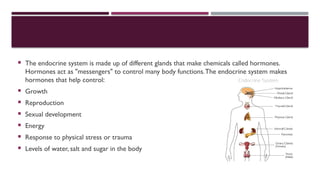
 The endocrine system is made up of different glands that make chemicals called hormones.
Hormones act as "messengers" to control many body functions.The endocrine system makes
hormones that help control:
 Growth
 Reproduction
 Sexual development
 Energy
 Response to physical stress or trauma
 Levels of water, salt and sugar in the body
 endocrine glands are the primary hormone producer
 The brain,heart,lungs,liver,skin,thymus,gastrointestinalmucosa and placenta also
produce and release harmones
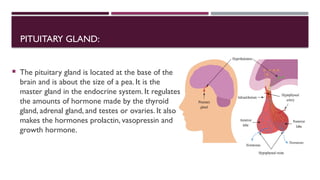
PITUITARY GLAND:
 The pituitary gland is located at the base of the
brain and is about the size of a pea. It is the
master gland in the endocrine system. It regulates
the amounts of hormone made by the thyroid
gland, adrenal gland, and testes or ovaries. It also
makes the hormones prolactin, vasopressin and
growth hormone.
SECRETION FROM ANTERIOR PITUITARY GLAND:
 1- Growth hormone
 Are essential for the growth and development of bones, muscle and other organs. It enhances protein synthesis decrease the use
of glucose and promotes fat destruction
 Growth hormone [Hyper secretion of it during
 childhood causes Gigantism, hypersecretion during
 adulthood causes Acromegaly, and hyposecretion
 causes Dwarfism].
 2-Adrenocorticotropin(ACTH):
 Essential for the growth and development of the adrenal cortex
 ACTH [Hypersecretion causes Cushing’s
 disease, while hyposecretion is rare].
SECRETION OFTHE THYROID GLAND:
 3-Thyroid-Stimulating Hormones: •
 (TSH) are essential for the growth and development of the thyroid gland •
 [Hypersecretion causes Grave’s disease, and
 hypo secretion causes cretinism in children and
 myxedema in adults].
 4- Follicle stimulating Hormone: •
 (FSH) are gonadotropic hormone. It stimulates the growth ,ovarian follicles in the female and the
production of sperm in male •[Hypersecretion causes no known
 effects, while hyposecretion can cause failure of sexual maturation]
 5- Luteinizing Hormone:
 (LH) is a gonadotropic hormone stimulating the development of corpus luteim the female
ovarian follicles and the production of testosterone in male[Disorders are similar to
those for FSH
 6- Prolactin:
 (PRL) stimulates the development and growth of the mammary glands and milk production during
pregnancy[Hypersecretion can disrupt
 normal menstrual cycles in female and causes impotence in male;
 and hyposecretion causes poor milk production in female].
 7- Melanocyte stimulating Hormones:
 (MSH) regulates skin pigmentation and promotes the deposit of melanin in the skin
after exposure t0 sunlight[Hypersecretion causes abnormally dark skin pigment, and
 hyposecretion causes abnormally light skin pigment]..
SECRETION FROM THE POSTERIOR LOB OF PITUITARY GLAND:
 1- Oxytocin:
 stimulates the uterus to contract during labor( delivery).A synthetic version of the
hormone used to induce labor is called Pitocin . It also stimulates mammary glands to
release milk. [Disorders are
 rare and have no known effects, except in some
 hyposecretion cases, weak labor contraction is
 reported].
 2-Antiduretic Hormone:
 (ADH) stimulates the reabsorption of water by renal tubes. Hyposcreation of the
hormone can result in diabetes insipidus[Hypersecretion
 has no know effects, and hyposecretion causes
 frequent urination called diabetes insipidus].
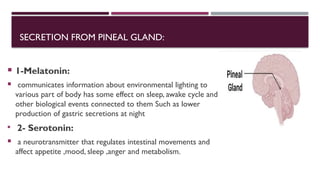
SECRETION FROM PINEAL GLAND:
 1-Melatonin:
 communicates information about environmental lighting to
various part of body has some effect on sleep, awake cycle and
other biological events connected to them Such as lower
production of gastric secretions at night
 2- Serotonin:
 a neurotransmitter that regulates intestinal movements and
affect appetite ,mood, sleep ,anger and metabolism.
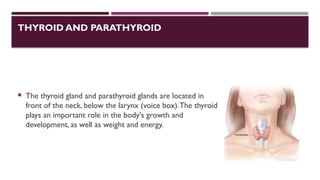
THYROID AND PARATHYROID
 The thyroid gland and parathyroid glands are located in
front of the neck, below the larynx (voice box).The thyroid
plays an important role in the body's growth and
development, as well as weight and energy.
SECRETION OF THE THYROID GLAND:
 1- Calcitonin:
 influence bone and calcium metabolism maintain a homeostasis of calcium in blood plasma. [Both
hyposecretion and
 hypersecretion would affect normal balances of calcium and phosphate
 2-Thyroxine and triiodothyronine:
 essential to BMR - basal metabolic rate ,influence physical,mental development of
growth[Hyposecretion causes hypothyroidism, similar to
 cretinism and myxedema, and hypersecretion causes hyperthyroidism
 that results in a goiter or in Graves’ disease].
SECRETIONS OF PARATHYROID GLAND:
 The two pairs of parathyroid gland are located on
dorsal side of the thyroid gland.They secrete
parathyroid(PTH) which play a role in the
metabolism of phosphorus.Too little result in
cramping.Too much results in osteoporosis or
kidney stones. [Hyposecretion causes tetany, and
 hypersecretion causes osteitis fibrosa cystica].
ADRENAL GLAND
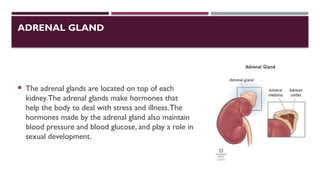
 The adrenal glands are located on top of each
kidney.The adrenal glands make hormones that
help the body to deal with stress and illness.The
hormones made by the adrenal gland also maintain
blood pressure and blood glucose, and play a role in
sexual development.
SECRETIONS FROMTHE ADRENAL CORTEX:
 1- Cortisol:
 regulates carbohydrates, protein and fat metabolism has an anti-inflammatory effect
help the body cope during times of stress
 2- Corticosterone:
 Like cortisol it is steroid influences potassium and sodium
metabolism[Hyposecretion causes Addison’s disease ,
 and hypersecretion causes Cushing’s syndrome].
 3- Aldosterone: •
 Essential in regulating electrolyte and water balance by promoting sodium
and chloride retention and potassium excretion. Hyposecretion causes
Addison’s disease , and hypersecretion causes Cushing’s syndrome].
 4- Androgens: •
 Several hormones including testosterone they promote the development of secondary
sex characteristics in the male. [Hyposecretion causes congenital adrenal hyperplasia, and
hypersecretion causes gynecomastia in male
SECRETIONS FROMTHE ADRENAL MEDULLA
 1- Dopamine:
 is used to treat shock it dilates the arteries elevates systolic blood pressure.
Increase cardiac output and increase urinary output
 2- Epinephrine:
 is also called adrenalin. It elevates systolic blood pressure. Increase heart rate and
cardiac output. Speedup the release of glucose from liver giving a spurt of energy
dilates the bronchial tubes and relaxes airways.
 3- Norepinephrine:
 Like epinephrine it release when the body is under stress.It creates the underlying
influences in the fight or flight response. [No known effects are due to hyposecretion
of these, but hypersecretion can caused hypertension, increased blood glucose level ,
and high heart rate].
OVARIES
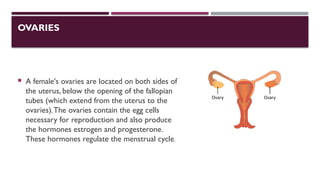
 A female's ovaries are located on both sides of
the uterus, below the opening of the fallopian
tubes (which extend from the uterus to the
ovaries).The ovaries contain the egg cells
necessary for reproduction and also produce
the hormones estrogen and progesterone.
These hormones regulate the menstrual cycle.
SECRETION OFTHE OVARIES:
 The ovaries produce several estrogen hormones and progesterone.These hormones
prepare the uterus for pregnancy promote the development of mammary glands.play
a role in sex drive and develop secondary sex characteristics in female. Estrogen is
essential for the growth and development of female sex organs. Both hyposecretion
and hypersecretion will have broad effects in female reproduction].Progesterone
Disorders are similar to estrogen
TESTES
 A male's testes are located in the scrotum.The testes produce testosterone and
sperm.The testes produce the hormone testosterone, which is responsible for the
development of male characteristics, and protects muscle and bone health.
SECRETIONS OFTHETESTES:
 The testes produce the male sex hormones called testosterone. It is essential for
normal growth and development of the male sex organs. • Testosterone is
responsible for the erection of the penis. Both hyposecretion and hypersecretion and
will have broad effects in male reproduction].
SECRETIONS OFTHE PLACENTA:
 During the pregnancy the placenta serves as an endocrine gland. It produces chronics
gonadotropin hormones estrogen and progesterone.
SECRETIONS OFTHE GASTROINTESTINAL MUCOSA:
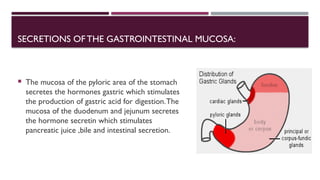
 The mucosa of the pyloric area of the stomach
secretes the hormones gastric which stimulates
the production of gastric acid for digestion.The
mucosa of the duodenum and jejunum secretes
the hormone secretin which stimulates
pancreatic juice ,bile and intestinal secretion.

Endocrine system anatomy presentation ps

  • 1.
    ENDOCRINE SYTEM DR HAFIZASHEHREEN DPT(KING EDWARD MEDICAL UNIVERSITY)
  • 2.
    GLANDS  Glands areimportant organs located throughout the body.They produce and release substances that perform certain functions.
  • 3.
    TYPES OF GLANDS Though you have many glands throughout your body, they fall into two types  1- Exocrine gland  2- Endocrine gland
  • 4.
    ENDOCRINE GLANDS  Endocrineglands are part of your endocrine system.They make hormones and release them into your bloodstream.These hormones control a number of important functions in your body, such as:  your growth and development  metabolism  mood  reproduction
  • 5.
     Your endocrineglands include:  adrenal glands  pituitary gland  hypothalamus  thyroid  pineal gland
  • 6.
    EXOCRINE GLANDS  Yourexocrine glands produce other substances — not hormones — that are released through ducts to the exterior of your body, such as sweat, saliva, and tears.  The substances released by your exocrine glands play important roles in your body. They do things like help regulate your body temperature, protect your skin and eyes, and even help mothers feed babies by producing breast milk.
  • 7.
     Your exocrineglands include:  salivary  sweat  mammary  sebaceous  lacrimal Lymph nodes are often referred to as glands, but they’re not true glands.They’re part of your immune system and help your body fight infection.
  • 8.
     The endocrinesystem is made up of different glands that make chemicals called hormones. Hormones act as "messengers" to control many body functions.The endocrine system makes hormones that help control:  Growth  Reproduction  Sexual development  Energy  Response to physical stress or trauma  Levels of water, salt and sugar in the body
  • 9.
     endocrine glandsare the primary hormone producer  The brain,heart,lungs,liver,skin,thymus,gastrointestinalmucosa and placenta also produce and release harmones
  • 10.
    PITUITARY GLAND:  Thepituitary gland is located at the base of the brain and is about the size of a pea. It is the master gland in the endocrine system. It regulates the amounts of hormone made by the thyroid gland, adrenal gland, and testes or ovaries. It also makes the hormones prolactin, vasopressin and growth hormone.
  • 11.
    SECRETION FROM ANTERIORPITUITARY GLAND:  1- Growth hormone  Are essential for the growth and development of bones, muscle and other organs. It enhances protein synthesis decrease the use of glucose and promotes fat destruction  Growth hormone [Hyper secretion of it during  childhood causes Gigantism, hypersecretion during  adulthood causes Acromegaly, and hyposecretion  causes Dwarfism].  2-Adrenocorticotropin(ACTH):  Essential for the growth and development of the adrenal cortex  ACTH [Hypersecretion causes Cushing’s  disease, while hyposecretion is rare].
  • 12.
    SECRETION OFTHE THYROIDGLAND:  3-Thyroid-Stimulating Hormones: •  (TSH) are essential for the growth and development of the thyroid gland •  [Hypersecretion causes Grave’s disease, and  hypo secretion causes cretinism in children and  myxedema in adults].  4- Follicle stimulating Hormone: •  (FSH) are gonadotropic hormone. It stimulates the growth ,ovarian follicles in the female and the production of sperm in male •[Hypersecretion causes no known  effects, while hyposecretion can cause failure of sexual maturation]
  • 13.
     5- LuteinizingHormone:  (LH) is a gonadotropic hormone stimulating the development of corpus luteim the female ovarian follicles and the production of testosterone in male[Disorders are similar to those for FSH  6- Prolactin:  (PRL) stimulates the development and growth of the mammary glands and milk production during pregnancy[Hypersecretion can disrupt  normal menstrual cycles in female and causes impotence in male;  and hyposecretion causes poor milk production in female].
  • 14.
     7- Melanocytestimulating Hormones:  (MSH) regulates skin pigmentation and promotes the deposit of melanin in the skin after exposure t0 sunlight[Hypersecretion causes abnormally dark skin pigment, and  hyposecretion causes abnormally light skin pigment]..
  • 15.
    SECRETION FROM THEPOSTERIOR LOB OF PITUITARY GLAND:  1- Oxytocin:  stimulates the uterus to contract during labor( delivery).A synthetic version of the hormone used to induce labor is called Pitocin . It also stimulates mammary glands to release milk. [Disorders are  rare and have no known effects, except in some  hyposecretion cases, weak labor contraction is  reported].
  • 16.
     2-Antiduretic Hormone: (ADH) stimulates the reabsorption of water by renal tubes. Hyposcreation of the hormone can result in diabetes insipidus[Hypersecretion  has no know effects, and hyposecretion causes  frequent urination called diabetes insipidus].
  • 17.
    SECRETION FROM PINEALGLAND:  1-Melatonin:  communicates information about environmental lighting to various part of body has some effect on sleep, awake cycle and other biological events connected to them Such as lower production of gastric secretions at night  2- Serotonin:  a neurotransmitter that regulates intestinal movements and affect appetite ,mood, sleep ,anger and metabolism.
  • 18.
    THYROID AND PARATHYROID The thyroid gland and parathyroid glands are located in front of the neck, below the larynx (voice box).The thyroid plays an important role in the body's growth and development, as well as weight and energy.
  • 19.
    SECRETION OF THETHYROID GLAND:  1- Calcitonin:  influence bone and calcium metabolism maintain a homeostasis of calcium in blood plasma. [Both hyposecretion and  hypersecretion would affect normal balances of calcium and phosphate  2-Thyroxine and triiodothyronine:  essential to BMR - basal metabolic rate ,influence physical,mental development of growth[Hyposecretion causes hypothyroidism, similar to  cretinism and myxedema, and hypersecretion causes hyperthyroidism  that results in a goiter or in Graves’ disease].
  • 20.
    SECRETIONS OF PARATHYROIDGLAND:  The two pairs of parathyroid gland are located on dorsal side of the thyroid gland.They secrete parathyroid(PTH) which play a role in the metabolism of phosphorus.Too little result in cramping.Too much results in osteoporosis or kidney stones. [Hyposecretion causes tetany, and  hypersecretion causes osteitis fibrosa cystica].
  • 21.
    ADRENAL GLAND  Theadrenal glands are located on top of each kidney.The adrenal glands make hormones that help the body to deal with stress and illness.The hormones made by the adrenal gland also maintain blood pressure and blood glucose, and play a role in sexual development.
  • 22.
    SECRETIONS FROMTHE ADRENALCORTEX:  1- Cortisol:  regulates carbohydrates, protein and fat metabolism has an anti-inflammatory effect help the body cope during times of stress  2- Corticosterone:  Like cortisol it is steroid influences potassium and sodium metabolism[Hyposecretion causes Addison’s disease ,  and hypersecretion causes Cushing’s syndrome].
  • 23.
     3- Aldosterone:•  Essential in regulating electrolyte and water balance by promoting sodium and chloride retention and potassium excretion. Hyposecretion causes Addison’s disease , and hypersecretion causes Cushing’s syndrome].  4- Androgens: •  Several hormones including testosterone they promote the development of secondary sex characteristics in the male. [Hyposecretion causes congenital adrenal hyperplasia, and hypersecretion causes gynecomastia in male
  • 24.
    SECRETIONS FROMTHE ADRENALMEDULLA  1- Dopamine:  is used to treat shock it dilates the arteries elevates systolic blood pressure. Increase cardiac output and increase urinary output  2- Epinephrine:  is also called adrenalin. It elevates systolic blood pressure. Increase heart rate and cardiac output. Speedup the release of glucose from liver giving a spurt of energy dilates the bronchial tubes and relaxes airways.
  • 25.
     3- Norepinephrine: Like epinephrine it release when the body is under stress.It creates the underlying influences in the fight or flight response. [No known effects are due to hyposecretion of these, but hypersecretion can caused hypertension, increased blood glucose level , and high heart rate].
  • 26.
    OVARIES  A female'sovaries are located on both sides of the uterus, below the opening of the fallopian tubes (which extend from the uterus to the ovaries).The ovaries contain the egg cells necessary for reproduction and also produce the hormones estrogen and progesterone. These hormones regulate the menstrual cycle.
  • 27.
    SECRETION OFTHE OVARIES: The ovaries produce several estrogen hormones and progesterone.These hormones prepare the uterus for pregnancy promote the development of mammary glands.play a role in sex drive and develop secondary sex characteristics in female. Estrogen is essential for the growth and development of female sex organs. Both hyposecretion and hypersecretion will have broad effects in female reproduction].Progesterone Disorders are similar to estrogen
  • 28.
    TESTES  A male'stestes are located in the scrotum.The testes produce testosterone and sperm.The testes produce the hormone testosterone, which is responsible for the development of male characteristics, and protects muscle and bone health.
  • 29.
    SECRETIONS OFTHETESTES:  Thetestes produce the male sex hormones called testosterone. It is essential for normal growth and development of the male sex organs. • Testosterone is responsible for the erection of the penis. Both hyposecretion and hypersecretion and will have broad effects in male reproduction].
  • 30.
    SECRETIONS OFTHE PLACENTA: During the pregnancy the placenta serves as an endocrine gland. It produces chronics gonadotropin hormones estrogen and progesterone.
  • 31.
    SECRETIONS OFTHE GASTROINTESTINALMUCOSA:  The mucosa of the pyloric area of the stomach secretes the hormones gastric which stimulates the production of gastric acid for digestion.The mucosa of the duodenum and jejunum secretes the hormone secretin which stimulates pancreatic juice ,bile and intestinal secretion.