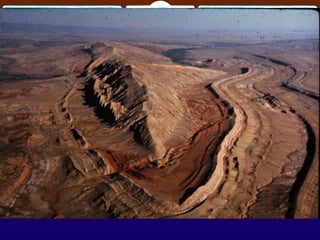
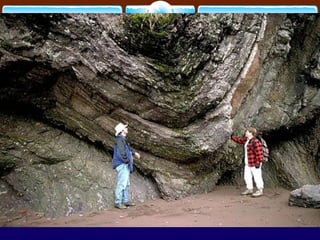
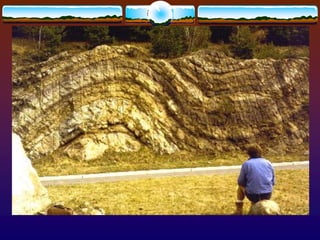
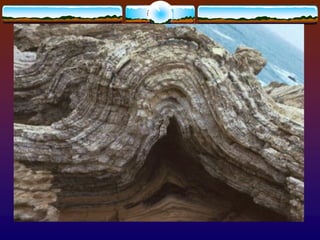
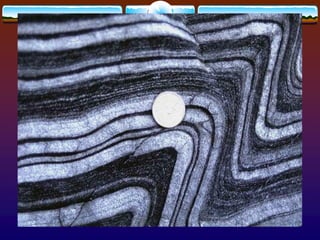
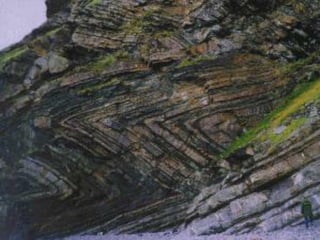
4. DEFORMASI BATUAN
Tegangan yang terjadi akibat gerakan tektonik tersebut
mempunyai arah sejajar permukaan bumi (mendatar) dari segala arah
dan tegangan yang lain berasal dari dalam bumi ke arah permukaan
bumi (vertikal). Kekuatan tegangan-tegangan tersebut berbeda satu
sama lain baik arah mendatar maupun yang berarah vertikal, oleh
karenanya tegangan ini sering dikenal dengan tegangan utama
(principal stress). Berdasarkan perbedaan kekuatan tegangan tersebut
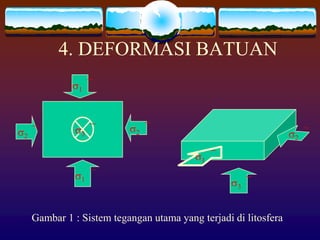
dibedakan menjadi 3 bagian yaitu (s1) Tegangan utama maksimum,
(s2) Tegangan utama menengah, dan (s3). Faktor lain yang
berpengaruh adalah sifat fisik dan mekanik batuan, seperti misalnya
bila batuan bersifat plastis maka batuan akan mengalami pelipatan
teta[I bila btuan bersifat tegar (rigid) maka batuan akan retak/pecah.
4. DEFORMASI BATUAN
Gambar 1 : Sistem tegangan utama yang terjadi di litosfera
s2`s2` s3`
s1`
s1`
s3`
s2`
s1`
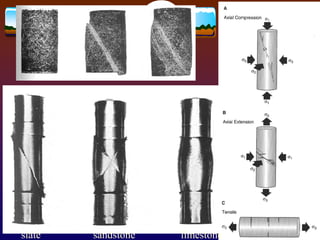
slate sandstone limestone
STRUKTUR GEOLOGI
Deformasi batuan adalah perubahan lapisan kerak bumi yang
diakibatkan adanya tegangan yang bersasal dari gerakan
tektonik
Hasil dari proses deformasi batuan dikenal dengan Struktur geologi.
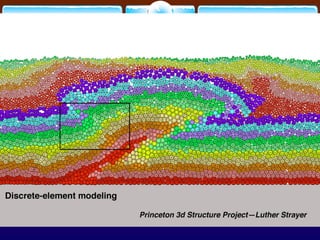
Struktur geologi adalah bentuk arsitektural lapisan batuan yang muncul
dipermukaan bumi.
Struktur geologi dapat dibedakan menjadi 4 macam yaitu :
1. Struktur kekar (joint)
2. Struktur patahan (fault)
3. Struktur lipatan (fold)
4. Struktur ketidakselarasan (unconformity)
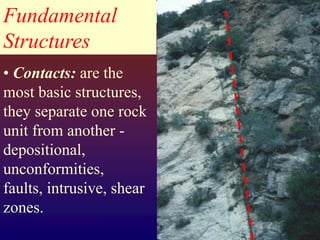
Fundamental
Structures
• Contacts: are the
most basic structures,
they separate one rock
unit from another -
depositional,
unconformities,
faults, intrusive, shear
zones.
Fundamental Structures
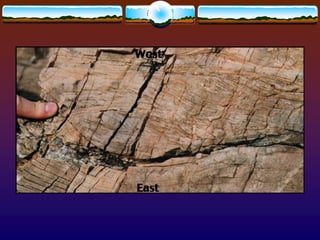
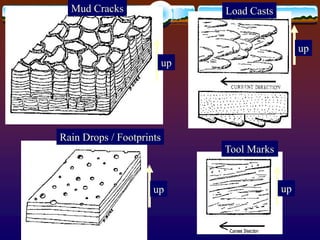
• Primary Structures: These are sedimentary
structures that may be in strata prior to
deformation. They may be quite useful as strain
markers (giving us an initial state) and as way-
up indicators, etc.
• They must not be mistaken for secondary
structures, which are the result of deformation.
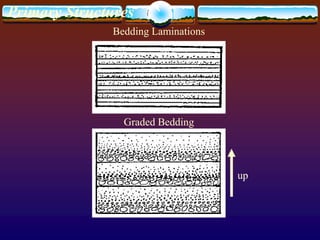
Bedding Laminations
Graded Bedding
up
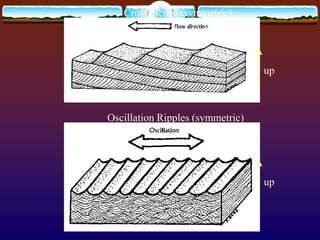
Primary Structures
Cross-Beds (asymmetric)
Oscillation Ripples (symmetric)
up
up
up
up
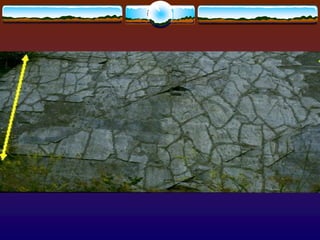
Mud Cracks
Rain Drops / Footprints
Load Casts
Tool Marks
up
up
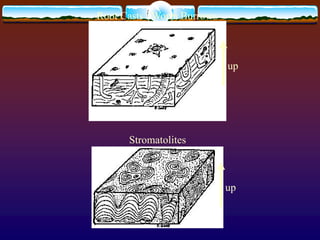
Root Casts / Worm Burrows
Stromatolites
up
up
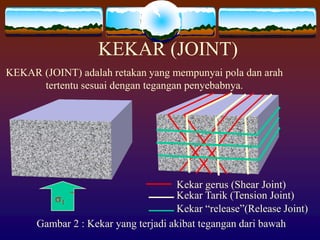
KEKAR (JOINT)
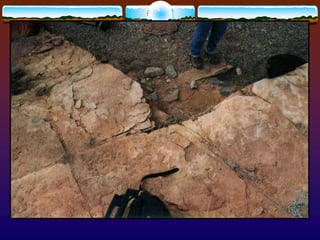
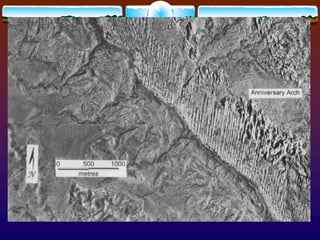
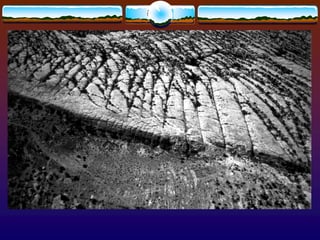
KEKAR (JOINT) adalah retakan yang mempunyai pola dan arah
tertentu sesuai dengan tegangan penyebabnya.
Gambar 2 : Kekar yang terjadi akibat tegangan dari bawah
s1`
Kekar gerus (Shear Joint)
Kekar Tarik (Tension Joint)
Kekar “release”(Release Joint)
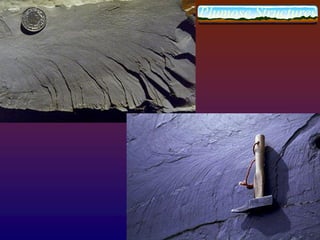
Plumose Structures
Secondary Structures
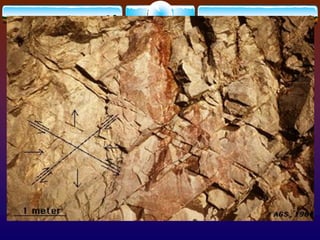
Shear fractures:
• Form in response to a very slight shearing
movement parallel to the plane of the fracture.
• Commonly found in conjugate sets, in rocks
that have been folded or faulted.
Secondary Structures
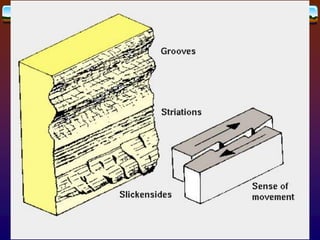
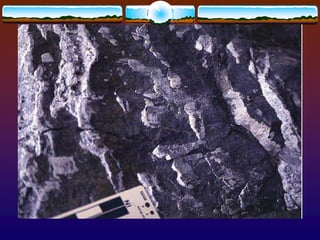
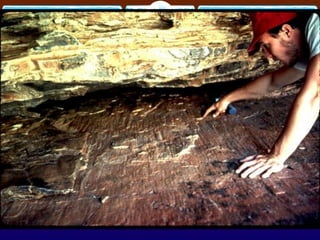
Slickensides, slickenlines:
• Effectively, they are small scratches that form
in response to motion on a fault.
• May be the result of very large or very small
displacements.
• Lines indicate direction of motion. Steps in
rock or mineral coatings may indicate sense of
slip.
KEKAR NON TEKTONIK
1. Kekar Tiang (columnar joint)
2. Kekar lembar (sheeting joint)
PATAHAN
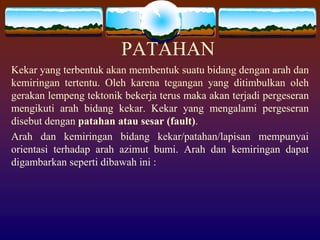
Kekar yang terbentuk akan membentuk suatu bidang dengan arah dan
kemiringan tertentu. Oleh karena tegangan yang ditimbulkan oleh
gerakan lempeng tektonik bekerja terus maka akan terjadi pergeseran
mengikuti arah bidang kekar. Kekar yang mengalami pergeseran
disebut dengan patahan atau sesar (fault).
Arah dan kemiringan bidang kekar/patahan/lapisan mempunyai
orientasi terhadap arah azimut bumi. Arah dan kemiringan dapat
digambarkan seperti dibawah ini :
PATAHAN
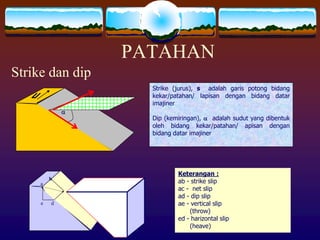
Strike dan dip
Strike (jurus), s adalah garis potong bidang
kekar/patahan/ lapisan dengan bidang datar
imajiner
Dip (kemiringan), a adalah sudut yang dibentuk
oleh bidang kekar/patahan/ apisan dengan
bidang datar imajiner
a
c
Keterangan :
ab - strike slip
ac - net slip
ad - dip slip
ae - vertical slip
(throw)
ed - harizontal slip
(heave)
a
de
b
PATAHAN
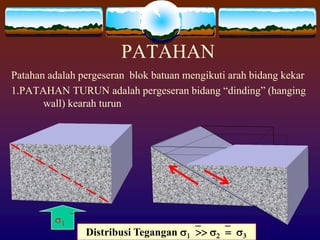
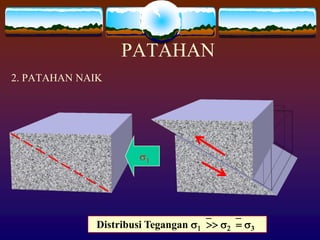
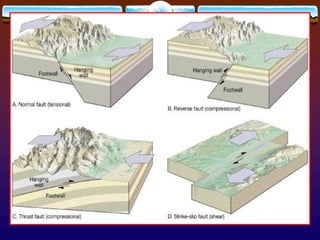
Patahan adalah pergeseran blok batuan mengikuti arah bidang kekar
1.PATAHAN TURUN adalah pergeseran bidang “dinding” (hanging
wall) kearah turun
s1`
Distribusi Tegangan s1`>> s2`= s3
PATAHAN
2. PATAHAN NAIK
s1
Distribusi Tegangan s1`>> s2`= s3
PATAHAN
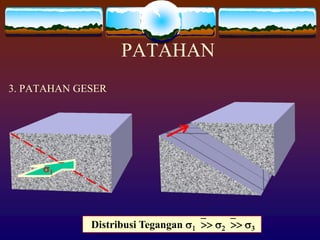
3. PATAHAN GESER
Distribusi Tegangan s1`>> s2`>> s3
s1`
PATAHAN
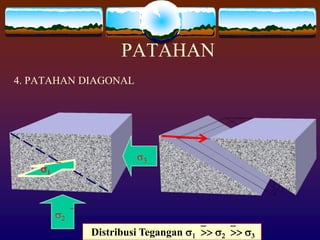
4. PATAHAN DIAGONAL
s1`
s2`
s3
Distribusi Tegangan s1`>> s2`>> s3
LIPATAN
There can be two (2) resulting responses to stress:
1. Ductile deformation -- usually occurring deeper and with higher
temperatures; flow
2. Brittle deformation -- usually occurring shallower and with cooler
temperatures
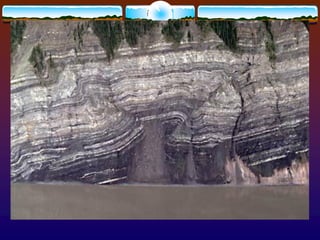
Ductile deformation produces folds:
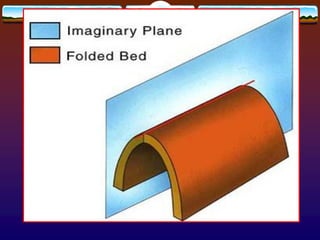
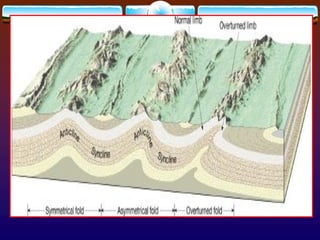
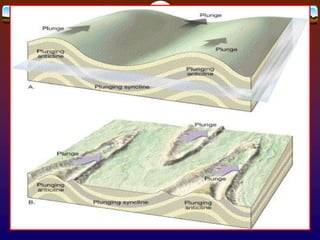
1. Anticline -- upwarping of rocks to produce an "A-like" structure
2. Syncline -- downwarping of rocks to produce "spoon-like" structure
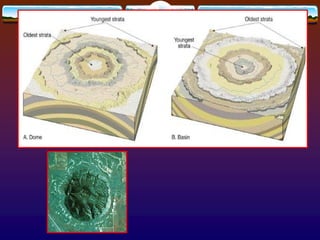
3. Dome -- three-dimensional anticline resembling inverted cereal bowl
4. Basin -- three-dimensional syncline resembling upright cereal bowl
* When brittle deformation occurs and rocks fracture, they can simply
crack producing a fracture with no offset, called a joint (= kekar).
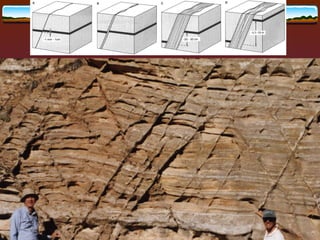
When brittle deformation occurs and rocks fracture, they
can also crack producing a fracture with offset,
called a fault (= patahan = sesar).
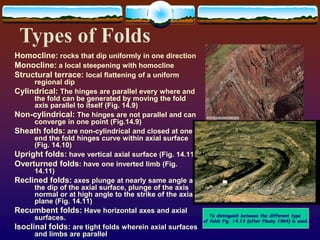
Homocline: rocks that dip uniformly in one direction
Monocline: a local steepening with homocline
Structural terrace: local flattening of a uniform
regional dip
Cylindrical: The hinges are parallel every where and
the fold can be generated by moving the fold
axis parallel to itself (Fig. 14.9)
Non-cylindrical: The hinges are not parallel and can
converge in one point (Fig.14.9)
Sheath folds: are non-cylindrical and closed at one
end the fold hinges curve within axial surface
(Fig. 14.10)
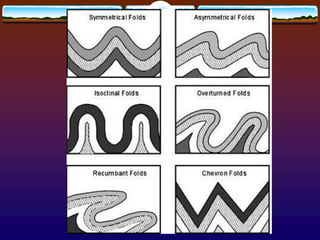
Upright folds: have vertical axial surface (Fig. 14.11)
Overturned folds: have one inverted limb (Fig.
14.11)
Reclined folds: axes plunge at nearly same angle as
the dip of the axial surface, plunge of the axis
normal or at high angle to the strike of the axial
plane (Fig. 14.11)
Recumbent folds: Have horizontal axes and axial
surfaces.
Isoclinal folds: are tight folds wherein axial surfaces
and limbs are parallel
To distinguish between the different type
of folds Fig. 14.13 (after Fleuty 1964) is used.
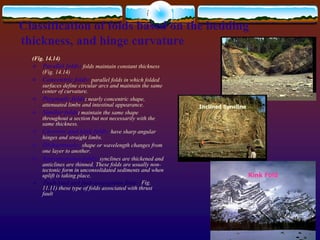
(Fig. 14.14)
 Parallel folds: folds maintain constant thickness
(Fig. 14.14)
 Concentric folds: parallel folds in which folded
surfaces define circular arcs and maintain the same
center of curvature.
 Ptygmatic folds: nearly concentric shape,
attenuated limbs and intestinal appearance.
 Similar folds: maintain the same shape
throughout a section but not necessarily with the
same thickness.
 Chevron and kink folds: have sharp angular
hinges and straight limbs.
 Disharmonic: shape or wavelength changes from
one layer to another.
 Supratenuous folds: synclines are thickened and
anticlines are thinned. These folds are usually non-
tectonic form in unconsolidated sediments and when
uplift is taking place.
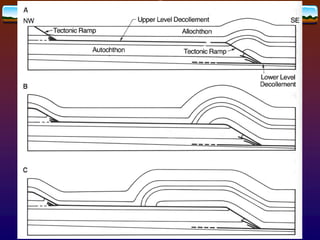
 Fault-bend and fault-propagation folds: (Fig.
11.11) these type of folds associated with thrust
fault
Deformasi batuan
Deformasi batuan
Deformasi batuan
Deformasi batuan
Deformasi batuan
Deformasi batuan
Deformasi batuan
Deformasi batuan
Deformasi batuan
Deformasi batuan

Deformasi batuan

  • 1.
    4. DEFORMASI BATUAN Teganganyang terjadi akibat gerakan tektonik tersebut mempunyai arah sejajar permukaan bumi (mendatar) dari segala arah dan tegangan yang lain berasal dari dalam bumi ke arah permukaan bumi (vertikal). Kekuatan tegangan-tegangan tersebut berbeda satu sama lain baik arah mendatar maupun yang berarah vertikal, oleh karenanya tegangan ini sering dikenal dengan tegangan utama (principal stress). Berdasarkan perbedaan kekuatan tegangan tersebut dibedakan menjadi 3 bagian yaitu (s1) Tegangan utama maksimum, (s2) Tegangan utama menengah, dan (s3). Faktor lain yang berpengaruh adalah sifat fisik dan mekanik batuan, seperti misalnya bila batuan bersifat plastis maka batuan akan mengalami pelipatan teta[I bila btuan bersifat tegar (rigid) maka batuan akan retak/pecah.
  • 2.
    4. DEFORMASI BATUAN Gambar1 : Sistem tegangan utama yang terjadi di litosfera s2`s2` s3` s1` s1` s3` s2` s1`
  • 3.
  • 4.
    STRUKTUR GEOLOGI Deformasi batuanadalah perubahan lapisan kerak bumi yang diakibatkan adanya tegangan yang bersasal dari gerakan tektonik Hasil dari proses deformasi batuan dikenal dengan Struktur geologi. Struktur geologi adalah bentuk arsitektural lapisan batuan yang muncul dipermukaan bumi. Struktur geologi dapat dibedakan menjadi 4 macam yaitu : 1. Struktur kekar (joint) 2. Struktur patahan (fault) 3. Struktur lipatan (fold) 4. Struktur ketidakselarasan (unconformity)
  • 5.
    Fundamental Structures • Contacts: arethe most basic structures, they separate one rock unit from another - depositional, unconformities, faults, intrusive, shear zones.
  • 6.
    Fundamental Structures • PrimaryStructures: These are sedimentary structures that may be in strata prior to deformation. They may be quite useful as strain markers (giving us an initial state) and as way- up indicators, etc. • They must not be mistaken for secondary structures, which are the result of deformation.
  • 7.
  • 8.
  • 10.
    up up Mud Cracks Rain Drops/ Footprints Load Casts Tool Marks up up
  • 12.
    Root Casts /Worm Burrows Stromatolites up up
  • 13.
    KEKAR (JOINT) KEKAR (JOINT)adalah retakan yang mempunyai pola dan arah tertentu sesuai dengan tegangan penyebabnya. Gambar 2 : Kekar yang terjadi akibat tegangan dari bawah s1` Kekar gerus (Shear Joint) Kekar Tarik (Tension Joint) Kekar “release”(Release Joint)
  • 17.
  • 18.
    Secondary Structures Shear fractures: •Form in response to a very slight shearing movement parallel to the plane of the fracture. • Commonly found in conjugate sets, in rocks that have been folded or faulted.
  • 20.
    Secondary Structures Slickensides, slickenlines: •Effectively, they are small scratches that form in response to motion on a fault. • May be the result of very large or very small displacements. • Lines indicate direction of motion. Steps in rock or mineral coatings may indicate sense of slip.
  • 24.
    KEKAR NON TEKTONIK 1.Kekar Tiang (columnar joint) 2. Kekar lembar (sheeting joint)
  • 25.
    PATAHAN Kekar yang terbentukakan membentuk suatu bidang dengan arah dan kemiringan tertentu. Oleh karena tegangan yang ditimbulkan oleh gerakan lempeng tektonik bekerja terus maka akan terjadi pergeseran mengikuti arah bidang kekar. Kekar yang mengalami pergeseran disebut dengan patahan atau sesar (fault). Arah dan kemiringan bidang kekar/patahan/lapisan mempunyai orientasi terhadap arah azimut bumi. Arah dan kemiringan dapat digambarkan seperti dibawah ini :
  • 26.
    PATAHAN Strike dan dip Strike(jurus), s adalah garis potong bidang kekar/patahan/ lapisan dengan bidang datar imajiner Dip (kemiringan), a adalah sudut yang dibentuk oleh bidang kekar/patahan/ apisan dengan bidang datar imajiner a c Keterangan : ab - strike slip ac - net slip ad - dip slip ae - vertical slip (throw) ed - harizontal slip (heave) a de b
  • 27.
    PATAHAN Patahan adalah pergeseranblok batuan mengikuti arah bidang kekar 1.PATAHAN TURUN adalah pergeseran bidang “dinding” (hanging wall) kearah turun s1` Distribusi Tegangan s1`>> s2`= s3
  • 28.
  • 29.
    PATAHAN 3. PATAHAN GESER DistribusiTegangan s1`>> s2`>> s3 s1`
  • 30.
  • 38.
  • 39.
    There can betwo (2) resulting responses to stress: 1. Ductile deformation -- usually occurring deeper and with higher temperatures; flow 2. Brittle deformation -- usually occurring shallower and with cooler temperatures Ductile deformation produces folds: 1. Anticline -- upwarping of rocks to produce an "A-like" structure 2. Syncline -- downwarping of rocks to produce "spoon-like" structure 3. Dome -- three-dimensional anticline resembling inverted cereal bowl 4. Basin -- three-dimensional syncline resembling upright cereal bowl * When brittle deformation occurs and rocks fracture, they can simply crack producing a fracture with no offset, called a joint (= kekar). When brittle deformation occurs and rocks fracture, they can also crack producing a fracture with offset, called a fault (= patahan = sesar).
  • 41.
    Homocline: rocks thatdip uniformly in one direction Monocline: a local steepening with homocline Structural terrace: local flattening of a uniform regional dip Cylindrical: The hinges are parallel every where and the fold can be generated by moving the fold axis parallel to itself (Fig. 14.9) Non-cylindrical: The hinges are not parallel and can converge in one point (Fig.14.9) Sheath folds: are non-cylindrical and closed at one end the fold hinges curve within axial surface (Fig. 14.10) Upright folds: have vertical axial surface (Fig. 14.11) Overturned folds: have one inverted limb (Fig. 14.11) Reclined folds: axes plunge at nearly same angle as the dip of the axial surface, plunge of the axis normal or at high angle to the strike of the axial plane (Fig. 14.11) Recumbent folds: Have horizontal axes and axial surfaces. Isoclinal folds: are tight folds wherein axial surfaces and limbs are parallel To distinguish between the different type of folds Fig. 14.13 (after Fleuty 1964) is used.
  • 43.
    (Fig. 14.14)  Parallelfolds: folds maintain constant thickness (Fig. 14.14)  Concentric folds: parallel folds in which folded surfaces define circular arcs and maintain the same center of curvature.  Ptygmatic folds: nearly concentric shape, attenuated limbs and intestinal appearance.  Similar folds: maintain the same shape throughout a section but not necessarily with the same thickness.  Chevron and kink folds: have sharp angular hinges and straight limbs.  Disharmonic: shape or wavelength changes from one layer to another.  Supratenuous folds: synclines are thickened and anticlines are thinned. These folds are usually non- tectonic form in unconsolidated sediments and when uplift is taking place.  Fault-bend and fault-propagation folds: (Fig. 11.11) these type of folds associated with thrust fault