1/26
Deformable Part Models are Convolutional
Neural Networks
Ross Girshick, Forrest Iandola, Trevor Darrell, Jitendra Malik
Presentor: YANG Wei
January 25, 2016
2/26
Outline
1 Introduction
2 DeepPyramid DPMs
Feature pyramid front-end CNN
Constructing an equivalent CNN from a DPM
3 Implementation details
4 Experiments
3/26
Outline
1 Introduction
2 DeepPyramid DPMs
Feature pyramid front-end CNN
Constructing an equivalent CNN from a DPM
3 Implementation details
4 Experiments
4/26
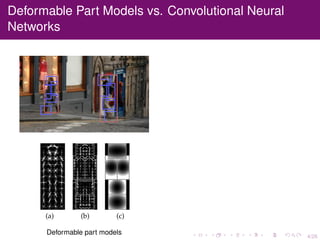
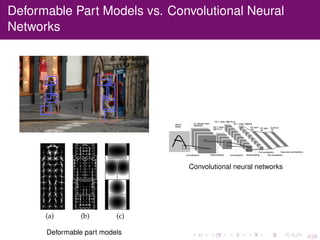
Deformable Part Models vs. Convolutional Neural
Networks
Deformable part models
4/26
Deformable Part Models vs. Convolutional Neural
Networks
Deformable part models
Convolutional neural networks
5/26
Are DPMs and CNNs actually distinct?
DPMs: graphical models
CNNs: “black-box” non-linear classifiers
This paper shows that any DPM can be formulated as an
equivalent CNN, i.e., deformable part models are convolutional
neural networks.
6/26
Outline
1 Introduction
2 DeepPyramid DPMs
Feature pyramid front-end CNN
Constructing an equivalent CNN from a DPM
3 Implementation details
4 Experiments
7/26
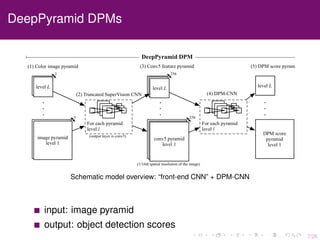
DeepPyramid DPMs
Schematic model overview: “front-end CNN” + DPM-CNN
input: image pyramid
output: object detection scores
8/26
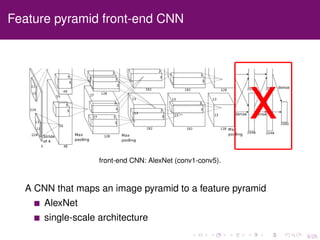
Feature pyramid front-end CNN
front-end CNN: AlexNet (conv1-conv5).
A CNN that maps an image pyramid to a feature pyramid
AlexNet
single-scale architecture
9/26
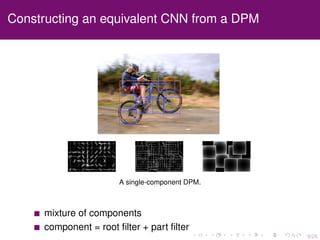
Constructing an equivalent CNN from a DPM
A single-component DPM.
mixture of components
component = root filter + part filter
10/26
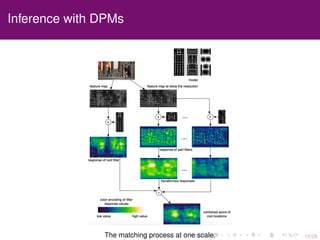
Inference with DPMs
The matching process at one scale.
11/26
Architecture of DPM-CNN
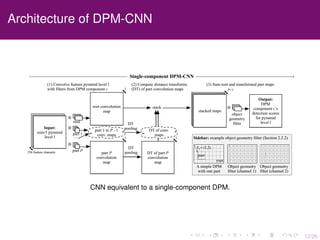
The unrolled detection algorithm of DPM generates a specific
network with fixed length:
1 input: conv5 feature pyramid of front-end CNN
11/26
Architecture of DPM-CNN
The unrolled detection algorithm of DPM generates a specific
network with fixed length:
1 input: conv5 feature pyramid of front-end CNN
2 generate P+1 feature maps: 1 root filter and P part filters
11/26
Architecture of DPM-CNN
The unrolled detection algorithm of DPM generates a specific
network with fixed length:
1 input: conv5 feature pyramid of front-end CNN
2 generate P+1 feature maps: 1 root filter and P part filters
3 P part feature maps are fed into distance transform layer
11/26
Architecture of DPM-CNN
The unrolled detection algorithm of DPM generates a specific
network with fixed length:
1 input: conv5 feature pyramid of front-end CNN
2 generate P+1 feature maps: 1 root filter and P part filters
3 P part feature maps are fed into distance transform layer
4 root feature map are stacked (channel-wise concatenated)
with the transformed part feature maps
11/26
Architecture of DPM-CNN
The unrolled detection algorithm of DPM generates a specific
network with fixed length:
1 input: conv5 feature pyramid of front-end CNN
2 generate P+1 feature maps: 1 root filter and P part filters
3 P part feature maps are fed into distance transform layer
4 root feature map are stacked (channel-wise concatenated)
with the transformed part feature maps
5 The resulting P+1 channel feature map is convolved with
an object geometry filter, which produces the output DPM
score map for the input pyramid level
12/26
Architecture of DPM-CNN
CNN equivalent to a single-component DPM.
13/26
Traditional distance transform
Traditional distance transforms are defined for sets of points on
a grid [FH05].
G: grid
d(p−q): measure of
distance between points
p,q ∈ G
B ⊆ G
Then the distance transform of
B on G
DB(p) = min
q∈B
d(p−q)
Distance transform (Euclidean distance)
14/26
Traditional distance transform
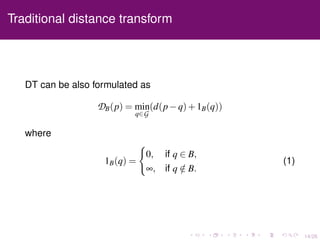
DT can be also formulated as
DB(p) = min
q∈G
(d(p−q)+1B(q))
where
1B(q) =
0, if q ∈ B,
∞, if q /∈ B.
(1)
15/26
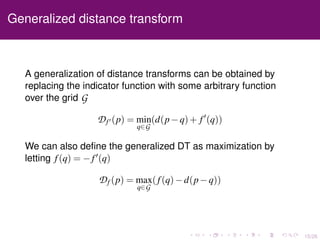
Generalized distance transform
A generalization of distance transforms can be obtained by
replacing the indicator function with some arbitrary function
over the grid G
Df (p) = min
q∈G
(d(p−q)+ f (q))
We can also define the generalized DT as maximization by
letting f(q) = −f (q)
Df (p) = max
q∈G
(f(q)−d(p−q))
16/26
Distance transform in DPM
In DPM, after computing filter responses we transform the
responses of the part filters to allow spatial uncertainty,
Di(x,y) = max
dx,dy
(Ri(x+dx,y+dy)−wi ·φd(dx,dy))
where
φd(dx,dy) = [dx,dy,dx2
,,dy2
]
The value Di(x,y) is the maximum contribution of the part
to the score of a root location that places the anchor of this
part at position (x,y).
16/26
Distance transform in DPM
In DPM, after computing filter responses we transform the
responses of the part filters to allow spatial uncertainty,
Di(x,y) = max
dx,dy
(Ri(x+dx,y+dy)−wi ·φd(dx,dy))
where
φd(dx,dy) = [dx,dy,dx2
,,dy2
]
The value Di(x,y) is the maximum contribution of the part
to the score of a root location that places the anchor of this
part at position (x,y).
By letting p = (x,y), p−q = (dx,dy) and
d(p−q) = w·φ(p−q), we can see that it is exactly in the
form of distance transform.
17/26
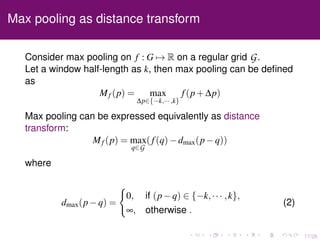
Max pooling as distance transform
Consider max pooling on f : G → R on a regular grid G.
Let a window half-length as k, then max pooling can be defined
as
Mf (p) = max
∆p∈{−k,···,k}
f(p+∆p)
Max pooling can be expressed equivalently as distance
transform:
Mf (p) = max
q∈G
(f(q)−dmax(p−q))
where
dmax(p−q) =
0, if (p−q) ∈ {−k,··· ,k},
∞, otherwise .
(2)
18/26
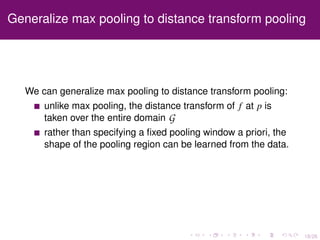
Generalize max pooling to distance transform pooling
We can generalize max pooling to distance transform pooling:
unlike max pooling, the distance transform of f at p is
taken over the entire domain G
rather than specifying a fixed pooling window a priori, the
shape of the pooling region can be learned from the data.
18/26
Generalize max pooling to distance transform pooling
We can generalize max pooling to distance transform pooling:
unlike max pooling, the distance transform of f at p is
taken over the entire domain G
rather than specifying a fixed pooling window a priori, the
shape of the pooling region can be learned from the data.
The released code does not include the DT pooling layer.
Please refer to [OW13] for more details.
19/26
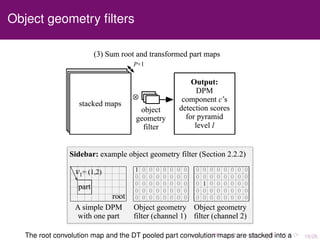
Object geometry filters
The root convolution map and the DT pooled part convolution maps are stacked into a
20/26
Combining mixture components with maxout
CNN equivalent to a multi-component DPM. A multi-component DPM-CNN is
composed of one DPM-CNN per component and a maxout [GWFM+13] layer that
takes a max over component DPM-CNN outputs at each location.
21/26
Outline
1 Introduction
2 DeepPyramid DPMs
Feature pyramid front-end CNN
Constructing an equivalent CNN from a DPM
3 Implementation details
4 Experiments
22/26
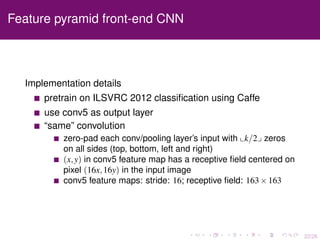
Feature pyramid front-end CNN
Implementation details
pretrain on ILSVRC 2012 classification using Caffe
use conv5 as output layer
“same” convolution
zero-pad each conv/pooling layer’s input with k/2 zeros
on all sides (top, bottom, left and right)
(x,y) in conv5 feature map has a receptive field centered on
pixel (16x,16y) in the input image
conv5 feature maps: stride: 16; receptive field: 163×163
23/26
Outline
1 Introduction
2 DeepPyramid DPMs
Feature pyramid front-end CNN
Constructing an equivalent CNN from a DPM
3 Implementation details
4 Experiments
24/26
Experiments
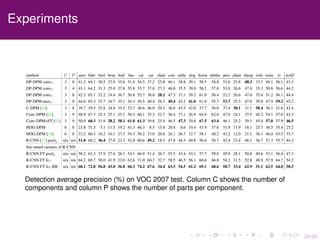
Detection average precision (%) on VOC 2007 test. Column C shows the number of
components and column P shows the number of parts per component.
25/26
Experiments
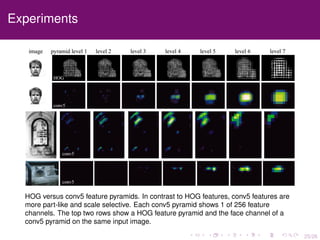
HOG versus conv5 feature pyramids. In contrast to HOG features, conv5 features are
more part-like and scale selective. Each conv5 pyramid shows 1 of 256 feature
channels. The top two rows show a HOG feature pyramid and the face channel of a
conv5 pyramid on the same input image.
26/26
References
Pedro F Felzenszwalb and Daniel P Huttenlocher, Pictorial structures for object
recognition, International Journal of Computer Vision 61 (2005), no. 1, 55–79.
Ian J Goodfellow, David Warde-Farley, Mehdi Mirza, Aaron Courville, and Yoshua
Bengio, Maxout networks, arXiv preprint arXiv:1302.4389 (2013).
Wanli Ouyang and Xiaogang Wang, Joint deep learning for pedestrian detection,
ICCV, IEEE, 2013, pp. 2056–2063.

Deformable Part Models are Convolutional Neural Networks

  • 1.
    1/26 Deformable Part Modelsare Convolutional Neural Networks Ross Girshick, Forrest Iandola, Trevor Darrell, Jitendra Malik Presentor: YANG Wei January 25, 2016
  • 2.
    2/26 Outline 1 Introduction 2 DeepPyramidDPMs Feature pyramid front-end CNN Constructing an equivalent CNN from a DPM 3 Implementation details 4 Experiments
  • 3.
    3/26 Outline 1 Introduction 2 DeepPyramidDPMs Feature pyramid front-end CNN Constructing an equivalent CNN from a DPM 3 Implementation details 4 Experiments
  • 4.
    4/26 Deformable Part Modelsvs. Convolutional Neural Networks Deformable part models
  • 5.
    4/26 Deformable Part Modelsvs. Convolutional Neural Networks Deformable part models Convolutional neural networks
  • 6.
    5/26 Are DPMs andCNNs actually distinct? DPMs: graphical models CNNs: “black-box” non-linear classifiers This paper shows that any DPM can be formulated as an equivalent CNN, i.e., deformable part models are convolutional neural networks.
  • 7.
    6/26 Outline 1 Introduction 2 DeepPyramidDPMs Feature pyramid front-end CNN Constructing an equivalent CNN from a DPM 3 Implementation details 4 Experiments
  • 8.
    7/26 DeepPyramid DPMs Schematic modeloverview: “front-end CNN” + DPM-CNN input: image pyramid output: object detection scores
  • 9.
    8/26 Feature pyramid front-endCNN front-end CNN: AlexNet (conv1-conv5). A CNN that maps an image pyramid to a feature pyramid AlexNet single-scale architecture
  • 10.
    9/26 Constructing an equivalentCNN from a DPM A single-component DPM. mixture of components component = root filter + part filter
  • 11.
    10/26 Inference with DPMs Thematching process at one scale.
  • 12.
    11/26 Architecture of DPM-CNN Theunrolled detection algorithm of DPM generates a specific network with fixed length: 1 input: conv5 feature pyramid of front-end CNN
  • 13.
    11/26 Architecture of DPM-CNN Theunrolled detection algorithm of DPM generates a specific network with fixed length: 1 input: conv5 feature pyramid of front-end CNN 2 generate P+1 feature maps: 1 root filter and P part filters
  • 14.
    11/26 Architecture of DPM-CNN Theunrolled detection algorithm of DPM generates a specific network with fixed length: 1 input: conv5 feature pyramid of front-end CNN 2 generate P+1 feature maps: 1 root filter and P part filters 3 P part feature maps are fed into distance transform layer
  • 15.
    11/26 Architecture of DPM-CNN Theunrolled detection algorithm of DPM generates a specific network with fixed length: 1 input: conv5 feature pyramid of front-end CNN 2 generate P+1 feature maps: 1 root filter and P part filters 3 P part feature maps are fed into distance transform layer 4 root feature map are stacked (channel-wise concatenated) with the transformed part feature maps
  • 16.
    11/26 Architecture of DPM-CNN Theunrolled detection algorithm of DPM generates a specific network with fixed length: 1 input: conv5 feature pyramid of front-end CNN 2 generate P+1 feature maps: 1 root filter and P part filters 3 P part feature maps are fed into distance transform layer 4 root feature map are stacked (channel-wise concatenated) with the transformed part feature maps 5 The resulting P+1 channel feature map is convolved with an object geometry filter, which produces the output DPM score map for the input pyramid level
  • 17.
    12/26 Architecture of DPM-CNN CNNequivalent to a single-component DPM.
  • 18.
    13/26 Traditional distance transform Traditionaldistance transforms are defined for sets of points on a grid [FH05]. G: grid d(p−q): measure of distance between points p,q ∈ G B ⊆ G Then the distance transform of B on G DB(p) = min q∈B d(p−q) Distance transform (Euclidean distance)
  • 19.
    14/26 Traditional distance transform DTcan be also formulated as DB(p) = min q∈G (d(p−q)+1B(q)) where 1B(q) = 0, if q ∈ B, ∞, if q /∈ B. (1)
  • 20.
    15/26 Generalized distance transform Ageneralization of distance transforms can be obtained by replacing the indicator function with some arbitrary function over the grid G Df (p) = min q∈G (d(p−q)+ f (q)) We can also define the generalized DT as maximization by letting f(q) = −f (q) Df (p) = max q∈G (f(q)−d(p−q))
  • 21.
    16/26 Distance transform inDPM In DPM, after computing filter responses we transform the responses of the part filters to allow spatial uncertainty, Di(x,y) = max dx,dy (Ri(x+dx,y+dy)−wi ·φd(dx,dy)) where φd(dx,dy) = [dx,dy,dx2 ,,dy2 ] The value Di(x,y) is the maximum contribution of the part to the score of a root location that places the anchor of this part at position (x,y).
  • 22.
    16/26 Distance transform inDPM In DPM, after computing filter responses we transform the responses of the part filters to allow spatial uncertainty, Di(x,y) = max dx,dy (Ri(x+dx,y+dy)−wi ·φd(dx,dy)) where φd(dx,dy) = [dx,dy,dx2 ,,dy2 ] The value Di(x,y) is the maximum contribution of the part to the score of a root location that places the anchor of this part at position (x,y). By letting p = (x,y), p−q = (dx,dy) and d(p−q) = w·φ(p−q), we can see that it is exactly in the form of distance transform.
  • 23.
    17/26 Max pooling asdistance transform Consider max pooling on f : G → R on a regular grid G. Let a window half-length as k, then max pooling can be defined as Mf (p) = max ∆p∈{−k,···,k} f(p+∆p) Max pooling can be expressed equivalently as distance transform: Mf (p) = max q∈G (f(q)−dmax(p−q)) where dmax(p−q) = 0, if (p−q) ∈ {−k,··· ,k}, ∞, otherwise . (2)
  • 24.
    18/26 Generalize max poolingto distance transform pooling We can generalize max pooling to distance transform pooling: unlike max pooling, the distance transform of f at p is taken over the entire domain G rather than specifying a fixed pooling window a priori, the shape of the pooling region can be learned from the data.
  • 25.
    18/26 Generalize max poolingto distance transform pooling We can generalize max pooling to distance transform pooling: unlike max pooling, the distance transform of f at p is taken over the entire domain G rather than specifying a fixed pooling window a priori, the shape of the pooling region can be learned from the data. The released code does not include the DT pooling layer. Please refer to [OW13] for more details.
  • 26.
    19/26 Object geometry filters Theroot convolution map and the DT pooled part convolution maps are stacked into a
  • 27.
    20/26 Combining mixture componentswith maxout CNN equivalent to a multi-component DPM. A multi-component DPM-CNN is composed of one DPM-CNN per component and a maxout [GWFM+13] layer that takes a max over component DPM-CNN outputs at each location.
  • 28.
    21/26 Outline 1 Introduction 2 DeepPyramidDPMs Feature pyramid front-end CNN Constructing an equivalent CNN from a DPM 3 Implementation details 4 Experiments
  • 29.
    22/26 Feature pyramid front-endCNN Implementation details pretrain on ILSVRC 2012 classification using Caffe use conv5 as output layer “same” convolution zero-pad each conv/pooling layer’s input with k/2 zeros on all sides (top, bottom, left and right) (x,y) in conv5 feature map has a receptive field centered on pixel (16x,16y) in the input image conv5 feature maps: stride: 16; receptive field: 163×163
  • 30.
    23/26 Outline 1 Introduction 2 DeepPyramidDPMs Feature pyramid front-end CNN Constructing an equivalent CNN from a DPM 3 Implementation details 4 Experiments
  • 31.
    24/26 Experiments Detection average precision(%) on VOC 2007 test. Column C shows the number of components and column P shows the number of parts per component.
  • 32.
    25/26 Experiments HOG versus conv5feature pyramids. In contrast to HOG features, conv5 features are more part-like and scale selective. Each conv5 pyramid shows 1 of 256 feature channels. The top two rows show a HOG feature pyramid and the face channel of a conv5 pyramid on the same input image.
  • 33.
    26/26 References Pedro F Felzenszwalband Daniel P Huttenlocher, Pictorial structures for object recognition, International Journal of Computer Vision 61 (2005), no. 1, 55–79. Ian J Goodfellow, David Warde-Farley, Mehdi Mirza, Aaron Courville, and Yoshua Bengio, Maxout networks, arXiv preprint arXiv:1302.4389 (2013). Wanli Ouyang and Xiaogang Wang, Joint deep learning for pedestrian detection, ICCV, IEEE, 2013, pp. 2056–2063.