By: Claudia Vásquez 
V.
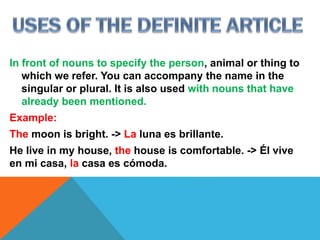
In front of nouns to specify the person, animal or thing to 
which we refer. You can accompany the name in the 
singular or plural. It is also used with nouns that have 
already been mentioned. 
Example: 
The moon is bright. -> La luna es brillante. 
He live in my house, the house is comfortable. -> Él vive 
en mi casa, la casa es cómoda.
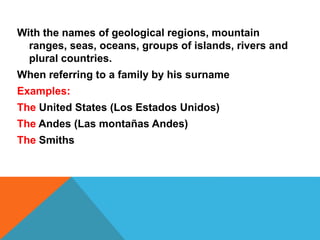
With the names of geological regions, mountain 
ranges, seas, oceans, groups of islands, rivers and 
plural countries. 
When referring to a family by his surname 
Examples: 
The United States (Los Estados Unidos) 
The Andes (Las montañas Andes) 
The Smiths
To reference directions (right, left, top, bottom) 
and the cardinal points (north, south, east, 
west). 
Example: 
the south of France (el sur de Francia) 
the house on the left (la casa de la izquierda) 
the top of the page (arriba de la pagina)
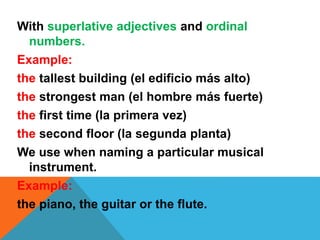
With superlative adjectives and ordinal 
numbers. 
Example: 
the tallest building (el edificio más alto) 
the strongest man (el hombre más fuerte) 
the first time (la primera vez) 
the second floor (la segunda planta) 
We use when naming a particular musical 
instrument. 
Example: 
the piano, the guitar or the flute.
Not use when we talk about something in 
general. 
Example: 
I like ice cream. (Me gusta el helado.) 
Math is difficult. (Las matemáticas son 
difíciles.)
Not use when it comes to TV, the mealtimes, the days 
of the week, months of the year, seasons, years or 
time. 
Example: 
- I do not like to watch TV. (No me gusta ver la 
televisión) 
- I have an appointment on Monday. (Tengo una cita el 
lunes.) 
- We eat breakfast at 9:00. (Comemos el desayuno a las 
9:00.)
Not use institutions and modes of transport when we're 
talking in general. 
Example: 
- We like school. (Nos gusta la escuela.) 
- I go to work by train. (Voy al trabajo en tren.) 
- They go to church on Sundays. (Van a la iglesia los 
domingos.)
Not use with names of cities and place names in 
general. Article lakes or streets is not used. 
Example: 
- I went to Lake Titicaca. (Fui al lago Titicaca.) 
- She lives on Flores Street. (Vive en la calle Flores.)

Definite Article (THE)

  • 1.
  • 2.
    In front ofnouns to specify the person, animal or thing to which we refer. You can accompany the name in the singular or plural. It is also used with nouns that have already been mentioned. Example: The moon is bright. -> La luna es brillante. He live in my house, the house is comfortable. -> Él vive en mi casa, la casa es cómoda.
  • 3.
    With the namesof geological regions, mountain ranges, seas, oceans, groups of islands, rivers and plural countries. When referring to a family by his surname Examples: The United States (Los Estados Unidos) The Andes (Las montañas Andes) The Smiths
  • 4.
    To reference directions(right, left, top, bottom) and the cardinal points (north, south, east, west). Example: the south of France (el sur de Francia) the house on the left (la casa de la izquierda) the top of the page (arriba de la pagina)
  • 5.
    With superlative adjectivesand ordinal numbers. Example: the tallest building (el edificio más alto) the strongest man (el hombre más fuerte) the first time (la primera vez) the second floor (la segunda planta) We use when naming a particular musical instrument. Example: the piano, the guitar or the flute.
  • 6.
    Not use whenwe talk about something in general. Example: I like ice cream. (Me gusta el helado.) Math is difficult. (Las matemáticas son difíciles.)
  • 7.
    Not use whenit comes to TV, the mealtimes, the days of the week, months of the year, seasons, years or time. Example: - I do not like to watch TV. (No me gusta ver la televisión) - I have an appointment on Monday. (Tengo una cita el lunes.) - We eat breakfast at 9:00. (Comemos el desayuno a las 9:00.)
  • 8.
    Not use institutionsand modes of transport when we're talking in general. Example: - We like school. (Nos gusta la escuela.) - I go to work by train. (Voy al trabajo en tren.) - They go to church on Sundays. (Van a la iglesia los domingos.)
  • 9.
    Not use withnames of cities and place names in general. Article lakes or streets is not used. Example: - I went to Lake Titicaca. (Fui al lago Titicaca.) - She lives on Flores Street. (Vive en la calle Flores.)