
Articles: a/an/the EOI El Puerto 2º CAL Inglés © Rafael Moreno Esteban 2008
Using Articles What is an article? Basically, an article is an adjective. Like adjectives, articles modify nouns. English has two articles:  the  and  a/an .  The  is used to refer to specific or particular nouns;  a/an  is used to modify non-specific or non-particular nouns. We call  the  the  definite  article and  a/an  the  indefinite  article. the = definite article a/an = indefinite article For example, if I say, "Let's read  the  book," I mean a  specific  book. If I say, "Let's read  a  book," I mean  any  book rather than a specific book. © Rafael Moreno Esteban 2008
Here's another way to explain it:  The  is used to refer to a  specific  or  particular  member of a group. For example, "I just saw  the  most popular movie of the year." There are many movies, but only one particular movie is the most popular. Therefore, we use  the . " A/an " is used to refer to a  non-specific  or  non-particular  member of the group. For example, "I would like to go see  a  movie." Here, we're not talking about a  specific  movie. We're talking about  any  movie. There are many movies, and I want to see  any  movie. I don't have a specific one in mind. Normally, we use  a/an  to refer to something for the first time. For example, “We went to a museum in Paris. We ate at the museum too”. © Rafael Moreno Esteban 2008
Indefinite Articles: a and an "A" and "an" signal that the noun modified is indefinite, referring to  any  member of a group. For example: "My daughter really wants  a  dog for Christmas." This refers to  any  dog. We don't know which dog because we haven't found the dog yet.  "Somebody call  a  policeman!" This refers to  any  policeman. We don't need a specific policeman; we need any policeman who is available.  "When I was at the zoo, I saw  an  elephant!" Here, we're talking about a single, non-specific thing, in this case an elephant. There are probably several elephants at the zoo, but there's only  one  we're talking about here.  © Rafael Moreno Esteban 2008
Remember, using a or an depends on the sound that begins the next word. So... a  + singular noun beginning with a consonant:  a  boy;  a  car;  a  bike;  a  zoo;  a  dog   an  + singular noun beginning with a vowel:  an  elephant;  an  egg;  an  apple;  an  idiot;  an  orphan   a  + singular noun beginning with a consonant sound:  a  user (sounds like 'yoo-zer,' i.e. begins with a consonant 'y' sound, so 'a' is used);  a  university;  a  unicycle Remember that this rule also applies when you use acronyms: Introductory Composition at Purdue (ICaP) handles first-year writing at the University. Therefore, an ICaP memo generally discusses issues concerning English 106 instructors. © Rafael Moreno Esteban 2008
If the noun is modified by an adjective, the choice between  a  and  an  depends on the initial sound of the adjective that immediately follows the article: a  broken egg  an  unusual problem  a  European country (sounds like 'yer-o-pi-an,' i.e. begins with consonant /j/ sound)  Remember, too, that in English, the indefinite articles are used to indicate membership in a group: I am  a  teacher. (I am a member of a large group known as teachers.)  Brian is  an  Irishman. (Brian is a member of the people known as Irish.)  Seiko is  a  practicing Buddhist. (Seiko is a member of the group of people known as Buddhists.) © Rafael Moreno Esteban 2008
Definite Article: the The definite article is used before singular and plural nouns when the noun is specific or particular.  The  signals that the noun is definite, that it refers to a particular member of a group. For example: " The  dog that bit me ran away." Here, we're talking about a  specific  dog, the dog that bit me. "I was happy to see  the  policeman who saved my cat!" Here, we're talking about a  particular  policeman. Even if we don't know the policeman's name, it's still a particular policeman because it is the one who saved the cat. "I saw  the  elephant at the zoo." Here, we're talking about a  specific  noun. Probably there is only one elephant at the zoo.  © Rafael Moreno Esteban 2008
Countable and Noncountable Nouns The  can be used with noncount nouns, or the article can be omitted entirely. "I love to sail over  the  water" (some specific body of water) or "I love to sail over water" (any water).  "He spilled  the  milk all over the floor" (some specific milk, perhaps the milk you bought earlier that day) or "He spilled milk all over the floor" (any milk).  "A/an" can be used only with count nouns. "I need  a  bottle of water."  "I need  a  new glass of milk." Most of the time, you can't say, "She wants a water," unless you're implying, say, a bottle of water. © Rafael Moreno Esteban 2008
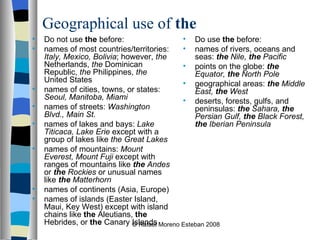
Geographical use of  the Do not use  the  before: names of most countries/territories:  Italy, Mexico, Bolivia ; however,  the  Netherlands,  the  Dominican Republic,  the  Philippines,  the  United States  names of cities, towns, or states:  Seoul, Manitoba, Miami   names of streets:  Washington Blvd., Main St.   names of lakes and bays:  Lake Titicaca, Lake Erie  except with a group of lakes like  the Great Lakes   names of mountains:  Mount Everest, Mount Fuji  except with ranges of mountains like  the  Andes  or  the  Rockies  or unusual names like  the  Matterhorn   names of continents (Asia, Europe)  names of islands (Easter Island, Maui, Key West) except with island chains like  the  Aleutians,  the  Hebrides, or  the  Canary Islands Do use  the  before: names of rivers, oceans and seas:  the  Nile,  the  Pacific   points on the globe:  the  Equator,  the  North Pole   geographical areas:  the  Middle East,  the  West   deserts, forests, gulfs, and peninsulas:  the  Sahara,  the  Persian Gulf,  the  Black Forest,  the  Iberian Peninsula © Rafael Moreno Esteban 2008
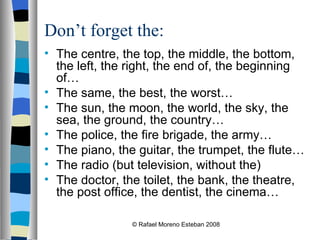
Don’t forget the: The centre, the top, the middle, the bottom, the left, the right, the end of, the beginning of… The same, the best, the worst… The sun, the moon, the world, the sky, the sea, the ground, the country… The police, the fire brigade, the army… The piano, the guitar, the trumpet, the flute… The radio (but television, without the) The doctor, the toilet, the bank, the theatre, the post office, the dentist, the cinema… © Rafael Moreno Esteban 2008
Do not use the: Breakfast, lunch, dinner Go to work, get to work, be at work, start work, finish work… Got to school, be at school, start school, leave school… Go to university, be at university… Go to church, be in chuch (or mass) Go to bed, be in bed Go to hospital, be in hospital Go to prison, be in prison Go home, get home, arrive home, come home, walk home, leave home, be at home, stay at home © Rafael Moreno Esteban 2008
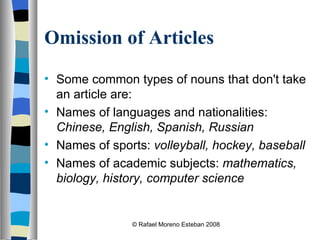
Omission of Articles Some common types of nouns that don't take an article are: Names of languages and nationalities:  Chinese, English, Spanish, Russian   Names of sports:  volleyball, hockey, baseball   Names of academic subjects:  mathematics, biology, history, computer science © Rafael Moreno Esteban 2008

Articles

  • 1.
    Articles: a/an/the EOIEl Puerto 2º CAL Inglés © Rafael Moreno Esteban 2008
  • 2.
    Using Articles Whatis an article? Basically, an article is an adjective. Like adjectives, articles modify nouns. English has two articles: the and a/an . The is used to refer to specific or particular nouns; a/an is used to modify non-specific or non-particular nouns. We call the the definite article and a/an the indefinite article. the = definite article a/an = indefinite article For example, if I say, "Let's read the book," I mean a specific book. If I say, "Let's read a book," I mean any book rather than a specific book. © Rafael Moreno Esteban 2008
  • 3.
    Here's another wayto explain it: The is used to refer to a specific or particular member of a group. For example, "I just saw the most popular movie of the year." There are many movies, but only one particular movie is the most popular. Therefore, we use the . " A/an " is used to refer to a non-specific or non-particular member of the group. For example, "I would like to go see a movie." Here, we're not talking about a specific movie. We're talking about any movie. There are many movies, and I want to see any movie. I don't have a specific one in mind. Normally, we use a/an to refer to something for the first time. For example, “We went to a museum in Paris. We ate at the museum too”. © Rafael Moreno Esteban 2008
  • 4.
    Indefinite Articles: aand an "A" and "an" signal that the noun modified is indefinite, referring to any member of a group. For example: "My daughter really wants a dog for Christmas." This refers to any dog. We don't know which dog because we haven't found the dog yet. "Somebody call a policeman!" This refers to any policeman. We don't need a specific policeman; we need any policeman who is available. "When I was at the zoo, I saw an elephant!" Here, we're talking about a single, non-specific thing, in this case an elephant. There are probably several elephants at the zoo, but there's only one we're talking about here. © Rafael Moreno Esteban 2008
  • 5.
    Remember, using aor an depends on the sound that begins the next word. So... a + singular noun beginning with a consonant: a boy; a car; a bike; a zoo; a dog an + singular noun beginning with a vowel: an elephant; an egg; an apple; an idiot; an orphan a + singular noun beginning with a consonant sound: a user (sounds like 'yoo-zer,' i.e. begins with a consonant 'y' sound, so 'a' is used); a university; a unicycle Remember that this rule also applies when you use acronyms: Introductory Composition at Purdue (ICaP) handles first-year writing at the University. Therefore, an ICaP memo generally discusses issues concerning English 106 instructors. © Rafael Moreno Esteban 2008
  • 6.
    If the nounis modified by an adjective, the choice between a and an depends on the initial sound of the adjective that immediately follows the article: a broken egg an unusual problem a European country (sounds like 'yer-o-pi-an,' i.e. begins with consonant /j/ sound) Remember, too, that in English, the indefinite articles are used to indicate membership in a group: I am a teacher. (I am a member of a large group known as teachers.) Brian is an Irishman. (Brian is a member of the people known as Irish.) Seiko is a practicing Buddhist. (Seiko is a member of the group of people known as Buddhists.) © Rafael Moreno Esteban 2008
  • 7.
    Definite Article: theThe definite article is used before singular and plural nouns when the noun is specific or particular. The signals that the noun is definite, that it refers to a particular member of a group. For example: " The dog that bit me ran away." Here, we're talking about a specific dog, the dog that bit me. "I was happy to see the policeman who saved my cat!" Here, we're talking about a particular policeman. Even if we don't know the policeman's name, it's still a particular policeman because it is the one who saved the cat. "I saw the elephant at the zoo." Here, we're talking about a specific noun. Probably there is only one elephant at the zoo. © Rafael Moreno Esteban 2008
  • 8.
    Countable and NoncountableNouns The can be used with noncount nouns, or the article can be omitted entirely. "I love to sail over the water" (some specific body of water) or "I love to sail over water" (any water). "He spilled the milk all over the floor" (some specific milk, perhaps the milk you bought earlier that day) or "He spilled milk all over the floor" (any milk). "A/an" can be used only with count nouns. "I need a bottle of water." "I need a new glass of milk." Most of the time, you can't say, "She wants a water," unless you're implying, say, a bottle of water. © Rafael Moreno Esteban 2008
  • 9.
    Geographical use of the Do not use the before: names of most countries/territories: Italy, Mexico, Bolivia ; however, the Netherlands, the Dominican Republic, the Philippines, the United States names of cities, towns, or states: Seoul, Manitoba, Miami names of streets: Washington Blvd., Main St. names of lakes and bays: Lake Titicaca, Lake Erie except with a group of lakes like the Great Lakes names of mountains: Mount Everest, Mount Fuji except with ranges of mountains like the Andes or the Rockies or unusual names like the Matterhorn names of continents (Asia, Europe) names of islands (Easter Island, Maui, Key West) except with island chains like the Aleutians, the Hebrides, or the Canary Islands Do use the before: names of rivers, oceans and seas: the Nile, the Pacific points on the globe: the Equator, the North Pole geographical areas: the Middle East, the West deserts, forests, gulfs, and peninsulas: the Sahara, the Persian Gulf, the Black Forest, the Iberian Peninsula © Rafael Moreno Esteban 2008
  • 10.
    Don’t forget the:The centre, the top, the middle, the bottom, the left, the right, the end of, the beginning of… The same, the best, the worst… The sun, the moon, the world, the sky, the sea, the ground, the country… The police, the fire brigade, the army… The piano, the guitar, the trumpet, the flute… The radio (but television, without the) The doctor, the toilet, the bank, the theatre, the post office, the dentist, the cinema… © Rafael Moreno Esteban 2008
  • 11.
    Do not usethe: Breakfast, lunch, dinner Go to work, get to work, be at work, start work, finish work… Got to school, be at school, start school, leave school… Go to university, be at university… Go to church, be in chuch (or mass) Go to bed, be in bed Go to hospital, be in hospital Go to prison, be in prison Go home, get home, arrive home, come home, walk home, leave home, be at home, stay at home © Rafael Moreno Esteban 2008
  • 12.
    Omission of ArticlesSome common types of nouns that don't take an article are: Names of languages and nationalities: Chinese, English, Spanish, Russian Names of sports: volleyball, hockey, baseball Names of academic subjects: mathematics, biology, history, computer science © Rafael Moreno Esteban 2008