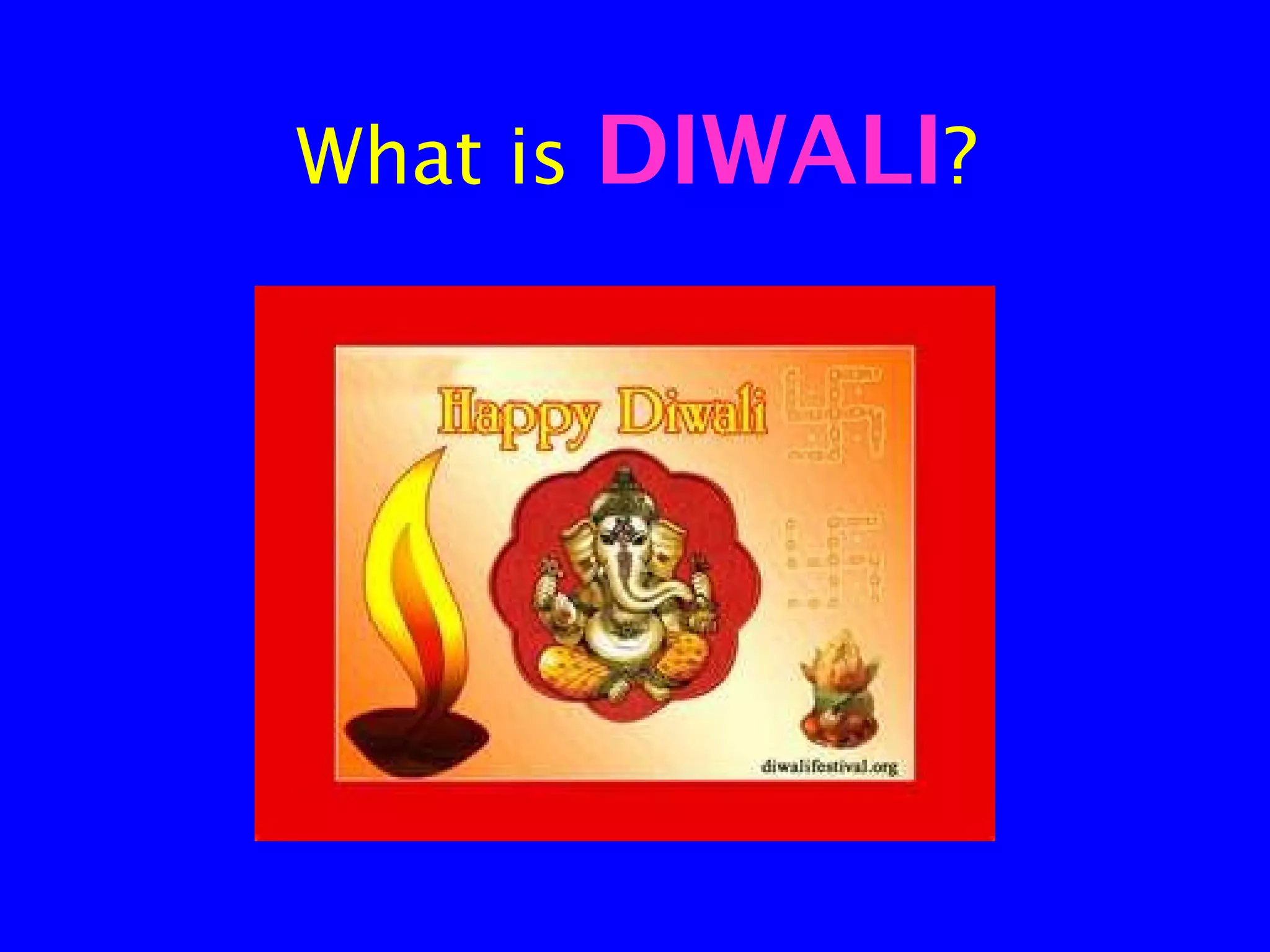
What is

DIWALI?
DIWALI is a

Hindu festival
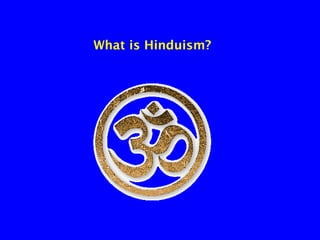
What is Hinduism?
Hinduism
Hinduism is the religion of the
majority of people in India and
Nepal. About 80% of the Indian
population regard themselves as
Hindu.
Most Hindus believe in a
Supreme God
whose
qualities and forms are
represented by the multitude of
deities which emanate from him.

[Brahman],
Hinduism
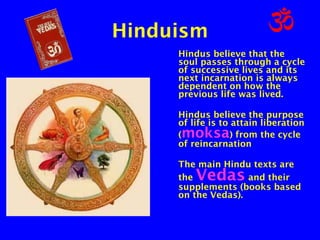
Hindus believe that the
soul passes through a cycle
of successive lives and its
next incarnation is always
dependent on how the
previous life was lived.
Hindus believe the purpose
of life is to attain liberation
(
) from the cycle
of reincarnation

moksa

The main Hindu texts are
the
and their
supplements (books based
on the Vedas).

Vedas
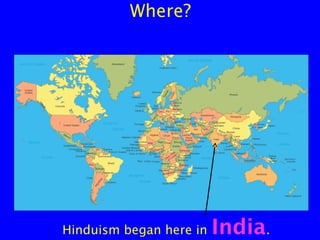
Where?

Hinduism began here in

India.
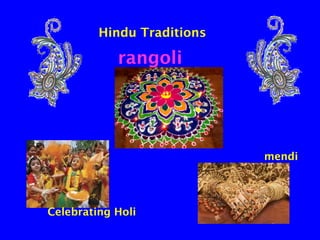
Hindu Traditions

rangoli

mendi

Celebrating Holi
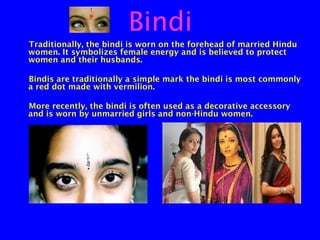
Bindi
Traditionally, the bindi is worn on the forehead of married Hindu
women. It symbolizes female energy and is believed to protect
women and their husbands.
Bindis are traditionally a simple mark the bindi is most commonly
a red dot made with vermilion.
More recently, the bindi is often used as a decorative accessory
and is worn by unmarried girls and non-Hindu women.
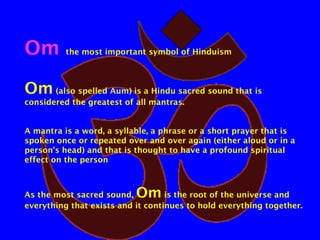
Om

the most important symbol of Hinduism

Om (also spelled Aum) is a Hindu sacred sound that is
considered the greatest of all mantras.
A mantra is a word, a syllable, a phrase or a short prayer that is
spoken once or repeated over and over again (either aloud or in a
person's head) and that is thought to have a profound spiritual
effect on the person

Om

As the most sacred sound,
is the root of the universe and
everything that exists and it continues to hold everything together.
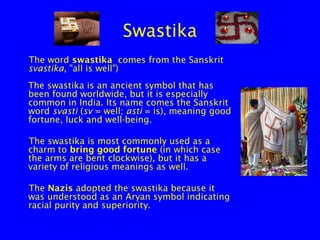
Swastika
The word swastika comes from the Sanskrit
svastika, "all is well")
The swastika is an ancient symbol that has
been found worldwide, but it is especially
common in India. Its name comes the Sanskrit
word svasti (sv = well; asti = is), meaning good
fortune, luck and well-being.
The swastika is most commonly used as a
charm to bring good fortune (in which case
the arms are bent clockwise), but it has a
variety of religious meanings as well.
The Nazis adopted the swastika because it
was understood as an Aryan symbol indicating
racial purity and superiority.
Hinduism is the third largest
world religion with about 900
million Hindus worldwide. The
religion dates back over 4,000
years.
Spiritual Leader
guru or sage

In 2006 there were about 150,000 Hindus in
Australia.

Key
Facts

Hinduism is made up of a variety of
different religious beliefs and practices
which originated near the river Indus in
India.

Hindus believe that life is a
cycle of birth, death, and
rebirth, governed by

Karma.

Place of Worship
temple or home
shrine

Holy Book [main]
The Vedas.
Hinduism is third largest
religion in the world

Hindus believe in Brahman:
the supreme being [or reality] The
gods of modern Hinduism include the
chief gods Shiva, Vishnu and the
Mother Goddess Shakti as well as a
myriad of local community gods. ,
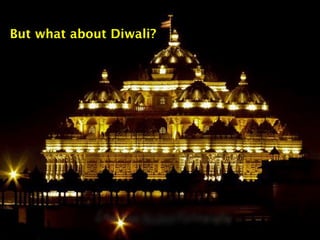
But what about Diwali?
Diwali marks the start of the Hindu year the
festival lasts for 5 days.

It is a time of new beginnings
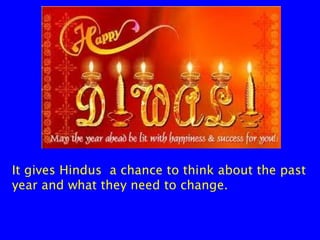
It gives Hindus a chance to think about the past
year and what they need to change.
What is Divali about?
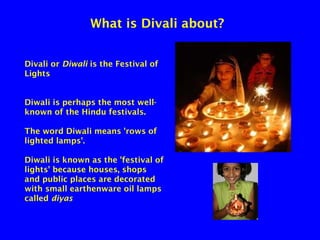
Divali or Diwali is the Festival of
Lights
Diwali is perhaps the most wellknown of the Hindu festivals.
The word Diwali means 'rows of
lighted lamps'.
Diwali is known as the 'festival of
lights' because houses, shops
and public places are decorated
with small earthenware oil lamps
called diyas
Celebrating Diwali

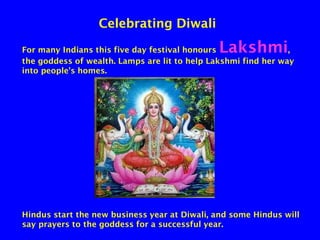
Lakshmi

For many Indians this five day festival honours
,
the goddess of wealth. Lamps are lit to help Lakshmi find her way
into people's homes.

Hindus start the new business year at Diwali, and some Hindus will
say prayers to the goddess for a successful year.
Celebrating Diwali

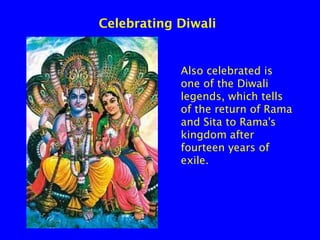
Also celebrated is
one of the Diwali
legends, which tells
of the return of Rama
and Sita to Rama's
kingdom after
fourteen years of
exile.
Diwali Food
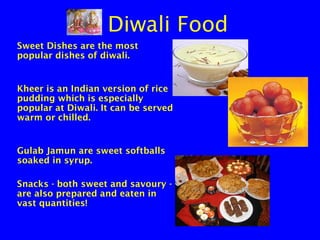
Sweet Dishes are the most
popular dishes of diwali.

Kheer is an Indian version of rice
pudding which is especially
popular at Diwali. It can be served
warm or chilled.

Gulab Jamun are sweet softballs
soaked in syrup.
Snacks - both sweet and savoury are also prepared and eaten in
vast quantities!
Diwali Gifts
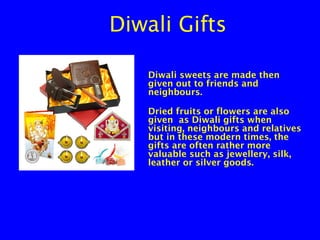
Diwali sweets are made then
given out to friends and
neighbours.
Dried fruits or flowers are also
given as Diwali gifts when
visiting, neighbours and relatives
but in these modern times, the
gifts are often rather more
valuable such as jewellery, silk,
leather or silver goods.
Rangoli
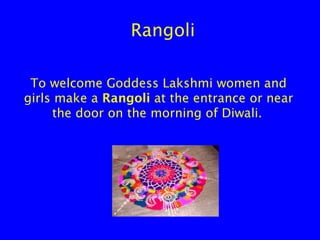
To welcome Goddess Lakshmi women and
girls make a Rangoli at the entrance or near
the door on the morning of Diwali.
What can you remember???
Using what you can remember from the previous slide, try to fill in your table

1. Approximately how old is Hinduism?

2. Where did it begin?
3. What is the festival of lights called?
4. Holy book [main]?
5. Place of worship?
6. What is the law governing life, death and rebirth?
Hindu key facts
Approximately how old is
Hinduism?
Where did it begin?

What is the festival of lights
called?
Holy book [main]?
Place of worship?

What is the law governing
life, death and rebirth?

what can you remember?
Hindu keyfacts answers
Approximately how old is
Hinduism?

4000 years

Where did it begin?

India

What is the festival of lights called?

Diwali

Holy book [main]?

Vedas

Place of worship?

temple

What is the law governing life,
death and rebirth?

karma

Divali/Diwali

  • 1.
  • 2.
  • 3.
  • 4.
    Hinduism Hinduism is thereligion of the majority of people in India and Nepal. About 80% of the Indian population regard themselves as Hindu. Most Hindus believe in a Supreme God whose qualities and forms are represented by the multitude of deities which emanate from him. [Brahman],
  • 5.
    Hinduism Hindus believe thatthe soul passes through a cycle of successive lives and its next incarnation is always dependent on how the previous life was lived. Hindus believe the purpose of life is to attain liberation ( ) from the cycle of reincarnation moksa The main Hindu texts are the and their supplements (books based on the Vedas). Vedas
  • 6.
  • 7.
  • 8.
    Bindi Traditionally, the bindiis worn on the forehead of married Hindu women. It symbolizes female energy and is believed to protect women and their husbands. Bindis are traditionally a simple mark the bindi is most commonly a red dot made with vermilion. More recently, the bindi is often used as a decorative accessory and is worn by unmarried girls and non-Hindu women.
  • 9.
    Om the most importantsymbol of Hinduism Om (also spelled Aum) is a Hindu sacred sound that is considered the greatest of all mantras. A mantra is a word, a syllable, a phrase or a short prayer that is spoken once or repeated over and over again (either aloud or in a person's head) and that is thought to have a profound spiritual effect on the person Om As the most sacred sound, is the root of the universe and everything that exists and it continues to hold everything together.
  • 10.
    Swastika The word swastikacomes from the Sanskrit svastika, "all is well") The swastika is an ancient symbol that has been found worldwide, but it is especially common in India. Its name comes the Sanskrit word svasti (sv = well; asti = is), meaning good fortune, luck and well-being. The swastika is most commonly used as a charm to bring good fortune (in which case the arms are bent clockwise), but it has a variety of religious meanings as well. The Nazis adopted the swastika because it was understood as an Aryan symbol indicating racial purity and superiority.
  • 11.
    Hinduism is thethird largest world religion with about 900 million Hindus worldwide. The religion dates back over 4,000 years. Spiritual Leader guru or sage In 2006 there were about 150,000 Hindus in Australia. Key Facts Hinduism is made up of a variety of different religious beliefs and practices which originated near the river Indus in India. Hindus believe that life is a cycle of birth, death, and rebirth, governed by Karma. Place of Worship temple or home shrine Holy Book [main] The Vedas. Hinduism is third largest religion in the world Hindus believe in Brahman: the supreme being [or reality] The gods of modern Hinduism include the chief gods Shiva, Vishnu and the Mother Goddess Shakti as well as a myriad of local community gods. ,
  • 12.
  • 13.
    Diwali marks thestart of the Hindu year the festival lasts for 5 days. It is a time of new beginnings
  • 14.
    It gives Hindusa chance to think about the past year and what they need to change.
  • 15.
    What is Divaliabout? Divali or Diwali is the Festival of Lights Diwali is perhaps the most wellknown of the Hindu festivals. The word Diwali means 'rows of lighted lamps'. Diwali is known as the 'festival of lights' because houses, shops and public places are decorated with small earthenware oil lamps called diyas
  • 16.
    Celebrating Diwali Lakshmi For manyIndians this five day festival honours , the goddess of wealth. Lamps are lit to help Lakshmi find her way into people's homes. Hindus start the new business year at Diwali, and some Hindus will say prayers to the goddess for a successful year.
  • 17.
    Celebrating Diwali Also celebratedis one of the Diwali legends, which tells of the return of Rama and Sita to Rama's kingdom after fourteen years of exile.
  • 18.
    Diwali Food Sweet Dishesare the most popular dishes of diwali. Kheer is an Indian version of rice pudding which is especially popular at Diwali. It can be served warm or chilled. Gulab Jamun are sweet softballs soaked in syrup. Snacks - both sweet and savoury are also prepared and eaten in vast quantities!
  • 19.
    Diwali Gifts Diwali sweetsare made then given out to friends and neighbours. Dried fruits or flowers are also given as Diwali gifts when visiting, neighbours and relatives but in these modern times, the gifts are often rather more valuable such as jewellery, silk, leather or silver goods.
  • 20.
    Rangoli To welcome GoddessLakshmi women and girls make a Rangoli at the entrance or near the door on the morning of Diwali.
  • 21.
    What can youremember??? Using what you can remember from the previous slide, try to fill in your table 1. Approximately how old is Hinduism? 2. Where did it begin? 3. What is the festival of lights called? 4. Holy book [main]? 5. Place of worship? 6. What is the law governing life, death and rebirth?
  • 22.
    Hindu key facts Approximatelyhow old is Hinduism? Where did it begin? What is the festival of lights called? Holy book [main]? Place of worship? What is the law governing life, death and rebirth? what can you remember?
  • 23.
    Hindu keyfacts answers Approximatelyhow old is Hinduism? 4000 years Where did it begin? India What is the festival of lights called? Diwali Holy book [main]? Vedas Place of worship? temple What is the law governing life, death and rebirth? karma