NAME:KIRAN.MANTHA
LE
USN:2VX15CWM09
1
contents
 Introduction
 Topography and geology
 Hydrology
 Flora
 Avifauna
 Aqua Fauna
 Fauna
 Public participation
2
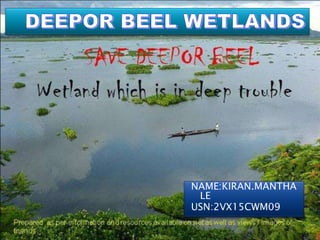
 The name Deepor Beel is stated to be derivative
of the Sanskrit word 'Dipa' which
means Elephant and the Beel means wetland or
large aquatic body in Assamese language,
inhabited by elephants
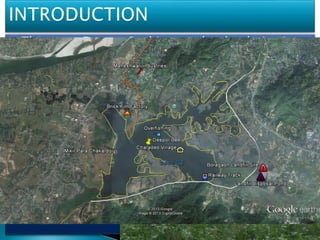
 It is located to the south-west of Guwahati city,
in Kamrup district of Assam, India.
 It is a permanent freshwater lake, in a former
channel of the Brahmaputra River, to the south of
the main river
 under the Ramsar Convention which has listed
the lake in November 2002, as a Ramsar Site for
undertaking conservation measures on the basis
of its biological and environmental importance.
3
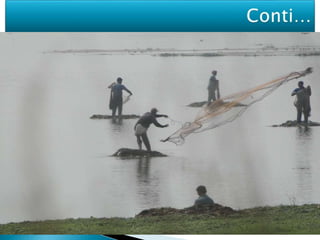
 The Dipor Bil is reported to provide, directly or
indirectly, its natural resources for the livelihood
of fourteen indigenous villages (1,200 families)
located in its precincts.
 Freshwater fish is a vital protein and source of
income for these communities; the health of
these people is stated to be directly
dependendent on the health of this wetland
ecosystem.
 A member of Deepor Beel Fishermen’s
Cooperative Society has succinctly stated:
4
 The Beel is bounded by the steep highlands on
the north and south, and the valley formed has a
broad U-shape with the Rani and Garbhanga hills
forming the backdrop.
 It is commonly stated that the beel together with
those adjoining it are an abandoned channel of
the Brahmaputra system.
 The beel and its lowland fringe are said to be
underlaid by recent alluvium consisting of clay,
silt, sand and pebbles, the highlands immediately
to the north and south of the beel are made up of
gneisses and schists of the Archaean age.
5
 The Beel has a perennial water spread area of about
10.1 km2, which extends up to 40.1 km2 during floods.
 However, an area of 414 ha has been declared as
“Deepor Beel Sanctuary” by the Government of Assam.
 As per a Remote Sensing Study the wetland area is
reported to have reduced to 14.1% (405 ha) from 1990
to 2002
 Temperatures in the beel vary from 10.60 to 320C.
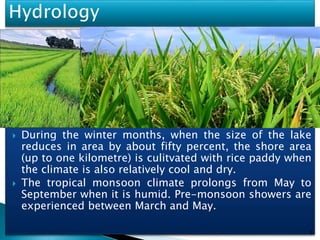
 During the winter months, when the size of the lake
reduces in area by about fifty percent, the shore area
(up to one kilometre) is culitvated with rice paddy when
the climate is also relatively cool and dry.
 The tropical monsoon climate prolongs from May to
September when it is humid. Pre-monsoon showers are
experienced between March and May.
6
 The hydrophytes vegetation of the beel has been
classified, based on ecological adaptation
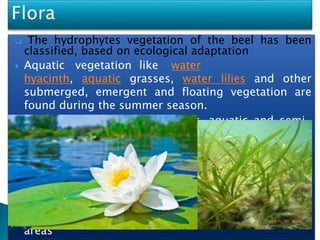
 Aquatic vegetation like water
hyacinth, aquatic grasses, water lilies and other
submerged, emergent and floating vegetation are
found during the summer season.
 In the dry areas, during winter, aquatic and semi-
aquatic vegetation are seen
 In deep open water area, marshy lands, mud flat,
emergent vegetation, water hyacinth patches, net-
grass land patches are reported
 Migratory water-fowl, residential water-fowl
and terrestrial avifauna are common in paddy
field areas, dry grassland areas and scattered forest
areas 7
 The Beel is a natural habitat to many varieties of
birds.
 219 species of birds including more than 70
migratory species are reported in the beel area.
 The largest congregations of aquatic birds can
be seen, particularly in winter, with a reported
recorded count of 19,000 water birds in a day.
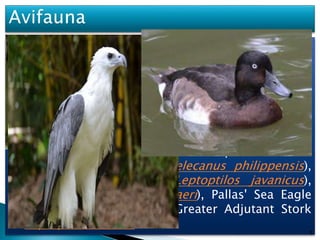
 Some of the globally threatened species of birds
like Spotbilled Pelican (Pelecanus philippensis),
Lesser Adjutant Stork (Leptoptilos javanicus),
Baer’s Pochard (Aythya baeri), Pallas' Sea Eagle
(Haliaeetus leucogaster), Greater Adjutant Stork
(Leptoptilos dubius)
8
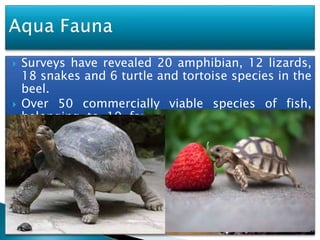
 Surveys have revealed 20 amphibian, 12 lizards,
18 snakes and 6 turtle and tortoise species in the
beel.
 Over 50 commercially viable species of fish,
belonging to 19 families have been identified,
which supplies stock to other nearby wetlands
and rivers.
 The beel provides food, acts as a spawning and
nursery water body; some of the species breed
within the beel
9
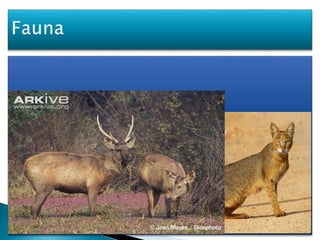
 Wild Asian Elephants (Elephas
maximus), Leopard, Jungle Cat and the
protected Barking
Deer, Chinese Porcupine and Sambar are found
in the beel.
10
 While the management authority for the beel is the Forest
Department of the Government of Assam, with the
Fisheries Department as the functional Authority, several
public and private institutions and universities are
involved in creating the awareness of the Ecological
importance of the beel and the need to restore it to its
original status.
 The Ramsar Convention, which has recognised the Deepor
Beel in its list of 1782 wetland sites.
 Aaranyak, an NGO organization.
 North Dakota State University, USA.
 The Animal Ecology Laboratory in the Department of
Zoology, Guwahati University has been involved in
biological studies of the beel
11
12

Deepor beel

  • 1.
  • 2.
    contents  Introduction  Topographyand geology  Hydrology  Flora  Avifauna  Aqua Fauna  Fauna  Public participation 2
  • 3.
     The nameDeepor Beel is stated to be derivative of the Sanskrit word 'Dipa' which means Elephant and the Beel means wetland or large aquatic body in Assamese language, inhabited by elephants  It is located to the south-west of Guwahati city, in Kamrup district of Assam, India.  It is a permanent freshwater lake, in a former channel of the Brahmaputra River, to the south of the main river  under the Ramsar Convention which has listed the lake in November 2002, as a Ramsar Site for undertaking conservation measures on the basis of its biological and environmental importance. 3
  • 4.
     The DiporBil is reported to provide, directly or indirectly, its natural resources for the livelihood of fourteen indigenous villages (1,200 families) located in its precincts.  Freshwater fish is a vital protein and source of income for these communities; the health of these people is stated to be directly dependendent on the health of this wetland ecosystem.  A member of Deepor Beel Fishermen’s Cooperative Society has succinctly stated: 4
  • 5.
     The Beelis bounded by the steep highlands on the north and south, and the valley formed has a broad U-shape with the Rani and Garbhanga hills forming the backdrop.  It is commonly stated that the beel together with those adjoining it are an abandoned channel of the Brahmaputra system.  The beel and its lowland fringe are said to be underlaid by recent alluvium consisting of clay, silt, sand and pebbles, the highlands immediately to the north and south of the beel are made up of gneisses and schists of the Archaean age. 5
  • 6.
     The Beelhas a perennial water spread area of about 10.1 km2, which extends up to 40.1 km2 during floods.  However, an area of 414 ha has been declared as “Deepor Beel Sanctuary” by the Government of Assam.  As per a Remote Sensing Study the wetland area is reported to have reduced to 14.1% (405 ha) from 1990 to 2002  Temperatures in the beel vary from 10.60 to 320C.  During the winter months, when the size of the lake reduces in area by about fifty percent, the shore area (up to one kilometre) is culitvated with rice paddy when the climate is also relatively cool and dry.  The tropical monsoon climate prolongs from May to September when it is humid. Pre-monsoon showers are experienced between March and May. 6
  • 7.
     The hydrophytesvegetation of the beel has been classified, based on ecological adaptation  Aquatic vegetation like water hyacinth, aquatic grasses, water lilies and other submerged, emergent and floating vegetation are found during the summer season.  In the dry areas, during winter, aquatic and semi- aquatic vegetation are seen  In deep open water area, marshy lands, mud flat, emergent vegetation, water hyacinth patches, net- grass land patches are reported  Migratory water-fowl, residential water-fowl and terrestrial avifauna are common in paddy field areas, dry grassland areas and scattered forest areas 7
  • 8.
     The Beelis a natural habitat to many varieties of birds.  219 species of birds including more than 70 migratory species are reported in the beel area.  The largest congregations of aquatic birds can be seen, particularly in winter, with a reported recorded count of 19,000 water birds in a day.  Some of the globally threatened species of birds like Spotbilled Pelican (Pelecanus philippensis), Lesser Adjutant Stork (Leptoptilos javanicus), Baer’s Pochard (Aythya baeri), Pallas' Sea Eagle (Haliaeetus leucogaster), Greater Adjutant Stork (Leptoptilos dubius) 8
  • 9.
     Surveys haverevealed 20 amphibian, 12 lizards, 18 snakes and 6 turtle and tortoise species in the beel.  Over 50 commercially viable species of fish, belonging to 19 families have been identified, which supplies stock to other nearby wetlands and rivers.  The beel provides food, acts as a spawning and nursery water body; some of the species breed within the beel 9
  • 10.
     Wild AsianElephants (Elephas maximus), Leopard, Jungle Cat and the protected Barking Deer, Chinese Porcupine and Sambar are found in the beel. 10
  • 11.
     While themanagement authority for the beel is the Forest Department of the Government of Assam, with the Fisheries Department as the functional Authority, several public and private institutions and universities are involved in creating the awareness of the Ecological importance of the beel and the need to restore it to its original status.  The Ramsar Convention, which has recognised the Deepor Beel in its list of 1782 wetland sites.  Aaranyak, an NGO organization.  North Dakota State University, USA.  The Animal Ecology Laboratory in the Department of Zoology, Guwahati University has been involved in biological studies of the beel 11
  • 12.