Deep Ocean Melissa Kane
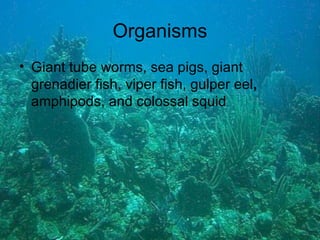
Organisms Giant tube worms, sea pigs, giant grenadier fish, viper fish, gulper eel ,  amphipods, and colossal squid
Environmental Conditions Dark Water Pressure increases atmospheres at a time Temperatures are from 2-4 degrees Celsius   Oxygen is very poor, but is not the worst zone in the ocean.
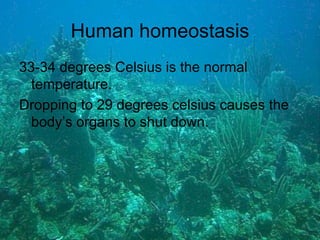
Human homeostasis 33-34 degrees Celsius is the normal temperature.  Dropping to 29 degrees celsius causes the body’s organs to shut down.
Adaptations needed to live there. Large eyes, bioluminescence, strong sense of smell, absence of swim bladder, expandable stomachs, absence of jaws, and bioluminescence. Color is another adaptation developed for camoflauge and protection from predators. Deep sea fish are often transparent, black, silvery and even red in color
Equipment needed A very strong structure, such as a submarine that can handle all the pressure. to remain in the structure
Can A human survive there? They would need to cool their body temperature, but that would cause the body to shut down The pressure would be so great that the lungs would collapse.  A human would survive no more than 15 minutes.

Deep Ocean

  • 1.
  • 2.
    Organisms Giant tubeworms, sea pigs, giant grenadier fish, viper fish, gulper eel , amphipods, and colossal squid
  • 3.
    Environmental Conditions DarkWater Pressure increases atmospheres at a time Temperatures are from 2-4 degrees Celsius Oxygen is very poor, but is not the worst zone in the ocean.
  • 4.
    Human homeostasis 33-34degrees Celsius is the normal temperature. Dropping to 29 degrees celsius causes the body’s organs to shut down.
  • 5.
    Adaptations needed tolive there. Large eyes, bioluminescence, strong sense of smell, absence of swim bladder, expandable stomachs, absence of jaws, and bioluminescence. Color is another adaptation developed for camoflauge and protection from predators. Deep sea fish are often transparent, black, silvery and even red in color
  • 6.
    Equipment needed Avery strong structure, such as a submarine that can handle all the pressure. to remain in the structure
  • 7.
    Can A humansurvive there? They would need to cool their body temperature, but that would cause the body to shut down The pressure would be so great that the lungs would collapse. A human would survive no more than 15 minutes.