Deep Dive into the CERN Cloud Infrastructure
Openstack Design Summit – Hong Kong, 2013
Belmiro Moreira
belmiro.moreira@cern.ch @belmiromoreira
What is CERN?
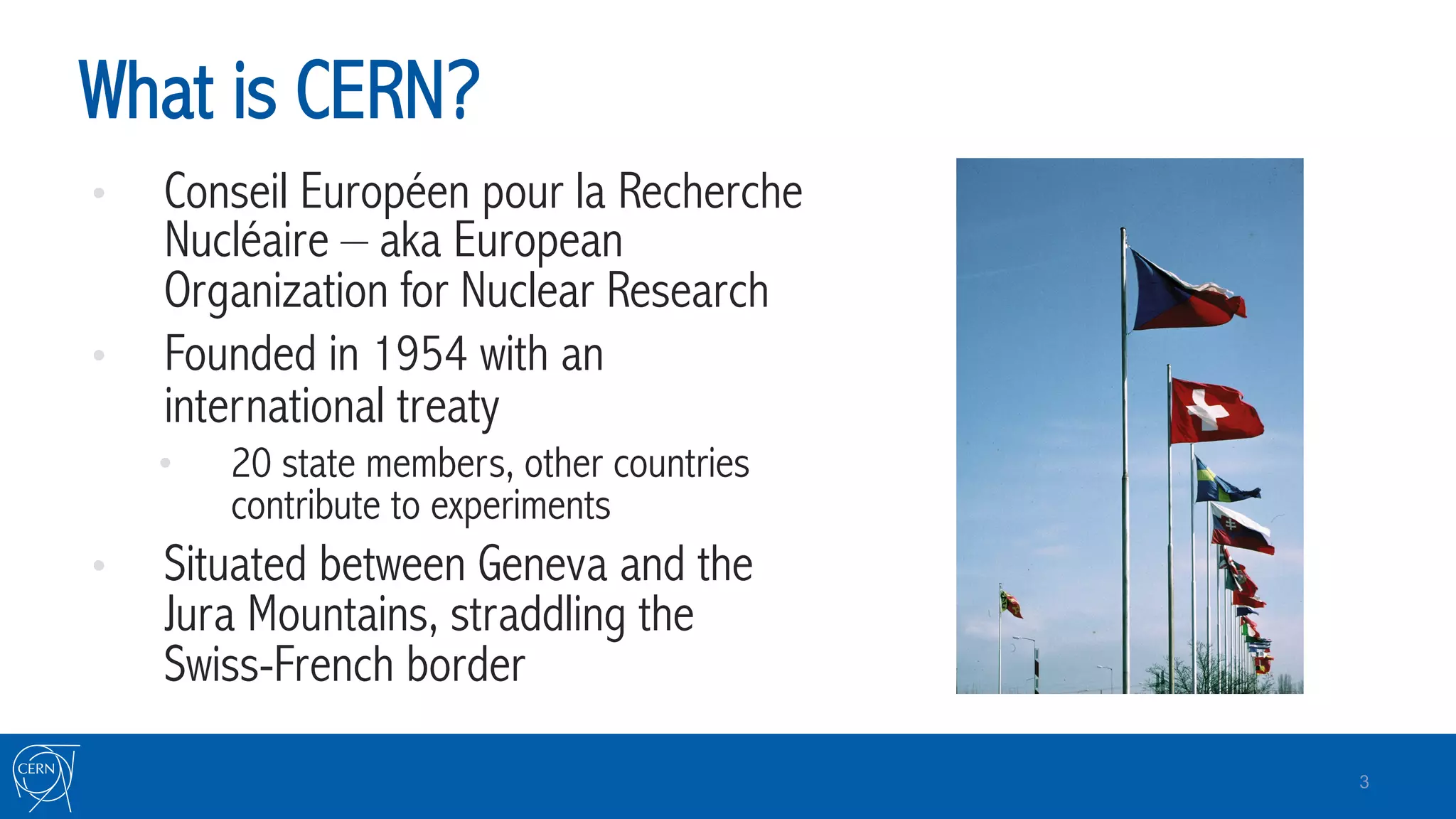
•  Conseil Européen pour la Recherche
Nucléaire – aka European
Organization for Nuclear Research
•  Founded in 1954 with an
international treaty
•  20 state members, other countries
contribute to experiments
•  Situated between Geneva and the
Jura Mountains, straddling the
Swiss-French border
3
What is CERN?
4
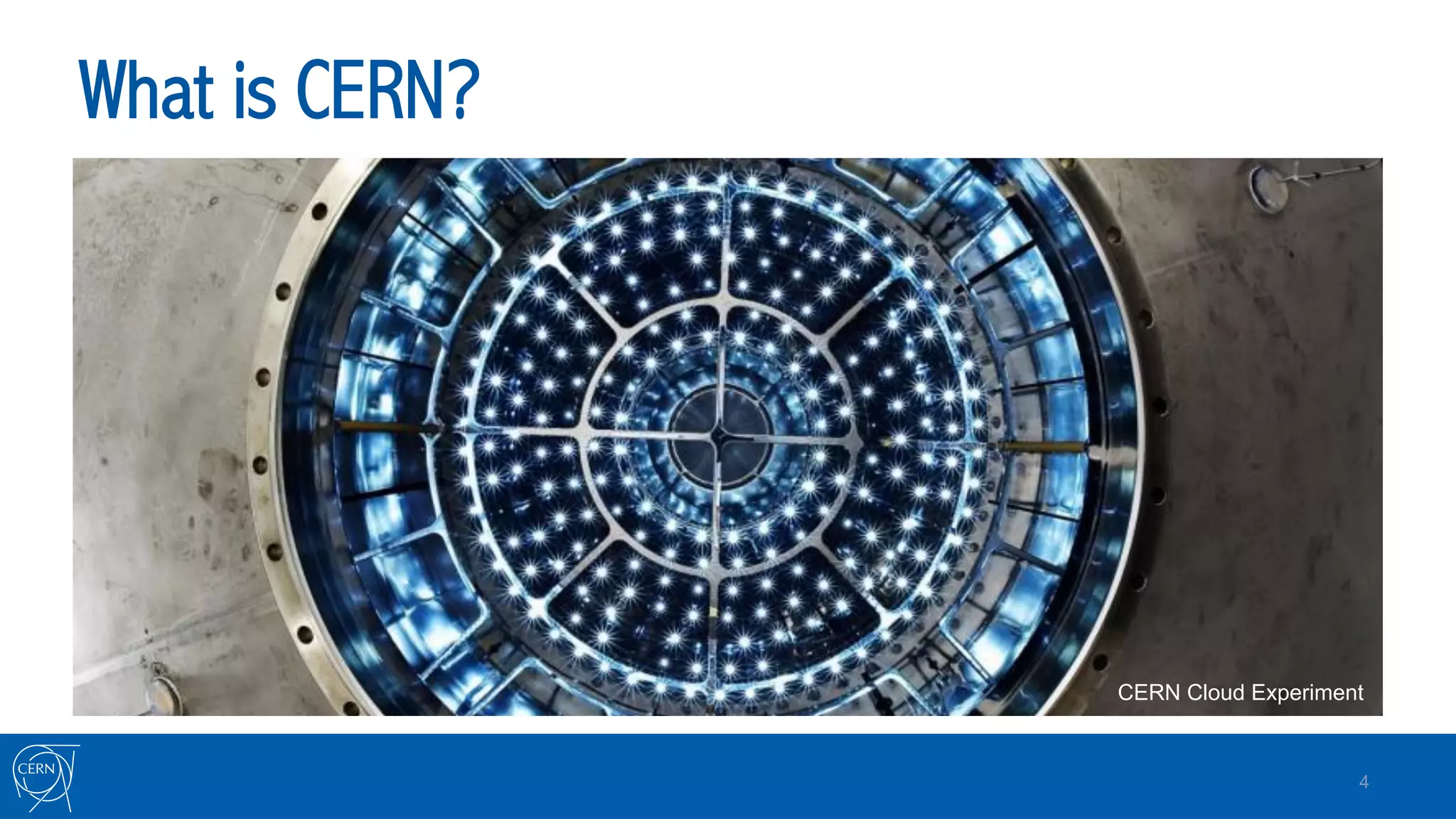
CERN Cloud Experiment
What is CERN?
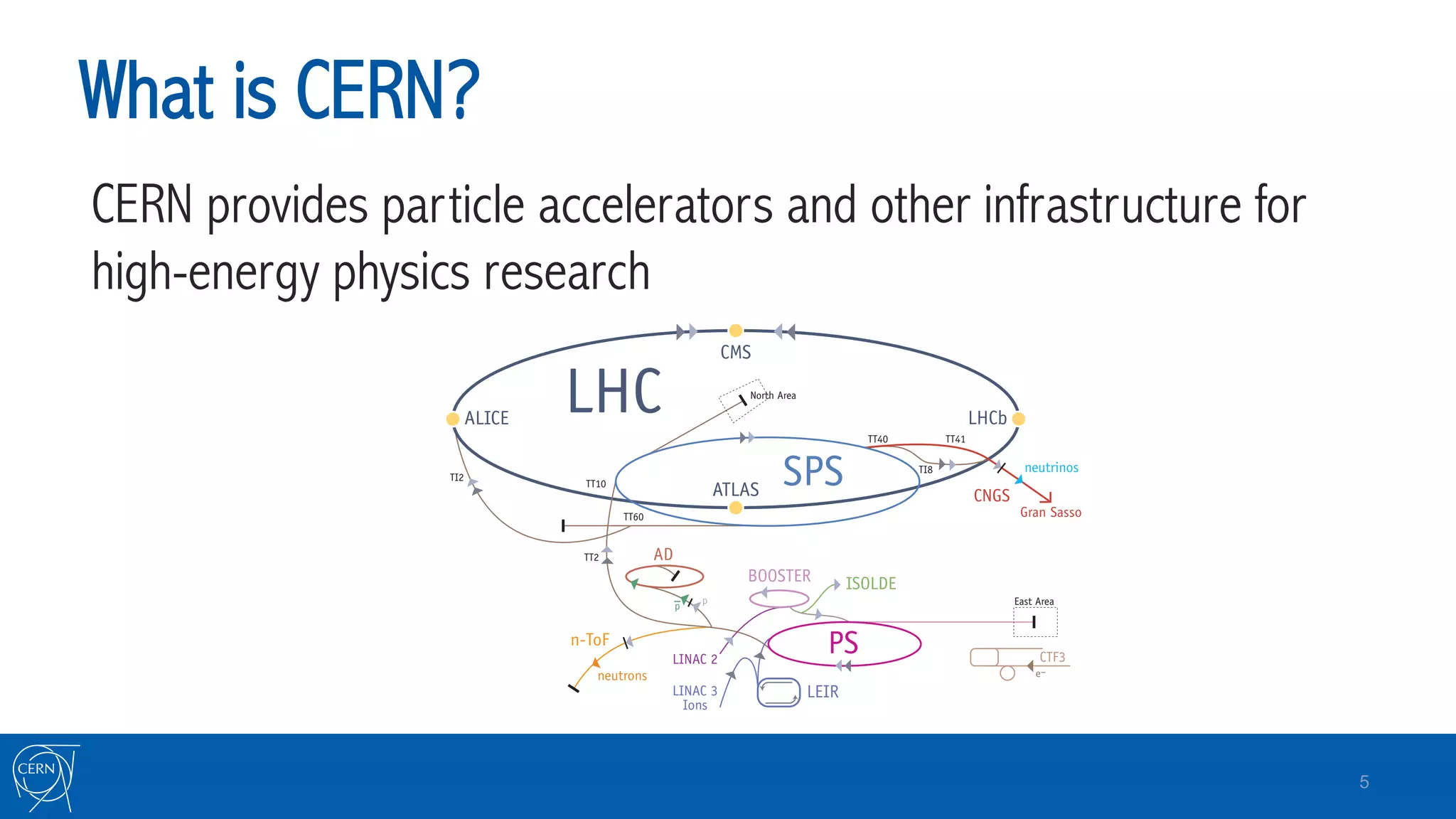
CERN provides particle accelerators and other infrastructure for
high-energy physics research
5
faqLHC
the guide
LINAC 2
Gran Sasso
North Area
LINAC 3
Ions
East Area
TI2
TI8
TT41TT40
CTF3
TT2
TT10
TT60
e–
ALICE
ATLAS
LHCb
CMS
CNGS
neutrinos
neutrons
p
p
SPS
ISOLDEBOOSTER
AD
LEIR
n-ToF
LHC
PS
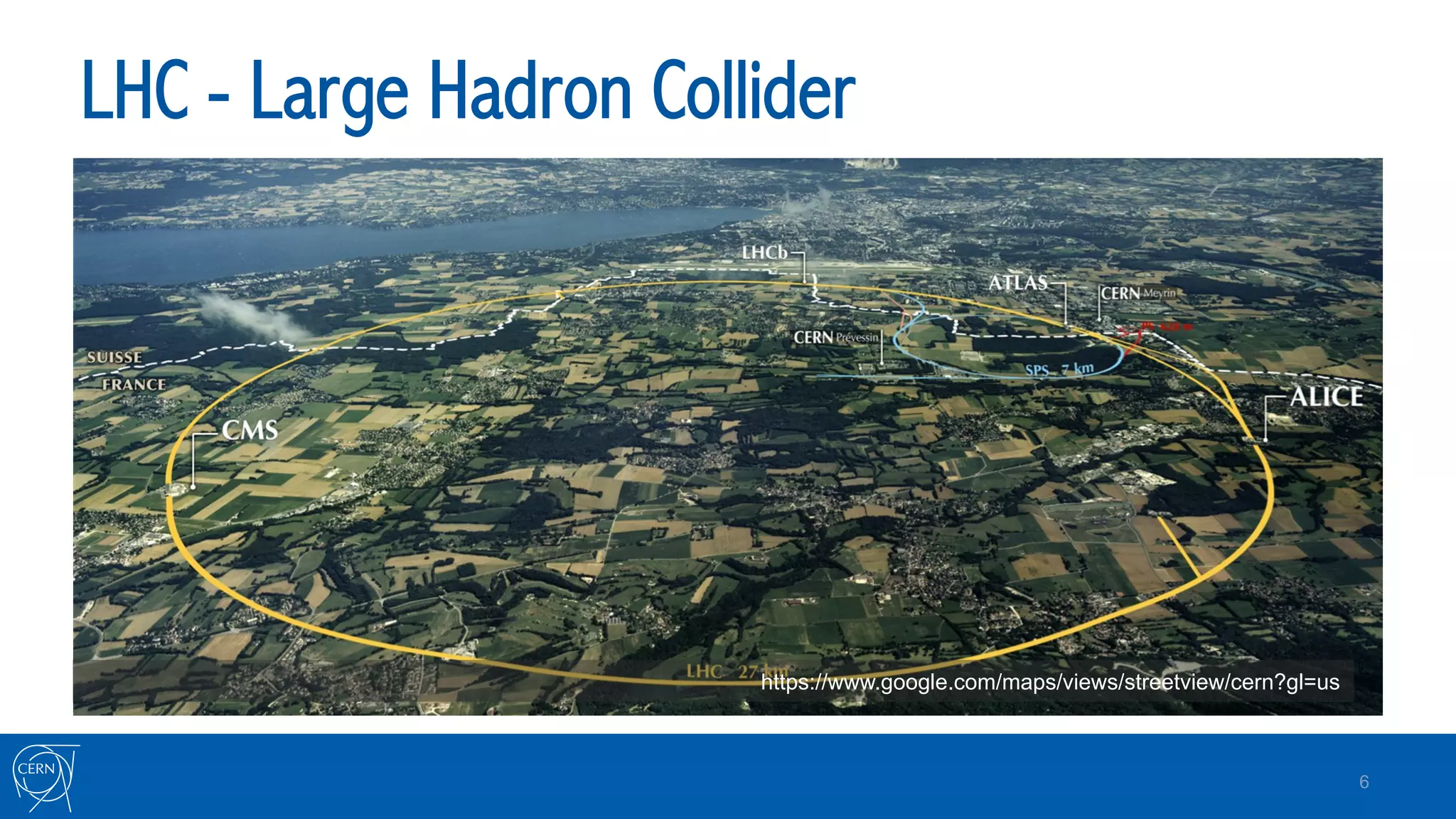
LHC - Large Hadron Collider
6
https://www.google.com/maps/views/streetview/cern?gl=us
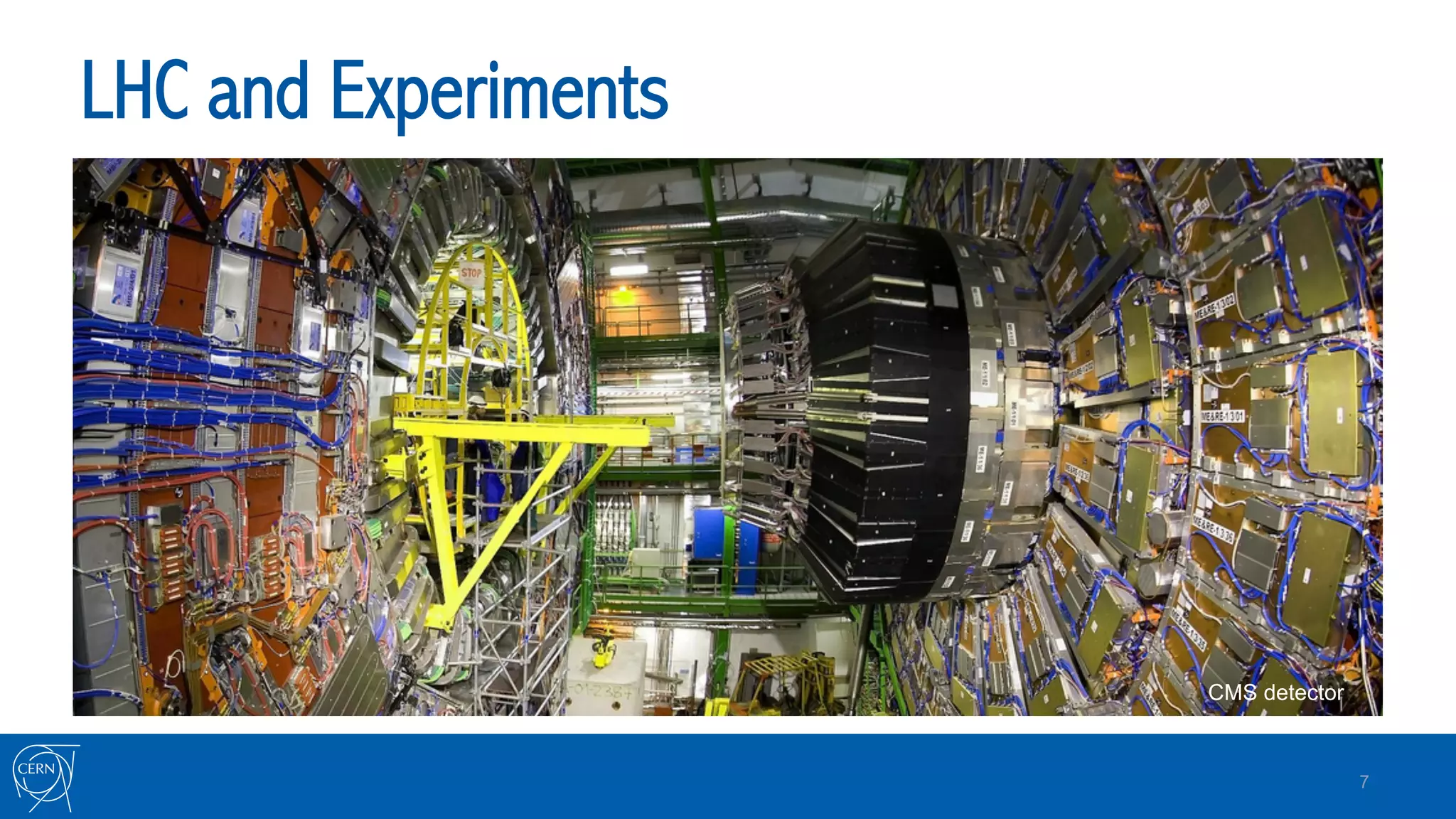
LHC and Experiments
7
CMS detector
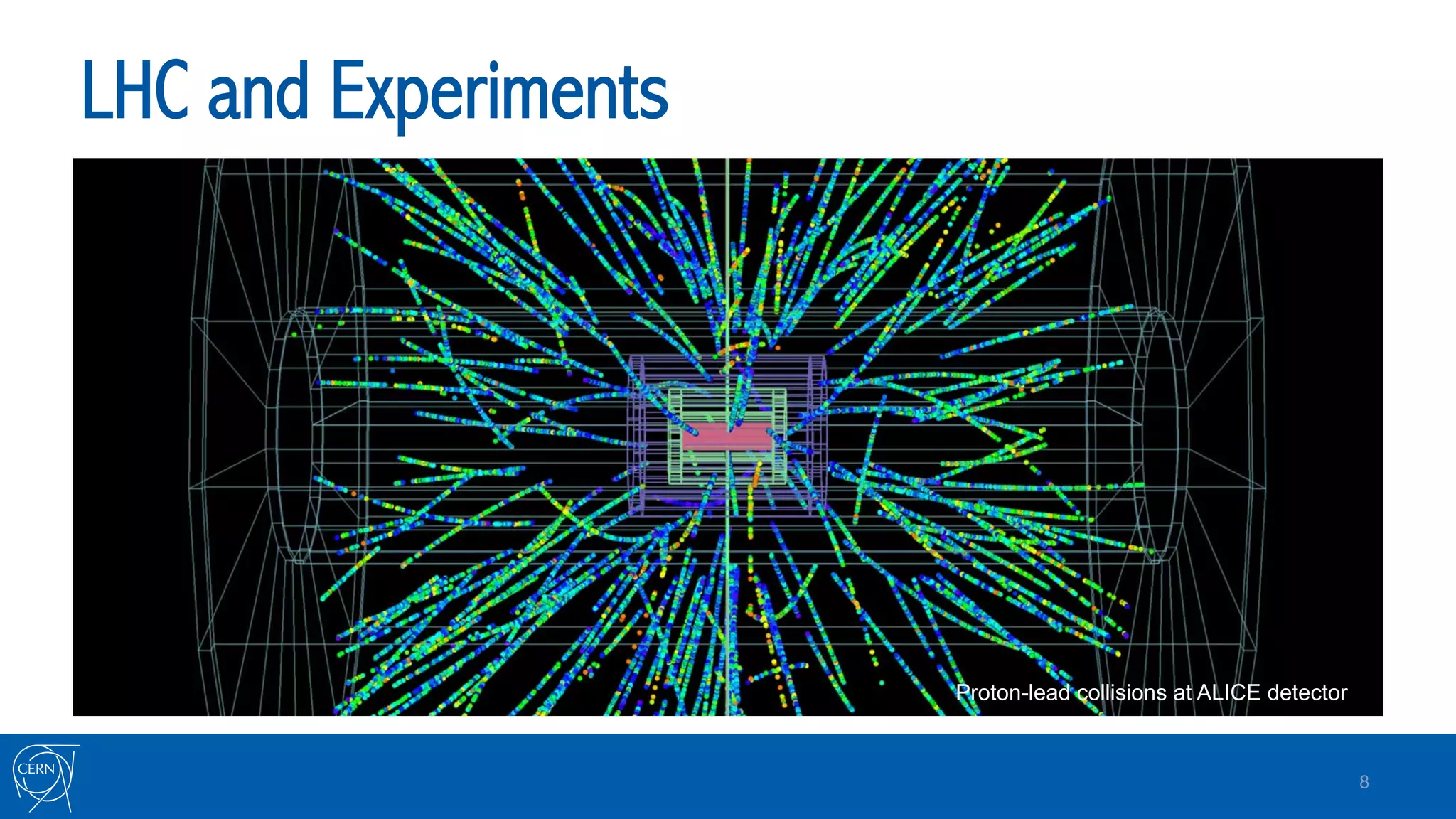
LHC and Experiments
8
Proton-lead collisions at ALICE detector
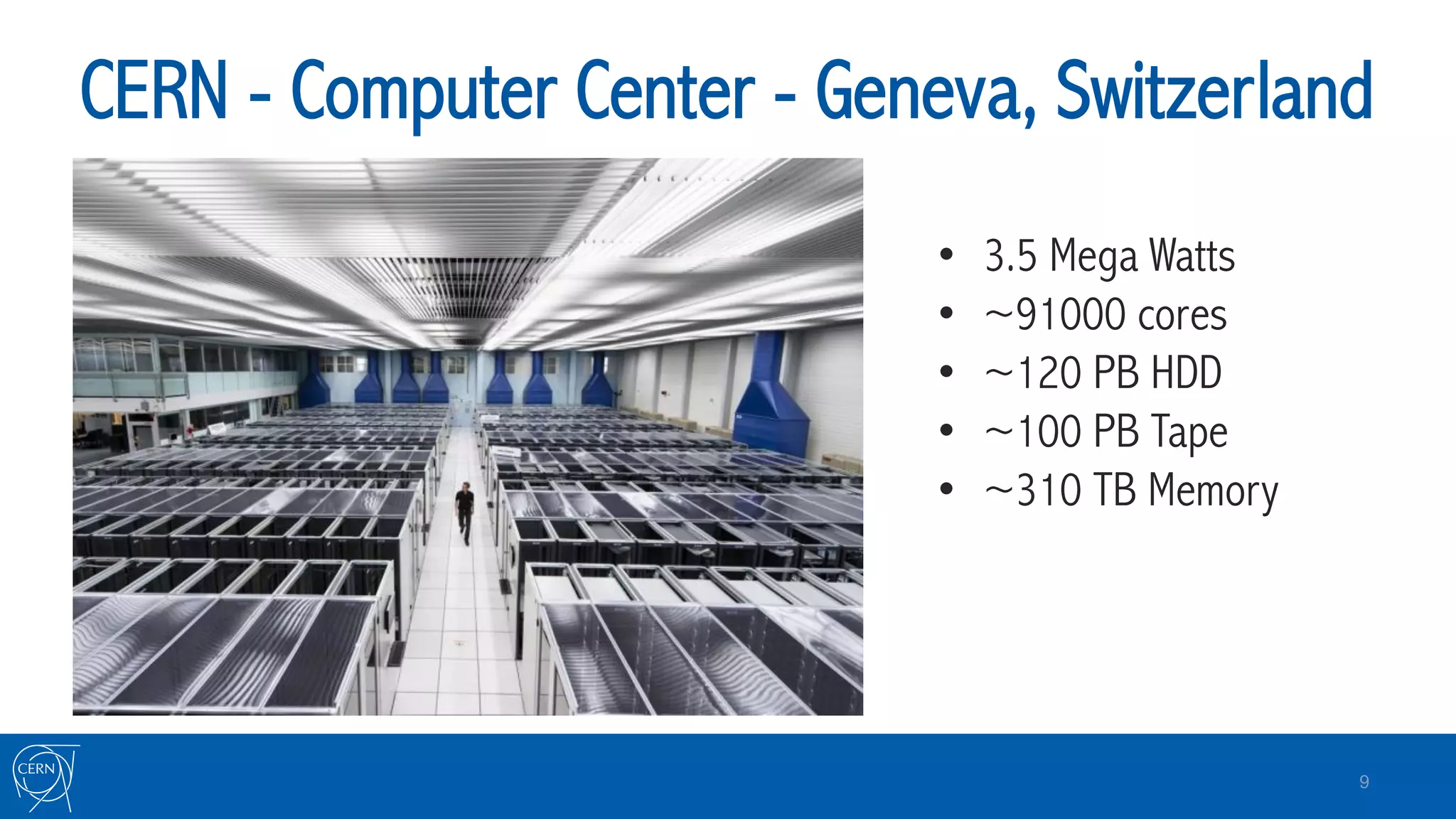
CERN - Computer Center - Geneva, Switzerland
9
•  3.5 Mega Watts
•  ~91000 cores
•  ~120 PB HDD
•  ~100 PB Tape
•  ~310 TB Memory
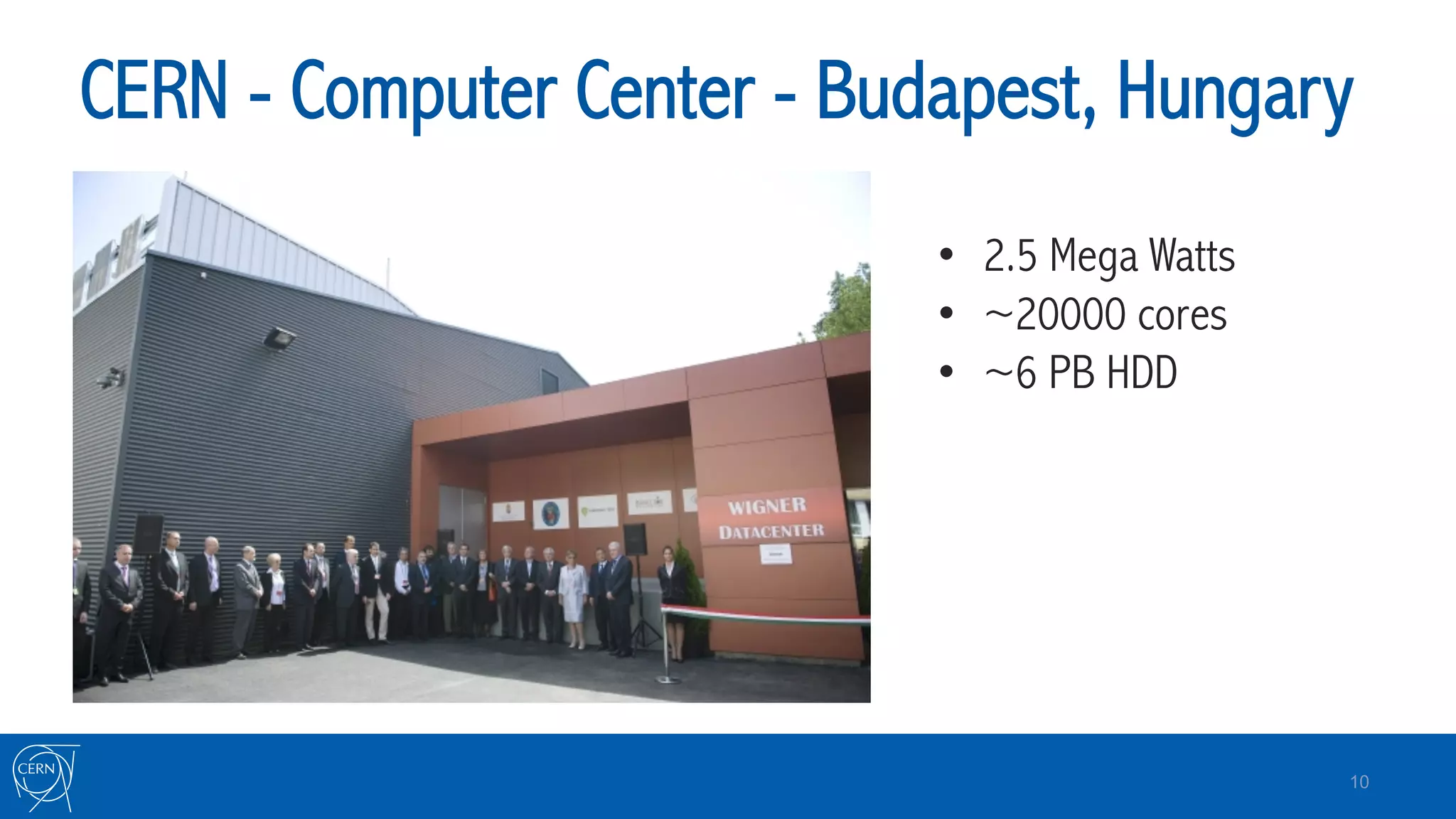
CERN - Computer Center - Budapest, Hungary
10
•  2.5 Mega Watts
•  ~20000 cores
•  ~6 PB HDD
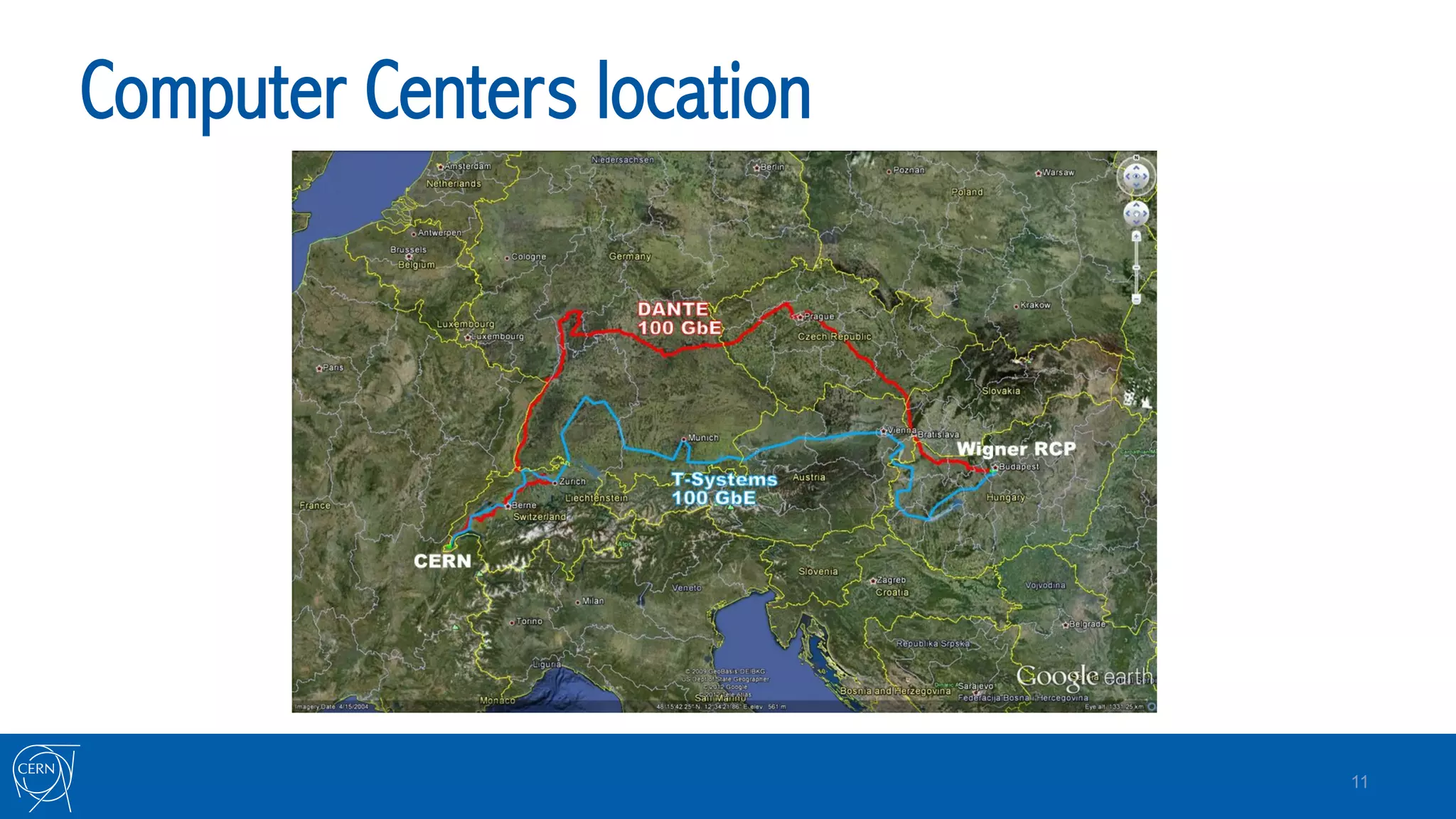
Computer Centers location
11
CERN IT Infrastructure in 2011
•  ~10k servers
•  Dedicated compute, dedicated disk server, dedicated service nodes
•  Mostly running on real hardware
•  Server consolidation of some service nodes using Microsoft HyperV/
SCVMM
•  ~3400 VMs (~2000 Linux, ~1400 Windows)
•  Various other virtualization projects around
•  Many diverse applications (”clusters”)
•  Managed by different teams (CERN IT + experiment groups)
12
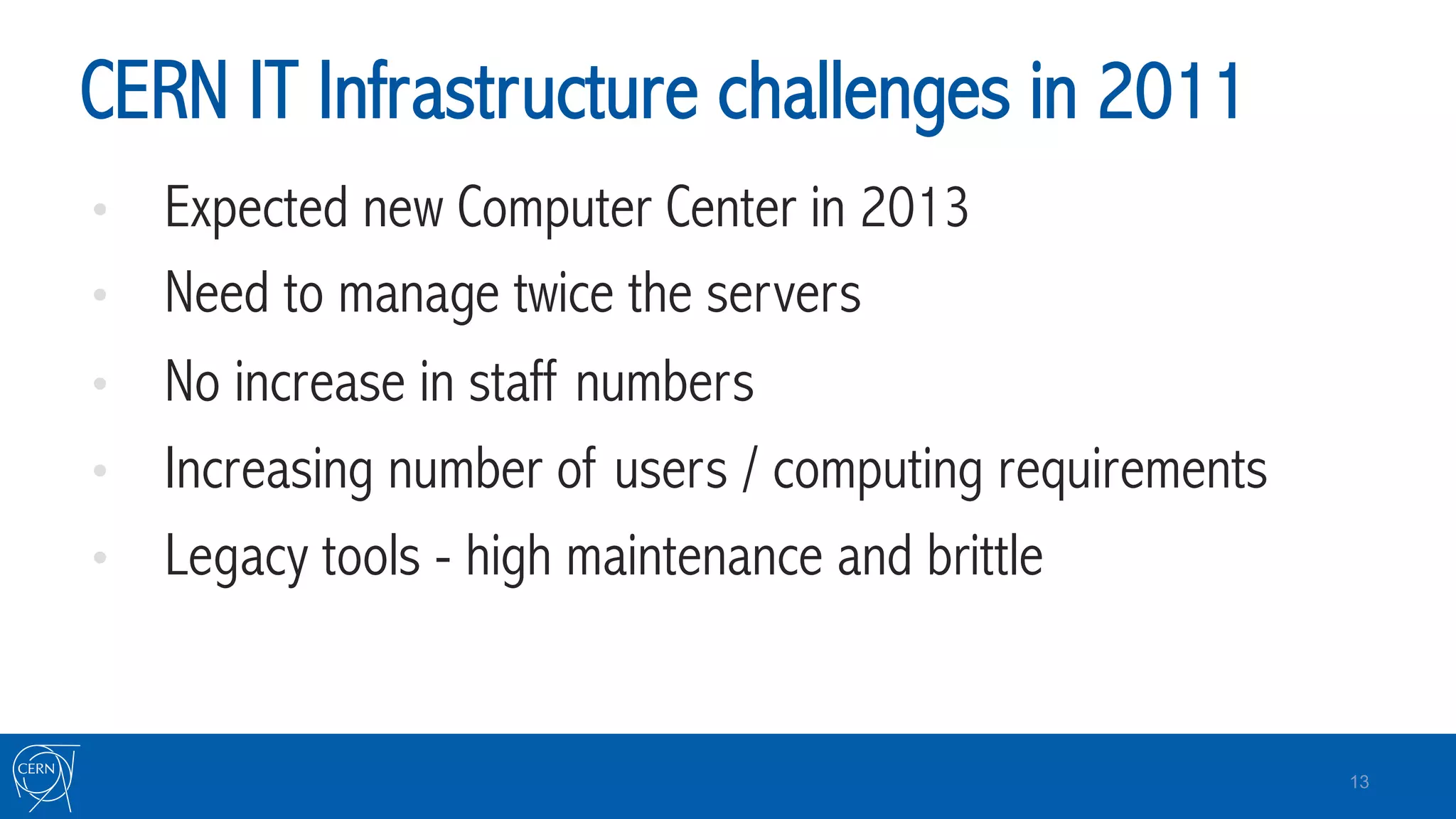
CERN IT Infrastructure challenges in 2011
•  Expected new Computer Center in 2013
•  Need to manage twice the servers
•  No increase in staff numbers
•  Increasing number of users / computing requirements
•  Legacy tools - high maintenance and brittle
13
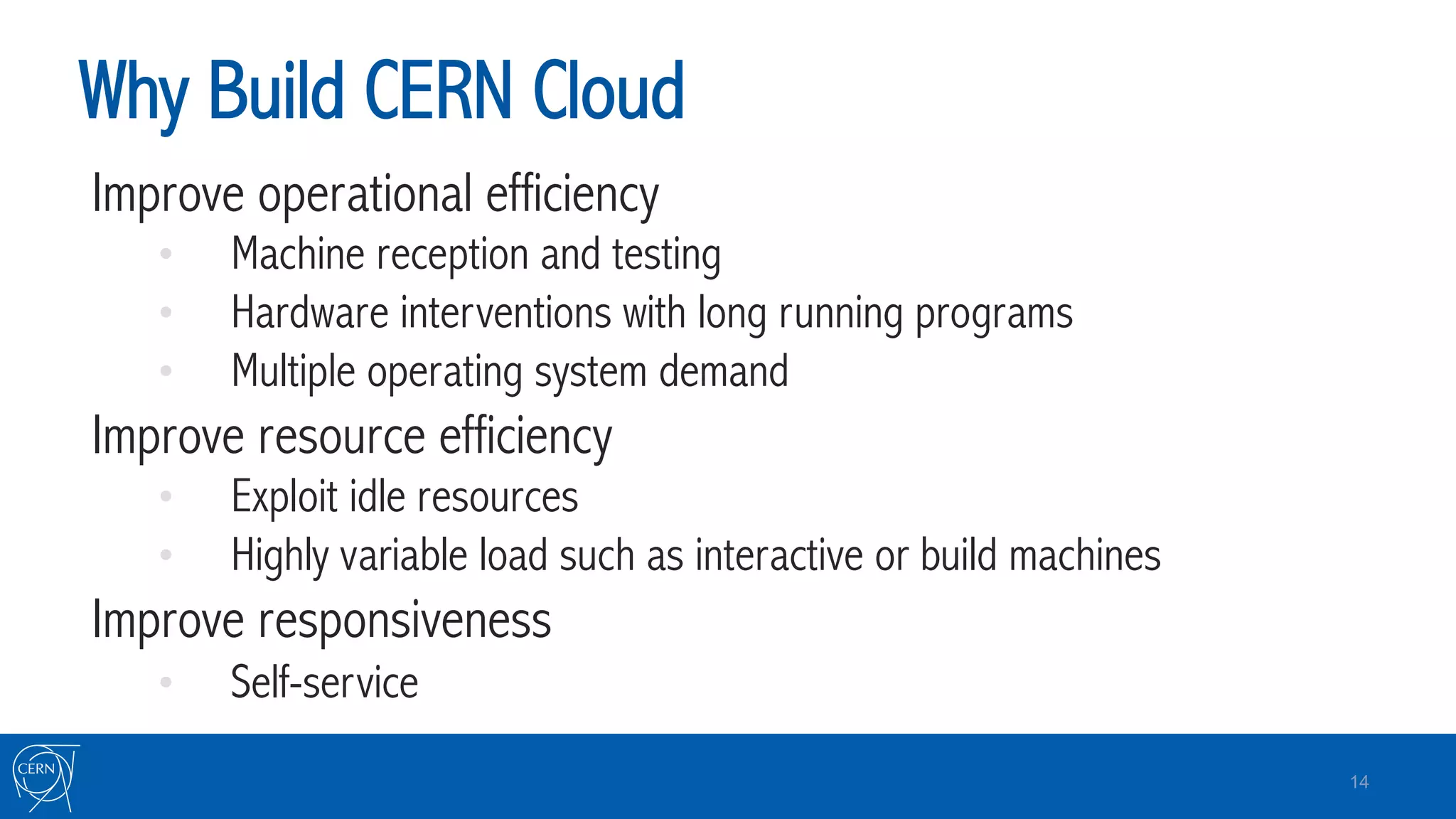
Why Build CERN Cloud
Improve operational efficiency
•  Machine reception and testing
•  Hardware interventions with long running programs
•  Multiple operating system demand
Improve resource efficiency
•  Exploit idle resources
•  Highly variable load such as interactive or build machines
Improve responsiveness
•  Self-service
14
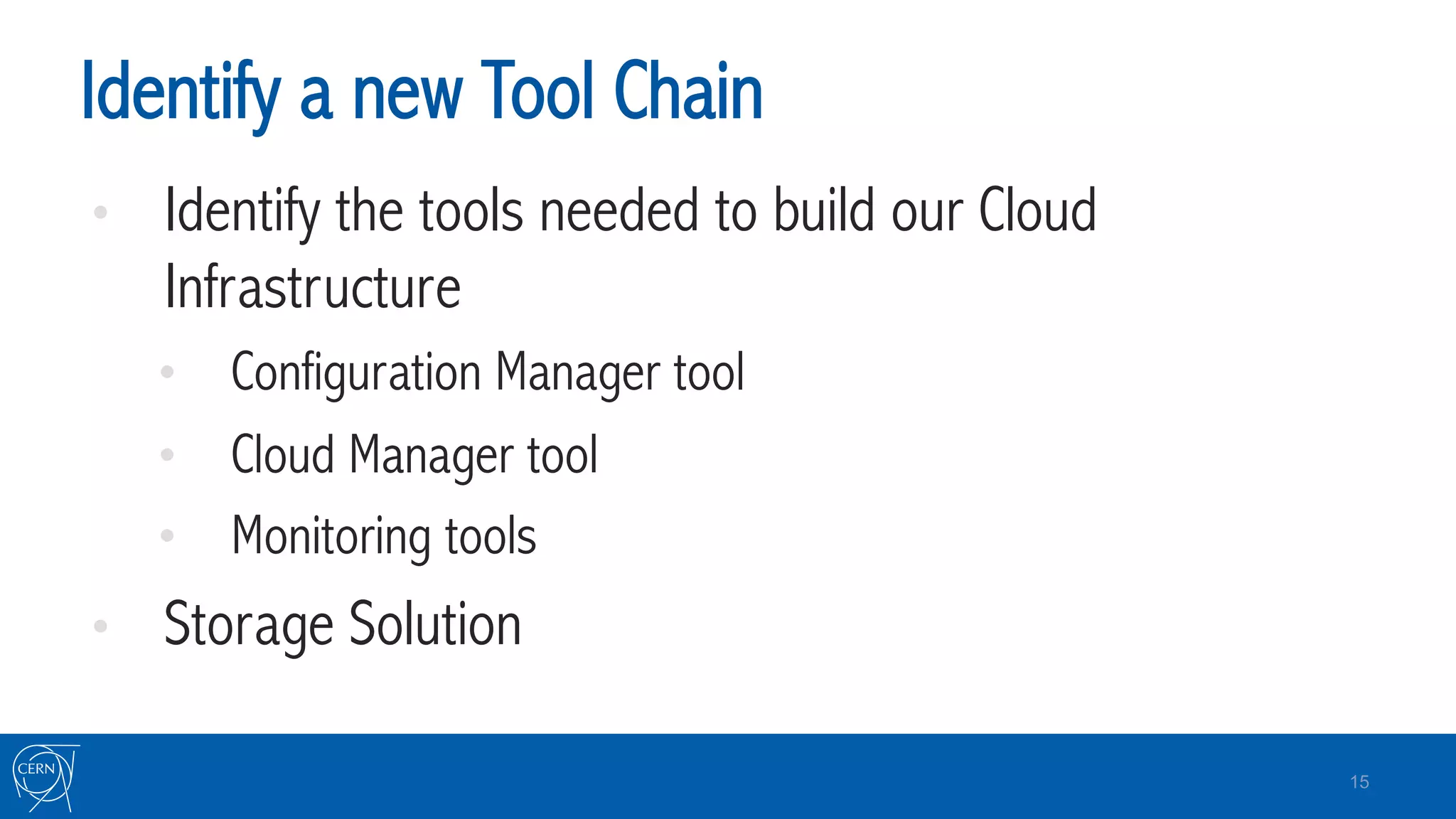
Identify a new Tool Chain
•  Identify the tools needed to build our Cloud
Infrastructure
•  Configuration Manager tool
•  Cloud Manager tool
•  Monitoring tools
•  Storage Solution
15
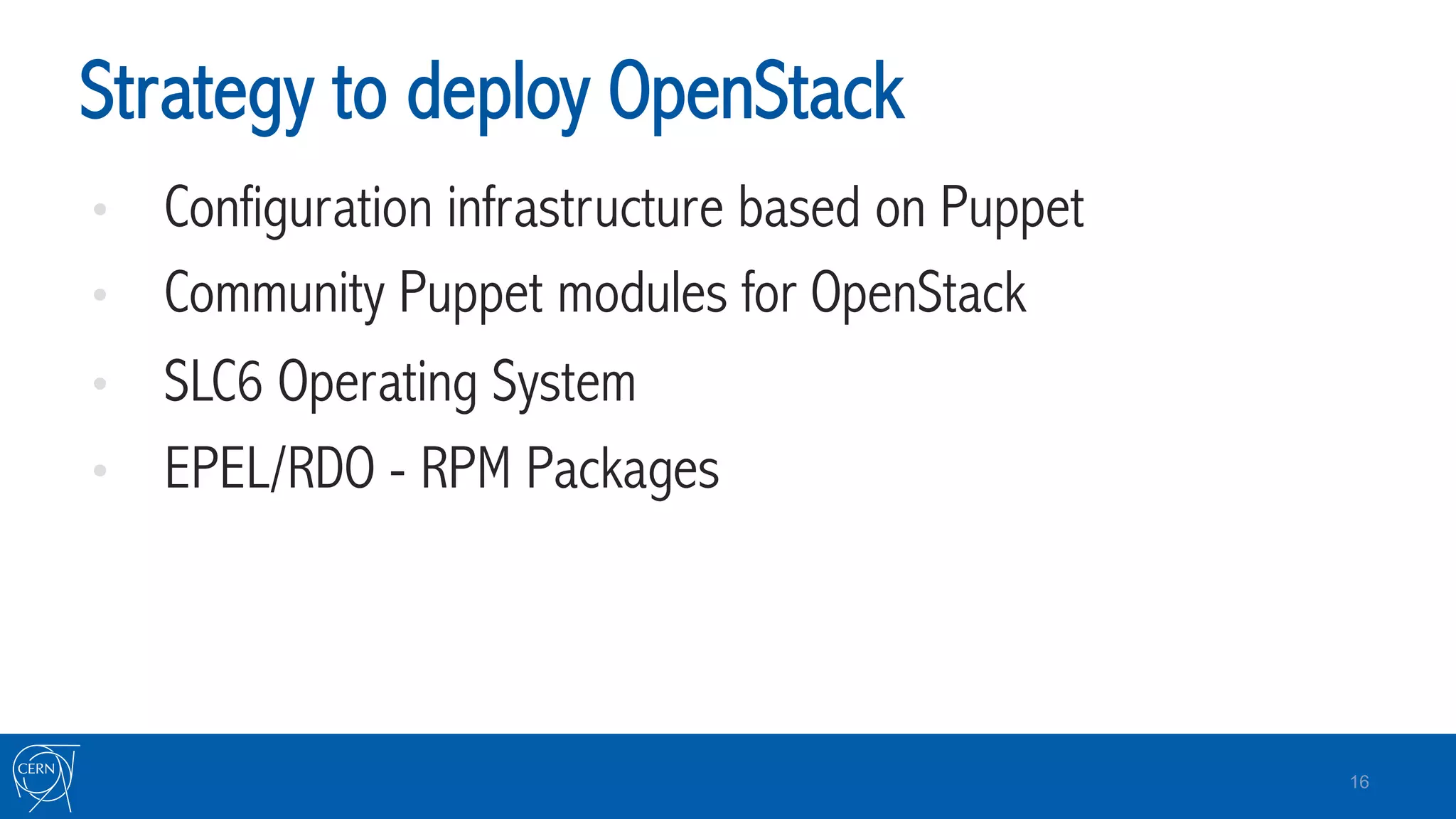
Strategy to deploy OpenStack
•  Configuration infrastructure based on Puppet
•  Community Puppet modules for OpenStack
•  SLC6 Operating System
•  EPEL/RDO - RPM Packages
16
Strategy to deploy OpenStack
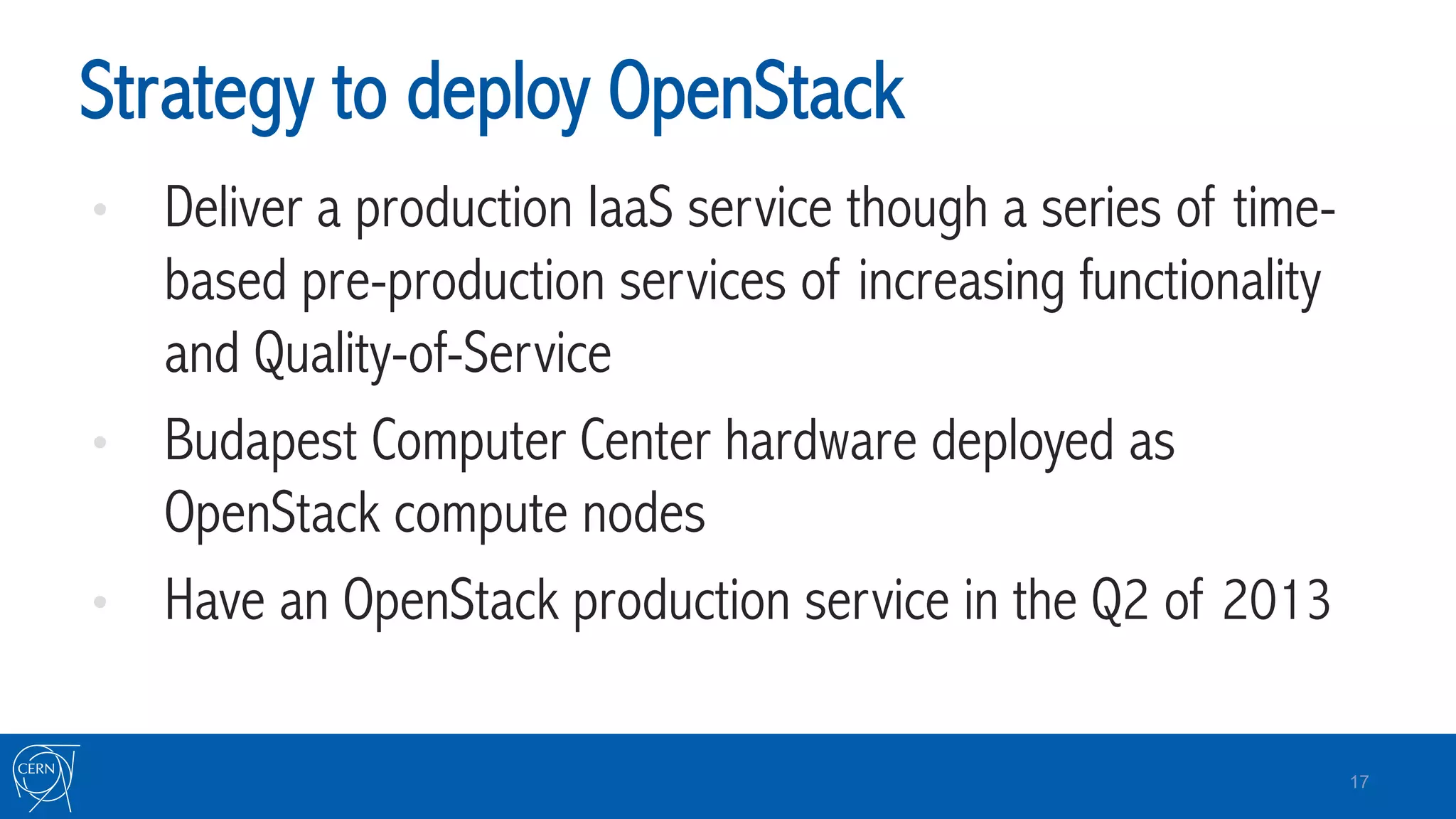
•  Deliver a production IaaS service though a series of time-
based pre-production services of increasing functionality
and Quality-of-Service
•  Budapest Computer Center hardware deployed as
OpenStack compute nodes
•  Have an OpenStack production service in the Q2 of 2013
17
Pre-Production Infrastructure
18
Essex Folsom
"Guppy" "Hamster" "Ibex"
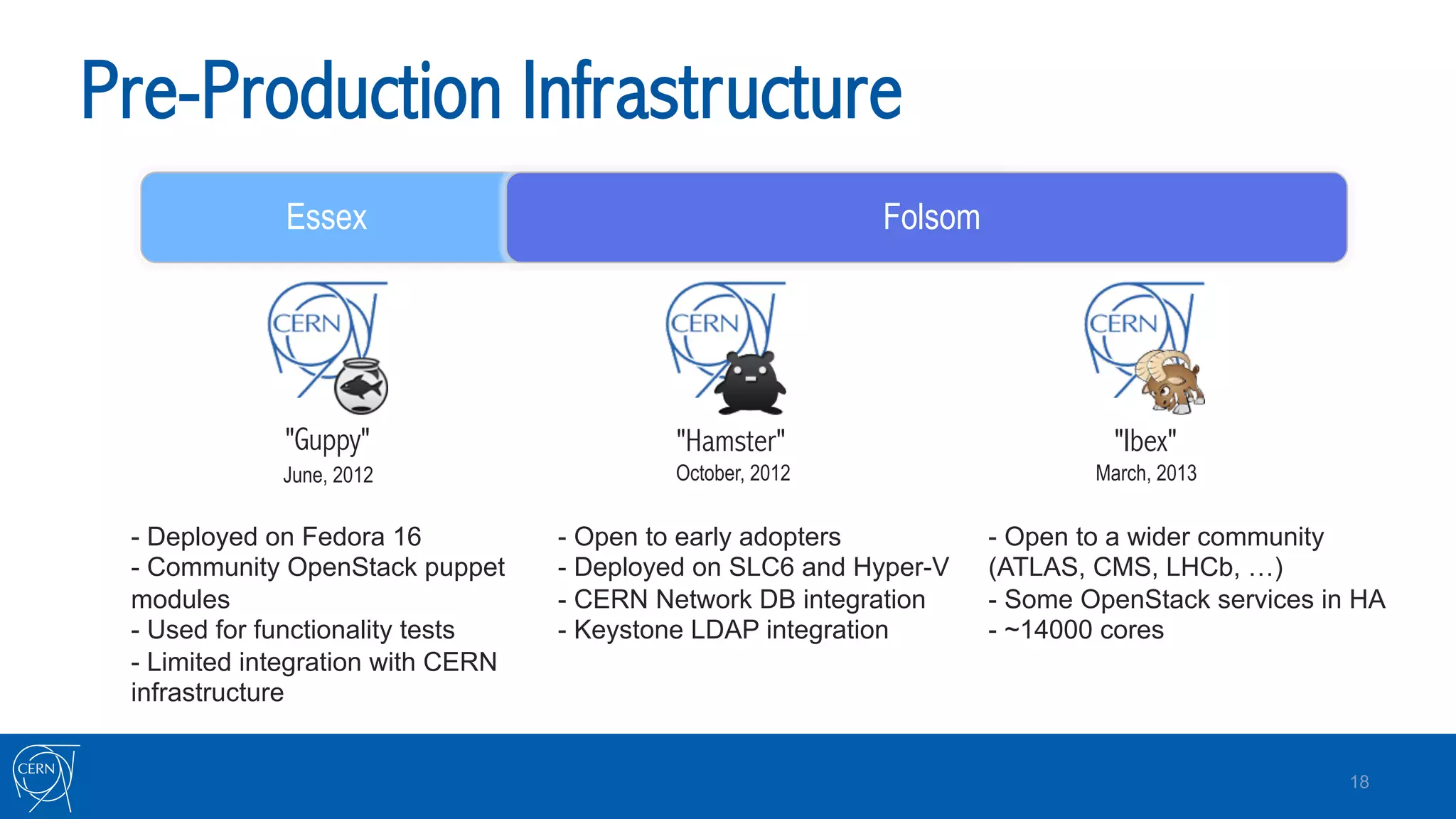
- Deployed on Fedora 16
- Community OpenStack puppet
modules
- Used for functionality tests
- Limited integration with CERN
infrastructure
- Open to early adopters
- Deployed on SLC6 and Hyper-V
- CERN Network DB integration
- Keystone LDAP integration
- Open to a wider community
(ATLAS, CMS, LHCb, …)
- Some OpenStack services in HA
- ~14000 cores
June, 2012 October, 2012 March, 2013
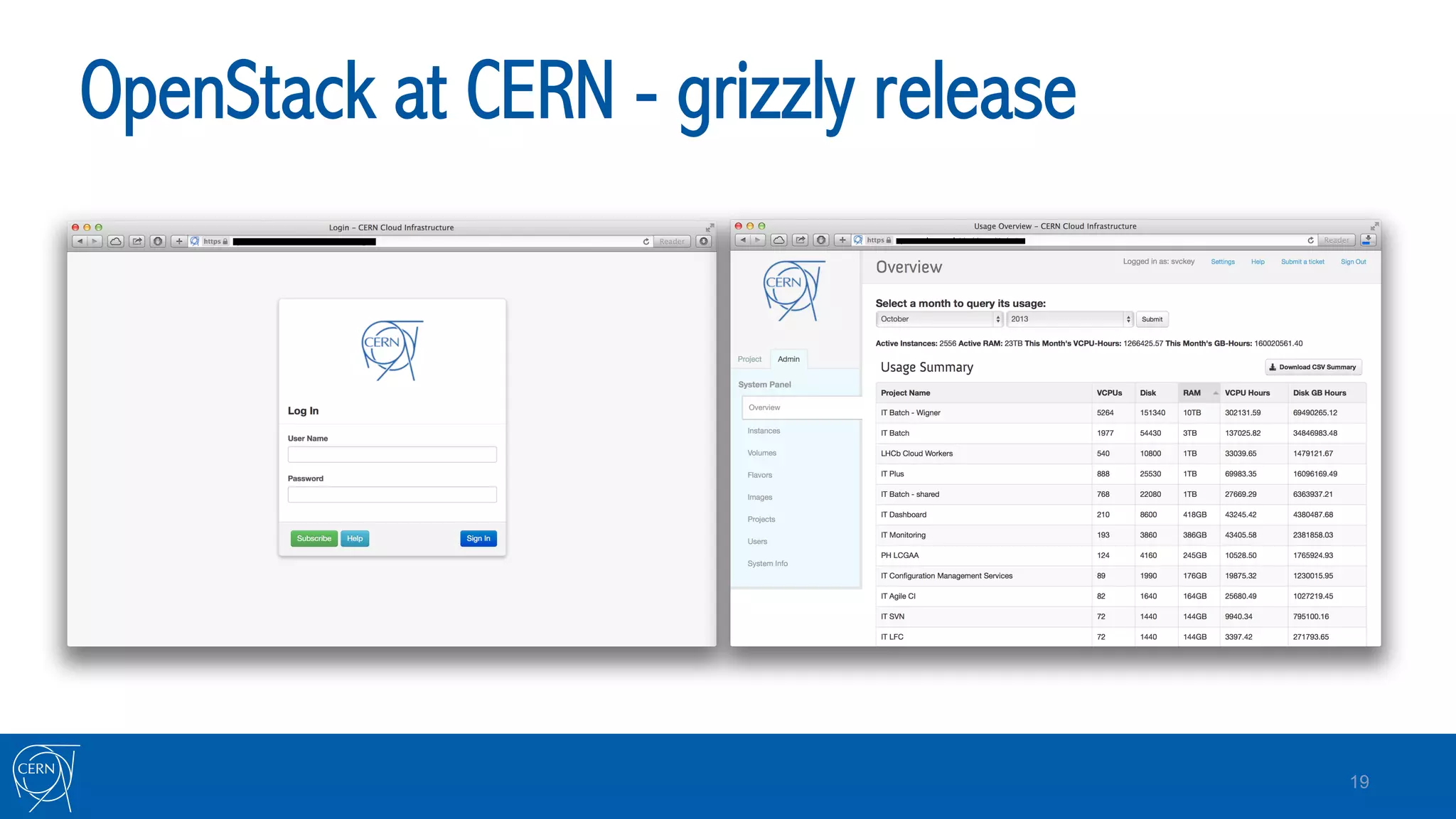
OpenStack at CERN - grizzly release
19
OpenStack at CERN - grizzly release
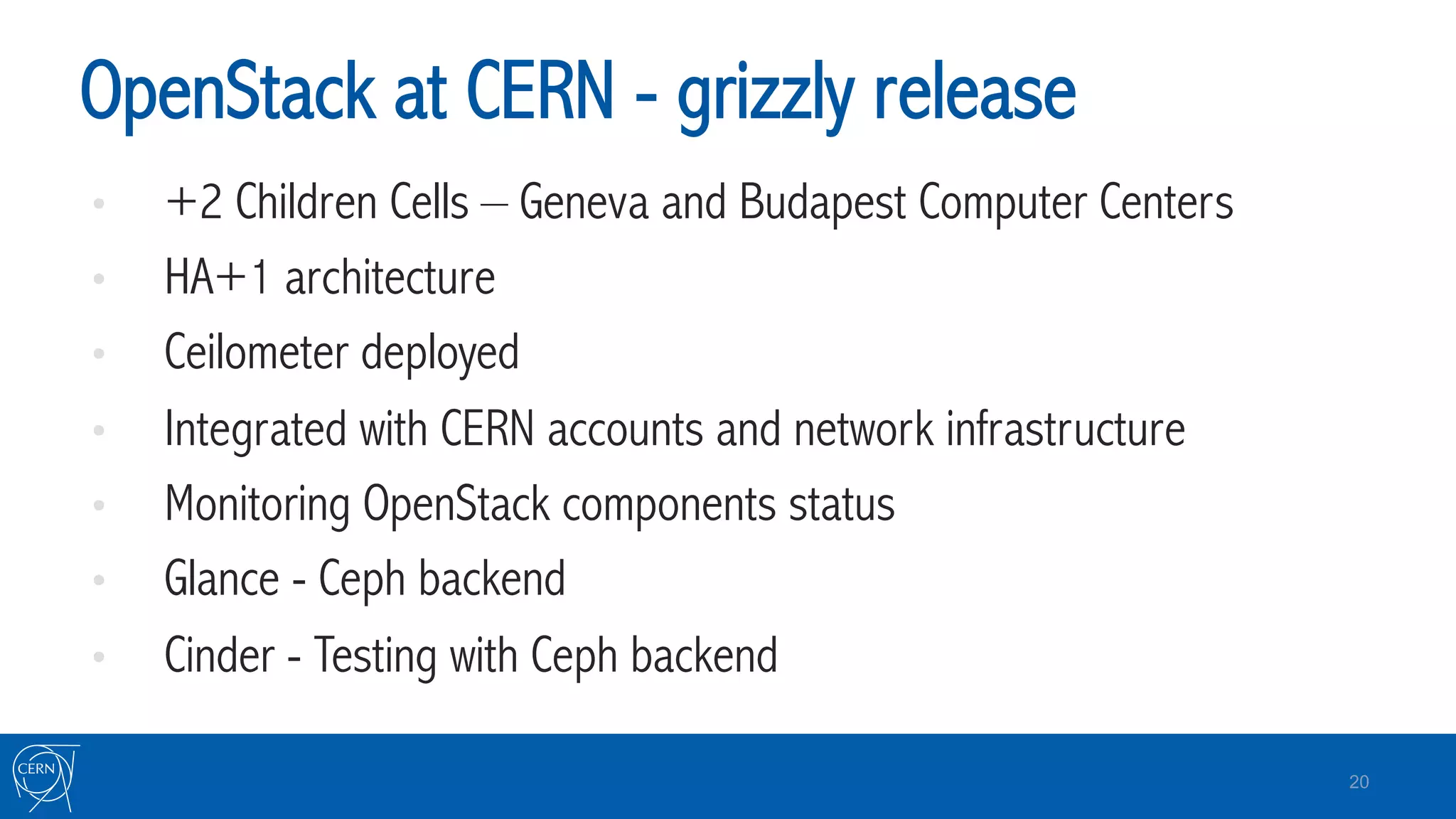
•  +2 Children Cells – Geneva and Budapest Computer Centers
•  HA+1 architecture
•  Ceilometer deployed
•  Integrated with CERN accounts and network infrastructure
•  Monitoring OpenStack components status
•  Glance - Ceph backend
•  Cinder - Testing with Ceph backend
20
Infrastructure Overview
•  Adding ~100 compute nodes every week
•  Geneva, Switzerland Cell
•  ~11000 cores
•  Budapest, Hungary Cell
•  ~10000 cores
•  Today we have +2500 VMs
•  Several VMs have more than 8 cores
21
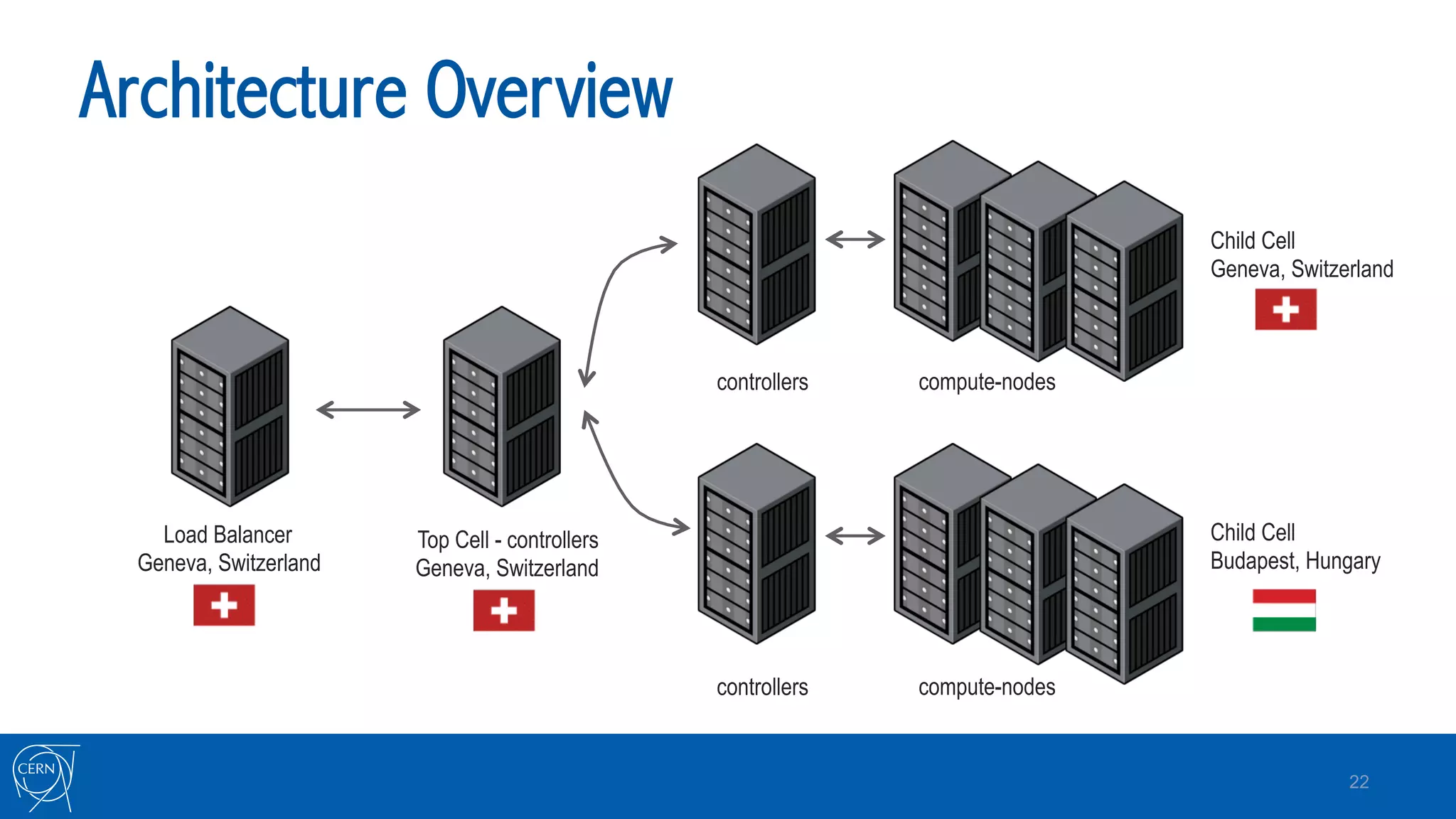
compute-nodescontrollers
compute-nodes
Architecture Overview
22
Child Cell
Geneva, Switzerland
Child Cell
Budapest, Hungary
Top Cell - controllers
Geneva, Switzerland
Load Balancer
Geneva, Switzerland
controllers
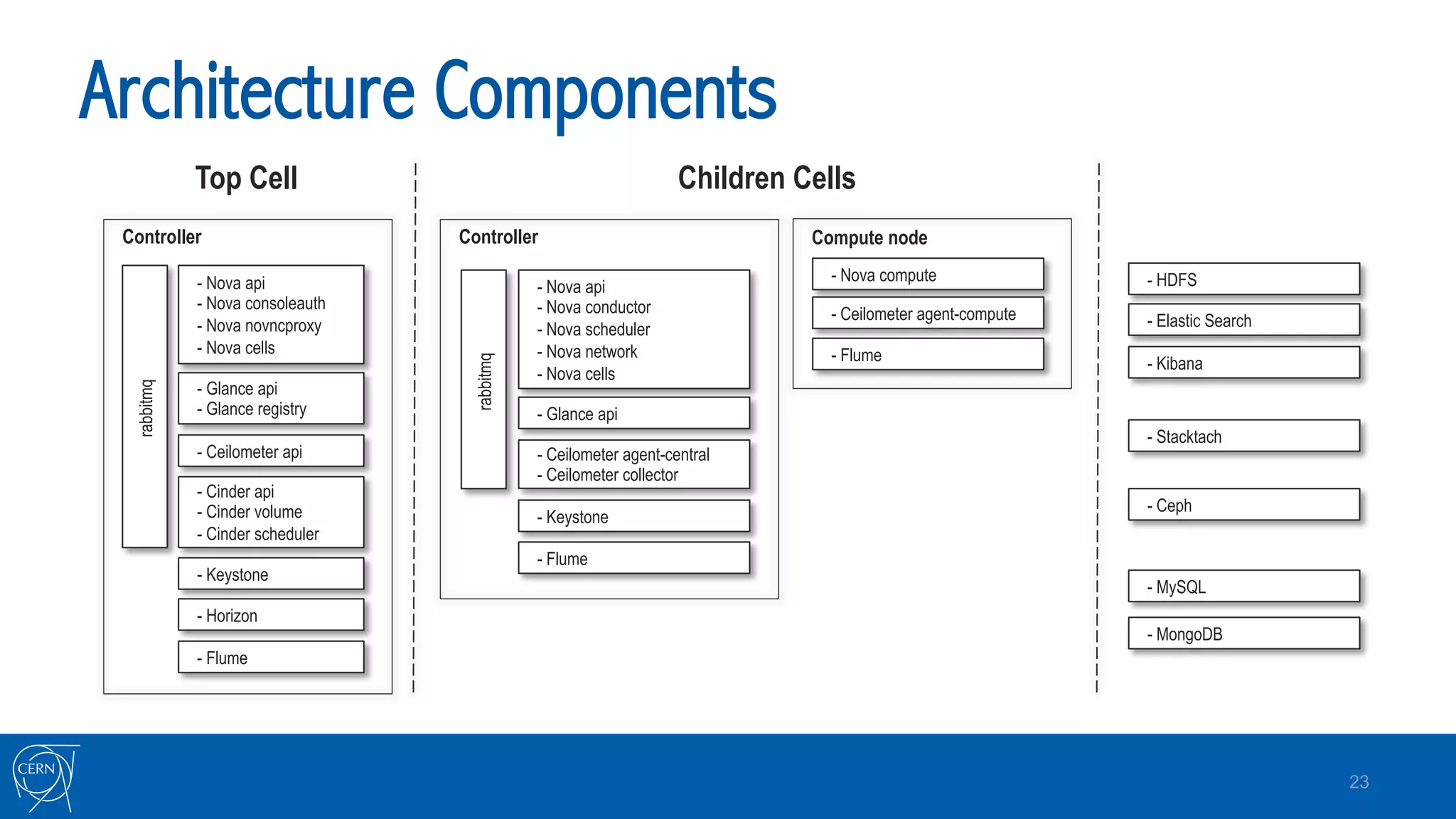
Architecture Components
23
rabbitmq
- Keystone
- Nova api
- Nova conductor
- Nova scheduler
- Nova network
- Nova cells
- Glance api
- Ceilometer agent-central
- Ceilometer collector
Controller
- Flume
- Nova compute
- Ceilometer agent-compute
Compute node
- Flume
- HDFS
- Elastic Search
- Kibana
- MySQL
- MongoDB
- Glance api
- Glance registry
- Keystone
- Nova api
- Nova consoleauth
- Nova novncproxy
- Nova cells
- Horizon
- Ceilometer api
- Cinder api
- Cinder volume
- Cinder scheduler
rabbitmq
Controller
Top Cell Children Cells
- Stacktach
- Ceph
- Flume
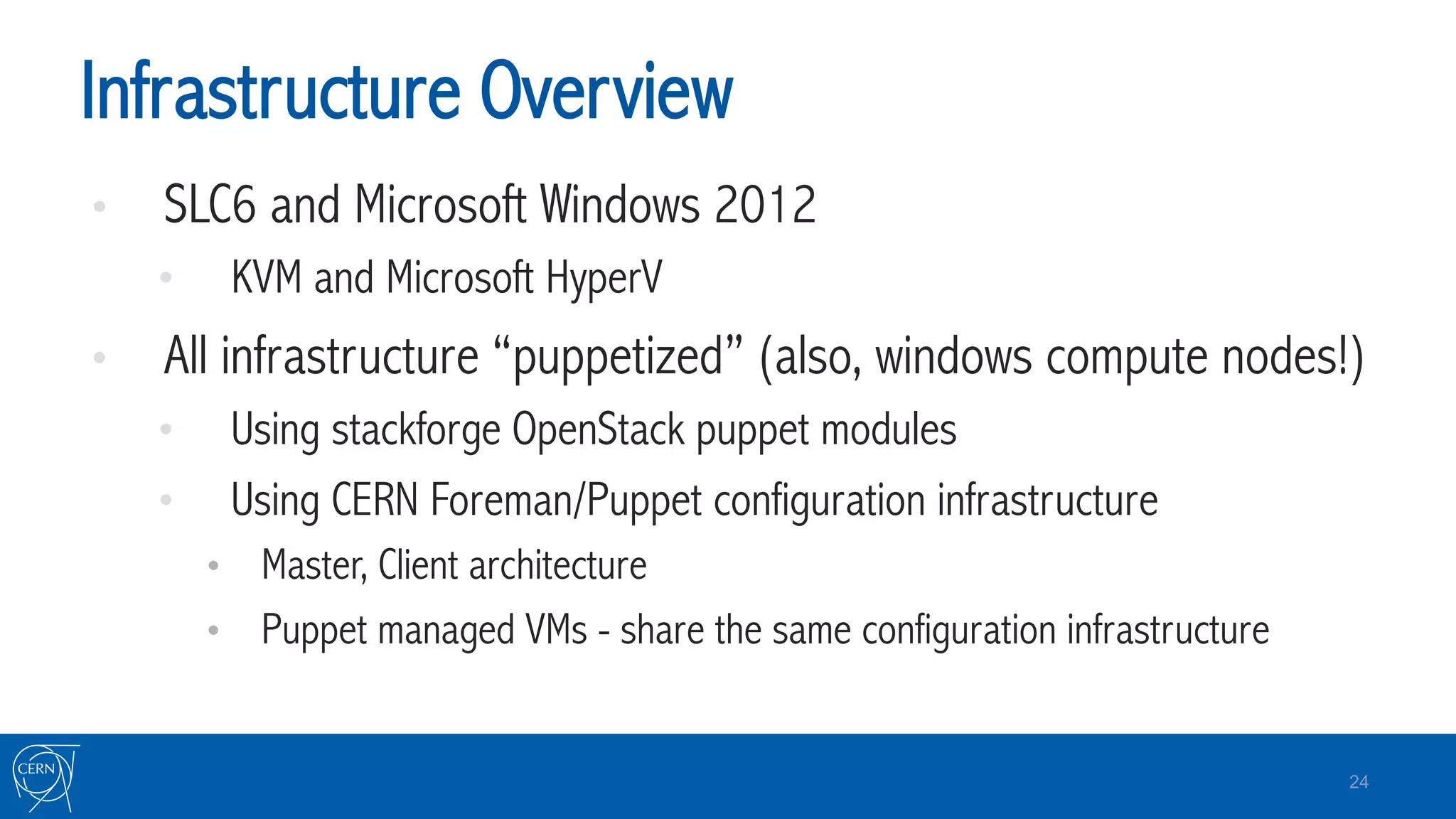
Infrastructure Overview
•  SLC6 and Microsoft Windows 2012
•  KVM and Microsoft HyperV
•  All infrastructure “puppetized” (also, windows compute nodes!)
•  Using stackforge OpenStack puppet modules
•  Using CERN Foreman/Puppet configuration infrastructure
•  Master, Client architecture
•  Puppet managed VMs - share the same configuration infrastructure
24
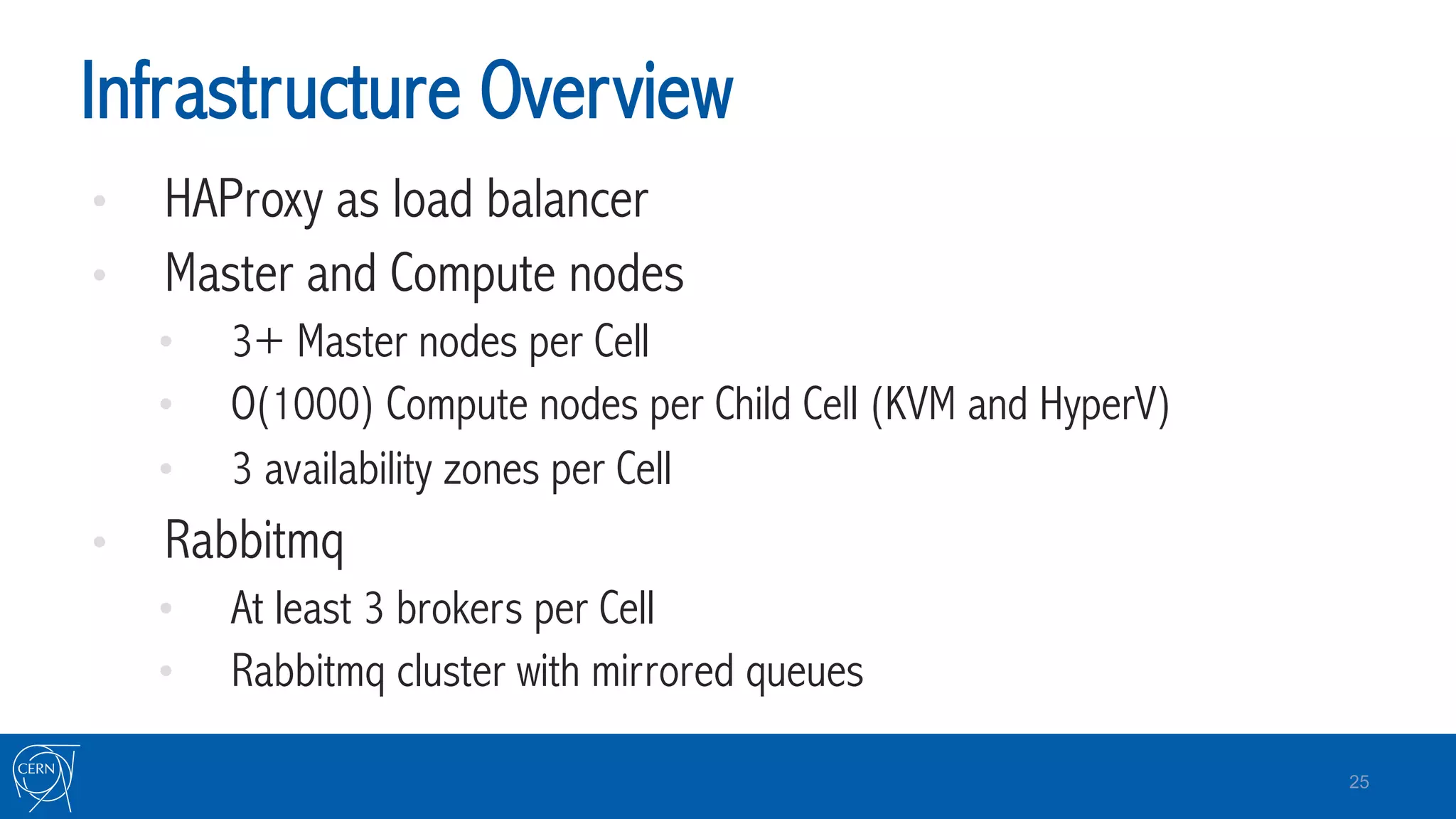
Infrastructure Overview
•  HAProxy as load balancer
•  Master and Compute nodes
•  3+ Master nodes per Cell
•  O(1000) Compute nodes per Child Cell (KVM and HyperV)
•  3 availability zones per Cell
•  Rabbitmq
•  At least 3 brokers per Cell
•  Rabbitmq cluster with mirrored queues
25
Infrastructure Overview
•  MySql instance per Cell
•  MySql managed by CERN DB team
•  Running on top of Oracle CRS
•  active/slave configuration
•  NetApp storage backend
•  Backups every 6 hours
26
Nova Cells
•  Why Cells?
•  Scale transparently between different Computer Centers
•  With cells we lost functionality
•  Security groups
•  Live migration
•  "Parents" don't know about “children” compute
•  Flavors not propagated to "children” cells
27
Nova Cells
•  Scheduling
•  Random cell selection on Grizzly
•  Implemented simple scheduler based on project
•  CERN Geneva only, CERN Wigner only, “both”
•  “both” selects the cell with more available free memory
•  Cell/Cell communication doesn’t support multiple Rabbitmq
servers
•  https://bugs.launchpad.net/nova/+bug/1178541
28
Nova Network
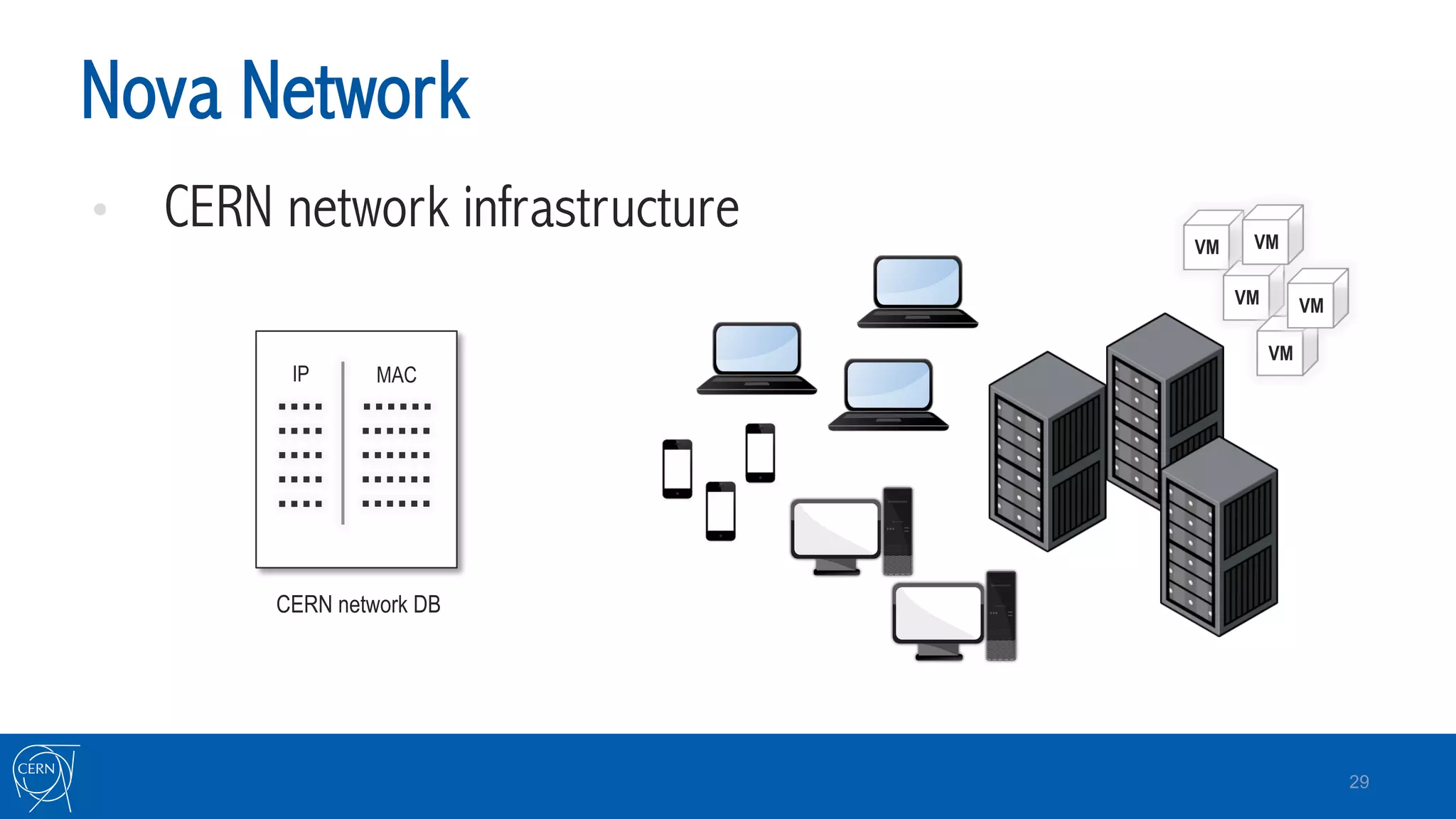
•  CERN network infrastructure
29
IP MAC
CERN network DB
VM
VM
VM
VM
VM
Nova Network
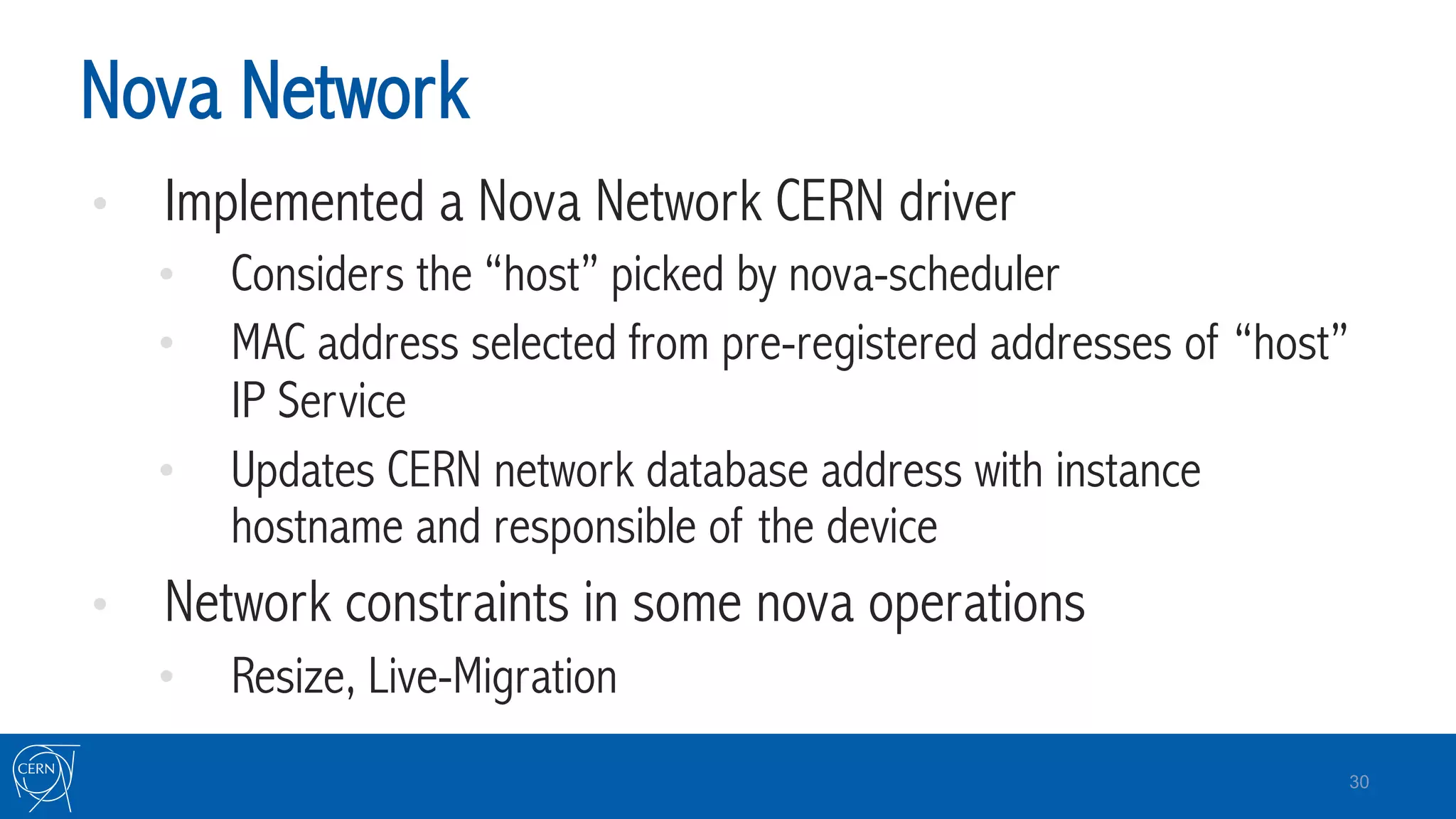
•  Implemented a Nova Network CERN driver
•  Considers the “host” picked by nova-scheduler
•  MAC address selected from pre-registered addresses of “host”
IP Service
•  Updates CERN network database address with instance
hostname and responsible of the device
•  Network constraints in some nova operations
•  Resize, Live-Migration
30
Nova Scheduler
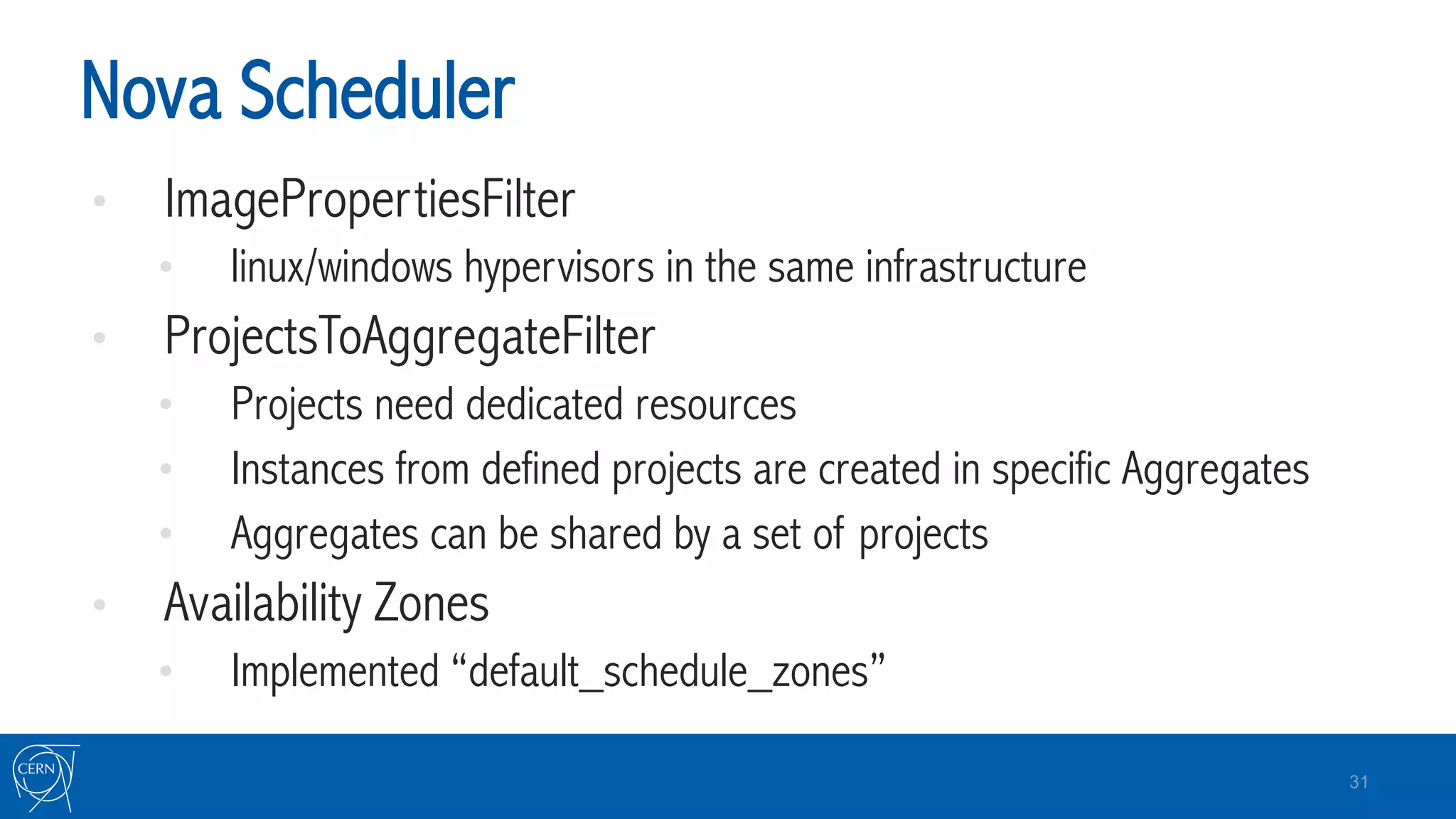
•  ImagePropertiesFilter
•  linux/windows hypervisors in the same infrastructure
•  ProjectsToAggregateFilter
•  Projects need dedicated resources
•  Instances from defined projects are created in specific Aggregates
•  Aggregates can be shared by a set of projects
•  Availability Zones
•  Implemented “default_schedule_zones”
31
Nova Conductor
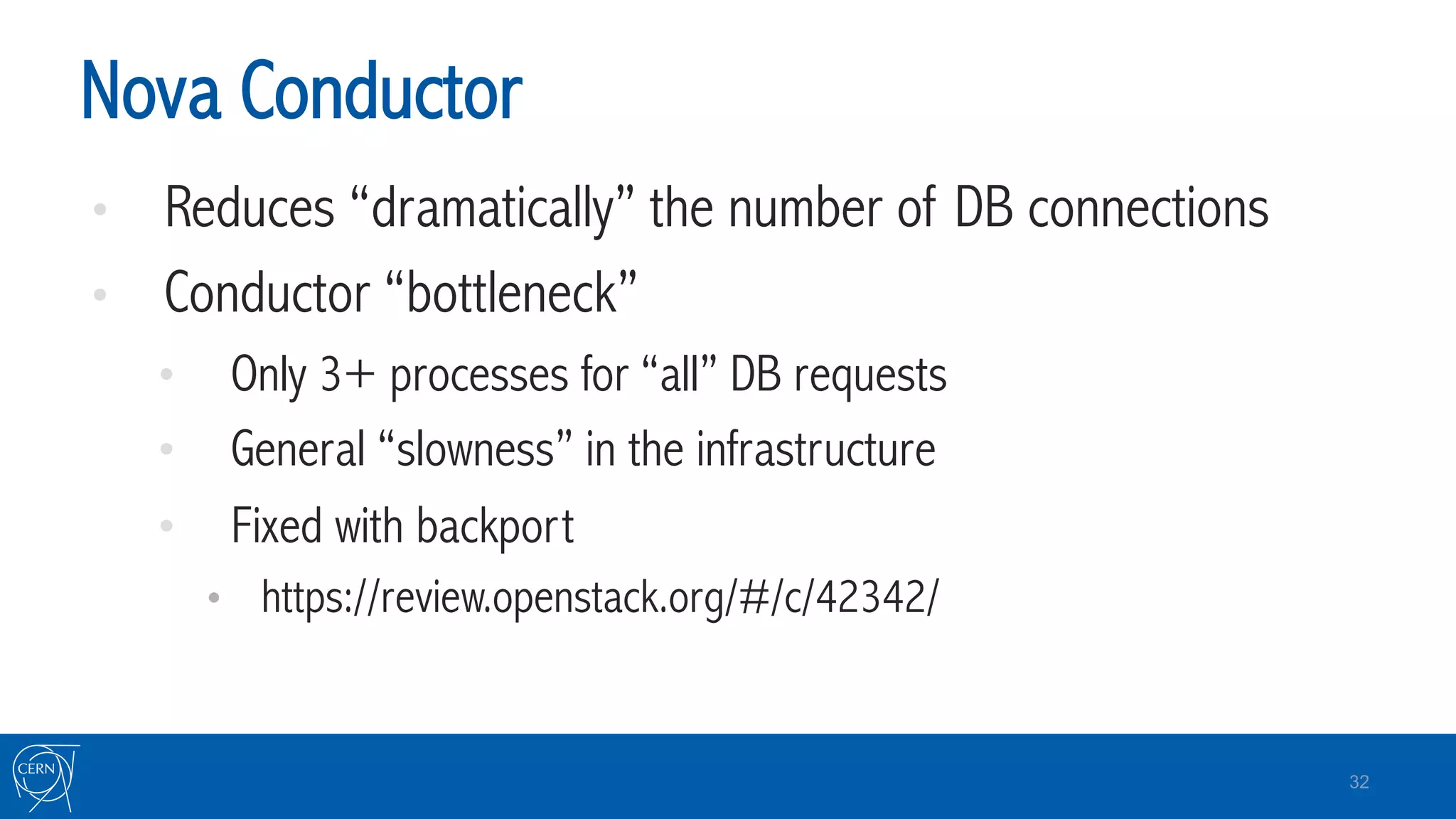
•  Reduces “dramatically” the number of DB connections
•  Conductor “bottleneck”
•  Only 3+ processes for “all” DB requests
•  General “slowness” in the infrastructure
•  Fixed with backport
•  https://review.openstack.org/#/c/42342/
32
Nova Compute
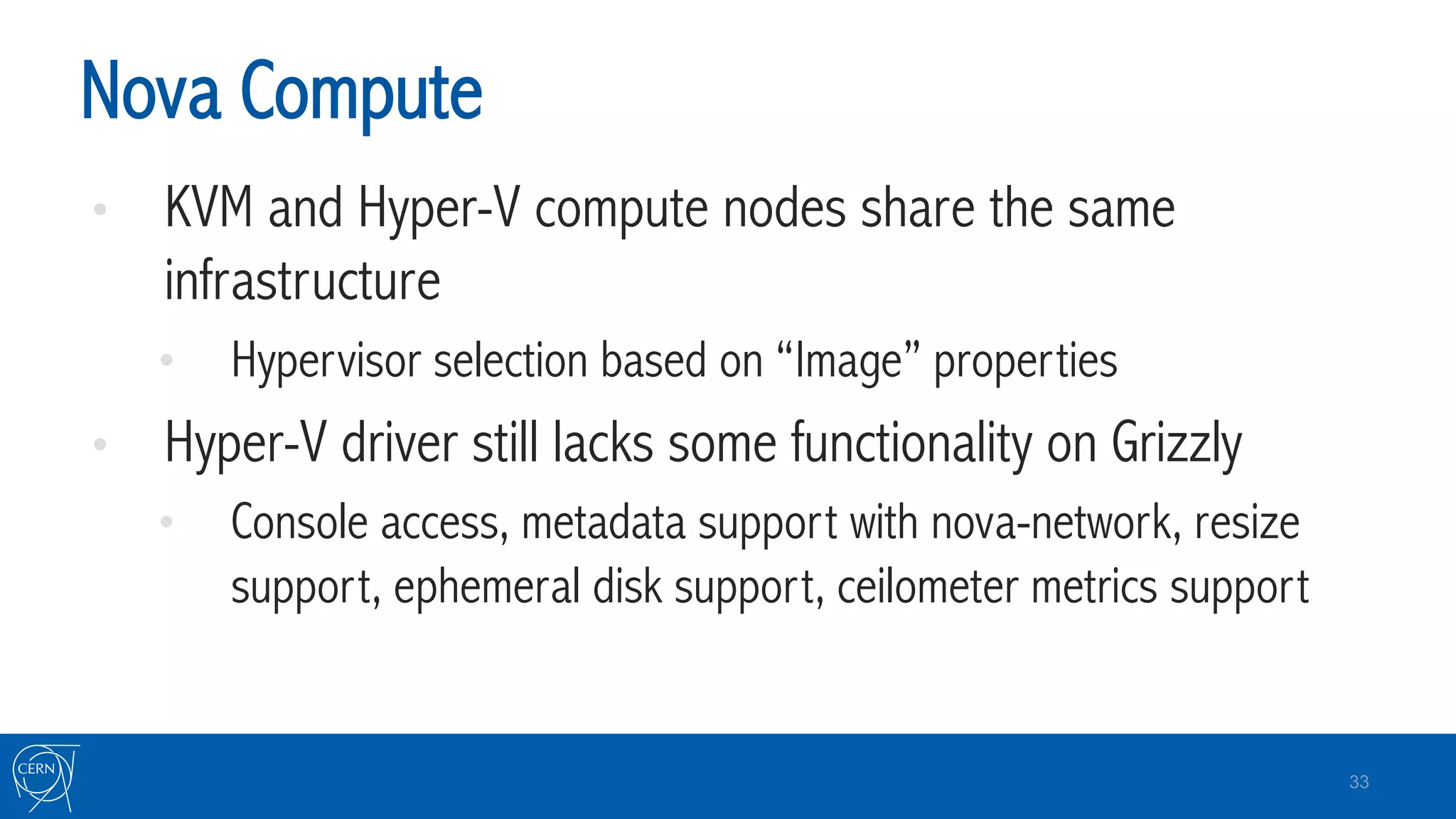
•  KVM and Hyper-V compute nodes share the same
infrastructure
•  Hypervisor selection based on “Image” properties
•  Hyper-V driver still lacks some functionality on Grizzly
•  Console access, metadata support with nova-network, resize
support, ephemeral disk support, ceilometer metrics support
33
Keystone
•  CERN’s Active Directory infrastructure
•  Unified identity management across the site
•  +44000 users
•  +29000 groups
•  ~200 arrivals/departures per month
•  Keystone integrated with CERN Active Directory
•  LDAP backend
34
Keystone
•  CERN user subscribes the "cloud service”
•  Created "Personal Tenant" with limited quota
•  Shared projects created by request
•  Project life cycle
•  owner, member, admin – roles
•  "Personal project" disabled when user leaves
•  Delete resources (VMs, Volumes, Images, …)
•  User removed from "Shared Projects"
35
Ceilometer
•  Users are not directly billed
•  Metering needed to adjust Project quotas
•  mongoDB backend – sharded and replicated
•  Collector, Central-Agent
•  Running on “children” Cells controllers
•  Compute-Agent
•  Uses nova-api running on “children” Cells controllers
36
Glance
•  Glance API
•  Using glance api v1
•  python-glanceclient doesn’t support completely v2
•  Glance Registry
•  With v1 we need to keep Glance Registry
•  Only runs in Top Cell behind the load balancer
•  Glance backend
•  File Store (AFS)
•  Ceph
37
Glance
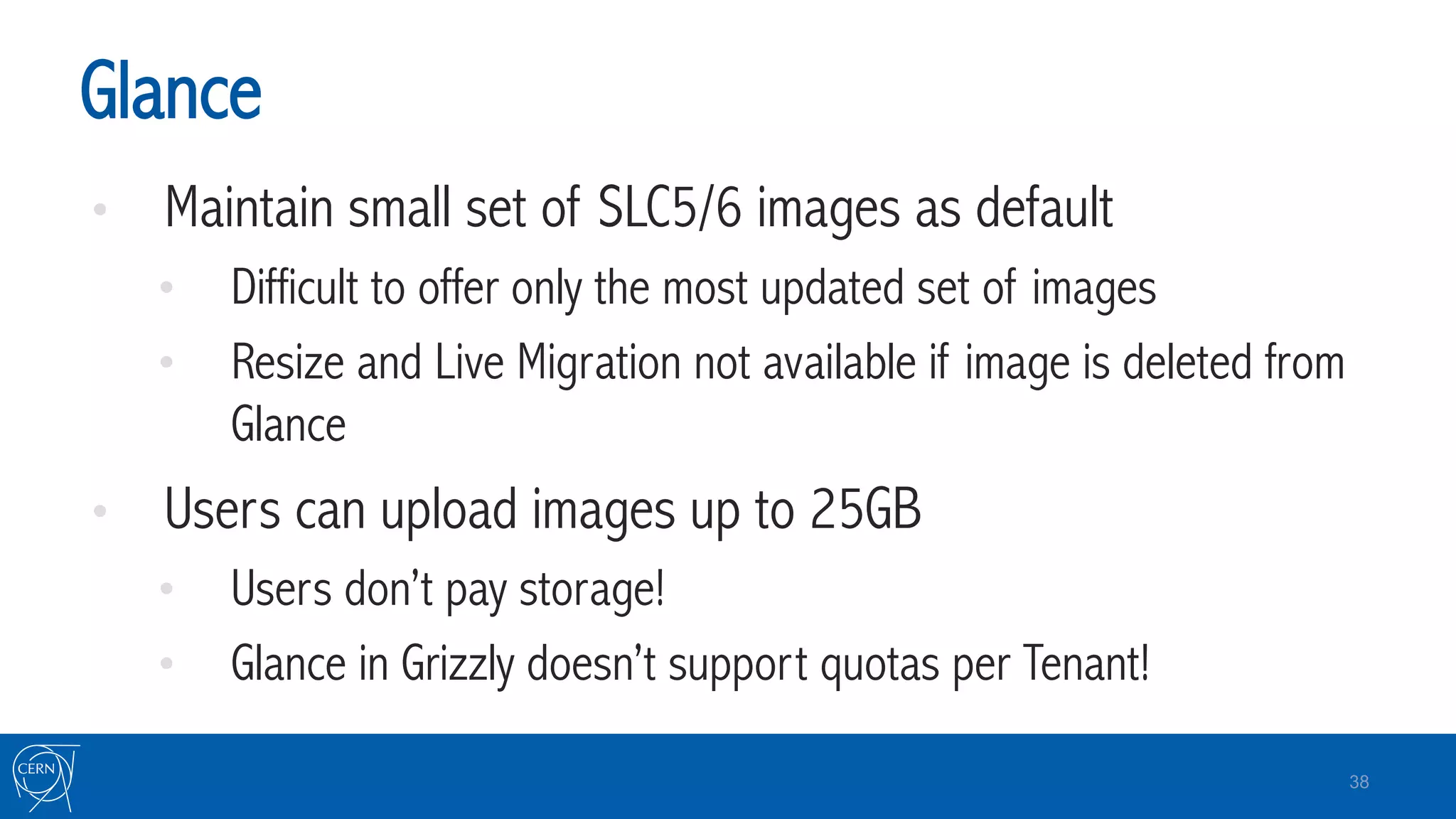
•  Maintain small set of SLC5/6 images as default
•  Difficult to offer only the most updated set of images
•  Resize and Live Migration not available if image is deleted from
Glance
•  Users can upload images up to 25GB
•  Users don’t pay storage!
•  Glance in Grizzly doesn’t support quotas per Tenant!
38
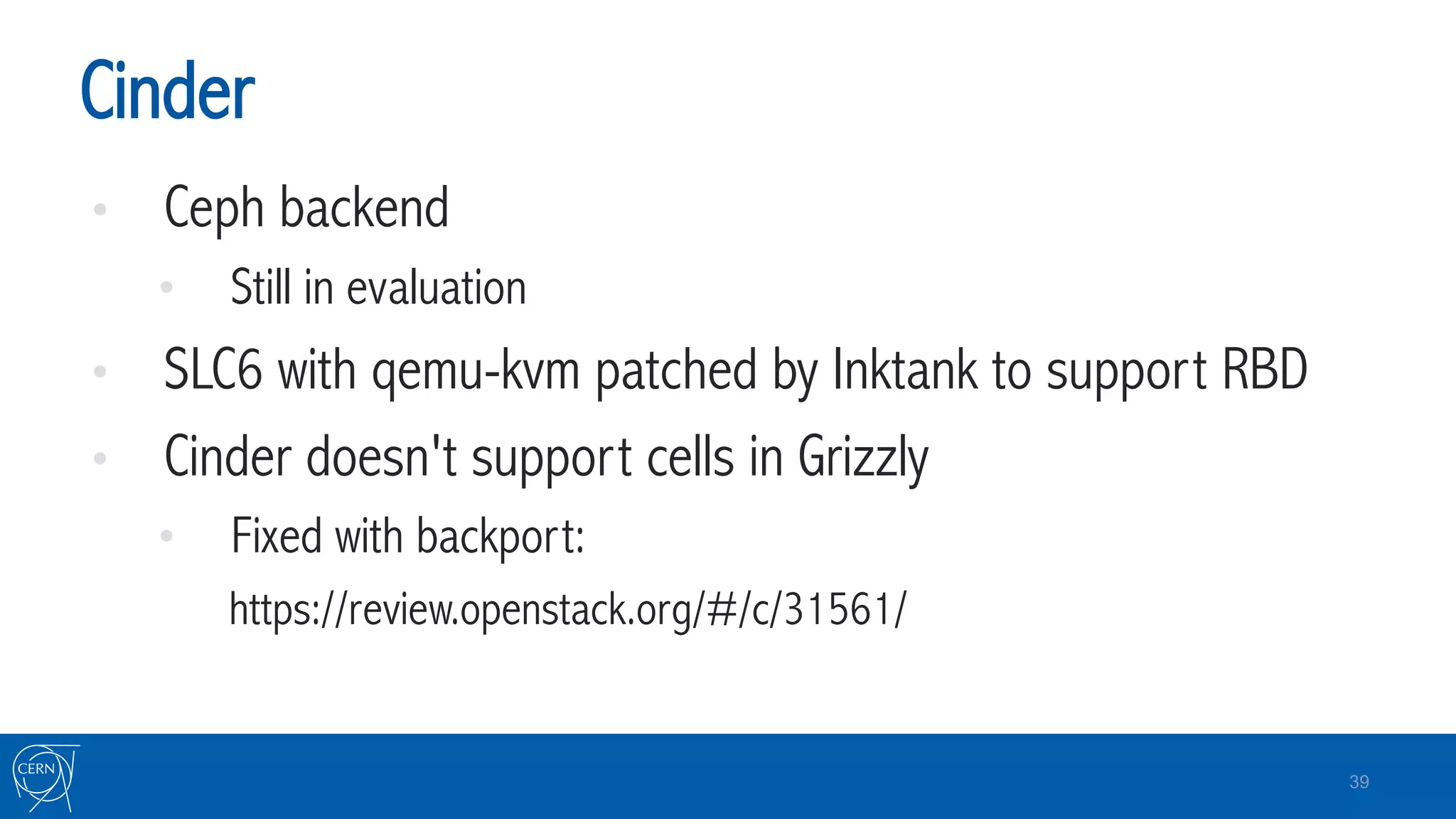
Cinder
•  Ceph backend
•  Still in evaluation
•  SLC6 with qemu-kvm patched by Inktank to support RBD
•  Cinder doesn't support cells in Grizzly
•  Fixed with backport:
https://review.openstack.org/#/c/31561/
39
Ceph as Storage Backend
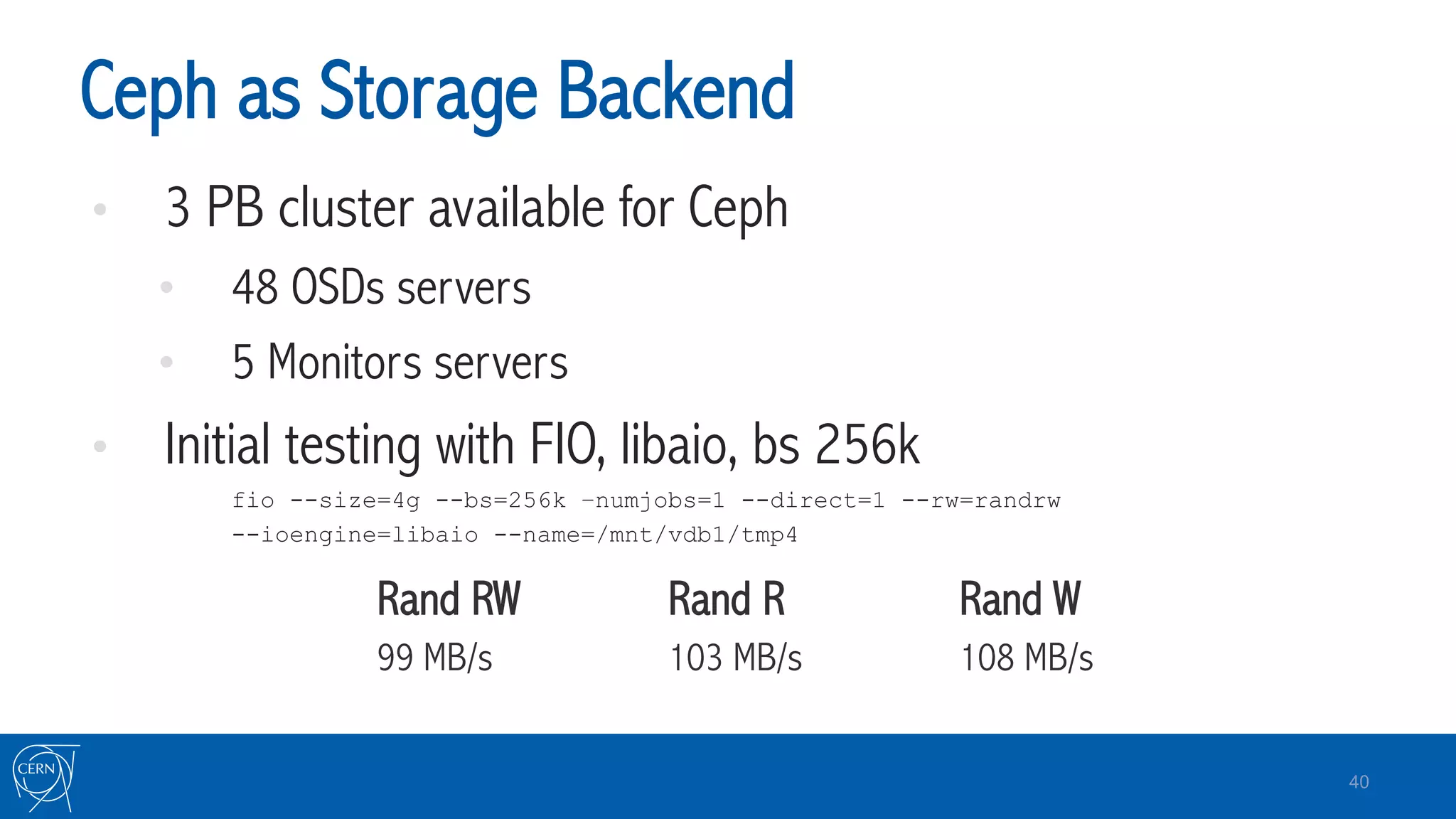
•  3 PB cluster available for Ceph
•  48 OSDs servers
•  5 Monitors servers
•  Initial testing with FIO, libaio, bs 256k
fio --size=4g --bs=256k –numjobs=1 --direct=1 --rw=randrw
--ioengine=libaio --name=/mnt/vdb1/tmp4
Rand RW Rand R Rand W
99 MB/s 103 MB/s 108 MB/s
40
Ceph as Storage Backend
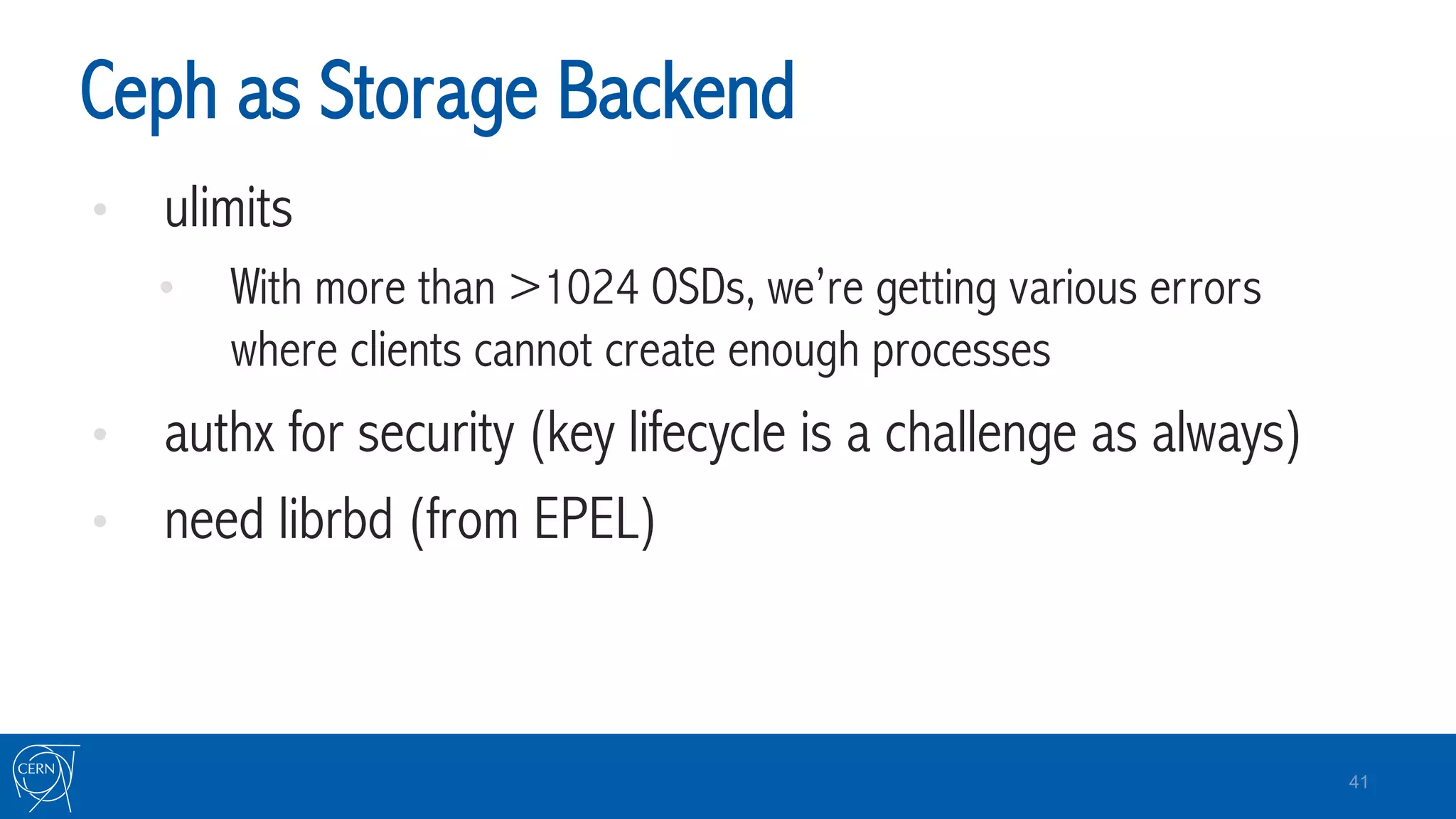
•  ulimits
•  With more than >1024 OSDs, we’re getting various errors
where clients cannot create enough processes
•  authx for security (key lifecycle is a challenge as always)
•  need librbd (from EPEL)
41
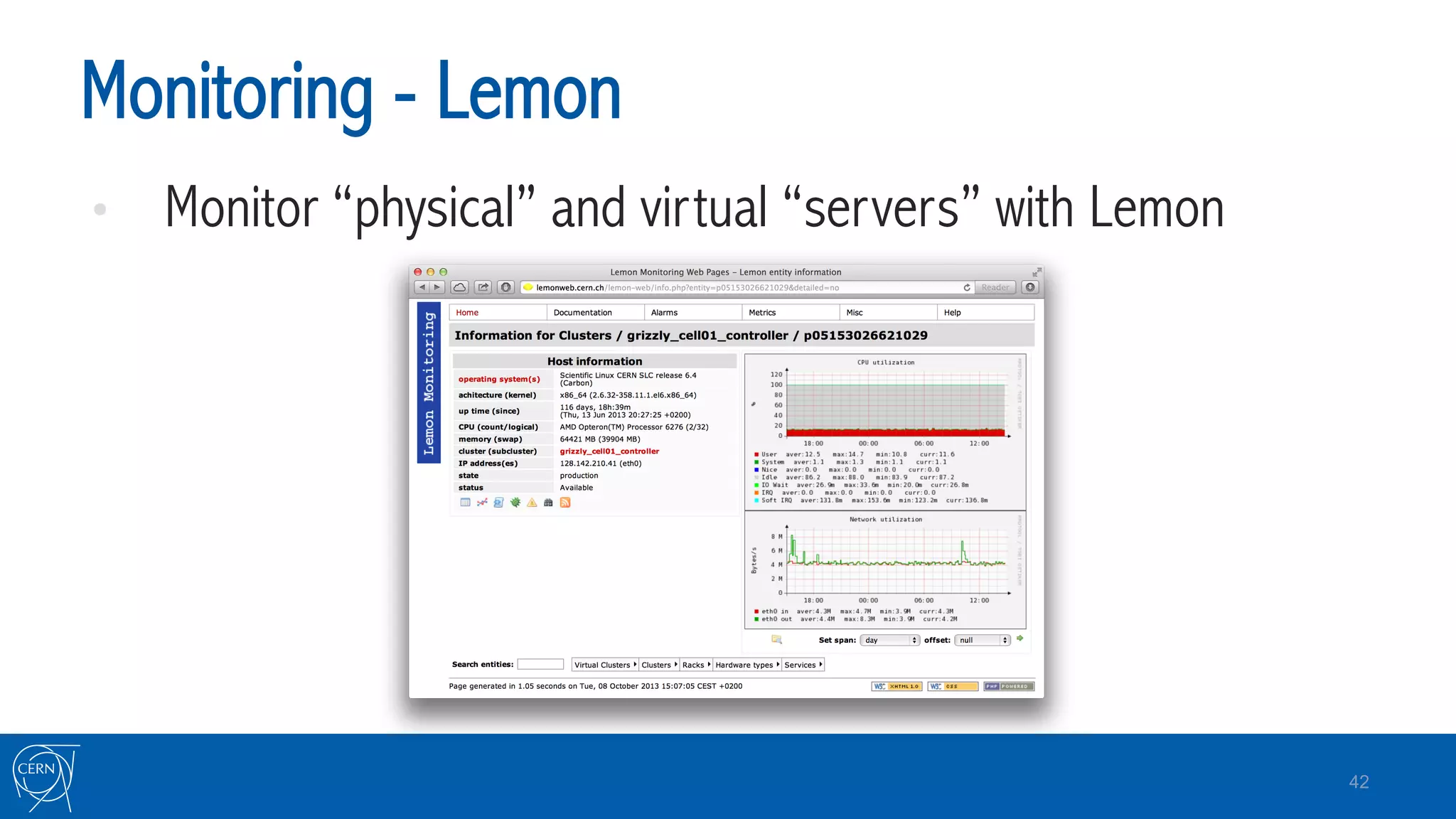
Monitoring - Lemon
•  Monitor “physical” and virtual “servers” with Lemon
42
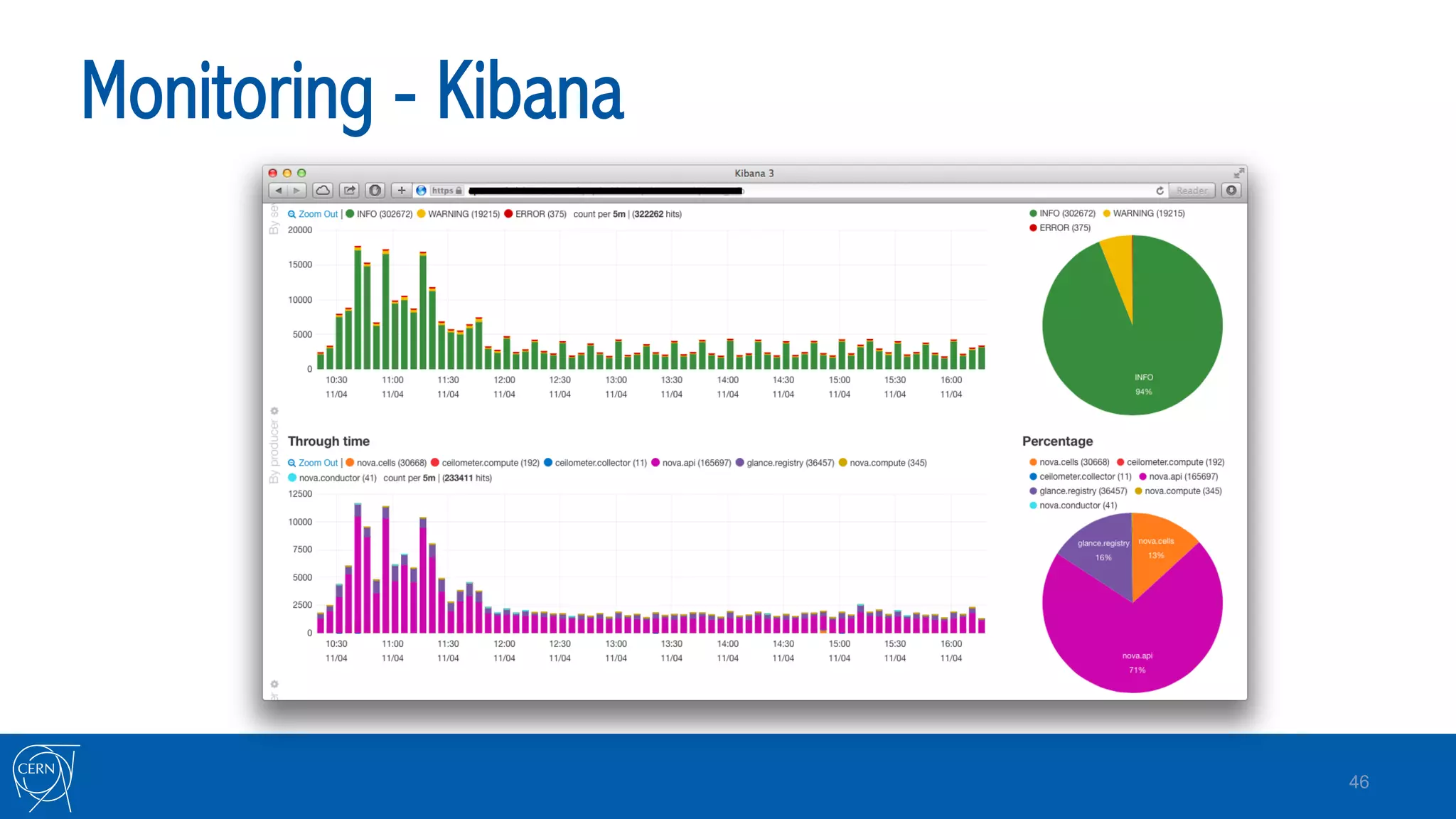
Monitoring - Flume, Elastic Search, Kibana
•  How to monitor OpenStack status in all nodes?
•  ERRORs, WARNINGs – log visualization
•  identify in “real time” possible problems
•  preserve all logs for analytics
•  visualization of cloud infrastructure status
•  service managers
•  resource managers
•  users
43
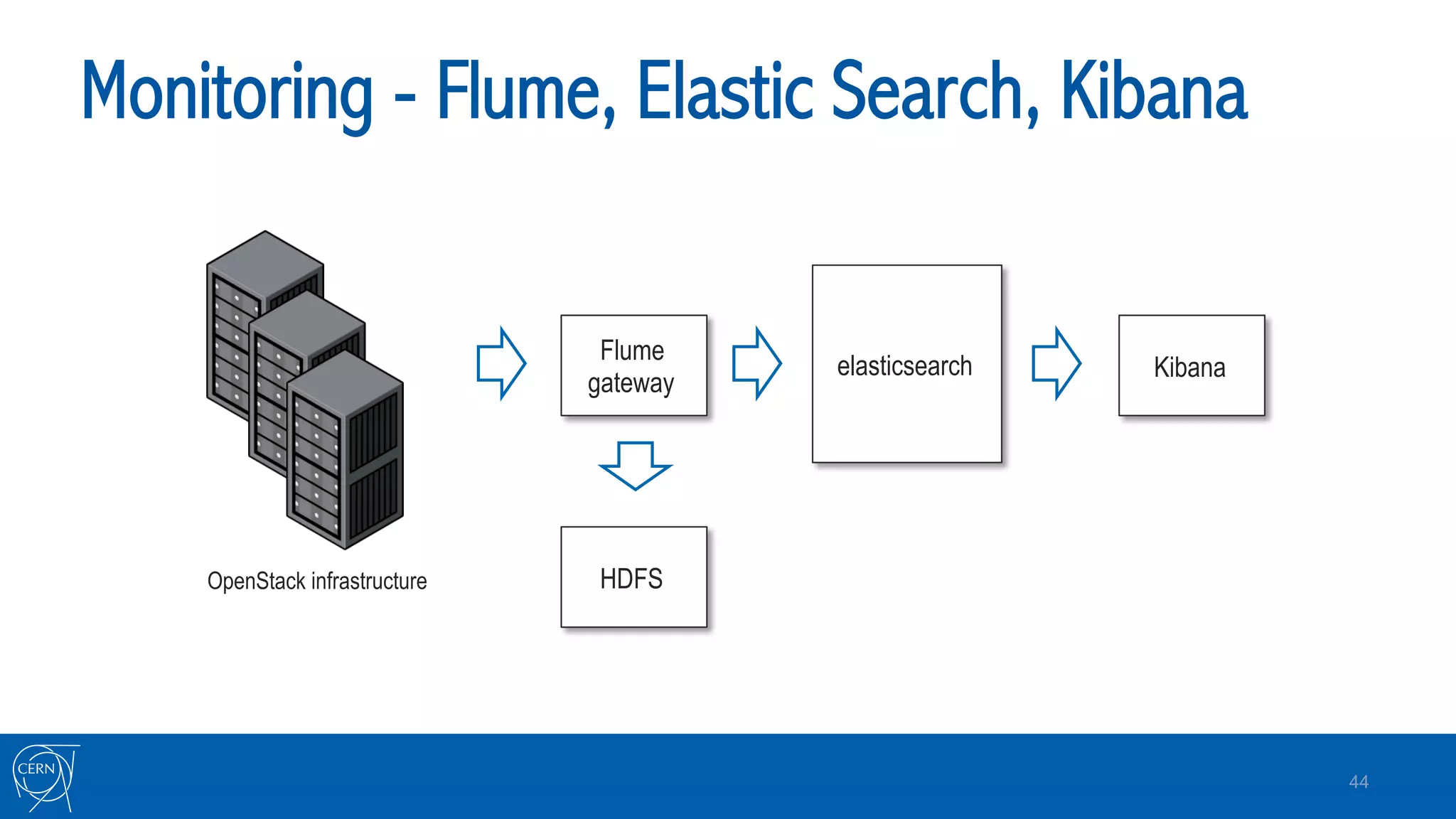
Monitoring - Flume, Elastic Search, Kibana
44
HDFS
Flume
gateway
elasticsearch Kibana
OpenStack infrastructure
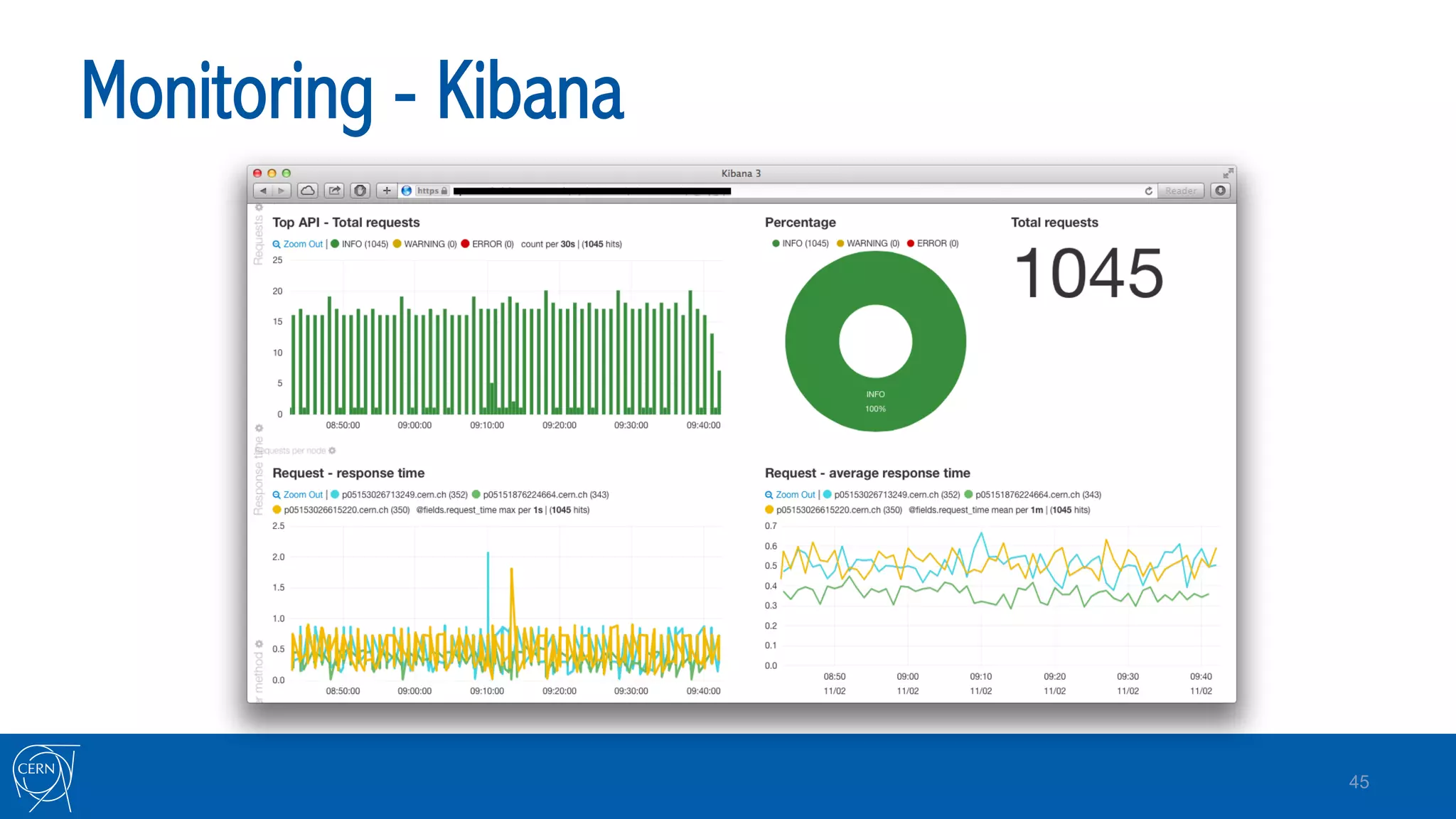
Monitoring - Kibana
45
Monitoring - Kibana
46
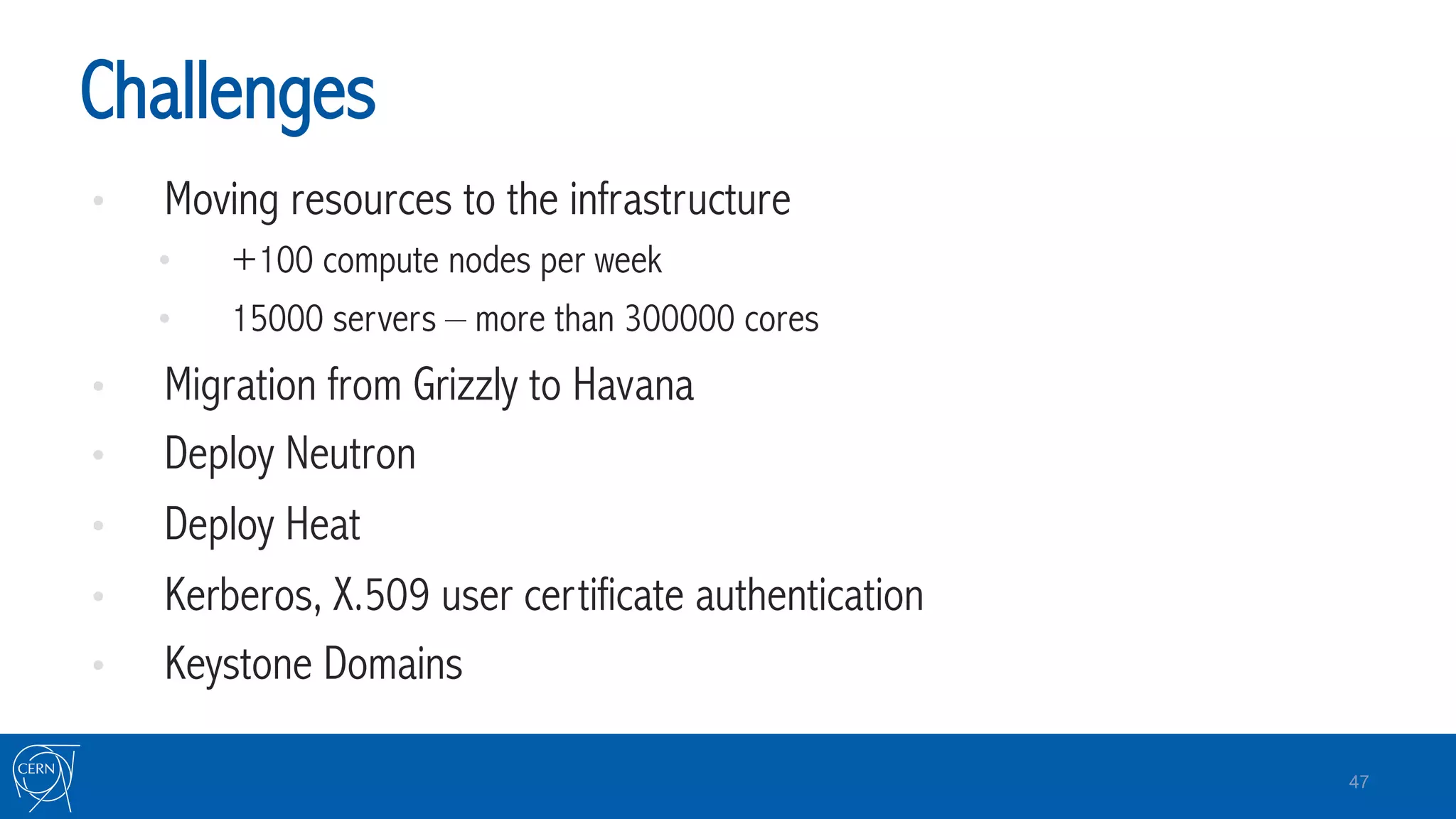
Challenges
•  Moving resources to the infrastructure
•  +100 compute nodes per week
•  15000 servers – more than 300000 cores
•  Migration from Grizzly to Havana
•  Deploy Neutron
•  Deploy Heat
•  Kerberos, X.509 user certificate authentication
•  Keystone Domains
47
belmiro.moreira@cern.ch
@belmiromoreira

Deep Dive Into the CERN Cloud Infrastructure - November, 2013

  • 2.
    Deep Dive intothe CERN Cloud Infrastructure Openstack Design Summit – Hong Kong, 2013 Belmiro Moreira belmiro.moreira@cern.ch @belmiromoreira
  • 3.
    What is CERN? • Conseil Européen pour la Recherche Nucléaire – aka European Organization for Nuclear Research •  Founded in 1954 with an international treaty •  20 state members, other countries contribute to experiments •  Situated between Geneva and the Jura Mountains, straddling the Swiss-French border 3
  • 4.
    What is CERN? 4 CERNCloud Experiment
  • 5.
    What is CERN? CERNprovides particle accelerators and other infrastructure for high-energy physics research 5 faqLHC the guide LINAC 2 Gran Sasso North Area LINAC 3 Ions East Area TI2 TI8 TT41TT40 CTF3 TT2 TT10 TT60 e– ALICE ATLAS LHCb CMS CNGS neutrinos neutrons p p SPS ISOLDEBOOSTER AD LEIR n-ToF LHC PS
  • 6.
    LHC - LargeHadron Collider 6 https://www.google.com/maps/views/streetview/cern?gl=us
  • 7.
  • 8.
    LHC and Experiments 8 Proton-leadcollisions at ALICE detector
  • 9.
    CERN - ComputerCenter - Geneva, Switzerland 9 •  3.5 Mega Watts •  ~91000 cores •  ~120 PB HDD •  ~100 PB Tape •  ~310 TB Memory
  • 10.
    CERN - ComputerCenter - Budapest, Hungary 10 •  2.5 Mega Watts •  ~20000 cores •  ~6 PB HDD
  • 11.
  • 12.
    CERN IT Infrastructurein 2011 •  ~10k servers •  Dedicated compute, dedicated disk server, dedicated service nodes •  Mostly running on real hardware •  Server consolidation of some service nodes using Microsoft HyperV/ SCVMM •  ~3400 VMs (~2000 Linux, ~1400 Windows) •  Various other virtualization projects around •  Many diverse applications (”clusters”) •  Managed by different teams (CERN IT + experiment groups) 12
  • 13.
    CERN IT Infrastructurechallenges in 2011 •  Expected new Computer Center in 2013 •  Need to manage twice the servers •  No increase in staff numbers •  Increasing number of users / computing requirements •  Legacy tools - high maintenance and brittle 13
  • 14.
    Why Build CERNCloud Improve operational efficiency •  Machine reception and testing •  Hardware interventions with long running programs •  Multiple operating system demand Improve resource efficiency •  Exploit idle resources •  Highly variable load such as interactive or build machines Improve responsiveness •  Self-service 14
  • 15.
    Identify a newTool Chain •  Identify the tools needed to build our Cloud Infrastructure •  Configuration Manager tool •  Cloud Manager tool •  Monitoring tools •  Storage Solution 15
  • 16.
    Strategy to deployOpenStack •  Configuration infrastructure based on Puppet •  Community Puppet modules for OpenStack •  SLC6 Operating System •  EPEL/RDO - RPM Packages 16
  • 17.
    Strategy to deployOpenStack •  Deliver a production IaaS service though a series of time- based pre-production services of increasing functionality and Quality-of-Service •  Budapest Computer Center hardware deployed as OpenStack compute nodes •  Have an OpenStack production service in the Q2 of 2013 17
  • 18.
    Pre-Production Infrastructure 18 Essex Folsom "Guppy""Hamster" "Ibex" - Deployed on Fedora 16 - Community OpenStack puppet modules - Used for functionality tests - Limited integration with CERN infrastructure - Open to early adopters - Deployed on SLC6 and Hyper-V - CERN Network DB integration - Keystone LDAP integration - Open to a wider community (ATLAS, CMS, LHCb, …) - Some OpenStack services in HA - ~14000 cores June, 2012 October, 2012 March, 2013
  • 19.
    OpenStack at CERN- grizzly release 19
  • 20.
    OpenStack at CERN- grizzly release •  +2 Children Cells – Geneva and Budapest Computer Centers •  HA+1 architecture •  Ceilometer deployed •  Integrated with CERN accounts and network infrastructure •  Monitoring OpenStack components status •  Glance - Ceph backend •  Cinder - Testing with Ceph backend 20
  • 21.
    Infrastructure Overview •  Adding~100 compute nodes every week •  Geneva, Switzerland Cell •  ~11000 cores •  Budapest, Hungary Cell •  ~10000 cores •  Today we have +2500 VMs •  Several VMs have more than 8 cores 21
  • 22.
    compute-nodescontrollers compute-nodes Architecture Overview 22 Child Cell Geneva,Switzerland Child Cell Budapest, Hungary Top Cell - controllers Geneva, Switzerland Load Balancer Geneva, Switzerland controllers
  • 23.
    Architecture Components 23 rabbitmq - Keystone -Nova api - Nova conductor - Nova scheduler - Nova network - Nova cells - Glance api - Ceilometer agent-central - Ceilometer collector Controller - Flume - Nova compute - Ceilometer agent-compute Compute node - Flume - HDFS - Elastic Search - Kibana - MySQL - MongoDB - Glance api - Glance registry - Keystone - Nova api - Nova consoleauth - Nova novncproxy - Nova cells - Horizon - Ceilometer api - Cinder api - Cinder volume - Cinder scheduler rabbitmq Controller Top Cell Children Cells - Stacktach - Ceph - Flume
  • 24.
    Infrastructure Overview •  SLC6and Microsoft Windows 2012 •  KVM and Microsoft HyperV •  All infrastructure “puppetized” (also, windows compute nodes!) •  Using stackforge OpenStack puppet modules •  Using CERN Foreman/Puppet configuration infrastructure •  Master, Client architecture •  Puppet managed VMs - share the same configuration infrastructure 24
  • 25.
    Infrastructure Overview •  HAProxyas load balancer •  Master and Compute nodes •  3+ Master nodes per Cell •  O(1000) Compute nodes per Child Cell (KVM and HyperV) •  3 availability zones per Cell •  Rabbitmq •  At least 3 brokers per Cell •  Rabbitmq cluster with mirrored queues 25
  • 26.
    Infrastructure Overview •  MySqlinstance per Cell •  MySql managed by CERN DB team •  Running on top of Oracle CRS •  active/slave configuration •  NetApp storage backend •  Backups every 6 hours 26
  • 27.
    Nova Cells •  WhyCells? •  Scale transparently between different Computer Centers •  With cells we lost functionality •  Security groups •  Live migration •  "Parents" don't know about “children” compute •  Flavors not propagated to "children” cells 27
  • 28.
    Nova Cells •  Scheduling • Random cell selection on Grizzly •  Implemented simple scheduler based on project •  CERN Geneva only, CERN Wigner only, “both” •  “both” selects the cell with more available free memory •  Cell/Cell communication doesn’t support multiple Rabbitmq servers •  https://bugs.launchpad.net/nova/+bug/1178541 28
  • 29.
    Nova Network •  CERNnetwork infrastructure 29 IP MAC CERN network DB VM VM VM VM VM
  • 30.
    Nova Network •  Implementeda Nova Network CERN driver •  Considers the “host” picked by nova-scheduler •  MAC address selected from pre-registered addresses of “host” IP Service •  Updates CERN network database address with instance hostname and responsible of the device •  Network constraints in some nova operations •  Resize, Live-Migration 30
  • 31.
    Nova Scheduler •  ImagePropertiesFilter • linux/windows hypervisors in the same infrastructure •  ProjectsToAggregateFilter •  Projects need dedicated resources •  Instances from defined projects are created in specific Aggregates •  Aggregates can be shared by a set of projects •  Availability Zones •  Implemented “default_schedule_zones” 31
  • 32.
    Nova Conductor •  Reduces“dramatically” the number of DB connections •  Conductor “bottleneck” •  Only 3+ processes for “all” DB requests •  General “slowness” in the infrastructure •  Fixed with backport •  https://review.openstack.org/#/c/42342/ 32
  • 33.
    Nova Compute •  KVMand Hyper-V compute nodes share the same infrastructure •  Hypervisor selection based on “Image” properties •  Hyper-V driver still lacks some functionality on Grizzly •  Console access, metadata support with nova-network, resize support, ephemeral disk support, ceilometer metrics support 33
  • 34.
    Keystone •  CERN’s ActiveDirectory infrastructure •  Unified identity management across the site •  +44000 users •  +29000 groups •  ~200 arrivals/departures per month •  Keystone integrated with CERN Active Directory •  LDAP backend 34
  • 35.
    Keystone •  CERN usersubscribes the "cloud service” •  Created "Personal Tenant" with limited quota •  Shared projects created by request •  Project life cycle •  owner, member, admin – roles •  "Personal project" disabled when user leaves •  Delete resources (VMs, Volumes, Images, …) •  User removed from "Shared Projects" 35
  • 36.
    Ceilometer •  Users arenot directly billed •  Metering needed to adjust Project quotas •  mongoDB backend – sharded and replicated •  Collector, Central-Agent •  Running on “children” Cells controllers •  Compute-Agent •  Uses nova-api running on “children” Cells controllers 36
  • 37.
    Glance •  Glance API • Using glance api v1 •  python-glanceclient doesn’t support completely v2 •  Glance Registry •  With v1 we need to keep Glance Registry •  Only runs in Top Cell behind the load balancer •  Glance backend •  File Store (AFS) •  Ceph 37
  • 38.
    Glance •  Maintain smallset of SLC5/6 images as default •  Difficult to offer only the most updated set of images •  Resize and Live Migration not available if image is deleted from Glance •  Users can upload images up to 25GB •  Users don’t pay storage! •  Glance in Grizzly doesn’t support quotas per Tenant! 38
  • 39.
    Cinder •  Ceph backend • Still in evaluation •  SLC6 with qemu-kvm patched by Inktank to support RBD •  Cinder doesn't support cells in Grizzly •  Fixed with backport: https://review.openstack.org/#/c/31561/ 39
  • 40.
    Ceph as StorageBackend •  3 PB cluster available for Ceph •  48 OSDs servers •  5 Monitors servers •  Initial testing with FIO, libaio, bs 256k fio --size=4g --bs=256k –numjobs=1 --direct=1 --rw=randrw --ioengine=libaio --name=/mnt/vdb1/tmp4 Rand RW Rand R Rand W 99 MB/s 103 MB/s 108 MB/s 40
  • 41.
    Ceph as StorageBackend •  ulimits •  With more than >1024 OSDs, we’re getting various errors where clients cannot create enough processes •  authx for security (key lifecycle is a challenge as always) •  need librbd (from EPEL) 41
  • 42.
    Monitoring - Lemon • Monitor “physical” and virtual “servers” with Lemon 42
  • 43.
    Monitoring - Flume,Elastic Search, Kibana •  How to monitor OpenStack status in all nodes? •  ERRORs, WARNINGs – log visualization •  identify in “real time” possible problems •  preserve all logs for analytics •  visualization of cloud infrastructure status •  service managers •  resource managers •  users 43
  • 44.
    Monitoring - Flume,Elastic Search, Kibana 44 HDFS Flume gateway elasticsearch Kibana OpenStack infrastructure
  • 45.
  • 46.
  • 47.
    Challenges •  Moving resourcesto the infrastructure •  +100 compute nodes per week •  15000 servers – more than 300000 cores •  Migration from Grizzly to Havana •  Deploy Neutron •  Deploy Heat •  Kerberos, X.509 user certificate authentication •  Keystone Domains 47
  • 48.