OpenStack High Availability
Jakub Pavlik
About me
Jakub Pavlík
• Cloud Platform Engineer
• 3 years in Cloud
• 2 years in OpenStack
High Availability vs. Disaster Recovery
High Availability = fault detection & correction procedures to maximize
availability of critical services and applications, often in an automated
fashion.
Disaster Recovery = process of preparing for recovery or continuation of
technology infrastructure critical to an organization after a natural or
human-induced disaster.
High Availability ≠ Disaster Recovery!
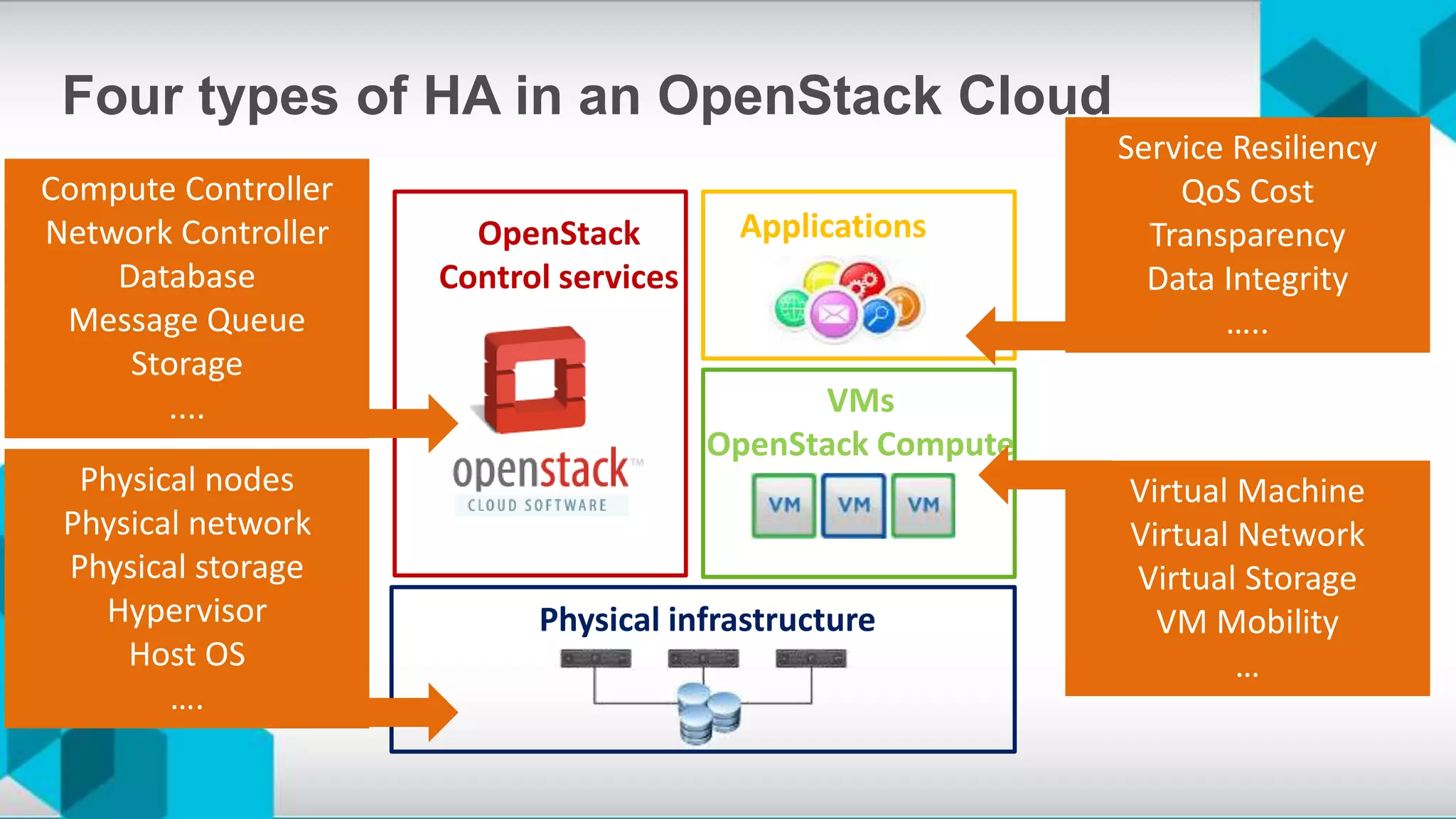
Four types of HA in an OpenStack Cloud
Physical infrastructure
OpenStack
Control services
VMs
OpenStack Compute
Applications
Compute Controller
Network Controller
Database
Message Queue
Storage
....
Physical nodes
Physical network
Physical storage
Hypervisor
Host OS
….
Service Resiliency
QoS Cost
Transparency
Data Integrity
…..
Virtual Machine
Virtual Network
Virtual Storage
VM Mobility
…
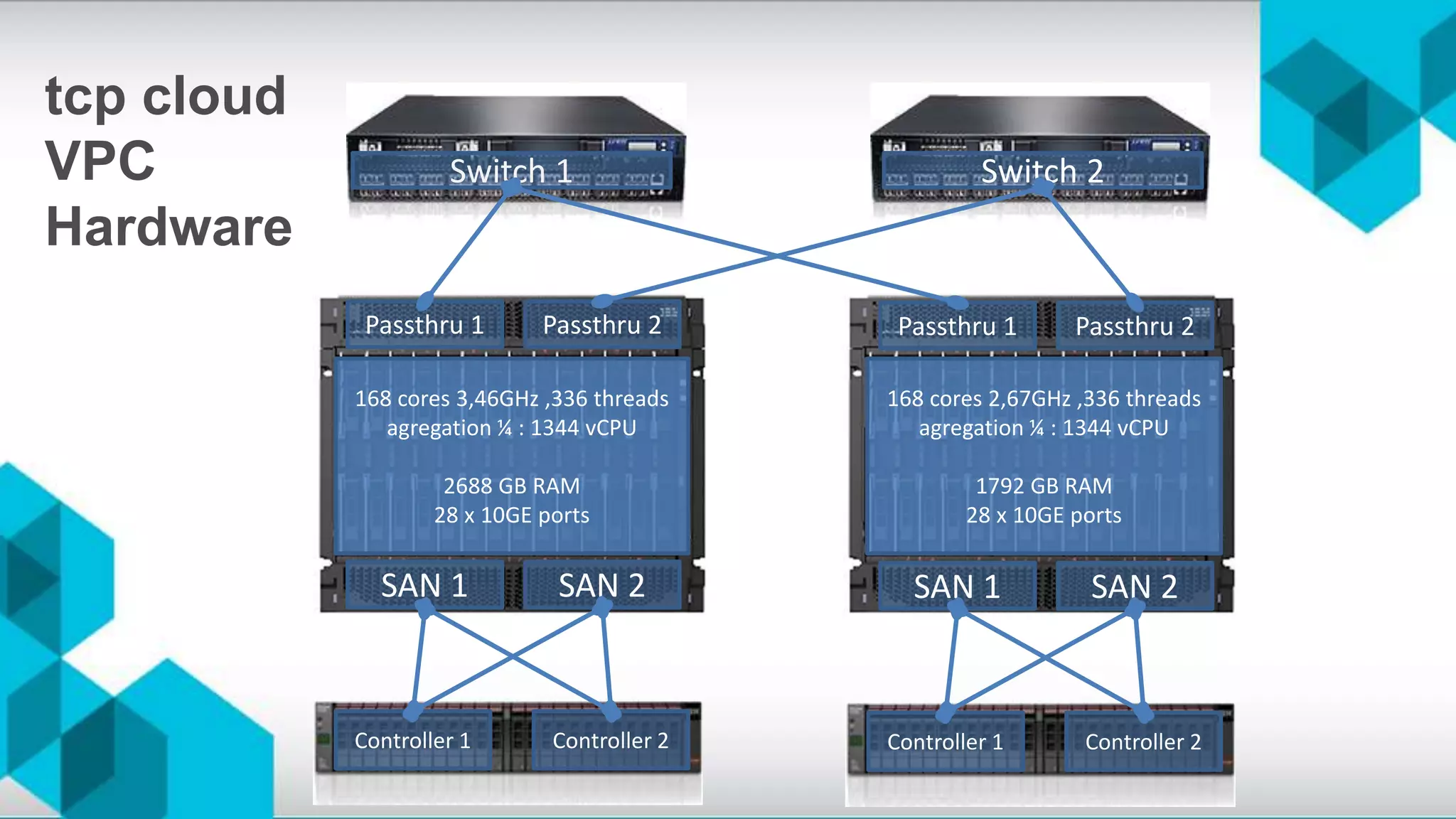
Physical Infrastructure
Controller 1 Controller 2
SAN 1 SAN 2
Passthru 2Passthru 1
Controller 1 Controller 2
SAN 1 SAN 2
Passthru 2Passthru 1
Switch 1 Switch 2
168 cores 3,46GHz ,336 threads
agregation ¼ : 1344 vCPU
2688 GB RAM
28 x 10GE ports
168 cores 2,67GHz ,336 threads
agregation ¼ : 1344 vCPU
1792 GB RAM
28 x 10GE ports
tcp cloud
VPC
Hardware
OpenStack Control services
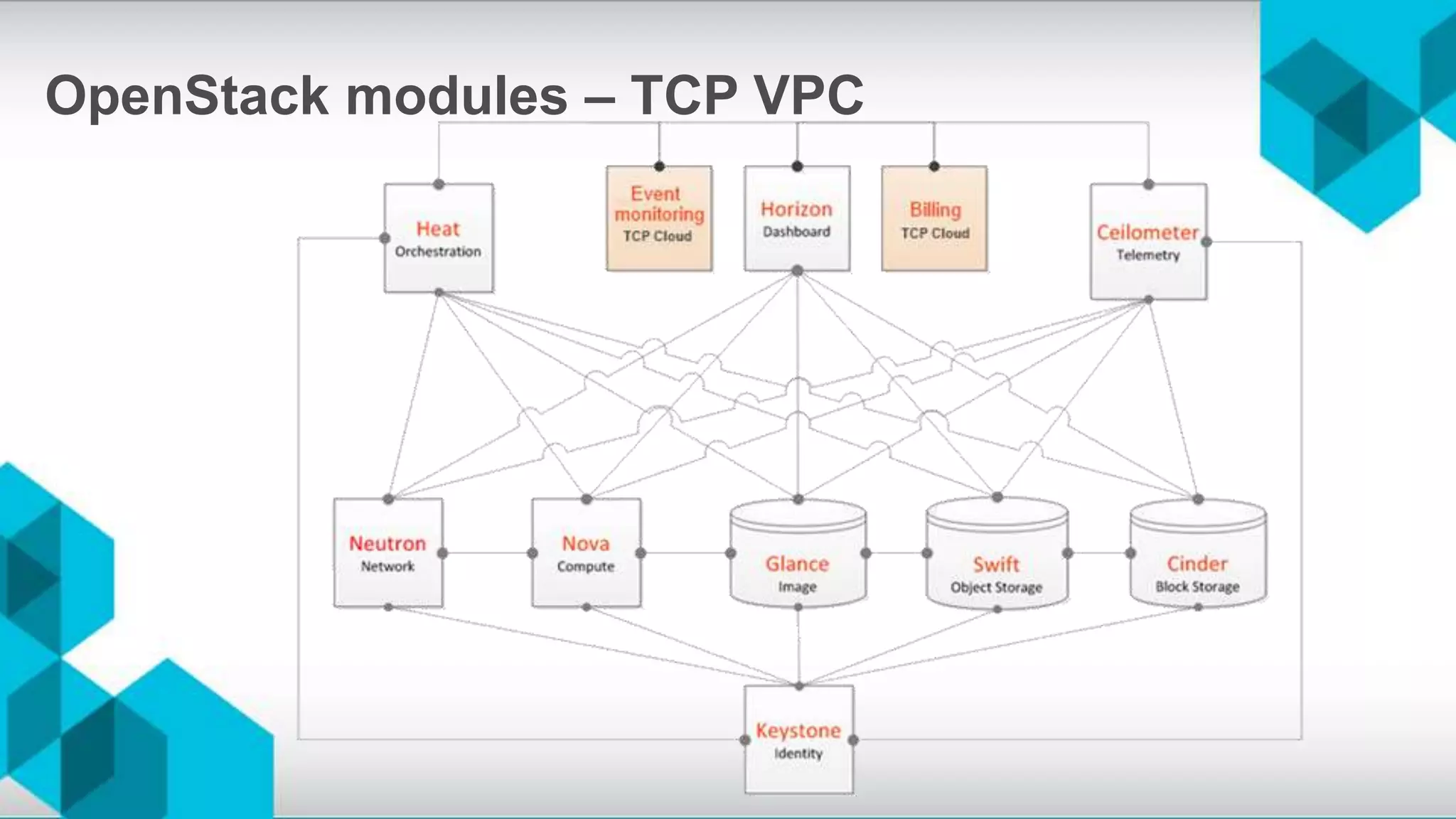
OpenStack modules – TCP VPC
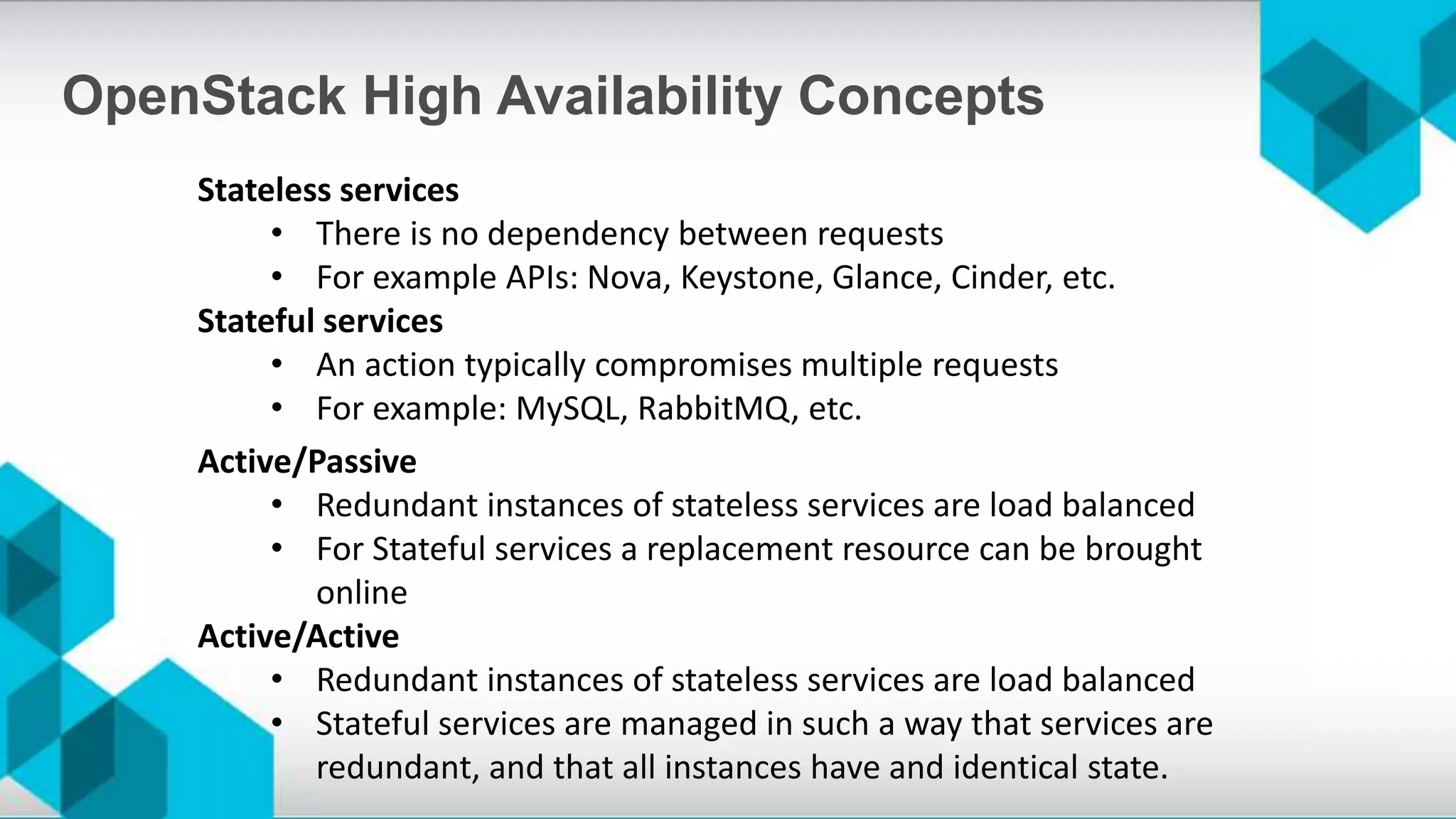
Stateless services
• There is no dependency between requests
• For example APIs: Nova, Keystone, Glance, Cinder, etc.
Stateful services
• An action typically compromises multiple requests
• For example: MySQL, RabbitMQ, etc.
OpenStack High Availability Concepts
Active/Passive
• Redundant instances of stateless services are load balanced
• For Stateful services a replacement resource can be brought
online
Active/Active
• Redundant instances of stateless services are load balanced
• Stateful services are managed in such a way that services are
redundant, and that all instances have and identical state.
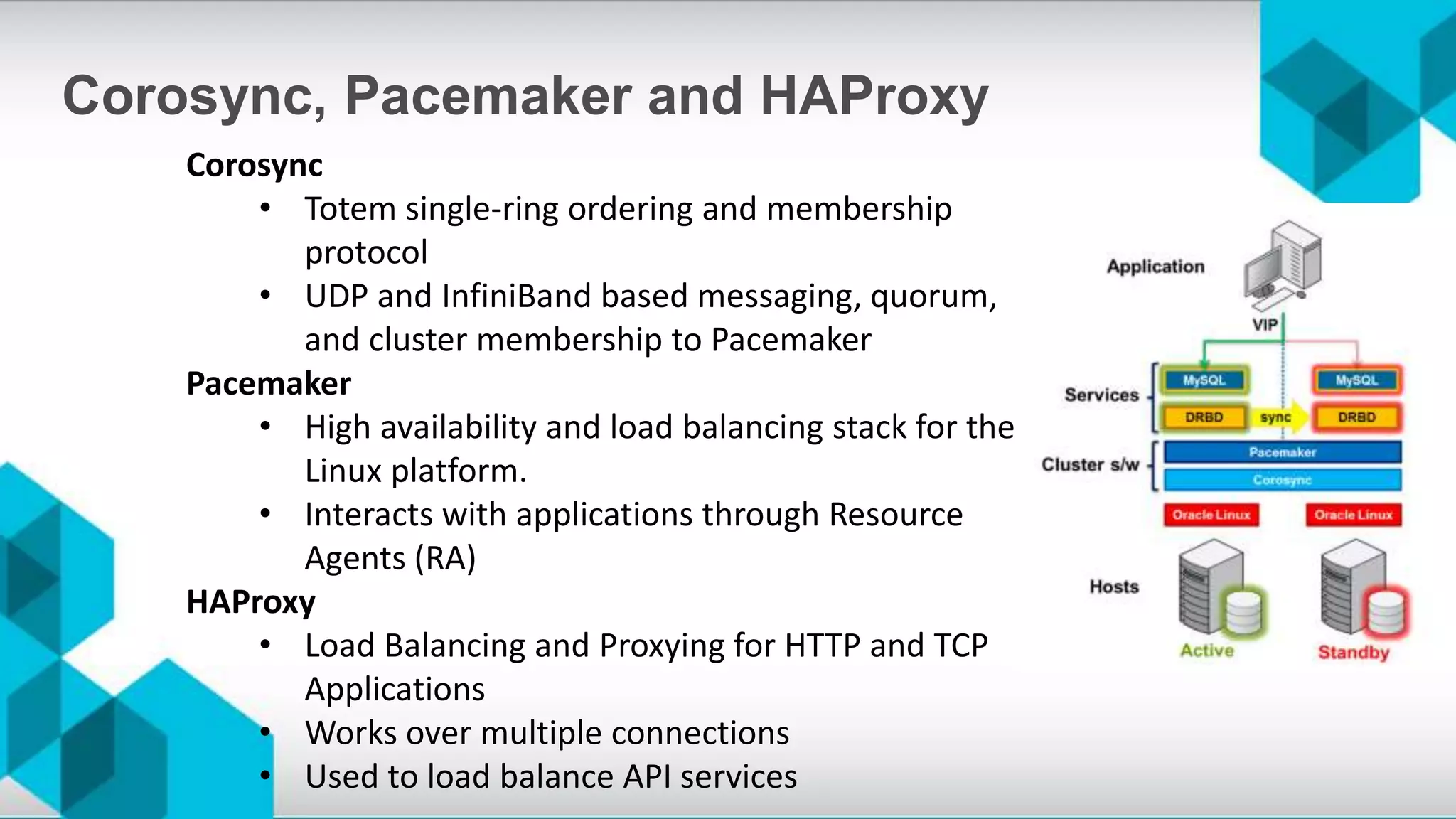
Corosync
• Totem single-ring ordering and membership
protocol
• UDP and InfiniBand based messaging, quorum,
and cluster membership to Pacemaker
Pacemaker
• High availability and load balancing stack for the
Linux platform.
• Interacts with applications through Resource
Agents (RA)
HAProxy
• Load Balancing and Proxying for HTTP and TCP
Applications
• Works over multiple connections
• Used to load balance API services
Corosync, Pacemaker and HAProxy
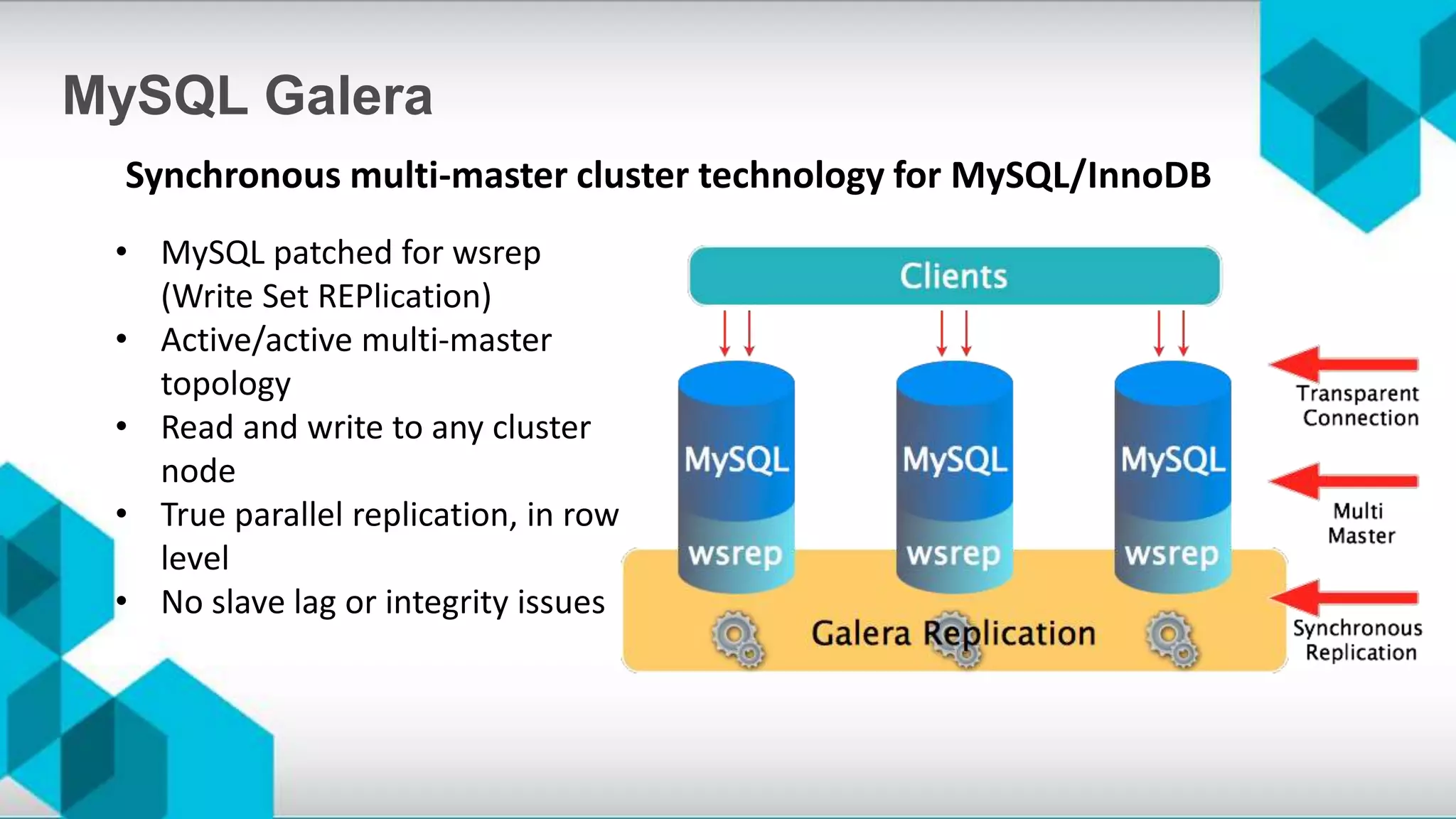
• MySQL patched for wsrep
(Write Set REPlication)
• Active/active multi-master
topology
• Read and write to any cluster
node
• True parallel replication, in row
level
• No slave lag or integrity issues
MySQL Galera
Synchronous multi-master cluster technology for MySQL/InnoDB
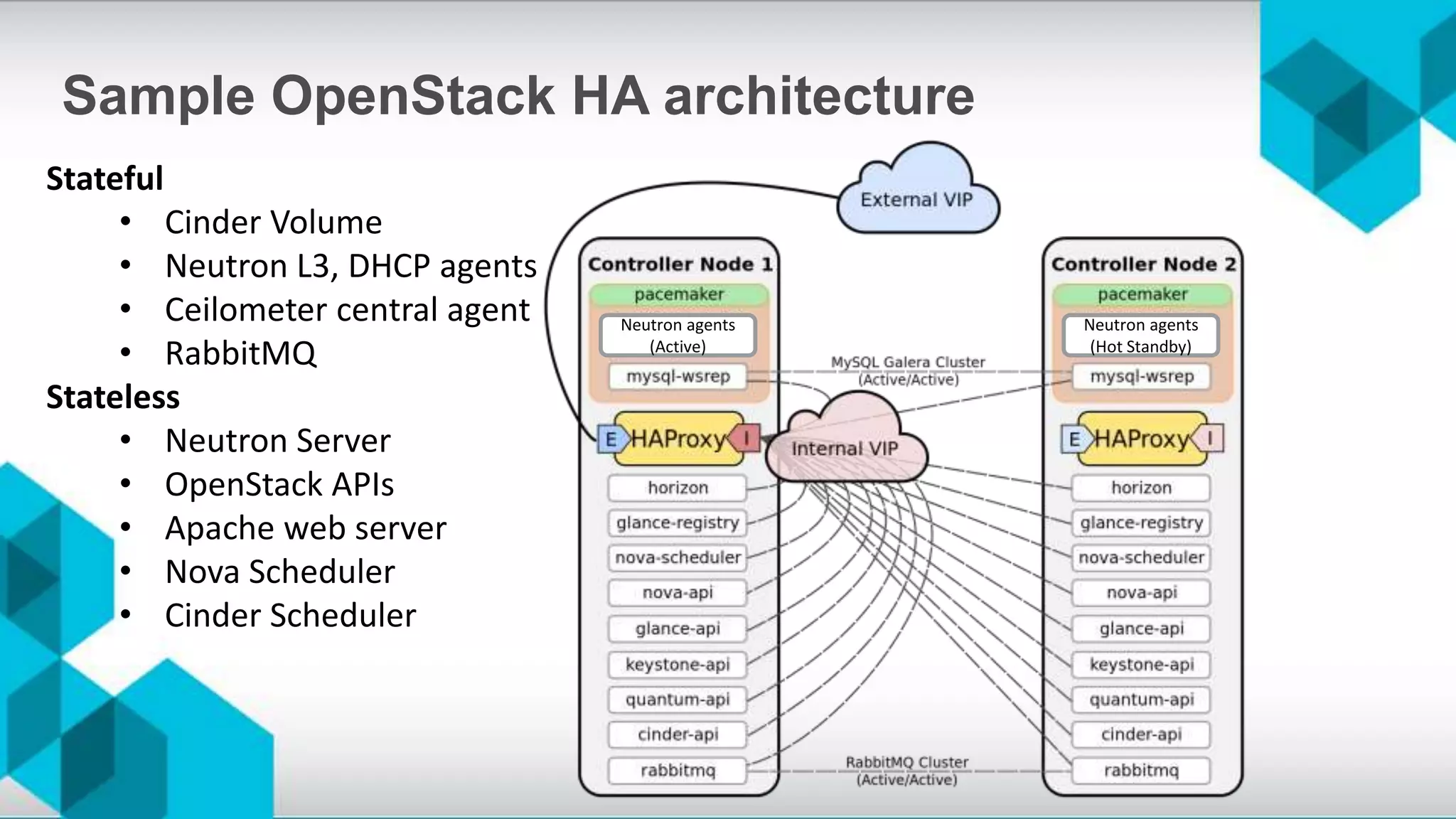
Sample OpenStack HA architecture
Stateful
• Cinder Volume
• Neutron L3, DHCP agents
• Ceilometer central agent
• RabbitMQ
Stateless
• Neutron Server
• OpenStack APIs
• Apache web server
• Nova Scheduler
• Cinder Scheduler
Neutron agents
(Active)
Neutron agents
(Hot Standby)
VMs – Compute nodes
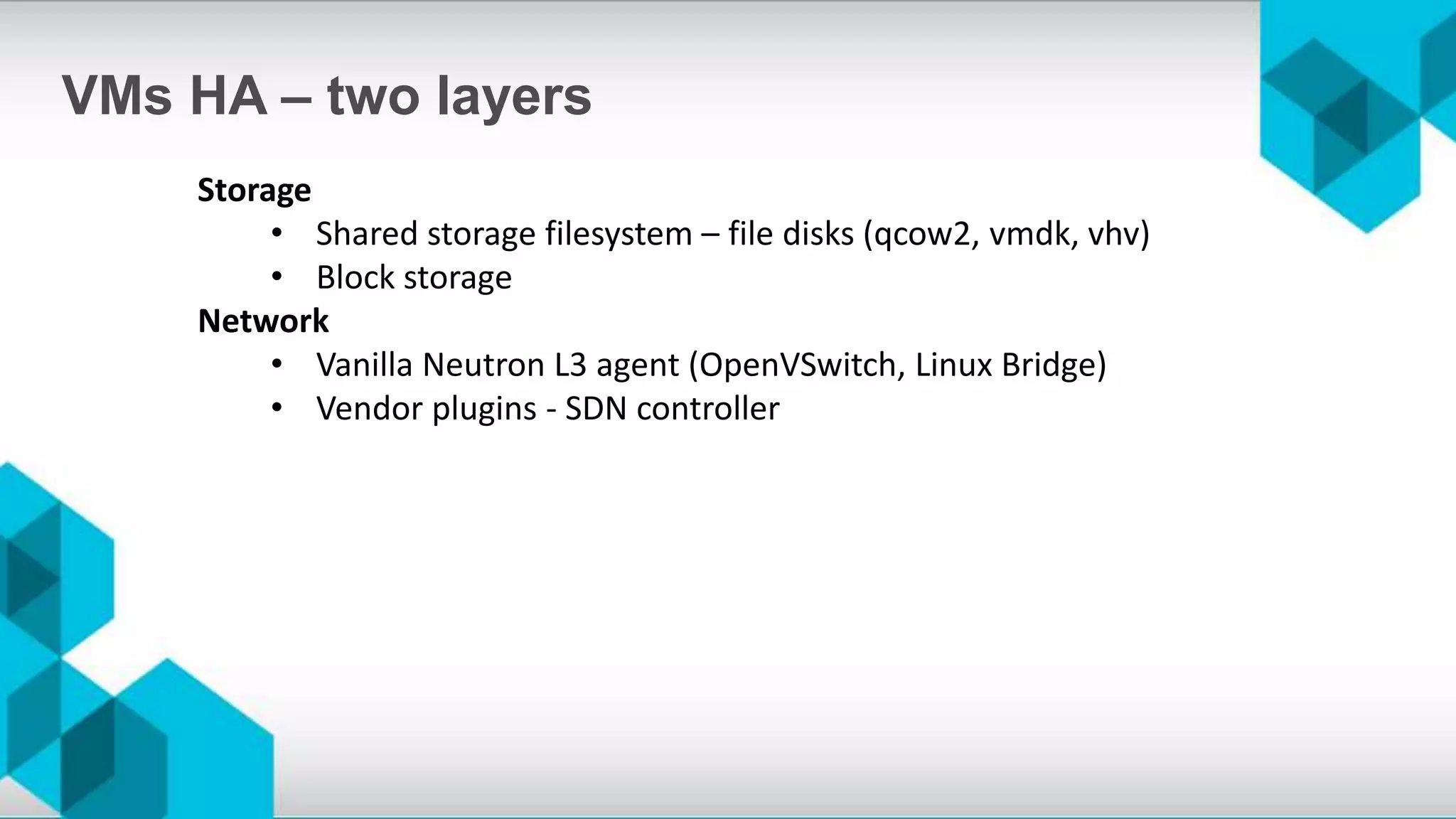
Storage
• Shared storage filesystem – file disks (qcow2, vmdk, vhv)
• Block storage
Network
• Vanilla Neutron L3 agent (OpenVSwitch, Linux Bridge)
• Vendor plugins - SDN controller
VMs HA – two layers
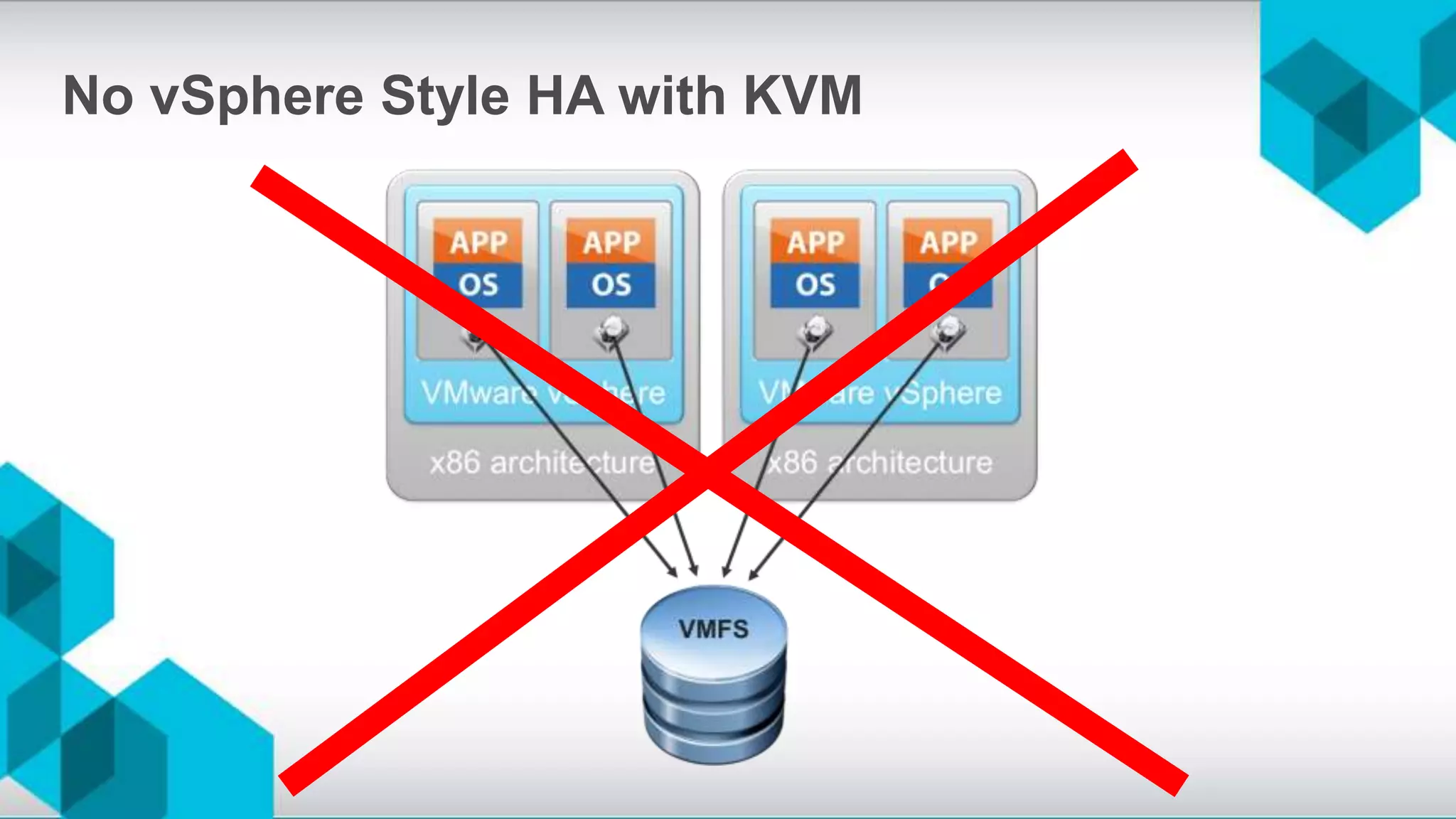
No vSphere Style HA with KVM
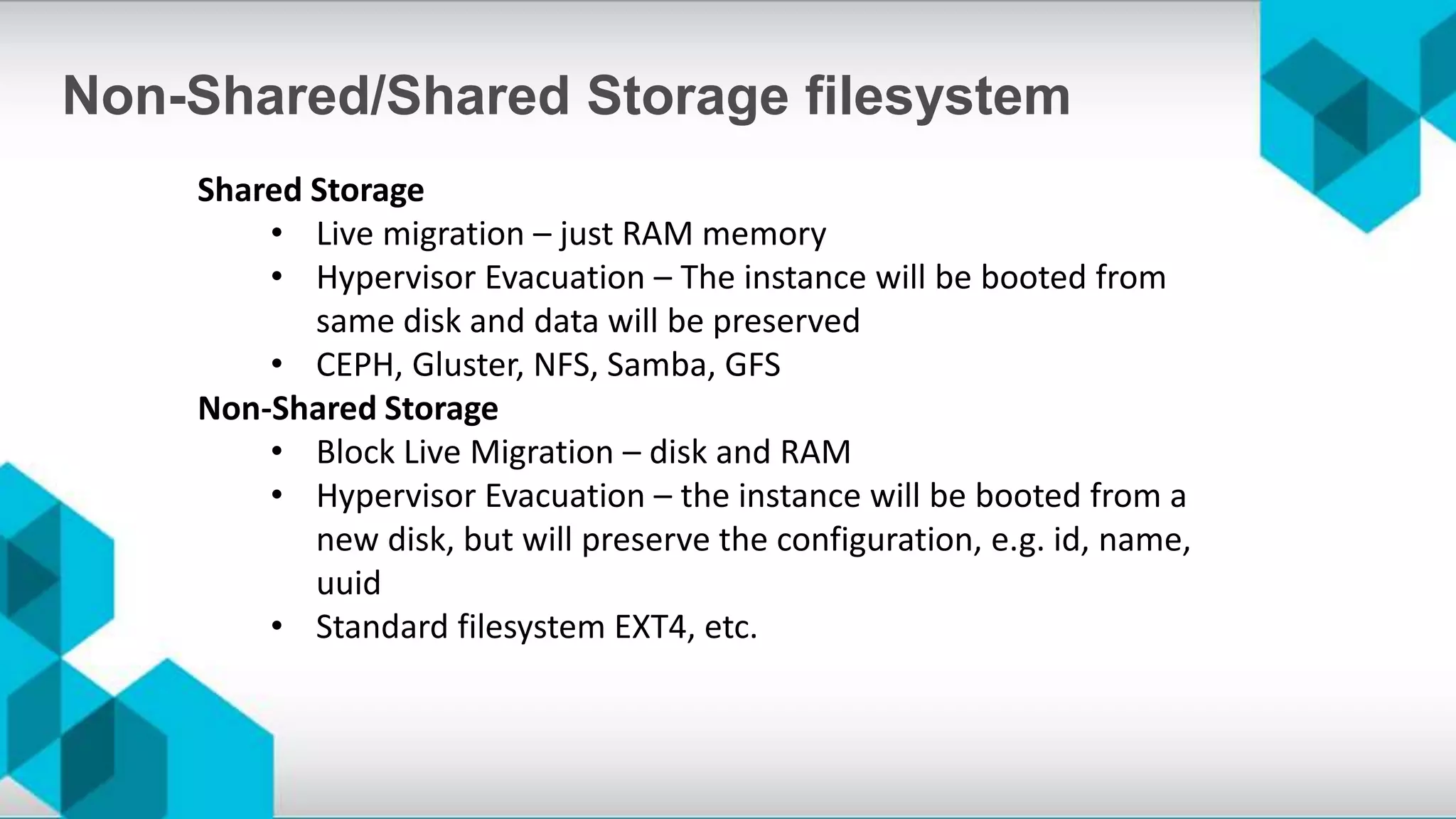
Shared Storage
• Live migration – just RAM memory
• Hypervisor Evacuation – The instance will be booted from
same disk and data will be preserved
• CEPH, Gluster, NFS, Samba, GFS
Non-Shared Storage
• Block Live Migration – disk and RAM
• Hypervisor Evacuation – the instance will be booted from a
new disk, but will preserve the configuration, e.g. id, name,
uuid
• Standard filesystem EXT4, etc.
Non-Shared/Shared Storage filesystem
• Instance boots from volume
• iSCSI/FC direct mapping to instance
• Enable Live Migration
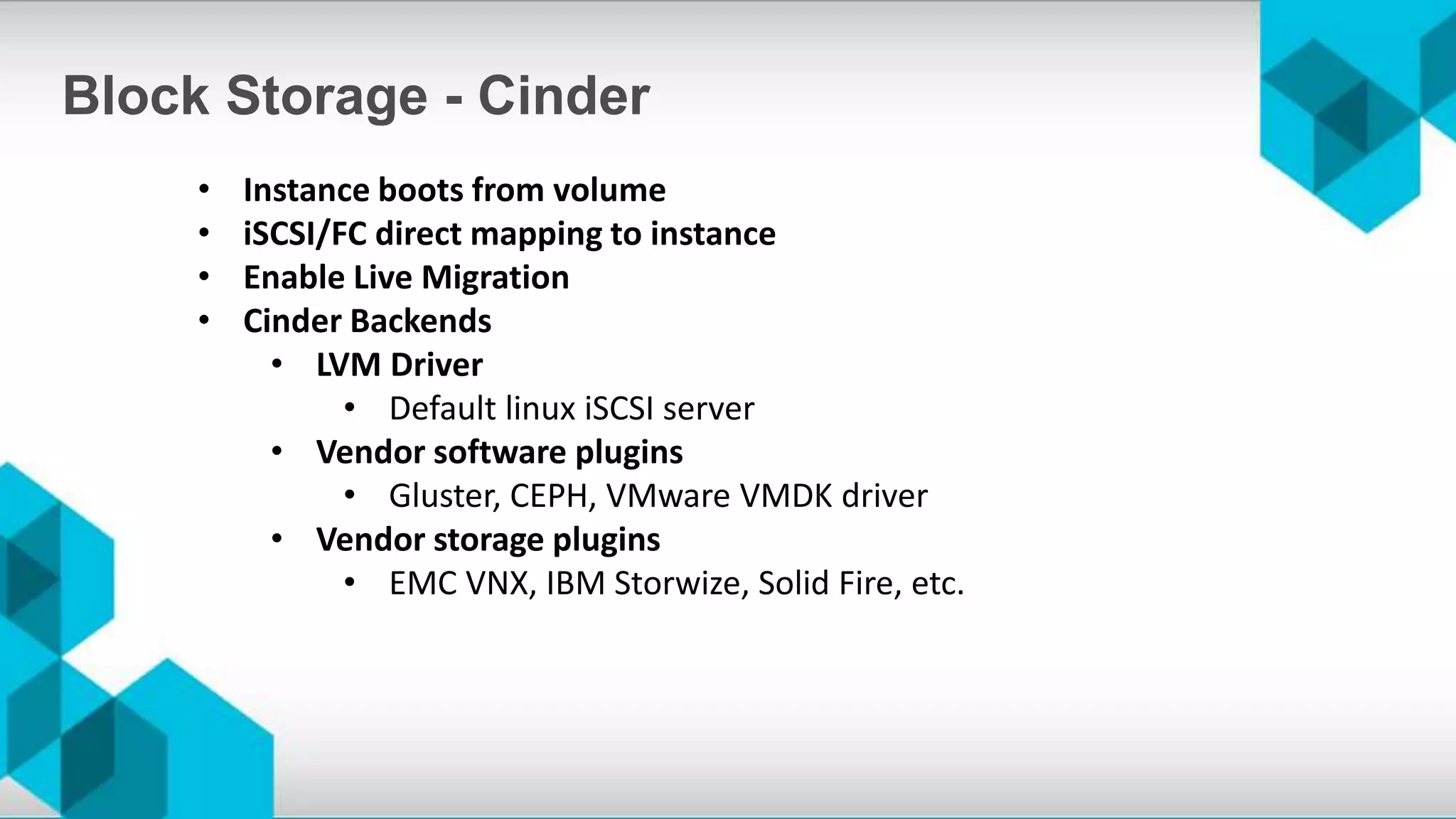
• Cinder Backends
• LVM Driver
• Default linux iSCSI server
• Vendor software plugins
• Gluster, CEPH, VMware VMDK driver
• Vendor storage plugins
• EMC VNX, IBM Storwize, Solid Fire, etc.
Block Storage - Cinder
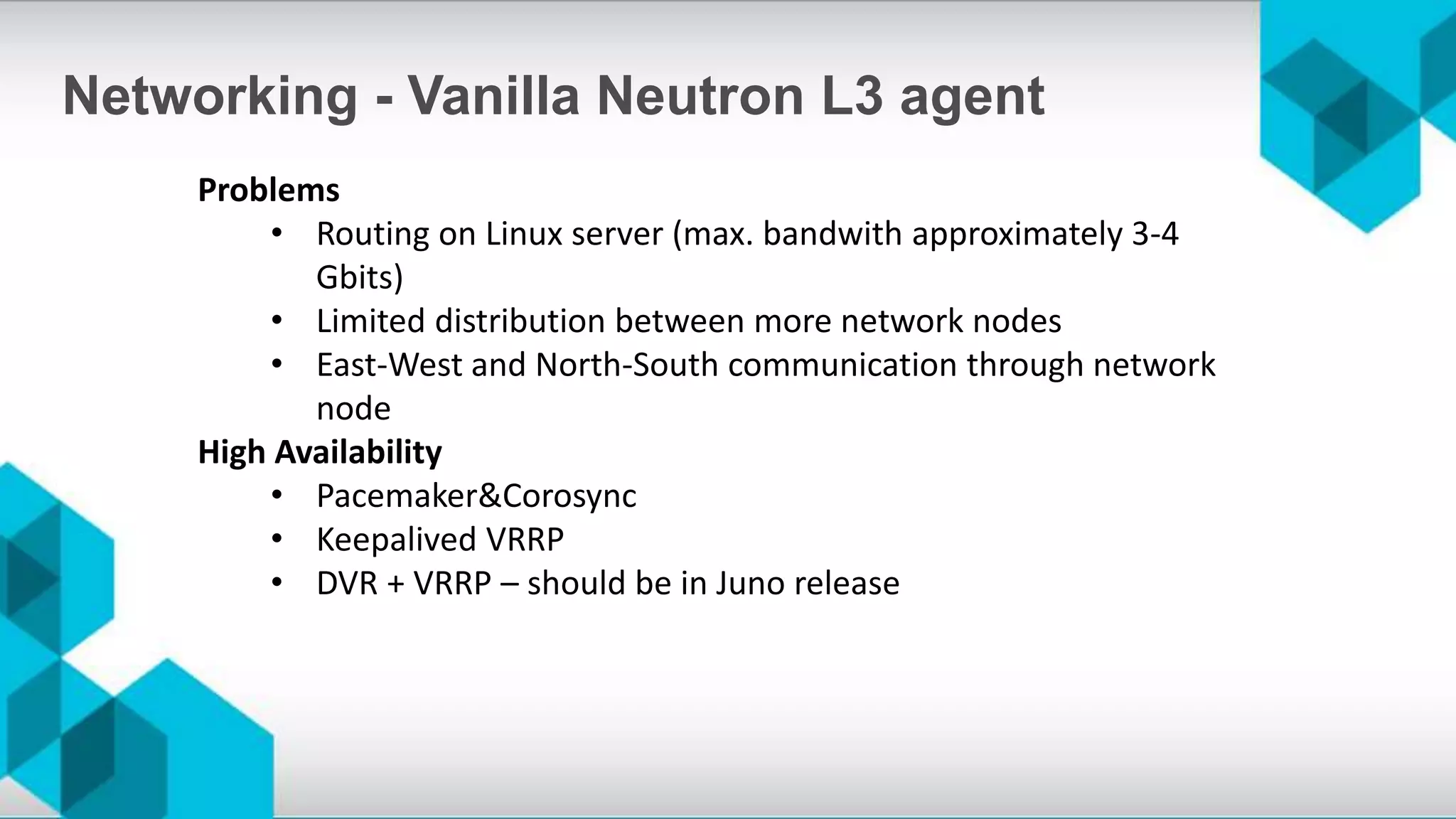
Problems
• Routing on Linux server (max. bandwith approximately 3-4
Gbits)
• Limited distribution between more network nodes
• East-West and North-South communication through network
node
High Availability
• Pacemaker&Corosync
• Keepalived VRRP
• DVR + VRRP – should be in Juno release
Networking - Vanilla Neutron L3 agent
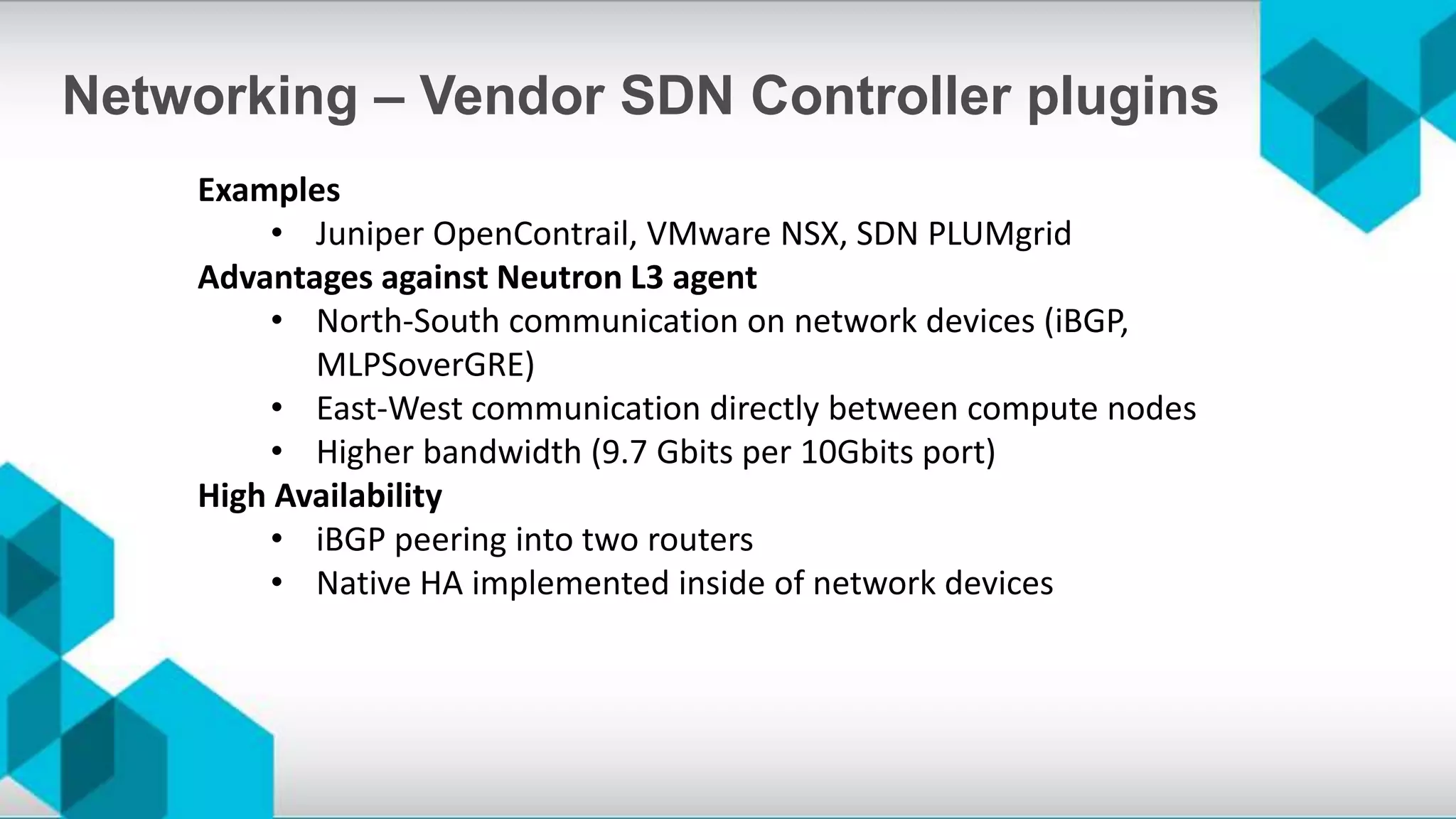
Examples
• Juniper OpenContrail, VMware NSX, SDN PLUMgrid
Advantages against Neutron L3 agent
• North-South communication on network devices (iBGP,
MLPSoverGRE)
• East-West communication directly between compute nodes
• Higher bandwidth (9.7 Gbits per 10Gbits port)
High Availability
• iBGP peering into two routers
• Native HA implemented inside of network devices
Networking – Vendor SDN Controller plugins
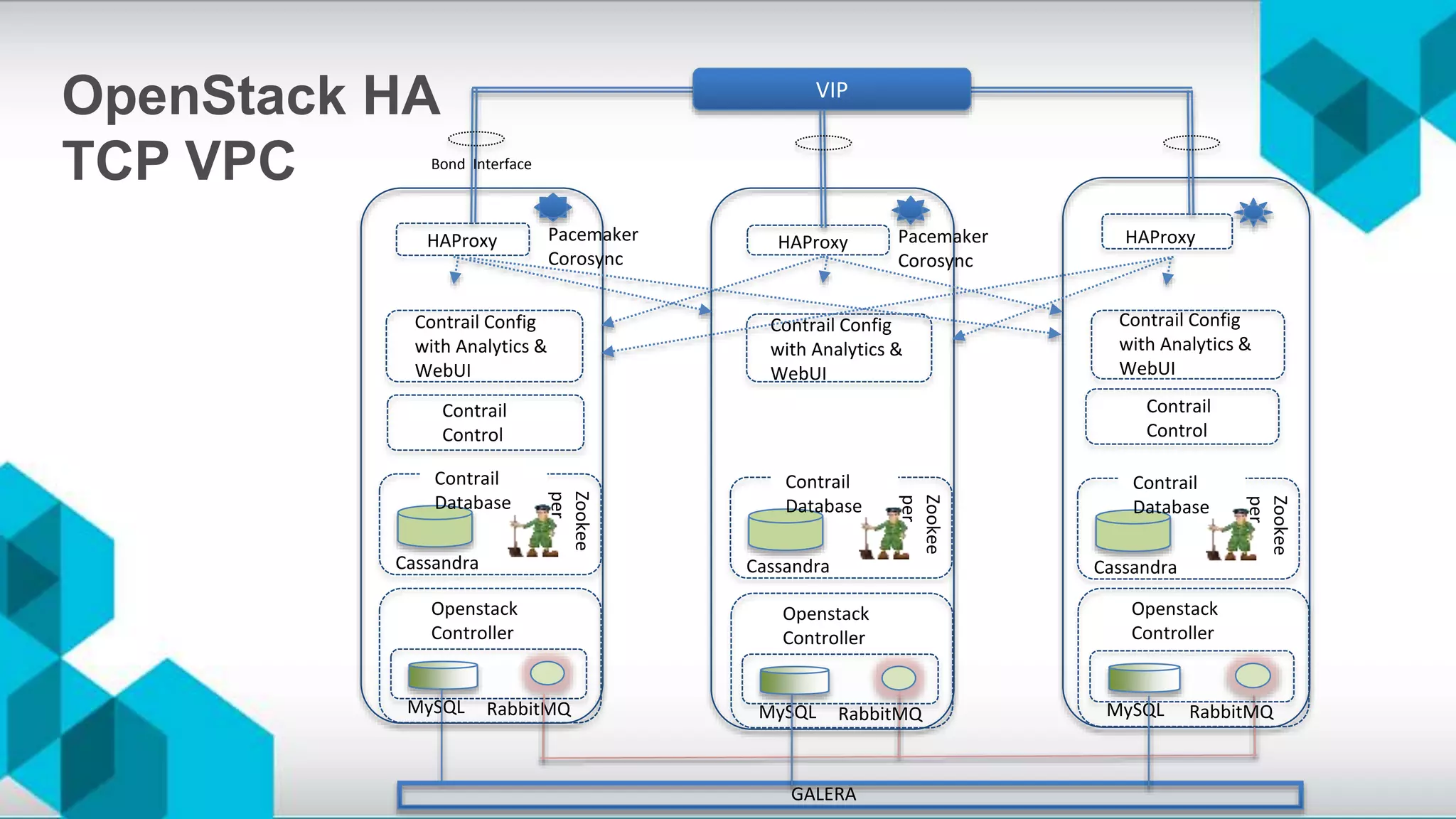
OpenStack HA
TCP VPC
MySQL RabbitMQ
Openstack
Controller
GALERA
Zookee
per
Cassandra
Contrail
Database
Contrail Config
with Analytics &
WebUI
Contrail
Control
Zookee
per
Cassandra
Contrail
Database
MySQL RabbitMQ
Openstack
Controller
MySQL RabbitMQ
Openstack
Controller
Zookee
per
Cassandra
Contrail
Database
Contrail
Control
Contrail Config
with Analytics &
WebUI
HAProxy HAProxy HAProxy
VIP
Bond Interface
Pacemaker
Corosync
Contrail Config
with Analytics &
WebUI
Pacemaker
Corosync
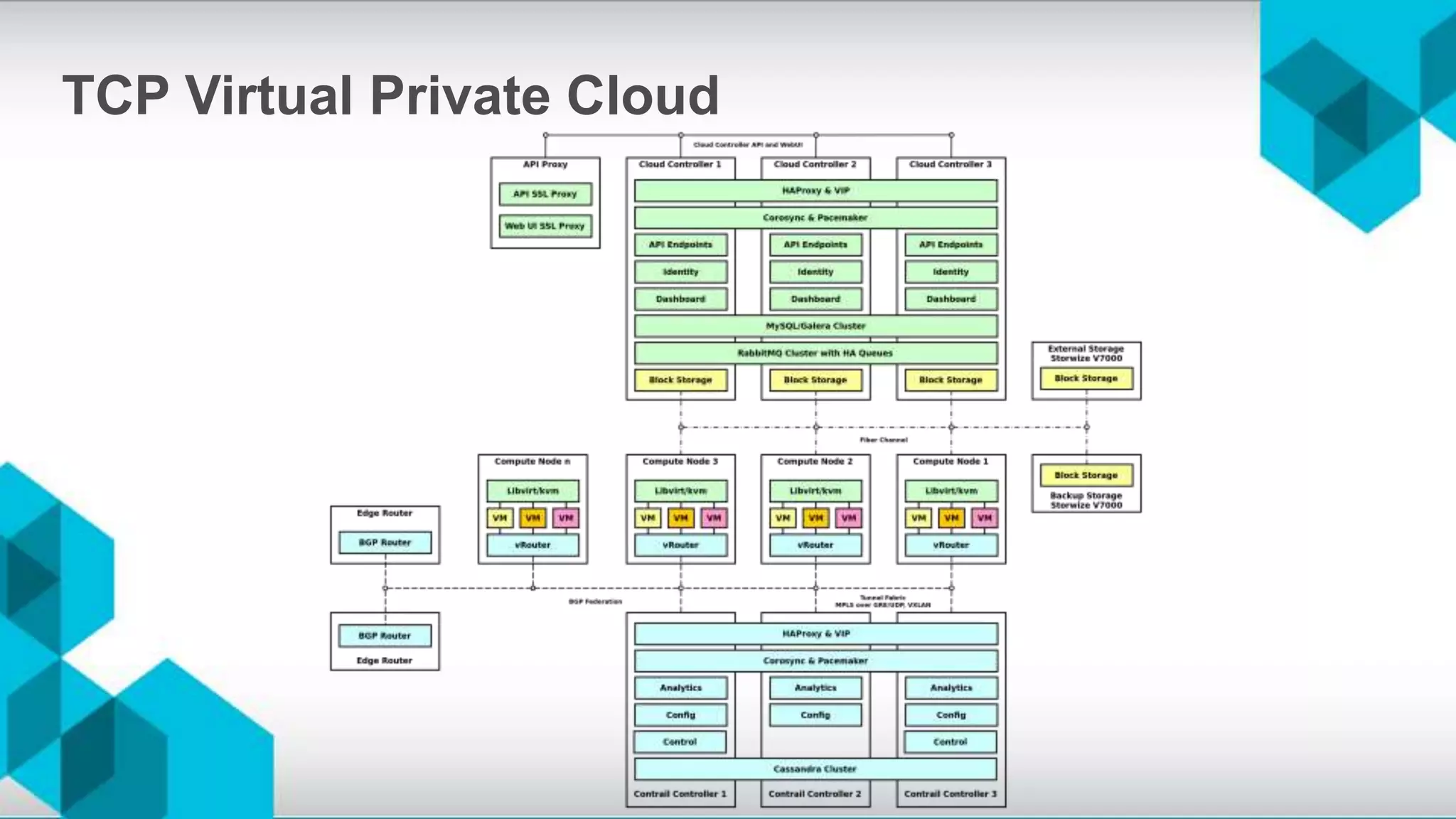
TCP Virtual Private Cloud
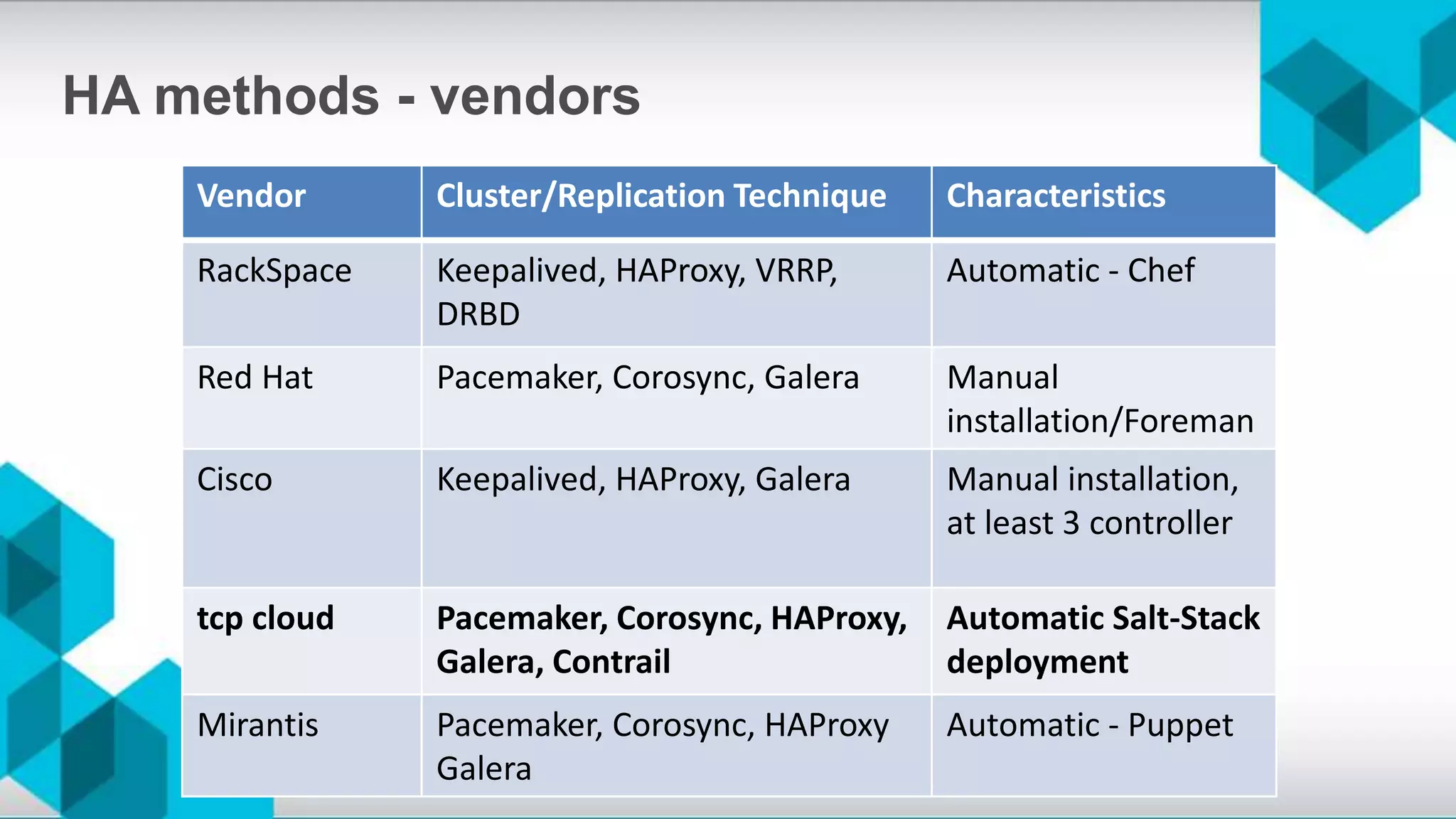
HA methods - vendors
Vendor Cluster/Replication Technique Characteristics
RackSpace Keepalived, HAProxy, VRRP,
DRBD
Automatic - Chef
Red Hat Pacemaker, Corosync, Galera Manual
installation/Foreman
Cisco Keepalived, HAProxy, Galera Manual installation,
at least 3 controller
tcp cloud Pacemaker, Corosync, HAProxy,
Galera, Contrail
Automatic Salt-Stack
deployment
Mirantis Pacemaker, Corosync, HAProxy
Galera
Automatic - Puppet
Thank you for your attention!

OpenStack High Availability

  • 1.
  • 2.
    About me Jakub Pavlík •Cloud Platform Engineer • 3 years in Cloud • 2 years in OpenStack
  • 3.
    High Availability vs.Disaster Recovery High Availability = fault detection & correction procedures to maximize availability of critical services and applications, often in an automated fashion. Disaster Recovery = process of preparing for recovery or continuation of technology infrastructure critical to an organization after a natural or human-induced disaster. High Availability ≠ Disaster Recovery!
  • 4.
    Four types ofHA in an OpenStack Cloud Physical infrastructure OpenStack Control services VMs OpenStack Compute Applications Compute Controller Network Controller Database Message Queue Storage .... Physical nodes Physical network Physical storage Hypervisor Host OS …. Service Resiliency QoS Cost Transparency Data Integrity ….. Virtual Machine Virtual Network Virtual Storage VM Mobility …
  • 5.
  • 6.
    Controller 1 Controller2 SAN 1 SAN 2 Passthru 2Passthru 1 Controller 1 Controller 2 SAN 1 SAN 2 Passthru 2Passthru 1 Switch 1 Switch 2 168 cores 3,46GHz ,336 threads agregation ¼ : 1344 vCPU 2688 GB RAM 28 x 10GE ports 168 cores 2,67GHz ,336 threads agregation ¼ : 1344 vCPU 1792 GB RAM 28 x 10GE ports tcp cloud VPC Hardware
  • 7.
  • 8.
  • 9.
    Stateless services • Thereis no dependency between requests • For example APIs: Nova, Keystone, Glance, Cinder, etc. Stateful services • An action typically compromises multiple requests • For example: MySQL, RabbitMQ, etc. OpenStack High Availability Concepts Active/Passive • Redundant instances of stateless services are load balanced • For Stateful services a replacement resource can be brought online Active/Active • Redundant instances of stateless services are load balanced • Stateful services are managed in such a way that services are redundant, and that all instances have and identical state.
  • 10.
    Corosync • Totem single-ringordering and membership protocol • UDP and InfiniBand based messaging, quorum, and cluster membership to Pacemaker Pacemaker • High availability and load balancing stack for the Linux platform. • Interacts with applications through Resource Agents (RA) HAProxy • Load Balancing and Proxying for HTTP and TCP Applications • Works over multiple connections • Used to load balance API services Corosync, Pacemaker and HAProxy
  • 11.
    • MySQL patchedfor wsrep (Write Set REPlication) • Active/active multi-master topology • Read and write to any cluster node • True parallel replication, in row level • No slave lag or integrity issues MySQL Galera Synchronous multi-master cluster technology for MySQL/InnoDB
  • 12.
    Sample OpenStack HAarchitecture Stateful • Cinder Volume • Neutron L3, DHCP agents • Ceilometer central agent • RabbitMQ Stateless • Neutron Server • OpenStack APIs • Apache web server • Nova Scheduler • Cinder Scheduler Neutron agents (Active) Neutron agents (Hot Standby)
  • 13.
  • 14.
    Storage • Shared storagefilesystem – file disks (qcow2, vmdk, vhv) • Block storage Network • Vanilla Neutron L3 agent (OpenVSwitch, Linux Bridge) • Vendor plugins - SDN controller VMs HA – two layers
  • 15.
    No vSphere StyleHA with KVM
  • 16.
    Shared Storage • Livemigration – just RAM memory • Hypervisor Evacuation – The instance will be booted from same disk and data will be preserved • CEPH, Gluster, NFS, Samba, GFS Non-Shared Storage • Block Live Migration – disk and RAM • Hypervisor Evacuation – the instance will be booted from a new disk, but will preserve the configuration, e.g. id, name, uuid • Standard filesystem EXT4, etc. Non-Shared/Shared Storage filesystem
  • 17.
    • Instance bootsfrom volume • iSCSI/FC direct mapping to instance • Enable Live Migration • Cinder Backends • LVM Driver • Default linux iSCSI server • Vendor software plugins • Gluster, CEPH, VMware VMDK driver • Vendor storage plugins • EMC VNX, IBM Storwize, Solid Fire, etc. Block Storage - Cinder
  • 18.
    Problems • Routing onLinux server (max. bandwith approximately 3-4 Gbits) • Limited distribution between more network nodes • East-West and North-South communication through network node High Availability • Pacemaker&Corosync • Keepalived VRRP • DVR + VRRP – should be in Juno release Networking - Vanilla Neutron L3 agent
  • 19.
    Examples • Juniper OpenContrail,VMware NSX, SDN PLUMgrid Advantages against Neutron L3 agent • North-South communication on network devices (iBGP, MLPSoverGRE) • East-West communication directly between compute nodes • Higher bandwidth (9.7 Gbits per 10Gbits port) High Availability • iBGP peering into two routers • Native HA implemented inside of network devices Networking – Vendor SDN Controller plugins
  • 20.
    OpenStack HA TCP VPC MySQLRabbitMQ Openstack Controller GALERA Zookee per Cassandra Contrail Database Contrail Config with Analytics & WebUI Contrail Control Zookee per Cassandra Contrail Database MySQL RabbitMQ Openstack Controller MySQL RabbitMQ Openstack Controller Zookee per Cassandra Contrail Database Contrail Control Contrail Config with Analytics & WebUI HAProxy HAProxy HAProxy VIP Bond Interface Pacemaker Corosync Contrail Config with Analytics & WebUI Pacemaker Corosync
  • 21.
  • 22.
    HA methods -vendors Vendor Cluster/Replication Technique Characteristics RackSpace Keepalived, HAProxy, VRRP, DRBD Automatic - Chef Red Hat Pacemaker, Corosync, Galera Manual installation/Foreman Cisco Keepalived, HAProxy, Galera Manual installation, at least 3 controller tcp cloud Pacemaker, Corosync, HAProxy, Galera, Contrail Automatic Salt-Stack deployment Mirantis Pacemaker, Corosync, HAProxy Galera Automatic - Puppet
  • 23.
    Thank you foryour attention!