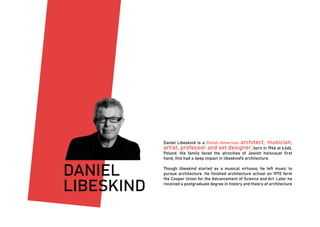
Daniel Libeskind is a Polish–American architect, musician,
artist, professor and set designer, born in 1946 at Łódź,
Poland. His family faced the atrocities of Jewish holocaust first
hand, this had a deep impact in libeskind's architecture.
Though libeskind started as a musical virtuoso, he left music to
pursue architecture. He finished architecture school on 1970 form
the Cooper Union for the Advancement of Science and Art. Later he
received a postgraduate degree in history and theory of architecture
DANIEL
LIBESKIND
STARTING
ARCHITECTURE
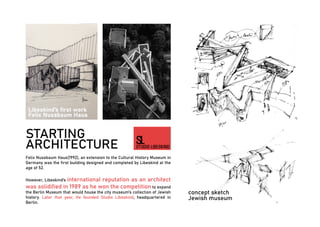
Felix Nussbaum Haus(1992), an extension to the Cultural History Museum in
Germany was the first building designed and completed by Libeskind at the
age of 52.
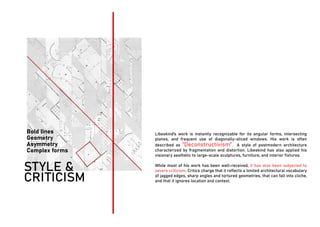
However, Libeskind’s international reputation as an architect
was solidified in 1989 as he won the competition to expand
the Berlin Museum that would house the city museum’s collection of Jewish
history. Later that year, He founded Studio Libeskind, headquartered in
Berlin.
Libeskind’s first work
Felix Nussbaum Haus
concept sketch
Jewish museum
PHILOSOPHY
SPACE, EMOTION, MUSIC, POEM
Libeskind’s philosophy is rooted in the idea that architecture should
be a reflection of the human experience.
One of his key concepts is "memory construction" which
refers to the idea that architecture has the power to create a collec-
tive memory and shape our understanding of history and culture. He
believes that architecture should look to the future while remember-
ing the past.
Also Libeskind's keen interest in art and music has influenced his
approach to architecture. He explored the relationship between
music and architecture in an architectonic and graphic point of view.
“I don’t think I’ve given up music, I’ve just changed
the instrument!”
RENOWNED
PROJECTS
SAPPHIRE BUILDING,
BERLIN, GERMANY (2020)
One World
Trade Centre (2003)
Museum of Military History,
Germany(2011)
Royal Ontario Museum,
Toronto, Canada (2007)
Frederic C. Hamilton Building,
United States(2006)
Libeskind's work is instantly recognizable for its angular forms, intersecting
planes, and frequent use of diagonally-sliced windows. His work is often
described as ”Deconstructivism”. A style of postmodern architecture
characterized by fragmentation and distortion. Libeskind has also applied his
visionary aesthetic to large-scale sculptures, furniture, and interior fixtures.
While most of his work has been well-received, it has also been subjected to
severe criticism. Critics charge that it reflects a limited architectural vocabulary
of jagged edges, sharp angles and tortured geometries, that can fall into cliche,
and that it ignores location and context.
Bold lines
Geometry
Asymmetry
Complex forms
STYLE &
CRITICISM
The architecture video series showcasing the Architect Daniel Libeskind and
his design for Jewish Museum, (between the lines)
Link: https://www.youtube.com/watch?v=tmddMMtX7N8
On 3,500 square meters of floor space, the museum presents the history of
Jews in Germany from the middle ages to the present days. In 1987, the Berlin
government organized an anonymous competition for an expansion to the
original Jewish Museum in Berlin that opened in 1933. The program wished to
bring a Jewish presence back to Berlin after WWII. In 1988, Daniel
Libeskind won the competition surpassing several internationally
acclaimed architects.
Location: Berlin, Germany
Architects: Studio Libeskind
Area : 15500 m²
Year : 1999
JEWISH MUSEUM
BERLIN
BACKGROUND &
C O N C E P T
The original Jewish Museum in Berlin was established in 1933, but it
wasn’t open very long before it was closed during Nazi rule in 1938. Un-
fortunately, the museum remained vacant until 1975. Libeskind’s ad-
dition to the Jewish Museum in 2001 finally opened that the
museum would finally establish a Jewish presence embedded culturally
and socially in Berlin.
Conceptually, Libeskind wanted to express feelings of absence,
emptiness, and invisibility – expressions of disappearance of
the Jewish Culture. It was the act of using architecture as a means of
narrative and emotion providing visitors with an experience of the ef-
fects of the Holocaust on both the Jewish culture and the city of Berlin.
Libeskind creates a promenade that follows the “zig-zag” formation of
the building for visitors to walk through and experience the spaces
within. The three routes present opportunities to witness the
Jewish experience.
1. Holocaust tower
2. Garden of exile
3. Continuity
3
AXIS
The building zigzags with its titanium-zinc façade and features
underground axes, angled walls, and bare concrete “voids” without heat
or air-conditioning.
Two gardens round out the building ensemble of the Libeskind building
and the Old Building. The 49 columns of the Garden of Exile are filled
with earth in which willow oaks grow. A rose garden around the Garden
of Exile recalls that in Jerusalem during the days of the Holy Temple.
Adjacent to the roses, a natural stone relief set into the ground contin-
ues in the area between the Old Building and the Libeskind building.
M A T E R I A L I T Y
L A N D S C A P E
FACADE DE TAIL
AWARDS AND
RECOGNITION
• First architect to receive the Dresden International Peace Prize (2023)
• First architect to win the Hiroshima Art Prize, awarded to an artist whose work
promotes international understanding and peace (2001)
• First recipient of honorary degree of Doctor of Fine Art from University of Ulster
in recognition of his outstanding services to global architecture and design (2009)
• In 2003, he received the Leo Baeck Medal for his humanitarian work promoting
tolerance and social justice.
• American Institute of Architects National Service Award for the World Trade Center
Master Plan (2012)
• RIBA Regional Award for Ogden Centre for Fundamental Physics at Durham
University (2017)
• RIBA International Award for Wohl Centre at Bar-Ilan University (2006)
• RIBA International Award for the Imperial War Museum North (2004)
• RIBA Award for the London Metropolitan University Graduate Centre (2004)
• Honorary member of the Royal Academy of Arts in London, England (2004)
• American Institute of Architects Medal for Highest Scholastic Achievement (1970)

Daniel Libinskind.pdf

  • 1.
    Daniel Libeskind isa Polish–American architect, musician, artist, professor and set designer, born in 1946 at Łódź, Poland. His family faced the atrocities of Jewish holocaust first hand, this had a deep impact in libeskind's architecture. Though libeskind started as a musical virtuoso, he left music to pursue architecture. He finished architecture school on 1970 form the Cooper Union for the Advancement of Science and Art. Later he received a postgraduate degree in history and theory of architecture DANIEL LIBESKIND
  • 2.
    STARTING ARCHITECTURE Felix Nussbaum Haus(1992),an extension to the Cultural History Museum in Germany was the first building designed and completed by Libeskind at the age of 52. However, Libeskind’s international reputation as an architect was solidified in 1989 as he won the competition to expand the Berlin Museum that would house the city museum’s collection of Jewish history. Later that year, He founded Studio Libeskind, headquartered in Berlin. Libeskind’s first work Felix Nussbaum Haus concept sketch Jewish museum
  • 3.
    PHILOSOPHY SPACE, EMOTION, MUSIC,POEM Libeskind’s philosophy is rooted in the idea that architecture should be a reflection of the human experience. One of his key concepts is "memory construction" which refers to the idea that architecture has the power to create a collec- tive memory and shape our understanding of history and culture. He believes that architecture should look to the future while remember- ing the past. Also Libeskind's keen interest in art and music has influenced his approach to architecture. He explored the relationship between music and architecture in an architectonic and graphic point of view. “I don’t think I’ve given up music, I’ve just changed the instrument!”
  • 4.
    RENOWNED PROJECTS SAPPHIRE BUILDING, BERLIN, GERMANY(2020) One World Trade Centre (2003) Museum of Military History, Germany(2011) Royal Ontario Museum, Toronto, Canada (2007) Frederic C. Hamilton Building, United States(2006)
  • 5.
    Libeskind's work isinstantly recognizable for its angular forms, intersecting planes, and frequent use of diagonally-sliced windows. His work is often described as ”Deconstructivism”. A style of postmodern architecture characterized by fragmentation and distortion. Libeskind has also applied his visionary aesthetic to large-scale sculptures, furniture, and interior fixtures. While most of his work has been well-received, it has also been subjected to severe criticism. Critics charge that it reflects a limited architectural vocabulary of jagged edges, sharp angles and tortured geometries, that can fall into cliche, and that it ignores location and context. Bold lines Geometry Asymmetry Complex forms STYLE & CRITICISM
  • 6.
    The architecture videoseries showcasing the Architect Daniel Libeskind and his design for Jewish Museum, (between the lines) Link: https://www.youtube.com/watch?v=tmddMMtX7N8 On 3,500 square meters of floor space, the museum presents the history of Jews in Germany from the middle ages to the present days. In 1987, the Berlin government organized an anonymous competition for an expansion to the original Jewish Museum in Berlin that opened in 1933. The program wished to bring a Jewish presence back to Berlin after WWII. In 1988, Daniel Libeskind won the competition surpassing several internationally acclaimed architects. Location: Berlin, Germany Architects: Studio Libeskind Area : 15500 m² Year : 1999 JEWISH MUSEUM BERLIN
  • 7.
    BACKGROUND & C ON C E P T The original Jewish Museum in Berlin was established in 1933, but it wasn’t open very long before it was closed during Nazi rule in 1938. Un- fortunately, the museum remained vacant until 1975. Libeskind’s ad- dition to the Jewish Museum in 2001 finally opened that the museum would finally establish a Jewish presence embedded culturally and socially in Berlin. Conceptually, Libeskind wanted to express feelings of absence, emptiness, and invisibility – expressions of disappearance of the Jewish Culture. It was the act of using architecture as a means of narrative and emotion providing visitors with an experience of the ef- fects of the Holocaust on both the Jewish culture and the city of Berlin. Libeskind creates a promenade that follows the “zig-zag” formation of the building for visitors to walk through and experience the spaces within. The three routes present opportunities to witness the Jewish experience. 1. Holocaust tower 2. Garden of exile 3. Continuity
  • 8.
  • 9.
    The building zigzagswith its titanium-zinc façade and features underground axes, angled walls, and bare concrete “voids” without heat or air-conditioning. Two gardens round out the building ensemble of the Libeskind building and the Old Building. The 49 columns of the Garden of Exile are filled with earth in which willow oaks grow. A rose garden around the Garden of Exile recalls that in Jerusalem during the days of the Holy Temple. Adjacent to the roses, a natural stone relief set into the ground contin- ues in the area between the Old Building and the Libeskind building. M A T E R I A L I T Y L A N D S C A P E FACADE DE TAIL
  • 10.
    AWARDS AND RECOGNITION • Firstarchitect to receive the Dresden International Peace Prize (2023) • First architect to win the Hiroshima Art Prize, awarded to an artist whose work promotes international understanding and peace (2001) • First recipient of honorary degree of Doctor of Fine Art from University of Ulster in recognition of his outstanding services to global architecture and design (2009) • In 2003, he received the Leo Baeck Medal for his humanitarian work promoting tolerance and social justice. • American Institute of Architects National Service Award for the World Trade Center Master Plan (2012) • RIBA Regional Award for Ogden Centre for Fundamental Physics at Durham University (2017) • RIBA International Award for Wohl Centre at Bar-Ilan University (2006) • RIBA International Award for the Imperial War Museum North (2004) • RIBA Award for the London Metropolitan University Graduate Centre (2004) • Honorary member of the Royal Academy of Arts in London, England (2004) • American Institute of Architects Medal for Highest Scholastic Achievement (1970)