Decluttering your Org
Karin Kraus
Portfolio Success Manager
Salesforce
Forward-Looking Statements
Statement under the Private Securities Litigation Reform Act of 1995:
This presentation may contain forward-looking statements that involve risks, uncertainties, and assumptions. If any such uncertainties materialize or if
any of the assumptions proves incorrect, the results of salesforce.com, inc. could differ materially from the results expressed or implied by the forward-
looking statements we make. All statements other than statements of historical fact could be deemed forward-looking, including any projections of
product or service availability, subscriber growth, earnings, revenues, or other financial items and any statements regarding strategies or plans of
management for future operations, statements of belief, any statements concerning new, planned, or upgraded services or technology developments
and customer contracts or use of our services.
The risks and uncertainties referred to above include – but are not limited to – risks associated with developing and delivering new functionality for our
service, new products and services, our new business model, our past operating losses, possible fluctuations in our operating results and rate of
growth, interruptions or delays in our Web hosting, breach of our security measures, the outcome of any litigation, risks associated with completed and
any possible mergers and acquisitions, the immature market in which we operate, our relatively limited operating history, our ability to expand, retain,
and motivate our employees and manage our growth, new releases of our service and successful customer deployment, our limited history reselling
non-salesforce.com products, and utilization and selling to larger enterprise customers. Further information on potential factors that could affect the
financial results of salesforce.com, inc. is included in our annual report on Form 10-K for the most recent fiscal year and in our quarterly report on Form
10-Q for the most recent fiscal quarter. These documents and others containing important disclosures are available on the SEC Filings section of the
Investor Information section of our Web site.
Any unreleased services or features referenced in this or other presentations, press releases or public statements are not currently available and may
not be delivered on time or at all. Customers who purchase our services should make the purchase decisions based upon features that are currently
available. Salesforce.com, inc. assumes no obligation and does not intend to update these forward-looking statements.
What is the Current State of Your Implementation?
 New Salesforce Implementation
 Well Oiled Machine achieving maximum ROI
 Needs a complete Re-Implementation
 Requires Preventative Maintenance
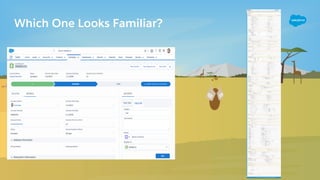
Which One Looks Familiar?
Decluttering your Org
Step 1: Assess you Org
Review org to determine the
amount of Technical Debt.
What is Technical Debt?
Technical debt is a phrase coined by Ward Cunningham
that refers to an IT concept that reflects the extra
development work that arises when code that is easy to
implement in the short run is used instead of applying
the best overall solution.
In Salesforce terms, it is the combination of inefficient
customizations, integrations, applications, and
processes that grow unchecked over time, resulting in a
system that lacks scalability and agility.
Technical Debt in Salesforce
Common areas of technical debt and the impact they create
Area Quality Adoption
Complexit
y
Performance Limits
Testing and
Training
Custom objects and fields ✔ ✔ ✔ ✔ ✔ ✔
Custom tabs and apps ✔ ✔ ✔
Page layouts and record types ✔ ✔ ✔
Workflow and validation rules ✔ ✔ ✔ ✔
Installed packages ✔ ✔
Apex code and Visualforce pages ✔ ✔ ✔
Reports and dashboards ✔ ✔
Roles and profiles ✔ ✔ ✔
How to Assess your Org’s Technical Debt
Forensic Tools in Salesforce
• Salesforce Setup
• System Overview
• Schema Builder
• Security Health Check
• Reports and Dashboards
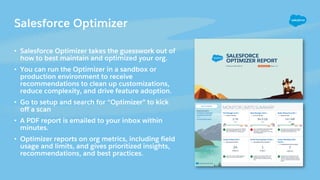
Salesforce Optimizer
• Salesforce Optimizer takes the guesswork out of
how to best maintain and optimized your org.
• You can run the Optimizer in a sandbox or
production environment to receive
recommendations to clean up customizations,
reduce complexity, and drive feature adoption.
• Go to setup and search for “Optimizer” to kick
off a scan
• A PDF report is emailed to your inbox within
minutes.
• Optimizer reports on org metrics, including field
usage and limits, and gives prioritized insights,
recommendations, and best practices.
Check the AppExchange
Many free and paid tools from our partners
• Toolkit For Salesforce
• Field Trip
• EasyDescribe
• Metadata Search
• Metadata Glimpser
• Schema Surfer
• Org Dictionary
• Many more…
Success Cloud has your back
More help from Customer Success
Premier & Signature Accelerators
• Org Health Assessment
• Codebase Health Assessment
• Service Cloud Health Assessment
Premier Support Admin Services
• 100+ Declarative change requests including: Page Layouts, Reports, Permissions, etc
• Business Process Assessment
• Enterprise Architecture Assessment
Create a Data Dictionary
Document the need for customizations in your org
• Data Dictionary can help track why a field, object, workflow, etc... Exist
• Dictionary should include:
• Business Purpose
• Requestor
• Date Created
• Date Last Verified
• Percentage of the time used
Rule of thumb: If a field is used less than 15%
of the time consider removing
Decluttering your Org
Step 2: Define your Corrective Action
How will you pay down the org’s Technical Debt?
Re-Implementation vs. Ongoing Maintenance
Re-Implementation Project
• Pause new feature release
• Deep Dive Org Analysis
• Scope what needs to be done
• Re-configuration Org leveraging
clicks over code
• Leverage Cloud Services & Partner
Ecosystem
Ongoing Maintenance
• Keep org moving forward while cleaning
up the mess
• Devote a percentage of each release to
clean up work (Recommended 10-20%)
• Prioritize largest areas of Technical Debt
• Leverage Premier Admin Services
Develop a Project Plan
Key Items to include in Project Plan:
• Sponsor & Key Stakeholders
• Budget
• Communication Plan
• Skills & Resources Needed
• Solution & Technical Designs
Plan Analyze Design Build Validate Deploy
• Prioritization
• Success Definition & KPIs
• Training
• Black out windows
• Post-deployment Support
Execute on your Plan
Put your plan into action
• Always start development work in a Sandbox
• Ensure proper Regressing Testing is completed
• Backup data and metadata before making changes
• Removal of most metadata can’t be done through Change Sets
• Directly access setup or if you use the Metadata API leverage a destructive changes xml file
• Consider restricting access to a customization using Profiles before removal
More Help from the Experts
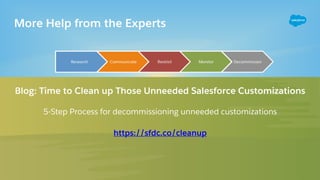
Blog: Time to Clean up Those Unneeded Salesforce Customizations
5-Step Process for decommissioning unneeded customizations
https://sfdc.co/cleanup
Even More Help…
Blog: Help! My Role Hierarchy is a Mess
Detailed process for cleaning up Roles
https://sfdc.co/rolemess
Decluttering your Salesfroce org

Decluttering your Salesfroce org

  • 1.
    Decluttering your Org KarinKraus Portfolio Success Manager Salesforce
  • 2.
    Forward-Looking Statements Statement underthe Private Securities Litigation Reform Act of 1995: This presentation may contain forward-looking statements that involve risks, uncertainties, and assumptions. If any such uncertainties materialize or if any of the assumptions proves incorrect, the results of salesforce.com, inc. could differ materially from the results expressed or implied by the forward- looking statements we make. All statements other than statements of historical fact could be deemed forward-looking, including any projections of product or service availability, subscriber growth, earnings, revenues, or other financial items and any statements regarding strategies or plans of management for future operations, statements of belief, any statements concerning new, planned, or upgraded services or technology developments and customer contracts or use of our services. The risks and uncertainties referred to above include – but are not limited to – risks associated with developing and delivering new functionality for our service, new products and services, our new business model, our past operating losses, possible fluctuations in our operating results and rate of growth, interruptions or delays in our Web hosting, breach of our security measures, the outcome of any litigation, risks associated with completed and any possible mergers and acquisitions, the immature market in which we operate, our relatively limited operating history, our ability to expand, retain, and motivate our employees and manage our growth, new releases of our service and successful customer deployment, our limited history reselling non-salesforce.com products, and utilization and selling to larger enterprise customers. Further information on potential factors that could affect the financial results of salesforce.com, inc. is included in our annual report on Form 10-K for the most recent fiscal year and in our quarterly report on Form 10-Q for the most recent fiscal quarter. These documents and others containing important disclosures are available on the SEC Filings section of the Investor Information section of our Web site. Any unreleased services or features referenced in this or other presentations, press releases or public statements are not currently available and may not be delivered on time or at all. Customers who purchase our services should make the purchase decisions based upon features that are currently available. Salesforce.com, inc. assumes no obligation and does not intend to update these forward-looking statements.
  • 3.
    What is theCurrent State of Your Implementation?  New Salesforce Implementation  Well Oiled Machine achieving maximum ROI  Needs a complete Re-Implementation  Requires Preventative Maintenance
  • 4.
    Which One LooksFamiliar?
  • 5.
    Decluttering your Org Step1: Assess you Org Review org to determine the amount of Technical Debt.
  • 6.
    What is TechnicalDebt? Technical debt is a phrase coined by Ward Cunningham that refers to an IT concept that reflects the extra development work that arises when code that is easy to implement in the short run is used instead of applying the best overall solution. In Salesforce terms, it is the combination of inefficient customizations, integrations, applications, and processes that grow unchecked over time, resulting in a system that lacks scalability and agility.
  • 7.
    Technical Debt inSalesforce Common areas of technical debt and the impact they create Area Quality Adoption Complexit y Performance Limits Testing and Training Custom objects and fields ✔ ✔ ✔ ✔ ✔ ✔ Custom tabs and apps ✔ ✔ ✔ Page layouts and record types ✔ ✔ ✔ Workflow and validation rules ✔ ✔ ✔ ✔ Installed packages ✔ ✔ Apex code and Visualforce pages ✔ ✔ ✔ Reports and dashboards ✔ ✔ Roles and profiles ✔ ✔ ✔
  • 8.
    How to Assessyour Org’s Technical Debt Forensic Tools in Salesforce • Salesforce Setup • System Overview • Schema Builder • Security Health Check • Reports and Dashboards
  • 9.
    Salesforce Optimizer • SalesforceOptimizer takes the guesswork out of how to best maintain and optimized your org. • You can run the Optimizer in a sandbox or production environment to receive recommendations to clean up customizations, reduce complexity, and drive feature adoption. • Go to setup and search for “Optimizer” to kick off a scan • A PDF report is emailed to your inbox within minutes. • Optimizer reports on org metrics, including field usage and limits, and gives prioritized insights, recommendations, and best practices.
  • 10.
    Check the AppExchange Manyfree and paid tools from our partners • Toolkit For Salesforce • Field Trip • EasyDescribe • Metadata Search • Metadata Glimpser • Schema Surfer • Org Dictionary • Many more…
  • 11.
    Success Cloud hasyour back More help from Customer Success Premier & Signature Accelerators • Org Health Assessment • Codebase Health Assessment • Service Cloud Health Assessment Premier Support Admin Services • 100+ Declarative change requests including: Page Layouts, Reports, Permissions, etc • Business Process Assessment • Enterprise Architecture Assessment
  • 12.
    Create a DataDictionary Document the need for customizations in your org • Data Dictionary can help track why a field, object, workflow, etc... Exist • Dictionary should include: • Business Purpose • Requestor • Date Created • Date Last Verified • Percentage of the time used Rule of thumb: If a field is used less than 15% of the time consider removing
  • 13.
    Decluttering your Org Step2: Define your Corrective Action How will you pay down the org’s Technical Debt?
  • 14.
    Re-Implementation vs. OngoingMaintenance Re-Implementation Project • Pause new feature release • Deep Dive Org Analysis • Scope what needs to be done • Re-configuration Org leveraging clicks over code • Leverage Cloud Services & Partner Ecosystem Ongoing Maintenance • Keep org moving forward while cleaning up the mess • Devote a percentage of each release to clean up work (Recommended 10-20%) • Prioritize largest areas of Technical Debt • Leverage Premier Admin Services
  • 15.
    Develop a ProjectPlan Key Items to include in Project Plan: • Sponsor & Key Stakeholders • Budget • Communication Plan • Skills & Resources Needed • Solution & Technical Designs Plan Analyze Design Build Validate Deploy • Prioritization • Success Definition & KPIs • Training • Black out windows • Post-deployment Support
  • 16.
    Execute on yourPlan Put your plan into action • Always start development work in a Sandbox • Ensure proper Regressing Testing is completed • Backup data and metadata before making changes • Removal of most metadata can’t be done through Change Sets • Directly access setup or if you use the Metadata API leverage a destructive changes xml file • Consider restricting access to a customization using Profiles before removal
  • 17.
    More Help fromthe Experts Blog: Time to Clean up Those Unneeded Salesforce Customizations 5-Step Process for decommissioning unneeded customizations https://sfdc.co/cleanup
  • 18.
    Even More Help… Blog:Help! My Role Hierarchy is a Mess Detailed process for cleaning up Roles https://sfdc.co/rolemess