Decision Tree
Swipe
Classification is a two-step process, learning step
and prediction step, in machine learning.
In the learning step, the model is developed based
on given training data.
In the prediction step, the model is used to predict
the response for given data.
Decision Tree is one of the easiest and popular
classification algorithms to understand and
interpret.
Decision Tree
Decision Tree algorithm belongs to the family of
supervised learning algorithms.
Unlike other supervised learning algorithms, the
decision tree algorithm can be used for solving
regression and classification problems too.
The goal of using a Decision Tree is to create a
training model that can use to predict the class or
value of the target variable by learning simple
decision rules inferred from prior data(training
data).
Decision Tree Algorithm
In Decision Trees, for predicting a class label for a
record we start from the root of the tree.
We compare the values of the root attribute with
the record’s attribute.
On the basis of comparison, we follow the branch
corresponding to that value and jump to the next
node.
Decision Tree Algorithm
Types of decision trees are based on the type of
target variable we have. It can be of two types:
Categorical Variable Decision Tree: Decision
Tree which has a categorical target variable
then it called a Categorical variable decision
tree.
Continuous Variable Decision Tree: Decision
Tree has a continuous target variable then it is
called Continuous Variable Decision Tree.
Types of Decision Trees
Example:-
Let’s say we have a problem to predict
whether a customer will pay his renewal
premium with an insurance company (yes/
no). Here we know that the income of
customers is a significant variable but the
insurance company does not have income
details for all customers. Now, as we know
this is an important variable, then we can
build a decision tree to predict customer
income based on occupation, product, and
various other variables. In this case, we are
predicting values for the continuous
variables.
Example
Important Terminology related to Decision
Trees
Root Node: It represents the entire population or
sample and this further gets divided into two or
more homogeneous sets.
Splitting: It is a process of dividing a node into two
or more sub-nodes.
Decision Node: When a sub-node splits into
further sub-nodes, then it is called the decision
node
Leaf / Terminal Node: Nodes do not split is called
Leaf or Terminal node.
Pruning: When we remove sub-nodes of a decision
node, this process is called pruning. You can say
the opposite process of splitting.
Branch / Sub-Tree: A subsection of the entire tree
is called branch or sub-tree.
Parent and Child Node: A node, which is divided
into sub-nodes is called a parent node of sub-
nodes whereas sub-nodes are the child of a parent
node.
Important Terminology related to Decision
Trees
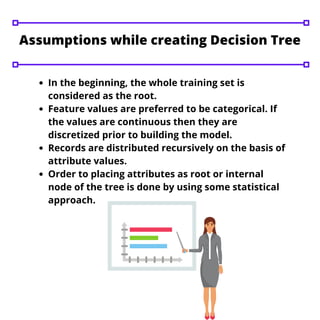
In the beginning, the whole training set is
considered as the root.
Feature values are preferred to be categorical. If
the values are continuous then they are
discretized prior to building the model.
Records are distributed recursively on the basis of
attribute values.
Order to placing attributes as root or internal
node of the tree is done by using some statistical
approach.
Assumptions while creating Decision Tree
Topics for next Post
k-nearest neighbor algorithm
Neural Networks
Similarity learning
Stay Tuned with

Decision tress

  • 1.
  • 2.
    Classification is atwo-step process, learning step and prediction step, in machine learning. In the learning step, the model is developed based on given training data. In the prediction step, the model is used to predict the response for given data. Decision Tree is one of the easiest and popular classification algorithms to understand and interpret. Decision Tree
  • 3.
    Decision Tree algorithmbelongs to the family of supervised learning algorithms. Unlike other supervised learning algorithms, the decision tree algorithm can be used for solving regression and classification problems too. The goal of using a Decision Tree is to create a training model that can use to predict the class or value of the target variable by learning simple decision rules inferred from prior data(training data). Decision Tree Algorithm
  • 4.
    In Decision Trees,for predicting a class label for a record we start from the root of the tree. We compare the values of the root attribute with the record’s attribute. On the basis of comparison, we follow the branch corresponding to that value and jump to the next node. Decision Tree Algorithm
  • 5.
    Types of decisiontrees are based on the type of target variable we have. It can be of two types: Categorical Variable Decision Tree: Decision Tree which has a categorical target variable then it called a Categorical variable decision tree. Continuous Variable Decision Tree: Decision Tree has a continuous target variable then it is called Continuous Variable Decision Tree. Types of Decision Trees
  • 6.
    Example:- Let’s say wehave a problem to predict whether a customer will pay his renewal premium with an insurance company (yes/ no). Here we know that the income of customers is a significant variable but the insurance company does not have income details for all customers. Now, as we know this is an important variable, then we can build a decision tree to predict customer income based on occupation, product, and various other variables. In this case, we are predicting values for the continuous variables. Example
  • 7.
    Important Terminology relatedto Decision Trees Root Node: It represents the entire population or sample and this further gets divided into two or more homogeneous sets. Splitting: It is a process of dividing a node into two or more sub-nodes. Decision Node: When a sub-node splits into further sub-nodes, then it is called the decision node
  • 8.
    Leaf / TerminalNode: Nodes do not split is called Leaf or Terminal node. Pruning: When we remove sub-nodes of a decision node, this process is called pruning. You can say the opposite process of splitting. Branch / Sub-Tree: A subsection of the entire tree is called branch or sub-tree. Parent and Child Node: A node, which is divided into sub-nodes is called a parent node of sub- nodes whereas sub-nodes are the child of a parent node. Important Terminology related to Decision Trees
  • 9.
    In the beginning,the whole training set is considered as the root. Feature values are preferred to be categorical. If the values are continuous then they are discretized prior to building the model. Records are distributed recursively on the basis of attribute values. Order to placing attributes as root or internal node of the tree is done by using some statistical approach. Assumptions while creating Decision Tree
  • 10.
    Topics for nextPost k-nearest neighbor algorithm Neural Networks Similarity learning Stay Tuned with