EvolutionEvolution
Organizational Decision Making
the of
Decision Making
CEO
Beginning in the late 80s to early 90s,
organizations began to flatten.
Everyone a Decision Maker
Employees are expected to make fast and accurate decisions and exercise
greater organizational judgment within the scope of their role.
The way organizations take action has evolved.
Trace the path of organizational decision making
from the past to today and beyond.
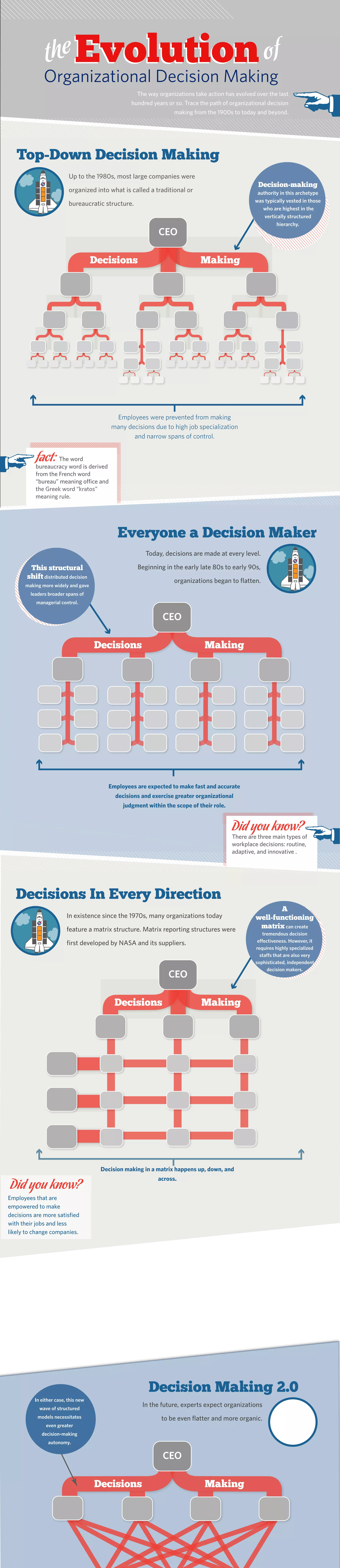
Up until the 1980s, most large companies were
organized into what is called a traditional or
bureaucratic structure.
Top-Down Decision Making
Decision Making
CEO
Employees are prevented from making many decisions due to
high job specialization and narrow spans of control.
Decision-making
authority in this archetype
is typically vested in those
who are highest in the
vertically structured
hierarchy.
This structural
shift distributed decision
making more widely and
gave leaders broader spans
of managerial control.
In existence since the 1970s, the matrix structure is still
used by many organizations today. Matrix reporting
structures were first developed by NASA and its suppliers.
Decisions In Every Direction
Decision making in a matrix happens up, down, and across. It requires highly
specialized staffs that are also sophisticated, independent decision makers.
Decision Making
CEO
A
well-functioning
matrix can create
tremendous decision
effectiveness.
Did you know?
Employees that are empowered to
make decisions are more satisfied
with their jobs and less likely to
change companies.
In the future, organizations will be aligned in even
more sophisticated models, including team-based
structures and strategic-business units.
Decision Making of the Future
Decision Making
CEO
As divisional barriers narrow and break down, there's greater opportunity
for collaboration, problem solving, and decision making.
Is your organization prepared for the future of decision making?
Contact us today to learn how we can help you
enhance and accelerate day-to-day decisions. insideoutdev.com | 1.888.262.2448
This new wave of
structured models
necessitates even greater
decision-making
autonomy.
fact: Individuals can
make faster decisions in the
workplace by utilizing a
systematic decision-making
process.
Functional
structure
Project
structure
Project
teams
Project
team
members
fact: The word
bureaucracy is derived from
the French word “bureau”
meaning office and the Greek
word “kratos” meaning rule.
Functional
structure
correlation level between decision
effectiveness and financial results.95%
A RECENT STUDY FOUND A
HIGHER THAN THOSE OF OTHER FIRMS.
6%
Companies that are most effective at decision making
generated average shareholder returns nearly
OF ALL CEOS1/2 launch an
organizational reorg during their first two years on the job.
In an effort to channel resources towards innovation
and decisions, nearly
Did you know?
There are three main types of
workplace decisions: routine,
adaptive, and innovative.
Resources:
The Decision-Driven Organization, Harvard Business Review, June 2010
Organizational Judgement is the New Decision Making, Fast Company, July 2012
How Companies Make Good Decisions, McKinsey Global Survey, December 2008
8 Basic Types of Organizational Structure, Management: A Practical Introduction
Organizational Structure, Encyclopedia of Management, 2009
Creative Commons – Attribution (CC BY 3.0) Team designed by Stephen Borengasser from the Noun Project http://thenounproject.com/term/team/43181/
Decision
Points
Decision
Points
Decision
Points
Decision
Points

Decision Making Infographic

  • 1.
    EvolutionEvolution Organizational Decision Making theof Decision Making CEO Beginning in the late 80s to early 90s, organizations began to flatten. Everyone a Decision Maker Employees are expected to make fast and accurate decisions and exercise greater organizational judgment within the scope of their role. The way organizations take action has evolved. Trace the path of organizational decision making from the past to today and beyond. Up until the 1980s, most large companies were organized into what is called a traditional or bureaucratic structure. Top-Down Decision Making Decision Making CEO Employees are prevented from making many decisions due to high job specialization and narrow spans of control. Decision-making authority in this archetype is typically vested in those who are highest in the vertically structured hierarchy. This structural shift distributed decision making more widely and gave leaders broader spans of managerial control. In existence since the 1970s, the matrix structure is still used by many organizations today. Matrix reporting structures were first developed by NASA and its suppliers. Decisions In Every Direction Decision making in a matrix happens up, down, and across. It requires highly specialized staffs that are also sophisticated, independent decision makers. Decision Making CEO A well-functioning matrix can create tremendous decision effectiveness. Did you know? Employees that are empowered to make decisions are more satisfied with their jobs and less likely to change companies. In the future, organizations will be aligned in even more sophisticated models, including team-based structures and strategic-business units. Decision Making of the Future Decision Making CEO As divisional barriers narrow and break down, there's greater opportunity for collaboration, problem solving, and decision making. Is your organization prepared for the future of decision making? Contact us today to learn how we can help you enhance and accelerate day-to-day decisions. insideoutdev.com | 1.888.262.2448 This new wave of structured models necessitates even greater decision-making autonomy. fact: Individuals can make faster decisions in the workplace by utilizing a systematic decision-making process. Functional structure Project structure Project teams Project team members fact: The word bureaucracy is derived from the French word “bureau” meaning office and the Greek word “kratos” meaning rule. Functional structure correlation level between decision effectiveness and financial results.95% A RECENT STUDY FOUND A HIGHER THAN THOSE OF OTHER FIRMS. 6% Companies that are most effective at decision making generated average shareholder returns nearly OF ALL CEOS1/2 launch an organizational reorg during their first two years on the job. In an effort to channel resources towards innovation and decisions, nearly Did you know? There are three main types of workplace decisions: routine, adaptive, and innovative. Resources: The Decision-Driven Organization, Harvard Business Review, June 2010 Organizational Judgement is the New Decision Making, Fast Company, July 2012 How Companies Make Good Decisions, McKinsey Global Survey, December 2008 8 Basic Types of Organizational Structure, Management: A Practical Introduction Organizational Structure, Encyclopedia of Management, 2009 Creative Commons – Attribution (CC BY 3.0) Team designed by Stephen Borengasser from the Noun Project http://thenounproject.com/term/team/43181/ Decision Points Decision Points Decision Points Decision Points