Do Your Leaders
Miss the Big
Picture?
Drive Results.
Faster.
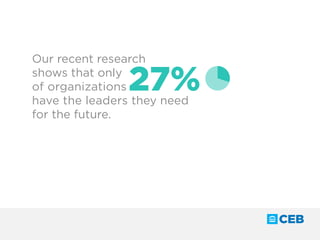
Our recent research
shows that only
of organizations
have the leaders they need
for the future.
27%
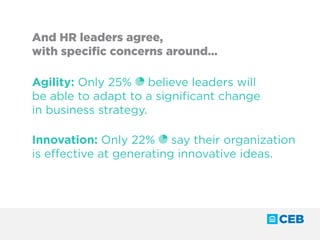
Agility: Only 25% believe leaders will
be able to adapt to a significant change
in business strategy.
Innovation: Only 22% say their organization
is effective at generating innovative ideas.
And HR leaders agree,
with specific concerns around…
So what’s
the reason
for this lack
of confidence?
While their abilities
haven’t changed,
the leadership
environment has.
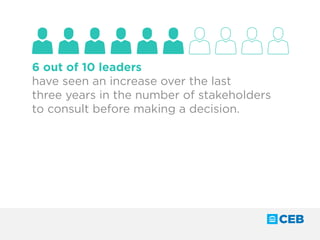
6 out of 10 leaders
have seen an increase over the last
three years in the number of stakeholders
to consult before making a decision.
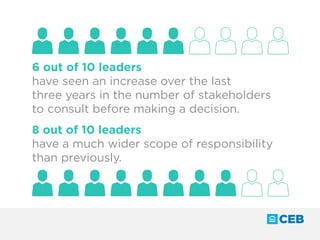
8 out of 10 leaders
have a much wider scope of responsibility
than previously.
6 out of 10 leaders
have seen an increase over the last
three years in the number of stakeholders
to consult before making a decision.
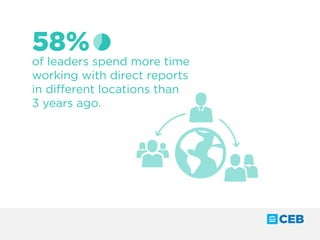
of leaders spend more time
working with direct reports
in different locations than
3 years ago.
58%
This new work
environment
demands a different
kind of leadership
to drive results.
Leaders hitting
individual targets
isn’t enough.
At CEB, we’ve identified
a new model for leader
success, where the most
impactful leaders are
those who:
Achieve strong
performance by
reaching their goals
and leading their teams
to do the same…
…and also
Show great
networked leadership
outcomes—building
bridges with
other leaders and
teams to share
resources and best
practices to improve
results across the
organization
We call them
enterprise leaders.
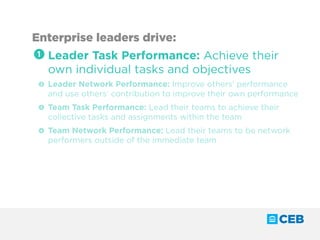
Enterprise leaders drive:
1 	Leader Task Performance: Achieve their
own individual tasks and objectives
2 	 Leader Network Performance: Improve others’ performance
and use others’ contribution to improve their own performance
3 	 Team Task Performance: Lead their teams to achieve their
collective tasks and assignments within the team
4 	 Team Network Performance: Lead their teams to be network
performers outside of the immediate team
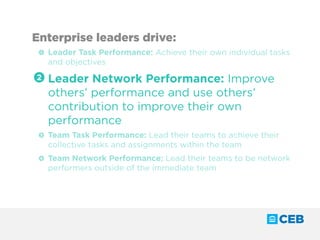
Enterprise leaders drive:
1 	 Leader Task Performance: Achieve their own individual tasks
and objectives
2 	Leader Network Performance: Improve
others’ performance and use others’
contribution to improve their own
performance
3 	 Team Task Performance: Lead their teams to achieve their
collective tasks and assignments within the team
4 	 Team Network Performance: Lead their teams to be network
performers outside of the immediate team
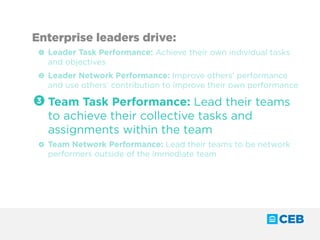
Enterprise leaders drive:
1 	 Leader Task Performance: Achieve their own individual tasks
and objectives
2 	 Leader Network Performance: Improve others’ performance
and use others’ contribution to improve their own performance
3 	Team Task Performance: Lead their teams
to achieve their collective tasks and
assignments within the team
4 	 Team Network Performance: Lead their teams to be network
performers outside of the immediate team
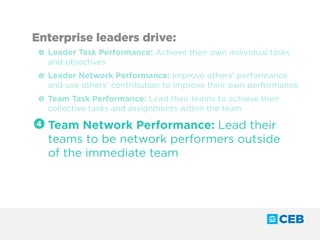
Enterprise leaders drive:
1 	 Leader Task Performance: Achieve their own individual tasks
and objectives
2 	 Leader Network Performance: Improve others’ performance
and use others’ contribution to improve their own performance
3 	 Team Task Performance: Lead their teams to achieve their
collective tasks and assignments within the team
4 	Team Network Performance: Lead their
teams to be network performers outside
of the immediate team
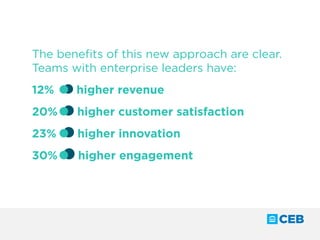
The benefits of this new approach are clear.
Teams with enterprise leaders have:
12%	 higher revenue
20%	 higher customer satisfaction
23%	 higher innovation
30%	 higher engagement
However, these leaders
are few and far between—
barely 1 in 10 leaders are
true enterprise leaders.
So how do you know
who the enterprise
leaders are in your
organization?
Objective assessment
gives you a snapshot
of your leadership team—
both individually and
looking across functions
and business units.
Assess leaders on their ability to:
1 	Leverage and support the work of other
leaders in the organization.
2 	Enable teams to leverage and contribute
to other teams across the organization.
Using objective assessment
also enables you to benchmark
your leaders against others in
your region or industry.
And how can you support
the development of this
new leadership mind-set
and approach?
1 	Invest in learning programs to build
leaders’ ability to model and enable
this new approach.
2 	Incorporate networked leadership into
your competency models.
3 	Create team climates that
support network performance.
Source: Creating Enterprise Leaders, CEB Corporate Leadership Council, 2015
© 2015 CEB. All Rights Reserved. SHL152455GD
Discover the insight and actions you
need to take for your leaders to drive
stronger business results.
Download the eBook today
cebglobal.com/leadership
Do Your Leaders
Miss the Big
Picture?
Drive Results.
Faster.

Are your leaders driving “One-Company” results?

  • 1.
    Do Your Leaders Missthe Big Picture? Drive Results. Faster.
  • 2.
    Our recent research showsthat only of organizations have the leaders they need for the future. 27%
  • 3.
    Agility: Only 25%believe leaders will be able to adapt to a significant change in business strategy. Innovation: Only 22% say their organization is effective at generating innovative ideas. And HR leaders agree, with specific concerns around…
  • 4.
    So what’s the reason forthis lack of confidence?
  • 5.
    While their abilities haven’tchanged, the leadership environment has.
  • 6.
    6 out of10 leaders have seen an increase over the last three years in the number of stakeholders to consult before making a decision.
  • 7.
    8 out of10 leaders have a much wider scope of responsibility than previously. 6 out of 10 leaders have seen an increase over the last three years in the number of stakeholders to consult before making a decision.
  • 8.
    of leaders spendmore time working with direct reports in different locations than 3 years ago. 58%
  • 9.
    This new work environment demandsa different kind of leadership to drive results.
  • 10.
  • 11.
    At CEB, we’veidentified a new model for leader success, where the most impactful leaders are those who: Achieve strong performance by reaching their goals and leading their teams to do the same…
  • 12.
    …and also Show great networkedleadership outcomes—building bridges with other leaders and teams to share resources and best practices to improve results across the organization
  • 13.
  • 14.
    Enterprise leaders drive: 1 Leader Task Performance: Achieve their own individual tasks and objectives 2 Leader Network Performance: Improve others’ performance and use others’ contribution to improve their own performance 3 Team Task Performance: Lead their teams to achieve their collective tasks and assignments within the team 4 Team Network Performance: Lead their teams to be network performers outside of the immediate team
  • 15.
    Enterprise leaders drive: 1 Leader Task Performance: Achieve their own individual tasks and objectives 2 Leader Network Performance: Improve others’ performance and use others’ contribution to improve their own performance 3 Team Task Performance: Lead their teams to achieve their collective tasks and assignments within the team 4 Team Network Performance: Lead their teams to be network performers outside of the immediate team
  • 16.
    Enterprise leaders drive: 1 Leader Task Performance: Achieve their own individual tasks and objectives 2 Leader Network Performance: Improve others’ performance and use others’ contribution to improve their own performance 3 Team Task Performance: Lead their teams to achieve their collective tasks and assignments within the team 4 Team Network Performance: Lead their teams to be network performers outside of the immediate team
  • 17.
    Enterprise leaders drive: 1 Leader Task Performance: Achieve their own individual tasks and objectives 2 Leader Network Performance: Improve others’ performance and use others’ contribution to improve their own performance 3 Team Task Performance: Lead their teams to achieve their collective tasks and assignments within the team 4 Team Network Performance: Lead their teams to be network performers outside of the immediate team
  • 18.
    The benefits ofthis new approach are clear. Teams with enterprise leaders have: 12% higher revenue 20% higher customer satisfaction 23% higher innovation 30% higher engagement
  • 19.
    However, these leaders arefew and far between— barely 1 in 10 leaders are true enterprise leaders.
  • 20.
    So how doyou know who the enterprise leaders are in your organization?
  • 21.
    Objective assessment gives youa snapshot of your leadership team— both individually and looking across functions and business units.
  • 22.
    Assess leaders ontheir ability to: 1 Leverage and support the work of other leaders in the organization. 2 Enable teams to leverage and contribute to other teams across the organization.
  • 23.
    Using objective assessment alsoenables you to benchmark your leaders against others in your region or industry.
  • 24.
    And how canyou support the development of this new leadership mind-set and approach?
  • 25.
    1 Invest inlearning programs to build leaders’ ability to model and enable this new approach. 2 Incorporate networked leadership into your competency models. 3 Create team climates that support network performance.
  • 26.
    Source: Creating EnterpriseLeaders, CEB Corporate Leadership Council, 2015 © 2015 CEB. All Rights Reserved. SHL152455GD Discover the insight and actions you need to take for your leaders to drive stronger business results. Download the eBook today cebglobal.com/leadership Do Your Leaders Miss the Big Picture? Drive Results. Faster.