DECISION MAKING
 Decision Making- the process of identifying
and choosing alternative courses of action in a
manner appropriate to the demands of
the situation.
- the heart of all the management
function.
 Decision are at various management levels. TOP ,
MIDDLE and LOWER LEVELS
 Decision are made at various management
functions. PLANNING, ORGANIZING, DIRECTING,
and CONTROLLING.
THE DECISION MAKING PROCESS
 Diagnose Problem
 Analyze environment
 Articulate problem or opportunity
 Develop viable alternatives
 Evaluate alternatives
 Make a choice
 Implement decision
 Evaluate and adapt decision results
DIAGNOSE PROBLEM
 If a manager wants to make an intelligent
decision, his 1st
move must be to identify the
problem.
 A problem exist when there is a difference
between an actual situation and desired
situation.
 Example : the actual situation of the firm is that
it has not yet constructed the building
 Example: the desired situation is the finished
25-storey building.
 In this case, the actual situation is different
from the desired situation
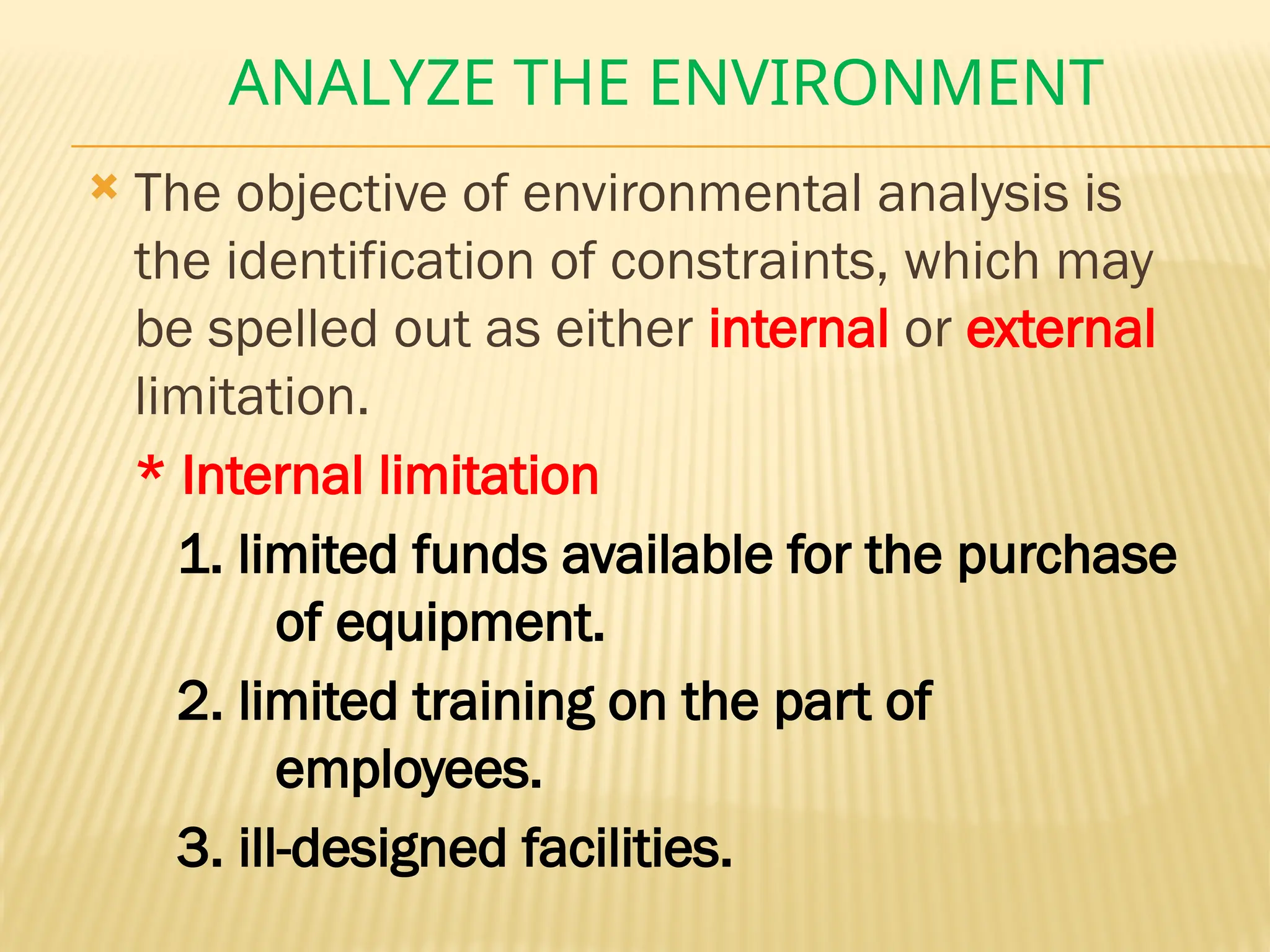
ANALYZE THE ENVIRONMENT
 The objective of environmental analysis is
the identification of constraints, which may
be spelled out as either internal or external
limitation.
* Internal limitation
1. limited funds available for the purchase
of equipment.
2. limited training on the part of
employees.
3. ill-designed facilities.
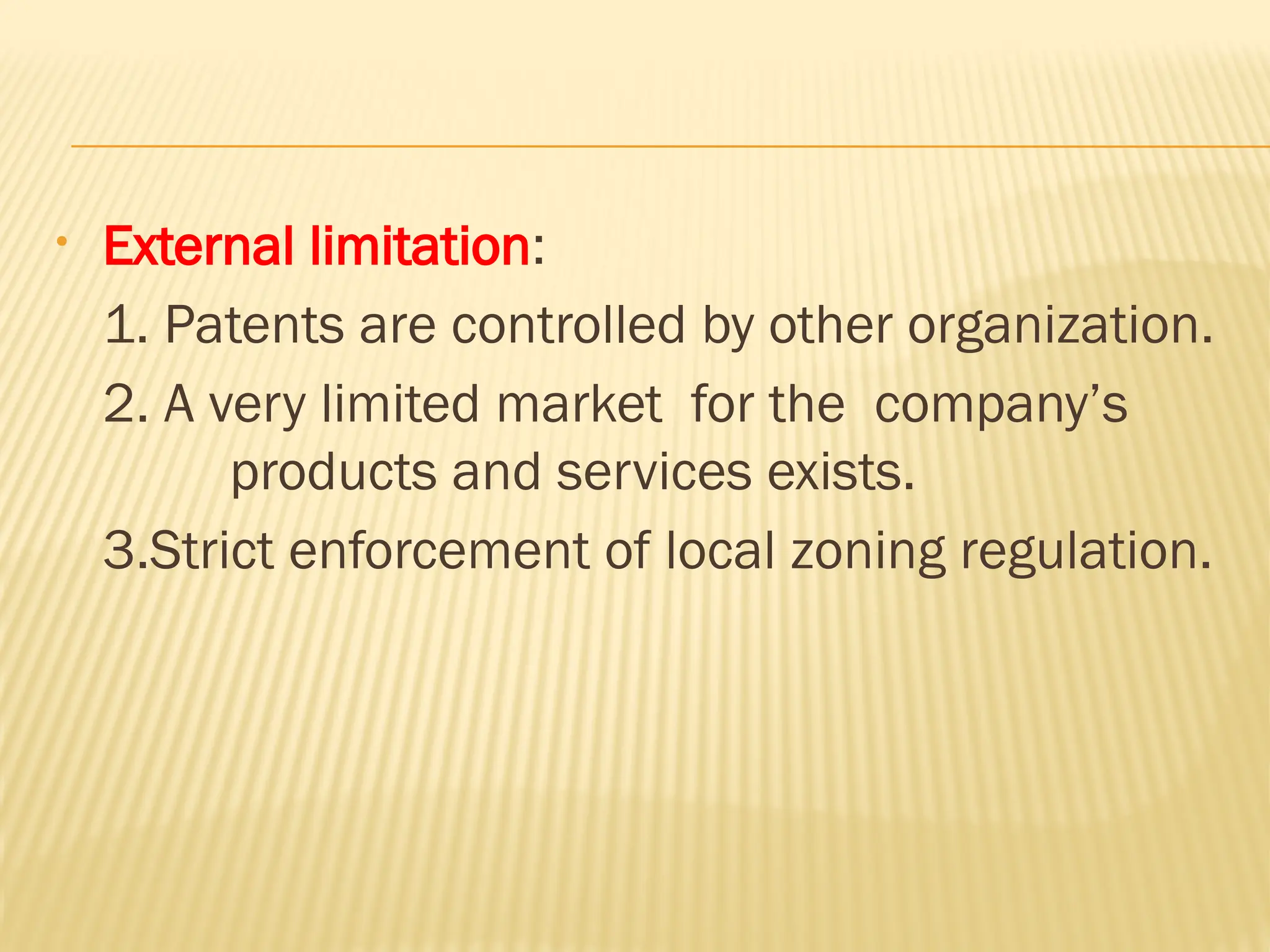
• External limitation:
1. Patents are controlled by other organization.
2. A very limited market for the company’s
products and services exists.
3.Strict enforcement of local zoning regulation.
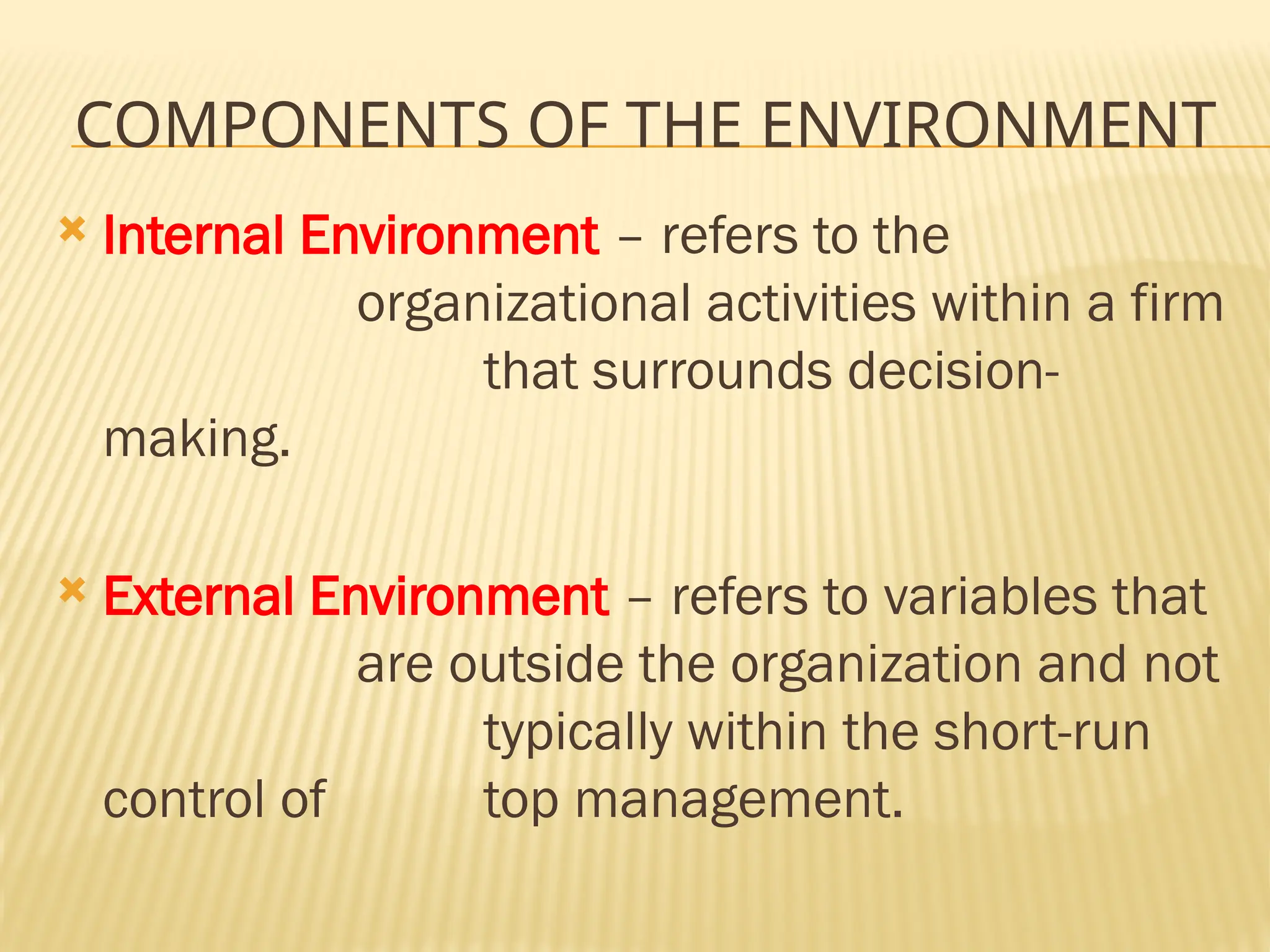
COMPONENTS OF THE ENVIRONMENT
 Internal Environment – refers to the
organizational activities within a firm
that surrounds decision-
making.
 External Environment – refers to variables that
are outside the organization and not
typically within the short-run
control of top management.
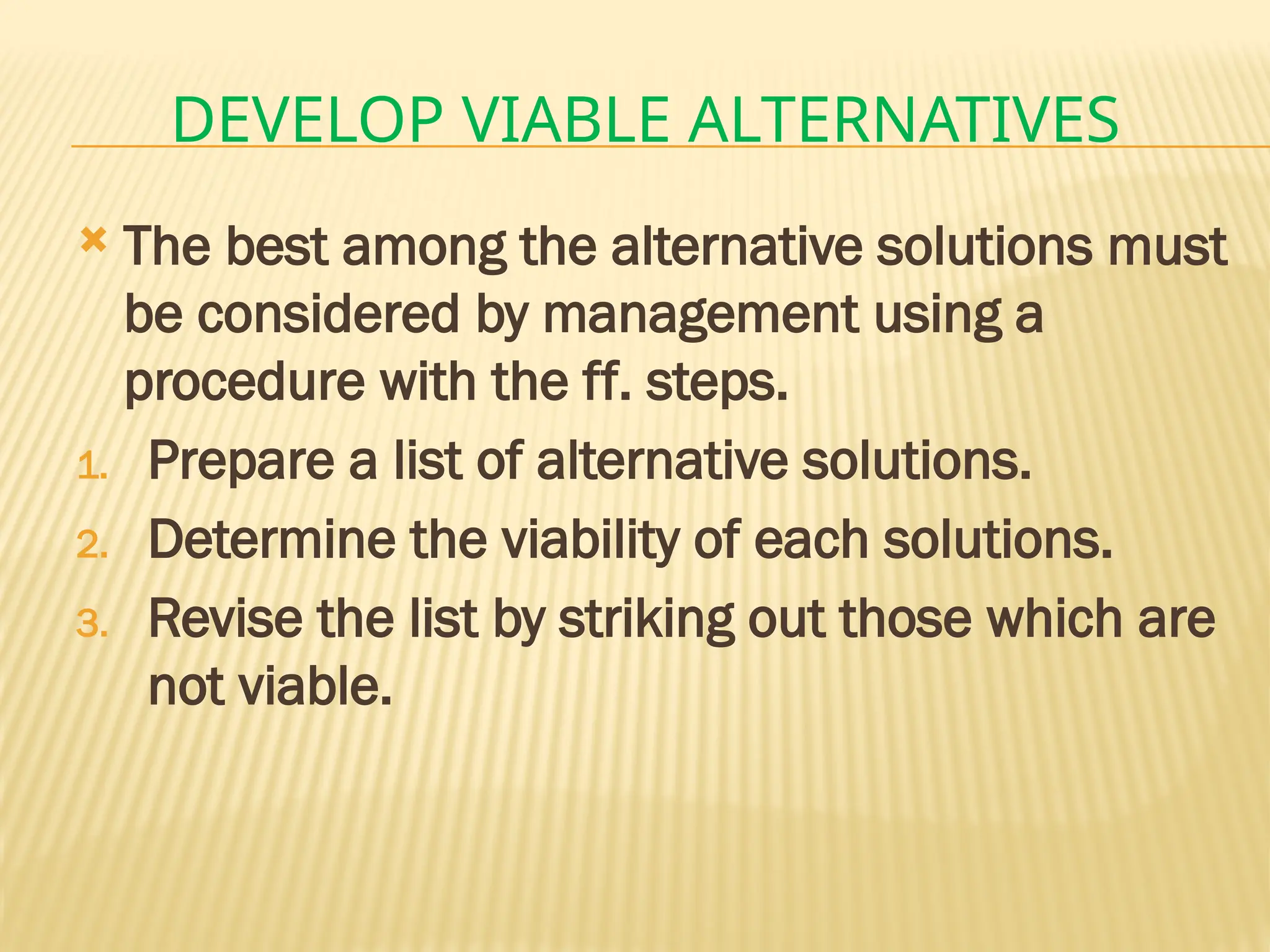
DEVELOP VIABLE ALTERNATIVES
 The best among the alternative solutions must
be considered by management using a
procedure with the ff. steps.
1. Prepare a list of alternative solutions.
2. Determine the viability of each solutions.
3. Revise the list by striking out those which are
not viable.
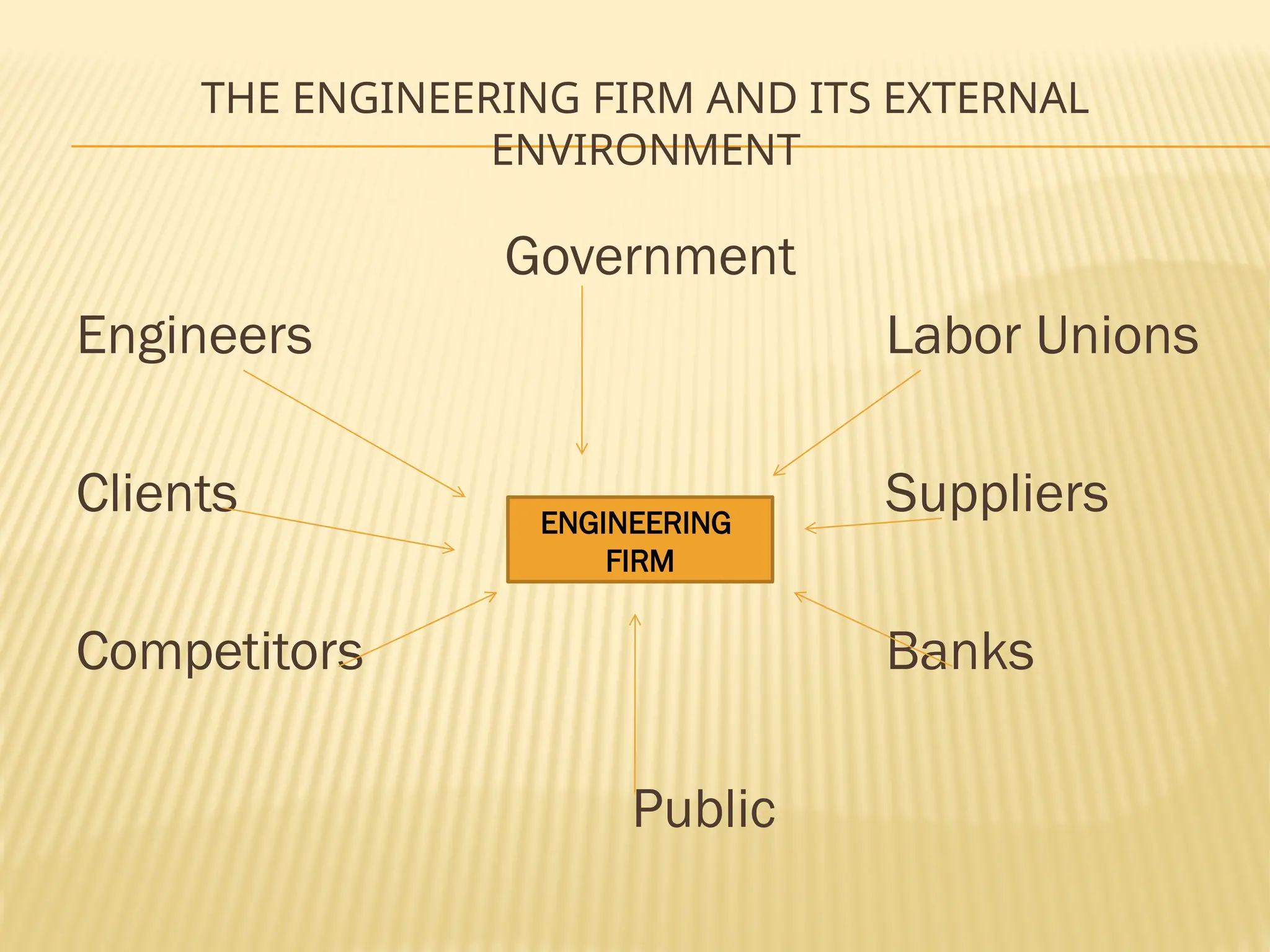
THE ENGINEERING FIRM AND ITS EXTERNAL
ENVIRONMENT
Government
Engineers Labor Unions
Clients Suppliers
Competitors Banks
Public
ENGINEERING
FIRM
 The list of solutions prepared by the engineering
manager shows alternative courses of action:
1. improve the capacity of the firm by hiring
more workers and building additional facilities.
2. Secure the services of subcontractors;
3. Buy the needed additional output from another
firm.
4. Stop serving some of the company’s customers;
5. Delay servicing some clients.
EVALUATE ALTERNATIVE
 How the alternatives will be evaluated
1. Depend on the nature of the problem
2. The objectives of the firm
3. The nature of the alternatives presented.
• Each alternative must be analyzed and evaluated
in terms of its value, cost, and risk
characteristics.*
• The value of the alternatives refers to benefit
that can be expected
MAKE A CHOICE
 Choice – Making – refers to the process of
selecting among alternatives representing
potential solutions to a problem.
* To make selection process easier, the
alternatives can be ranked from best to worst
on the basis of some factors like benefit, cost,
or risk.*
IMPLEMENT DECISION
 Implementation
– refers to carrying out the
decision so that the
objectives sought will be achieved.
- to make Implementation
effective, a plan must be
devised.
EVALUATE AND ADAPT DECISION
RESULT
 Important for the manager to use control and
feedback mechanisms to ensure results and to provide
information for future decisions.
Feedback – refers to the process which
requires checking at each stage of the process
to assure that the alternatives generated.
Control – refers to the actions made to ensure that
activities performed match the desired
activities or goals, that have been set.
APPROACHES IN SOLVING PROBLEMS
 Qualitative evaluation – refers to the evaluation
of alternatives using intuition and subjective
judgement. Stevenson states that managers
tend to use the qualitative approach when:
1. The problem is fairly simple.
2. The problem is familiar.
3. The costs involved are not great.
4. Immediate decisions are needed.
 Example of an evaluation using the qualitative
approach:
A factory operates on 3 shifts with the ff. schedule:
First shift - 6:00A.M. to 2:00P.M.
Second shift - 2:00 P.M. to 10:00 P.M.
Third shift - 10:00 P.M.to 6:00 P.M.
Because of time constraints, the manager made an
instant decision on who among the 1st
shift workers
would work overtime to man the five machines.
Each shift consist of 200 workers/200
machines. That day the operations went
smoothly until the factory manager, an
industrial engineer, was notified at 1:00 P.M.
that 5 of the workers assigned to the second
shift could not report for work because of
injuries sustained in a traffic accident while
they were on their way to the factory.
APPROACHES IN SOLVING PROBLEM
 Quatitative evaluation
- this term refers to the
evaluation of alternatives using any technique
in a group classified as rational and analytical
QUANTITATIVE MODELS FOR DECISION MAKING
 Types of quantitative techniques:
1. Inventory Models
2. Queuing Theory
3. Network models
4. Forecasting
5. Regression analysis
6. Simulation
7. Linear programming
8. Sampling Theory
9. Statistical decision theory
QUANTITATIVE MODELS FOR DECISION MAKING
 Inventory Models :
1. Economic order quantity model – this one
is used to calculate the number of items
that should be ordered at one time.
2. Production order quantity model – this is an
economic order quantity technique
applied to production orders.
QUANTITATIVE MODELS FOR DECISION MAKING
* Inventory Models
3. Back order inventory model – this is an
inventory model used for planned shortages.
4. Quantity discount model – an inventory
model used to minimize the total cost when
quantity discounts are offered by suppliers.
QUANTITATIVE MODELS FOR DECISION MAKING
 Queuing Theory – is one that describes how
to determine the number of service
units that will minimize both customers
waiting time and cost of service.
- applicable to companies
where waiting lines are a common
situation.
QUANTITATIVE MODELS FOR DECISION MAKING
 Network Models – these are models where large
complex tasks are broken into smaller segments
that can be managed independently.
The 2 most prominent network models are:
1. The Program Evaluation Review Technique – a
technique w/c enables engineer managers to
schedule, monitor, and control large and complex
projects by employing three time estimates for
each activity.
2. The Critical Path Method – this is a network
technique using only one time factor per activity
that enables engineer managers to schedule,
QUANTITATIVE MODELS FOR DECISION MAKING
 Forecasting - the collection of past and current
information to make predictions
about the future
 Regression Analysis– examines the association
between 2 or more variables. It uses
data from previous periods to
predict future events.
 Simulation – is a model constructed to
represent reality, on w/c conclusions about
real-life problems can be used.
QUANTITATIVE MODELS FOR DECISION MAKING
 Linear Programming – is a quantitative
technique that is used to produce an optimum
solution within the bounds imposed by
constraints upon the decision.
 Sampling Theory – is a quantitative technique
where samples of populations are statistically
determined to be used for a number of
processes, such as quality control and
marketing research.
QUANTITATIVE MODELS FOR DECISION MAKING
 Statistical Decision-Theory
- rational way to conceptualize,
analyze, and solve problems in situations
involving limited, or partial information about
the decision environment.

Decision-Making-Engineering-Management.pptx

  • 1.
  • 2.
     Decision Making-the process of identifying and choosing alternative courses of action in a manner appropriate to the demands of the situation. - the heart of all the management function.  Decision are at various management levels. TOP , MIDDLE and LOWER LEVELS  Decision are made at various management functions. PLANNING, ORGANIZING, DIRECTING, and CONTROLLING.
  • 3.
    THE DECISION MAKINGPROCESS  Diagnose Problem  Analyze environment  Articulate problem or opportunity  Develop viable alternatives  Evaluate alternatives  Make a choice  Implement decision  Evaluate and adapt decision results
  • 4.
    DIAGNOSE PROBLEM  Ifa manager wants to make an intelligent decision, his 1st move must be to identify the problem.  A problem exist when there is a difference between an actual situation and desired situation.
  • 5.
     Example :the actual situation of the firm is that it has not yet constructed the building  Example: the desired situation is the finished 25-storey building.  In this case, the actual situation is different from the desired situation
  • 6.
    ANALYZE THE ENVIRONMENT The objective of environmental analysis is the identification of constraints, which may be spelled out as either internal or external limitation. * Internal limitation 1. limited funds available for the purchase of equipment. 2. limited training on the part of employees. 3. ill-designed facilities.
  • 7.
    • External limitation: 1.Patents are controlled by other organization. 2. A very limited market for the company’s products and services exists. 3.Strict enforcement of local zoning regulation.
  • 8.
    COMPONENTS OF THEENVIRONMENT  Internal Environment – refers to the organizational activities within a firm that surrounds decision- making.  External Environment – refers to variables that are outside the organization and not typically within the short-run control of top management.
  • 9.
    DEVELOP VIABLE ALTERNATIVES The best among the alternative solutions must be considered by management using a procedure with the ff. steps. 1. Prepare a list of alternative solutions. 2. Determine the viability of each solutions. 3. Revise the list by striking out those which are not viable.
  • 10.
    THE ENGINEERING FIRMAND ITS EXTERNAL ENVIRONMENT Government Engineers Labor Unions Clients Suppliers Competitors Banks Public ENGINEERING FIRM
  • 11.
     The listof solutions prepared by the engineering manager shows alternative courses of action: 1. improve the capacity of the firm by hiring more workers and building additional facilities. 2. Secure the services of subcontractors; 3. Buy the needed additional output from another firm. 4. Stop serving some of the company’s customers; 5. Delay servicing some clients.
  • 12.
    EVALUATE ALTERNATIVE  Howthe alternatives will be evaluated 1. Depend on the nature of the problem 2. The objectives of the firm 3. The nature of the alternatives presented. • Each alternative must be analyzed and evaluated in terms of its value, cost, and risk characteristics.* • The value of the alternatives refers to benefit that can be expected
  • 13.
    MAKE A CHOICE Choice – Making – refers to the process of selecting among alternatives representing potential solutions to a problem. * To make selection process easier, the alternatives can be ranked from best to worst on the basis of some factors like benefit, cost, or risk.*
  • 14.
    IMPLEMENT DECISION  Implementation –refers to carrying out the decision so that the objectives sought will be achieved. - to make Implementation effective, a plan must be devised.
  • 15.
    EVALUATE AND ADAPTDECISION RESULT  Important for the manager to use control and feedback mechanisms to ensure results and to provide information for future decisions. Feedback – refers to the process which requires checking at each stage of the process to assure that the alternatives generated. Control – refers to the actions made to ensure that activities performed match the desired activities or goals, that have been set.
  • 16.
    APPROACHES IN SOLVINGPROBLEMS  Qualitative evaluation – refers to the evaluation of alternatives using intuition and subjective judgement. Stevenson states that managers tend to use the qualitative approach when: 1. The problem is fairly simple. 2. The problem is familiar. 3. The costs involved are not great. 4. Immediate decisions are needed.
  • 17.
     Example ofan evaluation using the qualitative approach: A factory operates on 3 shifts with the ff. schedule: First shift - 6:00A.M. to 2:00P.M. Second shift - 2:00 P.M. to 10:00 P.M. Third shift - 10:00 P.M.to 6:00 P.M. Because of time constraints, the manager made an instant decision on who among the 1st shift workers would work overtime to man the five machines.
  • 18.
    Each shift consistof 200 workers/200 machines. That day the operations went smoothly until the factory manager, an industrial engineer, was notified at 1:00 P.M. that 5 of the workers assigned to the second shift could not report for work because of injuries sustained in a traffic accident while they were on their way to the factory.
  • 19.
    APPROACHES IN SOLVINGPROBLEM  Quatitative evaluation - this term refers to the evaluation of alternatives using any technique in a group classified as rational and analytical
  • 20.
    QUANTITATIVE MODELS FORDECISION MAKING  Types of quantitative techniques: 1. Inventory Models 2. Queuing Theory 3. Network models 4. Forecasting 5. Regression analysis 6. Simulation 7. Linear programming 8. Sampling Theory 9. Statistical decision theory
  • 21.
    QUANTITATIVE MODELS FORDECISION MAKING  Inventory Models : 1. Economic order quantity model – this one is used to calculate the number of items that should be ordered at one time. 2. Production order quantity model – this is an economic order quantity technique applied to production orders.
  • 22.
    QUANTITATIVE MODELS FORDECISION MAKING * Inventory Models 3. Back order inventory model – this is an inventory model used for planned shortages. 4. Quantity discount model – an inventory model used to minimize the total cost when quantity discounts are offered by suppliers.
  • 23.
    QUANTITATIVE MODELS FORDECISION MAKING  Queuing Theory – is one that describes how to determine the number of service units that will minimize both customers waiting time and cost of service. - applicable to companies where waiting lines are a common situation.
  • 24.
    QUANTITATIVE MODELS FORDECISION MAKING  Network Models – these are models where large complex tasks are broken into smaller segments that can be managed independently. The 2 most prominent network models are: 1. The Program Evaluation Review Technique – a technique w/c enables engineer managers to schedule, monitor, and control large and complex projects by employing three time estimates for each activity. 2. The Critical Path Method – this is a network technique using only one time factor per activity that enables engineer managers to schedule,
  • 25.
    QUANTITATIVE MODELS FORDECISION MAKING  Forecasting - the collection of past and current information to make predictions about the future  Regression Analysis– examines the association between 2 or more variables. It uses data from previous periods to predict future events.  Simulation – is a model constructed to represent reality, on w/c conclusions about real-life problems can be used.
  • 26.
    QUANTITATIVE MODELS FORDECISION MAKING  Linear Programming – is a quantitative technique that is used to produce an optimum solution within the bounds imposed by constraints upon the decision.  Sampling Theory – is a quantitative technique where samples of populations are statistically determined to be used for a number of processes, such as quality control and marketing research.
  • 27.
    QUANTITATIVE MODELS FORDECISION MAKING  Statistical Decision-Theory - rational way to conceptualize, analyze, and solve problems in situations involving limited, or partial information about the decision environment.