The Smart Metering System
Equipment and communications within energy
consumers’ homes
The smart metering equipment installed by energy
suppliers will normally consist of a smart electricity meter,
a smart gas meter, and a communications hub (which will
typically sit on top of the electricity meter). Energy
suppliers will offer all domestic customers an In-home
Display at no upfront cost as part of the installation
process. These devices are explained below.
 Smart electricity and gas meters
Existing electricity and gas meters in consumers’
homes will be replaced with smart versions. Unlike
traditional meters, they automatically send meter
readings to energy suppliers, and support new
functions including enabling smart appliances and time
of use tariffs.
This leaflet explains how the smart metering system will work from 2016, when a new
shared smart metering national infrastructure will be in place. Some energy suppliers are
already offering smart meters using their own systems and technologies.
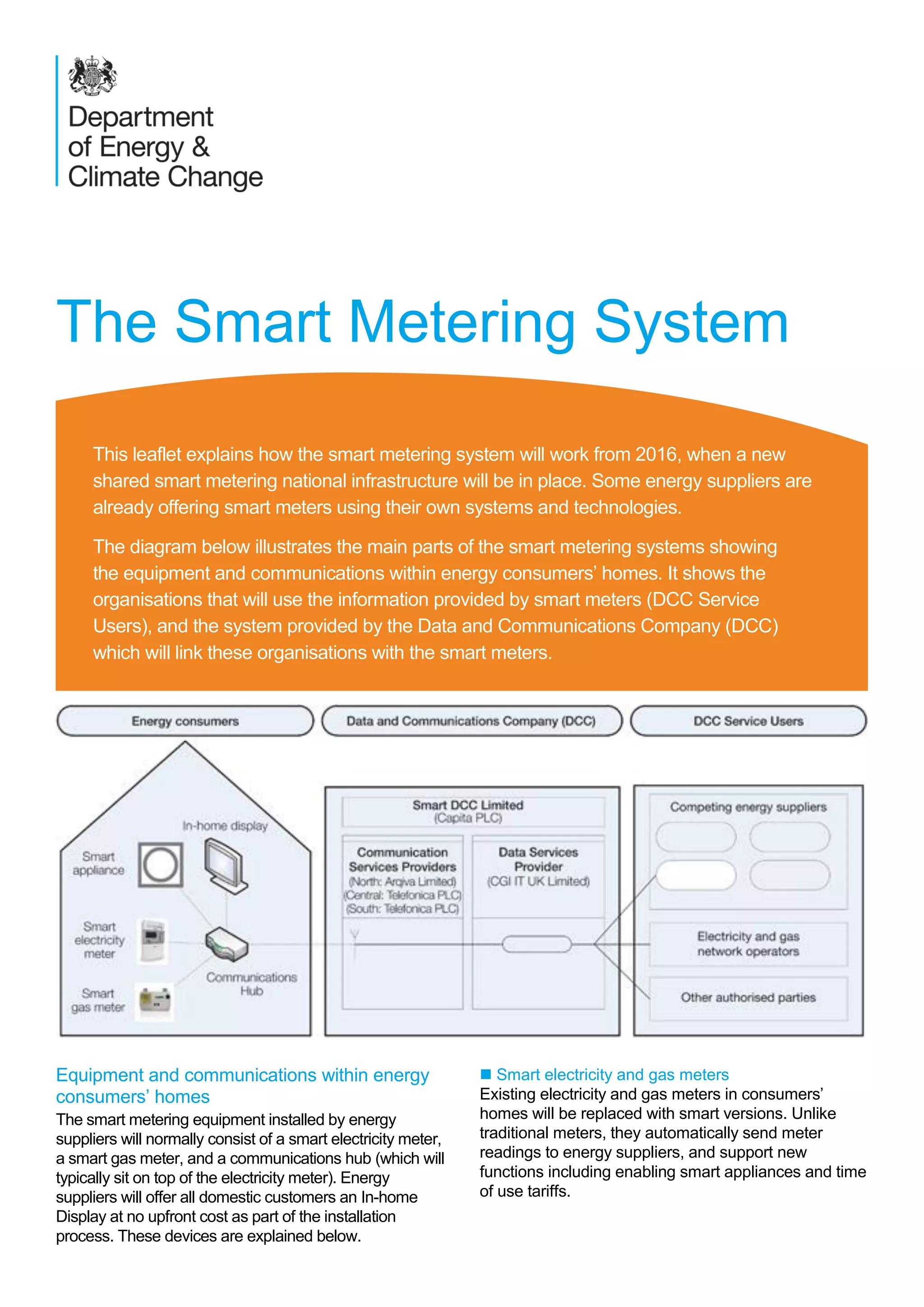
The diagram below illustrates the main parts of the smart metering systems showing
the equipment and communications within energy consumers’ homes. It shows the
organisations that will use the information provided by smart meters (DCC Service
Users), and the system provided by the Data and Communications Company (DCC)
which will link these organisations with the smart meters.
 In-home Display
The In-home display will allow consumers to see what
energy they are using and how much it is costing in
near real time. The display can also show information
about the amount of energy used in the past day,
week, month and year. This will help people to
understand and control their energy consumption.
 Communications hub
The communications hub has two functions. Firstly it
allows the smart meters and In-home Display (and
other devices which consumers may wish to use) to
communicate with each other over a Home Area
Network, in a similar way to wireless computer
networks (Wi-Fi). Secondly it provides a link to the
Wide Area Network which allows information to be
sent to and from meters by energy suppliers, energy
network operators and energy service companies.
Organisations that will use the information
provided by smart meters (DCC Service
Users)
Consumers will have a choice about how their energy
consumption data is used, apart from where it is
required for billing and other activities that energy
companies are legally required to undertake. Other
organisations (for example, switching sites) will wish
to access consumer data, but will only be able to do
so if the customer agrees.
 Energy Suppliers
A consumer’s energy supplier will communicate
remotely with smart metering equipment to take meter
readings, including on change of supplier or change of
tenancy, as well as to update configuration and pricing
information.
 Energy Networks
The organisations that operate the energy network
infrastructure will be able to access data on an
aggregated basis, to help them understand the loads
on their network at the local level and to respond to
loss of supply issues. They will have better
information for managing and planning investment
activities which will help the move towards ‘smart
grids’ that allow the monitoring and active control of
generation and demand in near real-time.
 Organisations offering services
Consumers can choose to allow other organisations
to have access to the data from their smart meter.
For example, switching sites could use accurate
information on the amount of energy used to advise
consumers on the best tariff and energy supplier.
As the rollout proceeds, an increasing range of
devices should become available to help consumers
manage their energy usage, including smart
appliances which can operate automatically
when electricity is cheaper.
Smart meter communications outside the
home: the DCC and the Wide Area Network
The DCC will put in place communications across
Great Britain to send and receive information from
smart meters to energy suppliers, energy network
operators and energy service companies. The DCC
will be operated by Capita PLC under a licence
regulated by Ofgem.
The DCC will manage three main subcontractors.
CGI IT UK Limited is the Data Services Provider,
which controls the movement of messages to and
from smart meters. Arqiva Limited and Telefónica UK
Limited are the Communications Service Providers
who will put in place the Wide Area Network.
Arqiva will provide the network for Scotland and the
north of England using long-range radio
communications. Such infrastructure and technology
is already used for other important national
communications networks, such as those for digital
television and emergency services.
Telefónica’s network will cover the rest of England
and Wales using cellular radio communications
(technology typically used in mobile phone systems)
plus “mesh” radio technology to supplement
connectivity in a small number of hard to reach
locations (such mesh systems have been used in
smart meter installations in Sweden, Norway and
Finland).
Further information
Further information about smart meters can be found
on the Government’s website at https://www.gov.uk/
smart-meters-how-they-work.
Leaflets in this series
Smart Metering Implementation Programme:
information leaflet: https://www.gov.uk/government/
publications/smart-metering-implementation-
programme-information-leaflet
Smart Metering Implementation Programme non-
domestic leaflet: https://www.gov.uk/government/
publications/smart-metering-non-domestic-leaflet
URN14D/154

Decc smart metering-system_leaflet

  • 1.
    The Smart MeteringSystem Equipment and communications within energy consumers’ homes The smart metering equipment installed by energy suppliers will normally consist of a smart electricity meter, a smart gas meter, and a communications hub (which will typically sit on top of the electricity meter). Energy suppliers will offer all domestic customers an In-home Display at no upfront cost as part of the installation process. These devices are explained below.  Smart electricity and gas meters Existing electricity and gas meters in consumers’ homes will be replaced with smart versions. Unlike traditional meters, they automatically send meter readings to energy suppliers, and support new functions including enabling smart appliances and time of use tariffs. This leaflet explains how the smart metering system will work from 2016, when a new shared smart metering national infrastructure will be in place. Some energy suppliers are already offering smart meters using their own systems and technologies. The diagram below illustrates the main parts of the smart metering systems showing the equipment and communications within energy consumers’ homes. It shows the organisations that will use the information provided by smart meters (DCC Service Users), and the system provided by the Data and Communications Company (DCC) which will link these organisations with the smart meters.
  • 2.
     In-home Display TheIn-home display will allow consumers to see what energy they are using and how much it is costing in near real time. The display can also show information about the amount of energy used in the past day, week, month and year. This will help people to understand and control their energy consumption.  Communications hub The communications hub has two functions. Firstly it allows the smart meters and In-home Display (and other devices which consumers may wish to use) to communicate with each other over a Home Area Network, in a similar way to wireless computer networks (Wi-Fi). Secondly it provides a link to the Wide Area Network which allows information to be sent to and from meters by energy suppliers, energy network operators and energy service companies. Organisations that will use the information provided by smart meters (DCC Service Users) Consumers will have a choice about how their energy consumption data is used, apart from where it is required for billing and other activities that energy companies are legally required to undertake. Other organisations (for example, switching sites) will wish to access consumer data, but will only be able to do so if the customer agrees.  Energy Suppliers A consumer’s energy supplier will communicate remotely with smart metering equipment to take meter readings, including on change of supplier or change of tenancy, as well as to update configuration and pricing information.  Energy Networks The organisations that operate the energy network infrastructure will be able to access data on an aggregated basis, to help them understand the loads on their network at the local level and to respond to loss of supply issues. They will have better information for managing and planning investment activities which will help the move towards ‘smart grids’ that allow the monitoring and active control of generation and demand in near real-time.  Organisations offering services Consumers can choose to allow other organisations to have access to the data from their smart meter. For example, switching sites could use accurate information on the amount of energy used to advise consumers on the best tariff and energy supplier. As the rollout proceeds, an increasing range of devices should become available to help consumers manage their energy usage, including smart appliances which can operate automatically when electricity is cheaper. Smart meter communications outside the home: the DCC and the Wide Area Network The DCC will put in place communications across Great Britain to send and receive information from smart meters to energy suppliers, energy network operators and energy service companies. The DCC will be operated by Capita PLC under a licence regulated by Ofgem. The DCC will manage three main subcontractors. CGI IT UK Limited is the Data Services Provider, which controls the movement of messages to and from smart meters. Arqiva Limited and Telefónica UK Limited are the Communications Service Providers who will put in place the Wide Area Network. Arqiva will provide the network for Scotland and the north of England using long-range radio communications. Such infrastructure and technology is already used for other important national communications networks, such as those for digital television and emergency services. Telefónica’s network will cover the rest of England and Wales using cellular radio communications (technology typically used in mobile phone systems) plus “mesh” radio technology to supplement connectivity in a small number of hard to reach locations (such mesh systems have been used in smart meter installations in Sweden, Norway and Finland). Further information Further information about smart meters can be found on the Government’s website at https://www.gov.uk/ smart-meters-how-they-work. Leaflets in this series Smart Metering Implementation Programme: information leaflet: https://www.gov.uk/government/ publications/smart-metering-implementation- programme-information-leaflet Smart Metering Implementation Programme non- domestic leaflet: https://www.gov.uk/government/ publications/smart-metering-non-domestic-leaflet URN14D/154