1
How smarter gas meters can
add more customer value
Gerrit Rentier
Senior Business Process Analyst
DELTA Energy & Multimedia
Middelburg, the Netherlands
July 4th, 2014
2
Few EU member states roll out smart gas meters
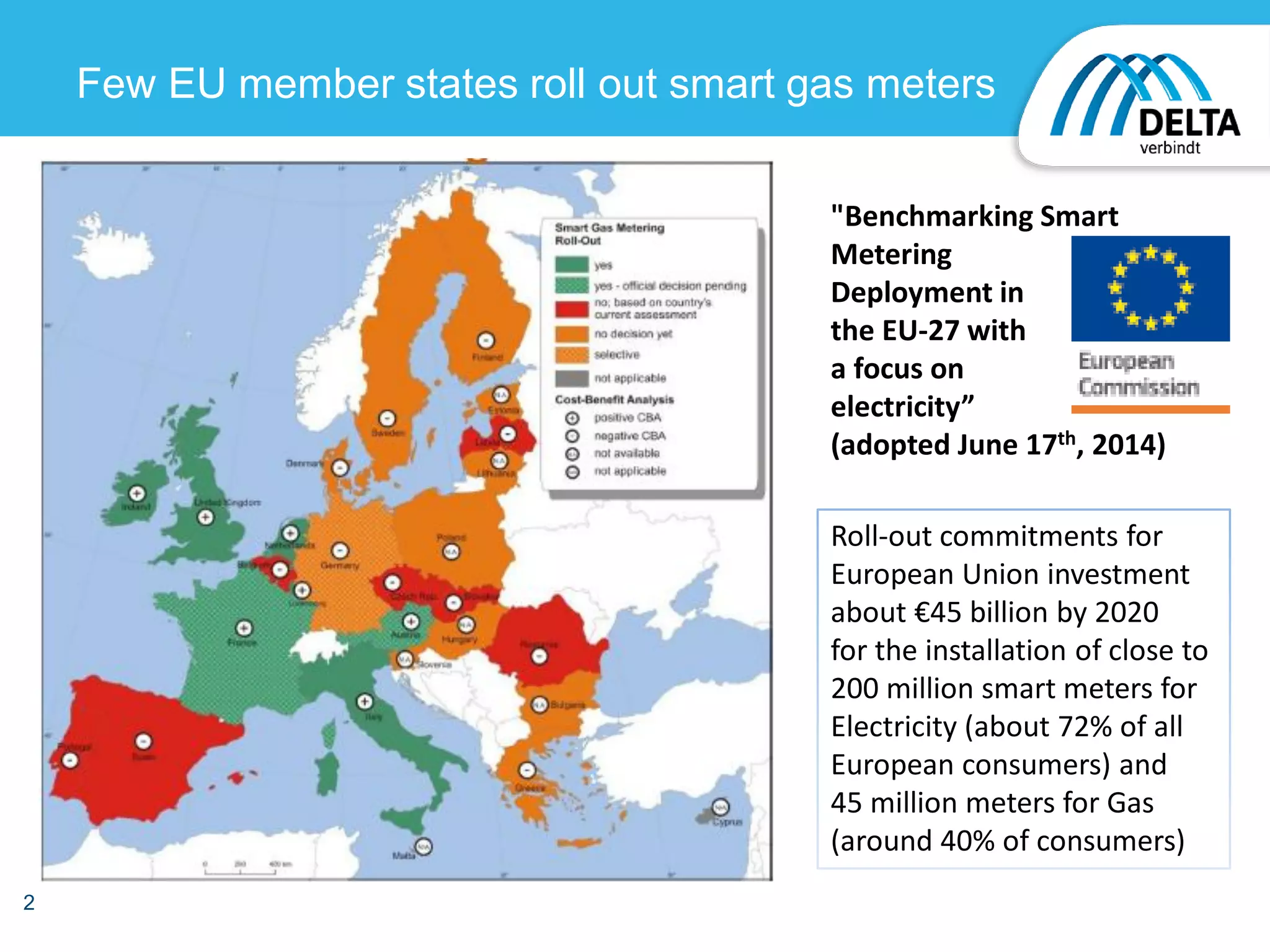
Roll-out commitments for
European Union investment
about €45 billion by 2020
for the installation of close to
200 million smart meters for
Electricity (about 72% of all
European consumers) and
45 million meters for Gas
(around 40% of consumers)
"Benchmarking Smart
Metering
Deployment in
the EU-27 with
a focus on
electricity”
(adopted June 17th, 2014)
3
Less attention to smart gas meters; but why?
However, Smart Meter Program Key Success Factor Number 1 (© Accenture) is
“Design and deploy with the consumer at the heart of the solution…”
and the biggest impact on the energy bill of many consumers is their gas use..
 shouldn’t we pay full attention to how we design & roll out Smart Gas Meters?
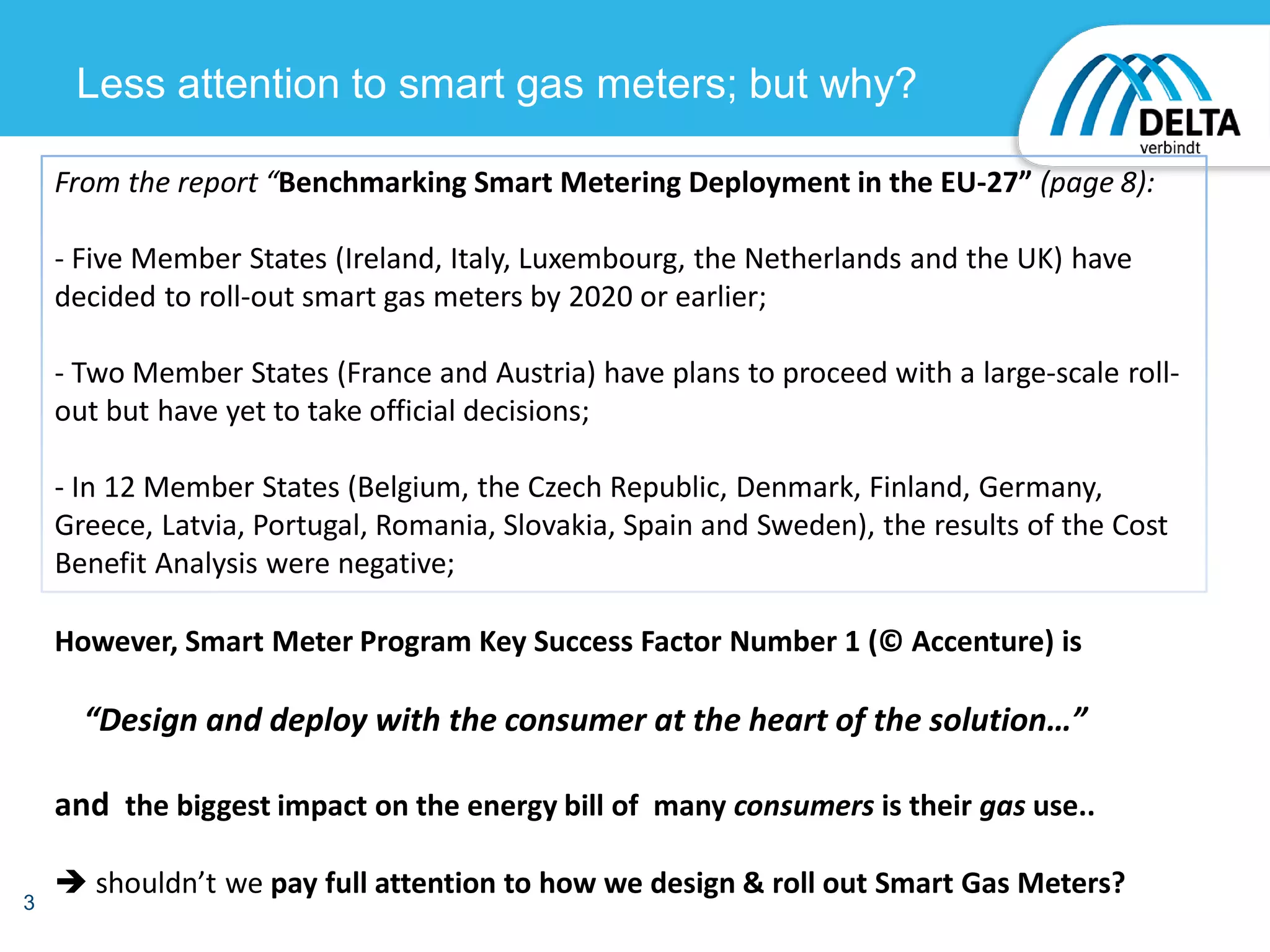
From the report “Benchmarking Smart Metering Deployment in the EU-27” (page 8):
- Five Member States (Ireland, Italy, Luxembourg, the Netherlands and the UK) have
decided to roll-out smart gas meters by 2020 or earlier;
- Two Member States (France and Austria) have plans to proceed with a large-scale roll-
out but have yet to take official decisions;
- In 12 Member States (Belgium, the Czech Republic, Denmark, Finland, Germany,
Greece, Latvia, Portugal, Romania, Slovakia, Spain and Sweden), the results of the Cost
Benefit Analysis were negative;
4
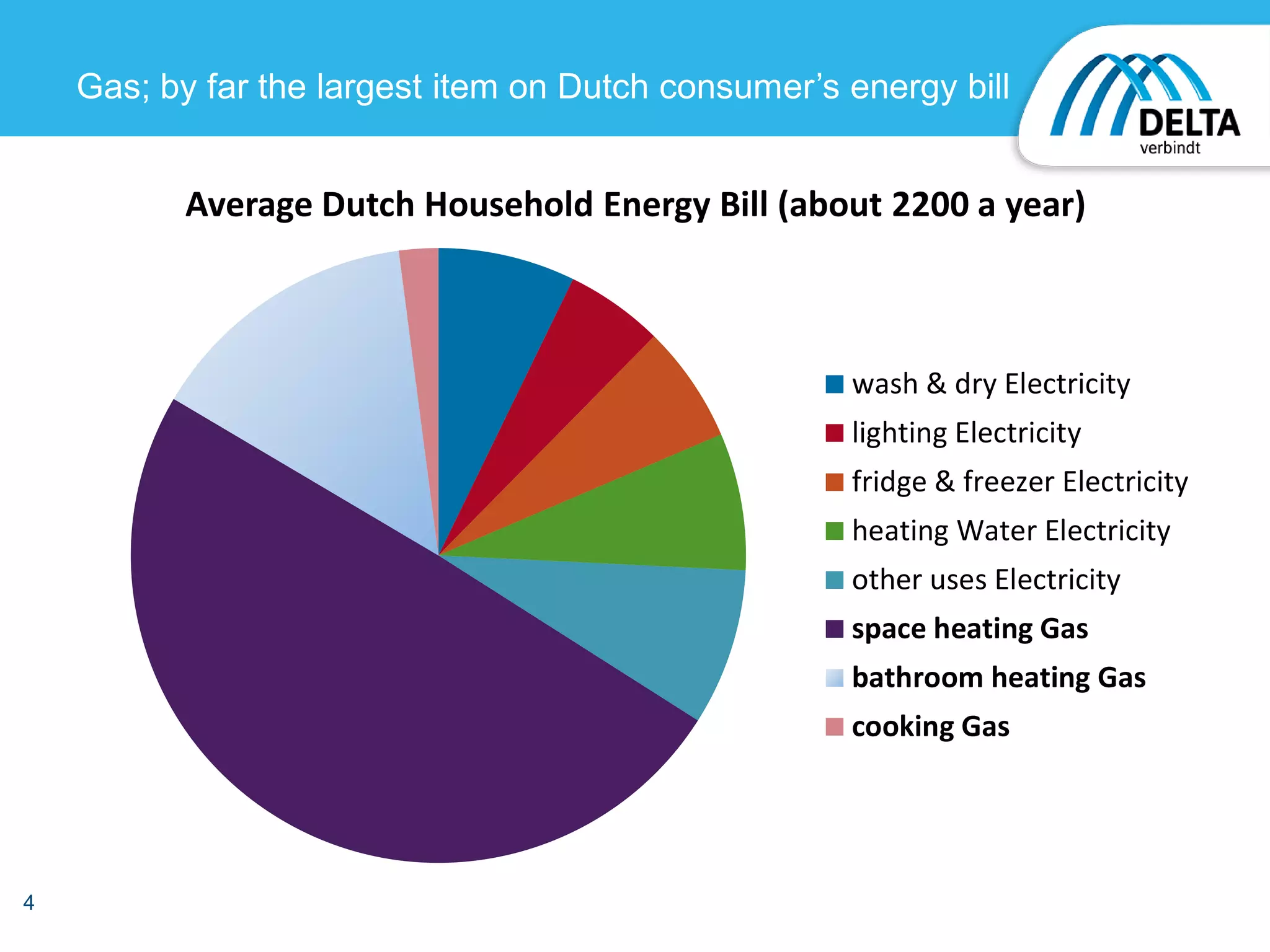
Gas; by far the largest item on Dutch consumer’s energy bill
Average Dutch Household Energy Bill (about 2200 a year)
wash & dry Electricity
lighting Electricity
fridge & freezer Electricity
heating Water Electricity
other uses Electricity
space heating Gas
bathroom heating Gas
cooking Gas
5
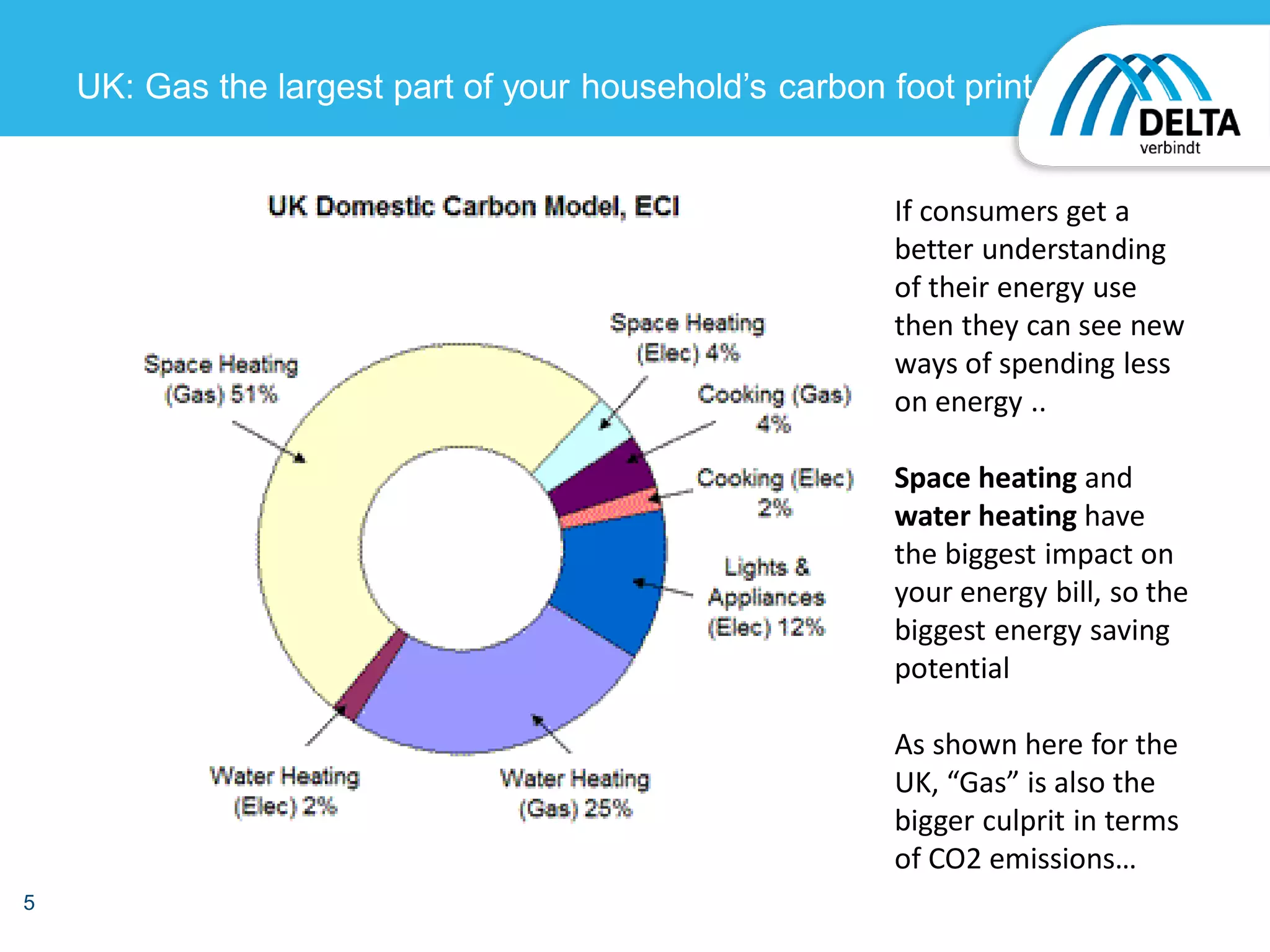
UK: Gas the largest part of your household’s carbon foot print
If consumers get a
better understanding
of their energy use
then they can see new
ways of spending less
on energy ..
Space heating and
water heating have
the biggest impact on
your energy bill, so the
biggest energy saving
potential
As shown here for the
UK, “Gas” is also the
bigger culprit in terms
of CO2 emissions…
6
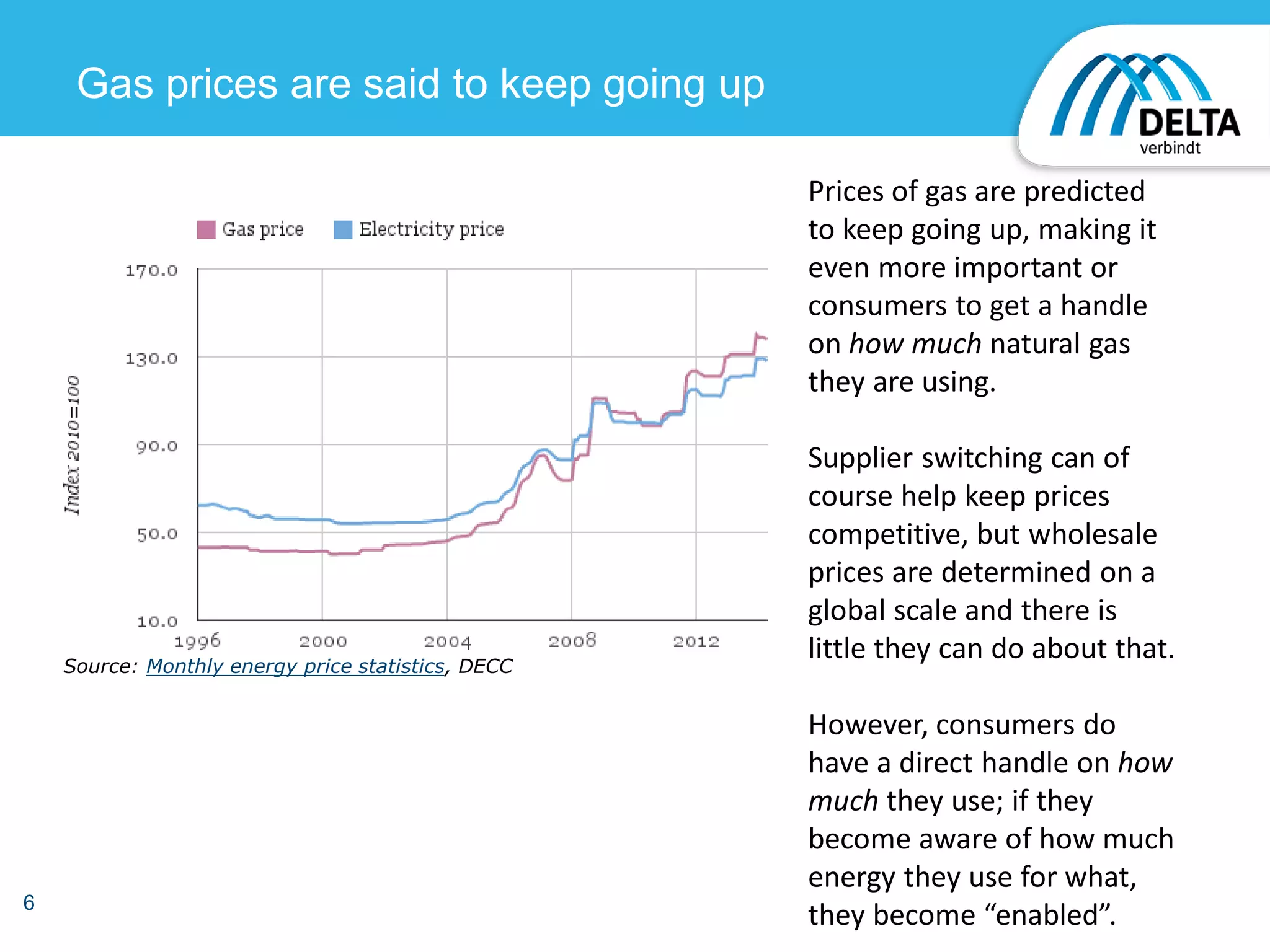
Gas prices are said to keep going up
Source: Monthly energy price statistics, DECC
Prices of gas are predicted
to keep going up, making it
even more important or
consumers to get a handle
on how much natural gas
they are using.
Supplier switching can of
course help keep prices
competitive, but wholesale
prices are determined on a
global scale and there is
little they can do about that.
However, consumers do
have a direct handle on how
much they use; if they
become aware of how much
energy they use for what,
they become “enabled”.
7
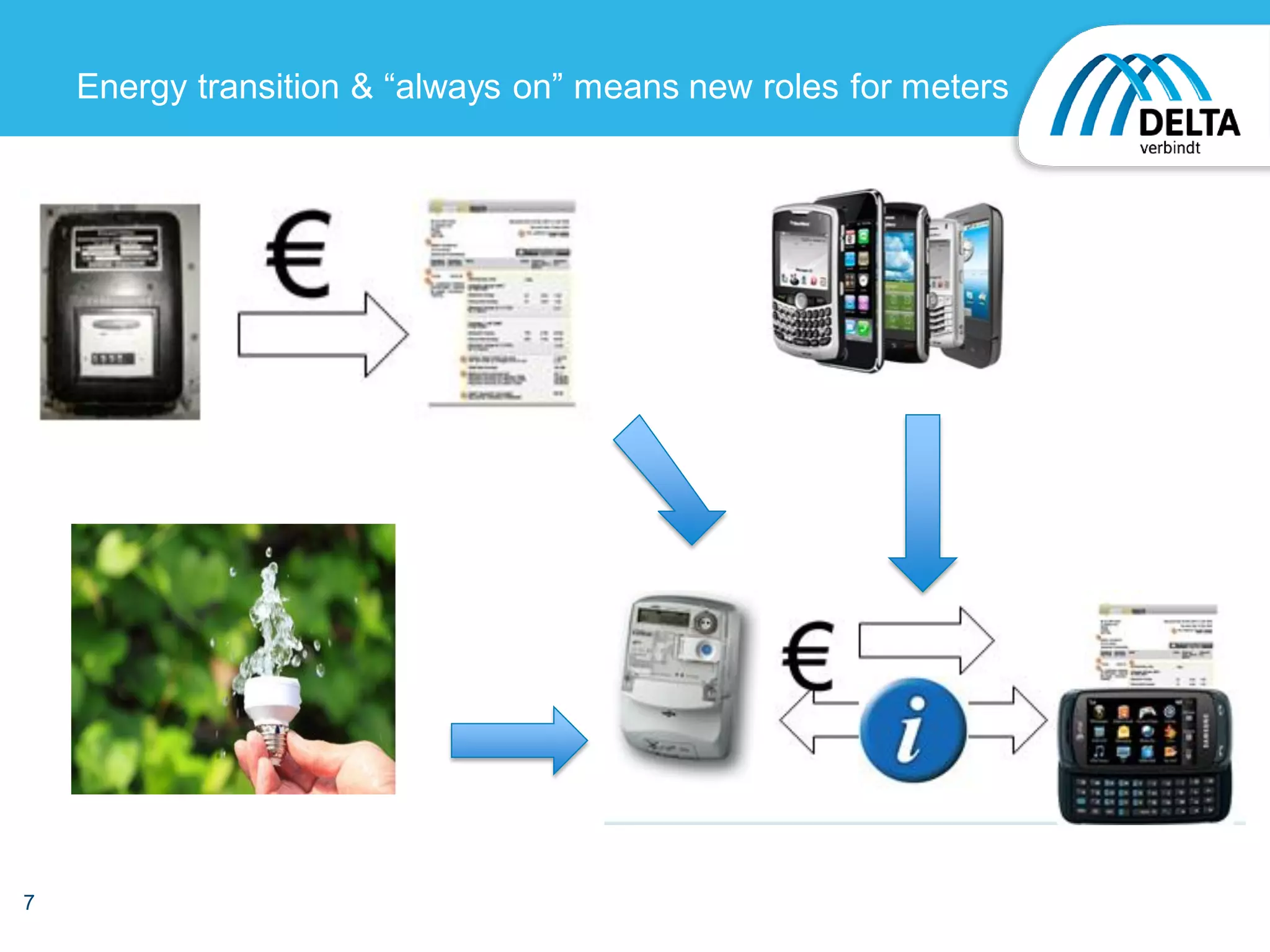
Energy transition & “always on” means new roles for meters
8
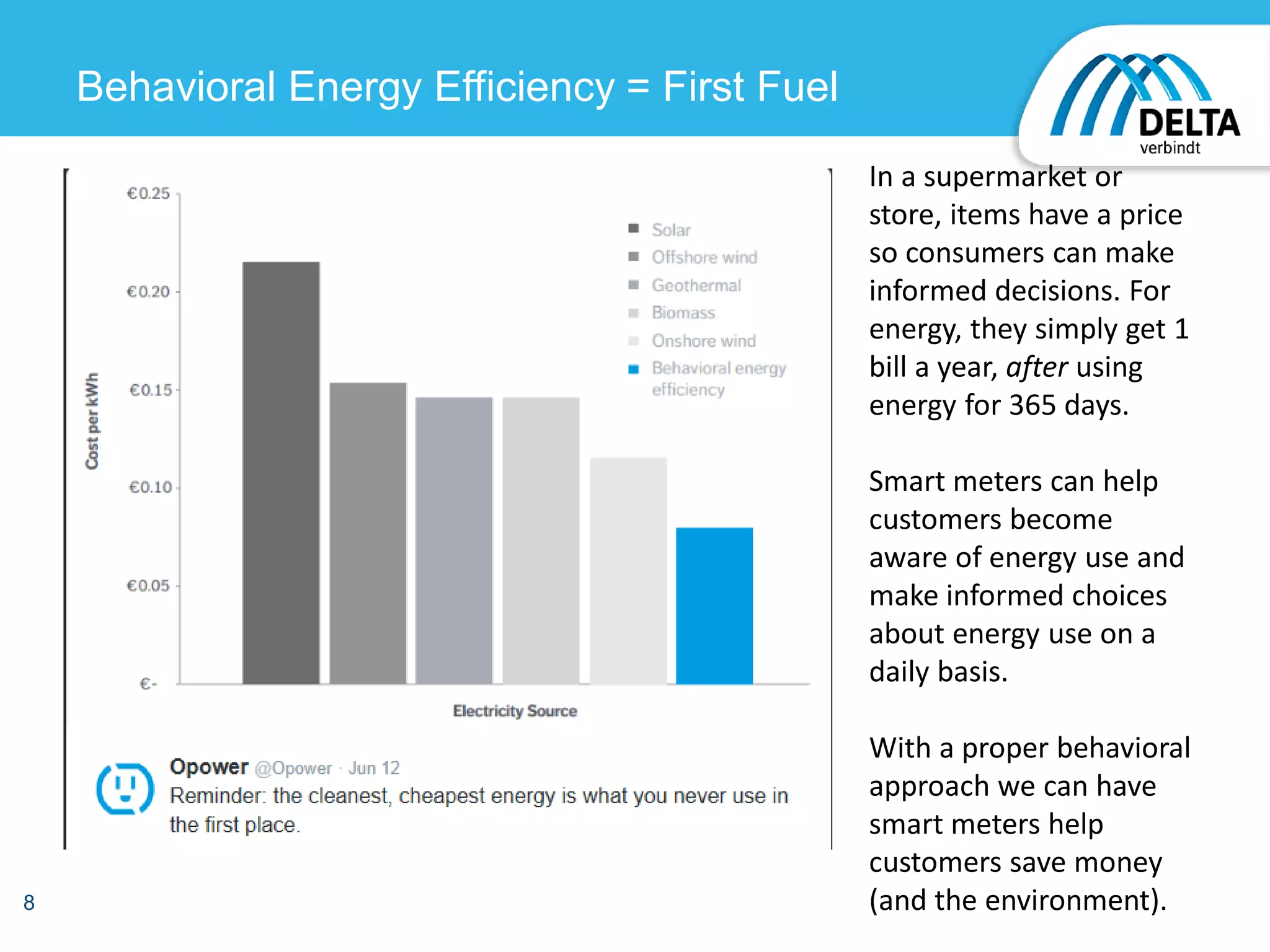
Behavioral Energy Efficiency = First Fuel
In a supermarket or
store, items have a price
so consumers can make
informed decisions. For
energy, they simply get 1
bill a year, after using
energy for 365 days.
Smart meters can help
customers become
aware of energy use and
make informed choices
about energy use on a
daily basis.
With a proper behavioral
approach we can have
smart meters help
customers save money
(and the environment).
9
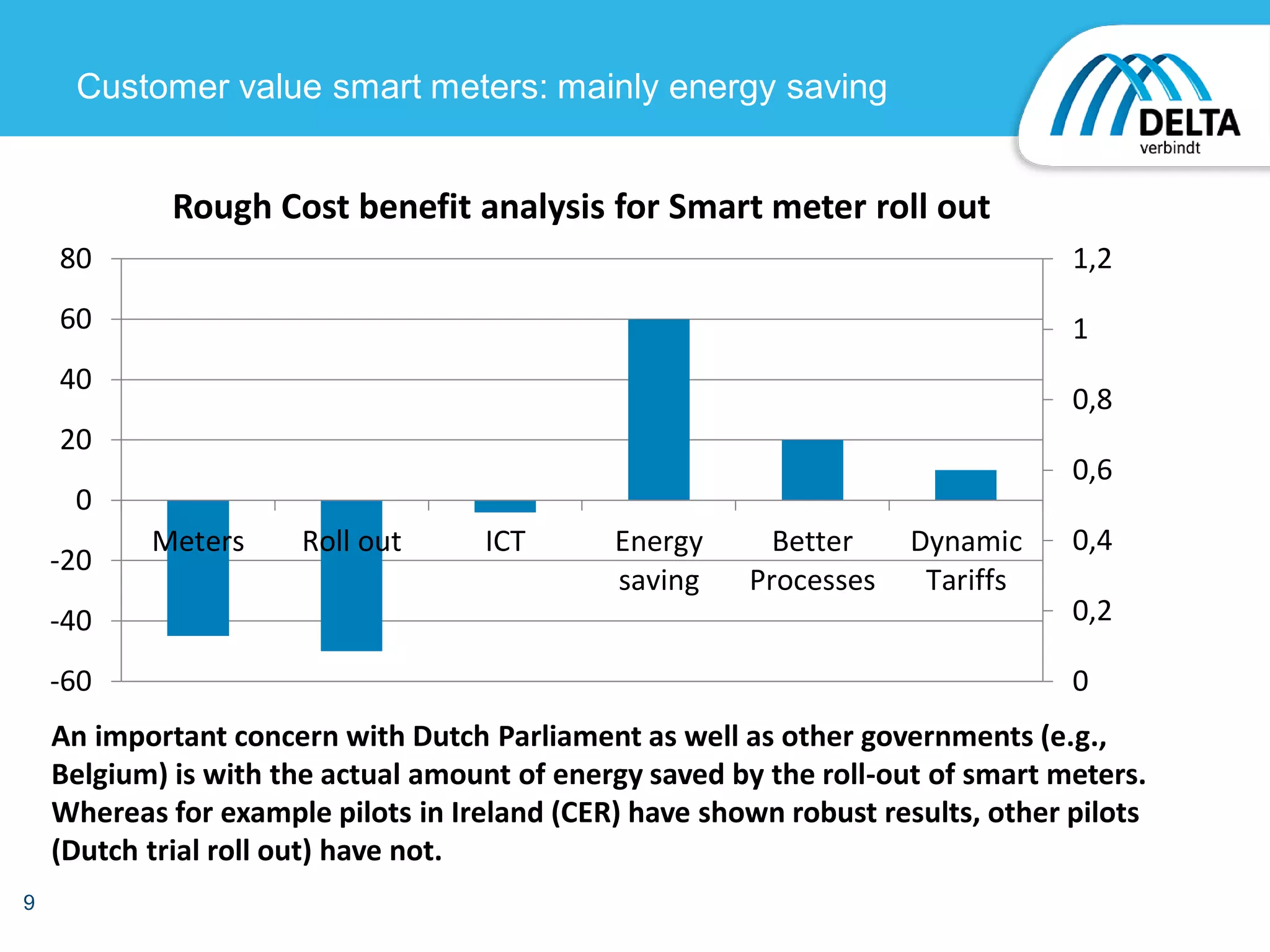
Customer value smart meters: mainly energy saving
0
0,2
0,4
0,6
0,8
1
1,2
-60
-40
-20
0
20
40
60
80
Meters Roll out ICT Energy
saving
Better
Processes
Dynamic
Tariffs
Rough Cost benefit analysis for Smart meter roll out
An important concern with Dutch Parliament as well as other governments (e.g.,
Belgium) is with the actual amount of energy saved by the roll-out of smart meters.
Whereas for example pilots in Ireland (CER) have shown robust results, other pilots
(Dutch trial roll out) have not.
10
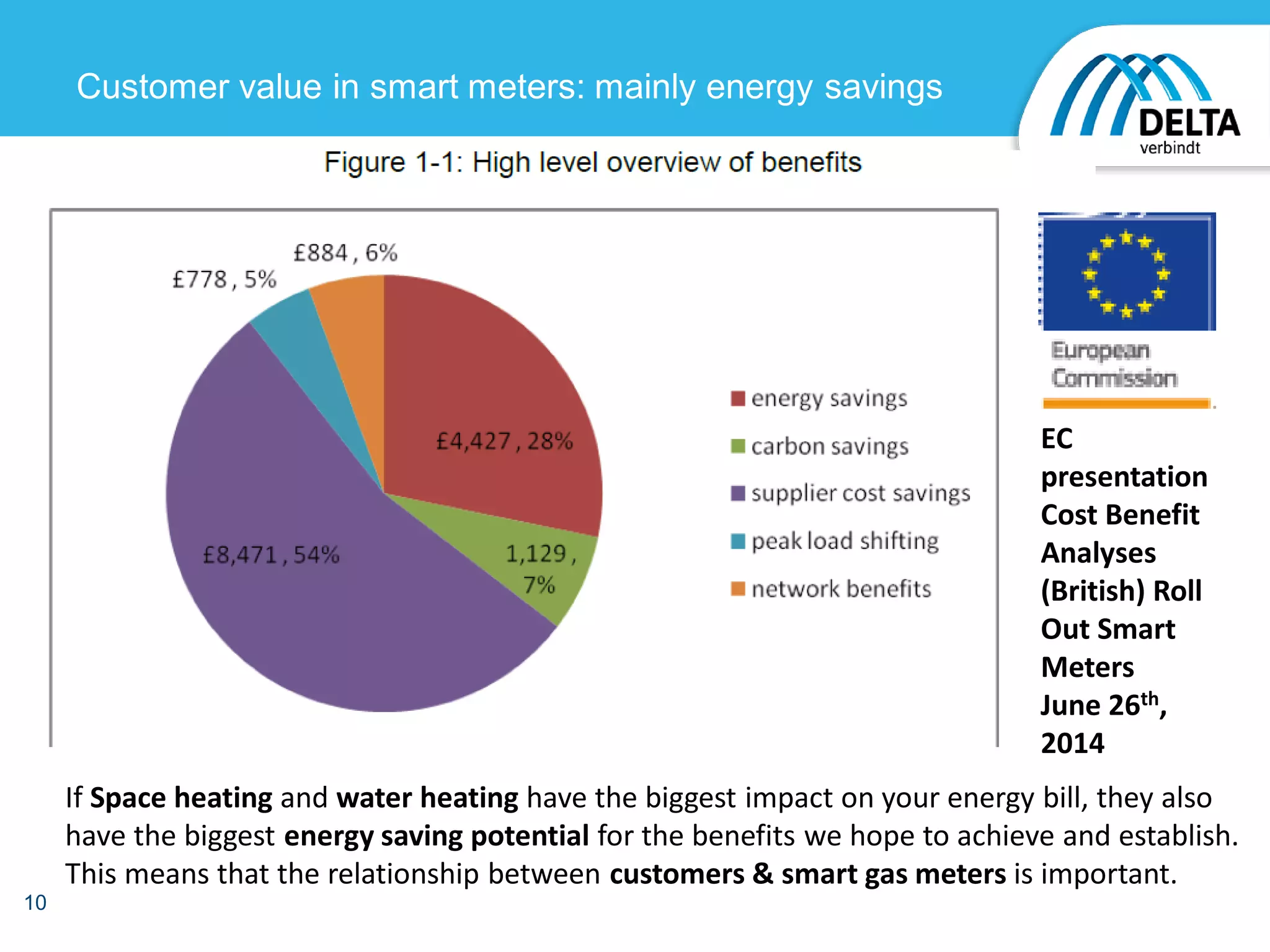
Customer value in smart meters: mainly energy savings
If Space heating and water heating have the biggest impact on your energy bill, they also
have the biggest energy saving potential for the benefits we hope to achieve and establish.
This means that the relationship between customers & smart gas meters is important.
EC
presentation
Cost Benefit
Analyses
(British) Roll
Out Smart
Meters
June 26th,
2014
11
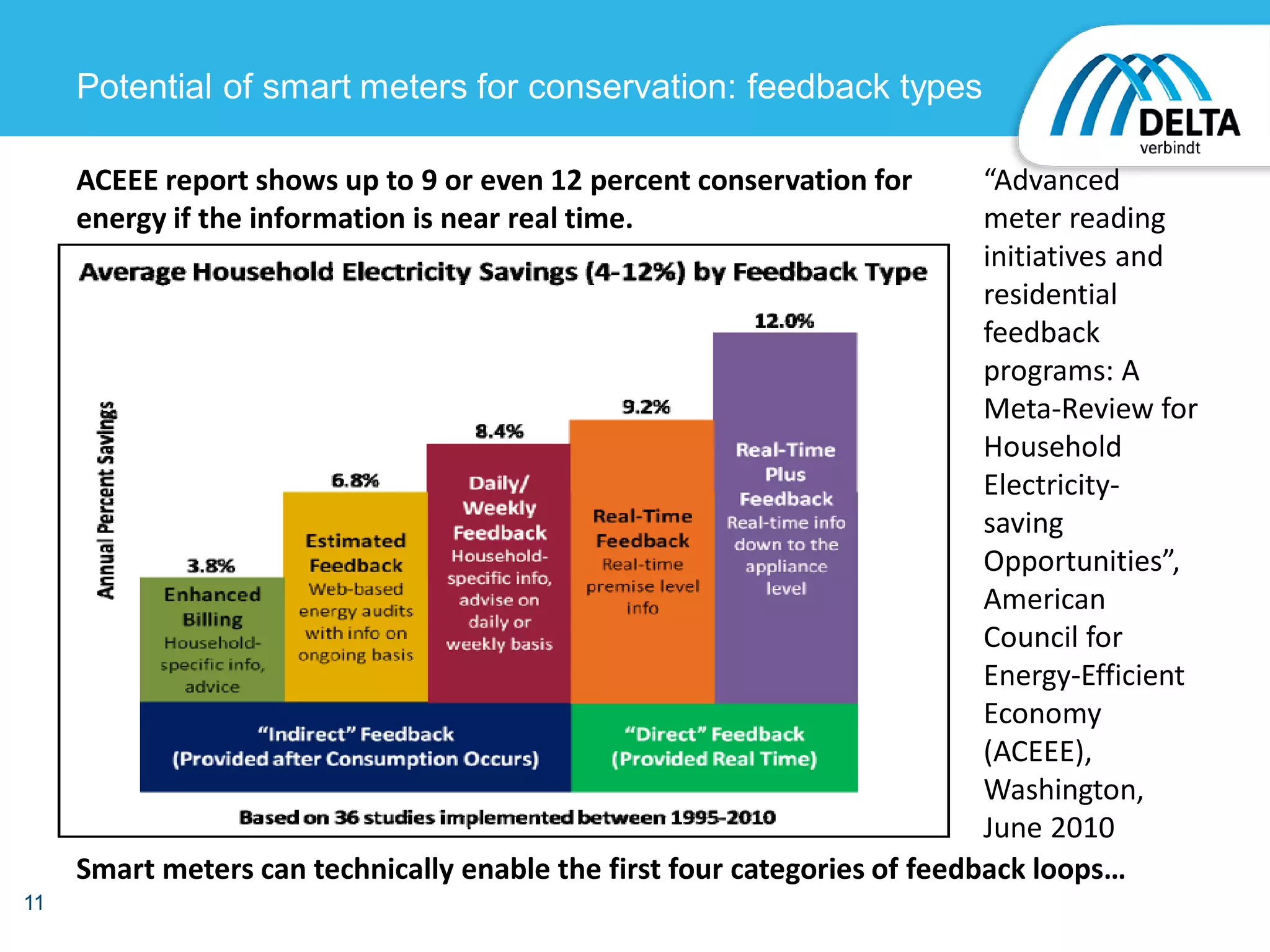
Potential of smart meters for conservation: feedback types
ACEEE report shows up to 9 or even 12 percent conservation for
energy if the information is near real time.
ACEEE report shows up to 9 or even 12 percent conservation for
energy if the information is near real time…
Smart meters can technically enable the first four categories of feedback loops…
“Advanced
meter reading
initiatives and
residential
feedback
programs: A
Meta-Review for
Household
Electricity-
saving
Opportunities”,
American
Council for
Energy-Efficient
Economy
(ACEEE),
Washington,
June 2010
12
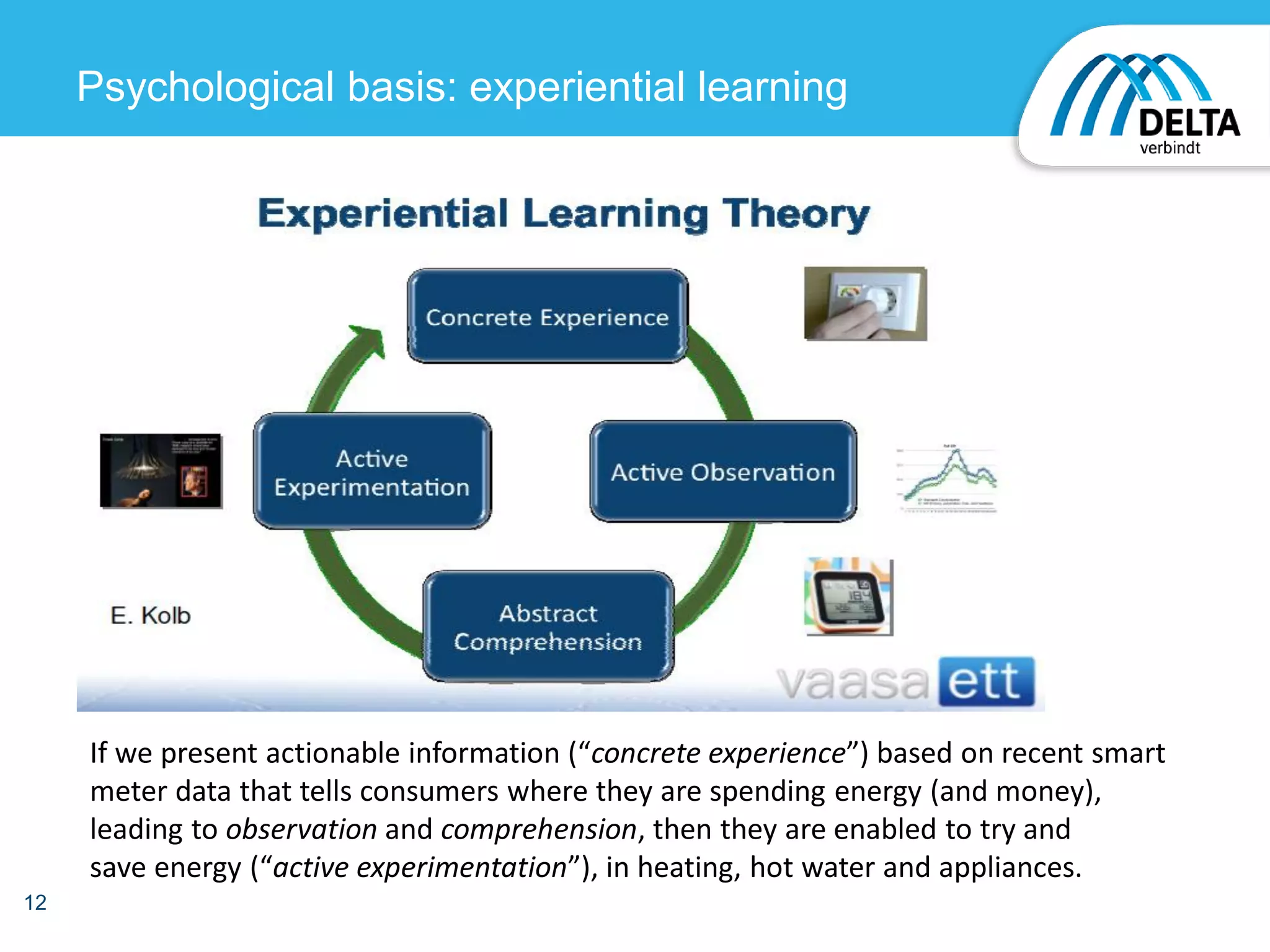
Psychological basis: experiential learning
If we present actionable information (“concrete experience”) based on recent smart
meter data that tells consumers where they are spending energy (and money),
leading to observation and comprehension, then they are enabled to try and
save energy (“active experimentation”), in heating, hot water and appliances.
Current version Dutch Smart Meter Requirements
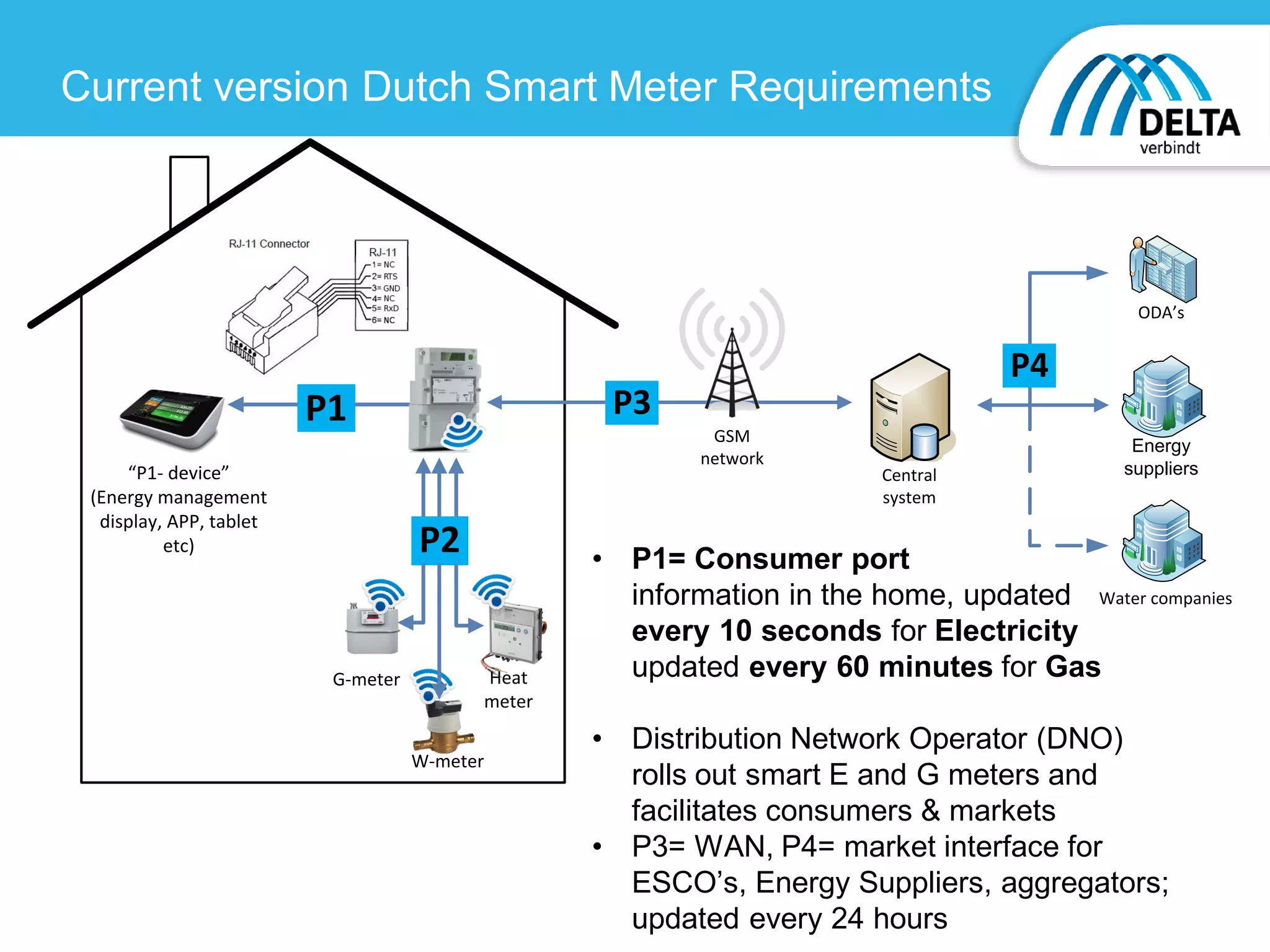
• P1= Consumer port
information in the home, updated
every 10 seconds for Electricity
updated every 60 minutes for Gas
• Distribution Network Operator (DNO)
rolls out smart E and G meters and
facilitates consumers & markets
• P3= WAN, P4= market interface for
ESCO’s, Energy Suppliers, aggregators;
updated every 24 hours
“P1- device”
(Energy management
display, APP, tablet
etc)
P1
G-meter
W-meter
Heat
meter
P2
Central
system
GSM
network
P3
P2
Energy
suppliers
ODA’s
Water companies
P4
(A)
Tradi-
tional
meters
Regulatory
(Energy
Efficiency
Directive
or EED)
(B)
Smart
meters
Regulatory
(EED )
home
reports
(C)
Smart
meter E
remote
(WAN)
(D)
Smart meter E
with device in
the home
(HAN)
(E) “Niche”
Smart meter E,
with device in the
home and near
real time data
from slave meters
(DSMR 5: 2016,..)
Home Area Network
(F)
Smart
thermostats/
smart homes
HAN (WAN)
Remote
control
(Nest, GEO)
E Bill
(Year)
Monthly
(bi-monthly)
24 hrs
(web
portal)
10 seconds 1 second
(DSMR 5: 2016)
Real time
G Bill
(Year)
Monthly
(bi-monthly)
24 hrs
(web
portal)
60 minutes
(DSMR 2, 4)
5 minutes
(DSMR 5: 2016)
Real time
€ Free Free Free or
Cheap
Medium price
(+/- 100, 150)
Plain read only P1
customer devices
Pricey Device
+/- 250/350
14
Frequency of customer info; from meters to smart homes
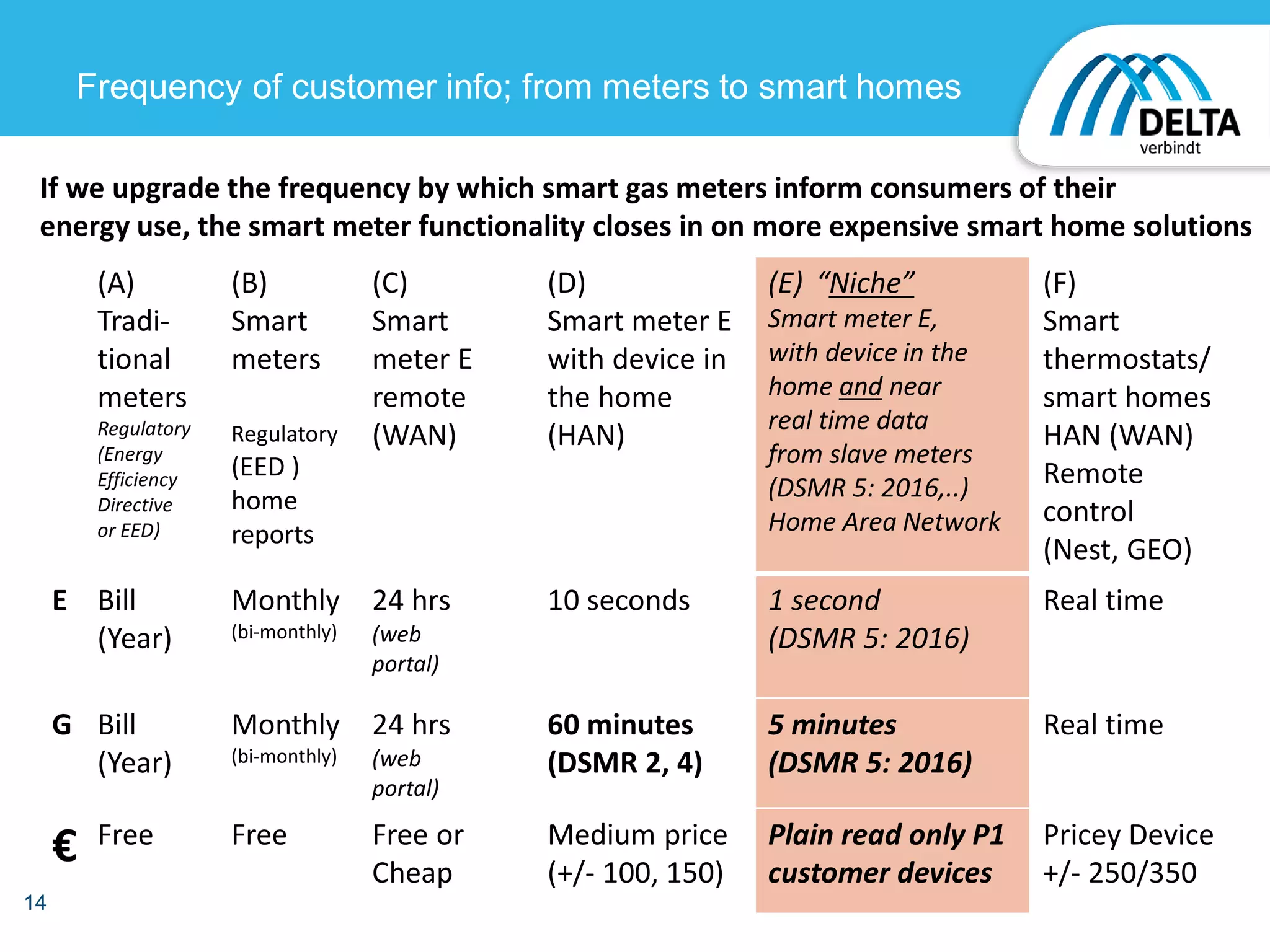
If we upgrade the frequency by which smart gas meters inform consumers of their
energy use, the smart meter functionality closes in on more expensive smart home solutions
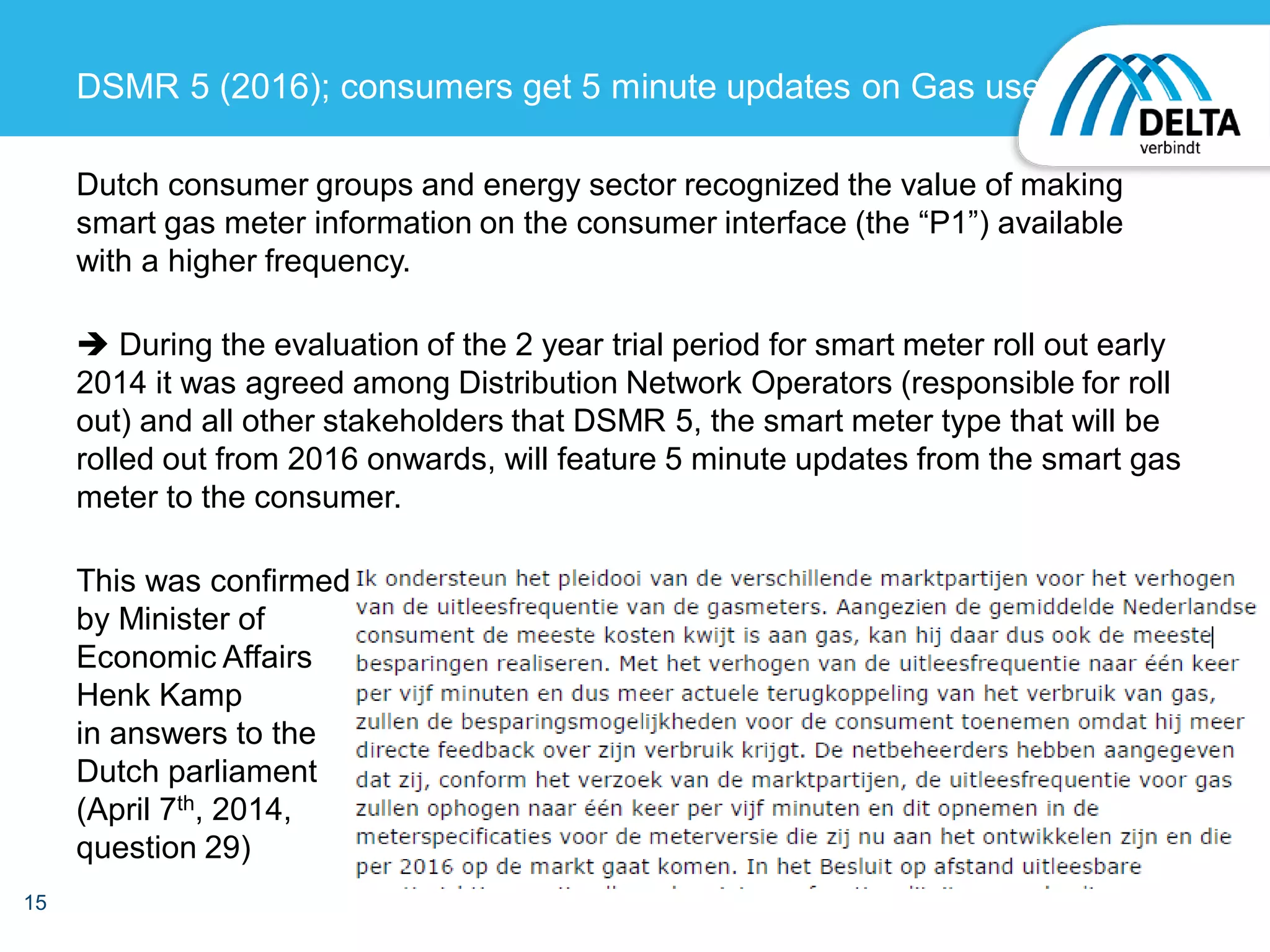
Dutch consumer groups and energy sector recognized the value of making
smart gas meter information on the consumer interface (the “P1”) available
with a higher frequency.
 During the evaluation of the 2 year trial period for smart meter roll out early
2014 it was agreed among Distribution Network Operators (responsible for roll
out) and all other stakeholders that DSMR 5, the smart meter type that will be
rolled out from 2016 onwards, will feature 5 minute updates from the smart gas
meter to the consumer.
This was confirmed
by Minister of
Economic Affairs
Henk Kamp
in answers to the
Dutch parliament
(April 7th, 2014,
question 29)
15
DSMR 5 (2016); consumers get 5 minute updates on Gas use
DSMR 5 (2016) delivers more customer value
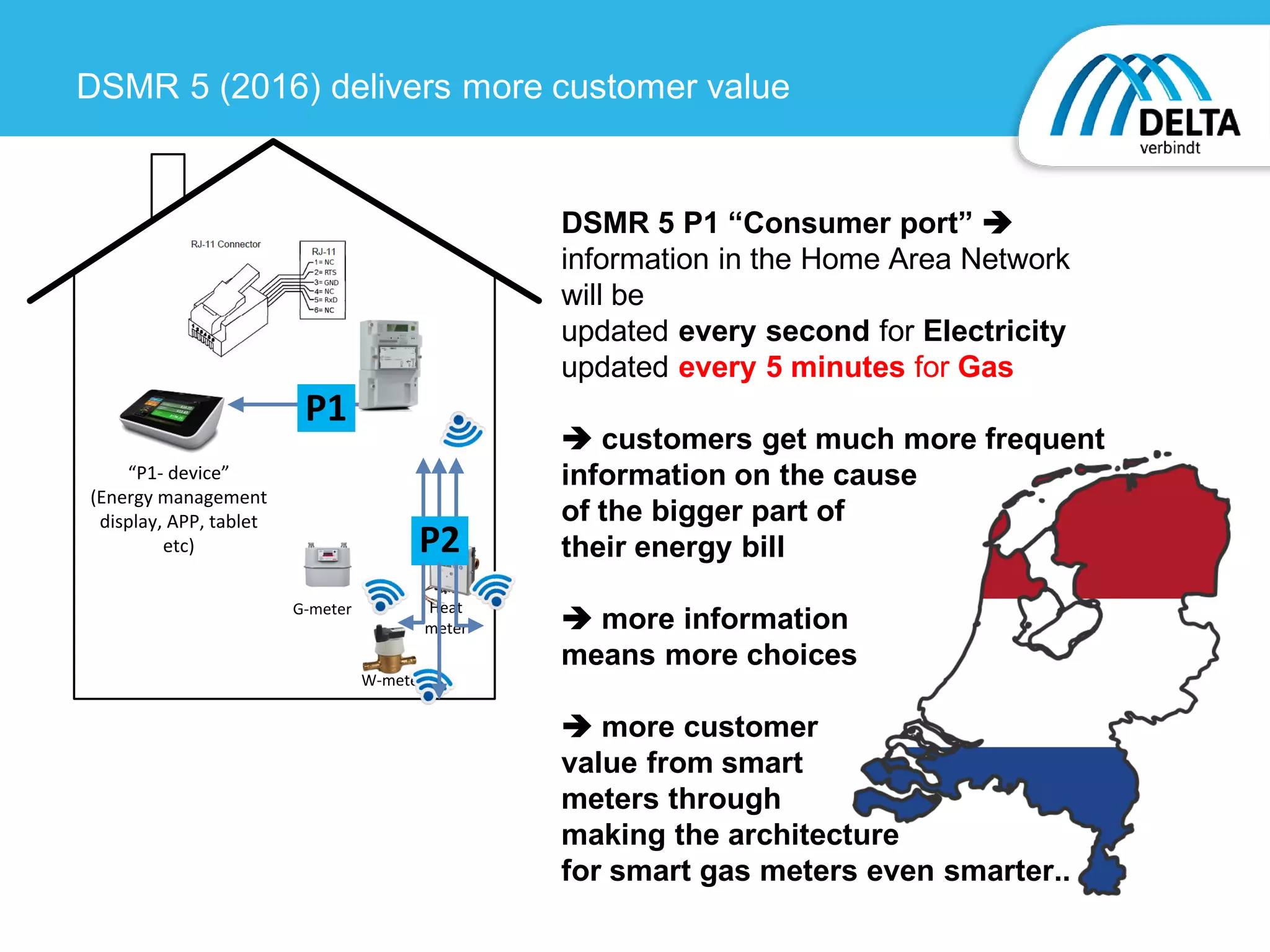
DSMR 5 P1 “Consumer port” 
information in the Home Area Network
will be
updated every second for Electricity
updated every 5 minutes for Gas
 customers get much more frequent
information on the cause
of the bigger part of
their energy bill
 more information
means more choices
 more customer
value from smart
meters through
making the architecture
for smart gas meters even smarter..
“P1- device”
(Energy management
display, APP, tablet
etc)
P1
G-meter
W-meter
Heat
meter
P2P2

How Smarter Gas Meters Add More Customer Value

  • 1.
    1 How smarter gasmeters can add more customer value Gerrit Rentier Senior Business Process Analyst DELTA Energy & Multimedia Middelburg, the Netherlands July 4th, 2014
  • 2.
    2 Few EU memberstates roll out smart gas meters Roll-out commitments for European Union investment about €45 billion by 2020 for the installation of close to 200 million smart meters for Electricity (about 72% of all European consumers) and 45 million meters for Gas (around 40% of consumers) "Benchmarking Smart Metering Deployment in the EU-27 with a focus on electricity” (adopted June 17th, 2014)
  • 3.
    3 Less attention tosmart gas meters; but why? However, Smart Meter Program Key Success Factor Number 1 (© Accenture) is “Design and deploy with the consumer at the heart of the solution…” and the biggest impact on the energy bill of many consumers is their gas use..  shouldn’t we pay full attention to how we design & roll out Smart Gas Meters? From the report “Benchmarking Smart Metering Deployment in the EU-27” (page 8): - Five Member States (Ireland, Italy, Luxembourg, the Netherlands and the UK) have decided to roll-out smart gas meters by 2020 or earlier; - Two Member States (France and Austria) have plans to proceed with a large-scale roll- out but have yet to take official decisions; - In 12 Member States (Belgium, the Czech Republic, Denmark, Finland, Germany, Greece, Latvia, Portugal, Romania, Slovakia, Spain and Sweden), the results of the Cost Benefit Analysis were negative;
  • 4.
    4 Gas; by farthe largest item on Dutch consumer’s energy bill Average Dutch Household Energy Bill (about 2200 a year) wash & dry Electricity lighting Electricity fridge & freezer Electricity heating Water Electricity other uses Electricity space heating Gas bathroom heating Gas cooking Gas
  • 5.
    5 UK: Gas thelargest part of your household’s carbon foot print If consumers get a better understanding of their energy use then they can see new ways of spending less on energy .. Space heating and water heating have the biggest impact on your energy bill, so the biggest energy saving potential As shown here for the UK, “Gas” is also the bigger culprit in terms of CO2 emissions…
  • 6.
    6 Gas prices aresaid to keep going up Source: Monthly energy price statistics, DECC Prices of gas are predicted to keep going up, making it even more important or consumers to get a handle on how much natural gas they are using. Supplier switching can of course help keep prices competitive, but wholesale prices are determined on a global scale and there is little they can do about that. However, consumers do have a direct handle on how much they use; if they become aware of how much energy they use for what, they become “enabled”.
  • 7.
    7 Energy transition &“always on” means new roles for meters
  • 8.
    8 Behavioral Energy Efficiency= First Fuel In a supermarket or store, items have a price so consumers can make informed decisions. For energy, they simply get 1 bill a year, after using energy for 365 days. Smart meters can help customers become aware of energy use and make informed choices about energy use on a daily basis. With a proper behavioral approach we can have smart meters help customers save money (and the environment).
  • 9.
    9 Customer value smartmeters: mainly energy saving 0 0,2 0,4 0,6 0,8 1 1,2 -60 -40 -20 0 20 40 60 80 Meters Roll out ICT Energy saving Better Processes Dynamic Tariffs Rough Cost benefit analysis for Smart meter roll out An important concern with Dutch Parliament as well as other governments (e.g., Belgium) is with the actual amount of energy saved by the roll-out of smart meters. Whereas for example pilots in Ireland (CER) have shown robust results, other pilots (Dutch trial roll out) have not.
  • 10.
    10 Customer value insmart meters: mainly energy savings If Space heating and water heating have the biggest impact on your energy bill, they also have the biggest energy saving potential for the benefits we hope to achieve and establish. This means that the relationship between customers & smart gas meters is important. EC presentation Cost Benefit Analyses (British) Roll Out Smart Meters June 26th, 2014
  • 11.
    11 Potential of smartmeters for conservation: feedback types ACEEE report shows up to 9 or even 12 percent conservation for energy if the information is near real time. ACEEE report shows up to 9 or even 12 percent conservation for energy if the information is near real time… Smart meters can technically enable the first four categories of feedback loops… “Advanced meter reading initiatives and residential feedback programs: A Meta-Review for Household Electricity- saving Opportunities”, American Council for Energy-Efficient Economy (ACEEE), Washington, June 2010
  • 12.
    12 Psychological basis: experientiallearning If we present actionable information (“concrete experience”) based on recent smart meter data that tells consumers where they are spending energy (and money), leading to observation and comprehension, then they are enabled to try and save energy (“active experimentation”), in heating, hot water and appliances.
  • 13.
    Current version DutchSmart Meter Requirements • P1= Consumer port information in the home, updated every 10 seconds for Electricity updated every 60 minutes for Gas • Distribution Network Operator (DNO) rolls out smart E and G meters and facilitates consumers & markets • P3= WAN, P4= market interface for ESCO’s, Energy Suppliers, aggregators; updated every 24 hours “P1- device” (Energy management display, APP, tablet etc) P1 G-meter W-meter Heat meter P2 Central system GSM network P3 P2 Energy suppliers ODA’s Water companies P4
  • 14.
    (A) Tradi- tional meters Regulatory (Energy Efficiency Directive or EED) (B) Smart meters Regulatory (EED ) home reports (C) Smart meterE remote (WAN) (D) Smart meter E with device in the home (HAN) (E) “Niche” Smart meter E, with device in the home and near real time data from slave meters (DSMR 5: 2016,..) Home Area Network (F) Smart thermostats/ smart homes HAN (WAN) Remote control (Nest, GEO) E Bill (Year) Monthly (bi-monthly) 24 hrs (web portal) 10 seconds 1 second (DSMR 5: 2016) Real time G Bill (Year) Monthly (bi-monthly) 24 hrs (web portal) 60 minutes (DSMR 2, 4) 5 minutes (DSMR 5: 2016) Real time € Free Free Free or Cheap Medium price (+/- 100, 150) Plain read only P1 customer devices Pricey Device +/- 250/350 14 Frequency of customer info; from meters to smart homes If we upgrade the frequency by which smart gas meters inform consumers of their energy use, the smart meter functionality closes in on more expensive smart home solutions
  • 15.
    Dutch consumer groupsand energy sector recognized the value of making smart gas meter information on the consumer interface (the “P1”) available with a higher frequency.  During the evaluation of the 2 year trial period for smart meter roll out early 2014 it was agreed among Distribution Network Operators (responsible for roll out) and all other stakeholders that DSMR 5, the smart meter type that will be rolled out from 2016 onwards, will feature 5 minute updates from the smart gas meter to the consumer. This was confirmed by Minister of Economic Affairs Henk Kamp in answers to the Dutch parliament (April 7th, 2014, question 29) 15 DSMR 5 (2016); consumers get 5 minute updates on Gas use
  • 16.
    DSMR 5 (2016)delivers more customer value DSMR 5 P1 “Consumer port”  information in the Home Area Network will be updated every second for Electricity updated every 5 minutes for Gas  customers get much more frequent information on the cause of the bigger part of their energy bill  more information means more choices  more customer value from smart meters through making the architecture for smart gas meters even smarter.. “P1- device” (Energy management display, APP, tablet etc) P1 G-meter W-meter Heat meter P2P2