Debulking Devices
Cutting Balloon
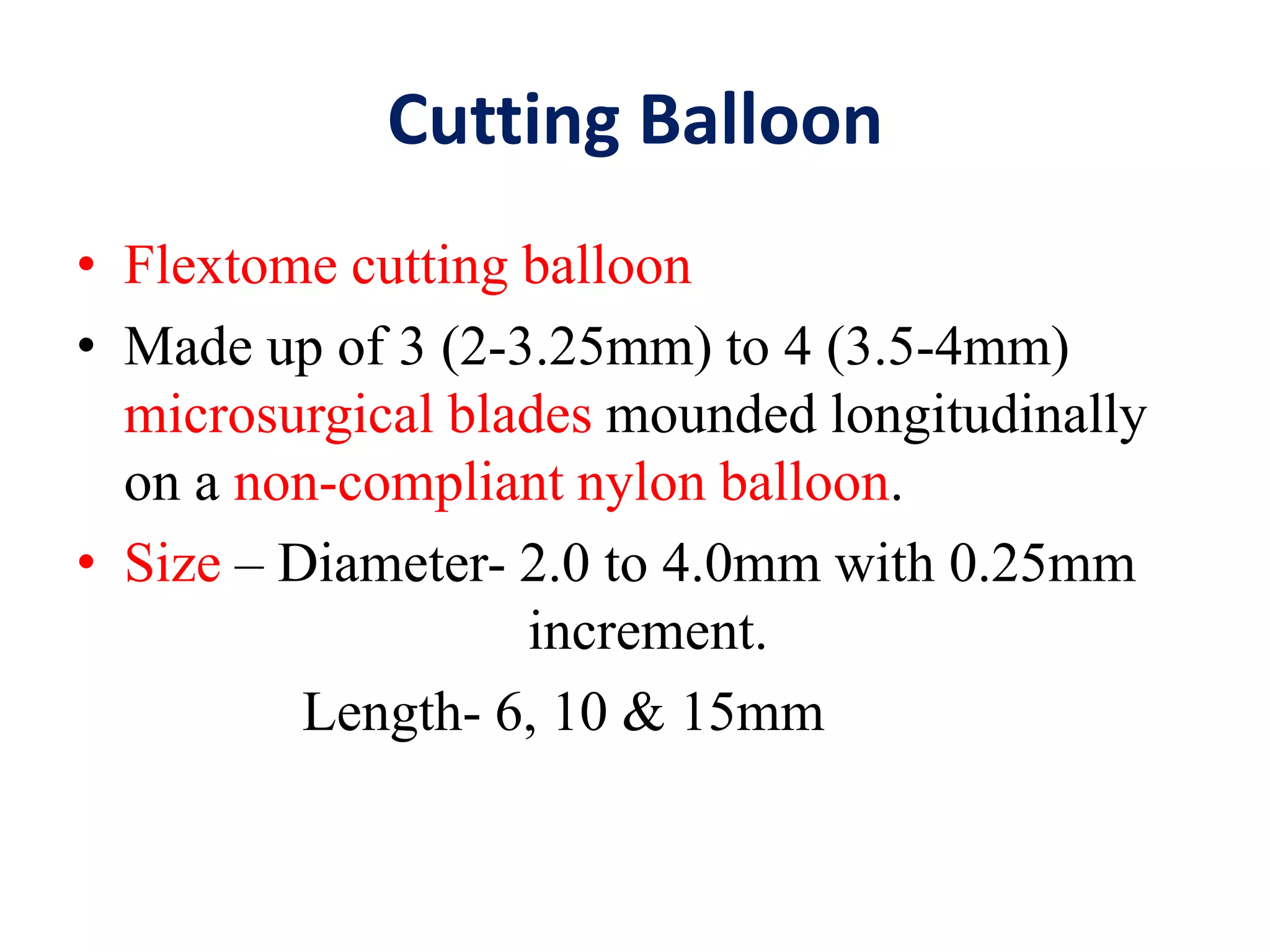
• Flextome cutting balloon
• Made up of 3 (2-3.25mm) to 4 (3.5-4mm)
microsurgical blades mounded longitudinally
on a non-compliant nylon balloon.
• Size – Diameter- 2.0 to 4.0mm with 0.25mm
increment.
Length- 6, 10 & 15mm
• Mechanism- longitudinal incision in the
plaque that allows controlled dilatation at
lower pressure with less vessel wall injury
Scoring Balloon
• AngioSculpt scoring balloon
• Consist of 3 rectangular spiral nitinol scoring
elements wrapped on a semi-compliant nylon
balloon
• Size – Diameter- 2.0 to 5.0mm
Length- 10, 15 & 20mm
Inflating pressure – wide 2 to 18 atm
• Mechanism- During dilatation, rectangular
scoring elements lock the device in place &
prevent watermelon seeding.
Dilatation force is concentrated over a small area
of the scoring elements & exert a force equal to
15-25 times that of conventional balloon leading
to large lumen expansion with limited vessel
wall injury.
• Advantage
– Smaller crossing profile (2.7Fr)
– Enhanced flexibility facilitates delivery of catheter
in tortuous anatomies.
Complication-
– Coronary spasm-
-Not uncommon
-I/C NTG
– Coronary dissection –
-10% cases
-mainly minor/ non-flow limiting
-Stent implantation
- Perforations
- Rare
- M/C- Balloon oversizing ( Balloon:artery ratio>1.1)
- T/T- reversal of anticoagulation, prolonged balloon
inflation, covered stent implantation
- Late aneurysm
- Reported in perforation managed with prolonged
balloon inflation.
- Device entrapments
- During t/t of ISR, when wire passes through an
unopposed stent strut
• Various maneuvers to remove the entrapped
device:-
– Advancing the device forward & rotating it to
unhook the trapped strut or atherotome.
– Inflating second balloon alongside the entrapped
device
– Deep seating of the guiding catheter & controlled
retraction of the device.
– Surgical removal, if all unsuccessful
Rotational atherectomy
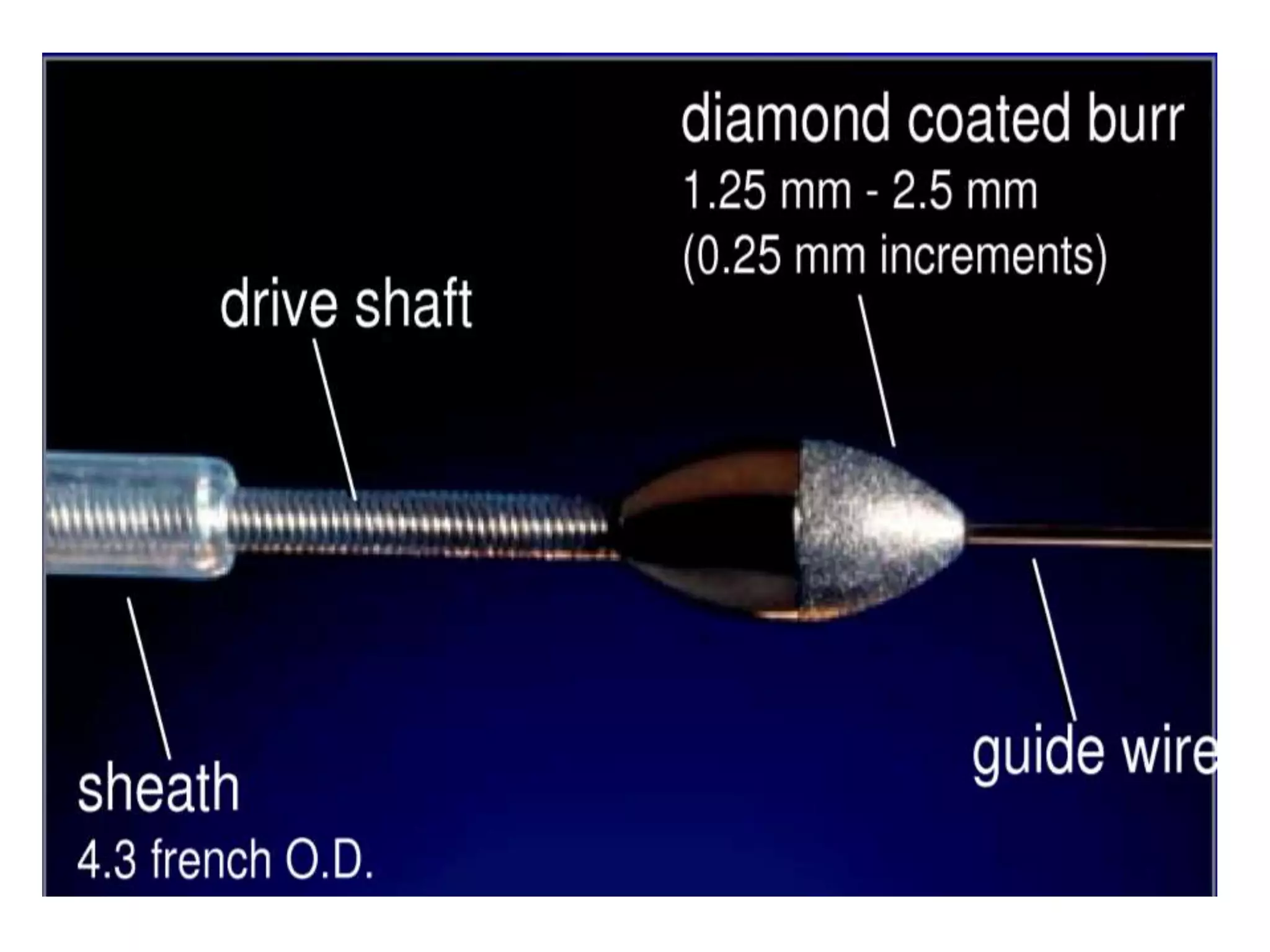
• Consist of: Cylinder, Console, advancer, Foot
pedal
• Burr- elliptical shaped with 2000-3000
microscopic diamond crystal on distal edge.
Proximal end- smooth
Mechanism-
• Differential cutting- rapidly rotating burr
selectively ablates rigid inelastic tissue
components (calcium & fibrous tissue) while the
elastic normal vessel wall components deflect
away from cutting edge
• Orthogonal displacement of friction- high speed
rotation changes the longitudinal friction vector
b/w the wire & burr to circumferential direction
which facilitates burr advancements through
tortuous anatomies
• Generated particle size- 5 micron, cleared by
reticuloendothelial system.
Indications for Use
• Calcified Vessels
• Failure to Dilate
• In-stent restenosis
– Multiple stent layers
– Jailed branches
• Ostial lesions (aorto-ostial lesions)
• Bifurcation lesions
• Long lesion <25mm
Rotational Atherectomy
Rotational Athectomy
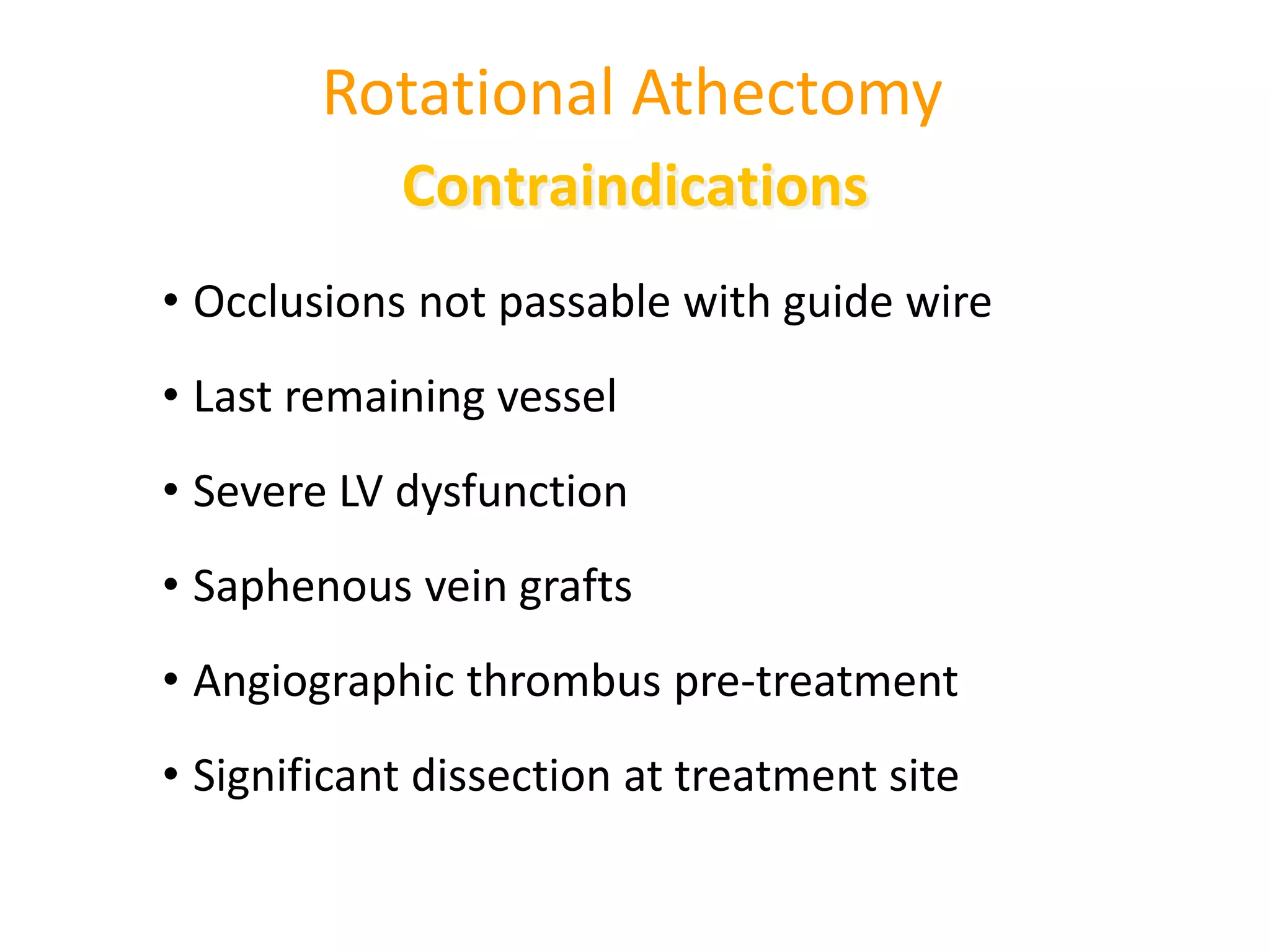
• Occlusions not passable with guide wire
• Last remaining vessel
• Severe LV dysfunction
• Saphenous vein grafts
• Angiographic thrombus pre-treatment
• Significant dissection at treatment site
Contraindications
Precaution
• EF<30%
• Angulated lesions (≥45°)
• TPI- lesion of RCA, Dominant LCX, Proximal
LAD
• Should only be carried out in hospital where
emergency CABG is available.
Complication
1) Slow flow/ no reflow
0.5-2%
cause:-
• Large burr & higher speed
• Lesion that are thrombotic/ contain large amount of fatty atheroma
• Shorter time intervals b/w ablation runs
Prevention
-Slow speed rotational ablation (RPM 140,000-160,000)
-Minimal deceleration during ablation runs
-Multiple short runs of 30 seconds or less
-Rest period b/w runs
T/t-
-retraction of burr
-Optimization of perfusion pressure
-I/C vasodilators- NTG, CCB, adenosine, nicorandil
-IABP
2) Perforation
- 0.05-1%
-Oversized burr
-Angulated lesions.
3) Burr entrapment
Burr crossing the lesion without adequate ablation.
T/T
-Gentle controlled traction with guide catheter
deep intubation or mother & child catheter
-Balloon inflation besides the burr
-Snare assisted traction
-Surgical removal
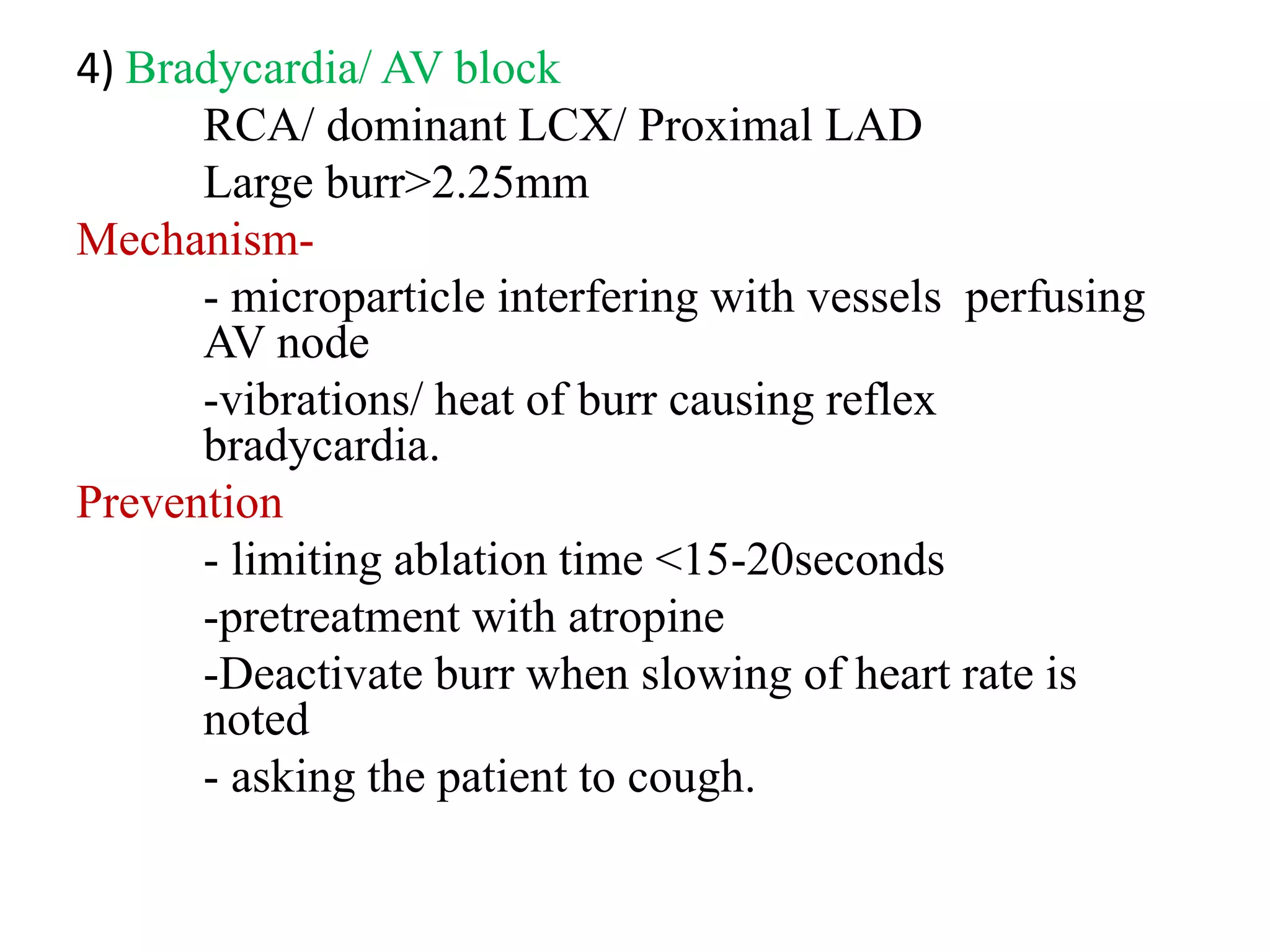
4) Bradycardia/ AV block
RCA/ dominant LCX/ Proximal LAD
Large burr>2.25mm
Mechanism-
- microparticle interfering with vessels perfusing
AV node
-vibrations/ heat of burr causing reflex
bradycardia.
Prevention
- limiting ablation time <15-20seconds
-pretreatment with atropine
-Deactivate burr when slowing of heart rate is
noted
- asking the patient to cough.
Orbital atherectomy
• Diamond back 360° coronary orbital
atherectomy system.
• Ablating component- diamond encrusted
crown.
• Mechanism- differential sanding & centrifugal
force
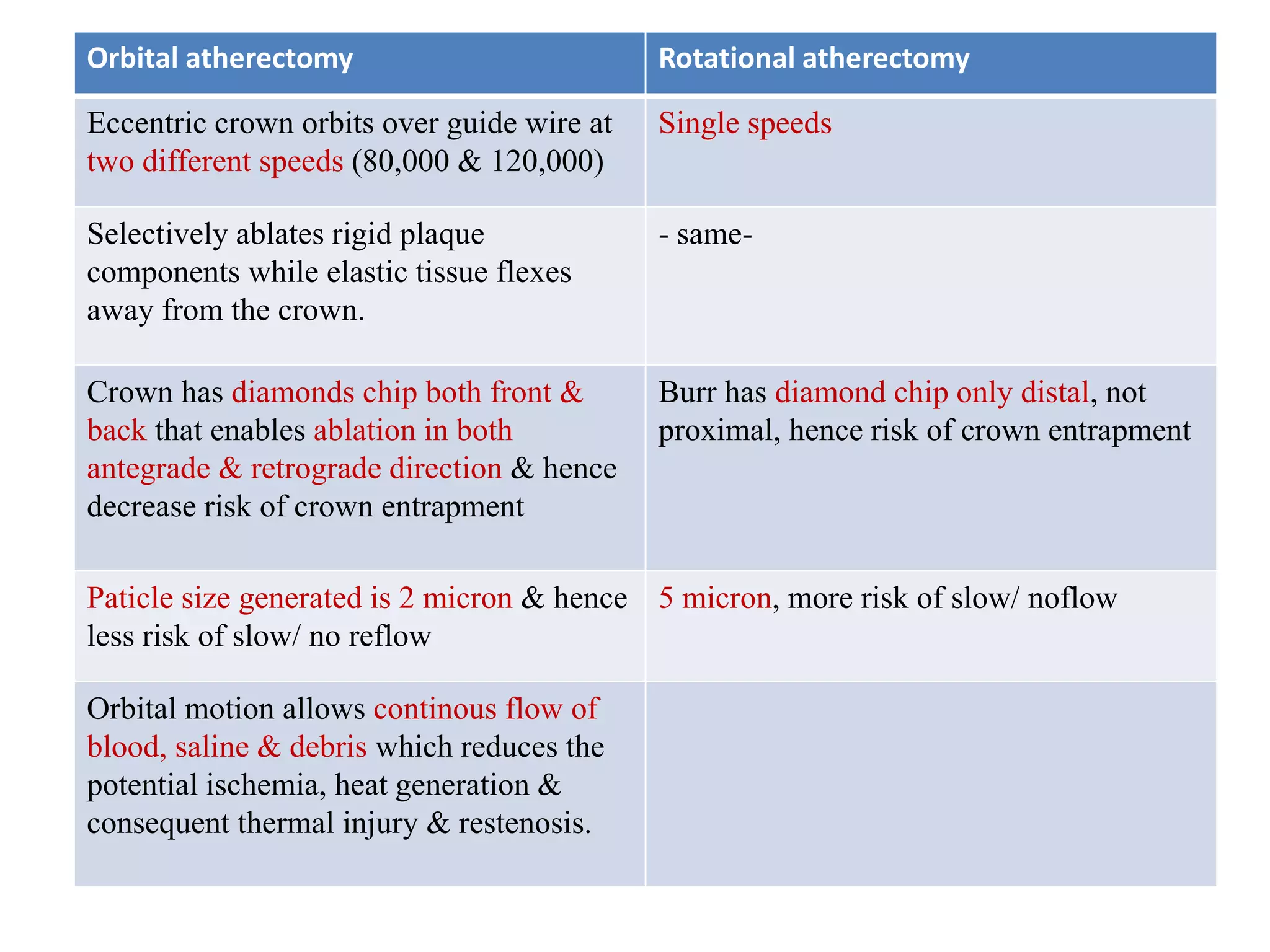
Orbital atherectomy Rotational atherectomy
Eccentric crown orbits over guide wire at
two different speeds (80,000 & 120,000)
Single speeds
Selectively ablates rigid plaque
components while elastic tissue flexes
away from the crown.
- same-
Crown has diamonds chip both front &
back that enables ablation in both
antegrade & retrograde direction & hence
decrease risk of crown entrapment
Burr has diamond chip only distal, not
proximal, hence risk of crown entrapment
Paticle size generated is 2 micron & hence
less risk of slow/ no reflow
5 micron, more risk of slow/ noflow
Orbital motion allows continous flow of
blood, saline & debris which reduces the
potential ischemia, heat generation &
consequent thermal injury & restenosis.
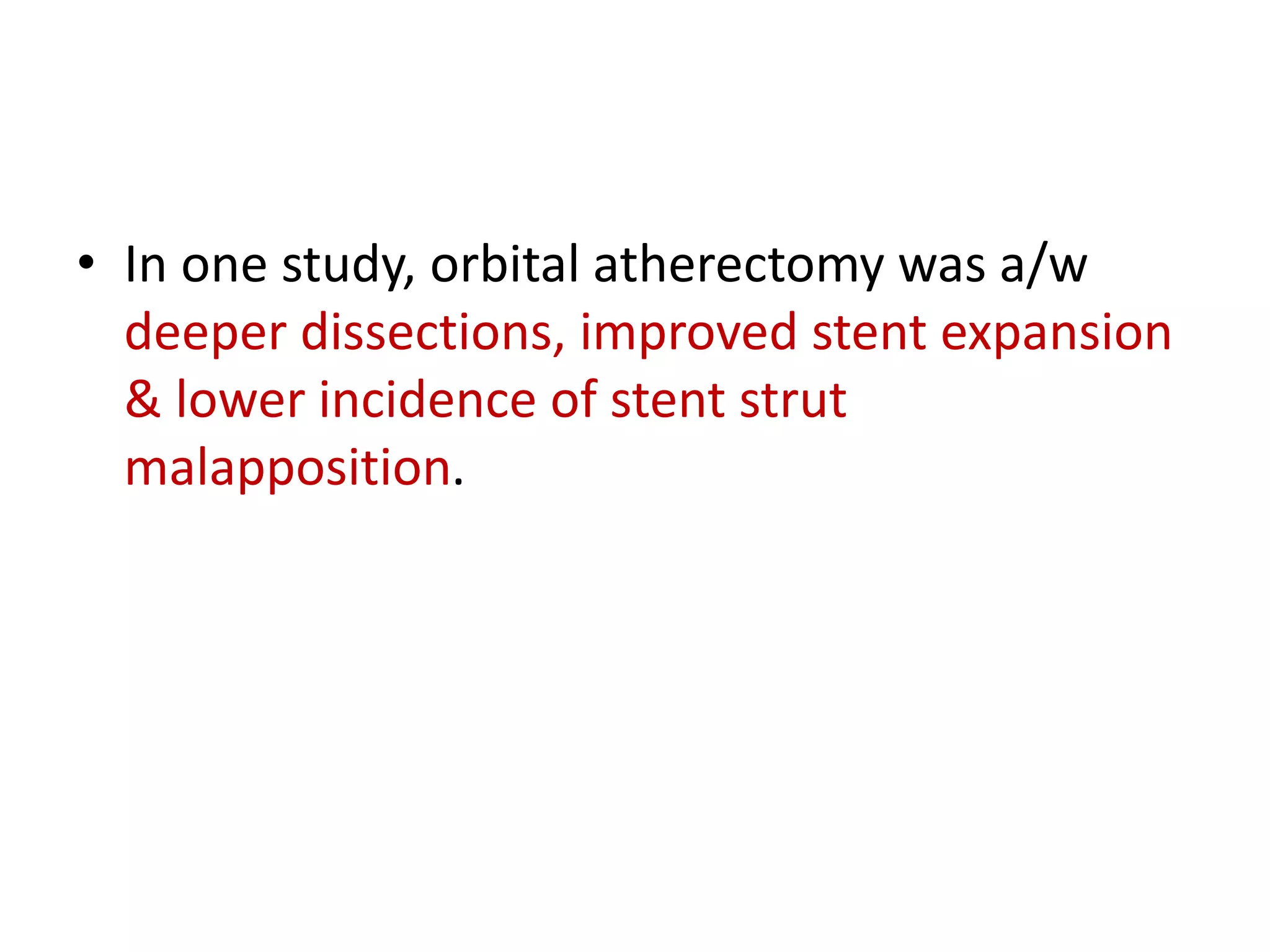
• In one study, orbital atherectomy was a/w
deeper dissections, improved stent expansion
& lower incidence of stent strut
malapposition.
Laser atherectomy
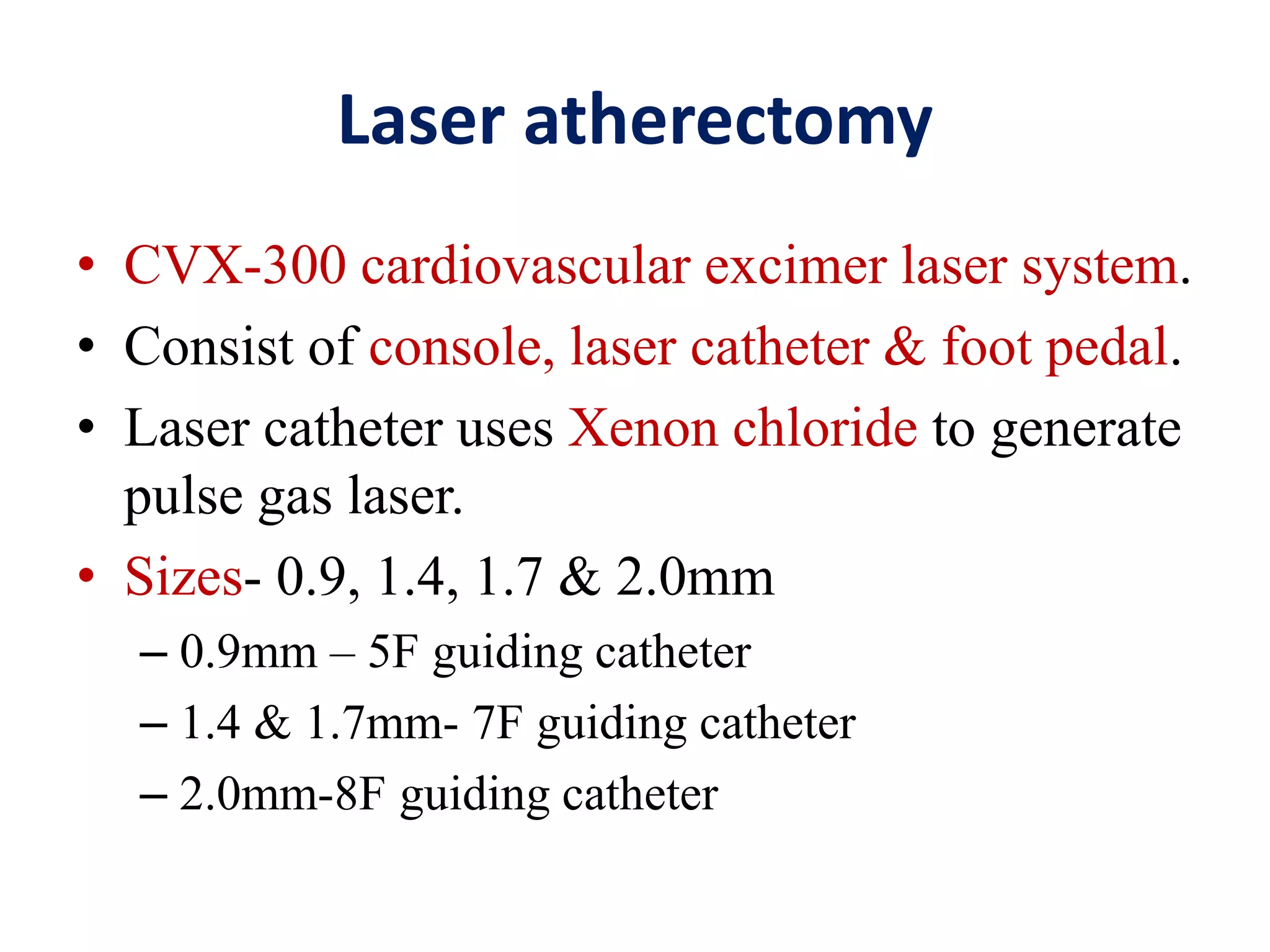
• CVX-300 cardiovascular excimer laser system.
• Consist of console, laser catheter & foot pedal.
• Laser catheter uses Xenon chloride to generate
pulse gas laser.
• Sizes- 0.9, 1.4, 1.7 & 2.0mm
– 0.9mm – 5F guiding catheter
– 1.4 & 1.7mm- 7F guiding catheter
– 2.0mm-8F guiding catheter
• Mechanism- XeCl emit light rays in UV
spectrum.
• Causes tissue removal by photoablation.
• Photoablation occur in 3 stages:-
– Photochemical- UV light absorb by tissue & cause
breakdown of carbon-carbon molecular bands
– Photothermal- high frequency molecular vibration
result in cellular breakdown & formation of vapor
bubbles
– Photomechanical- vapor bubbles expand & implode to
cause further tissue distruption
Debulking device
Debulking device
Debulking device
Debulking device
Debulking device

Debulking device

  • 1.
  • 2.
    Cutting Balloon • Flextomecutting balloon • Made up of 3 (2-3.25mm) to 4 (3.5-4mm) microsurgical blades mounded longitudinally on a non-compliant nylon balloon. • Size – Diameter- 2.0 to 4.0mm with 0.25mm increment. Length- 6, 10 & 15mm
  • 3.
    • Mechanism- longitudinalincision in the plaque that allows controlled dilatation at lower pressure with less vessel wall injury
  • 6.
    Scoring Balloon • AngioSculptscoring balloon • Consist of 3 rectangular spiral nitinol scoring elements wrapped on a semi-compliant nylon balloon • Size – Diameter- 2.0 to 5.0mm Length- 10, 15 & 20mm Inflating pressure – wide 2 to 18 atm
  • 7.
    • Mechanism- Duringdilatation, rectangular scoring elements lock the device in place & prevent watermelon seeding. Dilatation force is concentrated over a small area of the scoring elements & exert a force equal to 15-25 times that of conventional balloon leading to large lumen expansion with limited vessel wall injury. • Advantage – Smaller crossing profile (2.7Fr) – Enhanced flexibility facilitates delivery of catheter in tortuous anatomies.
  • 8.
    Complication- – Coronary spasm- -Notuncommon -I/C NTG – Coronary dissection – -10% cases -mainly minor/ non-flow limiting -Stent implantation - Perforations - Rare - M/C- Balloon oversizing ( Balloon:artery ratio>1.1) - T/T- reversal of anticoagulation, prolonged balloon inflation, covered stent implantation
  • 9.
    - Late aneurysm -Reported in perforation managed with prolonged balloon inflation. - Device entrapments - During t/t of ISR, when wire passes through an unopposed stent strut
  • 10.
    • Various maneuversto remove the entrapped device:- – Advancing the device forward & rotating it to unhook the trapped strut or atherotome. – Inflating second balloon alongside the entrapped device – Deep seating of the guiding catheter & controlled retraction of the device. – Surgical removal, if all unsuccessful
  • 11.
    Rotational atherectomy • Consistof: Cylinder, Console, advancer, Foot pedal • Burr- elliptical shaped with 2000-3000 microscopic diamond crystal on distal edge. Proximal end- smooth
  • 13.
    Mechanism- • Differential cutting-rapidly rotating burr selectively ablates rigid inelastic tissue components (calcium & fibrous tissue) while the elastic normal vessel wall components deflect away from cutting edge • Orthogonal displacement of friction- high speed rotation changes the longitudinal friction vector b/w the wire & burr to circumferential direction which facilitates burr advancements through tortuous anatomies • Generated particle size- 5 micron, cleared by reticuloendothelial system.
  • 14.
    Indications for Use •Calcified Vessels • Failure to Dilate • In-stent restenosis – Multiple stent layers – Jailed branches • Ostial lesions (aorto-ostial lesions) • Bifurcation lesions • Long lesion <25mm Rotational Atherectomy
  • 15.
    Rotational Athectomy • Occlusionsnot passable with guide wire • Last remaining vessel • Severe LV dysfunction • Saphenous vein grafts • Angiographic thrombus pre-treatment • Significant dissection at treatment site Contraindications
  • 16.
    Precaution • EF<30% • Angulatedlesions (≥45°) • TPI- lesion of RCA, Dominant LCX, Proximal LAD • Should only be carried out in hospital where emergency CABG is available.
  • 17.
    Complication 1) Slow flow/no reflow 0.5-2% cause:- • Large burr & higher speed • Lesion that are thrombotic/ contain large amount of fatty atheroma • Shorter time intervals b/w ablation runs Prevention -Slow speed rotational ablation (RPM 140,000-160,000) -Minimal deceleration during ablation runs -Multiple short runs of 30 seconds or less -Rest period b/w runs T/t- -retraction of burr -Optimization of perfusion pressure -I/C vasodilators- NTG, CCB, adenosine, nicorandil -IABP
  • 18.
    2) Perforation - 0.05-1% -Oversizedburr -Angulated lesions. 3) Burr entrapment Burr crossing the lesion without adequate ablation. T/T -Gentle controlled traction with guide catheter deep intubation or mother & child catheter -Balloon inflation besides the burr -Snare assisted traction -Surgical removal
  • 19.
    4) Bradycardia/ AVblock RCA/ dominant LCX/ Proximal LAD Large burr>2.25mm Mechanism- - microparticle interfering with vessels perfusing AV node -vibrations/ heat of burr causing reflex bradycardia. Prevention - limiting ablation time <15-20seconds -pretreatment with atropine -Deactivate burr when slowing of heart rate is noted - asking the patient to cough.
  • 20.
    Orbital atherectomy • Diamondback 360° coronary orbital atherectomy system. • Ablating component- diamond encrusted crown. • Mechanism- differential sanding & centrifugal force
  • 21.
    Orbital atherectomy Rotationalatherectomy Eccentric crown orbits over guide wire at two different speeds (80,000 & 120,000) Single speeds Selectively ablates rigid plaque components while elastic tissue flexes away from the crown. - same- Crown has diamonds chip both front & back that enables ablation in both antegrade & retrograde direction & hence decrease risk of crown entrapment Burr has diamond chip only distal, not proximal, hence risk of crown entrapment Paticle size generated is 2 micron & hence less risk of slow/ no reflow 5 micron, more risk of slow/ noflow Orbital motion allows continous flow of blood, saline & debris which reduces the potential ischemia, heat generation & consequent thermal injury & restenosis.
  • 22.
    • In onestudy, orbital atherectomy was a/w deeper dissections, improved stent expansion & lower incidence of stent strut malapposition.
  • 23.
    Laser atherectomy • CVX-300cardiovascular excimer laser system. • Consist of console, laser catheter & foot pedal. • Laser catheter uses Xenon chloride to generate pulse gas laser. • Sizes- 0.9, 1.4, 1.7 & 2.0mm – 0.9mm – 5F guiding catheter – 1.4 & 1.7mm- 7F guiding catheter – 2.0mm-8F guiding catheter
  • 24.
    • Mechanism- XeClemit light rays in UV spectrum. • Causes tissue removal by photoablation. • Photoablation occur in 3 stages:- – Photochemical- UV light absorb by tissue & cause breakdown of carbon-carbon molecular bands – Photothermal- high frequency molecular vibration result in cellular breakdown & formation of vapor bubbles – Photomechanical- vapor bubbles expand & implode to cause further tissue distruption